- Title. Author. Summary

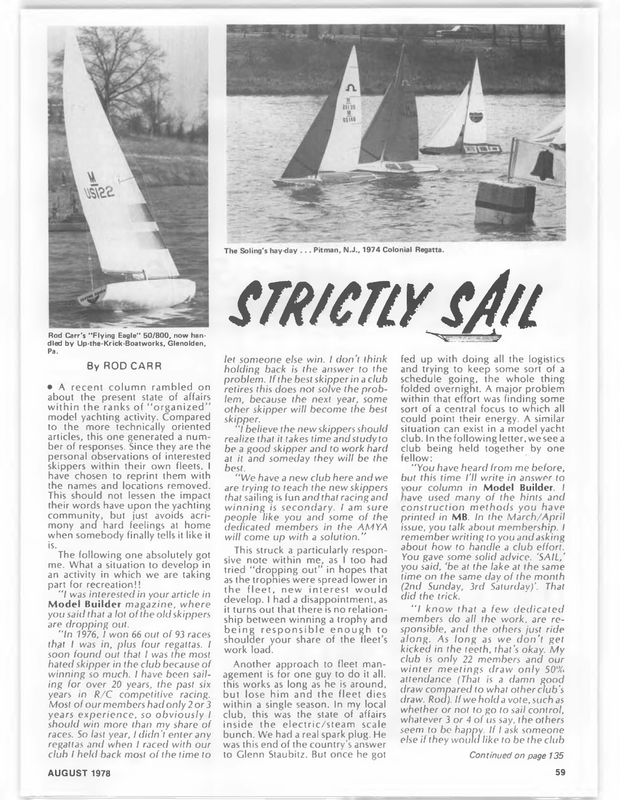
Rod Carr‘s ‘Flying Eagle’’ 50/800, now handled by Up-the-Krick-Boatworks, Glenolden, Pa. By ROD CARR ® A recent column rambled on about the present state of affairs within the ranks of ‘‘organized”’ model yachting activity. Compared to the more technically oriented articles, this one generated a number of responses. Since they are the personal observations of interested skippers within their own fleets, I have chosen to reprint them with the names and locations removed. This should not lessen the impact their words have upon the yachting community, but just avoids acrimony and hard feelings at home when somebody finally tells it like it is. The following one absolutely got me. What a situation to develop in an activity in which we are taking part for recreation!! “t was interested in your article in Model Builder magazine, where you said that a lot of the old skippers are dropping out. “In 1976, | won 66 out of 93 races that | was in, plus four regattas. | soon found out that | was the most hated skipper in the club because of winning so much. | have been sailing for over 20 years, the past six years in R/C competitive racing. Most of our members had only 2 or 3 years experience, so obviously | should win more than my share of races. So last year, | didn’t enter any regattas and when | raced with our club | held back most of the time to AUGUST 1978 let someone else win. | don’t think holding back is the answer to the problem. If the best skipper inaclub retires this does not solve the problem, because the next year, some other skipper will become the best skipper. “| believe the new skippers should realize that it takes time and study to be a good skipper and to work hard at it and someday they will be the best. “We have a new club here and we are trying to teach the new skippers that sailing is fun and that racing and winning is secondary. | am sure people like you and some of the dedicated members in the AMYA will come up with a solution.” This struck a particularly responsive note within me, as | too had tried “dropping out” in hopes that as the tropnies were spread lower in the fleet, new interest would develop. | had a disappointment, as it turns out that there is no relationship between winning a trophy and being responsible enough to shoulder your share of the fleet’s work load. Another approach to fleet man- agement is for one guy to do it all. this works as long as he is around, but lose him and the fleet dies within a single season. In my local club, this was the state of affairs inside the electric/steam scale bunch. We had a real spark plug. He was this end of the country’s answer to Glenn Staubitz. But once he got fed up with doing all the logistics and trying to keep some sort of a schedule going, the whole thing folded overnight. A major problem within that effort was finding some sort of a central focus to which all could point their energy. A similar situation can exist in a model yacht club. In the following letter, we see a club being held together by one fellow: “You have heard from me before, but this time lil write in answer to your column in Model Builder. | have used many of the hints and construction methods you have printed in MB. in the March/April issue, you talk about membership. | remember writing to you and asking about how to handle a club effort. You gave some solid advice. ‘SAIL,’ you said, ‘be at the lake at the same time on the same day of the month (2nd Sunday, 3rd Saturday)’. That did the trick. “I know that a few dedicated members do all the work, are responsible, and the others just ride along. As long as we don’t get kicked in the teeth, that’s okay. My club is only 22 members and our winter meetings draw only 50%, attendance (That is a damn good draw compared to what other club’s draw. Roa). Ifwe hold a vote, suchas whether or not to go to sail control, whatever 3 or 4 of us say, the others seem to be happy. If lask someone else if they would dit like to be the club Continued on page 135 59
heavy. Take another strong back with you. Teg Pes our shop tor it in advance, a glass door is not some- Write For FREE BROCHURE once and for alt One suggestion for R/C PROPORTIONAL EQUIPMENT On Our Complete Line Of thing which you can horse around, it should be permanently placed; mounting it, other than the logical bench top, is to use it cantilever style. It has ample strength so that one edge can be buried in masonry, leaving the other edges completely free from all obstructions. Once you have it, modelers’ ingenuity will certainly find ways of using its precision to good advantage. Because of magazine “lead time” and all that, as this is being written, | have yet to see the first issue of MB with the column in it. So, it was a surprise to receive the FIRST reader letter today, it is always good to know that SOMEONE appreciates the work that goes into these sort of things! WORLD’S SMALLEST SUPERLIGHT DIGITAL CONTROL SYSTEMS SMALLEST SIZES (PLEASE SEND AIRMAIL POSTAGE) right, wants no R/C pracleme: Send the equipment to a first class service center for a ‘‘check-up”. When he gets it back he will KNOW that itisin fine. shape, including the batteries which concern him now. Graham will be having a Mammoth Scale for his next project. Has some concern about being able to use ‘‘normal” servos with it. Wishes some manufacturer would produce ultra-powerful servos for use with these models (???). It seems reasonable to expect that if this big plane movement continues, some of the manufacturers will see the need and WE WILL have special servos available for such use. However, things like that are not developed overnight. It will take some time to do it. In the meantime, | am happy to tell Graham that a column is already in the ‘‘pipe line” which discusses the use of “normal” servos with the big planes. | believe that he will get some good out of that column, and hopefully, some answers to tide him over until what he really wants, is available. | hope that you will remember that we do want YOU to be part of these discussions, please feel free to LOWEST PRICES 13400-26 Saticoy Street CANNON North Hollywood, Colif. 91605 Phone (213) 764-1488 communicate; you will get a reply! Hal deBolt, 49 Colden Court, Buffalo, NY 14225. e Sailing…… Continued from page 59 First in is Graham Ainslea, of Depoe Bay, Oregon. Graham is another example of the fact that old modelers just do not fade away. He built his first model in 1927, first gas job in 1936, later dropped out for a while and now has been in R/C for 7 years. First R/C was aL.W. “Champ” that is still going strong. Has not been flying for 2 years while he built a new house with a “super work shop”, what else? Now, has a couple of questions to get started again. His equipment is not new, has been shelved for 2 years, what should he do? From this viewpoint the answer is simple. He wants to get started AUGUST 1978 including secretary, they all tell me what a great job I’m doing and they wouldn’t want to change that. “So it goes. But | must remember that | started this thing; | wanted to create interest, and through a push and a shove, got this club going. So! must keep it going… We sail mostly Pea Pods (MB Plan 4733, $3.25) and have all kinds of fun. Fast to build, cheap and easy. Fun is the name of the game. We race, follow rules, but try to keep the fun in the hobby. Maybe that is missing in other clubs. We always tell new members “have fun’’. Enjoy building, enjoy the fellowship of our club. Sail to win, but remember to have fun while doing it. Share your knowledge, share your tricks, but also discuss your mistakes so we can all learn together. . . ‘surely wish | could contribute something to your column in Model Builder. Maybe one day…” Well anyway, that is what I got in the mail. Two letters … Kind of reminded me of the meeting they called at Central University to discuss student apathy. Three people showed up!! (Wouldn ‘t it be neat if two countries declared war on each other, and nobody showed up to fight! wen) The following outline was drawn up for members of the Noroton Junior Yacht Club in Connecticut, as an introduction to the racing rules. It may prove to be a handy introduction to new skippers who are immediately thrown into the water with the fleet. Merely reading the USYRU rulebook does not give the beginner what he needs. It is filled with too much detailed verbiage that is not immediately useful to 14 newcomer. You might make copies of these rules and hand them out at the lake to everybody. detco AMPHIBIOUS FLYING FUN the “HAYVIGATOR” #RC-5 $27.50 52” Wingspan, 39° ” Overall .075-.10 Engines A great Beautiful Fun-Flying Amphibian. The NAVIGATOR is the classic-standard of the RIC Flying Boat Class. Flying off anything—land, sea, lakes, snow, wet grass. Take off from water and land on land, or vice versa, for the R/C thrills of a lifetime. Kit features select, shaped, and die-cut balsa, covering material, and a great set ot plans. A ship you’ll be proud to fly. tF NOT AVAILABLE AT DEALER ORDER DIRECT SEND 25c FOR CATALOG _ CA ZAIC CO. INC CAT 5353 LEXINGTON AVE DEPT D-3 BROOKLYN NY 11221 Our thanks go to Bill Cox who provided them for the betterment of the sport. 1. When booms are on different sides, port tack (boom on right side of boat) keeps clear. 2. When booms are on the same side, windward boat keeps clear. 3. Overtaking boat keeps clear. 4. If right-of-way suddenly switches to you, give the other boat time to respond and room to keep clear. Don’t hesitate to hail a warning. 5. Before you start, don’t luff another boat suddenly … only slowly. WHEN CONTACTING ADVERTISERS, TELL “EM MODEL BUILDER SENT YOU! 135
HRE.. CUSTOM R/C CAR COMPONENTS $169.95 @® NEW HRE 1500 RS This new chassis has adjustable front and rear roll suspension for better performance on all track surfaces. ’ 7 @® HRE 1000 CHASSIS = **¢ = ~ $144.95 KIT Basic chassis kit has performance where it counts: Ist 1975 Roar Nats, Expert Oval 1st 1975 Winter Nats, Expert Road 2nd 1974 Roar Nats, Expert Oval All metal chassis parts, aerospace quality, kits less body, engine, fuel tank and radio. WRITE FOR FREE BROCHURE HRE Inc., P.O. Box 4658, 6. At the start, ‘‘Don’t Barge”’ means don’t try to squeeze between a boat close to leeward of you and any starting mark. 7. If recalled, keep clear of all boats that start properly. You have no rights while reece to start until you are on the “‘betore starting” side of the starting line. 8. Don’t tack or jib too close (And if a boat is close behind you, don’t tack around a mark unless clear to tack if the mark were not there). 9. When you are two boat lengths froma nine mark or an obstruction or a finishing mark, give room to all boats that have inside overlaps on you. 10. When another boat tries to ass you to windward, you may luff Irvine, Catifornia 92716 12. Even when you have the rightof-way, it is your duty to avoid a collision. Though the month of April has come and gone as of this writing, | have yet to receive any reports of regatta activity. | am finding it hard to serve the sailing fraternity without any help from you out there. When you are sending in areporton your regatta to the AMYA Quarterly Newsletter, why not send me a copy? | can guarantee I’ll get it into print just as fast. A lot of potential newcomers will learn of activity in their areas. You quiet sailors have a need for publicity. Take this opportunity to send in your $5.00 annual dues to AMYA, 2709 S. Federal Highway, Delra Bm until his stern is abreast of your Beach, FL 33444. And if you will mast, at which point your right to enclose a stamped, walizaddiessed luff ceases and you must resume a proper course. 11. If you are on a reach or arun when another boat attempts to pass you to leeward, don’t bear off below ee proper course; and if the other oat overlaps you to leeward, he will be unable to luff you until he has pulled clear ahead. These 11 points will cover the better part of the situations you encounter on the course. The last one, No. 12 is ofter overlooked. 136 envelope, I’ll field questions at: 7608 Gresham St., Springfield, VA 22151.¢ Counter ….. Continued from page 10 All kidding aside, the term means that it will not migrate, will stay exactly where you put it, instead of flowing off to leave a weak joint and to cause a problem somewhere else. Designated as Formula 3, this latest Hobbypoxy product is formulated to a gel-like viscosity that you can apply to vertical surfaces, thin edges, and anywhere that thinner glues might run off. It is recommended for planking fillets, filling cracks, and joining between poorly fitting parts. The more you use it, the more places you will find that need it. Formula 3 is packaged in two fourounce cans, is mixed in a one-toone ratio, cures overnight, with a one-hour working time. And for those show class finishes, a filler compound is also available, designated as P.F.C., Polyester Filler Compound. It is a two-part filler, in pure white only, that requires the addition of a catalyst to set. It is perfectly compatible and will set over and on most common model materials. It sands easily and smoothly, and will accept most primers and paints. As with all products of these types, some care should be exercised during their use, as they may cause irritation to the skin and eyes. Use with good ventilation and don’t leave them on your skin for any long periods. Check your local shops for these new goodies from Hobbypoxy Products, 36 Pine St., Rockaway, NJ 07866. * = * Fans of Joe Bridi and his excellent line of kits must be hard pressed when it comes to deciding which one of the many successful and appealing airplanes to build next. Sorry, we can’t help you make that decision, but we do have some suggestions about some necessities for two of these kits, the “Shrike” and the Quarter Scale “Cosmic Wind”. For the former, the funny-looking plumbing in one of the photos is a scale muffler and exhaust system manufactured by Macs Mufflers, 8020 18th Ave., Sacramento, CA 95826. It is available for a variety of .40’s, such as the K&B, Enya, H.-P., Webra Speed, and others. The system comes complete with detailed instructions and all the hardware necessary to attach the assembly to the engine and in the nacelle. The model for the K&B is $45, for the others it is $50. And if your choice of Joe’s birds is the Quarter Scale ‘Cosmic Wind”, and you are considering a powerplant, we recommend the Webra .91 for your consideration. We first introduced this beauty to you in our March/April issue, and now would like to show you an installation in the Cosmic Wind. As can be seen, it is a perfect fit in the available space, and the cheek cowl covers it without an opening being required for the head. In the air, the combination is perfect, and there are already a number of them in California skies. WHEN CONTACTING ADVERTISERS, TELL ‘EM MODEL BUILDER SENT YOU! MODEL BUILDER