- Title. Author. Summary

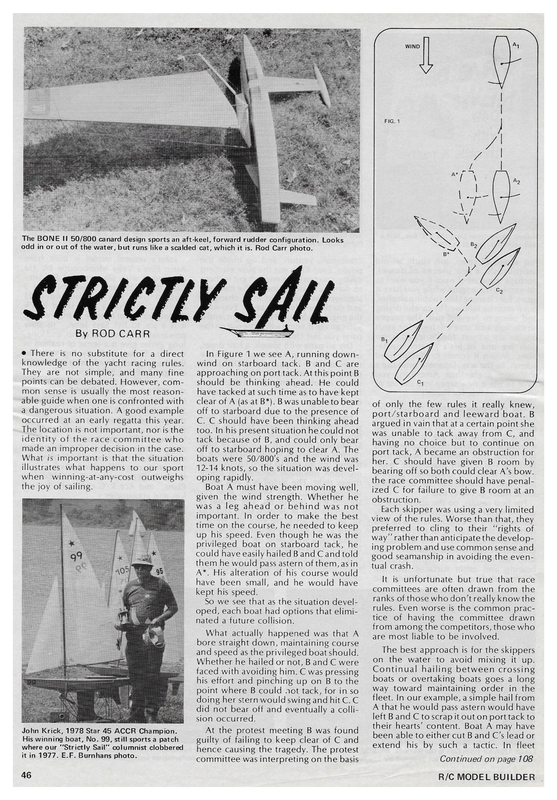
IG. 1 } Je Ve cake eof (ae eae sae NES Pale aN A> V Neely The BO NE tf 50/800 canard design sports an af t-keel, forward rudder configuration. Looks odd in or out of the water, but runs like a scalded cat, which it is. Rod Carr photo. —~\ \ é Za Lane J By a dangerous situation. A good example occurred at an early regatta this year. The location is not important, nor is the identity of the race committee who made an improper decision in the case. What is important is that the situation illustrates what happens to our sport when winning-at-any-cost outweighs the joy of sailing. By wind on starboard tack. B and C are approaching on port tack. At this point B should be thinking ahead. He could have tacked at such time as to have kept clear of A (as at B*). Bwas unable to bear off to starboard due to the presence of C. C should have been thinking ahead too. In his present situation he could not tack because of B, and could only bear off to starboard hoping to clear A. The boats were 50/800’s and the wind was 12-14 knots, so the situation was developing rapidly. Boat A must have been moving well, given the wind strength. Whether he was a leg ahead or behind was not important. In order to make the best time on the course, he needed to keep up his speed. Even though he was the privileged boat on starboard tack, he could have easily hailed B and Cand told them he would pass astern of them,as in A*. His alteration of his course would have been small, and he would have kept his speed. So we see that as the situation developed, each boat had options that eliminated a future collision. and speed as the privileged boat should. Whether he hailed or not, B and C were faced with avoiding him. C was pressing his effort and pinching up on B to the point where B could aot tack, for in so doing her stern-;would swing and hit C. C did not bear off and eventually a collision occurred. 46 Za In Figure 1 we see A, running down- What actually happened was that A bore straight down, maintaining course John Krick, 1978 Star 45 ACCR Champion. His winning boat, No. 99, still sports a patch where our “Strictly Sail” columnist clobbered it in 1977. E.F. Burnhans photo. / Je ROD CARR @ There is no substitute for a direct knowledge of the yacht racing rules. They are not simple, and many fine points can be debated. However, common sense is usually the most reasonable guide when one is confronted with Vie At the protest meeting B was found guilty of failing to keep clear of C and hence causing the tragedy. The protest committee was interpreting on the basis Ee of only the few rules it really knew, port/starboard and leeward boat. B argued in vain that at a certain point she was unable to tack away from C, and having no choice but to continue on port tack, A became an obstruction for her. C should have given B room by bearing off so both could clear A’s bow. the race committee should have penalized C for failure to give B room at an obstruction. Each skipper was using a very limited view of the rules. Worse than that, they preferred to cling to their “rights of way rather than anticipate the developing problem and use commonsense and good seamanship in avoiding the eventual crash. It is unfortunate but true that race committees are often drawn from the ranks of those who don’t really know the rules. Even worse is the common practice of having the committee drawn from among the competitors, those who are most liable to be involved. The best approach is for the skippers on the water to avoid mixing it up. Continual hailing between crossing boats or overtaking boats goes a long way toward maintaining order in the fleet. In our example, a simple hail from A that he would pass astern would have left B and C to scrap it out on port tack to their hearts’ content. Boat A may have been able to either cut B and C’s lead or extend his by such a tactic. In fleet Continued on page 108 R/C MODEL BUILDER
Sailing…… Continued from page 46 racing, double boat duels usually benefit the other boats more than the duelists. | always encourage others to engage in luffing matches and backwinding. While they are taking part in such activities | can take advantage of a wind shift or clear air. They will slow each other, leaving me free to make significant gains. LIGHT AIR SAILING Every now and then, one gets to a regatta and finds no wind. Knowing how your boat will behave in such a situation will pay off. | recommend patience, conservation of momentum, and standing next to a smoker. The latter will provide you with valuable information on what little air movement may be happening. This is especially crucial if the wind is not making any ripples on the water. Light air sailing is dominated by the psychology and attitude of the skipper. If you have prepared your boat and believe it to be fast in light conditions, it will be fast. Conversely, if you’re sure that your boat can’t handle the soft breezes, then you are doomed from the start. | keep reminding myself that the trophies for the light air days are just as tall and just as shiny! If there is any difference, it is in the sense of accomplishment that comes after a day of intense concentration. Boat preparation starts with the choice of gear to be installed. If you will be faced with light airs, a proportional winch is a good choice. This gear will allow you to know the position of your booms when the boat is becalmed R/C MODEL BUILDER
offshore, waiting for a puff. You can set the booms so the sails will produce drive from each errant puff … if you know which way you want to go and have guessed right where the puff is going to come from!! Sails should be set flatter than normal, in an effort to keep the low speed flow attached to the sail so that it will produce useful thrust. In a way, we might say that too much camber or draft in a sail will try to change the wind’s direction too much. The inertia ofthe air would prefer to continue moving in a straight line and will break away from the leeward side of the sail if we try to bend it too much. ANNOUNCING Fast ward in the sail and increase the camber near the leading edge to a too tight radius. Generalities are hard to give for the vang. In still water | favor no vang at all, since the gooseneck will swivel much easier. In a chop, some experts tighten the vang and try to get the leech of the sail to flop as the boat rolls and pitches. Whether this ooches the boat forward or not will have to be determined by some practice with your boat on the water. There are not too many sites that I’m familiar with that have waves left when the wind dies. Newport, Rhode Island, off Fort Adams is one place. Set the sheets to allow the slot to be plenty wide. In very light airs, one should really try to close the reach to allow boat speed to increase the apparent wind. In no case should the boat have the boom and club strapped in. If the class rules allow it, light air days are good candidates for a jib twitcher. This is a pair of lines from a heavy-duty servo that exit the deck a couple of inches on either side of the jib swivel and are then tied off at the front of the jib club. Hauling on one willsw the jibing out and hold it out. Remember that the club is being forced toward the centerline of the boat by the upward tension in the jib stay. Backstay tension should be at an absolute minimum to unload the jibstay as much as possible. In very light air, the wind won’t wing the jib for you, but the twitcher will. Then you can take advantage of the drive of all your square inches. Minimize all friction by oiling Steep Climb FLat Slow Glide 4 FLEXIBLE SHAFT COUPLER For the new P-30 class here is a model designed with the novice in mind and has the potential to win in the toughest THE POTENT.–30 Deluxe kit features include Completed prop and nose plug tail plug Piuder Rolled baisa fuselage Precut wing ribs and wing c 8 mount rated with Highest q lity iesuerubed donteot nies d. baisa strips , Detailed instructions flying tips to help you win! When flattening the sails, do not haul on the luff excessively. Too much luff tension will haul the draft too far for- The OCTURA CONNECTION!-the CAT NO R2 $6.95 PLUS $1.00 PaP. check or money order to CHAS WERLE 3620 MORSE AVE. NOB SACTO. CALIF. 95821 |Ces fittings and swivels with sewing machine oil. On the water remember thefollowing: @® Minimize rudder movement; steer with the trim lever if you can. @ When starting, stay close to the line. Keep to windward if the wind is variable to keep from getting blown away from the line. @ Ballast the boat slightly bow down to decrease wetted surface by lifting the afterbody out of the water. @ DON’T PINCH!!! Keep the boat moving at any cost. Pinching can actually increase the slippage to leeward and reduce the distance made good to weather. @ When tacking, coast up to windward more than you would on a breezy day. With light breezes, the boat will carry well up into the eye of the wind with little flogging. Any distance made good to weather is money in the bank. Nevertheless, tack as few times as you can. The amount of rudder required to turn the boat slows it substantially. Every bit of boat speed should be hoarded like King Midas’ gold. A last word of good advice: if you go to the lake on purpose when there isn’t any wind and practice, you’ll learn a lot about handling your particular boat. Those skippers who wait to do their research on regatta day are inevitably doomed to learn their lessons too late to finish in the top half of the fleet. Since light air practice is so low key and PIERCE AERO COMPANY PRESENTS ASSEMBLED EXPLODED (octuRa) Gey MODEL MARINE SUPPLIES ww ye SA 95 emnty | (including one collet) Additional Collets: $1.25 ea. The Octura Flex-Hex Coupling for flexible shafts uses an interchangeable collet, (available for .250, .187, .150 or .135 diameter cable) to hold the cable securely without fraying the end as with set screw connectors. Available to fit 6-24, %-28, 7mm or 6mm threaded crankshafts. When ordering specify thread and collet sizes. Order directly only if not available at your local hobby dealer — add 10% for postage. Illinois residents add additional 5% for sales tax. Send 50¢ for catalog and price list to: OCTURA MODELS, INC. “Celebrating our 25th year!” 7351 N. Hamlin Ave ¢ Skokie, IL 60076 potentially boring, take the opportunity to write down all the adjustments you finally choose. Next time, you can set up your boat “‘by the book” and just do a little tweaking between heats to maximize its performance. | am now operating out of our new location and will field questions accompanied by a stamped, self-addressed envelope sent to Rod Carr, 4115 172nd Ave. N.E., Redmond, WA 98052. The American Model Yachting Association continues to serve the needs of the skippers across all 50 states. The annual dues of $10 are well worth the 4 Quarterly Newsletters which arrive on your doorstep full of the latest regatta results, new rules for class members to – * ” . COMPLETE KITS WITH PRECISION CUT PARTS ALL HARDWARE FULL-SIZE PLANS “RIDGE RAT” – $39.95 49” span Slope Sailplane Area – 436 sq. in., Wt. – 32 oz. Wing Loading – 10.6 oz/sq. ft. PIERCE AERO CO. 9626 Jellico Avenue, Northridge, California 91325 DECEMBER 1979 “PARAGON” – $69.95 118”. span Thermal Soarer Area – 1080 sq. in., Wt. – 48 oz. Wing Loading – 6.3 oz/sq. ft. Phone !213) 349-4758 109
vote on, technical articles, and many special interest columns such as Honest Ahab’s used boat listing. Send your check to the AMYA Secretary, 7013 Ans- borough Dr., Citrus Heights, CA 95610. e