- Title. Author. Summary

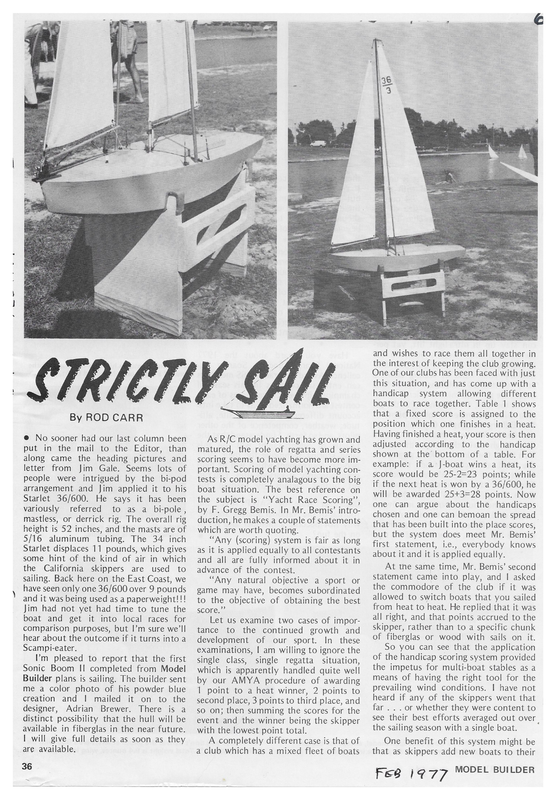
$7 and wishes to race them all together in the interest of keeping the club growing. One of our clubs has been faced with just By this situation, and has come up with a handicap system allowing different boats to race together. Table 1 shows that a fixed score is assigned to the ROD CARR @ No sooner had our last column been put in the mail to the Editor, than along came the heading pictures and letter from Jim Gale. Seems lots of people were intrigued by the bi-pod As R/C model yachting has grown and matured, the role of regatta and series scoring seems to have become more important. Scoring of model yachting con- arrangement and Jim applied it to his tests is completely analagous to the big boat situation. The best reference on variously referred to as a bi-pole, mastless, or derrick rig. The overall rig height is 52 inches, and the masts are of the subject is “Yacht Race Scoring”’, by F. Gregg Bemis. In Mr. Bemis’ introduction, he makes a couple of statements which are worth quoting. Starlet 5/16 36/600. aluminum He says it has been tubing. The 34 inch Starlet displaces 11 pounds, which gives some hint of the kind of air in which the California skippers are used to sailing. Back here on the East Coast, we have seen only one 36/600 over 9 pounds and it was being used as a paperweight!!! Jim had not yet had time to tune the boat and get it into local races for comparison purposes, but |’m sure we’ll hear about the outcome if it turns into a Scampi-eater. I’m pleased to report that the first Sonic Boom II completed from Model Builder plans is sailing. The builder sent me a color photo of his powder blue creation and | mailed it on to the designer, Adrian Brewer. There is a distinct possibility that the hull will be available in fiberglas in the near future. | will give full details as soon as they are available. 36 “Any (scoring) system is fair as long as it is applied equally to all contestants and all are fully informed about it in advance of the contest. “Any natural objective a sport or game may have, becomes subordinated to the objective of obtaining the best score.”’ Let us examine two cases of impor- position which one finishes in a heat. Having finished a heat, your score is then adjusted according to the handicap shown at the bottom of a table. For example: if a J-boat wins a heat, score would be 25-2=23 its points; while if the next heat is won by a 36/600, he will be awarded 25+3=28 points. Now One can argue about the handicaps chosen and one can bemoan the that has been built into the place but the system does meet Mr. first statement, i.e., everybody about it and it is applied equally. spread scores, Bemis’ knows At the same time, Mr. Bemis’ second Statement came into play, and | asked the commodore of the club if it was with the lowest point total. allowed to switch boats that you sailed from heat to heat. He replied that it was all right, and that points accrued to the Skipper, rather than to a specific chunk of fiberglas or wood with sails on it. So you can see that the application of the handicap scoring system provided the impetus for multi-boat stables as a means of having the right tool for the prevailing wind conditions. | have not heard if any of the skippers went that far .. . or whether they were content to see their best efforts averaged out over the sailing season with a single boat. A completely different case is that of a club which has a mixed fleet of boats One benefit of this system might be that as skippers add new boats to their tance to the continued growth and development of our sport. In these examinations, | am willing to ignore the single class, single regatta situation, which is apparently handled quite well by our AMYA procedure of awarding 1 point to a heat winner, 2 points to second place, 3 points to third place, and SO on; then summing the scores for the event and the winner being the skipper Fire i? 77 MODEL BUILDER
spread system was the dastardly habit some skippers had of doing all the required calculations and discovering that they could protect a one-point cumulative lead if they sat out the last NARAGANSETT MODEL YACHTING ASSOCIATION SCORING 1976 1976 NMYA PROPOSAL POSIRION ies 2 POINTS Based | is 4 56 9} a7 PAs | 744 | Alpe be 8S al ed BY del beRael Ba § On 10} OFT 11} 12|13|14]15|DNF | ONS |S Ors |cae lo ele 6-27mc Handicap For Positions 1 – 15 3 – 72mc eee Score -2 0/200 Se 3-72mc A&10Rater ; ; or | Possibl 1 0 event, thus dooming skippers close on their heels the lower points accorded to a smaller regatta. Wasn’t Bemis right, about the scoring system taking over as the goal rather than sailing, as was the = Score -1 original idea of the sport??? ° 80 a FIG. 1 : = 74 4 = 9 proportionally more likely to control the Nee zo outcomes than heavy-air ones. | do not oe oe CUMULATIVE POINTS AWARDED S. will lead to nice-weather regattas being COX-SPRAGUE POINTS S cacti ark f Maa Ne CRD NU in a given regatta. More heats will mean higher scores for the winners, and that know how this club decided to handle the series problem, but since they were embarking on an 8-event series, | suspect that we will hear about the outcome in the near future. The problem of series scoring is our other point of discussion . . . in particular, a “selective” series. This is a series of regattas, 8 for example, in which the final scores from only 6 will be counted to determine the series winner. As previously outlined in this column, my local club has been using a regular spread scoring system for the cumulative scores. This awards cumulative points for each event as follows: one point for racing, plus one point for every boat that you were ranked ahead of at the “7 end of the event. In an 9-boat regatta, the 1. 2 s3e-4eeo 07 27-69 AO winner would get 1+8=9 points, second FINISHING PLACE FOR REGATTA place 1+7=8, and so on. The fly in this personal fleets, they may be encouraged to do so in a manner which will allow one or two single class fleets to develop. ointment was that the varying size of regattas often meant that winning a small regatta was useless, since 3rd or 4th in a larger regatta meant more points. In this constant spread system, there was no bonus for winning small events, nor was there really any bonus for winning large events. On the one hand, a good system would measurably reward the winner of any event no matter what the size, yet would somehow retain a bonus of some sort that would give due credit for winning a bigger regatta. Another evil to be found in the constant | suspect would that 50/800’s and EC/12’s might be the most probable candidates. This scoring will system rank the skippers at the end of the regatta. How the scores are handled for the season | do not know. It obviously makes no difference how many skippers show up for the event, as first place points in each heat are already defined regardless of population. What does become important is the number of heats that are run TABLE 2 10 4 (0) – PTS. 21 – 58 22 – 57 23 – 56 31 – 48 32 – 47 33 – 46 25 – 54 35 – 44 24 – 55 26 27 28 29 30 – 53 52 51 50 49 point amounts are different as seen on the left hand scales. Below 6th place, the Cox-Sprague and Constant Spread systems are acting alike. But above 6th, the Cox-Sprague gets proportionally larger as one nears first place. This reflects in the score the increasing amount of effort it requires to move up one place in the standings. From 9th to 8th is a comparitively easy step up, but the move from Sth to 4th is harder, and the hurdle from 2nd to first is quite steep. A complete tabular format of the Cox-Sprague scoring system is presented in Table 2. Note that the winner gets more points for a bigger regatta, but that the 6 point spread between first and second is maintained. If we left it at that, we would have made much improvement… for bigger regattas are still the overwhelming control over a good score. The situation improves if we instead Continued on page 80 4 5 6 7 8 9 10 11 12 13 14 15 16 17 18 19 *20 31 43 52 6O 66 72 76 80 84 87 90 92 94 96 97 98 99 100| 50 46 43 40 (38) 56 52 49 46 44 (42) 62 58 55 72 50 48 (46) 66 62 59 56 54 52 50 70 66 63 GO 58 56 54 74 70 67 G64 62 6GO 58 77 73 70 67 65 63 61 80 76 73 70 68 66 64 82 78 75 72 70 68 66 84 80 77 74 72 70 G68 86 82 79 76 74 72 70 87 83 80 77 75 73 71 88 84 81 78 76 74 72 89 85 82 79 77 75 73 90 86 83 80 78 76 74 (53) 56 58 6O 62 63 G64 65 66 | 13 63 62 61 6O 59 G64 63 62 61 60 25 37 46 54 6O 66 70 74 78 81 21 33 42 (17) 29 38 (26) 35 (32) () Pts. are for 36 37 38 39 40 * 43 42 41 40 39 the actual 3 34-45 – though COX-SPRAGUE SYSTEM FOR SELECTIVE SERIES NUMBER OF STARTERSINREGATTA|2 PLACE Well, naturally a better system does exist, and we are just now appreciating the benefits to be found in it. It is called the Cox-Sprague System, and seems to make a good stab at curing all the evils we have just listed. It isa variable or increasing spread system. At the end of a regatta, the cumulative total score that you get is larger, as the regatta population increases; and simultaneously, you get more points the nearer the front of the fleet you get. The plot in Figure 1 compares the constant spread cumulative score for a 10 boat regatta, with the Cox-Sprague system. A vertical square is worth one point, |Place 1 84 86 88 90 91 92 93 94 2 3 4 5 6 7 8 9 (48) 52 56 59 62 64 66 G68 69 70 71 72 | 10 (50) 54 57 6O 62 64 G66 67 68 69 70 | 11 (52) 55 58 6O 62 G4 65 66 G7 68 | 12 DNF or Disa. (55) 57 59 61 920 or more 62 63 G64 65 | 14 (56) 58 60 61 (57) 59 GO (58) 59 (58) 62 61 6O 59 (58) | | | | | 15 16 17 18 19 (58) 59 | 20 SE SRC SNA FEBRUARY 1977 TE IS INI NN PT ILS SD a 37
ple Ars” — x Sailing. ….. Cont inued from page 36 make each skipper’s sc ore a percentage of the winner’s score for a given regatta. For example, in a 5boat regatta, the ¥ winner gets 52 points, and if you are in second place you will get 46 points, 46—52=.884619. For a 6 boat regatta, the situation becomes 54-260=.900000 for the same second place finish. The different point totals that the CoxSprague system assigns to the finishing places, coupled with using a percentage way of reporting the scores, makes smaller regattas less handicapped, makes the scores much closer together, and | hope, will encourage more people to race. It is conceivable that a situation would develop that even though the two top skippers elected to sit out a final regatta, a winning performance by the next skipper down could have such an effect that he might bump one or both of them for the whole series. 1 went back through the series that a Fi ig wether Since the skippers at the top of the fleet are usually the ones who have already held positions as fleet captains or regatta directors, they will probably prefer to yield to others. The fellows who make up the bulk in the middle of the fleet will benefit the most score-wise frao fre m e second plac finish, and they are just the skippers who we m ist count on to keep the cceare realty and growing. aad ia The fellows | have talked to seem to like the idea, and I’m hoping that the EC/12 Fleet will vote to accept the practice into its 1977 activities. Since | will always be there to act as score- keeper and advisor, as well as help with the protest decisions, | hope that it will provide an easy way to increase the number of qualified Regatta Directors. | also think that once some of these people get a chance to see a Regatta from that viewpoint, their conduct and enjoyment of other regattas will be the Potomac R/C Sailing Association improved. final outcome annual dues to American Model Yachting has had in past years. In no Case did the of the scores calculated by the Cox-Sprague system shuffle the order of the trophy winners. What it did do was show that as the end of the season approached, the final outcome was still in doubt right up into the last regatta. Take the Table 2 and sit down with some of the series regattas you have been in. You might discover that you could have been a winner under that . . = EN format. Scoring is A * . the final product of a day’s worth of racing. Even before the first score is written down, before the first heat starts, there has beena good deal of effort expended in preparation for the event. As | read the modeling press, | am somewhat worried by seeing the same names coming up all the time all across the country as Regatta Directors. It is not a difficult job, but it is certainly one that should be prac- ticed before you are handed an ACCR to run. | am going to suggest an experi- ment to our local EC/12 meter fleet this next year, with a goal of breaking people into Management, the routine of regatta and making it something that will be worthwhile for their series boating score. Initially, | plan to run the first regatta myself, as | never believe that you can sail and officiate at the same time. At the end of the regatta, | will call for one volunteer who will run the next month’s event. You will only get the chance to be Regatta Director once a season, and must sign up ahead of time. The reward will be that upon completion of your day as Regatta Director, you will be able to put second place competition points down o your score card, these points being one of regattas you may the count toward your final score at the end of the season. Remember to send in your $5.00 Association, 2709 So. Federal Highway, Delray Beach, Florida 33444. & et a