- Title. Author. Summary

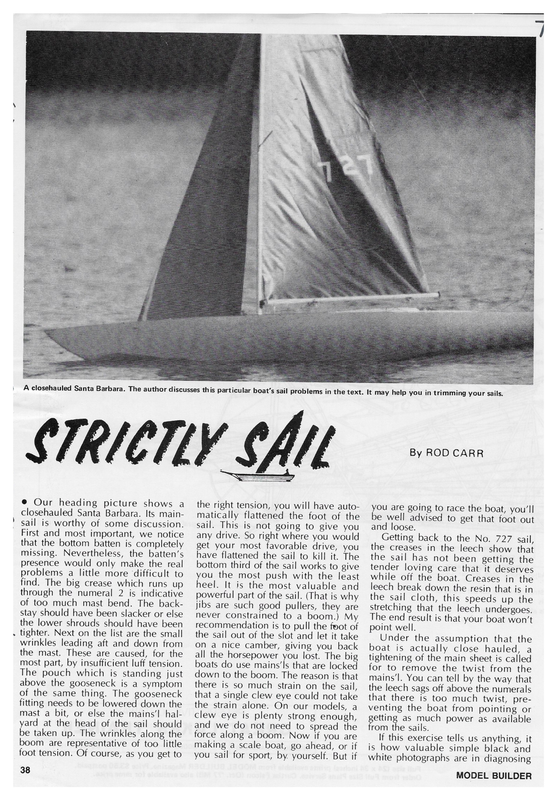
By @ Our heading picture shows a closehauled Santa Barbara. Its mainSail is worthy of some discussion. First and most important, we notice that the bottom batten is completely missing. Nevertheless, the batten’s presence would only make the real problems a little more difficult to find. The big crease which runs up through the numeral 2 is indicative of too much mast bend. The back- stay should have been slacker or else the lower shrouds should have been tighter. Next on the list are the small wrinkles leading aft and down from the mast. These are caused, for the most part, by insufficient luff tension. The pouch which is standing just above the gooseneck is a symptom of the same thing. The gooseneck fitting needs to be lowered down the mast a bit, or else the mains’! halyard at the head of the sail should be taken up. The wrinkles along the boom are representative of too little foot tension. Of course, as you get to 38 the right tension, you will have automatically flattened the foot of the sail. This is not going to give you any drive. So right where you would get your most favorable drive, you nave flattened the sail to kill it. The bottom third of the sail works to give you the most push with the least heel. It is the most valuable and powerful part of the sail. (That is why jibs are such good pullers, they are never constrained to a boom.) My recommendation is to pull the foot of the sail out of the slot and let it take on a nice camber, giving you back all the horsepower you lost. The big boats do use mains’Is that are locked down to the boom. The reason is that there is so much strain on the sail, that a single clew eye could not take the strain alone. On our models, a clew eye is plenty strong enough, and we do not need to spread the force along a boom. Now if you are making a scale boat, go ahead, or if you sail for sport, by. yourself. But if ROD CARR you are going to race the boat, you’l| be well advised to get that foot out and loose. Getting back to the No. 727 sail, the creases in the leech show that the sail has not been getting the tender loving care that it deserves while off the boat. Creases in the leech break down the resin that is in the sail cloth, this speeds up the stretching that the leech undergoes. The end result is that your boat won’t point well. Under the assumption that the boat is actually close hauled, a tightening of the main sheet is called for to remove the twist from the mains’l. You can tell by the way that the leech sags off above the numerals that there is too much twist, pre- venting the boat from pointing or getting as much power as available from the sails. If this exercise tells us anything, it is how valuable simple black and white photographs are in diagnosing MODEL BUILDER
our sail set and trim. | shot No. 727 with a 400mm telephoto lens while the boat was a good 250 feet off shore. At this range, the focus of the lens does not have to be changed as the boat wanders a bit from her course. Trying to get meaningful photos of a boat with the typical wide-angle lens found on most cameras is doomed. You’d be surprised at the photos that | often get which have a picture of someone’s boat 3/16 of an inch tall in the middle of a wide expanse of water. Just not worth the paper they are printed on. A recommendation would be for an 80-200mm zoom ens as the best single investment. ‘Il admit my 400mm is a bit unwieldy, even though I’ve mounted it ’on a rifle stock. The other two photos are of former AMYA A-Class Secretary Ed Williams’ A-boat. She has a hard chine, and is planked of thin ply on the diagonal. That monstrous lead ‘‘shoe’’ comes off and makes transportation a good deal easier. In the waterborne shot, we see that Ed is persisting in carrying a forestay as part of his rig. In the light air at the time this was no . problem. But when the wind blows, the forestay steals some of the tension that should be carried by up, her ability to go to weather was reduced. It is not obvious in the photo, but the jib does not sit on the stay that goes from the forward end of the jib club, but on a third stay that goes from just above the club’s pivot point. It is no wonder that the jibstay has sagged almost 2-1/2 inches in its mid-portion. As | said, in light air, no problem, and it may well contribute to a nice open slot between the main and jib. But in heavy air, look out. CURRENT CONSIDERATIONS Conspicuously absent from the model yaching literature is any men- tion or discussion of currents. Our courses are usually short, and in protected waters. One would think that currents would have little to do with our sailing. | suppose that one can go forth and find a little pond where there is no significant water movement. But the chances are slight. We can identify three broad classes of currents and discuss each in turn: a) Tidal Currents b) River Currents c) Wind Driven Currents. TIDAL CURRENTS Tidal currents are associated with coastal waters, estuaries and the like. The most important feature is a time-related regime of ebb and flow with us, fellows? RIVER CURRENTS These can exist in an actual river, or might be found along a shore of a very large lake, where they were started by wind pressure. The structure of the current is what is important. | want to discuss the current with no attention paid to the wind except to say that it has a constant direction and speed. It is very common to lay a course within easy visual reach of the skippers on the nearby shore. So let us confine ourselves to a simple situation shown in Figure 1. A longshore current slows down as one gets further inshore, due to friction with the bottom along the shallower edge (Remember how the wind did that in a vertical sense when we looked at profiles of wind speed over water). In short, we are saying that the speed of the current is less near to shore. On Figure 1 is shown the track of a boat that has sailed the course. At a number of points (lettered A, B, C, etc….) we will discuss the vector forces which work on the boat. There are two vectors working in each case, with a third vector being the resultant of those two. The current vector, plus the boat speed vector, gives a resultant which is sos Former AMYA A-Class Sec., Ed Williams, built this A-boat. Note hard chine, diagonal planking. Lead shoe removable for transport. the jibstay. It is the jibstay tension that keeps the stay straight for the jib to set properly. If the jibstay is allowed to sag, the jib will sag in its middle parts, thereby ruining its *pointing ability and probably backwinding the mainsail to boot. The forestay will also prevent the backstay from bending the mast in heavy air. This mast bend will match the curve of the mast with the luff curve of the sail, flattening the mainsail and reducing the heeling moment of the rig. In watching the boat sail at Marsh Creek early in the season, it was obvious that as the wind picked FEBRUARY 1978 Ed uses a forestay, which is OK in light air, but, according to Carr, steals valuable tension from the jibstay during heavy blows. which would sweep across a race course, paying little attention to the local wind and the race committee. What was a foul current during the morning may well turn into a slack or fair current at some point later in the day. A couple of potential spots where these considerations might be required would be in some of the California sites, such as Mission Bay, or at Newport, Rhode Island, where the Mini-America’s Cup is sailed. Perhaps we will be lucky enough to elicit some thoughts on those sites by readers who have sailed at them. How about sharing your observations the track of the boat over the bottom. In some cases the boat is helped by the current, in others it is hindered. In all cases it is affected. In all the vector diagrams, the boat speed has been taken as 2 knots. This is not really the case, as we know that boats reach faster than they beat. But by keeping the boat speed constant, our understanding of the effect of current will be easier. Secondly, it is assumed that the boat will sail within 45° of the true wind. So in still water, the angle between the true wind and the boat’s heading will be 45°. 39
CURRENT ONE (1) KNOT T! a$$ WIND FINISH At the gun, our skipper is on starboard tack, mainly because he wants to use the starboard side of the course where the current is slower near the shore. | show him carrying on starboard for a little while, since he was apparently able to end up to weather of the whole fleet. By staying on starboard, he is forcing them farther out into the current, realizing that they will have to come back through it to get to the shallows. They can’t tack until he does. At A, we refer to the first vector diagram. In still water he would make 45° to the wind, but with the one-knot current pushing him back, we see that he makes only 75° to the wind. FIG. 2 <_ WIND Note that having the wind come from the same direction as the current was done to make drawing easier. Also note that a one-knot current is really pretty healthy and not something you'll run into very often. Our skipper now tacks and makes for shore. We look at him again at B. He is into an area where the current speed has dropped knots. The change in the resultant vector point 12° higher than in 63° of the wind. to only 0.75 the direction of allows him to before, or withBelieve me, if you can point 12° higher than the competition, nobody is going to catch you. Realizing his advantage, our man tacks back and forth, staying in the low current speed area. It is bounded on the shore side by the depth of the water his boat has to have, and off- set you back. Having rounded the mark, we look at the situation at C. In order to stay on the proper course to the wing mark, our skipper must head high or to starboard of his line of sight. On this leg he is helped by the current, and his 2.0-knot boat speed through the water, goes up to 2.65 knots over FIG. 3 [a WIND DRIVEN CURRENT shore by the place where the current is back up to the full speed of one knot. Notice that when he makes his last tack for the mark (No. 8) he NEAR SHORE RETURN is pointing way above the mark just after his tack. As he gets nearer to the mark, he enters the full current speed area and his boat gets set down to port. If he had started for the mark at tack No. 6, when his boat was pointed at the mark, he would have sailed out past tacking Wind driven currents in a round pond. point No. 7 and never laid the mark. So one needs to remember to head into the current, ie., higher than CURRENT 4, Near shore current structure. the mark, if the current is going to 40 MODEL BUILDER
4. FULL CURRENT — BEATING CURRENT 1.0 kt B. INSHORE — BEATING CURRENT 0.75 kt C. FIRST REACH The guy who really started it all... R/C model yacht sailing as we know it today, that is... Tom Protheroe, creator of the original Santa Barbara One-Design, now produced by Vortex. the bottom. Since the buoys are anchored to the bottom, it is speed over the bottom that counts. He then rounds the wing mark and probably jibes. Now at D he must hold to port, more into the current to keep from being carried below the mark. If one has to sin, it must be in holding too much to port. CURRENT 1.0 KNOTS E. One can always bear off and run down to the mark with the help of the current, while if you are carried below the mark, it will be a beat back, and in the adversity of the ‘tu! current. We have already seen how touch that can be. 2 The final beat to the finish line is Continued on page 335 RUNTO FINISH BOAT SPEED ae 2.0 kt Ba CURRENT 1.0 kt | SE RESULTANT 3.0 kt COURSE TO LEEWARD MARK FEBRUARY 1978 41
Sailing...... Continued from page 41 a repeat of the first weather leg. The other point of sail to be mentioned is shown at E. Often times, the final leg will be a run to the finish. In this case, stay right in the strongest Current you can find and ride it right to the line. Through this whole discussion, we have worked in an absolutely constant wind field. I’m sure your first day on the water convinced you that such a condition doesn’t really exist. So, like everything else in sailing, you'll have to continually balance the benefits of wind shifts against Current strengths. Where and what the competition is doing will deter- mine your choice of tactics on many occasions. But if you are struggling along in the middle of the course and happen to notice another fellow sneaking quickly up the side, you’re probably sailing against another uni-directional wind, as shown in Figure 2. Places where the wind actually pushes on the water are shown stippled. All the water gets pushed downwind toward X. When it gets piled up enough (maybe a 1/4 inch or so) it will naturally flow downhill. The nearshore currents result. A typical flow regime is shown for Section A-A in Figure: 3. In this case, a nearshore current can be the largest water movement in the pond. Take advantage of it if it will help you, or try to lead your competitors into it if it will hold them back. Remember to send in your $5.00 annual dues to the Secretary, AMERI- CAN MODEL YACHTING ASSOCIATION, 2709 S. Federal Highway, Delray Beach, FL 33444. And I'll continue to field questions, either directly to MODEL BUILDER or to me at 7608 Gresham St., Springfield, MODEL BUILDER reader. VA WIND DRIVEN CURRENTS addressed, included. This situation occurs most of ten on ponds that we are prone to sail on. The way to assess what’s ha ppening is to stroll around the pu ddle and toss a handful of grass into the water every few steps. The grass li es flat on the water and is indicative of the Water wind movement rather than movement water, which just of the above the may be entirely dif- 22151 eas ulong. stamped as. a®selt- envelope is e A. J. FISHER INC. MANUFACTURERS SCALE BRASS FITTINGS OF QUALITY | SHIP AND YACHT SINCE 1925 PLANS - FITTINGS - KITS - BooKs ILLUSTRATED CATALOG, $1.50 ferent. These currents are the result of wind stress on the water. The wi nd pushes the water up to the pond , and a means has to be found fo r it to flow back. Wind often lifts off the surface of a.pond near the ed ges in response to beaches or bluffs. The immediately adjacent water is not pushed by the wind and can move toward areas where the wa ter has been literally blown away. Cons ider the case of a circular pond wi th a ay 1002 ETOWAH ST. PISS ROYAL OAK, MICH.