- Title. Author. Summary

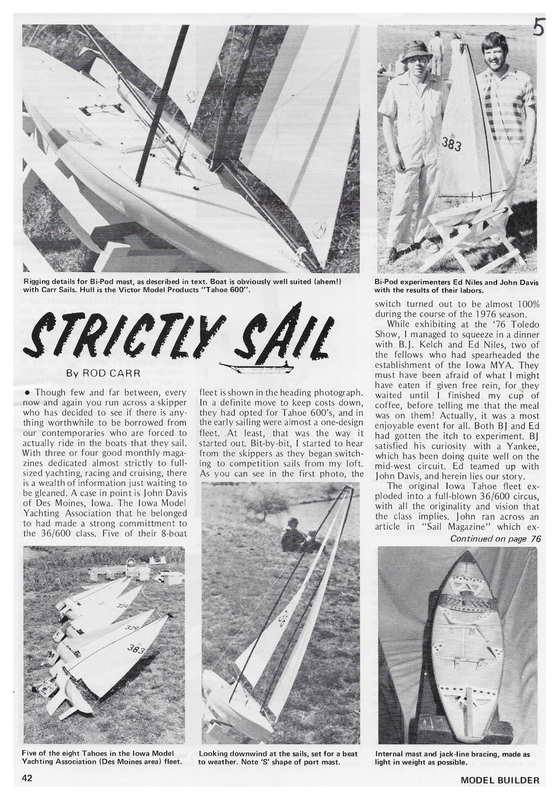
te Rigging details for Bi-Pod mast, as described in text. Boat is obviously well suited (ahem!) with Carr Sails. Hull is the Victor Model Products ‘““Tahoe 600”. Bi-Pod experimenters Ed Niles and John Davis with the results of their labors. switch turned out to be almost 100% during the course of the 1976 season. By While exhibiting at the ‘76 Toledo Show, | managed to squeeze in a dinner with B.J. Kelch and Ed Niles, two of the fellows who had spearheaded the establishment of the lowa MYA. They ROD CARR e Though few and far between, every now and again you run across a skipper who has decided to see if there is anything worthwhile to be borrowed from our contemporaries who are forced to actually ride in the boats that they sail. With three or four good monthly magazines dedicated almost strictly to fullsized yachting, racing and cruising, there is a wealth of information just waiting to be gleaned. A case in point is John Davis of Des Moines, lowa. The lowa Model Yachting Association that he belonged to had made a strong committment to the 36/600 class. Five of their 8-boat fleet is shown in the heading photograph. In a definite move to keep costs down, they had opted for Tahoe 600’s, and in the early sailing were almost a one-design fleet. .At least, that was the way it started out. Bit-by-bit, | started to hear from the skippers as they began switching to competition sails from my loft. As you can see in the first photo, the Se sakes must have been afraid of what | might have eaten if given free rein, for they waited until | finished my cup coffee, before telling me that the meal was on them! Actually, it was a most enjoyable event for all. Both BJ and Ed had gotten the itch to experiment. BJ satisfied his curiosity with a Yankee, which has been doing quite well on the mid-west circuit. Ed teamed up with John Davis, and herein lies our story. The original lowa Tahoe fleet exploded into a full-blown 36/600 circus, with all the originality and vision that the class implies. John ran across an article in ‘Sail Magazine’? which exContinued on page 76 Five of the eight Tahoes in the lowa Model Looking downwind at the sails, set for a beat Yachting Association (Des Moines area) fleet. Internal mast and jack-line bracing, made as to weather. Note ‘S’ shape of port mast. light in weight as possible. 42 of MODEL BUILDER
Another suspected advantage of this kind of a rig was to be a greatly increased mainsail efficiency, since the forward variety, which allows a rapid but compart of the sail would now be sitting plete control of the amount of jib on a stay, just like a jib, rather than swivel offset as the wind speed changes. being hidden behind a mast, in what Is must. absolute an is ‘This known to be turbulent air. Another To make a long story shorter, the from set-up the at look a us gives photo Bi-Pod special (no relation to the dead upwind. You have to admit that Pea Pod) started her competition career to y tunit oppor every have now both sails in the 1976 Hawkeye Regatta held in gain maximum efficiency. A good deal of thought went into the design of the boat. An extensive effort was made to keep her light, in order that the amount of ballast required for stiffness would not be so much as to cause the hull to float below its lines. The Tahoe is a very round-shaped hull at the mid-section. As we have previously discussed for a number of 50/800’s, a hull of this shape gets almost all of her stability from her keel weight. The hull does not push back when it is heeled. Ed and John knew that the extra mast section was going to put some weight aloft just where it was not wanted, so they replaced the stock Tahoe keel of 7 inch depth, with a Scampi keel which drew 11 inches. The longer lever arm would help resist heeling. Also, efforts were made to reduce to a minimum the weight of any masthead fittings. The final arrangement is shown in Figure 1. Though the Sail article was calling for a large end plate to smooth the airflow at the masthead and prevent tip losses, the additional weight of such a fitting was deemed to be detrimental to overall performance, suitably and the end plate was modified. Des Moines on August 26th. She blew everybody off the lake by winning outright two-thirds of the heats sailed. The winds were light, steady 5 knots, with an occasional gust to 10. This is just what the Bi-Pod ordered, and she took a full helping of silverware home for her owner. Ed Niles came in second, extremely happy to have been so soundly whipped by something he had helped another skipper build. In his correspondence with me, John was quick to get better control over the leach. This would help somewhat. But in the final analysis, we may say right now that there is no reason to think that the standard, center-line mounted mast is becoming extinct. For heavy air, we might hear that John has developed a revolutionary new concept for his boat, a Mono-Pod! | would like to thank John and Ed for the effort that they expended in providing me with the photos and information about this fascinating experi- ment. There is nothing so exciting as seeing an idea taken from scratch paper right out onto a boat in the competition arena, to see if the idea works. | hope this column will induce other skippers to share their ideas with us, to make the sport that much more fun. Remember to renew your AMYA membership for 1977. Send $5.00 to the Secretary, 2709 So. Federal Highway, Delray Beach, Florida 33444. Tell him | sent you and that you read about it in STAY fying hobby of which to be a part. But isn’t there a catch? If bi-pods are so good, why aren’t there more of them on the lakes? Is there any thing about the boat with which John is not happy? Of course the answer to the last question Is mobility of the point of maximum draft will be marked, and the boat may actually go from lee to weather helm in certain instances. The effect on boat speed will be detrimental. As the draft | > BI—-POD MAST HEAD ( light brass ) moves around in the main, you can go from a draft-aft, high speed sail, to a draft-forward, high acceleration sail; all with only the wind speed varying as you beat along. MAIN STAY FITTTNG 1 The mainsail sitting on that stay becomes as unruly as some jibs. A first step cure would be to use 3 oz. sail cloth for heavy airs. This will keep the shape from being so mobile as it is in 2.2 oz. Dacron. For this specific boat, | – would do everything | could to obtain— 0 —~ on ou of —<— — “ey balancing of one force or fitting against another. It is knowing when to fight the wind and when to submit willingly. In the case of the bi-pod, John says that as the wind picks up, she is unwilling My reasoning is that the same mainstay that allows the mainsail to work so efficiently at low wind speeds, is the mainstay that starts to bow and sag as t a) “ winning performance is a continual an increase in draft in the main, which will probably cause a continually varying amount of weather helm as the velocity changes on the windward legs. The | }|| "f 4 “ves”. As with all aspects of sailing, the wind pressures on the sail increase. With the increased sag in the stay comes FIG. 1 ll field questions at 7608 Gresham 9 St., Springfield, VA 22151. point out that the project would never have been completed without Ed. That is the kind of unselfish attitude which has made model yachting such a Satis- to continue her docile winning ways. JIB Model Builder. $35.00 labors. main traveler has been fitted, and the main clew is lead directly down to the gooseneck swivel on its stay. End boom sheeting is used on the jib club for direct and positive control of leach shape when going to windward. We can see that the jib club swivel is of the “wrap-around”’ end-of-boom sheeting for the main, to - $30.00 - $30.00 their One of the photos shows the deck layout used. We do see some ath wartships shrouds which are used to keep the mast sections in the proper plane. A . 0D oo =“ or oHcoce Se co a ® pate w COCOHY GE <= - Oc Uae CBU “ <& GCakh w =) + AVY ee Oo ~~ x a i oh a ar Qgn wn feng ia = o~— eo 2oc wou wo mao rw ooc WN =H >TO DG BS a og GIS we eam OG oy l= | DOC ooc od hiv oow aA Shwe > cal iam | fat ; , ae, ons S SS TA 2 ow aiv wm S55 ° ne 3 eE= Oleco OWoE- SPRINGFIELD tolled the theoretical virtues of a Bi-Pod mast. Basically, the idea was to eliminate all the wind resistance of the myriad shrouds and stays by cutting back toa forestay, backstay, mainstay and two masts, joined at the head and stepped at the chain plates. One of the photos shows Ed, John, and the result of 7 Haiccoanon alacaovetne ~ ® tia) ‘ Om mo 2. MUR OVE © aw oc qiut i — o 5e000 SlS ELn vy De Aajtaannva cm . ae o -10 -HDTe amo oO. Ze nre ete qcewwors Eelam 07000 aad 5M cw gS feat qjeo olo- So! Ole>rOra oO ‘ fl)