
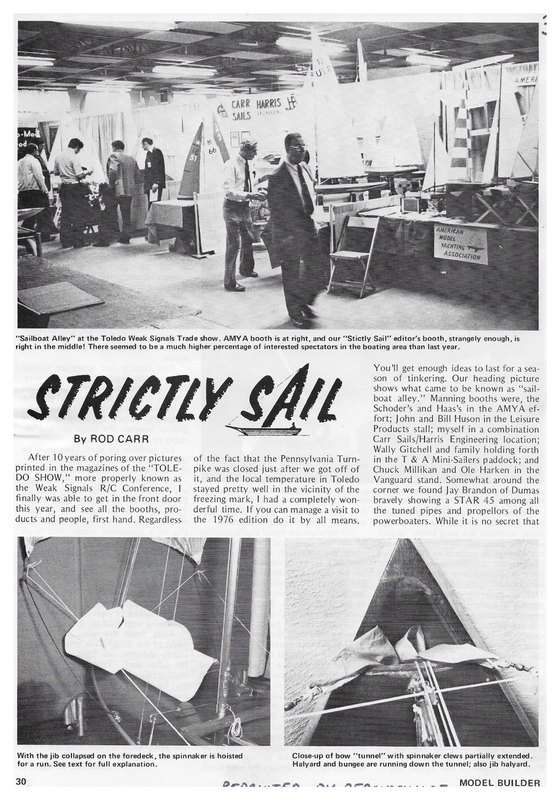
- Strictly Sail. By Rod Carr
- This article chronicles the author’s experience at the Toledo Weak Signals R/C Conference’s “Sailboat Alley” before diving into a comprehensive technical primer on R/C sailboat spinnakers. It explores the mechanical challenges of hoisting, dousing, and controlling a spinnaker, highlighting innovator Wally Gitchell’s successful implementation of dual spring-loaded poles and roller-furling jibs on his “Petrel” models to manage airflow and prevent deck tangles. The column concludes with a breakdown of spinnaker aerodynamics across different sailing postures (reaching versus running) and lists newly sanctioned clubs joining the American Model Yachting Association (AMYA).

“Sailboat Alley”’ at the Toledo Weak Signals Trade show. AMY A booth is at right, and our “‘Stictly Sail’’ editor’s booth, strangely enough, is right in the middle! There seemed to be a much higher percentage of interested spectators in the boating area than last year. You’ll get enough ideas to last for a season of tinkering. Our heading picture shows what came to be known as “‘sailboat alley.’’ Manning booths were, the Schoder’s and Haas’s in the AMYA ef- fort; John and Bill Huson in the Leisure Products stall; myself in a combination By ROD CARR After 10 years of poring over pictures printed in the magazines of the ‘‘TOLEDO SHOW,” more properly known as the Weak Signals R/C Conference, | finally was able to get in the front door this year, and see all the booths, products and people, first hand. Regardless Carr Sails/Harris of the fact that the Pennsylvania Turnpike was closed just after we got off of it, and the local temperature in Toledo stayed pretty well in the vicinity of the freezing mark, | had a completely wonderful time. If you can manage a visit to the 1976 edition do it by all means. With the jib collapsed on the foredeck, the spinnaker is hoisted for a run. See text for full explanation. 30 Engineering location; Wally Gitchell and family holding forth in the T & A Mini-Sailers paddock; and Chuck Millikan and Ole Harken in the Vanguard stand. Somewhat around the corner we found Jay Brandon of Dumas bravely showing a STAR 45 among all the tuned pipes and propellors of the powerboaters. While it is no secret that Close-up of bow ‘‘tunnel” with spinnaker clews partially extended. Halyard and bungee are running down the tunnel; also jib halyard. BwrAAa.,s…- PF Am A. we) Kon ed VEY ae ea aa a) MODEL BUILDER
ORE CL No other reason to print this picture but to give everyone a dose of “Spinnaker Fever.” Ain’t that purdy? I’m a prejudiced bloke, it seems that here we had a representation of hobby manufacturers who took the time to make a special effort in support of the growth of R/C sailing. Not the least of the high spots of the busy weekend was a face to face encounter with the fearless editor of MODEL BUILDER. It can now be told; Bill Northrop cannot bend steel in his bare hands, nor change the course of mighty rivers. He is just a mild mannered editor of a great modeler’s maga- zine!! (111 send your check today! wen) But to return to our promised subject, let’s take a cursory look at spinnakers. Of all the “goodies” which a novice yachtsman thinks he would like to put on his new boat, a spinna ker is the first choice of the majority. Of all the skippers who I’ve had the opportunity to talk with, only two had proof that they had in fact set a spinnaker Gunwale-mounted spinnaker poles mou nted on Wally Gitchell’s PETREL. while underway, flown it full and draw ing, and then retracted it. The first was Rich Matt, of Chicago, who did the trick on a Santa Barbara, using tw in poles for trimming, and set the chute from a hole in the foredeck forward of the jib. Retraction was by heaving on a downhaul line attached to the center of the chute. A three-drum winch in the boat would either set or retract the chute. The system was described in more detail in an early issue of the AMYA Quarterly. The second, and the current titleholder is AMYA open class secretary, Wally Gitchell. His covey of PETREL models have been used as testbeds for all of the extra functions we have dreamed about around on to our boats, developing. but never For got example, what do you do with the jib when you set the spinnaker? One solution is to haul the jib down the jibstay as the spin- naker halyard is hoisted away. This leaves somewhat of a tangle on the fore- deck, and if we are looking toward a system which will be eventually applic – able to a racing boat, it might not be our first choice. Wally stepped right in and has provided us with roller furling of the jib. This takes the luff wire, ro- tates it, and rolls the jib right up into a cylinder on the stay. No mess, and ver y little disturbance of the airflow when under spinnaker power. Details of the roller furling system are available fr om T & A Mini-Sailers, at 14330 Fancherville. Rds.No. «3 1, Westerville, Oh io 43081. (Loose footed Reaching chute). Any good text on sailing will give you the basic requirements for a functionin g spinnaker. The most comprehensive I’v e seen is in a new book by Wally Ross, called SAIL POWER and published by Alfred Knopf, Inc., 1975. (Would you believe two Wally’s in the same article!! ) You will need a halyard to pull the head of the spinnaker up to the mast head. (In some classes, such as the 50/800, another location is specified as the maximum height at which the halyard may meet the mast). You will need a downhaul, and | suspect that the center attached type, such as Rich used, will be optimal. It will collapse the sail quickly when required, be able to feed easily into the funnel shaped arrangement which is built under the deck, and leave the head and clews of the spinnaker immediately available for rehoisting. Gitchell provides a bit of insurance in the way of an elastic bungee cord which opposes the downhaul line. This will keep the spinnaker out of the water should it collapse completely. Probably we should fit one of these in much the same way the helicopter modeler fits “training wheels.” The amount of halyard that will have Radial headed chute on a shore-based te st rack. Bet you thought Linda Carr was sail ing downtown to the grocery store! JUNE 1975 to be reeled in depends on your mast height, and your mast location to forestay distance. A rating rule would describe these as “Il” and ‘J’? measure- Continued on page 82 31
ments. We are in reality looking at an amount of halyard equal to the hypo- tenuse of this triangle, or 12+ J2.On a 36/600, this may be as small as 38 inches, while Whirlwind, on Vanguard’s it stretches to monster 102. As a result, one needs a halyard winch capable of rapid processing of long stretches of line. This has been solved utilizing an adaptation of one of T&A’s Dynamic Balance Sail Control Units. Now that we can hoist and douse it, what control do we need to put on the sail while it is flying? First, it must be realized that spinnakers can produce drive for your boat in two ways, in the classic downwind running mode, or in the reaching mode which has so rapidly developed of late. In either case, the relationship between the sail and the apparent wind must be controllable. This will mean that we will have spinnaker poles, sheets and guys to control the attitude of the beast. At the present time, such control functions would re- quire so much attention that their direct application to established racing classes Figure 1 shows a very basic spinnaker arrangement. The spinnaker pole needs to be as square to the wind as possible and will have to be hoisted someway up the mast in order that the spinnaker be allowed to lift and assume its proper shape. The pole is carried on the same side of the boat that the wind is coming over. In this configuration, the jib is powering the boat due to its aerodynamic lift. Should the wind direction, Or your course change, as in Figure 2, the pole is changed by hauling in the guy, and the sheet is slackened. Since the sail shape of a spinnaker is cut into it by the sailmaker, we see our chute which did so well while reaching, is not bagging out so well as we progress toward a run. A good compromise chute would be fairly flat in order that the reaches be well taken care of. Finally, in Figure 3, we assume a downwind running posture, and the spinnaker assumes its more familiar “parachute” shape. Here it is acting as a giant air brake and dragging the boat to leeward with it. Projected area becomes from port side to starboard side in a jibe is taken care of in Wally Gitchell’s which are attached to either gunwale (edge of the deck) and which can swing FIG. 2 that we will first see the routine use of spinnakers in larger boats such as the from side to side under the pressure of the weather sheet. This allows the wind “A” class, and the new “J’’class, where the additional weight of a spinnaker handling system does not harm the boat, to swing from aft on the starboard side, past the centerline to the port side, and the spinnaker is swung to compensate. ae and where the extra equipment for the chute can be handled by a ‘“‘foredeck hand” who is operating a separate radio oowpe ee The photo gives you an idea of their relationship to the standing rigging and the spinnaker exit point in the bow of Wally’s PETREL. The effect of spring loaded spinnaker poles is to make spinnaker shape directly related to the wind strength. As the speed goes up, the chute pulls harder against the poles, bending FORESTAY eee on another frequency. Another oe | ep, eee probable use for the spinnakers will be by some clever fellow in the 50/800 eae class who uses an 800 square inch catrigged mainsail, and a fairly flat chute with around 1500 square inches which can be used to reach in apparent winds as far forward as 60°. Won’t that scare ‘hem toward the centerline, an d collapsing the foot of the chute some what. On the other hand, the system wo rks, and would certainly be a good begi nning for the pants off of the race committees? someone who wants to star t with a tried bf FIG. 1 yee: ced system, by having two spinnaker poles seems a long way off. My prediction is system BACKSTAY a SAMI. .. 22.. Continued from page 31 A method of spinnaker handling for which Ve ae there is hardware, guidance and exper- lence available. The PETREL in the photo gives you a good exampl e of the fascination which the sail holds fo r Us types. Having seen some movi es of it in action, | can imagine how | wo uld feel! relatively more important than airfoil shape on this point of sail. BACKSTAY Should we continue to head to port we will eventually observe the wind to have crossed our stern. We will have jibed. On a full size boat, the pole would be changed from the old tack to the new tack, while the mainsail was brought over the stern. In our one pole system , we are without the means of continuin g to swing ship to a broad reach and then a close reach without seeing our spinnaker collapse. If we use two poles as previously mentioned, we seriously limit how close we can get to the winds on the reaching legs (That is unless some- one can come up with a way to scope the poles while underway!!!). This ability to slew the tele- spinnaker if | heard a “pop” from behind and looked back to see this monster moving up on me. | wonder if another way to approa ch the problem and maintain the ge ometric relationships required, would be to have (WO separate chutes. One for either tack. (You’d expect a sailmaker to make a suggestion like this, wouldn’t you!!! !) The problem might come in jibing on cCownwind legs of the course, but it seems gained most to on me that the benefits the reaches would attractive. In the larger to be make it classes, where the individual legs of the course are longer, we might well see disc ussions as to best tactical approach to the leg being heid as the skipper and fore deck hand reach a mark. Roller furling, main
and jib trim, and rudder, would be handled by the captain; the spinnaker would be handled by the foredeck hand, who would double as tactician and timekeeper on the weather legs. Really starts to sound like a new dimension in model yachting. While we have attempted a short excursion into the art of rigging and handling a spinnaker, | am not basically a rigging expert, and am looking forward to some input from our readers on their ideas. By the time the rigging is per- fected, there will have been an equal amount of effort expended to ready the Sails that you will need to fly. One photo shows a radial headed spinnaker we made for an East Coast 12 skipper. How he is going to fly it from that boat we don’t yet know, but will keep a close eye on him to see what his solution is. As is our usual custom we would like to alert you to new AMYA Sanctioned Model Yacht Clubs which have organized: f SPRINGFIELD CARR SAILS 7608 GRESHAM ST. , ALL TYPES OF SPINNAKERS-~~RADIAL HEAD, TRI-RADIAL, HORIZONTAL AND SPHERICAL CUTS AVAILABLE IN A WIDE RANGE OF COLORS, WRITE FOR OUR BROCHURE AND PRICE LIST, WE WILL INCLUDE OUR UPTO-DATE LISTING OF ECONOMY PRICED USED SAILS, FREE QUOTES ON WEARS THE CARR LOGO, YOU’LL BE OUT IN FRONT–~-EAST. MA FORMULA OR ONE-DESIGN, RACING OR CRUISING, IF YOUR SAIL WARDROBE – ROSE FESTIVAL DO/800 REGATTA, PORTLAND, OREGON. ST, a ss – 46/600 DIVISIONAL CHAMPIONSHIP, RICHMOND, VA, EE ater tah Ce ~ Fast Coast 12-METER DIVISIONAL CHAMPIONSHIP. > agearntnrs vetie bis ey be, Shik -~ IND CHESAPEAKE REGATTA, BALTIMORE, MARYLAND. Ist, 2ND, SRD lst, 2ND, SRD ist,2ND, SRD ae ay Piss RANT he i ee ok ie? Oy = 4 SASS pea) uns e . 14 y eed *2) ie oe J A RT CNR TRS OUP IL HEI SES RG Iw, 3Ro, {ITH — COLONIAL 50/200 REGATTA, PITMAN, NEW JERSEY. Ss 7608 Gresham St., Springfield, VA. 22151, orin care of MODEL BUILDER. I’d like to thank all the folks who stopped by our booth at Toledo and offered criticism on this columnists effort. It was all quite constructive and greatly appreciated. 2 Corte chee tad comments can be sent to me directly at ade fay <* aye Le ra naeair Suggestions and other column related , YACHTING ASSOCIATION. He’ll love you forit. 6 $5 00 dues for the AMERICAN MODEL uF Ave., Brookfield, Ih. 60513 with your > AMYA wheel, with no pay or praise, out of a sense of “‘it needs to be done.” Write to Bud Salika, 3917 Sunnyside +8 continue to put their shoulder to the Meet of the caliber of folks who have put and ho Can you think of two more savvy fellows? This is a good example me Barbara. oe Vortex, the former as Sales Manager and the latter as the designer of the Santa GB GILL address and he will be called, !’m sure, to lend his expertise as the need arises. Both Ed and Tom were associated with LN BG PE somebody who had the necessary hours to donate. Luckily, we still have Ed’s Fg pired term of Ed Shipe as an AMYA Director. Ed found his time spoken for and asked that the post be filled by MT, SGN of Tom Protheroe to fill out the unex- APE LT We are also happy to report that AMYA has announced the appointment AGLI ‘ayOntario, Canada L1G 4M6 VELLA OET LOT No. 45 — Oregon Model Yacht Club Herb Hoser, 675 S.W. 238th Ave., Hillsboro, Oregon 97123 (Greater Portland area) No. 46 — Oshawa Model Mariners arryeFletcher, 1444 Oneida Court, REIN (Boynton, Delray, Deerfield, Pompano Beach, Margate, Boca Raton) OO Or OL VIRGINIA oy No. 44 — Gold Coast R/C Model Mariners Bob Crysler, 2709 So. Federal Highway, Del Ray Beach, Fla. 33444