- Title. Author. Summary

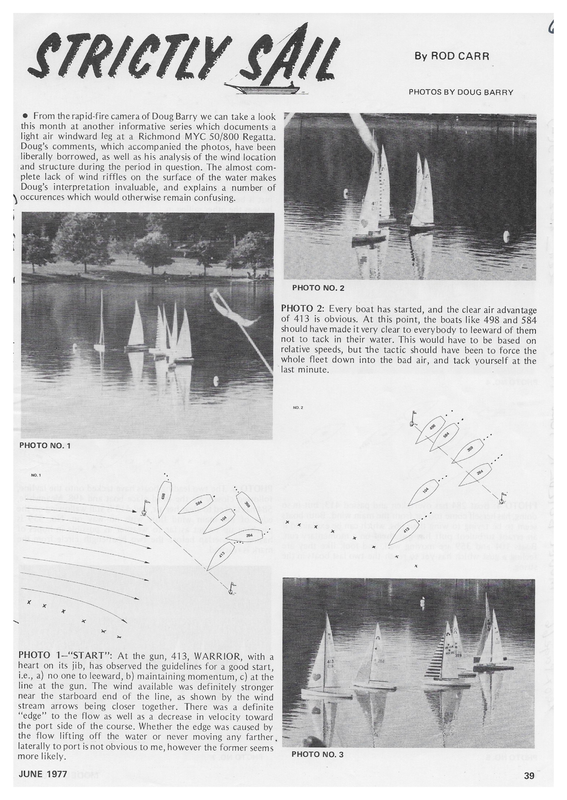
By ROD CARR PHOTOS BY DOUG BARRY * * oie RRRE SERS SPREE @ From the rapid-fire camera of Doug Barry we can take a look this month at another informative series which documents a light air windward leg at a Richmond MYC 50/800 Regatta. Doug’s comments, which accompanied the photos, have been liberally borrowed, as well as his analysis of the wind location and structure during the period in question. The almost complete lack of wind riffles on the surface of the water makes Doug’s interpretation invaluable, and explains a number of \, occurences which would otherwise remain confusing. PHOTO NO. 2 PHOTO 2: Every boat has started, and the clear air advantage of 413 is obvious. At this point, the boats like 498 and 584 should have made it very clear to everybody to leeward of them not to tack in their water. This would have to be based on relative speeds, but the tactic should have been to force the whole fleet down into the bad air, and tack yourself at the last minute. NO. 2 PHOTO 1—“START”: At the gun, 413, WARRIOR, with a heart on its jib, has observed the guidelines for a good start, i.e., a) no one to leeward, b) maintaining momentum, c) at the line at the gun. The wind available was definitely stronger near the starboard end of the line, as shown by the wind stream arrows being closer together. There was a definite “edge” to the flow as well as a decrease in velocity toward the port side of the course. Whether the edge was caused by & the flow lifting off the water or never moving any farther, laterally to port isnot obvious to me, however the former seems ~ more likely. JUNE 1977 a PHOTO NO. 3 39
’ NO. 5 (eX. Q= Spee ae § ~ ZR E A Ny NO, 3 —— 8g aa NG mere x os Se | og x 2 St ve r Se ne, Ld PHOTO 3: Boat 413 was so pleased with his start that he sailed right out of the main wind stream and is now caught in the swirly edge. The three SOLINGS are trying to stay closer to the center of the course, and have been able to tack, gently, but properly, in front of 584 and 498. So no foul could be called by the latter. PHOTO NO. 4 Loar eo Vv x ap x ws *. al) one 999 x x =< Pw 413 et Sibeee 5 PHOTO 5: Boat 284 has reached the gust and is falling off to pick up way. No. 498 is forced to bear off in order to fill his sails with the wind deviated by the SOLINGS in front and to weather of him. Boat 584 is feeling the ‘‘snow fence” effect of the boats to weather of him, and it is possible that the wind has not yet descended to his level after having lifted over the other boats. Boat 413 still seems to be caught in the doldrums, but is bearing away to starboard in preparation for the air that he sees the other sailing in. NO. 6 wae aoe Nee Oe y . NO, 4 [Wino S, \\ 104 % PHOTO 4: Boat 284 has overtaken and passed 413, but in so doing, has herself come too far from the main wind. Both boats seem to be trying to wing their jibs, which can be explained if an errant turbulent puff has put them on a momentary run. Boats 104 and 359 are moving well, and look like they are feeling a gust which has yet to reach the two last boats in the x oe = ae, one ies es PHOTO 6: The two leading boats have tacked onto the layline, followed closely by the third place boat and 498. Meanwhile, 584 has tacked to clear her air, and 413 is still wallowing on the edge of the main wind flow with no way on. No. 359 is pinching up to get as far to weather as possible in hopes of having an overlap before the two boatlength circle from the mark is reached. string. PHOTO NO.5 40 PHOTO NO. 7 MODEL BUILDER
NO.7 PHOTO 8: No. 104 has rounded and reaching away from the mark. 284 is rounding up and should be hollering for 359 to stay clear, since he had not established a proper overlap. 498 has tacked for the mark, covering 413 and 584, which may have been his strategy all along. And 584 has hardened up and is moving past 413. PHOTO 7: Boat 104 is rounding the mark, 284 is following, and 359 has not established an overlap, so will have to keep clear as she rounds. 498 has not yet tacked, possibly due to not having much way on, and the skipper is holding on to see if he can get a puff to help him around. Neither 413 nor 584 appear to make too much headway, though the latter is contriving to overtake 413 to weather. PHOTO NO. 9 NO. 3 oe oe Apo AL eZ /\ a oy ea iS, \ nn Dee pa PHOTO NO.8 wick aoe NO. 8 PHOTO 9: No. 104 is long gone, pursued by 359, who has successfully prevented 284 from rounding. For this, 359 should get its 2 foul points. But coming on strong, having sniffed the wind that is pushing 104 so well, is 498, on the lay line and with plenty of way on. 584 and 413 are continuing their ballet, and | can’t tell whether they are responding to the local wind, or each other, in their gyrations. | do know that in light air, the only way to get a boat moving is to reach off a bit with the sails cracked, this allows the gentle breeze to make it through the slot and lets the sail shape fill out. PHOTO NO. 10 NO, 10 PHOTO 10: Boat 498 rounds the mark and slips inside 359, who is hampered somewhat by a lack of momentum due to her tight turn at the mark. 284 is bearing off in order to pick up enough speed to tack, though she might have been better off to gybe around. 584 has finally filled away and will be in good shape to tack for the mark depending on the future path taken by 284. 413 has fizzled out again, trying to point too high with Sails strapped in, and has slowed to a crawl. Doug said that the first three rounders of the weather mark, were all able to get around the leeward mark before any of the other three were able to make the windward mark. This gives an indication of the importance of clear air to boat speed. ConT . on Ps é S53 rmreraofa ca pididttp ae PEN ttal eae JUNE 1977 41 |
Sailing...... Continued from page & In retrospect, we see that though at the gun, 413 looked like she had the best Start, in reality, 498 and 104 were able to sail wisely, keeping in clear air and keeping their boats moving by using as few tacks as possible. | will be the first to admit that Monday morning quarterbacking is easy. Also, I’m sure you will be able to find many witnesses who have seen me pull the same mistakes as we have observed here. Maybe we can get Doug to catch this author at the wrong end of the line, and | can do some self-analysis for the benefit of all. ! would be more than happy to have an opportunity to see similar series from your regattas. All it takes is a somewhat elevated vantage point, and a camera lens in the 50 to 100 mm focal length range. Shoot fast, and take some notes. We can all learn much from these sometimes painful vignettes. Questions in care of Model Builder, or when accompanied directly with a stamped, self-addressed envelope, to 7608 Gresham 2215 IE St., Springfield, Va. ®