- Title. Author. Summary

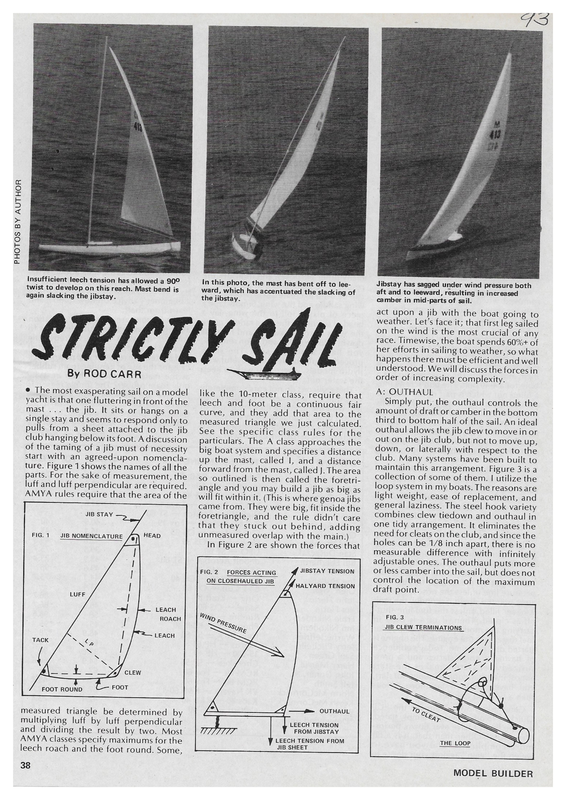
PHOTOS BY AUTHOR Insufficient leech tension has allowed a 90° twist to develop on this reach. Mast bend is again slacking the jibstay. In this photo, the mast has bent off to leeward, which has accentuated the slacking of the jibstay. STRICTLYSA By ROO CARR @ The most exasperating sail on a model yacht is that one fluttering in front of the like the 10-meter class, require that leech and foot be a continuous fair mast … the jib. It sits or hangs on a single stay and seems to respond only to curve, and they add that area to the measured triangle we just calculated. See the specific class rules for the particulars. The A class approaches the pulls from a sheet attached to the jib club hanging below its foot. A discussion of the taming of a jib must of necessity big boat system and specifies a distance start with an agreed-upon nomenclature. Figure 1 shows the names of all the parts. For the sake of measurement, the up the mast, called 1, and a distance forward from the mast, called J. The area so outlined is then called the foretriangle and you may build a jib as big as will fit within it. (This is where genoa jibs came from. They were big, fit inside the luff and luff perpendicular are required. AMYA rules require that the area of the [ JIB STAY FIG. 1 JIB NOMENCLATURE foretriangle, and the rule didn’t care that they stuck out behind, adding unmeasured overlap with the main.) In Figure 2 are shown the forces that HEAD FIG. 2 FORCES ACTING JIBSTAY TENSION ON CLOSEHAULED JIB HALYARD TENSION Wipy SRESSUp Jibstay has sagged under wind pressure both aft and to leeward, resulting in increased camber in mid-parts of sail. act upon a jib with the boat going to weather. Let’s face it; that first leg sailed on the wind is the most crucial of any race. Timewise, the boat spends 60%+ of her efforts in sailing to weather, so what happens there must be efficient and well understood. We will discuss the forces in order of increasing complexity. A: OUTHAUL Simply put, the outhaul controls the amount of draft or camber in the bottom third to bottom half of the sail. An ideal outhaul allows the jib clew to move in or out on the jib club, but not to move up, down, or laterally with respect to the club. Many systems have been built to maintain this arrangement. Figure 3 is a collection of some of them. | utilize the loop system in my boats. The reasons are light weight, ease of replacement, and general laziness. The steel hook variety combines clew tiedown and outhaul in one tidy arrangement. It eliminates the need for cleats on the club, and since the holes can be 1/8 inch apart, there is no measurable difference with infinitely adjustable ones. The outhaul puts more or less camber into the sail, but does not control the location of the maximum draft point. FIG. 3 JIB CLEW TERMINATIONS & FOOT ROUND measured triangle be determined by multiplying luff by luff perpendicular and dividing the result by two. Most. AMYA classes specify maximums for the leech roach and the foot round. Some, 38 e ——B OUTHAUL LEECH TENSION FROM JIBSTAY LEECH TENSION FROM L JIB SHEET THE LOOP ea | MODEL BUILDER
the high speed flow of air required for top boat speed. Here is a reason for saving all your momentum in the tacks. For top boat speed, the maximum camber of the sail should be at 40-45% of the way aft on the sail. This sail does not accelerate as well as one with the draft significantly farther forward. To allow maximum boat speed, you are taking a bit of a loss in tacking and mark rounding acceleration based on thesail set you have chosen. Tacking carefully is good advice anywhere on the course, and | don’t mean to make a federal case of it here. C: SHEET TENSION The geometry of a center-sheeted jib club deserves study. Figure 4 shows the situation on a typical model. You are looking forward toward the bow. On the centerline of the boat is the jib club swivel. The jib club is seen somewhat foreshortened as if on starboard tack. STEEL HOOK preponderance of wind pressure is horizontal, working across the lens, asshown in Figure 5. When the boat heels, the lens tips, but the wind direction stays the same. If the puff is hard enough, it will overpower the leech tension derived from the jibstay. When this happens, the clew can lift to a position like Ci even before the boat heels. This shows how much we are at the mercy of the balance of swivel offset and jibstay tension. While heeled, the wind pressure can take the jib club to a position C1, instead of C. What has happened to the leech of the jib? It has been slacked, and has twisted off. This has reduced the ability of the sail to hold the bow of the boat off the wind, and under the influence of the mains’l, the boat swoops to weather. | <—<————_— JIB STAY AXIS OF ROTATION WIND FORCE WIND FORCE FIG.5 fe WIRE TRACK B: HALYARD The halyard adjustment puts tension into the luff of the sail, right into the jcloth itself. Since the tension is on the bias, or at an angle to the sailcloth /threads, a deformation can set in which results in the migration of extra cloth in the body of the sail toward the luff. As ' the wind increases, the sail becomes too full, and the point of maximum draft moves aft with disastrous results. The draft is pulled forward by tightening the halyard. But be careful; if you pull too tight you will create a crease just behind the luff that will ruin the performance of the sail. And if you pull harder than that, you will overstretch the cloth and require a new sail, much to the joy of . your sailmaker’s banker. Remember, if the wind lightens you must slack the halyard. What you might think are nervous habits between races, may in fact be the winning skippers continually adjusting their boats to maximize performance in the prevailing conditions. A halyard left too tight makes the draft near the luff, the sail accelerates well, but cannot maintain MARCH 1979 FIG. 4 JIB CLUB “LENS” | The clew end is marked with a C, swivel point with an S, and the tack or forward end with a T. Notice that the jibstay has been carried off the centerline of the boat in an amount proportional to the amount of offset. (Offset is the distance from the swivel to the tack end of the jib club.) The jib, jib club, and associated rigging actually rotate about an imaginary line which connects the swivel top with the point where the jibstay inter- sects the mast. Based purely on geometry, the sheet attachment point on the jib club can move anywhere below the arc labeled M-N, constrained only by the sheet. Now, assuming the jib leech does not stretch (and I’m the first to admit it will), that same sheet attachment point on the club could move anywhere above the arc O-P, as the sail swings port-starboard. Operating both systems together, we get a lens-shaped area that is an allowable location for the sheet attachment point when close hauled. The system is symmetrical in that on either tack, the club generally tries to get into one of the two outboard corners of the lens: Now, everything is OK as long as the boat is not drastically heeled, which is another way of saying that the MOVEMENT OF JIBCLUB UNDER HEEL SLACKS JIB LEECH Now, I’ve gone all the way with this, not to get you to throw out your center sheeting systems but to explain the common behavior seen in gusty weather. On a boat, when the skipper does not anticipate the arrival of a gust by feathering up into it, we see those swoops to weather all the time. The simplicity and reliability of center sheeting systems make them the overwhelming favorite. But to maximize the efficiency of your boat, you must know why she acts like she does. At a later date, I'll provide the -drawings for a traveler sheeting system and show the advantages of that system, if you can stand the weight and complexity. It does introduce a number of things to fiddle with, which for some people, is the name of the game. The final point that is important regards the effects of shortening the sheet and what happens to leech tension. In the case of the center sheeting system, it responds to a shortening of sheet by pulling in as well as down on the jib leech. The result is a choked-off slot, a starving of the sail plan, and a usual drop in boat speed. Just the opposite occurs when the sheet is slacked, the tension lessens on the leech, the crew lifts, the sail twists and reduces the drive obtainable. Same result, a drop in boat speed!!! The natural question is, how did you know you had the jib in the right place before we started fiddling with it? The answer is that you don’t. The only way to tell is by pair sailing, with a buddy, making small adjustments, switching boats and so on as |’ve described before. While | don’t Continued on page 84 39
recommend practicing during the mid- dle of a regatta, you do have a good batch of boats against which to judge your speed, so utilize them as benchmarks and make adjustments between heats. D: JIBSTAY TENSION Here | am referring to tension in the jibstay, not on thesail perse. The tension in the jibstay determines how nearly straight the stay will remain when sideloaded by the wind blowing on the sail. The photographs show an experimental 50/800 rig built by John Smith, of my local club. He admittedly used a mast with too much flexibility, but for our purposes that was fine. In the shot with the boat on starboard tack coming toward us, the sag in the jibstay is responsible for the extraordinar fully ness seen in the area of the numerals in the upper half of the sail. He was using a masthead attachment for both jibstay and backstay. The spar was so limber that it could bend out of column, and as it became functionally shorter, the jibstay got loose and floppy. The lack of tension in the head stay has caused the incredible twist in the broadside view on the starboard beam reach. The angle between the jib club and the chord in the head of the sail is almost 90°. In a previous column, we discussed sail twist and came to the conclusion that something between 10 and 12° was about right for us and our small vessels. Note also that the jib sheet attaches midway down the club, instead of directly under the clew as it should. Asa result, the jib sheet is not contributing as much as it could to holding the clew down and preventing twist. It is the jibstay tension that is levered at the jib swivel fulcrum and turned into a downward force on the leech. The amount of force applied there is equal to the ratio of the arm lengths multiplied by the tension in the stay. For example, with 5 pounds tension on the stay, anda 2-inch offset on a 14-inch jib club, we have: 5 pounds x 2/(14- 2) =0.83 pounds. To tension the leech, it is obvious that moving the swivel is preferred to overtensioning the jibstay. The tension the stay carries has in influence on mast shape and the mains’l, so must be looked at carefully. (That is, unless you throw the mains’! away, like John did!) Jibstay sag also manifests itself in ruining the shape of your jib. Figure 6 shows the increased camber, the movement aft of the point of maximum draft, and the tendency of a sail sitting on a Sagging stay to backwind the mains’ behind it. The exhaust angle is the direction that the air leaving the leech JIBSTAY SAG / MAX DRAFT | i MAX DRAFT sy FIG. 6 JIBSTAY SAG, CAMBER CHANGE, EXHAUST ANGLE CHANG E takes. As you can see from the figure, the saggy sail will exhaust its air right back onto the mains’ luff, and will be choking the slot in doing so. Well, as you can see, your jib is not a simple animal. However, if you want your boat to sail well, you’ll have to roll up your sleeves and tame it. | would be happy to discuss further details of jibs if | get any questions from you. | Remember to renew your AMYA dues, which are now $10.00 and should be sent to Dick Hein, AMYA Treasurer, 1884 Campus Court, Rochester, Michigan 48063. | am still answering questions at the “same old shop, 7608 Gresham St., Spring- field, VA 22151. | have to ask for a selfaddressed, business-size envelope or I'll go broke. Often the answers are already: contained in previous columns that I’ve written, or are scattered through two or three columns. In such a case, a couple of stamps on your envelope will guarantee that you get just about everything that | can stuff in the envelope. @