- Strictly Sail. By Rod Carr
- This issue focuses heavily on the technical setup and community news surrounding radio-controlled (R/C) model boating and car racing. It provides detailed instructions on mounting deck hardware and calculating boom radius points for the “Yankee” Marblehead-class model sailboat, alongside performance and hydrodynamic data such as center of buoyancy and prismatic coefficients. Additionally, the text includes a critique of an R/C auto expert road race—advocating for a standardized limited carburetor class to save hobbyists time and money—and features an open letter protesting the Academy of Model Aeronautics’ (AMA) decision to launch an official magazine without open member discourse.

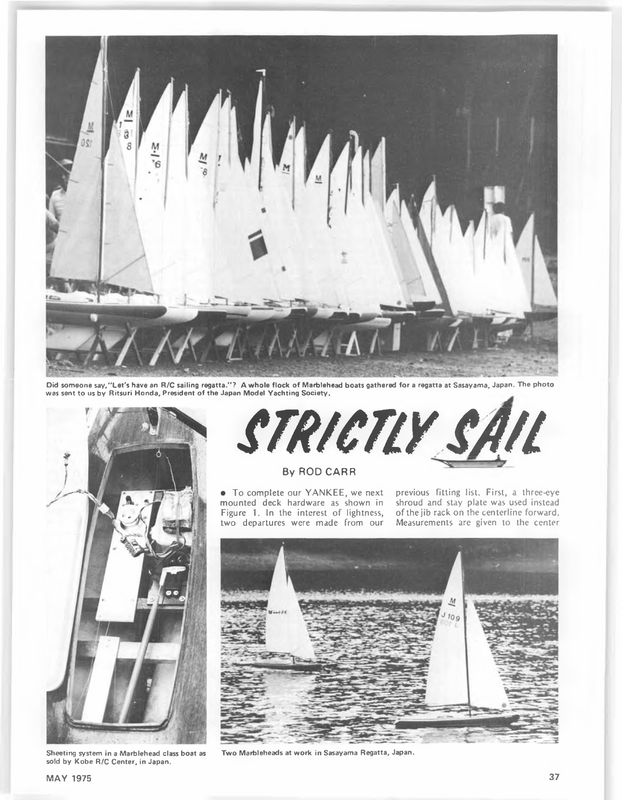
ee < ee . bn — vr - vw : * - * - — - : soon t = - - aa — {wT} \ Pee, te. ~~ A>. >. = ;_ ——_ Did someone say, “Let’s have an R/C sailing regatta.””? A whole flock of Marblehead boats gathered for a regatta at Sasayama, Japan. The phota was sent to us by Ritsuri Honda, President of the Japan Model Yachting Society. Ve STRICTLY § – – Seely By ROD CARR @ To complete our YANKEE, we next mounted deck hardware as shown in Figure 1. In the interest of lightness, two departures were made from our Sheeting system in a Marblehead class boat as previous fitting list. First, a three-eye shroud and stay plate was used instead of the jib rack on the centerline forward. Measurements are given to the center Two Marbleheads at work in Sasayarna Regatta, Japan. sold by Kobe R/C Center, in Japan. MAY 1975 37
Figure 1 33-1/4″ = Note: Not to scale vena 3| eu t ts j] =” _— – ——— 7 JBR ae > MBR > loop of the stay plate. Secondly, a proper sized hole was drilled into the foot of the winch arm). Drop vertically down- the mast and a 6-32 bolt with the head axis and read off the amount of jib or main boom radius that you need removed was epoxied in the hole with about 3/16 inch protruding. After it cured, the threads were filed off, and the diameter of the stub measured. Then a 4 inch long brass plate was drilled to accept the stub as well as two flat head screws for mounting to the deck. (See Figure 2). Also, an aluminum chunk was shaped as in the figure to serve as the lower anchor for the main boom vang. Mounting of the sheet exit guides poses some special problems. For a complete discussion of the winch/winch arm/ sheet exit guide/boom attachment tech- ward at that point This will prevent it from snagging other boat’s “close rigging when maneuvering in quarters.” You can also easily change the close-hauled position of the sails by adjusting the cleated end without opening the boat to get to the bowsers we put on the other end of the sheets, You can also put another screw eye into the main boom, about 4 inches out from the gooseneck, for the vang to pass through. A second cleat will go on the underside of the boom for securing the vang. A discussion of the role of the vang in mainsail control will be found to the horizontal (10-1/2″). From the point where the main boom swivels (the gooseneck) measure out the MBR (main boom radius) distance and put a small screw eye under the boom to receive the main sheet. In a like manner, measure from the jib swivel out JBR distance and put a screw eye under the club to receive the jib sheet. Directly under these positions on the centerline of the deck is the preferred location for the sheet exit guides. You can simply measure from the points indicated on Figure 1 to locate your sheet exit guides. in the Sept/Oct. 1974 issue of MODEL BUILDER. Figure 4 shows the basic dimensions for the mast and rigging. The permissible Bob Remember, you need to know how location ofthe jib stay attachment point Harris has available a monograph. Write to him at 7628 Dunston St., Springfield, Va. 22151. A stamped, self-addressed many degrees your sail control unit arm on the mast is given in the AMYA rules swivels, and you need to know the length of the radius of the arms of the SCU. as 80% of the height of the main head- envelope is suggested. Here, we will ab- Then, enter the graph to find out where Stract from his treatment to specifically cover our current installation. We have set up the Little Hercules winch in the the boom attachment-points are for the nique, intrepid AMYA President prototype YANKEE to rotate 120° between the close-hauled and running-free positions. We also know that we wish both jib club and main boom to rotate about 85° between close-hauled and running-free. Additionally, we can mea- sure the arm length which will fit easily inside the YANKEE, and discover that the radius of the winch arm which we can work with is about 4-1/8 inches. Now, using the graphic calculator in Figure 3, we can enter the vertical axis with 4-1/8 (the length of the double purchase winch arm). Proceed horizon- tally to the right until we intercept the line labeled 120° (the angular swing of | inches above the deck … 80% of that is 50.8 inches, but we dropped to 49.5 inches just to insure that a measurer would be easily satisfied. We used the jenny rack arrangement to support the sheets, as well as where to put the sheet exit guides. Attachment of the sheets to the booms is easily accomplished by cleating the free end to a cleat after it has passed through the eye we previously fixed to each boom. Put the cleat about halfway down toward the gooseneck or swivel, and put tt on the underside of the boom. jib head, however, remember that nothing which holds up the jib can extend beyond that 80% location. One wag has suggested that the test of legality in such a case is to cut the offending cable or Figure 3 6 tee 6 printed with pe of Robert Harris) bt z — $ 4 = 2 3 2° 3 Figure 2 board bottom. On the prototype, we ended up with the main headboard 63.5 ci « — = E < a z — = me |---->—-3 Ee = — ila dD sf Pag ay Bye 5 Pn Ws 3″ 9″ rh 10″ A Ww eb 12″ ee Pe ee Ey 13″ 14″ Jib/Main Boom Radius 38 MODEL BUILDER
Figure 4 J ; t 4 ie O headboard r> | Ly 63.5″ — Bottom of 1/2” Fin only 70 r-— Aa Yankee 7 le 1/2″ 5/8″ O Displacement BE vs. ey ws 3/4″ Must be less than | Figure 5 Displacement C4 For 50/800 Class \ 80% of headboard height, 50.8″ 60 — — Stock Yankee /\ Jd. / | i a | | k F A / 7 H Boomerang / Boomer 3i 50 | —— —— a h g 27″ Soling 3 To deck 40 ——_;—— ee — | oe se ‘ oe Warrior tl 4″ e strut, and if the jib falls down the piece cut was illegal!! The jenny stays pass through arms of the jenny rack, but they are free to slide in the struts, and are not contributing to holding up the jib. The jenny rack was described more completely in the December 1974 MODEL BUILDER. be) some of the gathered technical data about the hull would be of interest to the budding naval architects among us. Prismatic Coefficient, Cy = 0.52 Wetted Surface: As built stock, 574 sq. in. Bulb 4 Ib., 5 tn. fin, 479 sq. in. 3 Ib. lead in 5 in. fin only, 442 sq. in. Center of Effort of Sail plan: On main luff, 22 inches above the deck. The mast cross sections shown on Figure 4 seem to be a good compromise between strength and lightness. In our case, the mast was originally slotted, but the slot was filled in with a pine sliver and some epoxy, then the mast was turned around and a line of round- Lead: Sail plan Center of Effort is 2.5 inches forward of Center of Lateral Resistance of hull underbody. Center of Lateral Resistance: head wood screws put in. A wire was tensioned in the lined up stots of the screws and soldered in place, becoming a “jackline.” Our mainsail luff was 27-3/16 inches aft of bow. Center of Buoyancy: 27.37 inches aft of bow, which undergoes an aftward movement treated to a series of dress hooks placed on alternate sides and now swivels nicely on its jackline when reaching. of about 5/8 inch when heeled 20°, Trim ballasting for sailing should be done with the winch batteries. Don’t put any more weight aboard her than necessary in order that the acceleration of the boat remain at its potentially high level. We’ll have continuing comments about our YANKEE this season as we shake her down into competition trim. All trim and tuning discoveries will be passed right along to you. We spent a morning with the lines from the YANKEE and thought that MAY 1975 12 Wetted surface change with heel: Only about 40 sq. in. decrease with a 20 angle of heel. This is contrary to one’s guess when looking at the hull. Finally, | plotted the displacement of popular 50/800 class models against the sail area/displacement ratio (Fig. 5). This ratio is telling us how many square inches of sail area are pushing each pound of boat weight. Sort of a power factor. While this plot tells us nothing 16 18 Displacement (pounds) 20 22 24 about top speeds, nor any of the other myriad factors which affect total boat performance, it does give us a good idea of acceleration potential. It is acceleration which will separate boats in a tack- ing duel, or in close work around buoys. It also will rank boats in the order in which we would expect them to begin planing. This plot does not tell us any more than that a Warrior II has about 36 square inches of sail pushing each pound, while a Yankee has about 57 or so square inches pushing each of its pounds. Tis food for thought. Our long awaited launching was completely uneventful. I’m happy to say that the boat floated right on her design waterline and needed no shifting of ballast to obtain fore and aft trim. Winds were gusty, in the 10-15 knot range, and we did see the first stages of planing developing on the reaches, but were more concerned with windward performance. The entire boat stayed dry as a bone, showing the benefits of preplanning the installation by utilizing ideas seen on previous vessels. April 27th will see her in the first out-of-town regatta, so we should have some relative comments on performance after that time. Jim Gale, of J. G. Products, was nice enough to send us the latest version of his radial jib fitting. We can’t resist swapContinued on page 75 39
above 144MHZ (the details of this are not clear at this time). Although six meter operation would not be permitted, it is possible that R/C flying might be permitted on either 144MHZ (two meter band) or the 220MHZ band, This would certainly give us the much needed relief that our AMA Frequency Com- mittee has been Jooking for. Passing a simple VHF theory test would be well worth it. Something to think about! At any rate please write. If you don’t take an interest now, don’t complain about what you lost in a couple of years. ® R/C Auto …. Continued from page 51 the main. He did a lot of racing and overcame many problems to earnhis win. As expected, Kyes and Campbell jumped out at the start of the Expert main. | got through some traffic after Turn One, and was third or fourth. There was lots of racing and not too many tangles during the first part of the race. At 17 laps, everybody started pitting. | planned to stop at lap 21 and 41 for the 60 lap race, so | went into the lead. At lap 21 | had a clear field ahead and continued, since there was no indication of low fuel. | got in and out at lap 22, ahead of the leaders. Later | learned | + t * —” 70″ SANTA BAR » . ‘ Kyes had broken a front steering cross- On lap 41, | heard the announcement, “9 laps to go,” so | came in and fueled and got back out. Now | had a 2 Jap lead, so I just motored around. Campbell did a series of cart wheels next to me and went over the wall on the back straight. It turned out his battery had been dragging on the ground, causing all sorts of problems. Bill Jianas was behind me so | told him to pass. Jianas said, “‘No way.” | couldn’t figure that out ‘cause I know how Bil! drives … but then | found out he had second place sewed up and was also motoring to the finish! The race had been shortened to 50 laps because of darkness, but | was unaware of the change. It’s just as well, because | may have tried for one pit stop at 25 laps and been sorry. In the road cars, the one technical thing of interest was that about 4 or 5 cars had ‘‘rocker” power pods. Jack Garcia had a “rocker” car about 3 years ago. The general idea is to let the rear end, and engine, rock, so that you get better rear traction…But then the problem becomes, how to get front traction, The cars which had a rocker rear end, that | know of, belonged to Steve Betts, Al Olseen and myself. There are still little problems to work out to get them to work right. After the races, a bunch of the participants: drivers, officials, helpers, and observers, stopped off at a local pizza house to conclude the weekend of racMAY 1975 i . f 210 EAST ORTEGA ST. SANTA BARBARA, CA 93101 ing. Everybody really appreciated the fireplace and all congregated in that area to guzzle and munch. A lot of the excit- ing, Outstanding, and funny things were rehashed. One group got into a discussion concerning how much time and money it takes to be competitive. Time seems to be more important than money. If a guy gets the best equipment today, and is good, he’ll still be out of it next year. He has to spend all kinds of time to do those little things to get the car to handle the increased power that always seems to keep coming. That’s really the only reason that car designs change. | still feel that a limited carburetor and fuel class is the way to provide a more uniform class for competitors who have a limited amount of TIME as well money (TOOT-TOOT, that’s my horn blowing again). If a fellow builds a limited class car today, it will still be competitive next year. Changes to the chassis and engine will not have to be made continually, which costs lots of time and money. Then the competitor will not have to be super-active all the time to be in the race. We’ll start seeing again some of those faces we remember who had to drop out of competition because they didn’t have the time to be away from their families, work, etc. for weeks to get ready for a big race. So the proposed class, rules might be: limited carburetor bore (.156 in. dia. db ~— «f/feoe with his car and | had to drive around him at the last corner as he spun out. Bob Donkels wasn’t so fortunate, because he had a strong third place near the end, but went out when he hit Campbell during another spin out. ie Sv om arm bolt after his first pit stop. Campbell seemed to be having problems – * hy. See youn habe, retailer > to start); and 10% nitro. No other air bleeds to the engine would be allowed, such as free porting, where the piston opens the exhaust port, or other ports, when the piston is near TDC. It may be required to tech inspect the top finishers in the final race, but this would guarantee the honest guys that they weren’t being cheated (I’ll volunteer for the post race tech inspection, or a committee can be appointed). Fuel for the Nats heats and finals would be provided. In local races, fuel (K&B 1000, Eagle 1200 or equivalent) could be provided with a slightly increased entry fee. Well, that’s it for now. See you in two months. I’m taking the big step in a couple of weeks and | won’t have time to write an article (or so my future wife says). e Sailing…… Continued from page 39 ping it onto the YANKEE to see just what effect it will have on pointing ability. I’ll have a performance report at a later date, but can say now that I’ve held the fitting in my hand and that if it works as nicely as it is constructed, it will rate the 5 star treatment in our book. You can obtain information on the item from J. G. Products, 8030 Fordham Road, Los Angeles, CA. 90045. While we are passing out kudos, we’d like to send one out to Ron Menet, editor of the MASTHEAD, a monthly newsletter of the El Dorado Yacht Club. WHEN CONTACTING ADVERTISERS, TELL ‘EM MODEL BUILDER SENT YOU! 75
A FINE “The first event was that of a poll being taken to determine interest in a LINE permanent OF PRECISION PRODUCTS FOR RADIO CONTROL and nationals | don’t subscribe to the Competition News. | am, however, a sometime com- BOATS petitor and president of my club, The West Jersey Radio Flyers. | am also an active Contest Director. Since you didn’t ask me, | vote ‘no’ until aff the members of the A.M.A. have been presented with aff the facts regarding the proposed pur- chase. “The second event was the rather MARINE 4SPEC/ALTIES bh limited (to say the least) forum provided academy members to ask questions of the A.M.A. at the special District II meeting at the WRAMS show on Mar. 2. “f CUSTOM MODEL “Just so you don’t think I’m venting BOATING HARDWARE PO Box 588 Saratoga Ca 95070 send for catalog – 50¢ headquarters site at Hutchinson, Kansas. | was not asked to participate in the poll because dealer inquires invited my spleen on you and the Executive Council exclusively, Ell pass a salutory 21 Bronx cheer salute at those District II pyton flyers who, at the conclusion of their particular bit of business, rudely got up and left without so much as a wave bye-bye. (We concur with this heartily. It was an outstanding display of bad manners; the worst we have seen in all our years of modeling, wen) “Back to the business at hand. “LT learned from our new District II V.P., John Byrne, at Friday night’s cock- His two or three page effort every month is keeping us really up to date on happenings in the Los Angeles area. Having run a similar effort during ’69-’71, | can only sympathize with Ron, as it often turns into a one man operation. Nevertheless, it seems to reflect the seriousness with which the El Dorado Club is taking the challenges of new membership drives and so forth. If your club is lagging, or even if it has new members to burn, there is nothing like a club newsletter to keep al! hands up on what’s happening. Ron’s effort is professional, and will benefit his fellow club members greatly, he’s at: 12246 Yearling Place, Cerritos, CA. 90701. Another new effort is being handled by Bob and Sue Crysler, Box 32, Delray Beach, Florida 33444. Their WATERLINES ts coming out on a monthly basis and concerns itself with the activities of the Florida skippers who we northerners all envy. A new sailing club, called the Avenue, Brookfield, Il. 60513 will get the Quarterly Newsletter, shoulder patch, rules and regulations, and most of all, a direct connection with the fastest growing head-to-head competition sport in the country. In upcoming months we will address ourselves to the whole problem of sail control units. We’ll take a Jook at that sailmakers dream . . . the spinnaker. And we’ll interview the 1975 AMYA president, Bob Harris, to find out what the view looks tike from the top of the heap. Keep those cards and letters coming, in care of MODEL BUILDER, or direct to 7607 Gresham St., Springfield, VA. 22151. e Workbench… Continued from page 4 en a good deal of its pages to discuss the technical aspects of the sport. This is something that will certainly attract the stands? Aren’t most of them available only to members? AMA says that, “MA is budgeted for 80 pages with minimal advertising, but if advertising support is greater, AMA members will benefit by having an improved magazine and staving off a dues increase.”’ Does this mean that if the advertising support is mof greater than minumum, that the dues will have to go up to support the magazine? And now the open letter to John Worth from Dave Meier. newer skippers just getting into yachting. “Dear Mr. Worth, Remember to get your dues into AMYA. Five dollars sent to the Secretary, Bud Salika at 3917 Sunnyside “It is seldom that I write letters of this nature. [t is also seldom that events rile me up enough to do so. Gold Coast R/C Model Mariners, has sprouted under their care and feeding and is applying to AMYA for official sanction. WATERLINES is not only presenting news and schedules, but has tak- 76 tail party that the Executive Council planned to publish an A.M.A. magazine. Correction: Not only planned, but had gone right ahead to do it, apparently hiring an editor, one William Winter, who 1 recall as being at the head of several now defunct publications. “To refresh your memory, sir, | am the one who stood up and protested this action at the WRAMS show. “It is now several days later. I’ve thought it over carefully, and discussed it with about sixty A.M.A. members so far. Hf anything, | now protest even louder. “First, and possibly most important, a government that sets its own editorial policy gets the ability to tell those who are governed pretty much what it wants, when it wants, without all that fuss and bother of presenting dissenting opinions, unless it wants to. The amount of dissenting opinions presented is probably inversely proportional to the amount received. “Second, the competitive atmosphere is rather cloudy. ‘There are four existing model aircraft publications. Three more, not including yours, are planned. Two model aircraft publications have recently failed. ! don’t think the modeling public is clamoring for the three new publications, let alone yours. “Let’s say though, that in the next few months, we are treated to eight model aircraft publications. Here is what | see happening: 1. Subscription sales wil! fall off for the existing magazines. Sales for the new WHEN CONTACTING ADVERTISERS, TELL EM MODEL BUILDER SENT YOU! MODEL BUILDER