- Title. Author. Summary

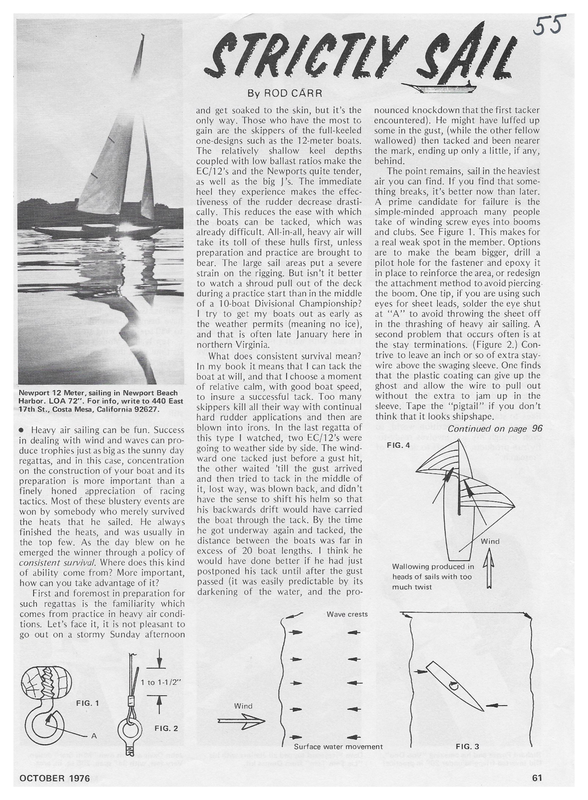
By ROD CARR and get soaked to the skin, but it’s the only way. Those who have the most to gain are the skippers of the full-keeled one-designs such as the 12-meter boats. The relatively shallow keel depths coupled with low ballast ratios make the EC/12’s and the Newports quite tender, as well as the big J’s. The immediate heel they experience makes the effectiveness of the rudder decrease drastically. This reduces the ease with which the boats can be tacked, which was already difficult. All-in-all, heavy air will take its toll of these hulls first, unless preparation and practice are brought to bear. The large sail areas put a severe strain on the rigging. But isn’t it better to watch a shroud pull out of the deck during a practice start than in the middle of a 10-boat Divisional Championship? | try to get my boats out as early as the weather permits (meaning no ice), and that is often late January here in northern Virginia. Newport 12 Meter, sailing in Newport Beach Harbor. LOA 72”. For info, write to 440 East 17th St., Costa Mesa, California 92627. @ Heavy air sailing can be fun. Success in dealing with wind and waves can produce trophies just as big as the sunny day regattas, and in this case, concentration on the construction of your boat and its preparation is more important than a finely honed appreciation of racing tactics. Most of these blustery events are won by somebody who merely survived the heats that he sailed. He always finished the heats, and was usually in the top few. As the day blew on he emerged the winner through a policy of consistent survival. Where does this kind of ability come from? More important, how can you take advantage of it? First and foremost in preparation for such regattas is the familiarity which What does consistent survival mean? In my book it means that | can tack the boat at will, and that | choose a moment of relative calm, with good boat speed, to insure a successful tack. Too many skippers kill all their way with continual hard rudder applications and then are ens A Wind << > —- > a = —_- = =g- for failure is the at “‘A’”’ to avoid throwing the sheet off in the thrashing of heavy air sailing. A second problem that occurs often is at the stay terminations. (Figure 2.) Con- trive to leave an inch or so of extra staywire above the swaging sleeve. One finds that the plastic coating can give up the ghost and allow the wire to pull out without the extra to jam up in the sleeve. Tape the “‘pigtail” if you don’t think that it looks shipshape. Continued on page 96 FIG. 4 Wind Wallowing produced in heads of sails with too much twist e, ~~ —> Surface water movement OCTOBER 1976 candidate eyes for sheet leads, solder the eye shut ‘Wave crests >_> prime simple-minded approach many people take of winding screw eyes into booms and clubs. See Figure 1. This makes for a real weak spot in the member. Options are to make the beam bigger, drill a pilot hole for the fastener and epoxy it in place to reinforce the area, or redesign the attachment method to avoid piercingthe boom. One tip, if you are using such darkening of the water, and the pro- 1 to 1-1/2″ FIG. 2 A passed (it was easily predictable by its ee f the mark, ending up only a little, if any, behind. The point remains, sail in the heaviest air you can find. If you find that something breaks, it’s better now than later. going to weather side by side. The windward one tacked just before a gust hit, the other waited ’till the gust arrived and then tried to tack in the middle of it, lost way, was blown back, and didn’t have the sense to shift his helm so that his backwards drift would have carried the boat through the tack. By the time he got underway again and tacked, the distance between the boats was far in excess of 20 boat lengths. | think he would have done better if he had just postponed his tack until after the gust tions. Let’s face it, it is not pleasant to go out on a stormy Sunday afternoon a encountered). He might have luffed up some in the gust, (while the other fellow wallowed) then tacked and been nearer blown into irons. In the last regatta of this type | watched, two EC/12’s were comes from practice in heavy air condi- FIG. 1 nounced knockdown that the first tacker FIG. 3 61
Sailing…… Continued from page 67 and it is speed that will allow you to So here we are at a regatta that was 78° and 8 knots last year, but the wea- going to weather. 1) Ease the traveler . . . will reduce the boat. heel. dency of the boat, and be awake to the slewing effect that you experience when you go down the frontside of a wave. The water at the crest is going with you, and the water in the trough is coming in ther man has sent 45° and 22-25 knots for this edition. Look over at your com- petition. First of all, there is his boat sitting up on the cradle, waiting for a knockdown with a wind shift, and flogging its sails to beat the band. You have your boat lying down, sails almost hori- zontal, and have built a wall of toolboxes around your rudder so that nobody will step on it. He picks his boat up and heads for the water, almost getting blown over in the process, while you keep the bow to the wind and get a crew member to carry your transmitter, knowing you’ll have your hands full with the boat. If the opponent gets waterborne, you can watch him blowing tack after tack, gyrating wildly downwind and in general moaning about what he could be doing instead if he had stayed at home… Consistent survival? Not that turkey!!! You have had the experience necessary to know what to do to ready the boat for these winds, not only know, but have done them. You are prepared with foul weather gear, boots and warm socks, a plastic rain bag for your transmitter, a wide brimmed hat to keep rain drops off of your glasses, and one of Harris Engineering’s waterproof switches so you don’t have to take a hatch off unless you are changing battery packs. Your check list has _ included: 1) New sheets. 2) All fittings checked and oiled, including all staywire. 3) All batteries and ballast tied down tight in the boat, 90° heel will not move anything. 4) Maximum _ obtainable _— watertight integrity, all hatches taped shut no matter how they were built. 5) Plenty of spare battery packs, larger receiver packs … you’ll need more rudder servo power, and the extra weight will be a blessing. 6) You may have storm sails up. . . check with your sailmaker. | recommend 3 oz. cloth, maintain the original foot dimensions and reduce the amount of roach and luff heights. My 50/800 sails like a banshee with 650 square inches when it’s piping up. |’ve had her out in 35 knot gusts and she survives quite nicely. One-design classes will benefit from an overall 15% reduction in area, where a real improvement in performance will appear. Now let’s go around the course and see what we can do to make some adjustments to the rig and boat for heavy air. BEATING This is probably the most important ! make sure tacks. Here is a set-up list for 2) Bend the mast back with backstay tension to release the leech of the mains’! and allow some twist to develop. This will allow the head of the main to start to luff early and reduce heel. 3) Tighten the main luff halyard or downhaul. As the wind increases, the draft in the -sail is blown aft. This increases weather helm by cupping the aft half of the sail, a definite no-no. ishes. Weather helm will slow you down, the 1) Goosewing 2) Anticipate sails the to balance broaching ten- reverse (take my word for it). The result is two forces acting to yaw the boat around if you don’t counteract. (Fig- ure 3.) 3) As a general rule, don’t let the boom or club go all the way out to hard Tightening the luff will pull the draft forward. (Remember to slack it off for abeam (90°). The reason is in the twist produce. very least, will start a wild rolling that will scare the daylights out of anyone near you. Fig. 4. The vectors that you of the sails that we put there to help in sailing to weather. The twisted sail will allow a force to develop to weather of the main, can cause a broach, or at the storage.) 4) Flatten sail feet with outhauls. This will reduce the heel that the rig will 5) Devise a means of locking shroud turnbuckles so that vibration and tension will not let them loosen. | have used 2-56 nuts on the turnbuckle threads for locknuts, or surgical tubing to immobilize see in the tops of each sail are directed off of the axis of the boat. They will result in more yawing moments which will cause the hull to slew around. If this gets in step with the natural period of oscillation of the boat, or if they happen to push in conjunction with the wave/water couple shown in Fig- the barrels and prevent turning. 6) Adjust your jib traveler or sheet. On an EC/12, snugging it in to backwind the mains’! is good. On some 50/800’s, letting it out will reduce heel effectively without interfering with the main. Tuning trials with a partner will help tell you which to do. 7) Move ballast aft to keep the rud- der in the water, and to move the CLR aft, reducing weather helm. 8) Tightening the vang will help bow the mast forward and flatten the main- ure 3, the incredible. can be benefits of a port tacker who cannot sail, and will be related to the aspect yield to you on starboard tack. Make sure that the crossing situation is well ratio involved, taller sails requiring the softer vang setting. understood … yell, “STARBOARD,”’ with gusto . . . then when he can’t tack, 9) Keep jibstay tight, the increased you tack and make sure he gets the two points for failing to give you the rightof-way. Nasty, sure .. . but you were the one who has been standing out in the rain practicing . . . it ought to be backstay tension will help, and the jenny’s will need to be tuned to produce a smooth curve in the head of the mast. 10) Sailing to weather minimize the number of tacks. This is just good sense, worth something tangible. (Sounds /ike tacking is risky in heavy air, it takes time, and it loses ground if you miss one. Pick your spots and tack with authority. Dirty Dan has been talking to you, Rod. wen) In stormy starting sequences, | prefer to start late, and to weather of the fleet, in clear air. The interferences of wind A good rule to remember with regard to almost ail rigging adjustments is: “THE HARDER SHE BLOWS, THE TIGHTER IT GOES.” Except for sheets, this seems to hold quite well. REACHES 1) Adjust sail trim to minimize heel. 2) Keep the jib full to minimize the pressure on the rudder. 3) Luff the main if necessary to balance the boat. 4) Remember, “WHEN IN DOUBT, LET ’EM OUT.” A heeling hull with a its teeth only looks fast. The this will reduce speed and make man_euvering difficult. broach in this kind of weather can be fatal. You do have the opportunity to take the allowing some twist to develop in the bone in resulting GENERAL TACTICS The loss of vessel control that your opponents experience in heavy air can work to your advantage. In any case, give them a wide berth, since collisions sail. But this has to be balanced with leg to tune for. The requirement is for more nearly vertical you can keep the weather of n reductio a and heel reduced mast, the more sail power is going into helm and leeway. Heeling reduces the drive and the less into heel. amount of sail area which is producing 5) Avoid dragging boom in water as drive, and leeway becomes pronounced as the effective area of the keel dimin- RUNS — flow in a bunched fleet makes sure control difficult. Also, there is an inevitable crunching of boats in that bunch which | want to avoid. Keep clear of the pack. Arrival at the weather mark requires caution, if anyone has managed to keep up with you. Give the mark a wide berth, and remember that your opponent may not be in full control of his boat. It makes good sense to overstand the mark so that if you happen to get slowed by other boats, the leeway that you make will not carry you below the mark. It isa good practice to keep a weather eye up the course to see just what kind of wind is coming your way. This allows you to tack in relatively quiet air, it will help you to plan your buoy roundings, CANTINGED ON PAGE 57
CONTINUED FROM ?. Se and most important, it will give you a good indication of what is going to happen to your hapless opponent who is still muttering about the rotten weather. As | said before, keep boat speed up. The water velocity flowing past your rudder is what allows you to change direction. Help all you can with the sails. On the aforementioned keelboat Classes, the rudder is easily overpowered by the sailpan in heavy air, so a good strong winch and a quick thumb on the transmitter will serve you well. Let the sails and rudder work together, rather than fighting one with the other. And after the sun comes out on you as they hand you the trophy . . . just remember all those soggy hours of practice . . . see, heavy air sailing really is fun. Remember to send your dues into the AMERICAN MODEL YACHTING ASSOCIATION. The new Secretary is Bob Crysler, 2709 So. Federal Hwy, Del Ray Beach, Fla. 33444. The Quarterly Newsletter is easily the best value you can get for $5.00 ayear, here: or anywhere else. ¢/