- Title. Author. Summary

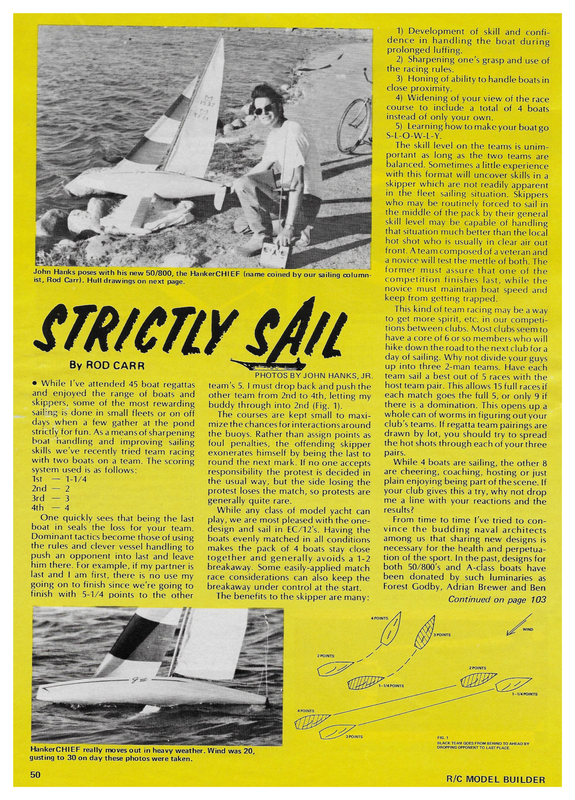
1) Development of skill and confi- dence in handling the boat during prolonged luffing. 2) Sharpening one’s grasp and use of the racing rules. 3) Honing of ability to handle boats in close proximity. 4) Widening of your view of the race course to include a total of 4 boats instead of only your own. 5) Learning how to make your boat go S-L-O-W-L-Y. The skill level on the teams is unimportant as long as the two teams are balanced. Sometimes a little experience Panay a is new 50/800, the HankerCHI EF (name coined by our sailing column- ist, Rod Carr). Hull drawings on next page. with this format will uncover skills in a skipper which are not readily apparent in the fleet sailing situation. Skippers who may be routinely forced to sail in the middle of the pack by their genera skill level may be capable of handling that situation much better than the loca hot shot who is usually in clear air out front. A team composed of a veteran and a novice will test the mettle of both. The former must assure that one of the competition finishes last, while the novice must maintain boat speed and keep from getting trapped. This kind of team racing may be a way to get more spirit, etc. in our competi- By ROD CARR e While I’ve attended 45 boat regattas and enjoyed the range of boats and skippers, some of the most rewarding sailing is done in small fleets or on off days when a few gather at the pond strictly for fun. As ameans of sharpening boat handling and improving sailing skills we’ve recently tried team racing with two boats on a team. The scoring system used is as follows: tt tions between clubs. Most clubs seem to have a core of 6 or so members who will hike down the road to the next club fora day of sailing. Why not divide your guys l-174 2nd — 2 3rd — 3 ig) = One quickly sees that being the last boat in seals the loss for your team. Dominant tactics become those of using the rules and clever vessel handling to push an opponent into last and leave him there. For example, if my partner is last and | am first, there is no use my going on to finish since we’re going to finish with 5-1/4 points to the other PHOTOS BY JOHN HANKS, JR. team’s 5. | must drop back and push the other team from 2nd to 4th, letting my buddy through into 2nd (Fig. 1). The courses are kept small to maximize the chances for interactions around the buoys. Rather than assign points as foul penalties, the offending skipper exonerates himself by being the last to round the next mark. If no one accepts responsibility the protest is decided in the usual way, but the side losing the protest loses the match, so protests are generally quite rare. While any class of model yacht can play, we are most pleased with the onedesign and sail in EC/12’s. Having the boats evenly matched in all conditions makes the pack of 4 boats stay close together and generally avoids a 1-2 breakaway. Some easily-applied match race considerations can also keep the breakaway under control at the start. The benefits to the skipper are many: 2POINTS Cz a up into three 2-man teams. Have each team sail a best out of 5 races with the host team pair. This allows 15 full races if each match goes the full 5, or only 9 if there is a domination. This opens up a whole can of worms in figuring out your club’s teams. If regatta team pairings are drawn by lot, you should try to spread the hot shots through each of your three pairs. While 4 boats are sailing, the other 8 are cheering, coaching, hosting or just plain enjoying being part of the scene. If your club gives this a try, why not drop me a line with your reactions and the results? From time to time I’ve tried to con- vince the budding naval architects among us that sharing new designs is necessary for the health and perpetuation of the sport. In the past, designs for both 50/800’s and A-class boats have been donated by such luminaries as Forest Godby, Adrian Brewer and Ben Continued on page 103 eh ie Ve 4 2 POINTS 1—1/4 POINTS 4 POINTS FIG. 1 Hanker CHIEF really moves out in heavy weather. Wind was 20, BLACK TEAM GOES FROM BEHIND TO AHEAD BY DROPPING OPPONENT TO LAST PLACE. gusting to 30 on day these photos were taken. 50 R/C MODEL BUILDER
13LONAUWS¢)IT OCTOBER 1979 FULL SIZE PLANS AVAILABLE — SEE PAGE 116 51
Sailing…… Continued from page 35 Hogensen. To this roster we may now add the name of John Hanks of Sparks, Nevada. John has provided the lines for a 50/800 boat in the modern configuration with a 9-inch beam and 14-1/4 |b. displacement. The design shows the double-ended theme so successful in the EPIC. The U-shaped sections are reminiscent of the WIND presented in Model Builder a few years ago. We also see the reduction in aft freeboard just seen in the BONE series. A 7-pound bulb is used on the prototype, as well as Futaba 3-channel R/C and a Vortex SC-3 winch. The mast on John’s boat is 5/8inch aluminum tubing. Standard BINGO rig is used. Skippers interested in further details or later developments of this design should contact John Hanks at 5185 Oetting Lane, Sparks, NV 89431. My hat’s off to John for this contribution to our sport and to R/C MB’s editor for making the plans available. This columnist is readying for a major relocation at this writing. We will be moving everything cross-country to Seattle, Washington, to take up a new job and set up the typewriter, sailcutting table and sewing machine. I’ll answer questions accompanied by a stamped, self-addressed envelope to Rod Carr, 4115 172nd Ave. N.E., Redmond, WA 98052. e SS S