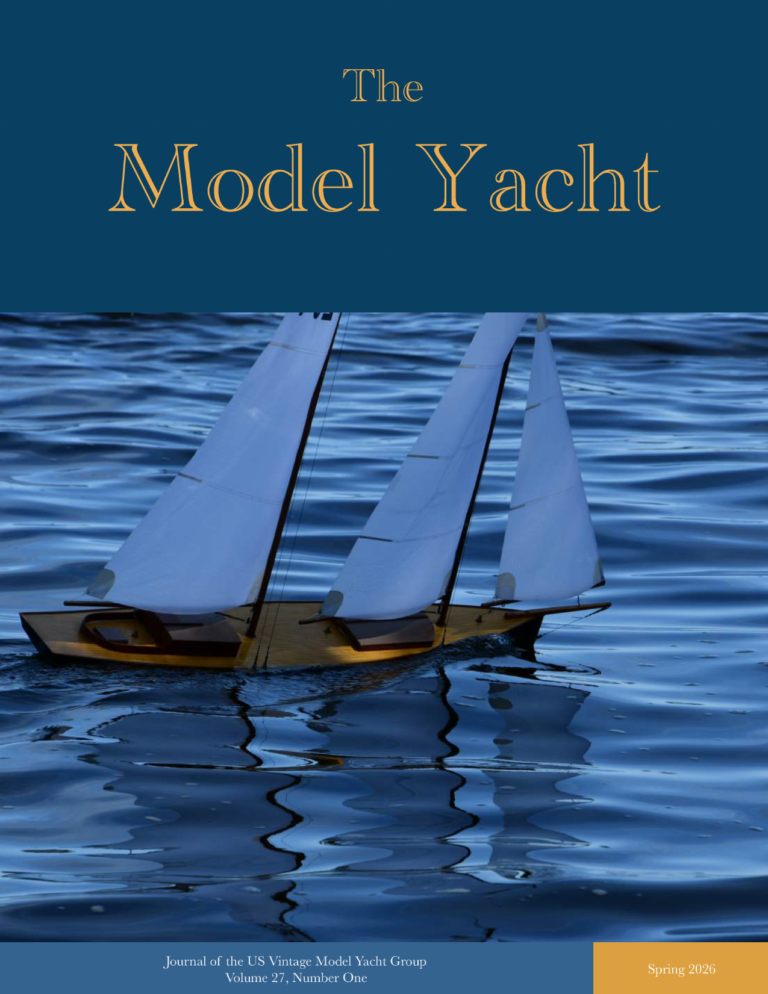
- Flamenco – A Double-Chine Marblehead Design
- Design Concept: Flamenco introduces a modern hard-chine hull for Marblehead class yachts, challenging past prejudice against “Kipper Box” designs. Hard chines now offer practical beauty and proven performance.
- Hull Features: Full midsection for displacement with minimal depth and beam; sharp keel entry for better windward efficiency; deep draught (12.5″) for stability and improved performance.
- Advantages: Easier and quicker to build than round-bilge boats, making it ideal for novices. Hard chine designs have shown success in full-size racing yachts like Bristol I and International 14-footers Yeti and Shdi.
- Specifications:
- L.O.A.: 50.25″
- Beam: 11.59″
- Draught: 12.5″
- Sail Area: 798 sq. in.
- Displacement: ~20.87 lbs
- Lead: 14 lbs
- Construction Note: Builders should follow plans precisely to maintain design integrity. Designer invites feedback on performance.

IMIGIO)EN IMIANKIE!R) this fact which made me decide, after having reasonable success with a 36 in. Restricted boat which won the national championships a few years back, and a 10 Rater that is doing very well in club races, handled by a very capable junior member, to make PLAMENGG available plans of 36 in. M, and 10 Rater yachts, with possibly a design to John Lewis’s new formula, which incidentally I believe will be a success. The sport needs a “no holds barred” development class. Turning to the design of Flamenco, which is the first in this series, it will be seen that she has been given a rather full midsection to contain the necessary displacement with the minimum of body depth and beam. The for’d sections are well veed and the after sections well flattened giving a deep chest and long flat run, which coupled with the low for’d overhang should prevent her nose from diving and help her on to the plane more easily. I think that provided this does not adversely effect hull balance, it is a good feature. In Flamenco it has been achieved with only a 0.04 in. movement of the C.B. aft when A DOUBLE-CHINE, DEEP DRAUGHT MARBLEHEAD By D. M. J. HOLLOM heeled to the gunwale. A rather deep draft of 123 in. has been chosen as I do not feel that the maximum draft has yet been reached in this class, and that future years will show an increase in this direc- |e past years there has been a great deal of prejudice emong both full size and model yacht sailors towards hard chine craft. They have, perhaps FLAMENCO aptly, been called “Kipper Boxes”, and many thought desired. that their performance left much to be e has been DESIGNED Recently, however, much of this prejudic ges swept away and some of their obvious advanta have come to the fore. Full size yachts have been produced that bear not the slightest resemblance to the “Kipper Boxes” of old, and which, in their own COPYRIGHT MODEL MAKER 38, CLARENDON ally way, can even be called beautiful; not tradition ity. beautiful, but having a beauty born of practical and time Their performance has been proved time again, some notable examples being the success of Bristol I in the “Round the Island Race”, and the brilliant racing records of the International 14 footers Yeti and Shdi, Yeti being described as un- doubtedly the fastest of her class in light to moder- ate winds, and the 2nd and 4th places attained by Shdi in the 1963 championships and P.O.W. cup respectively, speak for themselves. In the face of these facts I think that no model yachtsman should feel at a disadvantage if he desires to build and race a hard chine model, provided that the class of boat is kind to this type of yacht. the novice leaving the sport due aes in to =| results = One of his great advantages will be that he can build it quickly and easily. This type of boat should therefore appeal to the novice, who perhaps doesn’t think he is experienced enough to build a round bilge boat and therefore probably plumps for a second-hand boat, a situation which sometimes apparent lack of success. BY D.M.J. Hollom. His one snag will be in finding suitable plans, as to the best of my knowledge none, of modern design, exist that are available in published form. It was Full-size copies.of the drawing (right) are available, price 6/- including postage, from Model Maker Plans Service, 38 Clarendon Road, Watford, Herts. Note that the drawings show a full-size body plan but sheer and waterline plans are half size. 186 RD., OF PLANS WATFORD SERVICE HERTS.
APRIL tion. The advantages incurred by this deep draft are that given stability can be achieved with a lighter boat, and windward efficiency should also be improved due to the more advantageous LOCAL AUTHORITIES [Continued from page aspect has at least given us some general idea of how our sport is catered for at the Town Hall and how far we can go with our requests for facilities. Some of us may feel envious of the conditions enjoyed by other clubs, but I think we can be assured that generally local authorities are helpful when aware of the needs of a model power boat club. There are exceptions of course—my correspondence reveals that some clubs are unfortunately in a far worse position than my own. Some large cities appear to have no facilities for the sport at all, consequently the ‘boating’ interest in the local model club is practically non-existent, or perhaps a handful of enthusiasts are keeping things going and journeying considerable distances for a day’s running. On the other hand, there are instances where excellent municipally owned lakes are available but the local wrong. I would like to conclude by wishing all who build her every success I can see no reason why, if properly built and fitted out, she should not compete on an equal footing with more conventional yachts. It is very important that all yacht plans be accurately followed. This point cannot be too highly stressed, and unless the builder knows, not merely a little, but a good deal about naval architecture, he is well advised to stick to the plans, or otherwise he may ruin all that the designer has strived for. Lastly I would be glad to hear any constructive criticism, advice and general information about performance from anybody who builds her. For this purpose my address is: 38A St. James Street, Brighton, Sussex. interest in model power L.O.A 50° 25″. L.W.L 10+ 47″ SAIL AREA 798 So.” BUTTOCKS SPACED 1-00″, 48-50″ ORAFT 12-50″. SECTIONS SPACED 4° 85″ LEAD 14-00 LBs. MAX.BEAM 11°59″ DISPLACEMENT 20° 87 LBS. WATERLINES SPACED | – 00″. | boats is not take advantage of the facilities offered. LWwek 4 189] clubs who are still looking for a suitable luke and hope to persuade their local council that by building a model boating lake they would be providing a worthwhile public amenity. I feel that the effort ratio of the fin. A sharp entry has been given to the keel waterlines in preference to the more usual bluff one, on the basis of tank tests on Sovereign, which seem to indicate that the popular belief that a bluff entry was the answer has now been proved BEAM 1964 ; sufficient to r Z —— a_i hE MAINSAIL JIG I7 25°x61″ 62-5″, __|66’113-75″x 43-5″x 40″. __|17-25″%50″* 52″ _ |16-0″x42″x44″ 55’113-75°s35-5″x32″. 4″ “29-5” M.M. 790. ‘IN