- THE sport of racing model sailing yachts is one little understood by the public, in spite of its having achieved National and International status.
- Calling as it does for skill and concentration of no mean order, model yachting provides, more particularly in its threefold aspect of designing, building and racing, a hobby and sport of great fascination, and deserves to be more widely known, in a sea-faring nation like ours, than it is.
- Incidentally, it can be enjoyed all the year round and can still afford satisfaction and recreation when other more violent forms of sport have lost their attraction.
- Mr. Denis Browne has embodied in these notes, and in most able fashion, a great deal of information, some generally enlightening, much for the expert, and also much that should be of real interest to those whose interests lie only in full-sized sailing craft.
- To these latter, I can confidently assert that, if they really love boats and yet for one cause or another are not able to indulge in the real thing, then, if they are fortunate enough to be within reach of serious model yachting, they will find in it a complete expression of their boat love.
- To the public in general, these notes will help them to gather that there is as much difference between, say, children playing in the garden with bat and ball and first-class tennis as there is between just sailing toy-shop boats and this sport of model yacht racing.
- The book is well calculated to stimulate interest in the sport, and as such will, I feel, be welcomed by many.
- G. Howard Nash
- London,
- 16th February, 1949

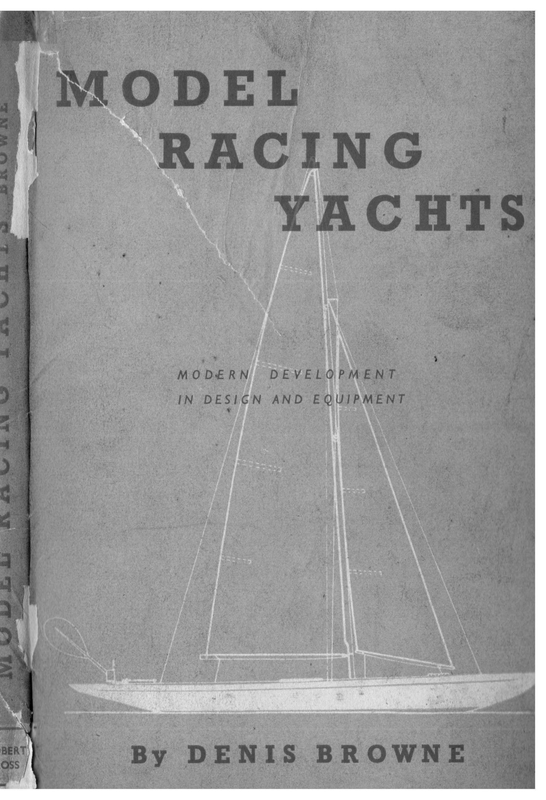
MODEL RACING YACHTS By DENIS R. H. BROWNE, O.B.E. 2nd Impression Model yachting, like its full-sized counterpart sport, is experiencing a post-war boom which, because of the comparatively low cost of building and sailing models, is unlikely to be set back by considerations of economics. The renewed interest and energy with which this sport has been pursued during the past few years has brought forth many new developments and a strengthening of trends in design and equipment which were in their infancy prior to the recent war. The author, who combines the attributes of possessing the necessary knowledge and critical faculty with the ability to pass on his observations to the reader in a straightforward and interesting manner, is the first to collect in book form descriptions of these modern developments. Of particular interest will be the discussion on various types of steéring gear and the observations on the performance of some of the best-known boats which use them. The Foreword is written by G. Howard Nash, C.B.E., M.I.E.E., A.I.N.A., whose boat Fantasy II is illustrated amongst others in the chapter on hull design. Illustrated by drawings and numerous photo- graphs by the author. 9s. 6d. net
i Scamp, winner of the 1949 British National Championship at Fleetwood, runni under spinnaker.
ng MODEL RACING YACHTS Some modern developments of Design and Equipment Comparative Speeds of Yachts and Models Notes on Planing and a Ljungstrém dinghy sail plan by DENIS R. H. BROWNE O.B.E., M.LE. (Ind.) Indian Service of Engineers (Ret’d.) SOUTHAMPTON ROBERT ROSS & CO. LTD. IN ASSOCIATION WITH GEORGE G. HARRAP & CO. LTD. LONDON SYDNEY TORONTO
First Published 1950 Reprinted 1951 ‘“‘ There be three things which are too wonderful for me. The way of an eagle in the air, the way of a serpent upon a rock, the way of a ship in the midst of the sea.” ; BY WwW. & Proverbs, XXX, 18, 1¢ PRINTED IN GREAT BRITAIN J. MACKAY & CO., LTD., CHATHAM
FOREWORD THE sport of racing model sailing yachts is one little understood by the public, in spite of its having achieved National and International status. Calling as it does for skill and concentration of no mean order, model yachting provides, more particularly in its three-fold aspect of designing, building and racing, a hobby and sport of great fascination, and deserves to be more widely known, in a sea-faring nation like ours, than it is. Incidentally, it can be enjoyed all the year round and can still afford satisfaction and recreation when other more violent forms of sport have lost their attraction. Mr. Denis Browne has embodied in these notes, and in most able fashion, a great deal of information, some generally enlightening, much for the expert, and also much that should be of real interest to those whose interests lie only in full-sized sailing craft. To these latter, I can confidently assert that, if they really love boats and yet for one cause or another are not able to indulge in the real thing, then, if they are fortunate enough to be within reach of serious model yachting, they will find in it a complete expression of their boat love. To the public in general, these notes will help them to gather that there is as much difference between, say, children playing in the garden with bat and ball and first-class tennis as there is between just sailing toy-shop boats and this sport of model yacht racing. The book is well calculated to stimulate interest in the sport, and as such will, I feel, be welcomed by many. G. Howarp NasH London, 16th February, 1949.
ome Wy
PREFACE Ir may be useful to put on record some random notes on the evolution of racing models as evidenced by models in this country and others designed in the U.S.A. and elsewhere, and to compare them with modern trends in the design of full-sized sailing craft. A good opportunity to study and compare some particularly interesting models occurred at the time of the British Empire Championship and the All Nations Regatta, held at Gosport in July and August of 1948. Tt is with some diffidence that I venture to write on this subject, as, compared with many who have taken part in serious model racing for many years before the war, I feel myself very much a novice in the racing and handling of these fascinating small racing machines. I first sailed models of sorts well over half a century ago, when for several summers I spent a large amount of time sailing various boats on the Canoe Lake at Southsea. There were thrilling interludes when, from Eastney Point, or, as a highly privileged young relative of a member, from the Royal Albert Yacht Club, now, alas, destroyed by enemy action, I watched the beautiful yachts of those days racing with their billowing canvas in the Solent : vessels such as Britannia, the German Emperor’s Meteor, the American yacht Navaho, and that lovely cutter Satanita, later altered to yawl rig, which linger in my thoughts as things of beauty I may never see again. A particularly vivid memory is one of Navaho nearly on her beam ends in a squall ! Even in those early days, sailing straight-stemmed models of about 30 in., my young thoughts were much exercised as to why my little yacht would persistently do her best to run up into the wind. In much later years I found myself up against the same problem when racing in a strong class of 18 ft. one-design boats, in which, incidentally, more by luck than judgment, I won a season’s championship. After World War I, I had occasional opportunities of sailing and racing yachts of various rigs, including a couple of 6-metres, and then, for the last ten of nearly thirty years’ Government service in India, no opportunities for sailing came my way, and what leisure I had was devoted to other forms of sport. Later, –
8 PREFACE on retirement, the dormant germs of that insidious disease, dubbed, by an old friend of mine, “‘boats in the belfry,” reasserted themselves, and I became the owner of a motor cruiser, a sailing dinghy and a small French sailing canoe. The last-namedI fell in love with at the Paris Exhibition of 1937, when on a cruise with the Pavillon d’Or, and brought back on the deck of my cruiser. I also, luckily as things turned out, acquired a 10-Rater racing model to play about with in the winter. I managed, after considerable difficulty, to bring my cruiser back from another Continental cruise in 1939, reaching Dover only three days before the outbreak of war, and there she had to stay till after the end of the war, suffering considerable damage by several near misses of bombs and shells from Calais. It took about two years more to get her repaired and made seaworthy. By that time it was abundantly clear that conditions, financial and otherwise, made it necessary for me to dispose of her and the dinghy, which eventually, to my regret, I succeeded in doing. In the meantime I had taken up model yachting seriously, with the help of some kind and expert friends, and I have never regretted doing so. It was reported that a member of the Russian football team that visited London after the war mentioned that one sight which had interested and surprised him was that of “‘ a number of elderly men running round a pond after small boats !’’ No doubt a good many of the thousands frequenting Kensington Gardens and the Round Pond look on the activities of model yachtsmen in a similar light and with faint amusement, although, as I know from personal experience, increasing numbers of them are boat-lovers and take an intelligent interest in models and their equipment arid handling. The following notes assume some knowledge of yachts and models on the part of the reader. Some portions may, to model yachting experts, seem elementary, but it is hoped they may be of interest to others less experienced and may also serve to introduce some, who have not yet sailed model yachts, to what can certainly be one of the most engrossing hobbies that anyone, with a bent and aptitude for if, can possibly find. Further, some points mentioned and suggestions put forward may stimulate more experimental model work and also interest yachtsmen and others concerned with full-sized craft, who may not have realised that there is more to be learnt from modern models and their sailing, racing and handling than is often recognised.
PREFACE 9 My acknowledgements are due, and are gratefully tendered, to :— Rear-Admiral Alfred Turner, for information obtained from his papers and writings, and for much valuable assistance given personally and by correspondence. Air-Commodore Sir Adrian Chamier, C.B., C.M.G., D.S.O., O.B.E., for information about Red Feather. Herr Kai Ipsen, of Copenhagen, for his drawings of Revanche, the plan of the Copenhagen sea course, the sail plan of Stormy and for photographs and information kindly supplied personally and by correspondence. The Model Yachting Association of Great Britain and the Commonwealth, for information given. in their publications (obtainable from Mr. C. V. Hooper, Hon. Publications Secretary, 4 Freke Road, Battersea, London, S.W.11) and in M.Y.A. News. The yachting press generally for much information gleaned from articles and letters, especially, if I may particularise, from two series of admirably lucid and informative articles by Mr. Douglas, H. C. Birt, A.I.N.A., published in Yachts & Yachting and in Aero and Marine Models. Dr. Manfred Curry and his publishers, Messrs. George Bell & Co., London, for permission to make use of notes from the former’s book, Yacht Racing and the Aerodynamics of Sails. Mr. Ian Proctor, Joint Editor The Yachisman, for information regarding canoe and dinghy planing speeds. Mr. H. B. Tucker for particulars of his ‘“‘ Duck ’’ design. Mr. Uffa Fox, for permission to use the sketch of his Flying Fifteen. The Chairman and Committee, London Model Yacht Club, for the plan of the Round Pond. To many model yachting friends, who have given me the benefit of their experience and assistance. Since this book was written and shortly before its publication, the death has occurred, in April 1950, at the age of 68, of my valued friend Mr. G. Howard Nash, C.B.E., M.I.E.E., M.R.I., F.A.I.E.E., who kindly wrote the foreword and without whose help and encouragement, generously given ever since I first seriously started model yachting, this book would not have been written. For many years the designing, building and sailing of model yachts, at all of which he was one of the acknowledged experts,
Io PREFACE had been his prime hobby and recreation. A master of line anc craftsmanship, his models were always things of beauty, as i evident from his design of Fantasy II published, by his kind per mission, in this book. Many references in later pages, including those to his successes in National Championships, will indicate hov much the sport of model racing owes to his work, his skill and hi: enthusiasm. Among the first to appreciate the value of Admira Alfred Turner’s Metacentric Shelf Analysis, he was one of its mos able protagonists ; his later models were ,designed strictly ir accordance with it and went far to add proofs of its complete succes in ensuring balanced hull-form. Apart from his model yachting activities, his life was full anc varied, associated as he was with many leading electrical under takings, some with interests in America and the Dominions, it which, for some twenty-seven years prior to the last world war he held a succession of important appointments, ranging fron Chief Engineer to Director and Chairman. During the first war h had done valuable inventive and research work on the seismophone for submarine detection, and his invention of the Nash “ Fish’ Hydrophone in 1917 was regarded as an outstanding achievement His work, which continued till 1919 as technical adviser at th Admiralty Experimental Station at Portland, brought him th decoration of C.B.E. (Civil) in 1918. At the outbreak of the secon war, although retired from active work, he joined the Air Ministr and speedily rose to Assistant Director and later Deputy Directo of Standardisation, Ministry of Aircraft Production. Always ready to encourage a novice and to help others les experienced or knowledgeable than himself, his passing cannot bu be keenly felt by his very numerous friends and admirers in th model yachting world, both in this country and abroad.
CONTENTS Page FOREWORD . BRE ic Ce CHAPTER: I… : 5 i : : ; snide i cahed ste cap MBI grate i ; , . 5 Ne dance a Model Yacht Clits “Oremstcotion r Model Yacht Racing—Inland and 4 CHAPTER HI. . Hull Balance—Metacentric “Shelf Mipetyase- thanks and Papers on the 27 Method CHAPTER III ; Air Tunnel Tests for Aneebidns Deetaeo Design in U.S.A. and lieder The Dutch Sor Windward Sailing j SO Tests Sor ‘Ship and Yacht Yacht Trial— Weather Helm rn = SS pet CP SY ef we LE i Load Open-water Sailing— Textbooks—Classes Recognised by M.Y.A. CHAPTER IV), A CR SOF Some Recent “‘ A”’ Class Model Neachts Ranger Revanche—Tinker Bell— og Spur—Lusitania CHAPTER V . Pie: Fins, Skegs and Hiddeas, StowS nd Rudders te Broder Stuting Gear— The Ufa Fox Flying Fisoli Feidiced Areas of Fins—Mast Adjustments— Balanced Rudders—Deep Rudders and Small Skegs—Windage and Rigging CHAPTER VI. ‘ CHAPTER VII 3 Braine Steering Gear. Method of Cuba with Sanne . : , : – – 48 ‘ a Saat”) Vane Steering Gears. Early Types—American Self-tacking Gears— Adjustments and Settings for Running and Beating—Methods of Guying CHAPTER VIII. Sails. | General—Boomed Hidienile Spiuahergen Use of Getoas Seldom 64 Practicable—Synchronous Sheet Setting—Flow and Twist in Sails—Ljung- str6m Rig_—Red Praihar LanganRig for Dinghy CHAPTER IX ’ Tests for Symmetry and Belsecs— Final Mast Anhutioils Checking of Rudder and 5 Fenders -Fack-lines—Sheets II 75
CONTENTS I2 Re GT 0 CHAPTER F008 Speeds of Sailing Ships, Yachts and Models. Clipper Ship Lightning— Speeds and Speed Length Ratios—Table of Speeds—Windspeed Diagram 78 “ ; E ‘ : 4 ; 2 CHAPTER XI Notes on Planing—Advantage of Early Planing Capacity—Some Comparative Advantages of Light and Heavy Displacement—Time Allowances for Various 94 A : ; CHAPTER XII Designs of Some Post-war Models and Notes on Aerodynamics of 98 Model Classes Sails. ‘‘A” Class Design Fantasy II—‘ A” Class Design Revanche— Suggested Hydrofoil Fin—Mr. H. B. Tuckers Novel Design, The Duck— Notes from *‘ Yacht Racing and the Aero-dynamics of Sails” CHAPTER XIII 113 Conclusion : 5 : 3 APPENDIX 1 International Model Yacht Racing ; history and results 115 ; 116 : : : ; : 5 : APPENDIX 2 Notes on the M.Y.A. “ A”? Class Regatta at Gosport 1948 ; British Empire Championship and All Nations’ Regatta APREMIE Boy yO Nea yg Og British and International “A” Class Championships, 1949 APPENDIX 4 pee iste! Some Model Yacht Suppliers 118 123
LIST OF ILLUSTRATIONS PLATES Page Frontispiece—Scamp, 1949 British National Champion Fleetwood Model Yachting Lake. : : : i ee) Models starting, Copenhagen Sound . i 4. Ranger using small flat spinnaker ; é : : : Ng 20 Scamp and Stormcloudin British National Championship, a0. 20 Rapture and Scamp, British National ih tak 1949 Scamp and Ranger starting onarun . LN 2° By 89 Sharma and Heliosin 1949 British National Championship | 88 Sharma running in British National Championship, 1946 * ‘ Braine gear seen from above » 38 : ; ‘ ; : . 55 ; ‘ : ; 2 : 4! OB Fisher Vane gear, top view Fisher Vane gear, side view . . ; ; ; ; : : ‘ ; ; : . . 56 56 Heliosin a light breeze , : : ; Ahir) : ! nae) Lassel Vane gear é A “ Duck’? design Marblehead Class‘padht : é Skeg and rudder for Vane steering : : , 4, ‘ F aarey ; : Bene Qe Rhapsody and Actinia planing. : . F : é Tinker Bell (England) International “ A’? Class Lusitania (Portugal) International “‘ A’? Class . , : Ranger (U.S.A.) International “ A’? Class Revanche (Denmark) International “‘ A’? Class Fig. 1. 2. 3. 4. 5. 6. 4. 8. 9. 10. 11. 12. 13. F + 93 – |) OI ; FIGURES Page The Round Pond, Kensington Gardens. ; : Stream-lining offin and rudder ‘ : : . . : : ; . Uffa Fox’s Flying Fifteen Diagrams showing various settings of Vane steering gear. : : j Ljungstrém rig for 8 ft. dinghy. Open sea course, Copenhagen Sound . : 4 ; Wind diagram forice yacht . “ie 34 48 . . 59 9 | L.W.L. yacht «. . . Diagram of wind speeds for “ A?ing Class model ae 25 fi. : 84 87 88 The sections of “A”? Class mandal, Fantasy it ; Class. . 100, 101 Sail plan of Revanche, International ““ A’? Class. Sail plan for International 6-metre, Stormy : ‘ =” HO4. . 106 Waterlines and buttocks, Fantasy II, International ‘‘ A”? 99 Waterlines and buttocks, Revanche, Taternational A’? Class 103 13
CHAPTER I d an d an nl —I ng ci Ra t ch Ya l de Mo of on ti sa ni ga Or s— ub Cl Model Yacht A. Y. M. by ed is gn co Re es ss la —C ks oo tb ex T g— in il Sa er Open-wat ld to be to ed ne t no do um se Mu o ir Ca e th en se ve ha o Tost wh e th of ys da e th in s at bo l de mo of rs de il bu rt pe ex that there were n ca rk wo e os wh of s en im ec sp l fu er nd wo s, ie st na dy an ti early Egyp e th in d un fo s mb to e th of me so om fr ics rel e be seen among th e th of es pi co ul hf it fa s es tl ub do gh ou th e, es Th s. ng Ki e Valley of th g in il sa l de mo ed ll ca be ly rd ha n ca , od ri pe e pleasure craft of th ist ass to s rt so of ls sai re ua sq th wi ted fit be d ul co me boats, though so l ra ve se l til t no s wa it ; le ab ur vo fa re we s the oarsmen when wind be n ca rd co re y an at th t, ac ex be to 26 18 l til er, thousand years lat at th In . ts ch ya g in il sa l de mo ce ra d an l sai to t mp te at y found of an t ch Ya l de Mo on nd Lo e th ed ll ca ub cl a at th ow year old records sh l al sm of rs ne ow g in be s er mb me al in ig or e th d, te ar st Club was re we er tt la e es Th . ls de mo d ha so al o wh yachts on the Thames re we , ely lik s em se it d, an ? t”’ uil r-b nke cli or d li so e “ dug out of th a on ls de mo r ei th ed il sa ey Th s. at bo er rg la models of the owners’ th wi ed nd ou rr su “ s wa s thi l til , rk Pa n ee Gr e “ reservoir’ in th s wa ng ci ra e Th . ne ti en rp Se e th to d ne ur jo ad ey th en wh railings,’ r fo s le ru ng ci ra no d ha ub Cl e th d an s he tc ma confined to two-boat er. lat s le ru g in am fr at rt sta a de ma ey th gh ou th many years, r ie th al we e th all ly ar ne en wh d en an to me ca However, the Club ls de mo d ne ow o wh s er mb me w ne me so e us ca be ed members resign only, managed to get elected ! r ei th ed il sa n me ts ch ya es am Th e os th en wh ys da So ended the e rg la of ng ti is ns co ly ab ob pr es ak st r fo r, he models against each ot by ar ne at ne wi d an e al ed ic sp of s et ss po th wi meals washed down coffee houses. ty gh ei me so d te ar st ve ha to id sa be y ma ng ti Serious model yach e th of s rt pa s ou ri va in ed rm fo be to n ga be s ub cl years ago, when e ar , ly ab ob pr , on nd Lo in s ub cl wn no -k st be country. Two of the g in il Sa t ch Ya l de Mo e th d an ub Cl l de Mo on the present Lond ; ly ve ti ec sp re 79 18 d an 84 18 in d de un fo re we e es Th Association. on g in il sa r ei th do nd sa en rd Ga on gt in ns Ke in s they have club-house 15
16 MODEL RACING YACHTS the Round Pond, where many thousands of the general public hav an opportunity of seeing it. I have heard that arose from ‘a request moved to compassion model homewards on permission to build boat-houses in the Par of Queen Victoria’s, whose royal heart wa when she saw an old man trundling a heav perambulator wheels. Whether this is a fac I have been unable to verify, but it is a pleasant story. In more recent years the development and organisation of mode yachting, both on a national and international basis, has pro gressed far more than is maybe generally realised. In fact, th whole organisation is in line with that for real yacht racing. Thu the Model Yachting Association of Great Britain and the Common wealth controls all racing here and in the Dominions and regulate the rating, measurement and sailing rules for the several classes c models recognised by the Association, so corresponding to the Yach Racing Association which exercises similar functions for full-size Then there is the International Model Yacht Racin yachts. Union, corresponding to the International Yacht Racing Union and there is even an International challenge cup, known as th “Yachting Monthly’’ cup as it was originally presented by th proprietors of that well-known journal, which corresponds to th America’s Cup, that elusive trophy, the recovery of which has bee: persistently, albeit unsuccessfully, attempted by our challengers a intervals on fifteen occasions up to and including 1937. The I.M.Y.R.U., the activities of which had been in abeyanc since the outbreak of the late war, has been reconstituted in th current year (1948) at a meeting held after the All Nations’ Regatt: at Gosport and presided over by the Chairman of the M.Y.A. Mr. F. C. Tansley. Representatives of all the foreign nations takin; part in the Regatta attended, together with officials of the M.Y.A. the Y.M. Cup Committee and the “‘ A ’’ Class Regatta Committee and Mr. F. L. Pigeon, U.S.A., was elected President of the re constituted Union, with Mr. C. R. Seabrooke, Great Britain, a acting Secretary-Treasurer. There are many model yacht clubs scattered over the length anc breadth of the United Kingdom and some in Northern Ireland anc the Irish Free State—wherever, in fact, suitable sailing water i available. During the late war all model yachting activities ceased as was inevitable. The boats remained in their boathouses, whil their owners were on war service or fully occupied with other war.
we 2M. SC VS SRS: er mm CR OD OR Ne et me = mR FE TOD EF nme wr SS BOA oO MODEL RACING YACHTS 7 time activities. After the war it took some time for things to get started again, but in spite of many difficulties the M.Y.A., and most of its affiliated clubs who still possess sailing waters, have gradually got going again more keenly than ever. The greatest handicap to the sport is the small number of suit- able ponds and lakes available. In some cases lakes have been for- bidden to model yachtsmen by their use for the more remunerative purposes of canoes and paddle boats. All the sailing in this country is pond sailing, as opposed to the open-water sailing done in some parts of the United States (where it is known a§ skiff sailing), Denmark, Portugal and elsewhere. In Denmark the skippers paddle after their boats in kayaks ; the photo on page 19 shows boats lining up for a start and indicates conditions. This open-water sailing is quite a different form of racing from the pond sailing of this country. It probably gives truer tests of the boats’ abilities than pond sailing in that the yachts sail much longer legs on the various points of sailing, and, as will be seen from the photograph, it is more like real yacht-racing because a large number of boats can sail together instead of sailing in pairs only as is necessary in pond racing. While pond sailing can be quite a strenuous exercise, particularly with “ A ’’ Class models in a strong breeze, open water sailing calls for real hard work on the part of the skippers, who, besides handling their yachts, have to chase after them in their kayaks, often in quite a rough sea. On the other hand, as will be seen later, pond sailing requires much more frequent changes of course and trim, and probably puts a higher premium on the speed and skill of the skippers. If model yachting continues to develop and sailing waters decrease in number, both of which seem not unlikely, it is possible that openwater sailing may be started in this country, and as a matter of fact, the M.Y.A. long ago laid down rules and regulations for the conduct of such racing. There are many places round the coast where facilities for pond sailing are non-existent but where suitable open-water courses are conveniently available, and it is just in such places that boat lovers abound and that the numbers of small dinghies are increasing rapidly. Failing being able to buy or hire suitable boats to follow their models or to borrow them from friends, keen model yachtsmen could, in many cases, build their own tenders at the cost of no more expense and labour than they bestow on their models.
18 MODEL RACING YACHTS Up to the later years between the wars no good text-book on model yachts existed, which undoubtedly delayed progress ; but in 1932 a first-class book, Model Sailing Craft, by W. J. Daniels and H. B. Tucker, was published by Chapman & Hall Ltd., London. This book runs to nearly 250 large pages and is a veritable classic on the subject. It is profusely illustrated with plans and drawings and all details of models, goes fully into the rules governing the different classes and the rules of racing, and also describes the various methods of construction, rigging and handling. The collaboration of the authors was a happy one } Mr. Daniels is ‘one of the most famous model yachtsmen in the world, having won championships in the past twenty-five years, National and International, in this country, in the U.S.A. and in Germany in 1936, with almost monotonous frequency, with models designed, built, and, in nearly all cases, sailed by himself. A glance at the history and results of International races in Appendix 1 will show how often his name appears, and, responsible as he was for the starting of International racing and with his winning of the Yachting Monthly International Cup outright with Invader (1923) and Crusader (1924. and 1925), it may truly be said that he was the one man, more than any other, who put model yachting in general, and British model yachting in particular, firmly on the map. His Albion, winner of the International races in 1929 and 1930, admittedly set an entirely new standard of design and performance for “‘ A’’ Class models, which was more than maintained by a series of his designs in succeeding years. Mr. Daniels still continues his good work, and has turned out a number of beautiful yachts since the end of the late war, every one of his creations being a thing of beauty. In connection with the early improvement and development of “A”? Class models, it is only fair to mention here that another veteran designer, the late Mr. J. G. Feltwell, was also outstanding with a series of excellent and successful designs. Mr. Tucker, with a life-time’s experience of yachts and the sea, is an expert designer and writer who took up model yachting after the first world war with a view to experimenting ; he was editor of The Model Yachtsman from its inception till the late war put an end to its publication, took a leading part in the affairs of the M.Y.A., and was responsible for founding the International Model Yacht Racing Union. The book has unfortunately been out of print for some
Fleetwood Model Yachting Lake is one of the finest in the country. The channel joining the two lakes is spanned by a wooden duck-board bridge. International 6-metre model yachts lining up for a start, Copenhagen Sound. Photo by courtesy of Kai Ipsen.
Ranger [U.S.A.] making use of a_ smal tive spinnaker with a quar wind. It can be seen hc spinnaker and jib are h each other. Scamp and _ Stormclou before fouling each ot the British National Scan pionship, 1949. sheered off from the without touching it, de by the force of her ow wave.
MODEL RACING YACHTS effec| flat tering yw the elping just d her in Chamip had . bank flected n bow- 2r n tio edi d ise rev and new a t tha s our rum are re the but t, pas rs yea may be published before long. Anyone who can get hold of this book from a library, happen on a second-hand copy, or borrow one from a friend, will have at his disposal an unsurpassed mine of information on the subject. A useful small book entitled Model was , den Bow E. C. el lon -Co ut. Lie by g, lin Sai and ion uct str Con ht Yac published by C. E. Marshall & Co., in 1947, at the modest price of gs. 6d. It touches on design, construction and operation, in the light of modern knowledge of aerodynamics and hydrodyamics, ina . ‘ highly interesting manner. I have often heard yachtsmen, ignorant about the methods of sailing racing models, express the opinion that there is little or no e, aus bec hts yac l rea of and els mod of ing rac the n wee bet y log ana they say, the steering of models is “‘ automatic.”’ The adjective is only applicable in so far that the steering is done by the pull of the sheets, or by the latest device of a wind vane. The real difference between the two is that there is a human steersman aboard the| larger boat, and none on the model. The skipper of a model has to do all his sail trimming and steering adjustments before he starts his the and t fec per are t men ust adj . and m tri the If . rse cou its on boat direction of the breeze holds steady, the boat, on a reach or a run, should sail straight from the starting line along the course to the finishing line ; but in the great majority of cases some slight error of trim or change in wind direction will bring her ashore, and it will be a matter for very quick decision and action on the part of the skipper or his mate to alter one or more of the adjustments so that the yacht will sail to the finishing line with as few “ retrims ”’ as possible. On a beat she will have to be tacked or put about by hand or by using a pole, unless she is made to change tack herself by a device known as a guy. Really good model yacht sailing waters are few and far between and few of them are good enough for serious championship racing. Particularly is this the case in most inland waters, where trees, buildings, or other obstructions cause baffling changes in the d un Ro the On d. pon the of nts poi ent fer dif at d win the of ion ect dir Pond, for instance, the avenues cut in the surrounding trees often cause miniature whirlwinds half-way down the pond, and it is not uncommon to see a model change her course by a right angle or even sail round in a circle. Only if you get a truly west wind of fair strength, from which direction there are fewer obstructions, can B
22 MODEL RACING YACHTS one get a,more or less straight run eastward or satisfactory beatin; conditions to westward. A plan of the Round Pond is given in Fig. 1. Two good lakes, both close to the sea and filled at high tides witl salt water, are those at Gosport and Fleetwood, and it is on one o other of these waters that the ‘“‘ A’’ Class Championships have bee: sailed in the years before and since the war. Finishing Line _ _ Finishing Line Fic. 1 The Round Pond, Kensington Gardens. Note.—The start of each board is fro the straight portion of bank behind the line marked “ Finishing Line”’ at each en The course measures 228 yds. each way. In pond sailing it is impossible to sail several boats together : constant fouls would be inevitable, and hence boats have to sz heats in pairs, each boat sailing every other boat. Each he consists of two “‘ boards,’ one one way of the pond and one tl TT! other, and points are given to the winner of each board. method of scoring is laid down by rules (and by the Officer of th
ws AS MODEL RACING YACHTS 23 day at the time of starting the race in accordance with the wind conditions), three points being awarded for a windward board and two points for a reaching or running board. Rules as to how a boat is to be turned when beating, or stopped and re-trimmed when reaching or running, are enforced by umpires, the penalty for a breach of rule being loss of the board. The rules regarding rating and measurement of the various classes recognised by the M.Y.A. are just as closely laid down in the case of models as in the case of real yachts, and, in the case of the “‘ A’’ Class and the 6-Metre Class, fully as complicated. The process of measurement for an ‘‘ A ’’ Class boat is no simple matter, and it may take several hours to complete it and the calculations. Measuring machines and tank apparatus are installed at several of the leading clubs. The classes of racing models recognised by the M.Y.A. are as follows :— (1) The “‘ A”? Class. (2) The ro-Rater Class. (3) The 6-Metre Class. (4) The Marblehead or “‘ M’”’ Class, also known as the 50/800 Class. (5) The 36 in. Restricted Class. The rating rules for the “‘ A’’ and 6-Metre classes are practically the same as the I.Y.R.U. rules for the big boats. In fact, the “A” Class rules, which were devised some thirty-six years ago by Major Malden Heckstall-Smith, then editor of the Yachting Monthly, whose reputation as an expert in‘all to do with yacht racing and design is world-wide, are, as a matter of fact, exactly the same as the rules recommended by the I.Y.R.U. in 1947 for their new small classes of racing boats, while the 6-Metre model rules are the same as those hitherto applied to the big 6-Metre and other I.Y.R.U. classes. I believe the true history of the “‘ A’’ Class rule is that Major Heckstall-Smith, when, in collaboration with other experts, he devised it, hoped that it would be used for the I.Y.R.U. big at classes as well as for models, but the I.Y.R.U. thought otherwise and made some not very important modifications for the purposes 1e of the big class rule. These modifications led to unforeseen develop- 1e ments in the case of the international 6-Metres, as they became 1e longer, heavier, narrower and more costly ; in fact, they began to il
24 MODEL RACING YACHTS approach the ‘‘ plank on edge leadmines”’ of the 1880’s, anc was found necessary to restrict their beam to a minimum of 6 While similar, though less pronounced, increases of length < displacement have taken place in “‘ A’’ Class and 6-Metre mod largely owing to the fact that a modern Bermudan sail plan comparatively small area can be more efficient than an old bro based sail plan of considerably bigger area, the recommendatior return to Major Heckstall-Smith’s rule is significant. The rules for the 10-Rater Class are simple in the extreme. the only factors in the rating are sail area and water-line len; Till about seventy years ago a similar rule was used for large yac It has the disadvantage that it has led to an undesirable incre in displacement and water-line length, and some of the later be of this class are rather heavy to handle and lift single-handed. The 6-Metre Class is built to the international rules for the | 6-Metres, but the models are to the scale of 13 in. to the f This class is more numerous in Scotland than further south | seems unlikely to increase in numbers owing to the far gre popularity of the 10-Rater and Marblehead classes. The Marblehead, or “‘ M’”’ Class, originated in America, an rapidly becoming very numerous both there and in this coun its moderate size and weight making it easy for handling transport. It is essentially an experimental class in that it g almost unlimited latitude in design, the main limitations being ' the overall length must not exceed 50 in. and the sail plan 800 sq The 36 in. Restricted Class is intended chiefly for junior mem of clubs and though the hull measurements and displacement ‘ closely restricted the sail area is unlimited. Some of these | boats carry sail plans almost as large as the Marbleheads. The detailed rating rules for the different classes can be obtai: in booklet form, from the M.Y.A. For the benefit of readers » do not know the different classes, some approximate figure average sizes and weights are as follows :— Length, 6 ft. to 7 ft. over all. A”? Class: L.W.L., 50 in. to about 54 in. Height of mast above deck, 7 ft. € approx. Weight 45 lb. to 60 Ib. (This class is often fitted with detachable keels to facil
MODEL transport. racing. RACING YACHTS 25 ‘T'wo persons are necessary to handle these boats when In some cases they are handled in the water by their skippers and mates in long sea-boots or waders. In ponds with masonry edges it needs two safely to lift a boat from the water.) ro-Rater Class : Length, 5 ft. 6 in. to 6 ft. over all. L.W.L., 45 in. to 50 in. Height of mast above deck, 6 ft. approx. Weight 25 lb. to 30 lb. 6- Metre Class : Length, 5 ft. to about 5 ft. 6 in. over all. L.W.L., 40 in. to 43 in. Height of mast above deck, 5 ft. 6 in. to 6 ft. Weight, 24 Ib. to 32 Ib. SM?” Glass’: Length, 50 in. over all. Weight, 15 lb. to 21 lb. 36-in. Restricted Class: Length, 36 in. over all. Weight (maximum) 11 d is itate Ib. All classes of models must be measured by official measurers and duly registered by the registrar of the M.Y.A. before they can take part in any race held under the auspices of the Association. At the time of first registration a sail number is allotted by the registrar, which, as in the case of full-sized yachts, has to be stencilled, together with the index letter laid down for the class, on the main- sail of the largest suit of sails. The certificate gives actual details of the measurements of hull and sail plan, and also the maximum distances to which the No. 1 mainsail can be hauled out on the boom and its head hoisted up the mast. These points are marked, in accordance with the rules, on the spars, and the central point for stepping the mast, together with the most forward point of the fore-triangle with that mast-setting, are also marked on the boat’s deck. In the case of an ‘“‘ A”’ Class boat, marks showing the forward and after ends of the water-line are also painted on the hull by the measurer. If any alteration of hull or sail plan be subsequently made, the boat must be re-measured and the new certificate regis- tered with the Association, and, in any case, both certificate and registration became invalid after two years, when they have to be renewed. Club burgees and racing (or owners’) flags are flown on the appropriate occasions as in big yacht racing.
26 MODEL RACING YACHTS As giving some idea of the numbers of model yachts racing this country, it is interesting to note that up to the end of Novemb 1948, the total number of yachts registered by the Model Yachti Association is 3,174 apportioned as follows :— “A” Class, 600; 6-Metre Class, 594; “ M”? Class, 291 ; and 36-in. Class, 611. 10-Raters, 1,07% The “MM”? Class, which is practically a post-war class in tl country, shows more rapid increase than any other class, seven’ eight having been registered in 1948. ¢
CHAPTER II Hull Balance—Metacentric Shelf Analysis —Books and Papers on the Method In my young days, as already mentioned, I could never understand why my small boat constantly tried to run up into the wind. I think I clearly realised that with sheets out, say, ‘to starboard, the wind was supplying a strong force, well out on that side, turning her bow to port, but I remember I was completely at a loss to understand why, with sheets close-hauled, she still tried her hardest to get into irons. My first idea, as far as I can remember, was that the big bow wave on the lee side was what was forcing her up to windward. No theories of balanced hulls then existed, and as a matter of fact, the old straight-stemmed yachts and models general in those days were, as is now known, badly out of balance. I defeated this tendency by fitting her, in the manner of those days, with gravity rudders of various sizes, and thought myself a bit of an inventor when I made a hollow tin rudder, which I loaded to different weights with strips of lead sheet. (Incidentally, I may remark that the best advice to give to any small boy starting model sailing is that he should fit his boat with two or three weighted rudders of different sizes.) By this means, I could force my boat, against her will, to hold a course more or less close to the wind or to make a pretty fair attempt at running or reaching. In later years when racing my 18-footer I always wondered why it was necessary to come in pretty well dead beat after straining hard at the tiller, even when going to windward, for two or three hours. Shortly before the late war I became acquainted with the writings of Engineer Rear-Admiral Alfred Turner and his disciple, the late Dr. T. Harrison Butler, and began to study the former’s fascinating theory of hull balance. Not till then did I realise that while open boats, with width aft to carry the weight of the crew and with transom sterns, are bound to pull hard unless, by “ sitting out,”’ they can be held.upright, ballasted hulls can be designed which are perfectly docile and can be held on their course to windward by 27
MODEL RACING YACHTS 28 fingertip control, or on other courses more off the wind with: any great exertion. The quality of good hull balance, often talk about by yachtsmen but much less frequently fully understood. essential, from the points of view of satisfactory performance a ease of handling, for all yachts. A fully balanced hull, by whict meant a hull which shows no tendency to deviate from a strai; course when heeled, is, for obvious reasons, even more necessary the case of a model than of a full-sized vessel. The Metacentric Shelf Analysis, a method of analysing a correcting a design to secure this essential ‘quality of balance, 1 invented by Engineer Rear-Admiral Alfred Turner, who read t papers on the subject before the Institution of Naval Architects, « in 1937, called ‘“‘ A Law of Hydrostatics and its Influence on Shape of Sailing Yachts,’ and the other in 1942, called “ On Balance of Heeled Ships.’’ The first paper is now out of print, | it is understood copies of the 1942 paper may still be obtaina from the Institution (at 10 Upper Belgrave Street, S.W.1) at 3s. each, and that copies of both can be seen in the Institution’s libra The value of this method has been clearly shown by m: highly successful racing models designed accordingly by Adm. Turner and others, while several well-known designers of full-si yachts, Robert Clarke and the late Dr. T. Harrison Butler am: them, have achieved equally successful results by using Turn method. Incidentally it should be emphasised that Turner’s system is a method of design resulting in any particular or stereotyped fc of hull ; it is a means by which various types of hull design can analysed and modified so as to secure the essential quality of ] balance. Of the eight yachts which reached the final of the “A” C Model Championship in 1939, five, speaking from memory, wv built from designs by Admiral Turner or designs which had b analysed and modified in accordance with his method. In the 1 championship the success of the method was again vindicated by winner, Rhapsody, a metacentric shelf design, and Actinia (: designed by Admiral Turner, while the design of Fantasy (E closely, though not exactly, conforms with Turner’s analysis. the recent championship (1948) the winner, Tinker Bell, wa: Admiral Turner’s design and Rhapsody was again well up in the le taking third place.
MODEL ut RACING YACHTS 29 In these championship regattas the boats have a really searching test over five or six days with varying strengths and directions of wind. Every yacht has to sail every other yacht, and the result is that on lakes such as those at Fleetwood or Gosport, with thirty or more competitors, each boat sails a total distance of ten miles or more. In the case of “‘ A ’’ Class models their average water-line measures about 50 in., while that of a pre-war “‘ J’ Class yacht was, say, 80 ft. onthe average. Thus the distance of ten miles covered by each model is, in the ratio of their water-line lengths, equivalent vas to about 200 miles sailed by the full-sized yacht. “Hence models wo sailing in a championship are probably put to as true and exhaustive one a test as could possibly be devised. the Incidentally, it may be noted that the term “‘ model’ is really the a misnomer, as model racing yachts are never exact scale repro- ductions of their bigger sisters, but are miniature racing craft specially designed and fitted for the conditions under which they are used. The sail areas of any two similar vessels, one large and one small, vary as the squares of the respective linear dimensions, while their displacements vary as the cubes of the same, hence the smaller the vessel the larger, proportionately, must be the dis- placement and consequently the stability. This being so, if a model were a true scale reproduction of a real yacht she would not be able to carry her sail plan and would go on her beam ends in even a light breeze. This can be got over in two ways :—firstly, by re- ducing the sail area of the model, and secondly by increasing her displacement and ballast. The second alternative is the one chiefly adopted, but this does not mean, so far as the lines of the design are concerned, that the model need otherwise depart in design from the full-sized craft. The extra displacement required is given to the model by increasing the vertical spacing between the water-lines and by making a corresponding increase in the volume of the lead keel, though actually much of the difference is offset by the fact that, for obvious reasons, the weight ot the lead keel of a model can be a much higher proportion of the total displacement (weight) than in the case of a full-sized yacht. Thus the lines of a balanced full- sized yacht can be used for a model, or vice versa, without losing the essential quality of balance. As was to be expected in the case of such an innovation, the publication of Admiral Turner’s theory aroused much controversy in the discussions on his papers and also in the yachting Press.
30 MODEL RACING YACHTS n sou on ed bas not s wa it t tha d hel s ect hit arc al nav me While so principles, other expert designers pronounced it completely sour and it was said that all interested in yacht design owed a deep del use lly era gen st mo e Th k. wor his for hor aut the to ude tit gra of method of examining a design is based on a comparison of what a: : tio por the y reb the g in an me ,” ges wed out d an in “ the as known sic r he at we the on n aw dr th wi se tho d an é sid lee the on ed rs me im when the vessel is heeled. This method is adequate to ensure boc oe can a of ts sis con ht yac ing rac a but y, bod oe can ed balanc plus a keel appendage, and Turner’s method is, so far as is know t wa rde un e ol wh the of t un co ac l ful es tak h ic wh e the only on tl d an , ngs thi rn bbo stu are ts Fac . sel ves led hee the of me lu vo accumulated proofs of the success of the method seem incontr vertible. One interesting fact brought out in the Admiral’s second pap was that the lines of H.M.S. Victory, designed in 1759, wh analysed by his method showed that she was almost perfect balanced. Whether this was arrived at by accident or desi; -w of nma e on st lea at t tha n ow kn is it t bu n, ow kn be ot cann built much later than Victory was so unmanageable under sail th she had to be scrapped! Who can say what effect the resulti: docility and manceuvrability of Nelson’s flag-ship may have h on the subsequent fortunes of Britain ? ly ana ’s ner Tur out ry car to w ho n lai exp to t mp te at not l I wil ra mi Ad the om fr od th me the dy stu can d ste ere int are o wh e os Th papers and from two books which deal with the subject: Ya C & old Arn rd wa Ed by 8 193 d she bli (pu s nd mo Sy A. A. by , ign Des and Cruising Yachts, Design and Performance, by the late Dr. w , Co. & ss Ro rt be Ro by 5 194 in hed lis pub st fir , ler But on is rr Ha a later and revised edition in 1947. The whole method is far | is ary ess nec is t tha All nk. thi ple peo ny ma n tha ed complicat nt ou am e abl son rea a d an gs in aw dr p shi of e dg le ow kn g in work skill in drawing and the use of drawing instruments. No gr mathematical knowledge is required ; the whole procedure a cy ura acc e, car th wi ed in mb co se sen on mm co of e on ly ial ent ess patience. Few calculations are necessary—Harrison Butler s: y if t rec cor is h ic wh , ard t-c pos a of ck ba the on got be n they ca can write fairly small—and a planimeter, if you can get one, i d en mm co n ca I e enc eri exp al son per om Fr p. hel very great ! wor the om fr n tio axa rel ng sti ere int st mo a as od th me the of study
MODEL RACING YACHTS 31 of present-day life ; there can be no doubt whatever that by its use any yacht design can be successfully modified to give a fully bal- anced hull. It has the enormous advantage that the designer can be certain, before it leaves the drawing-board stage, that his creation will have none of the vices caused by lack of balance. My first serious model, a 10-Rater, which, analysed by Turner’s method, turned out to be badly out of balance, proved to me beyond a shadow of doubt that such a hull can give its owner no satisfaction for ordinary sailing, let alone racing. There is no doubt that many more or less fully balanced hulls, model and otherwise, have been produced from designs not analysed by Turner’s method. But these have been arrived at by skilled much experience who have gradually evolved designers with balanced lines by making slight improvements to minimise faults discovered in previous examples. It is quite possible that in some cases these improvements have been suggested by examining hulls or designs of Turner-corrected craft.
CHAPTER III Air Tunnel Tests for Aeroplane Design—Tank Tests for Ship and Yac Design in U.S.A. and elsewhere—The Dutch Yacht Trial— Weather Hel for Windward Sailing One thing which makes yacht design much more complicated thé the design of aeroplanes is the fact that 4 yacht moves in tv different media ; the sail-plan moves in, and takes its motion fro the air, while the under-water body of the craft is in water, a ve much heavier medium, and is subject to considerable resistance it moves. Some yacht designers find it difficult to see any true analo; between tests in wind-tunnels for aeroplane design and tests water for the hulls of ships. Wind tunnel tests have been ve extensively carried out for many years, and the results have hac dominating influence on the design of planes and all their par such as rudders, elevators, flaps, and so on. Since huge sums are stake on aeroplane construction, and also the safety of innumerat human lives, it seems obvious that no pains have been spared apply all tests with complete thoroughness. There seems no logic reason why results obtained in a rarefied medium at high spe should not give a clear indication of the nature, if not the degree, the forces acting on more or less similar bodies in a dense mediv at low speed. , Compared with the amount of aeroplane testing, very lit testing of models has been carried out in the case of sailing yach though there have been many such tests of models of warships a merchant vessels. However, the Stephens Institute of Technolo at Hoboken, New Jersey, U.S.A., has carried out extensive tests models, particularly in connection with the design of the Americ defender for the last America Cup contest, and continues to cai out similar very valuable research work, while work on the sai lines is also done in Denmark and Holland. The outstanding res was that American wonder boat, Ranger, which showed herself the races in 1936 capable of completely outsailing the British ch lenger, Endeavour II. It may be remarked that in the previous ra in 1934, the British yacht, Endeavour I, had, in the opinion of bc 32
Ces oth MODEL RACING YACHTS 33 British and American observers who saw the races, shown herself superior to the American yacht of that year, Rainbow, though she had unfortunately failed to win the cup, largely, if not chiefly, owing to a ruling on a pure technicality regarding a protest. It seems that our American cousins realised that they had had a narrow shave, and consequently applied all their powers of money and research to producing the very best yacht then possible, in which they were certainly successful. During and since the late war there has been an enormous increase in the number of people employed in, or interested in, the design and handling of aeroplanes, and it is not surprising that many of these have realised that results obtained in research into the design of ’planes may also be of great assistance in the improvement of racing yachts. Regarding tank tests at the Stephens Institute, the Assistant Director of the Institute has recently most courteously supplied some results to a friend of mine, which are especially interesting. In these tests a model of a heeled 473 ft. water-line yacht was tested to find the resistance to forward motion, the rudder angle and torque, the leeway angleand the centre of lateral resistance; the leeway angle being defined as the angle between the longitudinal median axis of the boat and the course on which she is moving, or, in other words, the angle by which she is askew to her course. It is generally assumed that the leeway angle is of the nature of 5 deg. for ordinary hulls, though it may be less or more in the cases of different types. It can be roughly judged when sailing a yacht by looking aft and noting the angle of the ship’s wake. The Hoboken results showed that, with 20 deg. angle of heel, the minimum resistance to forward rhotion was obtained with a rudder angle of 2 deg. to leeward, that is, 2 deg. of weather helm, increasing to 5 deg. to 6 deg. for 30 deg. angle of heel ; also that with rudder amidships the leeway angle with the particular model tested was 5.1 deg. at 20 deg. angle of heel or 5.5 deg. at 30 deg. heel angle, while with 2 deg. and 5 deg. of weather helm in the two respective cases the leeway angles were reduced to 4.6 deg. and 4.4. deg. respectively. It will readily be seen that the less the centre line of the hull is askew to the desired course, the less will be the resistance to forward motion, hence it seems obvious that slight weather helm will increase the speed of a boat, as, in fact, these tests showed to be the case.
MODEL RACING YACHTS 34 It is interesting to note that the designer of the Danish mod t men eri exp out d rie car f sel him d ha he t tha me ed orm inf he anc Rev work at the Royal Technical College of Denmark, and had reach | ht, yac his ms tri lly efu car he , ult res a As ns. sio clu con r ila sim adjustment of the mast position, so that with rudder held amidshi she goes slowly into the wind. He then so adjusts the angle of t vane for windward work that it gives slight weather helm, ju sufficient to overcome this tendency. He considers that the fin a1 t’ lif “ ing giv oil rof hyd ed er mb ca a as act er eth tog er rudd windward and so reducing leeway drift, a theory which seet clearly borne out by the Hoboken results. A Fic. 2 z fin of ves cur the A, , side rd dwa win On e.— Not . der Rud and Fin of n Sectio rudder form one continuous curve as shown when sailing to windward with 3 d of weather helm. Tri d me na d, lan Hol om fr ht yac ll sma ing est arr rly ula tic par A built to the International 5-Metre Class, visited this country int in t par n ke ta d ha at bo is Th st. ere int ch mu d use aro d 1947 an national racing in Sweden in 1946, when she had taken seco 0 her in ; p Cu e tr Me 5al ion nat ter :In the in en ed place to Sw v she h ic wh for e rac ore -sh off ry eve n wo d ha she 7 194 in y countr entered. From a description in the yachting press, the design shov w , row nar d an ep de s wa er dd ru r He es. tur fea el nov y distinctl an aspect ratio of about two to one, with its top close up agai in om pr a dt, Sta de n Va G. G. E. er, ign des r He r. the counte th to le ang der rud of ts tes r ila sim de ma d ha , an sm lm he ing rac made at the Stephens Institute, which confirmed the fact tha wi for ent ici eff st mo the s wa . deg 3 t ou ab of le ang er dd small ru | ts Tes ly. ing ord acc t boa the d me im tr d ha d an k, wor rd wa also shown the advantage, with such a trim, of ensuring a smo g Fi in n ow sh as e, sid rd wa nd wi the on er dd ru d an fin curve of and here again stress was laid on the hydrofoil action of fin < rudder.
MODEL RACING YACHTS 35 As will be mentioned later, the Braine gear hitherto used for most models involves sailing to windward with rudder held amidships. This clearly means that the whole hull is more askew to the course than if slight weather helm were given. The Braine method is not sufficiently delicate to give the slight weather helm needed, but a properly adjusted Vane gear can do it admirably. Practical helmsmen like a yacht to require slight weather helm when going to windward ; it gives them the “ feel” of the boat corresponding to the light touch on the reins which forms the ideal means of communication between a rider possessing good hands and his horse, and it is generally thought that a boat steered thus gives of her best and travels faster. The results of tests mentioned above show that this is actually the case. In the case of a fully balanced hull, the necessary slight tendency to run up into the wind can be secured easily in the case of a model by shifting the mast slightly aft and/or by altering its rake ; in the case of a full-size boat it could probably be done, though less efficiently, by altering the trim of sheets or by using a smaller head sail. In this connection, it was interesting to read that Morgan Giles’s entrant, Susanna, for the Swallow Class trials in December, 1946, was provided with means for quickly altering the mast position over a length of several inches. It seems that the fact that the Vane gear can give the required result constitutes one of the great advantages of Vane over Braine steering, and experience with two “ A” Class boats so trimmed and sailed (Mr. W. G. V. Blogg’s Sharma and the writer’s Clarion), both of which had only been fitted with the gear just before the Cham- pionship, showed them to be quite definitely faster to windward than they had been when using Braine steering. They both got within a small number of points of reaching the final, much to the surprise of one, at least, of their owner-skippers.
CHAPTER IV Some Recent “A” Class Model Yachts—Ranger—Revanch Tinker Bell—Spur—Lusitania Some models of particular interest which took part in the Nations’ Race at Gosport (1948) were Ranger (U.S.A.), Reva (Denmark), Tinker Bell (Great Britain), Spur (Australia), Y Lusitania (Portugal). The winner, Ranger (see Plate II), owned and sailed by ° veteran American expert, Mr. F. L. Pigeon, was designed Carl Alberg, a noted designer of Boston, and built by her skipper, Mr. W. G. Bithell—84 in. over all with a water-line ler of 54.25 in., she has a beam of 133 in., displacement of 55.5 lb., sail area of 1,570 sq. in. I understood her design was arrive me ss Cla ” “A ng ndi sta out l era sev of es lin the ing par com er aft and those of some famous recent large yachts, not excluding e alr As . ger Ran ss Cla ” “J the in ed odi emb es tur fea of dy stu mentioned, the design of the big Ranger was the result of exhau: tank tests, and it may safely be assumed that this model is of fectly balanced design, as indeed seemed evident from watching racing. Like the large majority of American models she is fi with Vane steering gear. This gear was of the Ballantyne pat with, I understood, some slight modification. As will be seen { the photograph the “‘ feather ’’ used was very high and narrow its leading edge more or less vertical. Her fin is short and muck away aft, and she has a small isolated skeg and deep rudder vertical rudder post (see page 91). Her lead keel approaches form of a bulb and is faced with bronze sheet, thus giving a sm polished surface. It will be seen that the underwater append in s, thi of age ant adv the ; e fac sur ted wet ll sma y ver a es giv airs, was evident from the way in which she often got away a start in the area of comparative doldrums close to the shore gained a commanding lead over less “ nippy ”? opponents. example of beautiful workmanship and finish, she was remark well handled throughout. Ranger’s working sails were of light nylon, the jib being, a d an t, ren spa ran i-t sem be to as n thi so ws, sho photograph balloon spinnaker was a beautiful sail of light silk. 36
and 1 at dels the ady tive per- her tted tern rom with 1 cut with ; the ooth ages light t the and An ably s the her Rapture (616), the runner-up, and Scamp (530), the winner, in the last heat of the final for the British National Championship, 1949. Rapture is steered with Braine gear, whilst Scamp uses a Vane. Scamp and Ranger starting on arun. The ‘‘ angular ’’ pattern of Ranger’s para- chute spinnaker is interesting.
Sharma winning a run in the B National Championship, 1949. Sharma leading Helios sailing to ward in the 1949 British Se Championship. N
MODEL ritish windational RACING YACHTS 39 Revanche, which finished. second, was designed, built, and sailed by her owner, Herr Kai Ipsen of Copenhagen, and was in many ways of much interest (see photo on page 91). Her owner, a young marine engineer by profession, won the Scandinavian Cup with her in 1946 and 1947. This is sailed for by “‘ A”’ Class models, sometimes in Norway, sometimes in Denmark (Copenhagen), and was started in 1925. She is a full-keeled boat, an unusual feature in present-day racing models ; in fact, it is a return to the practice of nearly forty years ago. The whole fin, including the lead, is thin, and the sides, though streamlined, fairly flat. This means that the C.G. of the lead is higher than if it were more of a bulb form, but with her large beam and more or less skimming-dish mid-section she has ample stability. Her rudder; as can be seen in the photograph, is very deep and narrow, with a considerable forward slope. The whole Vane gear, mostly of aluminium, was to the owner’s design and made by him and the tiller and vane arm were fitted below deck, though easily accessible from a hatch fitted a short distance forward of the rudder post. The feather itself was small and made of very thin ($ mm.) Perspex, so the vane was, except for a light wood stiffening spar, practically invisible when sailing. Considering that most people detest the look ofa balsa-wood vane as being unseamanlike, this was a distinct advantage, though it is quite on the cards that with the increasing use of Vane steering, which seems likely if not inevitable, in this country, the present objections on this score will disappear in time on the principle of handsome is as handsome does. Revanche showed other refinements of detail, the main shrouds being brought through. small tubes through the deck and made fast to the keel, with tension screws below deck, and the luff of the mainsail running in a groove in the stream-lined hollow wooden mast. Further, instead of the usual sheet horses and jockeys used in this country, light metal straps, with a few holes in them for quick adjustment of sheets, were hinged to give lateral movement, the pivot point of the strap for the main sheet being well below deck level. The lifting handle is on deck, presumably for convenient handling from a kayak. A comparison of the photographs will show that Revanche’s full keel gives a much larger area of wetted surface than Ranger’s fin, and this extra skin resistance is further accentuated by her skimmingdish form of hull section, which in itself means greater wetted surface Cc
40 MODEL RACING YACHTS than that of a hull with less sharply turned bilges. While for por sailing, in which patches of light airs are often encountered, this undoubtedly a handicap, it is of no moment in the open-wat conditions for which she was specifically designed. With a displac ment of 49} Ib., her L.W.L. is 53.02 in., Beam, 16 in., and S.A 1,580 sq. in. Her sails were of very light material and, like Rang she carried a silk balloon spinnaker. Tinker Bell (see page 92), which, as the winner of the Briti Empire Championship, sailed for England in the All Natior Regatta and was the main hope of a British victory, was in t! lead after the first two days’ sailing with Revanche (Denmark), ea yacht having then scored 61 points, with Ranger (U.S.A.), only point behind. On the third and final day, however, she did not « so well and, with a total of 88 points, finished third to Ran; (103 points) and Revanche (92 points). Designed by Admiral Turn she was owned, built and sailed by Mr. R. Jurd of Gosport, who h: with previous yachts won the ‘“‘ A” Class Championships in 19 and 1938, and also the International Race in 1938. Her displaceme is 54 lb., L.W.L., 53.5 in., and sail area, 1,680 sq. in. As the phot graph shows, her fin and skeg are of the type generally adopted this country, her rudder being even shallower than usual. She w using Braine steering, while the American and Danish boats we fitted with Vane gears, and the results for the first two days indicat that, in the hands of experts, there is probably not much to choo generally speaking, between the two systems. It appears, howev that the design and technique of Braine gear seems to have reach finality, while for Vane gears this is probably not the case. Spur, from far-away Australia, was designed, built and sailed her owner, Mr. C. McPherson of Melbourne. Her water-line lens is 53-75 in., displacement 53.75 Ib., and sail area, 1,505 sq. in. remarkable feature of this design is the very large tumble-hor shown by the fact that her maximum beam is 14.12 in., while | beam on deck is only 12 in. This has two obvious advantag firstly, it means that the boat can heel to a considerably lar; angle than usual without putting her rail under and so increas the resistance to forward motion very considerably ; secondly. gives reduced wind pressure on the topsides when heeled. St pressure is, of course, a considerable factor in increasing leew Spur is undoubtedly a fast boat as she reached the final of British Empire Championship and in the All Nations’ Rega
MODEL RACING YACHTS 41 stood fourth after two days’ racing, when unfortunately she retired owing to a disqualification. Bought by a sporting member of the Gosport Club after the regatta, she will doubtless be seen racing here in the future. The Portuguese competitor, Lusitania (see page 92), had several interesting features and is understood to be the first “‘ A”? Class - yacht, in fact the only one, built in Portugal, up to the date of the regatta. Senhor J. de Freitas of Lisbon, who designed, built, and sailed her himself, has for many years been interested in models and has designed and built some 10-Raters and other boats, which are raced on open water. Wisely, I think, he follows them in a small and handy motor launch. He showed great enterprise in bringing this yacht over for the Championship, as he had done no previous pond sailing at all. As a matter of fact, he confessed that he was not fully conversant with the details of the ‘‘ A’ Class measurement rules, and Lusitania’s displacement and draft were found to exceed the limits. Nothing daunted, her owner cut away a large chunk of lead, which did the trick, but still left her with a displacement of 57 Ib. Her water-line is 54 in., and sail area, 1,563 sq. in. It will be seen from the photograph that her fin and skeg are closely on the lines generally used hitherto in this country, but her rudder post, instead of being vertical, or nearly so, has a very pronounced slope aft. She is fitted with neat and ingenious sheet-to-tiller steering gear designed by the owner. The designer, who modestly describes his ideas on model yachts as “100 per cent amateur,” explained to me that his objects in giving the slope aft to the rudder-post in preference to making it certical are, firstly, that the sloping angle between rudder and skeg gives a less abrupt change of direction of the slipstream and so less drag to forward motion ; secondly, that eddies formed by the rudder are deflected downwards and away from the counter, thus reducing surface resistance ; and, thirdly, that the slope means that the centre of rudder pressure is further aft and so gives more turning leverage. The third argument is clearly correct, though a similar result could be obtained with a vertical rudder-post by moving it further aft ; it seems the other reasons give little, if any, advantage, and that on the whole the vertical post is the best, in addition to simplifying the fitting of the tiller or quadrant as they then move in a horizontal plane. I understand that Senhor de Freitas is designing a new boat with a vertical post.
CHAPTER V Fins, Skegs and Rudders. Skegs and Rudders for Braine Steering Gear— ts— men ust Adj t Mas ns— Fi of as Are ced edu n—R tee Fif ing Fly Fox a Uff The Balanced Rudders—Deep Rudders and Small Skegs— Windage and Riggin Tur usual type of fin, skeg and rudder adopted for many years 0: models using Braine gear is seen on page 745 this form of under o d use l stil se tho e lik ls, kee full the of ce pla the k too y bod er wat full-sized yachts, which had been used on models up till some thirt years ago or more, and, as will be mentioned later, are still used i Denmark for open-water racing models. The great advantage claimed for this form of keel was that th large hollow in the after end of the fin formed a means of escapt at an early stage, for the rising stream of water formed along th lee garboard of the heeled vessel. The idea was to get rid of th pressure of this stream, which was tending to turn the vessel off th wind, as early as possible, and that it was effective in so doing ca h suc en wh t den evi er wat of ush upr ent bul tur the m fro n see be model is sailing at a considerable angle of heel. That a simil: shape of profile was not adopted for full-sized yachts seems to hay ar cle l kee d lea vy hea a as , ies ult fic dif al ion uct str con to e du en be needs a strong wood keel and dead-wood to carry it safely. It ha however, been tried in one or two cases, and a recent instance r ported in the yachting Press was of a somewhat out-classed 6-Met yacht, which, when altered to a fin and skeg keel on the lines of racing model, showed much improvement in speed and ease handling. It is interesting to see that in his latest designs for small ke boats that always original designer and great helmsman Uffa Fo has gone even further than most models in adopting a small detac able cast-iron fin and bulb no skeg whatever and an isolat lifting rudder sloping aft. Fig. 3 shows his Flying Fifteen (15 L.W.L.), the latest but one of his very attractive “ Flying ”’ ser: of designs, the last being the Flying Ten a charming little cr specially designed to give safer sailing for youngsters than a ding’ t in ers oth e Th s. nes eli liv d an ed spe e abl par com h wit m, pra or range are the Twelve, Twenty-five and Twenty, and all are 42
MODEL similar type. RACING YACHTS 43 Approximate costs vary from £150 for the Ten to £1,050 for the Twenty-five, and they are intended normally for adult crews numbering one, two, two, three and four respectively, though the Ten would take two adults at a pinch or two or three children easily. Uffa Fox’s Flying Fifteen :— L,0.A4. L.W.L. Beam . : f h . A ; Fic. 3 . 20 ft. iSite a et, Draft . GalvATea.: + ‘ . 2 ft. 6 in. 150 sq. ft. The first of the series was Pensive Temptress (20 ft. L.W.L.), which was one of the designs tried early in 1947 when the Y.R.A. were seeking a design for the Swallow class ; after the Swallow trials she was Officially computed to have a potential planing speed when reaching of 10-11 knots.
44. MODEL RACING YACHTS With regard to the Flying Fifteen, one of our best-known experts a are l era lat ll sma the of te spi in t, tha ed ort rep g lin sai t boa ll sma in of fin and keel, the boat made no more leeway, so far as could be seen, than a high-class racing yacht ; and later the same prototype, sailing in handicap races at Cowes with her designer at the helm, did so well that she had to allow five minutes in the hour tc Dragons and Swallows, in spite of their considerably greater water. line lengths! Particulars of the Flying series of boats, with con: ditions under which they can be built, etc., can be obtained from Messrs. Uffa Fox, Ltd., Medina Yard, Cowes, I.0.W. Generally it will be seen that in the case of racing model: used with Braine steering gear, a long skeg, with a rudder at least a wide as it is deep, is fitted, and this has certainly proved efficient fo: Braine steering, apparently for the reason that when the breeze fall light the rubber tension line pulls the rudder amidships, and, hel steady by skeg and rudder, the boat can carry on straight throug] a calm patch and has little tendency to wander off the course. It was once said by a highly skilled amateur designer, that if w could adopt the true fin and skeg for large yachts he saw no reaso | and , may it as t tha Be .” ger Ran nge -ra out “ not uld sho we y wh was probably true at the time, post-war experimental designs ¢ keels for models indicate that other forms, such as narrower fins an small isolated skegs, may be of even greater advantage, chiefly fror the point of view of reduced wetted surface. American model yachtsmen have, since the war, been experimen ing with some extraordinary designs of fins, some very narrow an placed far aft or far forward, with bulbs projecting forward or a respectively. But bulbs or keels projecting forward. of the leadin edge of the fin have now been prohibited in America and in th country. Their only possible object seems to have been to give chance of experimenting with another innovation tried in tk bee e hav n eve els mod me So n. pla sail g din sli a , ely nam .A. U.S - fitted with arrangements so that the whole sail plan can be shifte forward or aft as much as 6 in. or more, but no advantage whats« ever seems likely from such an arrangement. Racing models in this country are usually fitted with slides on tl o all ch whi t, mas the of t foo the e tak to ks rac d tte slo and k dec a movement of 2}-3 in. forward or aft in steps of about § i fi t mas the of e rak of se rea dec or se rea inc h wit ed bin com This, tl for on iti pos t bes e Th ed. uir req is t tha all is t, men ust adj te ica del
S e) a a ee OD mm MODEL RACING YACHTS 45 mast is arrived. at by trial before the boat is measured. At the time of measurement the position-so found is marked on the deck and thereafter the mast may not be moved more than } in. forward or aft of this position. The easy means of adjustment of the centre of effort of the sails is an obvious advantage, from the point of view of tuning and experiment, possessed by models over large yachts. Different types of rudder can readily be fitted to models and may lead to interesting results. Balanced rudders, that is, rudders with portions of their areas forward of the rudder post, as often used on power-driven craft, have been tried, but when used with Braine gear seem to be too powerful in action. It seems they might be effective with the more sensitive Vane gear, but a practical disadvantage is the lack of support of the rudder post at the foot, and the consequent liability to damage. Rudders used with Braine gear are, as already mentioned, generally about as deep as they are wide. Tests of rudders made by various scientific workers have shown that a rudder about twice as deep as it is wide, that is with an aspect ratio of 2 : 1, gives a turning moment, for usual rudder angles, up to 70 per cent greater than a “ square’ shaped rudder of the same area. Further, such a rudder gives its maximum turning moment at a.rudder angle of some 22 deg., whereas a “‘ square”’ rudder requires an angle of 30-35 deg. to exert its maximum lateral force. Clearly, the “square”? rudder at its greater angle means more resistance to forward motion and greater force on the tiller, and for these reasons the deep and narrow rudder is a great improvement, particularly for use with Vane steering, since the turning force of the vane is comparatively small and very much less‘than the power exerted by the sails on the Braine gear. The increased turning power of a deep rudder will be readily understood by anyone who has handled a power craft with a slow-speed propeller of large diameter and who therefore knows the considerable side-thrust given to. the ship’s stern by the propellor, due to the fact that its lower part is acting in water of higher pressure owing to the extra head. Page 74 shows a pattern of skeg and rudder which has been tried on an “‘ M”’ Class model and on one of the “ A’ Class, and seems to be quite successful. A somewhat similar arrangement is becoming common in the U.S.A. The photograph shows a rudder with its top carried up as close as possible to the under side of the boat’s counter. A rudder of this shape was used, as a result of careful
46 MODEL RACING YACHTS tests, in the case of the Dutch yacht, Trial, mentioned previously, e sur res h-p hig the m fro er wat of e kag lea the uce red to ng bei m the ai side over the top to the low-pressure side, which has been found to t tha n see be l wil it tch ske the om Fr y. atl gre y enc ici eff increase the t tha and , der rud the of t tha as e sam the ut abo is g ske the of a are the the shapes of both are, to all intents and purposes, the same as those t tha ng bei e enc fer dif y onl the s, ane opl aer of es typ ny ma for used they project upwards on an aeroplane and downwards on a yacht. oaer to ted fit not is ice dev ng eri ste of m for s thi t tha ar cle ms It see planes without very good reason. The American model Ranger (page 91) has a similar skeg and a rudder of the same aspect ratio, but the top of the latter is not carried up close to the counter. The whole object of a rudder is to give maximum side thrust to er, till the on ce for d an le ang der rud m mu ni mi h wit rn ste the boat’s is l hul the en wh al tic ver is h ic wh st -po der rud a d en s thi to d an upright seems clearly the most efficient ; further, the rudder should as ge era lev ch mu as it e giv to as so le cab cti pra as aft far as ted be fit possible to turn the boat. In the case of the “A” Class boat men- it ts tes of ult res a As . hes inc l era sev aft d ve mo s wa t pos the tioned has been established that the horizontal section of a rudder must be such as to form a fair continuation of the stream-lined section of the a: e, sid r the wea the on ve cur th oo sm a rm fo to as so fin or keel shown in Fig. 2, when going to windward. r tha g gin rig ng ndi sta ate bor ela re mo e hav els mod ing rac Many l wit ted fit e wer all rly nea ly, ent rec rly fai till , and , ary ess nec is wooden masts, hollow in the case of 10-Raters and “A” Class < is Th er. met dia ble era sid con of be to ve ha ht, lig gh ou th which hollow wooden mast for an “ A’’ Class boat has an average dia r the Fur . 6in ft. 7 t ou ab g in be ck de e ov ab gth len its , in. meter of 22 o rs pai , two ly sib pos or , one h wit ted fit lly era gen is st ma a h suc crosstrees carrying top-mast stays and probably spider stays, anc also fore and aft top-mast stays. From aeroplane tests it has been found that a round rod like : mast gives a wind resistance of about half that of a flat board of th s ma a ch su t tha s an me is Th er. met dia st ma the as h dt wi same gives a wind resistance equivalent to that of a flat board of approxr]i ila sim es tre sscro d an g gin rig ng di an st e Th a. are in. sq. 36 mately th to se clo g in be on, iti add in d, an e anc ist res ect dir e bl ia ec pr ap give sails, cause a certain, amount of eddy-forming interference. Clear] ic wh m mu ni mi the to d ce du re be uld sho e anc ist res of as these are
MODEL RACING YACHTS 47 safety permits, and in more recent practice this has been done, in models as well as in full-sized yachts (e.g., one or two of the 6-Metre and Swallow classes), and has definitely given improved speed. In a number of ‘‘ A’ Class models, and also in some 10-Raters and Marbleheads, wooden masts have been replaced by hollow steel masts made like steel golf-club shafts, crosstrees have been done away with, and shrouding, of stainless steel wire, stranded in the case of the larger classes, has been kept down to a minimum. A steel mast for an “ A’ Class boat averages only } in. diameter, and hence is equivalent in area to a flat board } in. wide, or an area of some 22 sq. in. giving a clear saving of about 14 sq. in. of windage resistance area as compared with the hollow wooden mast. With such a steel mast, a light wire forestay and two main shrouds on each side, the latter attached to the mast at the point of hoist of the forestay, are found sufficient for the main shrouding. The mast requires no lateral top-mast stays, but is kept straight in a fore and aft direction by standing light wire top-mast stays, or by one stay, which, with a cord extension for adjustment, can be used as forestay when beating or as backstay when running. A further obvious advantage is that the thinner mast reduces eddy interference with the airflow along the luff of the mainsail, its most valuable part. In the rigging of models the correct tension of the main shrouds is, in the case of the larger classes, obtained by fitting small rigging screws ; in other cases, and for the adjustment of sheets, small sliders of bone or celluloid, annular or flat, known as ‘“‘ bowsies,”’ are used, those for shrouds being on short cord extensions which can thus be quickly adjusted. In “‘ A’ Class models, the after main shroud on each side is attached to a sliding fitting which allows of its being quickly fixed at a point on the rail well aft of the mast position, and released and slid forward when running with the boom on that side. This forms a combined shroud and runner or preventer backstay. _
CHAPTER VI Braine Steering Gear—Method of Guying With Same In 1904 Mr. George Braine, a member of the Model Yachting Sail. ing Association, Kensington Gardens, invented a method of steering model yachts which revolutionised the sport aind which, with little or no alteration, has been universally in use till quite recently and is still used on nearly all models in this country. .Others had been working on improved steering gears about the same time, and the late Dr. Percy Tatchell, a member of the London Model Yacht Club, had produced a design in 1904 for a sheet-to-tiller gear. operating more or less on the same principle as the Braine gear. Before the introduction of the Braine gear, models had been controlled by weighted rudders acting by gravity when the boa heeled, or in some cases by rudders carrying sliding weights or tillers pointing aft, giving close adjustment of the leverage. The Braine gear (see page 55) consists of a quadrant, F mounted on the top of the rudder-post, with closely spaced hole: on each side and a “ tail ’’ which latter is controlled by an adjust. able rubber tension-line, L. The quadrant, which is practically ar adjustable yoke as used on rowing boats, is not in use when the yacht is beating to windward, and on this point of sailing the boon is controlled by a single. “ beating-sheet ”? adjusted by a slide (bowsie) running along a jack-line on the main boom. The beating sheet, in the case of the larger classes, is generally of very light chair so as to avoid any stretching. The boom is fitted with doubl “ running-sheets,”’ A and H, with a single adjustment on the boon which regulates both. These sheets are brought through blocks o: rings mounted on the deck, shown at CG and J on the plate, anc thence to the quadrant, to which they are attached by specia quick-fixing hooks. These hooks can, as will be seen, be attached t the quadrant at various points by putting them into different holes thus giving greater or less leverage. The plate shows the running-lines fixed suitably for a run or : broad reach. The boom (not shown) is out on the port side, and ‘will be seen that the pull of the sheet is through pulley C, and the —— 48
Se OE) FE OR SE ee eal ee REE Se ge ee; MODEL RACING YACHTS 49 to the port side of the quadrant, thus giving weather helm to counteract the turning force of the mainsail. The other running sheet is doing no work as long as the boat remains on the starboard tack, but its hook is fastened well out on thestarboard side of the quadrant, so that, should a gybe occur owing to excessive helm or a shift of wind, the boom, swinging out to starboard, will at once give strong helm the other way, so turning the boat back on to her previous gybe. As in the case of the mainsail, the headsail, with its jib club, is also fitted with two sets of sheets, double running-sheets and a single beating sheet, the latter also being usually of chain in the larger classes. The jib running-sheets, marked D and K in the plate, are led through pulleys on the deck to the quadrant, to which they can be hooked as in the case of the main running-sheets. When running dead before the wind, a method recently used by some skippers is to make the jib do all the steering. In this case, the main running sheets are hooked into a small central fitting with holes for the hooks, either fixed to the deck close to the rudder-head or so fitted that it can turn on the rudder-head without affecting the quadrant. The jib running-sheets are then hauled in till the jib can only swing to a small angle and the tension control is eased off considerably. With the jib running-sheet hooks well out on the quadrant on either side, it will be seen that when the jib swings out to starboard it gives the quadrant a pull on the starboard side, which at once brings the boat back dead before the wind, and the jib has a similar effect the other way if it swings out to port. This method is found very effective in the case of well-balanced boats, and actually is equivalent to using the jib as a sort of wind-vane. While it often works quite well in practice, it is not always a reliable method, as the flow of wind to the jib is often diverted and interfered with by the blanketing of the mainsail. It can be used with a balloon spinnaker, set forward of the forestay, but not with a flat spinnaker aft of the stay, as the jib and the spinnaker will then foul each other. As already mentioned, the Braine gear is not used when the boat is beating and the rudder is then held amidships by the rubber control. It is here that what seems to be the greatest disadvantage of Braine steering comes in, because, with the rudder amidships, it is necessary to provide something to prevent the boat going into irons on being headed by a slight shift of wind. The only way to do this is to sheet the jib in quite appreciably closer than the mainsail, so
50 MODEL RACING YACHTS that the moment the mainsail begins to shake, the jib, still pulling, turns the stem away from the wind until the mainsail again fills. This is bound to occur often in the course of a beat, and every time the mainsail begins to shake the yacht, of course, slows down. Further, the jib being tighter than the mainsail has a greater tendency to back-wind the latter, thus causing some loss of speed even when both sails are well filled. Another disadvantage is that the tighter jib means that more of the force of that sail is applied to heeling the boat than to giving her forward motion. It is precisely in avoiding these defects of the Braine method that Vane steering has its greatest advantage, as I shall endeavour to show later. “ Guying ’’ is a terrn much used in model yachting, though. for obvious reasons-not applicable to full-sized sailing. By it is meant the use of one or more devices by means of which a boat can be made to go about on the other tack after making an offing of greater o1 less distance. This manceuvre is very frequently necessary in ponc sailing when going to windward. It is seldom that one gets a winc straight up and down the course, and consequently the shortes' distance from starting line to finishing line will generally be a shor leg on one tack (the guying tack) followed by a long leg on the other Apart from this, guying is generally used in ordinary sailing othe: than racing, unless the skipper has a mate to help him by putting the boat about when she reaches the far bank. The main guying device used with Braine steering consists of ar extra sheet or guy, from the end of the main boom to a point on th windward rail, made of strongish rubber with an adjustable cor¢ extension. This guy is so adjusted as to haul the mainsheet in full amidships or even more. The ordinary beating sheet is still kep at its normal setting, and comes into action when the boat goe about. The rubber guy pulls in the boom, thus causing the boat t head up into the wind, when, with luck, she will go about on to th other tack. Some boats, however, are stubborn on the guy, and th latter can be assisted to turn her by an adjustable cord, fastened t the guy, which runs through a pulley on the rail and thence to ; hook attached on the windward side of the quadrant. This give lee helm when the guy stretches and steers the boat into the wind It is known as a tiller guy or booster. Unless some further help is given, however, the boat is ver prone to go into irons and stop altogether before paying off on on tack or the other and, to prevent this, many use what is called
me ce EE ote, ie a a he coe PEAT Di Rca Reee a ee ee ee LSa| MODEL RACING YACHTS “Liverpool Boy.’ 5I This device is apparently so named because someone thought it out-after seeing youths at Liverpool running forward and holding jibs or foresails to windward to bring boats round when tacking. It consists of a thin piece of elastic with a cord adjustment which can be hooked, either to the forward end of the jib club or to one side or other of a small wire crosstree mounted on the jib club, so as to give a light pull holding the jib out on the required side as soon as the boat heads into the wind and thus turning her bow off on to the new tack. The disadvantage of this method of guying is that on the off-shore tack the mainsail is hauled in so close by the guy that much of it is giving little or no useful forward drive. It seems, however, to be the only practicable method when using Braine gear and, though it is not ineffective in practice, it certainly savours of manceuvring the boat by main force and looks distinctly unseamanlike. With Vane steering gear other methods of guying which have not these disadvantages are possible, as will be explained later. In any case this whole business of guying is generally distinctly chancy and can be most annoying, particularly when racing. The difficulty is that it is largely a matter of luck how far the boat will sail out on the guying leg before she comes about ; in fact, she may fail to come about at all. To avoid the risk of this, guys are generally set so as to ensure short off-shore tacks. The ideal is to make longish tacks till close to the finishing line and then, if possible, to put in a short tack to take the yacht across the line.
CHAPTER VII Vane Steering Gear. Early Types—American Self-tacking Gears— Adjustments and Settings for Running and Beating—Methods of Guying Some twenty-five years ago a few model yachtsmen in this country had tried mast-head wind-vanes, connected to the rudder head by yoke-lines or light rotating shafts, but given them up as being com- plicated and unsatisfactory. Similar vanes were also tried in Norway and, in the years before the late war, a few skippers in Scandinavian countries and in America started using vanes mounted on the counter. These devices were essentially simple in design and operation, comprising a disc mounted on a vertical spindle near the yacht’s stern, and an arm, attached to the disc and projecting forward from it, which carried a vertical pin engaging with a longitudinal slot in the yacht’s tiller, the latter being so fitted as to project aft from the rudder-head. Above the disc, and so mounted as to be capable of being turned to any angle with the disc arm and held there by a friction device, was a vane feather, not unlike those used at present. This type of vane had to be reset whenever the boat was tacked, which took time and was a serious handicap when beating. Not- withstanding this Mr. S. Berge of Norway won the International ** A? Class Championship in 1935 with a boat, Prince Charming II, fitted with this type of vane steering. During the late war model yachting in this country was, as already mentioned, completely at a standstill, but it continued to flourish in America, where improved forms of vane gear, known as self-tacking gears, were developed. These were so successful that by the end of the war a large proportion of racing models in America had been fitted with various types of such gears. The best known types of American gears are the Lassel gear, invented by Mr. A. R. Lassel of 831 Lakme Avenue, Wilmington, California, and the Fisher gear, by Mr. A. J. Fisher of 1002 Etowak Avenue, Royal Oak, Michigan. Both these gears are of the self tacking variety and are similar in principle though differing ir detail. They are a very great advance on the somewhat primitive original form of vane, in that they embody oscillating devices whicl permit the vane to take up a suitable position towards the lee side o 52
MODEL RACING YACHTS 53 the boat’s quarter when beating on one tack, and when the boat is put about the vane automatically swings across to the corresponding position for the other tack. These two gears, as well as some other patterns more or less similar in principle, were fully described in a series of articles which appeared in Marine and Aero Models (published by the Hutchinson Periodical Company, Limited, 10 Great Queen Street, London, W.C.2) from March to June of this year (1948), by a promiment American expert, Mr. C. H. Farley. These articles gave illustrations of the various types, and quite a number of owners in this country have made gears from the descriptions and drawings. It is understood there is a hope that arrangements for the manu- facture of Fisher gears in this country before long may be found possible. The author has recently been able to examine one of the S.T. Vane gears (April, 1949) being supplied by Mr. J. W. Metcalf of Nottingham (see Appendix 3). The gear is an improved version of the Lassel pattern, thoroughly well made and finished, partly in polished non-corroding metal and with other parts chrome-plated. It weighs about 63 oz., which is about the same as a Lassel or a Fisher gear, and can be supplied, with instructions, for 37s. 6d., plus gd. for postage and packing. While the standard gear, with the appropriate area of vane feather, would do for any class of model, it is understood that a slightly modified gear for use on the smaller classes will shortly be available. Orders can, for the present, only be dealt with in rotation as received. A normal type of sailing yacht should make good a course, when close-hauled, at about 45 deg. on one side or the other of the direction of the wind, that is, the direction of each tack should be about at a right angle from that of the preceding tack, though a close- winded yacht should be able to go a bit closer than this. Self-tacking vanes are designed normally to swing over a maximum of go deg. when the boat is tacked, but an adjustment is provided so that the vane can be set to steer the boat as much closer to the wind as may be required. Most boats need an angle of some 35-40 deg. between the vane and the centre line of the hull. It will be séen from the plates that the gears are provided with counterbalance weights mounted on arms opposite to the. vane arms. These weights are adjustable and are provided for the purpose of balancing the gear when the yacht is heeled, so that, apart from wind pressure on the
MODEL RACING YACHTS 54 d an e, van the n tur to ing act y vit gra of ce for no be ll sha re the e, van consequently the tiller, one way or the other. This balancing must — ng ati flo be uld sho t boa the and air l stil in out d rie car lly efu be car in a tank if possible—so that the force of flotation on the rudder is included. A self-tacking gear really embodies two separate devices: (1) a simple vane attachment for use when running or reaching, which is te ara sep a (2) d an ng, eri ste ne va r wa epr the as me sa the lly virtua self-tacking device for use when beating to windward. On page 56 t, boa ss Cla ” A “ an on r gea ing ack f-t sel her Fis a of w vie a is a side ws vie se the h bot In e. sam the of ve abo om fr w vie a o als d an the gear is set for beating to windward on the port tack, and the various parts of the gear are shown. The upper pintle holding the top of the rudder post is shown at nal udi git lon a th wi es, wir in tw of de ma , ler til the ; ew B, top vi on w, vie e sid F, , pin k lin the th wi ng gi ga en t slo or ce spa l tra cen l tra cen A w. vie top D, at n ow sh is w, vie e sid G, the vane arm, on H, , dle pin e-s van d nte poi a on d te un mo is w, vie e sid K, bar, which it, together with the vane disc, is able to revolve with the the t tha is r gea ne va a of a ide e ol wh e Th on. cti fri le least possib the of ion ect dir the in elf its gn ali to nd te ays alw l wil r the fea vane apparent wind, this direction being, of course, the actual direction ht. yac the of ed spe d an ion ect dir the by ed ifi mod as nd wi of the Hence when sailing to windward the direction of the feather would in at bo the of e lin tre cen the om fr . deg 0 -4 35 t ou ab at be pointing the ore bef g in nn ru for ; er oth the or e sid e on on ion ect dir aft an wind the vane would be set to as to point forward towards the ster ht rig at nd wi nt re pa ap e th th wi ng, chi rea for d an t, boa of the angles to the centre line of the boat, the vane would be set at righ a Ge ne Va ing ack f-t Sel sel Las A er. oth the or e sid e angles on on pa ci in pr the 55, ge pa on n ow sh is t ch ya ad he le rb Ma a to fitted e sh Fi the to ple nci pri in r ila sim is ar ge is Th . ed rk parts being ma gear and is equally effective. tha t den evi is it ll sma y vel ati par com is ne va the of a are the As it cannot exercise any great power on the tiller, and for this reaso: ll ra ne ge e ar m ar ler til e th d an m ar ne va e th of s th ng le ve the relati so arranged so as to give some mechanical advantage to the vane tl lit as be ld ou sh re the t tha ve ti ra pe im is it o als on as re For this re cu se is s thi d an , der rud the of ng ti un mo the in le sib pos as on cti fri tl pin om tt bo the g in rm fo n pi d te in po a on t pos er dd ru by resting the
H I J L . K Braine gear, set forgrun or broad reach ; the boom is out on the port side. A and H—main running sheets. (Only A is pulling on the quadrant, as can be seen by the position of the latter.) Band I—blocks; C and J—rings or bull’s-eyes; D and K—jib running sheets ; E—cord adjustment for tension of rubber control ; F—quadrant ; G—adjustable slide ; L—rubber tension control. A B c OD ee OD oe ee ee bi << D E F G Lassel self-tacking Vane gear, set for close reach on port tack. A—top rudder pintle; B—counterweight on counterweight arm; C—vane feather; D—tiller; E—link pin; .F—vane disc with vane arm projecting forward and linking with tiller; G—two-way latch, in upward position (thus locking vane, central bar and counterweight together in one straight line).
Fisher Vane gear, top set for beating anc tacking. A—light rubber tille trol, with cord adjust p rudder B—top C—adjustable tiller : E—adje D—tiller ; Fcounterweight; G—vane fe disc; with adjustment r nn Mm 00 o lower end ; H—wit on jack stay ; I—cc weight arm; J—n adjustment of vane Fisher _ self-tacking gear, side view, : beating and self-ta A—vane feather ; justment nut for angle; C—countel of counterweight D—upper latch; EF—pin linking till vane arm; G—d F arm; vane spindle; — 1—lock J—lower latch; | tral bar; L—adji nut for vane fea
MODEL RACING YACHTS 57 and pivoting its top similarly on an adjustable pin projecting downwards from a small fitting above the rudder post. There should be complete clearance between the rudder trunk and the rudder post, so that the only friction is that on the pins at top and bottom. Vane gears, as usually fitted, cannot turn the tiller (or therefore the rudder) to a greater angle than about 22 deg. on either side of the centre line, and for this reason it is desirable that the most efficient type and shape of rudder should be used, as mentioned in Chapter V. On page 56 (lower) fittings, known as latches, are shown at D and J. When the self-tacking gear is in operation the upper latch, D, is turned downwards, thus releasing the counterweight arm, and, at the same time, the lower latch, J, is turned upwards so as to grip the central bar, K. When running or reaching the upper latch is turned upwards so as to lock the central bar, the counterweight arm and the vane feather, together in one straight line. The lower latch is, at the same time, turned downward out of engagement so that the bar, counterweight arm and vane can be turned to the required angle on the vane disc. The Lassel gear secures a similar result by means of a single two-way latch pivoted to the central bar. Suitable areas for rudders, if fitted well aft and of efficient shape as recommended in Chapter V, are 12 sq. in. for “ A” Class and 10 sq. in. for ‘‘ M”’ Class boats. Areas of vane feathers should be at least four times these rudder areas respectively. The power can be increased somewhat by giving the vane greater rake and so increasing its leverage, but it is preferable to keep the leading edge of the feather vertical (see p. 56 lower), as the foreshortening effect when the boat heels is then less pronounced. Feathers are made of }-in. balsa wood, stream-lined in section, so as to be as light as possible. Very thin perspex, as used for Revanche’s vane, would be better, from the point of view of appearance at any rate, but at present seems unobtainable in this country. American Vane gears have no centralising control as a standard fitting, but it has been found necessary to fit one in the form of a light rubber control with cord adjustment acting on a small forward extension fitted on the rudder-head. One such is shown at A on p. 56 (top). Its object is to hold the rudder central when sailing through a calm patch, such as often occurs, particularly close to shore. D
58 MODEL RACING YACHTS When sailing in salt water with Fisher gear it has been founc necessary to dry and clean the spindles at frequent intervals t avoid increased friction owing to corrosion. I have not used th Lassel gear in salt water, but believe its greater spindle clearance get over this trouble. For sailing with a vane it is nearly always necessary to move th mast slightly further aft of its best position with Braine gear ; th amount of movement will vary for different boats and might amoun to } in. or 2 in. in the case of an “‘ A” Class yacht, but repeatec trials and small movements fore or aft and/or slight alterations o rake of the mast will be necessary to get the best position. It ha already been suggested that a yacht will go best to windward i carrying slight weather helm, and it will generally be best wher fixing the mast position to try the boat on short tacks with the van removed and the tiller held straight, by a rubber control or other wise, until the boat, under the influence of the sail position alone just tends to go up into the wind. Slight weather helm to correc this can then be given by alteration of the vane angle. SETTINGS OF VANE GEAR FOR REACHING AND RUNNIN( The diagrams in Fig. 4 give Vane settings for various courses of the wind. On such points of sailing the direction of the apparent wind ma clearly be dead astern or at any angle over, say, 45 deg. on eithe side of the desired course, and the setting of the vane has to b carefully thought out before starting. If the setting is incorrect or th wind changes direction the boat will go to one side or other of th course and will probably come ashore, when a “ re-trim,”’ that is an alteration of the vane position, and also possibly of the sheets will be necessary to correct her course. It is not always easy, on th spur of the moment, to know in such a case which way to turn th vane on its disc, and to assist in this (and particularly to help a inexperienced mate to do what is correct) I have found the followin doggerel rhyme useful :— “On right-hand shore a gentle turn right-handed points should surely earn ; On left-hand shore the other way should keep her off and win the day.” This holds good whether the boat is on the starboard or the por
RACING 59 YACHTS Sy Pe: Se. Se, RNS Se MODEL e (a) Close reach on port tack. SE ee Re (See also page 55.) E D C (c) Dead run, without spinnaker, boom ~\ } Vines \ ar | Fic. 8 5 x Comparative Wind-Speed “ an ide 5, £ ONS ‘y EY | os NSN ye) r Ng if ‘ \. H i2 Rect ds ak OmWECM. | ; V4 ee \e) is | : . x NaN 3‘ De ‘e ptt Né. N. ee | ‘ ot SN. || yacht. % <. TaN NZ Diagrams for an “ A”? Class Model and a a5 ft. L.W.L. M er, 9 a TAO ao 2 G a | | | " 28 ,D 7 a knots or a a el ss 7 F ‘ Jp cnn ne --------- Sethi a minting: tcl nie Wie wv hE i mene caneocacncce Y M Model Yacht, 4 ft. L.W.L., beating at 2 knots (i.e., S/L ratio of 1). BO AO OM_ AM BM True wind, ro knots, 4 points (45 deg.) on port bow. Head-wind component of true wind, 7 knots. Head wind, 2 knots, due to speed of model. Total head wind, g knots. Apparent wind, 11.5 knots (by scale). MH_ GH _ Wind component normal to sails, 7.2 knots (by scale). Wind component giving forward motion, 1.3 knots (by scale). xs Yacht, 25 ft. L.W.L., beating at 5 knots (i.e., S/L ratio of 1). YF EF Wind component normal to sails, 7.2 knots (by scale). Wind component giving forward motion, 1.3 knots (by scale). ML Mean angle of sails. CGM or MG Wind component causing leeway, 7 knots. BO True wind, to knots, 4 points (45 deg.) on port bow. AO Head-wind component of true wind, 7 knots. OY Head wind, 5 knots, due to speed of yacht. AY Total head wind, 12 knots. ; BY Apparent wind, 13.9 knots (by scale). YN Mean angle of sails. DY or YE Wind component causing leeway, 7 knots. Ha ee re ied E
MODEL RACING YACHTS 89 yacht, Y, of 25 ft. L.W.L. beating at 5 knots (i.e. S/L ratio of 1), and an “ A” Class model, M, o 4 ft. L.W.L. beating at 2 knots (i.e., also S/L ratio of 1). In each case a true wind, speed 10 knots, 4 points (45 deg.) off the line of the course, is assumed. The parallelograms of wind speeds on the left-hand side of the diagram show the true wind, B.O., the apparent winds in each case and the com- ponents into which the latter can be split up. The parallelograms of wind speeds on the right-hand side show the wind components acting at right angles to the sails and the further components into which these can be split up. The notes appended to the diagram should make all clear. It will be seen that the two components MG and YE (those causing leeway) are the same in each case, viz., a 7-knot wind, as also are the components GH and EF (those giving forward motion), viz., a wind speed of 1.3 knots. (These two factors will actually remain constant for any given speed of true wind, whatever the speed of the vessel.) So far, neither boat has any advantage over the other from the point of view of motive power. Let us assume that the two vessels have hulls and sail plans of similar types, the areas of which, presented to the wind, are about in the ratio of the squares of their linear dimensions, i.e., their L.W.L.s. The areas of windage resistance against forward motion presented by the two boats will also be in similar relative proportions, and it is here that the smaller boat scores considerably, for she is encountering a total head-wind component of only g knots, whereas the 25-footer has to battle ‘against a total head wind of 12 knots. The total retarding forces will therefore be in the ratio of the squares of these wind speeds, ie., as 81 for the model to 144 for the yacht, whereas the forces giving forward motion to each are proportionately equal. Hence the net force driving the model is appreciably greater, proportionately than the net force driving the yacht. Thus, if with a 10-knot true wind as shown in the diagram, the yacht can maintain a speed of 5 knots (S/L ratio 1), it is clear that the model must somewhat exceed her assumed speed of 2 knots (S/L ratio 1) and reach a correspondingly higher figure of S/L ratio. It therefore appears clear that on a beat, as on a run or a reach, a small boat has an advantage, so far as relative speed (i.e., S/L ratio) is concerned, over a larger one, as is borne out by the results in the table.
go MODEL RACING YACHTS It will, of course, be understood that the ‘“‘ true wind ” in each case means the average true wind over the respective sail areas ; in other words the true wind measured at the heights above water of the respective centres of effort of the sail plans. It may be observed that the diagram makes no allowance for leeway, as this would unnecessarily complicate matters and make only a negligible difference, and further, that the full-sized yacht must sail slightly closer to the wind than the model if both are to make good the course shown; or conversely, if the weatherly abilities of both craft are exactly equal, the model will make good a slightly more weatherly course than the yacht. This is, of course, true, but again the difference would be negligibly slight, and the diagrams afford a fair and closely correct comparison between the two cases. TIME ALLOWANCES FOR DIFFERENT CLASSES OF MODELS It might be thought that the ratio of the square roots of the L.W.L.s giving, as it does, a fair comparison of the normal speeds of different hulls, could be used as a direct factor in working out the time allowances to be given to yachts of the various classes when racing together. This would be so but for the fact that there are considerable discrepancies between the classes in regard to the ratio of sail area to L.W.L. It would certainly be a fair method of handicapping between “A” Class yachts and modern 6-Metres, as will be seen from the figures of average speeds for these classes at Copenhagen given in the table, and it should also give pretty fair results if applied to 10-Raters sailing with these classes. But when we come down to the smaller class Marbleheads and 36-inchers the proportions of sail area to L.W.L. are so different that the method could not fairly be applied. Comparing a 10-Rater with a Marblehead, the former, on an average L.W.L. of 3.75 ft., carries something over 1,300 sq. in. of sail area, while the Marblehead is restricted to 800 sq. in. and the little 36-incher might have a sail area of up to about 600 sq. in. The London Model Yacht Club has for many years done a great deal of informal mixed class racing, and the handicaps which have been arrived at and found on the whole to be pretty fair, are as follows :— A 10-Rater gives 7 sec. over the course to a Marblehead or a 6-Metre, and 11 sec. over the course to a 36-in. boat.
International ‘‘A’’ class yacht Ranger (U.S.A.| (F. L. Pigeon, right). Designed by Carl Alberg, built by W. G. Bittrell (left), Ranger was the winner of the All Nations’ Race at Gosport, 1948. Mr. F. L. Pigeon is President of the recon- stituted International Model Yacht Racing Union. International ‘‘A’’ class yacht Revanche |Denmark| Lieut.(Kai Ipsen, left. Colonel D, N. MacLean, right). Designed, built and sailed by her owner, Revanche finished second in the All Race, Nations’ 1948. won Gosport, She had previously the ‘‘A’’ class Scandinavian Cup in 1946 and 1947.
International ‘“‘A’”’ c yacht Tinker Bell {Englar (R. Jurd, left. D. Skil right). Designed, built and sailed by her owner, Lusitania represented Portugal in the All Nations’ Race, Gosport, 1948. 28 International ‘‘A’’ class yacht Lusitania [Portugal], (J. de Freitas, left. W. J. Elger, right). .—C r,,.,rC—C—ia Designed by Admiral T ner, built and sailed by owner, Tinker Bell, won British Empire Champi ship, Gosport, 1948, ; finished third in the Race, Gospi , Nations’ 1948.
MODEL RACING YACHTS lass 93 Marbleheads and 6-Metres start together. Marbleheads and 6-Metres give 4 sec. over the course to a 36 in. a boat. ur- be easy to work out the allowances to be given on longer or shorter or ‘** A” Class boats are not included above as no boats of this class ie and “ The course measures 228 yds. (vide Fig. 1), so from this it would courses on other sailing waters. are sailed on the Round Pond, but they ought to be able, worked out in accordance with their average L.W.L.s to give about 2 sec. for each 100 yds. of the course to a 10-Rater. The use of such handicaps between the different classes is suggested to add interest to inter-class sailing.
CHAPTER XI Notes on Planing—Advantage of Early Planing Capacity—Some Comparative Advantages of Light and Heavy Displacement—Time Allowances for Various Model Classes THE reader may ask where, if anywhere, the somewhat lengthy dissertation on speeds in the preceding chapter has led us. Well, perhaps it does not take us very far, but at any rate it puts on record data regarding speeds of racing models, a comparison of their relative speeds with larger vessels, and planing speeds of both, which has, so far as is known, not before been collected ; and I think it has also established that the smaller the yacht the higher will be her proportionate speed, and given the reason why this should be so. The word “‘ planing,”’ which, in relation to sailing craft, has come into frequent use since the loosely. war, is one that is used somewhat To start with, it ought to be “ hydroplaning,” and that well known yachtsman and brilliant warrior for the proper use of words, Sir Alan P. Herbert, would doubtless and with justice point out that the truncated word ought only to mean shaving pieces of wood off a plank! But for simplicity’ s sake let us stick to’** planing,” so long as we understand whatis meant by it. Full planing,in its true sense of skimming over the drs can never be reached by any ballasted sailing craft, and only occurs in the case of a flying-boat just before the instant of take-off, a speed-boat driven, by air screw or otherwise, by very high engine power, or surf-board riding behind a fast motor boat. The more usual form of surf-boarding as seen on the beaches in Honolulu and Australia is more akin to ski-ing or tobogganing than to planing, as the rider is really running down the forward slope of the incoming wave and the driving force is virtually that of gravity only. High degrees of planing have, however, in recent years, been reached by motor gunboats and motor torpedo-boats driven by engines of 2,000 or 3,000 h.p. In these days, practically everybody is mechanically minded and the term “ power/weight ratio ’’ in the case of road vehicles is well understood. Its counterpart in the case of boats is power/ resistance ratio and obviously this ratio is much higher in the case 94
MODEL RACING YACHTS 95 of power-driven craft, such as those mentioned, than for sailing yachts dependent for their driving power on the wind. The latter can therefore at best only attain limited degrees of planing which, though undoubtedly often high in the cases of racing canoes and dinghies, can rarely approach true planing. In the previous chapter the water resistance has not been mentioned and only the propelling power of the wind has been discussed. The water resistance encountered by a yacht hull involves some rather complex problems. As already mentioned, a moderate pro- pelling force is sufficient to give a speed corresponding to an S/L ratio of about unity. Up to such a speed practically all the resistance consists of skin friction, but at higher S/L ratios power absorbed in wave formation increases rapidly and becomes the preponderating retarding factor. Obviously a bulky hull of deep displacement will expend more power in forming waves of a greater height from trough to crest than a hull with a shallower body, and, bearing in mind that speed-boats and others designed for planing have fairly flat floors, slightly V-shaped forward and giving a smooth and practically flat run aft, it seems obvious that a yacht hull with fairly flat floors and light displacement will, other things being equal, begin to plane earlier than will a boat with deeper and easier bilges. The beginning of planing is accompanied by an appreciable increase in speed with, however, small increase in resistance. I have already given some planing’ or partial planing speeds of yachts and models, and here are some more similar figures for “ A ’’ Class models which are interesting and, I think, give an indication of what S/L ratio coincides with a beginning of planing. A photograph on page 74 shows Rhapsody and Actinia running at 54 knot (S/L 2.63). It will be seen they carry bow waves rising to about 1 in. above the forward deck rail and, as noted on the plate, they had reached a considerable degree of planing. Another instance recorded was in a letter from Rhapsody’s owner, published in the Yachting Monthly for June, 1945, with which a photograph appeared showing the same boat running. with spinnaker at 4.5 knots (S/L ratio 2.16). A note was added that just after the photograph was taken she started planing, when the speed went ‘up to about 8 knots (S/L 3.82). In the photograph her bow wave was rising to just below the deck rail. In a very strong wind Mr. Nash once timed another of his “ A” Class yachts as reaching a speed of 11 m.p.h., equal to 9.8 knots,
96 MODEL RACING YACHTS corresponding to an S/L ratio of 4.65 ! A photograph of the boat on that occasion, carrying a small suit of sails and a diminutive spinnaker, which was reproduced in Admiral Turner’s second paper, read before the Institution of Naval Architects (see p. 28 ante), shows an almost incredible degree of planing, with the bow wave rising in a flurry of foam to about 5 in. above the rail from a point level with the mast and continuing right aft into the wake. This speed is an eye-opener when compared with the speeds of full-sized yachts given in the table. Taking these figures and those in the table into consideration, I think it is fair to say that a yacht of more or less normal type begins planing at a speed of about S/L ratio 2 or slightly more. A yacht with normal freeboard, when running before the wind without appreciable heel, would then show a bow wave just below the deck rail on each side. For a number of years some designers have pinned their faith to fairly deep and easy bilges and heavy displacement, while others have taken the other line and favoured flatter floors and lighter hulls. Admiral Turner calls the two types “peg-tops”’ and “skimmingdishes *’ respectively. The second type has, in later years, become more and more popular for full-sized racing craft of the smaller sizes, particularly in the Scandinavian countries. It is a truism to say that everything in yacht design is of the nature of a com- promise, and quite probably something between the two would give the best all-round boat ; but it seems the second and lighter type is already being adopted everywhere for the smaller racing classes of full-sized boats, in view of (a) the considerable saving in cost, length for length, and (4) the ability to start planing at an earlier stage whenever conditions allow. In this connection the very recent recommendation of the I.Y.R.U., that the new International 5% Metre Class should be of much smaller displacement, though only about 2 ft. shorter in over-all length, than the existing 6-Metre Class, is a case in point (the estimated. cost for the new class is about £1,750 against some £3,000 for a 6-Metre yacht), and Uffa Fox’s “* Flying ”’ series of small racing boats is another. At first sight it might be thought that a deep-bilged hull (a peg-top) would have a greater area of wetted surface than a skimming-dish, but, unless the profiles are very dissimilar, the reverse is the case, as can easily be seen by measuring the two skin-girths. This means that a peg-top form of hull will generally be faster in
MODEL RACING YACHTS 97 light breezes than a skimming-dish, as in such low speed conditions the resistance to forward motion consists almost entirely of surface friction, and this has been seen to be the case when 6-Metre yachts have sailed against the Scandinavian-designed 30 Square Metres. But in breezes of good sailing strength the Thirties, in spite of their considerably smaller sail area and displacement and greater wetted surface, outsail the Sixes, their lighter hulls and shallower bilges giving them less wave-making resistance to overcome ; and the stronger the breeze the more advantage they have. In a very strong breeze they will certainly begin to plane much before the Sixes show signs of doing so, and this will give them a further increase of speed. The same holds good in the case of racing models, and I have seen a “ long and heavy ” “ A’ Class racing a lighter and shorter boat in the lightest of light airs and ghosting away from her in almost uncanny fashion, in spite of the fact that the former, to keep within her rating, had the smaller sail area of the two. In winds of any decent sailing strength there seemed, however, little or nothing in. point of speed between the same two boats.
CHAPTER XII Designs of some Post-war Models and Notes on Aerodynamics of Sails. “A” Class Design, Fantasy II—‘‘ A” Class Design Revanche —Suggested Hydrofoil Fin—Mr. H. B. Tucker's Novel Design, the “* Duck ?’—Notes from Yacht Racing and the Aero-dynamics of Sails I am fortunate in being able to include in this book two post-war designs for International “ A ’’ Class models, (2) Mr. G. Howard Nash’s most recent design, Figs. g and 10, which is shortly being built to and which he calls Fantasy IT, and (6) that of the Scandinavian championship winner, Revanche, by Herr Kai Ipsen, Fig. 11. Fantasy ITis developed from the designer’s pre-war boats, Fantasy I, Rhapsody, and a third, Odyssey; which last-named was unfortunately, together with the owner’s car, stolen when she had sailed only a few times. The design is fully balanced in conformity with Admiral Turner’s method, and is a fine example of what may be called the British school of design. In comparison with the lines of Revanche it will be seen that Fantasy IT has beautifully rounded bilges, smoothly merging into a fin and keel of essentially bulb type, whereas Revanche has much more sharply turned bilges, giving distinctly flat floors, and a fin and keel which betray no symptom of a bulb. The diagonals are not shown in the drawings of Fantasy II ; they could, of course, be re-developed from them. The bulb form of keel has a low centre of gravity, and, the weight of lead being 71 per cent of the total displacement, Fantasy II, with her 15.4-in. beam, should have unusually good stability. Fantasy II’s predecessors have proved themselves outstanding performers. The original Fantasy, though not quite fully balanced by Turner’s analysis, won many cups before the war and reached the final of the British Championships in 1935, ’36 and °37, in one of which she was leading up to the last day and only lost first place owing to an unfortunate mast breakage. Again in 1947, sailed by her new owner Mr. N. D. Hatfield (Hon. Registrar, M.Y.A.), she finished 6th. The notable successes of her younger sister, Rhapsody _(see photograph on page 74), have already been mentioned. It cannot be doubted that the Fantasy IJ design will prove as successful as the previous ones, if not more so. 98
MODEL RACING YACHTS a 99 DATUM. “£ T 4‘ LL. ook Fic. 9 Fantasy II, International “‘ A” Class Model Yacht. 4
100 MODEL RACING YACHTS fans Sere ies AMS SAIL AREA: Mainsail : 80% 29 = 1,160 sq. in. Foretriangle : S > oS 15% = 540 sq. in. Total : 1,700 sq. in. Maximum height of sail plan above deck: 85-3 in, Quarter Beam Penalty: . : i Nil. Draft Penalty: . ‘ 5 ; , Nil. ‘ ! ( | Note: Sails should not be ordered until the hull is finished and measured, so that the area may be slightly ac Fig. 10 INTERNATIONAL “A”? CLASS MODEL YACHT FANT The design of Revanche, Fig. 11 (also see photograph on p. 91), is of quite a different type and essentially follows Scandinavian ideas. This yacht was specially designed for the purpose of open-sea sailing The metacentric enthusiast may remark that the water-lines do not indicate the close harmony between bow and stern sections demanded by Turner’s analysis, and as a matter of fact the yacht is not fully balanced. I have discussed this in detail with the designer, who carefully analysed her heeled sections at angles of heel of 10 deg. and 20 deg. by Turner’s method and deliberately designed the
MODEL RACING YACHTS L.W.L. 51°6 in. BEAM 15°4 in. IOI DISPLACEMENT 52 Ib. LEAD KEEL 37 Ib. necessary to accommodate any small hull variation. DESIGNED IN 1948 BY G. HOWARD NASH, C.B.E., M.IE.E., A.I.N.A. boat to give a certain amount of lack of balance (i.e., some inherent tendency to turn towards the wind) at the smaller angle and a somewhat greater amount at 20 deg. For the purpose of open-sea sailing he is of the opinion that a full keel, as adopted in his previous designs for “‘ A ”’ Class and 6-Metre models, is of great advantage as giving better hold on the water and a valuable hydrofoil effect, but from experience he knows that such a keel tends to turn the hull off the wind when heeled, owing to the pressure of the up-rushing garboard stream, and it was for this reason that he designed the
102 MODEL RACING boat as he did. YACHTS With all deference to his skill and ability, I feel that this is employing one fault to correct another, but the proof of the pudding is in the eating, and in the Scandinavian regattas Revanche has proved herself an outstanding success. When sailing in the All Nations’ Race at Gosport, 1948, she and her skipper were having their first experience of pond sailing, but nevertheless she was in the lead, level with Tinker Bell (England), up to the end of the second day’s sailing, and was only beaten into second place by Ranger (U.S.A.) on the final day. Kerr Kai Ipsen has supplied me with interesting details about this yacht and her design, which I will try to epitomise :— (a) Revanche was designed for sailing in rough water ; hence the V-shaped sections in the forward overhang. He remarks that Copenhagen Sound is for a model what the Atlantic is for an ocean-racing yacht. (6) With her flat floors and considerable beam she is designed to be sailed heeled. When heeled she may be seen to lift her weather side out of the water and runs on the long and narrow lee side only. The centre of buoyancy moves well out to the lee side and gives added stability, and further, she gains a consider- able upward lift, which he calls dynamical stability, from the garboard stream forced under her lee bilge and floor. Combined with this her lead keel (65 per cent of the total displacement) makes her very stiff when heeled. (c) He considers she is at her best in medium weather. In a strong breeze she can always hold her own ; fair in light going, she is slow in very light breezes, especially when starting and after tacking, owing to her large wetted surface. (d) He has often sailed Revanche without a vane and with her rudder centred by a rubber strap but with her mast rather more forward than its position for vane steering. He found that in thése conditions she sails to windward well, showing that the tendency to turn to windward is nicely counterbalanced by the leeward- turning effect of the keel and that the net result is a nicely balanced boat. (e) He considers Revanche’s increased tendency to turn to windward when hit by a slam is necessary for open-sea sailing to enable the boat to luff up sufficiently to ease the pressure and still keep sailing. As to (a) above, I have independent evidence that Revanche is
=e)Sease aeCoSOAe SBe = 4 = D) NtIs“OlyD1P‘su\maASbVX[ws2aoeneehhj|ABV,ST:LHIPeWOXIO=£r
104 MODEL RACING YACHTS Fic. 12 Revanche, International “‘ A’? Class Model Yacht. Sail Plan. Mainsail as we 85 per cent Fore triangle Sail area in ae 4/Sail area .. es ee .. ate ds .. +. ++ “s 1092.10 sq. in. 495.35 Sq. in. 1587.45 Sq. in. 39.84 in.
MODEL RACING YACHTS I05 conspicuously good to windward in a seaway and keeps wonderfully dry. The forward V-shaped sections should minimise the slamming which often slows down a yacht in a seaway. As to (b) above, this implies that the hull is virtually running on the upper surface of the garboard stream, which not only helps her stability but also gives her a certain amount of lift. Photographs certainly seem to bear this theory out. This seems an entirely new conception, and may well point the way to further developments of racing hulls. As to (c) above, the large wetted surface is clearly of little moment for open water sailing but is a distinct handicap for pond sailing, as – indeed was often evident in the racing at Gosport. The two designs form an interesting contrast between the two types of hull, Fantasy II being of modified and restrained peg-top form and Revanche being more or less a skimming-dish. Each design, for the particular conditions for which it is intended, is probably at least as good as any hitherto produced anywhere. A very noticeable difference is that Revanche’s forward overhang is a good deal shorter than that aft. From the point of view of appearance, the overhangs of Fantasy II, which are about equal fore and aft, are undeniably more pleasing. My personal opinion, for what it is worth, is that, for all-round ability, a fully-balanced hull will always have an advantage, whether steered by vane, Braine or the human hand, over one with even small lack of balance, and that any improvement likely in the near future, and that a small one, is likely to be, particularly for models sailing in inland waters, in the direction of smaller fins giving reduced surface friction. What would be really instructive would be two series of trials between Revanche and a Fantasy II design, one in inland water and one in open-sea sailing. My own guess is that there would be little between them in either series. ; I have for some time toyed with the idea that a future develop- ment might possibly be a forward fin of small area, rather the shape of the small skeg shown on page 74, supporting the forward end of a ballast bulb of torpedo shape, and carrying, at its after end above the bulb, a narrow “ flap.” The flap would be a stream-lined continuation of the fin, and would be like a very narrow vertical rudder ; it would be mounted on a post like a rudder-post, would be capable of turning to a maximum of, say, 5 deg. either way,
106 MODEL RACING YACHTS SCALE RT 0 3 6 9 #1 2 inches Fic. 13 Sail Plan for International 6-Metre Model Stormy. Designed 1945 by Kai Ipsen. L.O.A. ox ae tae Me 67 in. L.W.L. ah ne aN he 42.5 in. Beam .. Ay Draft .. He Displacement. . Weight of lead Sail Area 33 Me Mh ae es By i ath an uit a at bl eas ce ++ It in. 9.5 in. 32 |b. 24 |b. 1,000 sq. in. Note.—Figures printed on the design are in centimetres.
MODEL RACING YACHTS 107 would be weighted so as to turn to leeward when the yacht heeled, and would have a short tiller on deck controlled by an adjustable spring (or rubber in the case of a model). The fin and flap would be so placed that the latter would in no way act as a rudder, that is, would exert no turning force on the hull; it would simply combine with the fin to form a forward hydrofoil, offering a slight reduction in “ drag,” i.e., resistance to forward motion (see results of tests in U.S.A. and Holland in Chapter III), and giving not only sufficient hold on the water but at the same time a definite lateral force (“ lift’) pressing the hull up to windward. Such an arrange- ment would necessitate a strong separate support for the tail of the ballast bulb; an easily resistance. rotating this could be a wooden fairing, stainless-steel rod encased in stream-lined to cut down i Such an arrangement will, I hope, be the subject of future experiment. * AERODYNAMICS OF SAILS In the years between the wars a remarkably interesting book was published, Yacht Racing and the Aero-dynamics of Sails, by Dr. Manfred Curry, who had done much experimental work in collaboration with German scientists. This book is long out of print but it is satisfactory to learn that a new and completely revised edition is promised early in 1949, to be published by G. Bell and Sons, Ltd., London. I fortunately was able to borrow a copy during the war years and was specially struck by the following conclusions arrived at by the author :— (a) Suction on sails The suction effect on the lee of a sail amounts to three or four times the positive pressure on the windward surface. The boat is sucked, not driven, forward. The foot of every sail should slope up sharply to the aft (or outboard) end. This reduces eddies along the foot on the windward side and also allows for the 4 deg. average upward tendency of all wind passing over a roughened surface, like water. Dr. Curry got eddy data by bits of fluff fastened by thin silk to the end of a stick. * It is interesting to see, just before this book goes to press, a report that the designer of the Dutch yacht Trial (mentioned in Chapt. III), has recently produced an ocean racer, Zeevalk, with a short fin and a “‘flap’? forming a hydrofoil on the lines envisaged here. The “‘flap”” can be set at up to 5° angle either way, and a separate steering rudder is set well aft.
108 MODEL RACING YACHTS (b) Arching of Sails (or Wings) The lighter the wind the greater must be the arching. fast-flying birds have less wing-arching than slow fliers. Thus A curved boom, with a swivel at the gooseneck, was tried with success. Arching in the proportion of 1 : 13.5 (i.e., depth of arch to its length), with the maximum depth in the forward third, or rather more towards the middle, of the length, is found best on the average. (c) Bermuda Rig Aspect ratio (height: breadth) of mainsail should be at least 3 : (d) Overlap ofjib A jib acts as a Handley Page aeroplane slot in smoothing out the eddies on the lee side of the mainsail, hence the jib should go as far up the mast as possible to extend this useful function. A jib must not be cut too full, or its back wind will interfere with the mainsail. This back wind should flow somewhat away from the mainsail. A jib should overlap a mainsail by at least quarter the length of the main boom. Battens in the leach of the jib are essential. A large properly overlapping jib may so improve the suction on the lee of the mainsail as to give increased weather helm. A jib should never be sheeted home as close as a mainsail. The foot of the jib should rise towards the clew and the clew should be higher than the main boom at that point, otherwise it will interfere with lee eddies ac the foot of the mainsail. Outriggers for jib sheets are often advantageous but are not permitted for racing. (They were allowed, for a short time only, in Germany.) (e) Lead of Fib Sheet This should be at right angles to the fore stay, or say 20 deg. above the usual bisection of the angle at clew. Otherwise the leach of the jib is tighter.than its foot and the mainsail is interfered with by back wind from the jib. (f) Blanketing This is most effective at one mast-length’s distance. It is effective at up to four mast-lengths’ distance. But if boat A blankets boat B, a third boat C can often sail through B’s lee easily, as the lee suction recovers strength after the blanketing of B and carries C on.
= MODEL RACING YACHTS 109 (g) Speed of Wind This increases Thus :— rapidly with Height above water height above surface of water. Speed of wind 0.2 metres 2.5 m. per sec. 2.0 metres 5.0 Mm. per sec. 6.0 metres 6.4m. per sec. 10.0 metres 7.0 m. per sec. (h) Hopeless position on a beat The hopeless, position on a beat is to be just in the wake of another boat. The stern and bow waves give the second boat disturbed water ; the sails of the leading boat give her eddies and divert the wind unfavourably, so, even if faster, the second boat cannot get past to windward. Passing to leeward is impossible on account of the dead cone caused by blanketing by the leader’s sails. The only thing to do is to tack—i.e., split tacks—at once. (k) Safe position on a beat The leading boat in case (h) above, is safe, even though the sec ond boat may be slightly to windward. With regard to (a) above, the conclusion that the direction of wind close to the roughened surface of the water tends to be upward seems entirely reasonable. If this be accepted, it must certainly be advantageous to give the feet of sails a slight upward slope if we are to make the utmost use of the whole of the sail area. For man y years past it has become fashionable to have the booms of Bermuda mainsails horizontal and as nearly as possible at a right ang le to the mast. It would appear that this was first done when roller-re efing was generally adopted, to allow the sail to roll up smoothly on the boom when reefed, and that it then became the fashion, whe ther roller-reefing were used or not, and was consequently adopte d for many racing models simply for the sake of appearanc e. In the case ofa model a main boom sloping upwards gives the further adv antage that the end of the boom is less likely to touch the water at con siderable angles of heel. As to headsails, a sloping foot as recommended in (d) above certainly seems advantageous for the reason there given. With regard to (b) above, similar arching of mainsails was provided for in some of the later “J” Class big yachts, both in this G
110 MODEL RACING YACHTS country and in America, by fitting them with the so-called “ Park Avenue ’? booms, which were flat at the top in section. With regard to (d) and (e) above, I have already mentioned that it is impracticable to fit models with overlapping jibs. The best that can be done with a jib fitted on a jib club is to design the sail so that its leach shall be as close as possible to the mast. As mentioned, however, in Chapter VIII, it may occasionally be possible to use a genoa jib when reaching, and if so the sheet should be led well aft to prevent back-winding of the mainsail. If this be done so as to give a true Handley Page slot effect it should appreciably improve the speed. A friend of mine told me that when he was one of the crew of a 12-Metre racing in the Solent they were on a beat to windward and the yacht was doing badly ; she seemed to be dead until the lead of the genoa sheet was moved aft, when she ran through the whole fleet to windward. With regard to-(f), (#) and (k) above, it is not unusual to see examples of these relative positions when models are sailing, and the behaviour of the boats in these circumstances bears out the author’s conclusions. A NOVELTY IN HULL DESIGN Designs of distinct novelty, for the two classes, the ‘‘ M ”’ Class and the 36-in. Restricted Class, the rules for which lay down maximum over-all lengths, have been produced recently by Mr. H. B. Tucker, whose name was mentioned in connection with the book Model Sailing Craft, and the designer has very kindly permitted me to describe them’and what they aim at. The idea came to him before the war and he got out drawings of a 36-in. boat which he called Donald Duck but for various reasons was unable to do anything more for some time. A model was built after the war and sailed, without any preliminary trial or tuning, in the National Championship of 1947, when her performance encouraged Mr. Tucker to go ahead with the idea. As is well known, the critical speeds of craft of different sizes bear a direct relation to their water-line lengths. The whole idea of the “Duck” design was to obtain a boat whose water-line length and general lines were practically equivalent to those of a _considerably larger vessel. For the first 36-in. design a drawing was made of a boat with an over-all length of 48 in. and a L.W.L. of about 35 in. The ends were then sliced off, making the bow a round
MODEL RACING YACHTS Lit snub nose and the stern a transom. This gives the quarters and shoulders of the longer boat and the effect of sailing on a longer sailing length, as what she uses is almost that of a boat 48 in. over all instead of 36 in. Another innovation embodied in these designs is a transom “step,” as the designer calls it. He had noticed that a square transom seemed to drag water behind it and cause suction, slowing down the boat, and he knew that in a certain class of old destroyer the side and bottom plating slightly overlapped a transom type of stern, it being thought that this overlap helped to break the capillary attraction of the skin and thus reduced the amount of water the destroyers towed astern of them. Likewise hydroplane designers had tried steps with the bottom skin overlapping the vertical riser of the step, with the object of relieving any vacuum and reducing back- suction. He therefore thought it worth trying to give an overlap on the sides and bottoms of the “ Duck’s”’ transom. ‘Two sister models were built, this time to a 50-in. over-all design in the Marblehead class, both having }-in. steps of thin metal sheet round their transoms, and a removable flat block was made which could be fitted to either of the two boats, which were, of course, identical in sail plan, etc. When both of the steps were in action the two hoats sailed neck and neck with nothing to choose between them, while, when the step was put out of action by fitting the block to one of the boats, the other was able to beat her, showing clearly the benefit of the step in reducing stern suction and increasing speed. Further, a boat to the 36-in. design and fitted with a step was an easy winner of the 36-in. Championship in 1948. The designs include short inward curves at the upper edges of the topsides, giving the effect of an appreciable amount of tumble-home and so permitting increased heel before the rail goes under and causes increased. resistance. Several Marbleheads to the “‘ Duck ’’ design have been and are being built, and are showing themselves undoubtedly fast and efficient. One of them is shown in Plate XII. Like all Mr. Tucker’s designs the canoe bodies are very carefully balanced. The boats hitherto built have been fitted with Braine steering but one with a modified design of keel, skeg, and rudder will shortly be tried with Vane steering gear. Since the L.W.L. and not the over-all length is the chief factor in the rating of full-sized yachts such a design would not be applicable to them, though it may be remarked that
hi dP MODEL RACING YACHTS the successful ocean racer Myth of Malham, whose excellent per- formances have made her famous in the past season, shows some approach to the ‘‘ Duck ”’ idea in her short overhangs and rounded stem. These features tend to reduce cost of construction and also to keep down the area subject to leeward windage pressure. The ‘‘ Duck ”’ designs have a flat sheer and very little freeboard, and with practically no overhang at either end they are distinctly “‘ wet? boats and unconventional in appearance when sailing. This iin no way detracts from the scientific and practical efficiency of the designs, andin these days, when flat sheers, and even re- versed sheers, seem to be creeping into big yacht design, we may even get to like such a “‘ new look ” profile. As to the step device, there are many types of boats, open and otherwise, with transom sterns, to which similar steps could easily be fitted with advantage.
a} CHAPTER XIII Conclusion I HAVE now got to the end of these notes, which have become lengthier and more discursive than was originally expected. It is hoped that they will be found of some use to model yachts- men and may serve to stimulate interest in the sport, and also to introduce its possibilities to some boat lovers who may not have realised them. Readers may ask how they can make a start in model yachting. Well, if they are within reach of a model yacht club they can often get in touch with some of the members and obtain useful informa- tion. But here a word of warning ! Don’t put leading questions to a keen model yachtsman when he is racing, as such interruptions are then far from welcome. But a tactful approach will generally meet with sympathetic response. Many new models are being built at the present time, which means that quite a number of older boats should be available for those anxious to buy. The easiest way to start would be to buy a boat and join a club, and even an old boat not in the first flight can give its owner endless instruction and pleasure. If no inland sailing can be got, those within reach of salt water or a large lake might well consider starting model sailing on open water. Those who can design and build their own models and have the energy to do so are much to be envied, as they are then provided with a spare-time hobby andrecreation, indoor and outdoor, than which no other, probably, can be more satisfying and engrossing. Even a moderate amount of skill in making spars and small fittings and rigging models will give much interesting occupation and enable one to make many small improvements to a boat. The keen model yachtsman can, curiously enough, get at least as iy 7 much enjoyment out of his boat as the owner of a full-sized yacht, if not more, in that he can watch and study her performance from every point of view from, so to speak, a ring-side seat ; he can see what can be improved in her trim, or the set of her sails, and can compare the wave-forming characteristics of her hull with those of other boats in a way quite impossible in the other case. 113
114 MODEL RACING YACHTS It is hoped that readers concerned with larger boats may be interested in the suggested Ljungstroém rig for a dinghy and in the * step ’’ device used in the “‘ Duck’? Marblehead design. Notes on the history and results of International racing, the National and International Regattas of 1948 (at Gosport) and 1949 (at Fleetwood), and some addresses of suppliers which may be useful, are given in Appendices 1 to 4.
APPENDIX 1 International Model Yacht Racing History and Results The first record of any International model yacht race was in the Field of 1853, which reported a race in that year at Birkenhead, in which a British lugger, Black Joke, beat a sloop and a schooner from the U.S.A. and a local schooner. While it cannot be said that model yachting was carried on then. on any organised basis, this contest is evidence that there were at least a few keen followers of the sport on both sides of the Atlantic, whose rivalry was doubtless aroused by the victorious visit, in 1857, of the schooner America. But no further progress, except a race in 1913 between English, French and Belgian models in Paris, seems to have been made till 1922, when Mr. W.J. Daniels issued a challenge to any model yachtsman in the United States to meet him in a series of races and. took his yacht Endeavour, which he had designed and built to the American B-Class Rule, to the States, and sailed against the selected representative, Polka Dot. ‘Though the latter won, this sporting effort was directly responsible for starting the regular series of International races which began in 1923. The» Yachting Monthly then presented its first cup for International Racing between models built to a new formula devised by the editor of the Y.M., Major M. Heckstall Smith. This cup was won outright for Mr. Scott Freeman with Mr. W. J. Daniels as skipper, after victory in the three successive years, 1923-5 inclusive. Then in 1926 came the present Yachting Monthly Cup, which is a perpetual challenge trophy controlled for the donors by a body of seven model yachtsmen resident in Great Britain and nominated by the British Model Yachting So far the results have been :— Association. “A” GCLASS—INTERNATIONAL RACES FOR THE YACHTING MONTHLY CUP Tue First Cur Year Lake Winner Skipper Club Runner-up 1923 Gosport Invader J. Scott-Freeman & Staines Denmark 1924 Gosport Crusader J. Scott-Freeman & Staines Denmark 1925 Gosport Crusader J. Scott-Freeman & Staines AS .A¢ Daniels Daniels Daniels 115
116 MODEL RACING YACHTS Tue Seconp Cup Year Lake _ Winner Skipper Club Runner-up 1926 Gosport 1927 Gosport ‘Defiance Gertrude 1928 Gosport Little Nell A. Jones Gosport U.S.A. Flame A. Jones Gosport U.S.A. 1929 Gosport 1930 Gosport 1931 Gosport 1932 Gosport Albion Albion Hermione 1933 Fleetwood Glengarry Capt. F. W. Lazell Forest Gate Dr Thompson & — Gosport urd * U.S.A. U.S.A, Harvey & Daniels Serpentine U.S.A. Rudd & Daniels = Y.M. 6-m.O.A. U.S.A. Willey Y.M. 6-m.O.A. U.S.A. Dennistoun & Daniels Bedford U.S.A. 1935 Fleetwood Prince S. Berge Bedford Norway U.S.A. Great Britain 1936 Gosport Lady Nell 1937 Fleetwood Prince A. Jones S. Berge Gosport Norway Norway Great Britain 1938 Gosport R. Jurd Gosport Sweden 1934 Fleetwood Glengarry Charming II Charming II Seri Daniels 1939 Fleetwood Heather Glen J. Alexander Fleetwood Norway 194.7 Fleetwood, No race was held for the Yachting Monthly Cup in either of these 1948 Gosport years. 1948 Gosport Special All Nations’ Race, for a cup, to be won outright, presented by Mr. Harry Brickwood of Gosport. Ranger F. L. Pigeon & W. G. Bithell U.S.A, Denmark APPENDIX 2 Notes on the M.Y.A. “ A” Class Regatta 26th Fuly to 4th August, 1948, held at the Gosport Model Yacht Club, Gosport British Empire Championship Eliminating rounds were sailed off, in glorious weather and with winds light and variable at tumes but generally favourable, on the five days, Monday, 26th July, to Friday, goth. The thirty yachts competing represented eighteen clubs in many parts of Britain,one in Northern Ireland and one in Australia, and the eight yachts with the highest scores sailed off a final round on Saturday, 31st, carrying forward their previous points into the final. The eight finalists and their scores were as follows :— 1. Tinker Bell (Mr. R. Jurd), Gosport M.Y.C. (144 points). 2. Shalimar (Mr. W. H. Jones), Birkenhead M.Y.C. (143 points). 3. Rhapsody (Mr. G. Howard Nash), C.B.E., Y.M.6.M.O. Assoc. (126 points). 4. Scamp (Mr. L. K. Corooin), Fleetwood M.Y.C. (112 points).
MODEL RACING YACHTS 117 5. Rampant (Mr. O. M. Gosnell), S. London M.Y.C. (1074 points). 6. Torcello (Mr. B. H. Priest), Birkenhead M.Y.C. (105 points). 7. Thistle (Mr. J. Lapsley), Nottingham M.Y.C. (103 points). 8. Spur (Mr. D. McPherson), Albert Park M.Y.C., Melbourne, Australia (98 points). The issue was in doubt up to the last moment, Tinker Bell winning the last and deciding board. by about 2 yds. The owner-skippers of the first three yachts have now, in the past twenty-one years, a total of eight championship wins between them to their credit and nearly the same number of seconds, and Rampant (5th) was designed, built and sailed by that veteran expert, Mr. W. J. Daniels, who has been winning championships repeatedly since 1923, British and International, in this country, in the U.S.A., and in Germany in 1936. The All Nations’ Regatta, an International event of much interest, took place on the three days, Monday, 2nd August, to Wednesday, 4th. This had attracted nine entries, which came from as far away as Australia, the U.S.A. and four countries in Western Europe, as well as a representative each from England, Wales, Scotland and Northern Ireland. The first day’s sailing, in fluky winds, resulted in Revanche (Denmark) holding a slight lead with 30 points, closely followed by Ranger (U.S.A.) with 27 points, the English champion Tinker Bell, with 24 points, and Spur (Australia), 22 points, out of a possible 35 points. Steadier winds, light to moderate, prevailed on Tuesday and Wednesday, Denmark and England leading up to Tuesday with 61 points each, with the U.S.A. only 1 point behind. On the last day the Australian yacht, which was still well in the running in fourth place, retired, and Ranger, like her famous namesake, went ahead to win from Revanche and Tinker Bell. Final scores were :— © OY AAO Nin . Ranger (U.S.A., Mr. F. L. Pigeon), 103 points. Revanche (Denmark, Herr Kai Ipsen), 92 points. Tinker Bell (England, Mr. R. Jurd), 88 points. Piccolo (N. Ireland, Mr. R. Tregenna,) 84 points. Cariad (Wales, Capt. W. G. Harvey), 58 points. Pal (France, Mons. H. A. Boussy), 59 points. Lusitania (Portugal, Senhor J. de Freitas), 44 points. Ariane (Belgium, Mons. F. Vander) 31 points. Loch Lomond (Scotland, Mr. McKechnie), 24 points.
118 MODEL RACING YACHTS The racing produced many very close finishes, in some boards the verdict beifig gained by a matter of inches. APPENDIX 3 The British National ‘‘ A’? Class Championship, 1949 The British International Championship for 1949 was held at Fleetwood from 8th to 15th August. During the week fresh westerly winds were the rule, falling generally lighter in the finals. The Championship carries with it the Scrutton Cup and also constitutes the selection trials to determine the British representative for the International regatta. _ The record entry offorty-three yachts made it necessary, in order to complete the finals in the six days available, to split up the fleet into two divisions, twenty-two yachts in Division A and twenty-one yachts in Division B. The six yachts with the highest scores in each division passed into the finals on the Friday and Saturday and in these sailed off two complete rounds, starting from scratch, that is, not carrying forward the points scored in the qualifying rounds. The two rounds in the final meant that the boat that drew the choice of berth in the first round (invariably the weather berth on the beat, since each | round started from the East end of the lake) did not get that advan-. tage in the second round. Quite a number of the windward boards were won by such narrow margins by the windward yacht that the win was chiefly due to the choice of starting berth, and the change of berth in the second round gave her opponent a similar advantage with its chance of reversing the placings. The winner, Scamp, and the runner-up, Rapture, were designed and built by Messrs. J. Alexander of Preston (see page 123, Appendix 4). The 3rd, 4th, 8th and gth places were filled by yachts built to designs by Rear Admiral Alfred Turner. Some interesting facts emerge from the results. Out of the forty-three competing yachts, twenty (eleven in Division A and nine in Division B) were fitted with self-tacking Vane steering gears in various patterns, as against only three out of thirty so equipped of the previous year’s Championship. Of these twenty, no less than nine (four from Division A and five from Division B) reached the final, and.these nine supplied the winner, the third and the fourth.
MODEL RACING YACHTS 11g Running with winds on the quarter or dead aft, the vane-steered yachts generally showed definite superiority of course-control over those with Braine steering, and the performances of many of them to windward were noticeably better than can be obtained with Braine gear, despite the fact that many of their skippers had had only short experience of the use of a vane. As to the rudder design, it was interesting to find that on a certain number of the vane-steered boats short isolated skegs and deeper rudders than those usual with Braine steering had been fitted, approximating, more or less, to the type advocated in Chapter V of this book, and the boats so fitted showed a definite improvement in controllability. SELECTION TRIALS AND BRITISH “ A ” CLASS CHAMPIONSHIP, 1949 iS Rw se |28 |S Aa <1 Sih BS g oO Division A FS s Ls QslPs sls BRiS§ [8 .6]% Shoe ls x 3 - Qs § Sis 38 No. Yacht 203V. | Clarion 216 Charmar 240 Symphony 315V. | Marion 455 Primrose 464V. | Rhapsody 475V. | Ensign 489 Girl Muriel 520 526 530V. 537V. 549V. 580V. 584 590° | | | | Reveille Panther Scamp Mabs Torcello Helios Nala Gleneagle 605V. | Dewalt GogV. | Gaiety 610 Suzette 611V. | Estella 612 Lady Gertrude 616 Rapture Owner Club D. R. H. Browne | London C. McKechnie G. Howard Nash W. H. Porter P. Buchan Major G. B. Lee J. Tregenna L. K. Corrooin J. Parkinson B. H. Priest F. W. Douglas F. Boardman F. B. Lynch D. L. Jaffrey R. G. Bailey H. Hewson R. Jurd | R. Pilling J. Freedman II Helensburgh | 22 W. Wright J. T. Anyon Wright Bros. SAs Ss le Sis Fleetwood Bolton Windermere | Y.M.6m.O.A.| Bradford Aberdeen Eastbourne Ulster ‘| 19 17 8 i 7* Pam uiNgpi 21 | placings of 16 finalists 13 16 eo Fleetwood 6*| 69.5 | 80 | 1 Morecambe 20 |Birkenhead CE i Feiy BiBAR Barrow 2] 81.0 | 48] 9 Stanley Park | 11 S. Yorkshire 3] 75:2 | 58] 5 Barrow Windermere 9 18 Gosport Oldham Birkenhead 1 | 82.8 | 69 | 4 15 4| 74.3 | 76 | 2 Llandudno 14 * Rhapsody and Scamp sailed off tie for 6th place and latter won. V. after Reg. No, signifies Vane-steered. Yachts not so marked used Braine gear.
120 MODEL RACING YACHTS SELECTION TRIALS AND BRITISH “ A” CLASS CHAMPIONSHIP, 1949 f. [28 » Bale fe Bie 536 Sa N Seles Se oe Slow Yacht Actinia Snowy | Flame | Lady Ann | Arabis Chad Jupiter IIT | Thistle Ensignette 541V. | Sharma 581 Tinker Bell 589 591 Piccolo Merrythought 595V. | Stormcloud 603 Rayo 604 Black Empress 606V. | Georgina 607V. | Susie IT 608V. | Sunrise 613 Ceries II 614 ein ie JESS Sls 8/2318 Reg. No. 454 471V. 493V. 522V. 527 528 531V. be Q S[s5 Division B 423 & Nirvana Owner Brig. F. R. Inglis H. Leadbetter E. L. Dawson H. Miller W. G. Baker T. E. Bimson E. J. Blackshaw J. W. Lapsley J. W. Roberts W. G. V. Blogg L. Davis R. H. Tregenna, Jun. Miss J. Bailey K. Jones H. N. Amlot | R. Bradley W. G. Harvey E. R. Eales M. W. Hornby S. Hirst J. Atkinson Club S83 SOHBHE SAS se le Sle | Y.M.6m.0.A. | 8 Oldham Fleetwood Saltcoats Gosport Accrington Stanley Park Nottingham Bolton 15 9 12 | Points and 13 | placings of 18 Einalists | 11 |——*~— 2| 73.0 | 43 |10 Y.M.6m.0.A. | Gosport Ulster Oldham Morecambe Birkenhead Bolton Llandudno Barrow Windermere Bradford Ulster 17 4 | 31 70.0 | 56 | 6 71.0] 50] 8 16 14 5 | 68.0 | 35 10 7* 6*| 1} | 21 19 |11 62.0 | 28 |12 81.0] 53/7 20 * Black Empress and Georgina sailed off tie for 6th place and latter won. V. after Reg. No. signifies Vane-steered. Yachts not so marked used Braine gear. The displacements varied from 42.3 Ib. (Clarion) to 66.5 Ib. (Helios) and the average displacement for the whole fleet of forty- _ three yachts was 52.58 lb. ‘The twelve in the final varied from 48 lb. to 66.5 lb., with an average for the twelve of 53.55 Ib. The eventual winner, Scamp, (48 Ib.) was the lightest boat in the final, which she had only succeeded in entering after a tie for 6th place in her division. The strong winds and rough sea in the early part of the week distinctly favoured the heavier boats, particularly to windward, and if similar conditions had continued in the final it is more
MODEL RACING YACHTS IQ! than possible that one of the “ long and heavies ’? would have been successful. The thirteen yachts with registered numbers over 600 were all new boats since the previous ‘season, which, together with the record number of entries, indicates the rapid extension of interest in the class. The International Championships, 1949 The International “A ’’ Class Championship for’ the %achting Monthly Cup was sailed, for the first time since 1939 (when the winner was Heather Glen, J. Alexander, Great Britain), from Monday 15th to Wednesday 17th August, 1949, following on the Brit ish National Championship of the previous week. The races were held at Fleetwood. Challenges had been received from Belgium, Denmark, France and the U.S.A. Racing gave various conditions of wind strength and direction. It had been intended to sail eight rounds in all, but when seven and a half rounds had been completed on the last day, Ranger’s lead over Scamp made her victory certain and it was therefore unnecessary to complete the last round. Final scores were as follows :— Country U.S.A. Yacht Ranger Great Britain Scamp Denmark Revanche France Vie Belgium Uilespiegle Skipper W. G. Bithell A. M. Ballantyne L. K. Corrooin K. U. Ipsen, N. Dam H. Boussey P. de Wael Score 1194 97 go 64. 294 The four leaders used Vane steering gear and the Belgian yacht Braine gear. It was much regretted that Ranger’s veteran owner, Mr. F. L. Pigeon, of Boston, U.S.A., was unable, owing to ill-health, to make the trip to England for the regatta. Thus, for the first time in its history, the 7.M. Cup departed across the Atlantic. It was undoubtedly won by a good boat admirably handled by her sporting skipper and mate. In the eighteen contests held since 1923 the cup has been won by Great Britain fifteen times, by Norway twice and now by America once.
$22 MODEL RACING YACHTS Ranger, the winner, as already related in Appendix 2, of the All Nations’ Regatta at Gosport in 1948, has been described in Chapter IV of this book. A long easily-driven hull, of very moderate beam and with a small sail plan, she sailed consistently well, whether on or off the wind, and was generally remarkably steady running and broad reaching ; she lost only four down-wind boards in the three days’ sailing. She used three or four spinnakers of varied size and type in the changing wind conditions, the lightest being one made of plastic table-cloth material. € The Allan Forbes Open Water Trophy, 1949 This perpetual Challenge Trophy was presented in 1931 by Mr. Allan Forbes of the Boston (Mass.) M.Y.C., U.S.A., to promote ‘*A”’ Class model yacht racing on open water, to be raced for at the time and place of the International “‘A’’ Class Regatta of each year, irrespective of which country had won the Open Water Race of the preceding year. — The race was sailed on Lake Windermere on Sunday, 14th August, 1949, in a steady moderate breeze, the yachts being handled from skiffs by their skippers, single-handed. The racing was in two parts ; first over a triangular course and secondly over a straight course to windward and back, the total distance being about 44 miles. The times of each yacht for the two races were added together. The results were :— 1. Gt. Britain Mist(formerly S.Croft, WinderWhite Heather) mere M.Y.C. 2. Denmark Revanche K. U. Ipsen 3. U.S.A. Ranger 4. France Vie . A.M. Ballantyne 101 min. 50 sec. 103 min. 103 min. 10 sec. H. Boussey Retired (Broke shroud) This trophy, raced for since 1931 on seven’ occasions, has been won three times by Norway, twice by America, once by Sweden, and now, for the first time by Great Britain. The William M. Carpenter International ‘“‘ Wing and Wing’? Cup, 1949 This cup was presented to the M.Y.A. by a number of model yachtsmen in token of appreciation of the enthusiastic work in connection with the sport done by Mr. W. M. Carpenter of Fleetwood. It is awarded for one year to the yacht making the fastest run to leeward in the International Y.M. Cup races, each leeward board being officially timed.
MU 123 MODEL RACING YACHTS : The winner was Scamp, skipper L. K. Corrooin of Fleetwood, who had won the British National Championship in the previous week. Scamp’s time of 1 min. 65} sec. beat past records for this trophy. This speed over the course works out at 4.06 knots approximately, giving an S/L ratio of about 1.94. As a matter of fact, Scamp had been unofficially timed as doing a run in 1 min. 37 sec. in a stronger wind the week before in the National Championship, which means 4.64 knots and an S/L ratio of 2.25. This indicates a considerable j degree of planing. The “ Wing and Wing ’’ Cup has been sailed for on ten occasions since 1931 ; Great Britain has won it six times, America three times and Norway once. | APPENDIX 4 Some Designers and Suppliers of Model Yachts, Sails, Fittings, etc. W. J. Daniels, 4 Ambassador’s Close, Hounslow (West), Middlesex. Designer and Consultant. \ J. Alexander & Sons, 26 Victoria Parade, Ashton, Preston, Lancs. Complete yachts, all classes, also small models. Designs, hulls, sails, spars and fittings. J. W. Metcalf, ) ( Pb 17 Wordsworth Road, West Bridgford, Nottingham. i Tel. Nottingham 85684. Specialist in Model Yacht fittings. Fittings of all kinds and for all classes of yachts. Fittings to special designs. Self-tacking Vane gears. ‘‘ Metalite ’’ steel masts.
MODEL RACING YACHTS 124. W. H. Jones, * Noctorum Nurseries, Birkenhead. Stainless steel wire for hooks and rigging, sheet chain, riggi running lines, sail tape, hooks, eyelets, etc. J. G. Meir, 69 Wagon Lane, Sheldon, Birmingham 26. Maker of model yacht racing sails. € Price list available.
Ms, ? THE YACHTSMAN SAIL AND POWER Edited by -K, ADLARD COLES Published quarterly, this handy pocket-size magazine has for many years aimed at an exceptionally high quality of presentation of the most interesting and authoritative material available. The illustrations are chosen with particular care and besides many outstanding photographs in black and white, each issue also contains reproductions from colour photos, which are a unique and popular feature of the magazine. Modern designs and trends in all the varied branches of the sport are reviewed, discussed and illustrated with great understanding. There are technical articles, brief, pithy and pointed, which are of wide appeal. Cruising articles cover many coasts and often describe littleknown anchorages and waters and are frequently so detailed as to be of use as pilots’ guides. A subscription of 10s. 6d. will bring you four issues of The Yachtsman anywhere in the world, post free. Subscription Department: Rolls House Publishing Co. Ltd., Breams Buildings, London, E.C.4. m Editorial and Advertising Offices: West Park Road SOUTHAMPTON
“Perfect hull balance combined with ici Meus of‘ipa bra the late Dr. Harrison Butler. The principle of the me - sall these designs and the theories and methods of produ cing Turner (to whom the book is dedicated) arethoroughly * SAILING YACHT DESIGN (25s.,0d.) There has long been a need for a modern book on yacht de little, but their application has been affected by many recent ments. Mr. Douglas Birt, a Naval Architect attached to a fa’ mo) has'filled this: gap in yachting literature, and he has done it hr ab is a well- balanced book. The author approaches his subject : art and progress of yacht design and hull form from the le present, so that new developmentsin design:ahd rigging Risye are t *« and well illustrated by pictures of contemporary eican Be spective. CONTENTS. —The Art of Yacht Desig n—The. Pro; Hull Shape—The Keel—Stability, Ballast and) Hull| ‘4. Accommodation—The Modern —The Calculations—Design. » acht—Masts a The author is one of the best marine photographers wonderful impression ofsailing. Here we find yachts of| **J class, down to the smallest dinghy, andin class racers and cruisers, and half-decked be great graphs capture every mood of the weather; se days, with sun. and sparkle, and tempestuous conditions. 5 and the ominous black of approachingstorm rolling ip in supreme art lies in his action pictures. No marine ‘getting moveffent and vitality into a picture. The a unusual. He séems to be onthe spot with his camera wi ends, or carries away a spinnaker, when a crew ee recalcitrant sail, or a dinghy gets hung up to a b Sailing will delight every yachtsman, and indeed every, D or of sail ty} i ay ) ‘ PRACTICAL YACHT CONSTRUCTION (25. Written by a past lecturer in naval srapipectite and University College, who has been’‘chief dra htsman for over twenty-nine years. Aninvaluable a anto all | yachts, “OFFSHORE (45s. Od.) The design, equipment, ‘handling and management expounded with energy and strai htforward- attention: recognised throughout the world as an’‘authority on thi ei RACING DINGHY MAINTENANCE (I A detailed guide on the highly specialised maintenance of the modern . her equipment;\ much of the Informationyenis bi idenliebor and to models. rh