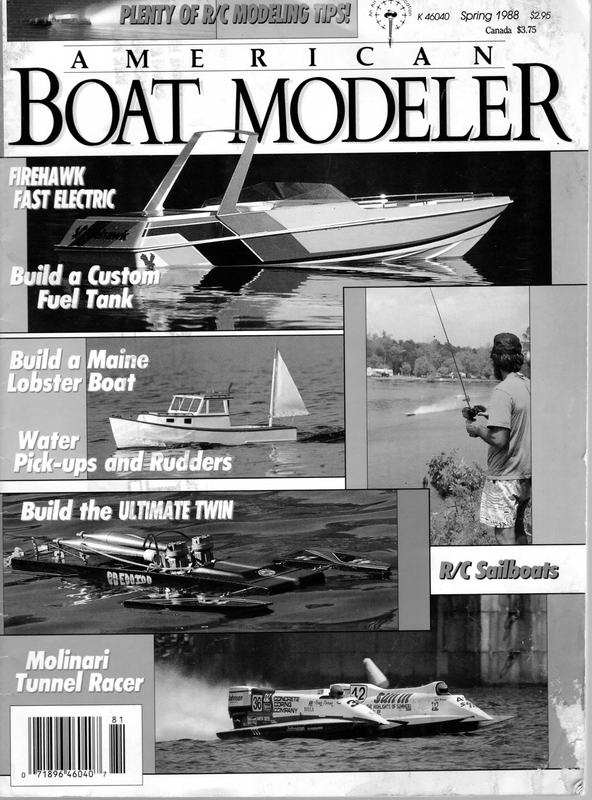
- Title. Author. Summary

k 46040 Spring 1988 $2.95 Canada $3.75 UL
L Ace Nautical T LAST YEAR’S Toledo R/C show, I talked with the “big three” radio manufacturers about producing a radio system tailored to meet the needs and requirements of the serious boat modeler. Several cross-country TRANSMITTER pes . Size: 134x6x6\ inches s. BARNARD Weight: 1.5 pound KEMTER Output: 600mW nominal. Voltage: 9.6V nominal. Yes telephone calls to Drain: 140mA average. these companies revealed little interest on their part. One company Modulation: AM. Pulse Width: 1.5ms+/-0.5ms. Channels: 5, withservo reversal switch- es on four channels. Dual rate option representative told for rudder. me that their BATTERIES 500: mA AA rechargeable nickel cad- market research indicated that there wasn’t a market for a boater’s radio system. These people may also think that there isn’t a market for a magazine devoted to R/C boats! Let mium cells. Receiver: 4.8V. Transmitter: 9.6V. | | | CHARGER | 50mA @ 4.8V and 50mA @ 9.6V. | dual output. 110V @ 60Hz input. LED monitor; RECEIVER me introduce a radio system that is designed for the power or sailboat Size: %,x1!¥32×2\, inches. Weight: 1.4 ounces. | Voltage: 4.8 nominal. Drain: 10mA. Sensitivity: Less than 2 microV. modeler. Ace R/C Inc.*, recently introduced their Nautical Commander radio | | yo system. Based on their Silver Seven family of electronics, the Nautical Commander offers a stick configuration that a boater will appreciate. Rejection: 6cB. Control System: Positive pulse output. The First Radio Specifically Designed For No longer do we have to be content with stick configurations that were intended for controlling aircraft or cars. There’s now a choice and what a choice! The first thing I noticed on the transmitter was an abundance of control sticks. At a glance, I realized that this system is different. I also noticed that this is a basic “meat and potatoes” type of system. The transmitter case is good, old-fashioned, vinyl-covered aluminum, which is both solid The RIC Boat Enthusiast. case, and two auxiliary short sticks—one on each side of the case. The rudder control, located in the usual place, is on the right. Instead of a mechanical click-stop trim, Ace uses an electronic trim located directly below the rudder control. This feature allows the user to dial small amounts of trim without a mechanical click-stop or ratchet to dictate and rugged. the amount of trim. lights and tail fins found on many imports that attempt to attract the buyer with their flashy appearance. In contrast, the Ace Nautical Commander is elegant in its simplicity. now possible. Electronic trim controls for these two This system doesn’t have a molded, plastic, stylized case with the fancy chrome plates, housings, horns, whistles, What really separated this from the other systems that we’ve been using is the layout of the control sticks. There are three, single-axis sticks on the face of the transmitter 30 RADIO CONTROL BOAT MODELER On the left side, where we usually find one, 2-axis stick, we find two separate throttle/sail controls mounted side-byside. This is a major breakthrough for the boater. Independent control of two motors or two sail winches is channels are located directly above, on the top of the transmitter case. (Continued on page 80)
Above: Lolling captains and sails waiting for the next round. Below: Ken Qualterie holds the main boom of Chris Jensen’s boat that broke when his hit Chris’s during a strong gust of wind. Below: George Greenhalgh re-sheets his Big Bad Orange in preparation for the event. by LOUIS ANDREKO SN’T IT ALWAYSa pleasure to tell about days when, despite all odds, everything went right and good things came your way? I had just such a day in September, and went home clutching a hard-won award. The events? The Mini America’s* Cup Match Race SPRING 1988 31
RACE RESULTS Mini America’s Cup U.S. Trials 1. Manny Costa 2. Al Spring Newport Mayor’s Cup Regatta 1. Manny Costa: 17 points 2. Ed Holt: 3734 points 3. Al Spring: 40% points Wooden Paddle Award Louis F. Andreko ANNY COSTA’S NAME is becoming familiar in the Northeast as he continually excells in the annual Newport EC 12-meter model sailboat races. Ironically, Manny’s most sought- after prize has eluded him— becoming the Mini-America’s Cup champion during one of the international race series. But as far as the Hobby Industry-sponsored U.S. Trials, the Fort Adams/MACA Cup and the Newport Mayor’s Cup goes, the name of Manny Costa appears more than the name of any other participating skipper. Manny has propelled himself to the top of the list of ranked skippers in the Northeast. The races in Newport were no exception, as Manny won nearly Trials, and the Newport Mayor’s Cup Regatta. Hosts for this two-day event in Brenton Cove, Newport, RI, were the members of the Narragansett Model Yachting Asssociation, AMY A* Club No. 51. When | arrived early on September 12, the club members were already test-tanking each model according to the rules. My East Coast 12 just made the 42-inch water line, so I knew it was a little light. However, as you read on you’ll discover how, with a touch of ingenuity and a lot of determination, | 32 RADIO CONTROL BOAT MODELER every race he sailed in, losing only one. No other skipper came close. Even the rain on Sunday failed to stop him. The weekend was a mixture of match races (Fort Adams/MACA Cup—U:SS. Trials) and regatta races (Newport Mayor’s Cup). Races were alternated, allowing skippers a chance to catch their breath from time to time. In 1988 we’ll have a new mayor’s name on the cup, as Mayor Patrick G. Kirby has elected not to rerun. With over a dozen potential candidates, it’s difficult to know who our next benefactor will be but we hope he’ll be as involved with our program as his four predecessors have been. was able to improve on this. The day was overcast and threaten- ing rain, but with hot coffee and doughnuts provided by George Greenhalgh, no one seemed to be worrying. George, president of the host club, introduced me to Jack Sullivan (Minuteman Model Yacht Club) and Hank Bouchard (Nar- ragansett Club) who were to be race directors during the weekend event. Hank gave me my racing card and advised me to tape it to the back of my transmitter. At 9:30am skippers met to discuss the course, and to hear the rules. One rule dismayed me. If you fouled another skipper’s right-of-way you’d have to do a “720”—two, 360 turnabouts! This would really be bad for your boat’s time, and definitely encouraged well-mannered seamanship. During this meeting I was constantly delighted to meet skippers whom Id previously known only by reading about them. The wind was blowing strongly and! soon found that my boat, Nasty Winch, needed more ballast to cope with the difficult, fast-paced conditions. The day was well organized, with some fleet racing between the fastrunning heat races. As one set of boats rounded the windward mark, the next set started racing. A high wind adds excitement but also takes its toll of the boats. The East Coast 12s had torn sails, broken sheet lines and stripped winch gears, and there were a few that just sailed away out of control and had to be retrieved. I thank the skippers who helped me when I had trouble sailing upwind. | knew my boat needed more ballast in her keel, and the thought tormented me until… Read on! To our relief, the afternoon was sunny, and by the end of the day 75 per cent of the match and fleet racing was over. At a well-earned dinner that evening at the Cricket Inn, Middletown, Rich Palmer entertained us with some enjoy- able home movies shot in Australia and New Zealand. But nothing could take my mind off ballast! I needed more and had to have it in time for Sunday’s racing! By 6:30 on a very rainy Sunday morning I was ballast-hunting in a (Continued on page 49)
BOAT REPORT VICTOR MODEL PRODUCIS 7 SOLING AN OLYMPIC-CLASS SLOOP WITH NO BAD HABITS. See TER HE SOLING 1 METER is a 2-channel semi-scale R/C model of the Soling 1 design racing sloop. The Soling is 39.3 inches long, has a beam of 9.25 inches, and carries just under 600 square inches of sails. These specifications conform to the Olympic one-meter class of the American Model Yacht Association*, and the Soling may be competitively sailed in 1-meter regattas. The Soling features molded high-impact styrene plastic deck, hull, bulkheads, keel and rudder. The components are precision-molded, trimmed and ready for assembly. A complete set of hardware is included. Also furnished is a complete set of finished Dacron sails. All that’s required to completely assemble the Soling is: adhesives, radio system with sail-control unit, paint and 6% pounds of lead shot ballast. The three sheets of instructions are well illustrated and include the latest revisions as well as a by BARNARD KEMTER separate sheet of instructions for installing an Airtronics* or Futaba” sail-control unit. CONSTRUCTION: Study the plans carefully before starting. Start with the keel. The wooden keel spar attaches A GOOD WAY FOR THE AVERAGE MODELER TO GET TO THE REGATTA. to the keel pieces with either epoxy or thick cyanoacrylate. Bond the outer edges of the keel together with plastic cement. While doing this, hold the edges together with masking tape to maintain alignment while the glue is drying. I used Micro-Weld* and a small (00) paintbrush to apply the adhesive and obtained excellent results. The plans call for adding 6% pounds of ballast, but if you usually sail in light winds I recommend that you use a pound less. Make sure that all the seams are well sealed. Any gaps that may appear on the edges can be filled with automobile polyester body putty and feather-sanded. Make sure that the keel has watertight seams. The rudder consists of two segments, and assembly is very similar to that of the keel. Don’t glue the rudder shaft in place at this time as it will be glued in place later. To prepare the deck, drill two holes for the sheet exits and install brass eyelets in these holes. The correct locations of the backstay and jib swivel are indicated by molded dimples in the deck. Make the mast footbracket as shown on the plans SPRING 1988 39
and glue in place with plastic cement. Use the glue sparingly when gluing the plastic. The hull assembly is well documented on the plans and drawings. The forward bulkhead requires a slight modification as shown on the plans. Notch out a small area in the center of Rese yop The Soling wing is made ‘4 high-impact styrene with a parts pretrimmed for easy assembly. Above: The overhang of the deck will be trimmed flush with the transom and the seam filled with wood dough. 40 RADIO CONTROL BOAT MODELER the bottom flange. Don’t overlook this as it may cause a problem when mounting the keel. When mounting the keel study the plans and do a dry run of the installation. Make sure that the keel is aligned vertically (both fore and aft) and that it’s centered lengthwise on the boat. Use plenty of epoxy to seal against leakage. Time spent on the keel installation will result in better boat performance. A misaligned keel creates useless drag in the water. While you’re doing all this, you can plan the radio installation. The instruction sheet for radio installation shows several suggestions. Another excellent source for building radio boards is the American Model Yacht Association. They offer several reprint articles on this subject for a nominal charge. Whatever method you choose, make sure that the radio board will fit through the opening in the deck, and that the mounting screws are accessible from the deck opening. Install the rudder block and rudder-bearing tube. When installing the deck, use masking tape to hold the deck tightly to the bulkheads. When gluing the deck flange to the hull, inject a small amount of glue into the joint while depressing the edge of the hull to create a gap between the hull and the deck flange. I used too much glue and found a soft bubble on the seam a day later, but I was able to puncture the bubble with a straight pin and press the seam flat. You’ll discover that the aft portion of the deck will overhang the transom. Trim the overhanging deck at the transom and fill the gaps with cellulose wood putty. When dry, sand the filler to achieve a smooth transom. The rudder may be installed now. My kit had the revised rudder instructions and control arm, and I welcomed this (Continued on page 62)
| i PROPELLER FIREHAWK (Continued from page 60) only fractions of a second, and its size and hull design make the Firehawk much more versatile. Running in a straight line or arounda buoy it will keep almost every boat in its wake when running on smooth water. As far as running in the chop, NOTHINGin its class will touch it! I recommend this boat is accomplished Sharpening and balancing from the back of the to anyone who wants to be the leader of by removing material blades only! the nautical pack! *The following is the address of the manu- hundred and fifty grit emery cloth will take out the scratches, and a buffing wheel will make your prop shine like a mirror, but a shiny prop doesn’t mean a lot. Proper balance and fairly sharp facturer of the Firehawk: Varicom Industries, 18480 Bandilier Circle, Fountain Valley, CA 92728 leading edges are all you really need. | prefer to sharpen the blades before balancing the propeller rather than Oo 1-METER SOLIfromNG page 40) (Continued sharpening the blades during balancing. To sharpen the blades, take material off the rear side of the prop from the leading edge to about ¥ inch from the edge. While the edges could be made change. The rudder was not removable and this caused some problems during the painting of my first Soling. When the rudder is removable, finishing the razor sharp, remember that you’ll be handling the propellers with your bare hull is a lot easier. To prepare the hull for finishing put a fillet of body putty where the keel joins the hull and wet sand with No. 600 wet/dry sandpaper. I painted the boat with acrylic auto body surface primer and lacquer. When the paint was thoroughly dry it was rubbed to a glossy finish with polishing compound. Striping tape was used to provide accent and contrast to the black hull and hands. The trailing edge of the prop blade should also be fairly sharp, so that the water leaving the blade can make a clean break. deck. The mast splice is precut for ship- ping. The spruce mast arrives in two pieces which must be glued together. I used epoxy for this operation, clamping the two pieces to make sure that the mast blank would be straight. Lay out the locations shown on the prop on their simple Balancing a Pratherbalan cer. but effective prop There are a few precautions that should be taken when working with propellers. Beryllium copper presents a health hazard if inhaled or ingested, so use goggles and a respirator if you use power tools to grind beryllium props. Be careful not to grind the propeller so thin that it becomes weak, and watch those sharp edges! There’s one other thing about balanced propellers—they make your boat go faster! *The following is the address of the manufacturer mentioned in this article: Prather Products, 1660 Ravenna Ave., Wilmington, CA 90744. oO 62 RADIO CONTROL BOAT MODELER plans for drilling the holes for the spreaders and sail attachment. Drill the holes and slot the mast for the brass masthead bracket before shaping the mast to a teardrop cross-section. The jib club and boom are spruce too, and must be laid out to have the required holes drilled prior to shaping the wood. I finished the wooden pieces by sanding and then coating with two coats of polyurethane. Rigging the mast requires that two sidestays of equal length be made. | made a jig out of a piece of 2×4 approximately 30 inches long, and used two finishing nails. I placed the two sidestay lugs over one nail and drove the nail into the board about 2 inches from one end of the board. Drive in the second finishing nail 23% inches away. You now havea jig that will enable you to fabricate two sidestays of the same length. Experience with the Soling has shown me that the sidestay lugs should be reinforced as the music wire pro- vided will, in time, cut its way through the lug. The Soling uses a mast-jack that is very similar to the rig used on the International 14-foot boat, Thunder and Lightning, which won the Prince Of Wales Cup in 1938. This mast-jack is used to tension the sidestays, and this method of rigging allows easy removal of the mast without readjustments. Since I’d already lost one stay during I chose to modify my rigging race, a and used German Pekabe fittings im- ported by R/C Model Yachts. These turnbuckles offer a quick release witha positive locked-closed feature. They are adjustable for fine-tuning and can be locked at a desired location. | also chose to use these fittings because | have a second set of high-aspect sails and mast that I interchange according to weather conditions. For the boom vangI used a Pekabe double turnbuckle with handwheel. This makes a very adjustable vang that doesn’t lose tension. I used a chain plate to attach the jib club swivel in such a way as to make it adjustable to changing wind conditions. While the rigging that comes with the Soling is adequate, I made modifications which suited my particular needs. The one-panel Dacron mainsail is attached to the mast with cotter pins that enclose a wire stiffener in the luff. Don’t glue the cotter pins to the mast until you’ve rigged the boat and are satisfied with the positioning of the mainsail. A drop of cyanoacrylate will hold the cotter pins securely in their predrilled holes. PERFORMANCE: The Soling per- formed faultlessly, was very agile and quickly responsive to the slightest command. Tacking was fast and accurate with no tendency to overshoot. The hatch cover, with its overlapping lip flange, kept the interior of the boat dry when a strong gust of wind caused the (Continued on page 67)
WORLD’S FASTEST TURNING BOAT SOLING 1-METER (Continued from page 62) boat to broach. The Soling is available in kit form from Victor Model Products*, and I strongly recommend it to you. The kit can be successfully completed by a modeler with average abilities. The wooden and plastic pieces all fit together well and are of a high quality. The kit sells for $70 plus $3.00 for shipping, and is also offered with an Airtronics SR-2 radio system, sailcontrol unit and rudder servo for $158.50 plus $6.00 for shipping. Over five hundred modelers have already taken advantage of this excellent offer. Once you’ve sailed your Soling you may want to join the American Model Yacht Association so that you can compete in the nationwide regattas which they promote and sponsor. On that breezy day when you first see the billowing sails of your new boat and you watch it glide smoothly with the nonchalance of a tugboat in a baby’s bath, you’ll feel richly rewarded for all your efforts. *The following are the names and addresses of the manufacturers mentioned in this article: Victor Model Products, 11715 Adenmoor Ave., Downey, CA 90241. Airtronics Inc., 11 Autry, Irvine, CA 92718. Futaba Corp. of America, 555 W. Victoria St., Compton, CA 90220. American Model Yacht Association, c/o Pat Hein, 1884 Campus Court, Rochester, MI 48063. Micro-Weld, Krasel Industries, Costa oO Mesa, CA 92647. CANADIAN NATS. (Continued from page 57) tight course. While the DaytonWalthers was the faster boat, with better acceleration, it didn’t hold as tight a course as the Atlas did. While Dayton-Walthers held the lead, Atlas never fell more than 100 feet behind. As the scale hydros finished the fourth lap, Dayton Walthers held a solid 15-length lead. Atlas Van Lines, still in second place, was coming on hard, held a tight course and gained ground through the first turn. Down the back straightaway Dayton Walthers held on to a 10-length lead. At turn 3, Dayton Walthers swung wide, going even wider in turn four. Atlas held tight through both turns and hit the front straight in first place, with Dayton Walthers closing fast. As both boats headed for the finish, Dayton Walthers was accelerating faster than Atlas and closing the gap. At the finish, Paul Omerzu’s Atlas held on to its lead of less than a length. The first-place finish for a perfect score of 1600 points gave Paul Omerzu the National Championship. Only hundredths of a second separated the two boats, keeping the spectators on their feet. Applause was loud for both racers. The hydro classes were dominated by the usual mixture of outrigger designs: Spiders, Coyotes and Crapshooters. However, catamarans and canard designs were also very competitive. Brian Jessup, Dean of the Calgary Club, drove a Fisher canard to win 40 Hydro. Mike Kurz drove 15 hours from Winnipeg to win 60 Hydro (Continued on page 70) R/C SPORTSCRAFT 2°. 120 Hui! Designs Largest Selection of 1/8 Scale Fiberglass Unlimiteds Highest Quality Available -—_ ABSOLUTE FASTEST HEAT RACE TIMES 86 NAMBA – IMPBA NATS ‘87 IMPBA— Huntsville, AL: Mare Bullard— Absolute Fastest Oval Record Ever Recorded. Complete Trophy Sweep In Some Oval Classes Available in 9 sizes Kits or Built-Up | Each Boat is Custom Built By Don Pinckert, ‘’Father of the Outrigger.” 1/8 Scale Unlimiteds Namba Approved Competition Proven Deep Vees Sport 40 Hydros (208) 667-1633 Why run the rest when you can run the best! Send $1 for catalog: P.O. Box 2331, Cour d’Alene, ID 83814 433 Grand Ave. Masaryktown, Florida 34609 Phone (904) 799-0595 SPRING 1988 67
| \ R/C YACHTS racing Ixperience the thrill of 12 meterLeachyacht are1 meter Fg with Victor Cup Series yachts. semi scale models of the most famous of the international 12 meter racing yachts designed specially for RIG sport or competition satling. sail area 598 sq in sible, spend a little more to purchase the manufacturer’s prepared kits. After you’ve completely rigged a tunnel or two, you’ll become innovative and will improvise and improve on the hardware you started with. Again, it’s wise : $ 85,00 AUSTRALIA II length = 39in. sailarea 598sqin to talk to those who run R/C tunnel hulls. Here’s wishing you blue skies $85.00 suitable forAMYA pocart ggaa Additional fits; SOLING 1M \ length 39.3 in. $70.00 length 36 in. $6090 TAHOE. II MINI SOLING sength 30 in. ce ngad aesco $45.00 length 232in, $350 SNIPE For complete details These rigging techniques and sug- gestions are offered only as a starting point. Experience dictates that you go with a winner. In other words, if pos- Complete kits (less ballast) / STARS & STRIPES length 39210 LS each kit add $390 shipping VICTOR Model Products IE Alen oe and calm water! *The following are the addresses of the manufacturers mentioned in this article: S. WoodK&B Manufacturing, Inc., 12152 ruff Ave., Downey, CA 90241. MRP, 18676 142nd Ave. N.E., Woodbin- ville, WA 98072. Sig Manufacturing Co., Inc., 401 S. Front St., Montezuma, IA 50171. Thermwell Products Co., Inc., Patterson, NJ 07524, or Los Angeles, CA 90058. Du-bro Products, Inc., 480 Bonner Rd., Wauconda, IL 60064. ASTRO MAKES WAVES! Astro announces four new super- performance electric motors, specifically designed for scale R/C model boats. A pair of these Super Ferrite Marine 40’s, turning 3-inch props, power the 9-foot, 179 Ib., 32nd Parallel submarine. For Shelly Foss and Mr. Darby class boats, two geared Super Ferrite Marine 25’s drive very realisti- cally for 2-3 hrs. (12V, 10Ah gell cell)… ora pair of direct drive Super Ferrite Marine 15’s will plane the Dumas Enterprise very nicely. Astro Super Ferrite Marine motors are available in 10, 15, 25, and 40 sizes, with or without integral gearboxes. Our marine gear boxes are machined from aluminum bar stock, use two ball bearings and two 303 stainless steel gears, #4042 fits the 10/15 motors and #4043 fits the 25/40 motors. We now have aluminum water cooled motor mounts, #4044 fits the 10/15 motors and #4045 fits the 25/40 motors. Our new electronic speed control #200 uses super efficient MOS power transistors and handles 30 amperes! Our deluxe AC/DC Charger #4005B can charge 4 to 7 nicads from 110VAC or 12VDC. Our new DC/DC Super Charger #102 charges up to 28 cells from 12VDC! VISIT YOUR LOCAL DEALER AND SEE HOW ASTRO IS ‘‘MAKING WAVES” proudly made in the U.S.A. by ASTRO FLIGHT INC. 13311 Beach Ave. ¢ Marina del Rey, CA * 90292 ® (213) 821-6242 80 RADIO CONTROL BOAT MODELER Bru-Line Industries, RO. Box 3786, Cen- ter Line, MI 48015. Hayes Products, 2610 Croddy Way, Unit A, Santa Ana, CA 92704. Prather Products, Inc., 1660 Ravenna Ave., Wilmington, CA 90744. Sullivan Products, 1 N. Haven St., PO. Box 5166, Baltimore, MD 21224. Aeromarine Laminates, 77 Cedar St., Babylon, NY 11702. Carl Goldberg Models Inc., 4734 West oO Chicago Ave., Chicago, IL 60651. ACE RADIO (Continued from page 30) The two auxiliary control sticks are located on either side of the transmitter case. These “mini-sticks” are mounted on an angle where they naturally fall below, and under, the index finger of each hand. Their positioning is comort able and they can be used without looking at the transmitter. If these five channels don’t provide enough control functions, an optional 7-channel system is available. The Nautical Commander is equipped with an expanded scale voltmeter (EVS) to monitor the Ni-Cd battery pack in the transmitter. As long as the needle is in the green segments it’s safe to operate. As the needle approaches the large red segment you know that it’s time to recharge the batteries. Removing the back of the transmitter allows access to the servo-reversing switches. These switches will reverse the direction of servo travel on the rudder, both throttles and the first auxiliary channel. The fifth channel, auxiliary No. 2, can be reversed by following the operator’s manual and reversing two wires. The throttles/sail control sticks can be converted to self-centering functions by adding a spring provided in the hardware package. Ace has also provided the capability to change the neutral point (centering) and amount of throw of all the servos. This pro- cedure is detailed in the owner’s manual and must be followed properly. I haven’t used this feature yet, but it’s nice to know that it’s there if needed. The flexibility to change frequencies is provided by plug-in crystal sockets in both the transmitter and receiver. I recommend buying a second set of
crystals when you order your system. At the first regatta in which I used this system I was required to either change frequency because of a conflict, or give up my plans to sail that day. IfI hadn’t had a second set of crystals with me, my three-hour drive to the race would have been in vain. Even the best-run regattas have unexpected glitches, and crystals for an alternate frequency are an inexpensive insurance policy. The receiver comes with a switch harness and a Ni-Cd battery pack. This system will work with any modern, three-wire, positive pulse, servo or speed control on the market today. Ace thinks that most boaters already have servos or sail-control winches on hand or already installed in their boats. To solve the problem of electrical connectors, a supply of Dean’s connectors is provided with the system. They are basic, solid and functional. I suggest that you paint them to improve the visibility of the polarizing marks on the connectors. Again, the electronics of the system are descendants of the popular Silver Seven series from Ace. In 1991 new frequencies for surface use will go into effect. The receiver supplied with the Nautical Commander is their Silver Seven series. This means that the system will be usable in the 1990s. The Ace Nautical Commander is a long-awaited boater’s radio system. The slight inconvenience that comes with having to replace your servo connectors with the Dean’s connectors is more than offset by the features that this system offers. The system has found instant acceptance with sailboaters, and since its introduction, boaters have been buying it sightunseen. With the transmitter, receiver, NiCd batteries, switch harness and dual charger, this radio system offers an alternative to what’s offered by the big three suppliers. How you choose to apply the control functions to your type of boating will be your decision. If you’re looking for a radio system that offers flexibility in control functions and layout then consider the Nautical Commander. *The following is the address of Ace, the manufacturer mentioned in this article: R/C Inc., 116 W. 19th St., Box 511C, Ace O Higginsville, MO 64037. LOBSTERBOAT (Continued from page 55) the time you’ve built the lobster traps and added the scale lobsters, you can’t wait to see it in the water. TWIN CRAFT DEEP-VEE RACING HULLS The Midwest M.E.P.S. motor and speed control were supplied for this review. However, other types of motors and speed controls could be used. The 1987 IMPBA Internats National Champion F Mono. Fastest oval time in E and F Mono. to attach it to the bulk head, and the kit is really designed for this installation. Unless you’re prepared to make some modifications on your own for another @ Hand-laid fiberglass. M.E.PS. motor uses a single large nut type of motor, the Midwest motor is the way to go. One or two 6- or 7-cell Ni-Cd race car battery packs (flat, not the “hump” packs) are used for power- ing the motor, and these fit neatly under the cabin floor hatch. These will provide adequate running time and may be quickly recharged for another operating session. Careful placement of the R/C com- Features: © Colored gel coat or metal flake. @ Factory-joined deck. Three Hulls Available: @ 56” twin .65-.90 engine $235. © 46” single .45-.90 engine $175. @ 37″ .20 class $150. Distributed through HOBBICRAFT 2005A Huguenot Road Richmond, VA 23235 (804) 323-1122 ponents as described in the manual, should avoid the need to add extra ballast. Your lobsterboat will look just dandy on a mantle display when you’re not sailing it, and the durable construction promises years of running. It’s a seaworthy boat, too. When I went down to the local pond for the boat’s maiden voyage, I found the water frozen so | had to use Great South Bay off Long Island. Even in a stiff breeze and moderate waves, the boat seemed at home. If you’re looking for something different and want a quality kit, try this one. They don’t come any better than this! *The following is the address of Midwest, the manufacturer featured in this article: Midwest Products Co., Inc., 400 S. Indiana St., P.O. Box 564, Hobart, IN 0 46342. THE SCALE SHIPYARD (Warship Hulls Unlimited) Dept. M 5866 Orange Ave #3 . Long Beach, CA 90805 Since 1979 U-505 GERMAN TYPE 4X-C SUB 4:32 Scale 9412” Long—812″ Beam Hull—Tower—Dive Pianes—Rudders— Plans USS TICONDEROGA CG-47 %” Scale 70%” Long—7%4″ Beam Hull Comes With Plan Set. USS MASSACHUSETTS BB-59 %” Scale 85” Long—13’%2” Beam Hull Comes With Fiberglass Super- structure Moldings & Plans. USS FLETCHER DD-445 CLASS %4″ Scale 47” Long—5” Beam Hull Comes With Plans Set. We Have Over 60 Fine Scale Molded Fiberglass Hulls To Choose From, Along With Hundreds of Cast Fittings. Send $2.00 For 1988 Catalog. SPRING 1988 81