- Title. Author. Summary

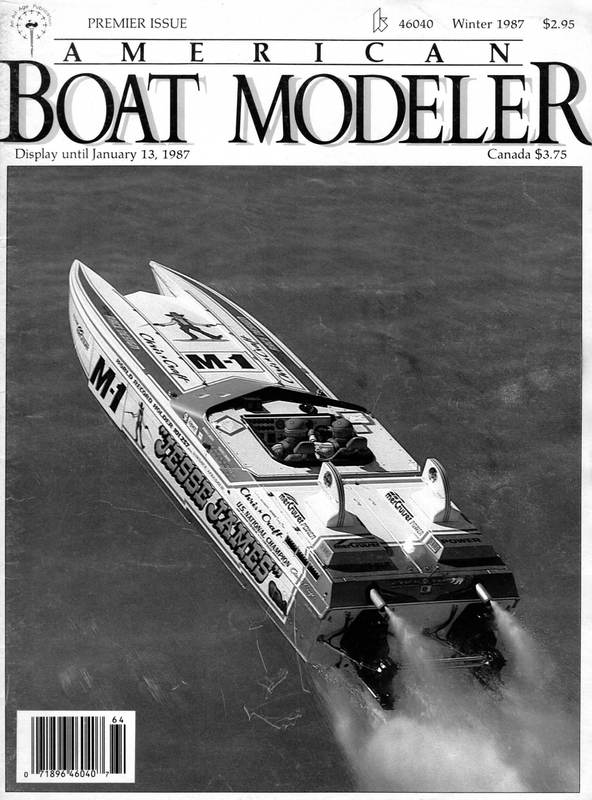
PREMIER ISSUE (f; 46040 Winter 1987 $2.95 C A N 30AT MODELER Display until January 13, 1987 0 | 64 96°46 | Canada $3.75
A superior sailing yacht for the 50/800 class. by DR. DAVID TROST AILING can be a most enjoyable and rewarding pastime. It can also be one of the most competitive sports. Model yachting offers the same relaxation, yet with the thrills of heated competition. Ive reviewed several boats in the past, but not until now have I had the PIROL= = opportunity FROM ROBBE iat I received for review is the Pirol from Robbe*, a model designed to compete in the 50/800 class (50 inches long with 800 square inches of sail). The exact specs of the Pirol are: length 50 inches, beam 11 inches, draught 15 inches, total weight 12 pounds, ballast 6 pounds, maximum sail area 800 square inches, and a max- imum mast height of 86.6 inches. THE KIT. The kit comes packaged in a brilliantly colored box. All the components are neatly bagged or wrapped in tissue paper for protection. The kit includes all the basic materials required for constructing the boat, except for keel ballast, mast, and radio control. Optional accessories consist of two additional sail sets for moderate and strong wind conditions. The hull of the Pirol is made of blow-molded plastic, with the hull and deck permanently joined. Holes for the rudder post are predrilled and the hatch and bow openings pre-cut. There are recesses molded into the hull and deck for chainplates, mast mounting rail, jib boom rail, and keel strake. The plastic used in the hull is very strong and damage-resistant. The surface is smooth and needs only light sanding before painting. The cabin superstructure is designed to slide into a channel in the hull, forming a watertight seal. The keel consists of a plastic strake with a cast-iron weight. The mast is a blue-anodized aluminum extrusion with a formed luff channel. It comes packaged separately from the kit in a heavy cardboard tube taped to a piece of wood to prevent damage. The main and jib booms also are aluminum extrusions. The dacron sails are supplied pre-sewn, ready to install. A complete hardware set containing everything needed to rig the boat is included. CONSTRUCTION. Construction is guided by a step-by-step manual and two plan sheets, oneillustrating the hull construction and the other the mast and rigging setup. The manual is brief but complete. Construction of the Pirol is quick and easy because most of the parts are formed plastic; all of which are high-quality, and produce a beautiful, sturdy, and functional boat. Construction begins 20 American Boat Modeler ! by building a stand for the photos by LOUIS V. DeFRANCESCO JR. boat. A diagram for a sturdy wood stand is included on one of the plan sheets. I built my own stand from some scrap styrofoam insulation that was lying around. The plastic used for the hull can be glued with cyanoacrylate, and silicone rubber cements, but not with standard epoxies. Robbe provided me with a package of Stabilit Express, which works well with this plastic. Stabilit is a thick, two-part type that is similar to most other epoxies. Mix up only an amount that can be used in about five minutes, because it sets quickly. Hull construction begins by fitting and gluing the wooden bulkhead support inside the cabin. The rudder post is then glued into the pre-drilled holes. The aluminum mast mount, chainplates and jib boom mount are supposed to be glued into their respective recesses at this time. I didn’t glue them on my boat, though; instead I rely on the six 2-mm bolts that go through each piece to hold them onto the deck. The chainplate recesses are angled away from the centerline so that when the shroud tensioners are attached, they angle away from the mast so the shrouds cannot be set up _ accurately. This problem can be corrected by blocking up the outer edge of the aluminum rails with a piece of scrap plastic. Holes for the fore and back stay mounts and the aluminum sheet guides (Continued on page 53)
The R/C version of a coveted American institution. R/C yacht racing is fun, as demonstrated by Manny Costa and his winning 1984 Mini-America’s Cup yacht. Twelve-Meter Model Yacht Challenge Series OR OVERa decade 12-meter model yachts have rivaled their full-size versions for a spot in the world showcase of yachting. These models of 12-meter boats provide all of the anxieties, frustrations, nerves of steel, and super skipper abilities of the fullsize 12s. February of next year will see the “big boys” dueling on the west coastline of Australia, near Perth/Fremantle. Back home in Newport, in September 1986, the model yacht “match racing” event will be defended by the United States. Although pilots of the full-size ships will be racing for the first time outside of the U.S.—hitherto perennial defender—the model yachts returned there after losing to John Cleave of England. England became the official defender in 1983, only to lose its brief hold on the coveted silver trophy when Buddy Black recaptured it for the U.S. in a very exciting seven-race series. The history of the Mini-America’s Cup began in 1974 when the Hobby Industry of America (HIA) featured model sailboat racing as a part of its ongoing public relations program and provided the TV news stations with various subjects of hobby interest. Taking advantage of the cup races during that year, HIA started a miniature version in conjunction with the Newport International Sailboat Show and the America’s Cup Races in September 1974. Although both skippers were from the U.S. (one from the by RICH PALMER Winter 1987 29
all-time best in the world of model sailing. Chuck Black (a prominent initiator of the 12-meter model boat) from the San Diego area faced his brother James “Buddy” Black (designer of the smaller model) from Tampa, Florida. The official model used at that time was a one-design class, EC 12- meter model yacht, measuring 52 inches in length and about 6 feet in height. Chuck Black, whose proficiency is with a larger version of East and one from the West Coasts), the racing procedures followed the race course and format that the fullsize boats were using in the Atlantic Above: These two model yachts near the starting line are vying for ke position an favorable winds. Below: These proud skippers were from the 1983 MiniAmerica’s Cup. 30 Ocean, outside of the Newport, Rhode Island, harbor. The model yacht races took place in the ocean seas within 100 feet of all ocean-going traffic entering or departing the harbor. Heavy wakes and windy seas provided a unique challenge for the first two skippers ever to compete in a Mini-America’s Cup race series. Ironically, when the HIA sought out two of the nation’s leading skippers from either side of the country, they wound up with two brothers who ranked among the the 12-meter model hull primarily used on the West Coast, eventually wound up losing to his brother in a five-race series (Buddy four wins, Chuck one), with Buddy’s experience in the smaller version paving the way for his victory. Interest was so keen at the end of the series that Rich Palmer (then chairman of HIA’s P.R. committee) experimented with letters to other countries to see if this might become an ongoing activity. Response was immediate and enthusiastic, and 1977 became the year of the first Mini-America’s Cup international event. Skippers from Australia and England were among those traveling thousands of miles with hopes of breaking the U.S. hold on what seemed a permanent domination of the America’s Cup hardware. Also in 1977, Bob Harris, president of the American Model Yachting Association (AMYA), from which the MAC rules were used, won out over a dozen U.S. skippers to become the first official defender of the Mini-America’s Cup. Neither of the Blacks were available for the 1977 program, leaving the field wide open for U.S. hopefuls. John Cleave of England bested Neil Bennel of Australia to earn the title of “first challenger.” A close race series ensued with Bob Harris establishing himself as the first winner of an international match race series in the Mini-America’s Cup. Unfortunately, Bob Harris passed away two years later, thus opening up the field, once again, for 1980, also the year in which it became clear that match racing was going to be an exciting part of model sailboating. Following the formula and formats of the big boys, model sailboating would
a Final awards for ’83 MAC presented by Newport Mayor Paul L. Gaines. Left, Buddy Black, USA winner, right John Cleave, English runnerup. The gent with the mike is organizer Rich Palmer. surely challenge the nerves and abilities of model skippers. An exciting duel between Chris Jensen of Itasca, Illinois, and Carter Cain of Hilton Head, South Carolina, ensued in 1980, too. It took seven races for Cain to best Jensen after Jensen gambled and lost in a technical maneuver in the seventh and final race. Cain then had to face John Cleave, who had easily won out over all foreign participants to again become challenger. Racing history was made at this time as John Cleave beat Cain to become the first foreign participant ever to take the cup away from the United States. With the defense of the full-size cup and the full-size pilots racing in Newport in 1983, John Cleave elected to defend his cup at Newport, famed “sailing capital of the world.” In the same year, Buddy Black decided to come out of retirement and compete. Each year there are 15 skippers selected by invitation or qualifications through regional model sailing contests. The Mini-America’s Bottom left: Buddy Black at the controls of Pied Piper with his infamous lucky hat. Bottom right: John Cleave, left, the English defender, with his Scalywag and Buddy Black, right, from the USA, with his Pied Piper. Cup boasts the largest group of super- skippers in the world of 12-meter (Continued on page 68) oe tm Winter 1987 31
spigot for the valve disc drive. It is supported in a seven-ball 8×22 mm bearing at the front and an eight-ball 12×28 mm bearing at the rear, both fully contained in a separate front housing which projects well into the rear of the flywheel. The flywheel has a diameter of 45.7 mm (1.80 in.), a length of 40 mm and weighs just 7% oz. A conventional U/J coupling is included. One final point. A quick look through the advertisement columns indicates that the Picco P-65 Marine is currently available at somewhat lower prices than its immediate rivals. Peter Chinn, c/o American Boat Modeler, 632 Danbury Rd., Wilton, CT Oo 06897. DEFENDER (Continued from page 27) Less than nine months after being commissioned, Ticonderoga departed from Norfolk on her first operational deployment on October 20, 1983. During the rest of that year and into early 1984 the cruiser destroyer group eight flagship proved herself much more than just a cruiser while off of Beirut, Lebanon. According to the U.S. commander-in- chief of the Navy in Europe, the ship “exceeded expectations in terms of the contribution made to overall battle group effectiveness. The ability to achieve and maintain a high-quality battle picture enables force commanders to control rather than react to the ever changing situation.” With the Soviet Union developing a potentially threatening array of ships and weapons systems designed to sink carriers, Ticonderoga, with its shield of | weaponry and umbrella of visibility, is the Navy’s answer. If the need should ever arise, a floating revolution, with its electronic prowess, will be called upon to O deliver the lethal dose. PIROL (Continued from page 21) then are drilled and the parts fitted. The next step is to build up the cabin superstructure. The cabin is made up of four pieces of plastic that form the hatch, and one piece that attaches to the hull hatch opening. The finished hatch simply slides into a slot on the hull, forming a watertight seal. The keel strake is assem- bled from two ABS plastic halves that sandwicha brass rod and steel pin. The rod is threaded to hold the keel weight, and the pin keeps the weight in proper alignment. The keel weight should be fitted to the brass rod while you’re assembling the strake to check alignment. I had to modify the guides for the brass rod somewhat to achieve perfect alignment of the plastic and metal parts of the keel. A hole then is drilled in the bottom of the hull to pass the brass tube. The keel strake is glued to the hull and the top of the brass tube to the underside of the deck. The manual recommends usinga fillet of glue only around the brass tube at the deck to secure it. I chose instead to run the tube through a small square of 4-inch plywood glued to the deck to strengthen the joint. ’’d recommend also strenghthening the junction of the keel strake and the hull from the inside with some wooden pegs or small screws. I didn’t do this originally, which resulted in the keel loosening up after the first few days of sailing. Make sure the keel is perpendicular to the hull as the glue sets. The hull is completed by adding some ABS plastic pieces to the bow to seal up most of the opening. The keel weight is of cast iron and must be filed and sanded smooth prior to paint- ing. Though this may be a pain in the neck, it’s necessary if the boat is to perform well. The radio is installed through the generous hatch opening. An Aero Sport Two by Two, two-channel radio control from Hobby Shack* was used in the Pirol. It’s a good, no-frills, dry-cell radio that features both high quality and solid performance, requiring only a few modifications to make it perfect for R/C sailboats. It has two single-axis gimbals with spring centering. This is fine for the rudder, but isn’t suitable for sail control—the spring centering mechanism, though, is easily removed from the left gimbal after opening up the transmitter. A standard servo was used on the rudder and a Futaba* S10 sail winch (Continued on page 58) a -CELLENT SULTS! Now there are16 OCTURA X-SERIES aN TO FITALL R/C MODEL BOATS LEGAL UNDER BOTH IMPBA & NAMBA ENGINE DISPLACEMENT RULES… From the 3.5cc outboard up toand including the15 and 30cc marine engines there is now an Octura X-series metal propeller to get maximum performance. RECOMMENDED APPLICATIONS 3.5 0UTRIGGER 4 .75 DEEP VEE 7.5 OUTRIGGER A X437/3 xaa0 /3 X442 445 X447 X450 oh X455/3 X457 X460 3-Bladed Propeller *y 467 indicates * 250 Bore. aor a 7.5 OUTBOARD TUNNEL 7.5 OUTBOARD .65 SCALE HYDRO .65 DEEP VEE 65 OUTRIGGER -90 DEEP VEE “X482——— TWIN .90 OUTRIGGER THE R/C MODEL BOAT PROPELLER PEOPLE 7351 N. Hamlin Ave « Skokie, IL 60076 Winter 1987 53
PIROL (Continued from page 53) servo for the sheets. The receiver and the rudder servo use four AA dry-cell batteries for power and the sail winch servo utilizes a separate 6-volt, 1,200mAh Ni-Cd battery. The servos and batteries are mounted on the plywood and glued to the hull. The rudder is connected to the servo througha standard arm and pushrod. After installing the rudder steering mechanism, I made a hatch out of scrap plastic to cover the recesses in the transom for the rudder torque arm. The sail winch servo has an output drum that rotates about four turns with full stick travel. A pulley is mounted under the forestay and under the cockpit. Access to the pulley under the forestay is accomplished through a hole in the bow. A line is run from the servo drum around the two pulleys and back to the drum. When the transmitter stick is moved, the line is taken up at one end and let out at the other, thereby rotating the loop. The main and jib sheets are tied onto the loop. The amount of loop-travel can be regulated by adjusting a pot on the servo or by limiting stick movement at the transmitter. The receiver and batteries should be waterproofed by wrapping them in plastic bags and sealing the ends with tape or wire ties. These components also can be raised up on styrofoam blocks for added protection. The radio installation was completed by fitting a Deans base-loaded antenna. The mast is constructed by drilling holes, filing flats, cutting slots in the places indicated on the diagrams, and fitting the spreaders. The two spreaders are assembled from brass tubes, brass cotter pins, and threaded rods. The booms are cut and trimmed according to diagrams. Brass cotter pins are fitted to the booms to attach the sheets and sails. The jib boom is connected to the hull with a ball-race-supported swivel. The main boom is attached to the mast witha ball link system. The stays and shrouds are made from thin braided steel cable soldered into brass sleeves. There are screw-tensioning devices on each of the shrouds and stays. It is essential that the mast is vertical both fore to aft, and side to side, which is accomplished by leveling the hull in the stand and hanging a plumb line (a string with a weight on the end) from the top of the mast and adjusting the stays and shrouds so the line hangs straight down the mast luff channel and touches the hull on the centerline. This procedure eliminates mast-bend and insures that the mast isn’t tilted to one side. The fore-to-aft position can be set by leveling the hull in the stand and adjusting the stays until the plumb line wind. Tacks were quick and controllable. Several times during gusts the boat heeled over about 40°, burying the side of the cabin, and shipped only a couple of drops of water. The boat seemed quick and pointed well, but as of yet I haven’t had a chance to compare it to another 50/800-class boat. I’m looking forward to amatch race that I’ve set up for the near future. Pirol is a quality kit that builds fast and produces a sharp-looking model that should be competitive in most 50/800 regattas, but it also can serve as means for a wonderfully relaxing afternoon of casual sailing. *The following are the adresses of the companies mentioned in this article: Robbe, 180 Township Line Rd., Belle Mead, NJ 08502. runs parallel to the mast. With sails mounted on the mast and booms, the sheets should be adjusted so that the booms cannot swing out more than perpendicular to the hull. I painted my Pirol with blue, white, and black Krylon paint. After final assembly and adjustments, the sheet pulleys should be lubricated with a drop of heavy oil, and then the rubber bow piece can be glued on. PERFORMANCE. I sailed the boat for the first time on a day with a 5-knot wind in slightly choppy water. The Pirol was placed in the water—and off it went. Thirty minutes of fun followed! The boat was very responsive to helm and tracked very straight on both tacks and down- Hobby Shack, 18480 Bandilier Circle, Foun- tain Valley, CA 92728. Futaba Corporation of America, 555 W. Oo Victoria, Compton, CA 90220. JESSE JAMES (Continued from page 34) voids. All bulkheads and engine rails are aircraft-grade birch ply and are firmly locked into place with heavy glass cloth. In high-stress areas, such as the transoms and sponson bottoms, extra cloth and matte are used to prevent flex and component separation. These hulls are exceptionally strong, yet light. AsI mentioned before, the gross evolution of R/C boat racing produced the offshore racing cat as you see it here. It’s the subtle “tricks” that Aeromarine incorporates into their hulls that make them the winners that they are. One more recent trick is the rubber flex mount, Dagger sDV Stiletto Canard Hydro 67-80 Engine Class A Holds NAMBA District 1 Low ET A 2nd IMBPA Winter Nationals A State of the art design fast and stable A gel coated fiberglass A hull and decks factory joined A choice of colors 40″ Deep Vee hull Surface Drive $120 with hatch A isolation engine mounts Send $2 for complete catalogrefundable with first order 58 American Boat Modeler $189 Dagger Boat Works 1 2392 New London Turnpike S. Glastonbury, CT 06073 (203) 633-0398
Hughey 05 Twinn The Twinn 05 Electric inboard power system is for fast electric racing boats, typically used in the USS. 8- to 16-cell classes that fall into the 20-35 mph range. Some of the Hughey 05 Twinn’s achievements in the IMPBA ‘4-mile oval in the 0- to 10-pound class are: 48.17 sec. time, 24.91 mph average speed, and an estimated 35 mph average straightaway speed. The geared output increases torque by three times that of an ungeared motor and lowers battery drain, yielding runs of up to five minutes on 8 to 16 sub-C cells, depending on hull. Features include: acceptance of most 05 motors, 14-ounce total weight with two motors, 21- and 37-tooth molded-nylon gears with metal hubs, and a compact width of only 2!*/6 inches. For more information write Hughey Boats (P.O. Box 68328, Indianapolis, IN 46268). Self-righting Catamaran Pop Up’s new cat embodies the best of the world’s greatest racing catamaran sailboats, modified to accommodate mechanism and conditions in ponds and small lakes. The boat is a superb sailing machine and has a fail-safe righting system that in no way impairs its appearance and performance. All mechanisms are hidden in hulls. The system uses a standard drum winch that has a wide margin of power to right the boat instantly with masts of more than 85 inches and sails of over 1,500 square inches. Specs are: length 48 inches, width 30 inches, weight 612 pounds, draft 8 inches, sail area 1,000 to 1,500 square inches, overall height 87-100 inches. A VHS tape is available for viewing. Contact Pop Up Manufacturing (27 Emerson Ave., Amityville, NY 11701) for more information. Sea Wasp-6 Mk II The Kroker Engineering and Development Sea Wasp-6 Mk II from Electurian (P.O. Box 14056, Albuquerque, NM 87191)is an ultra-precision electric marine motor. Kroker electric motors are known around the world for their superior quality and performance. The Krokers, used in more than 15 countries, hold numerous national and international records including the Gold Medal European Championships. The Sea Wasp-6 Mk IL like others in the Kroker line, features water-cooling, dynamically O.S. Marine Engines balanced annealed high-silicon-steel armature, diamond-bored ball bearing » Ww housings, lifetime-lubricated ball bearings, silver graphite brushes, diamondturned commutators, and resin-impregnated and welded (instead of soldered) armature windings, just to name a few. ‘Kem O.S. Marine Engines (distributed by Great Planes Model Distributors, P.O. Box 4021, Champaign, IL 61820) come in a variety of sizes for many types of boats. All two-cycle O.S. engines feature water-cooled heads for cool, reliable operation. They’re designed and built to the high standard quality that all O.S. engines are famous for. O.S. .10 FSRM, 20 FP-M, and .90 RSR-M are extremely reliable, easy to start, and easy to operate. The .90 RSR-M features ABC piston/sleeve construction. For competition, the O.S. .21 SE-M, .40 VR-M, .46 VR-M, .61 VR-M and .65 VR-M are ideal. All feature ABC piston/sleeve construction for high-compression and exceptional output. For smooth operation, great fuel economy, and a lower-pitched more scale-like sound, try an O.S. four-cycle marine engine. The O.S. FS-40M and FS-61M both feature built-in water-cooling jackets to keep the temperature low and Jomarine Primetime This competition-proven hull has been a winner in static display and heat racing. Designed for oval racing, it has excellent straightaway speed and sharp steady turning capabilities. This is easy to build and features white gelcoat finish, joined hull and deck (40×12 inches), plywood transom installed, flotation and turn fin materials, and complete instructions and hardware list. Options available: colored gelcoat, predrilled engine rails installed. Contact Jomarine (3422 Third Ave. W., Hibbing, MN 55746) for more information. performance high. Winter 1987 61
press releases supplied by Descriptions of new products appearing on these pages were derived from not constitute the manufacturers and/or their advertising agencies. The information given here does by American Boat endorsement by American Boat Modeler, or guarantee of performance or safety be Modeler. When contacting the manufacturer about any product described here, sure to mention you read about it in American Boat Modeler. Weatherly 12-Meter Aristocraft Australia Il The Australia II model is a well-detailed duplicate of the full-scale America’s Cup defender featuring a winged keel, also true to scale. The model has seen two years of testing and development, and has proved itself an active compe- titor in the new world of miniature R/C sailboats. Its dimensions are: length 20 inches, height 32 inches, width 5 inches. The boat draws 41 inches of water and glides accurately under a variety of The next release from Midwest Products Co. (400 S. Indiana St. P.O. Box 564, Hobart IN 46342) of the Midwest/ Laughing Whale boat line is The Weatherly, the most beautiful of all the 12-meters and selected in 1962 as the defender of the America’s Cup. This deluxe kit features Midwest Micro-Cut basswood and mahogany parts; cleanly die-cut frames featuring basswood, authentic plank-on-frame construction utilizing basswood strips, plus all material for mast, boom, sailcloth, and rigging including cordage. The full-size plan sheets and an illustrated step-by-step instruction booklet permit the hobbyist to make good replica for display or as a running model. The specs are: overall length 35 inches, beam 6 inches, height 48 inches, scale 2-inch to 1 foot. Ask for The Weatherly at your hobby shop minimal wind conditions. Installing a two-channel radio is an easy process and no expert model-building skills are necessary to complete this project; assembly time is just a few hours. For more information contact Polk’s-Aristocraft (346 Bergen Ave., Jersey City, Dagger SDV NJ 07304). Tom’s Cat The Tom’s Cat from Octura Models (7351 N. Hamilton Ave., Skokie, IL 60076) is a 3.5 outboard that took first place in the IMPBA national in Hunts- ville, Alabama. The Tom’s Cat is a plywood kit specifically designed for the 3.5 K&B outboard class with a fiberglass cowling. Dimensions are: length 29 inches, width 1 1 inches, tunnel width 514 inches. The model also is available in a fiberglass version with a fitted deck. Both versions come with full-size plans. Dremel Christmas Offer The Dremel (4915 21st St., Racine, WI 53406) 3950SP Variable-speed Mototool and Kit makes an excellent Christmas gift for the hobbyist or do-ityourselfer. Complete with the top-ofthe-line Moto-tool and a 40-piece accessory/bit assortment, the kit also contains a coupon for a free Chain Saw Sharpener attachment, 225 Flex Shaft attachment or a 229 Router attachment. The model 395 Moto-tool features ball-bearing construction and a new design that increases working power by 30%. It includes a new thrust bearing for greater drilling capability. The double-insulated motor requires no grounding, and a 6foot two-wire retractable cord eliminates the need for adapter plugs. The operating speed range of the model 395 Dagger Boat Works (2392 New London Turnpike, Glastonbury, CT 06073) announces the release of the Dagger SDV, surface-drive deep-vee. Designed for the competition racer or the sport enthusiast, it features a 40-inch fiberglass hull ideal for the .46-class engine. Deck and hull are factory -bonded and -taped for ease of construction. The SDV incorporates surface-drive to minimize drag and provide exceptional acceleration and speed. The SDV is designed for heat racing and deep-vee enduros. With the addition of the optional hatch, with scale cockpit and turbine cowl, the SDV can compete in the offshore class. The SDV is offered in white or custom- colored gelcoat combinations. Also available are isolation motor mounts and hatch cover. For more info, send $2.00 for full DBW product catalog, refundable with first order. is 5,000-30,000 rpm. Winter 1987 63
a AERODYNAMICS SCALE BOATING (Continued from page 54) (Continued from page 59) during which an assistant tells you where and when to steer while your back is to the course. It’s really not that tough. I know several people who took top honors their first time out. Where do you go from here? Wherever you like! Now that you’ve got a feel for what is available in the realm of this great hobby, you can decide what your next project will be. Maybe a more advanced kit, or a boat built from a fiberglass hull…or a larger or faster boat. Eventually you’ll feel like scratch-building, either because your favorite boat or ship isn’t available any other way, or just because you want to try your hand at one of those museum-quality models that the experts bring to the lake. We’ll help you along, with product reviews, building techniques, model features, contest reports, and everything else related to model boating. We’ll show you step by step how to build, detail, paint, finish, modify, and display boats of all types, and we’l explain about motors, propellers and electronics. Future issues will take you from the awesome 100 mph nitro-burning race boats to a giant scratch-built modern aircraft carrier with some really unusual features. So stay tuned! Eric Goldschrafe, c/o American Boat Modeler, 632 Danbury Rd., Wilton, CT 06897. O venting chine walk. As noted, chine walk is aerodynamically bad and a positive angle of attack combined with good airflow characteristics, rather than a negative angle of attack with poor airflow characteristics, is preferred. The best method of trimming the hull would be to set the trim tabs first. Set the port trim tab parallel to the bottom of the hull while adjusting the starboard trim tab down Ye inch. The strut depth and angle of attack are then adjusted for the proper ride. If the strut were set first and then the trim tabs adjusted for a good ride, the hull would still trim out, but not as well as it would if the trim tabs are set first; this is because excessive trim tab setting in either a positive or negative direction will cause adverse reactions as the hull rises and settles in the water. If the hull rides too high out of the water, the strut can be adjusted to a more shallow depth to let the hull settle into the water. If the hull is running too wet at full planing speed, the strut can be adjusted deeper to lift the boat free of the water. The angle of the strut can also be adjusted. Kicking the strut back lifts the bow, while pivoting it forward pushes the bow down. All deep-vees will come out of the water from time to time as wind gusts and boat wakes disturb the ride of the boats—but this need not always be disastrous. The boat can be balanced fore and aft so that when it becomes completely airborne, it flies reasonably level, thus returning to.the water at a flat enough attitude to be able to continue on its way. >> RPM… ” @ e e e te, Hi-Performance Connecting Rods Rubber Flex Motor Mounts Hi-Performance Carburetors Fast, Friendly Service Since 1974 Richardson Precision Machining Inc. 5070 Golden Drive « San Jose, CA 95129 be 68 American Boat Modeler (408) 257-7059 Dealer Inquiries Invited ie, If you’re considering designing your own boat, remember that angle of attack and balance probably play the biggest part in the formula for success. Design features such as crowned decks are not purely for looks. The crowned deck of a conventional three-point hydro, for instance, serves to direct airflow over the top of the hull in an effort to stabilize the hull when exposed to undesirable crosswinds. Airflow hitting the boat from the side tends to get under the sides of the sponson, thus lifting the sponson from the water. When the sponson is crowned, the crosswind airflow is equally distributed on both the bottom and top of the hull so that crosswinds have less influence in lifting the boat. Anything that causes airflow disturbance, causes drag. Open engine compartments probably account for most of the airflow drag in our models, while sharp edges and corners offer only little drag in the form of eddy currents. Although spoilers on the bow of a boat do help to hold the bow down on the water, they cause aerodynamic drag as well. Probably the best advice to any modeler is to set up the boat exactly as the manufacturer advises, because the manufacturer probably has worked out most of the problems. Every boat is a little different, however, and understanding how to use aerodynamics to one’s advantage also means taking one step closer to the winner’s circle. O MINI-AMERICA’S (Continued from page 31) model sailboats. Competition is keen, as 15 skippers participate in over 300 races spread out over three days, which determines who will represent the U.S. Buddy Black found his old form and became the U.S. title holder. Since the U.S. in effect became “challenger,” Buddy then had to sail against Japan and Canada to determine who would become the official challenger. Buddy clearly had the edge. He became the official challenger, and set the stage for his duel with John Cleave, which began on Saturday as the best four out of seven got under way. To no one’s surprise, Buddy immediately won three straight races as if in a clean sweep. Cleave then startled spectators as he pulled off a miraculous comeback with three straight wins, setting the stage for the seventh and final showdown on Sunday after-
a noon. Black got off to a good lead and held his position until the final leg of the race. A wind change caught Black too far upwind, with Cleave steaming for the finish. A last-second gamble by Black allowed him to cross the finish line with his bow less than 6 inches ahead of Cleave’s, thus ending one of the most dramatic sailing events ever held and leaving a crowd of spectators on land and others in boats, officials, and all the competing skippers utterly exhausted. This year will once again see 15 of the top U.S. skippers travelling to Newport from all points to again seek the prestigious title of U.S. Defender for the MiniAmerica’s Cup. Though Buddy Black is one of the top runners in this quest, other skippers, such as Manny Costa of Cumberland, Rhode Island, Chris Jensen of Itasca, Illinois, and Carter Cain of Williamsburg, Virginia, also will be part of the race. A newcomer from Sweden, Dr. Gerhard Kelter Jr., and previous winner John Cleave will duel for “challenger” event has become a popular tradition there. The winner is presented the Fort Adams/MACA Cup, which is perma- nently on display in that city. Another big event is the Mayor Patrick G. Kirby Regatta Race, which coincides with the MACA race. The Mayor’s Cup is a regatta-style race, and gives all skippers the opportunity of a second racing event. Winners of the U.S. “silver bucket” (presented by the HIA), the Fort Adams/ MACA Cup, and the Mayor Patrick G. Kirby Race are listed below: Mini-America’s Cup Series: 1974—-winner Buddy Black (USA), runner-up Chuck Black (USA); 1977—winner Bob Harris (USA), runner-up Neil Bennel (Australia); 1980—winner John Cleave (England), runner-up Carter Cain (USA); 1983—winner Buddy Black (USA), runner-up John Cleave England). rights. The entire event will be a preview of what’s to come in Perth/Fremantle, Australia, when the big boys go at it four months later. The winner of the MiniAmerica’s Cup will have the opportunity to travel to that country down under and watch the festivities there. It is hoped that the winner also will have a chance to race against Australia’s top 12-meter skipper in a best four out of seven series, which might be dubbed the “Mini-Australia’s Cup.” In addition to the Mini-America’s Cup regular match series every three years, Newport also is the scene of an “annual match race” for U.S. skippers. The Newport Mayor’s Mini-Cup Ser- ies: 1980-81—Chris Jensen; 1982— Manny Costa; 1983—Chris Jensen; 1984-85—Manny Costa. USS. Cup Trials: 1975-76—Buddy Black, 1979—Charles Lalor, 1981—Chris Jensen, 1982(a)—Carter Cain, 1982(b)—Manny Costa, 1984-85—Manny Costa. Ft. Adams/MACA Cup: 198485—Manny Costa. In 1977 the HIA turned over the promotional rights to Richard H. Palmer of R&R Promotions of Montville, New Jersey, who has since kept the program alive and maintained its activity. The HIA continues to endorse this program, while the rules format for the Mini-America’s Cup program is controlled under the guidance of the American Model Yachting Association, which also sanctions all MAC events. For additional information, send $1.00 to cover postage and handling of brochures, or $4.00 for the complete Mini-America’s book and brochures, to the Mini-America’s Cup Association, P.O. Box 391, Pine Brook, NJ 07058.0 RADIO BOX (Continued from page 9) Du-Bro* No. 203 Kwik-Switch mount, as many model boaters do. Now that we’ve pre-fit all components, we can make accommodations for a watertight lid. I use %-inch Plexiglas or Lexan, and then tape down the lid. Tape manufacturers have come up with many waterproof tapes; 3M makes a great plastic tape that comes in a multitude of colors and widths, and is available in most hardware stores, under 3M catalog No. 190. The 34-inch width is perfect for our purposes—as is its price of under a dollar. Well, what do we tape it to? I use the same hardwood we used for mounting our servos, 4×34-inch. Glue the lid-perimeter rails to the outside of the box, allowing for the Plexiglas used (%-inch, etc). This overhang allows the lid to sit on the ledge created by raising the outer rail, and also allows you to tape flush to the rail and top of the lid. Measure the inside dimen- “THERE IS NO COMPETITION in TUNNELS or CATS” Eats up the competition for breakfast. True scale hull configuration for higher speed. Better strength in RTM – Better power-toweight ratio. Outboards Narrower tunnel for higher speeds, less lift. NTERNATIONAL OBBIES £7. – Ars. _ NOW $149.50 Wellcraft’s X-Caliber Cat—Length: 40’/Width: 14.5” Choose your weapons of propulsion: Outboards, Outdrives, Flexshafts & Strudders, .40 to .90 displacement engines. Send $2.00 for our Color Catalog. Outdrives 1505ABM Timberline Rd. Fort Collins, CO 80525 (303) 221-3110 1-800-445-2201 Winter 1987 69
Radio Control! Tradewinds Length: 3672” eo, pe saiitee re 10%” awe Riviera Length: 20” Height: 40” Weight: 2% Ibs. Beam: 6” You can set sail on any lake or pond with Kyosho Tradewinds or Riviera — and never leav: the shore! These graceful sailboats ar designed to be controlled by a 2-channe radio control system (available separately and only require minimal assembly. Th: laminated foam hull, metal masts, and radi equipment compartments are all pre-buil and finished so you can be smooth sailin in no time. The Tradewinds is by far the mos popular R/C sailboat ever made and | standard in sanctioned “36/600 Class’ International Model Yachting Associ tion races. These boats perform amazingl like the real thing — they’re agile anc fast. The Tradewinds can cruise u to ten knots with excellent hand ling. The small Riviera is perfec for ponds or even your back yard pool. The look and attention to deta on these attractive sailin: crafts will even make yo proud to exhibit them in thei — . wooden display stands (ir \ cluded). If you’d like t \ catch the spirit of rez sailboats, you’ll lov radio contre sailinc