- Strictly Sail. By Rod Carr
- Continuing the discussion on main sail travellers and vanes.

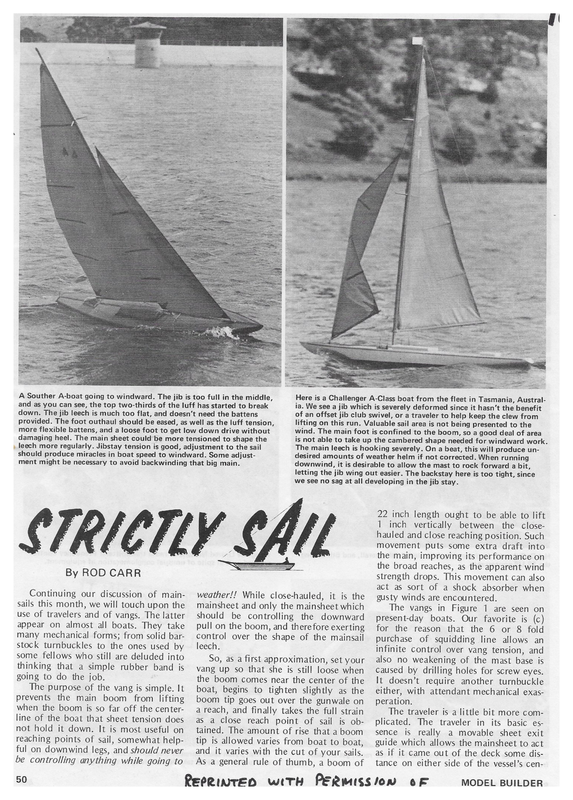
A Souther A-boat going to windward. The jib is too full in the middle, and as you can see, the top two-thirds of the luff has started to break down. The jib leech is much too flat, and doesn’t need the battens provided. The foot outhaul should be eased, as well as the luff tension, more flexible battens, and a loose foot to get low down drive without damaging heel. The main sheet could be more tensioned to shape the leech more regularly. Jibstay tension is good, adjustment to the sail should produce miracles in boat speed to windward. Some adjustment might be necessary to avoid backwinding that big main. Here is a Challenger A-Class boat from the fleet in Tasmania, Australia. We see a jib which is severely deformed since it hasn’t the benefit of an offset jib club swivel, or a traveler to help keep the clew from lifting on this run. Valuable sail area is not being presented to the wind. The main foot is confined to the boom, so a good deal of area is not able to take up the cambered shape needed for windward work. The main leech is hooking severely. On a beat, this will produce undesired amounts of weather helm if not corrected. When running downwind, it is desirable to allow the mast to rock forward a bit, letting the jib wing out easier. The backstay here is too tight, since we see no sag at all developing in the jib stay. ky RCT By appear on almost all boats. They take many mechanical forms; from solid bar- stock turnbuckles to the ones used by some fellows who still are deluded into thinking that a simple rubber band is going to do the job. The purpose of the vang is simple. It the main boom from lifting when the boom is so far off the centerline of the boat that sheet tension does not hold it down. It is most useful on reaching points of sail, somewhat helpful on downwind legs, and should never be controlling anything while going to 50 movement puts some extra draft into the main, improving its performance on the broad reaches, as the apparent wind strength drops. This movement can also ROD CARR Continuing our discussion of mainsails this month, we will touch upon the use of travelers and of vangs. The latter prevents 22 inch length ought to be able to lift 1 inch vertically between the closehauled and close reaching position. Such weather!! While close-hauled, it is the mainsheet and only the mainsheet which should be controlling the downward pull on the boom, and therefore exerting control leech. over the shape of the mainsail So, as a first approximation, set your vang up so that she is still loose when the boom comes near the center of the boat, begins to tighten slightly as the boom tip goes out over the gunwale on a reach, and finally takes the full strain as a Close reach point of sail is ob- tained. The amount of rise that a boom tip is allowed varies from boat to boat, and it varies with the cut of your sails. As a general rule of thumb, a boom of act as sort of a shock absorber when gusty winds are encountered. ne vangs in present-day Figure boats. Our 1 are seen on favorite is (c) for the reason that the 6 or 8 fold purchase of squidding line allows an infinite control over vang tension, and also no weakening of the mast base is caused by drilling holes for screw eyes. It doesn’t require another turnbuckle either, with attendant mechanical exasperation. The traveler is a little bit more complicated. The traveler in its basic essence is really a movable sheet exit guide which allows the mainsheet to act as if it came out of the deck some distance on either side of the vessel’s cen- REPRINTED WiTH PERmission oF MODEL BUILDER
FIG. 1A FIG. 1B terline. The purpose is to allow the sheet to come directly vertically from the deck, and so allow it to pull straight downward on the main leech. The traveler allows one to adjust the tension of the mainsail leech independent of the sail’s angle to the centerline of the boat. Good windward power only comes when the sail has had almost all of the twist taken out of it, by a downward pull of the sheet. The traveler allows this downward pull, and simultaneously allows one to pick the location the boom will take when close hauled . . . if for example you wish to slack it outboard slightly during heavy air. A completely controllable traveler wou!d be easy to make, but Figure 2 shows how such a device has been fitted to a class such as the East Coast 12~meter, in which controlling the traveler line (TL) by a servo is prohibited by the class rules. This arrangement was first spotted by the author on a boat skippered by Rich Matt, which did prove extremely potent on the weather legs. Notice that in such an arrangement, the sheet actually exits the deck near the foot of the mast and then runs along the boom and down to the traveler car, which is on the athwartships track. Adjustment of the traveler runs something like this: the amount of heel caused by the main. Under such conditions, the boat will usually go a bit better if she is freed off a bit, kept moving, and has good headway to carry her through the waves. If you try to pinch too high in waves, they will help to reduce your speed, and maneuverability. Also, be aware that a boom that is trimmed in too hard will make itself felt as weather helm, a tendency which will partially disappear as you free the sheets slightly. So it would seem reasonable to adopt some system of fixing the sheet leads on your boat, in order that you not start moving your rig fore and aft trying to balance the boat, when in reality what you need to be doing is a little fussing with the shape and positioning of your main. Heavy weather sailing is a subject which we might delve into separately. Suffice it to say at this point, that no heavy weather sailing techniques will be successful unless you have taken the pains to outfit your boat with strong fittings, strong rigging, and have tested each to breaking. One should always be ready to make repairs on the spot. So, simple, easily replaced fittings are a FIG. 1C must. Steer away from exotic goosenecks, fancy vangs and tiny 00-80 nuts and bolts no matter how “cute” they look. Try to make every fitting a bolt-on operation. You can’t afford the time, nor will you have the conditions neces- sary, to use epoxy, polyester resin or super stuff, whatever it is!!! RULE NUMBER 2 – Make everything on your boat STRONG, SIMPLE, and SWIFTk The photos document some of the activities of that other AMYA. Did you know that there were two AMYA’s?? Well it’s the Australian Model Yachting Association, and our information comes through the efforts of Garth Wilmot, of Tasmania. (Can’t you just see a fire- engine red, planing 50/800 called the TASMANIAN DEVIL… ) Since we’re sending sails down to Garth and his fellow skippers, he kindly volunteered permission to use the photos as further fodder for our “shape of speed”’ gallery. Let me remind everyone, that the only way to improve our boats is to identify the trouble, and Continued on page 72 FIG, 2 a) In light air, the traveler car should be fairly close to the centerline of the boat. Sheet tension should not be so hard as to eliminate a reasonable amount of twist in the sail, and the slight amount of mainsail leech which hooks to windward will be more than made up for by the pointing ability and greater “‘speed made good to wind- ward.”’ (See, there are times when that bottom batten can violate RULE 1, and to good advantage.) b) In moderate air, remove the ten- dency of the leech to hook to windward by increasing sheet tension, and simul- taneously ease the traveler so that the boom makes asmall angle to the centerline of the boat. c) As the wind and sea increase further, ease the traveler more, check the boom vang to see if it is starting to accept some of the load, and free off the sheet slightly to allow the head of the sail to twist off a bit and reduce SEPT/OCT 1974 51
Sailind.es tA; Continued from page 51 cure it. Luckily with sails, it is usually a simple tug on a downhaul, or a small change in mast bend that will do it. Hull problems require a good deal more labor. It is also very easy to send a boat out, that up till then, has looked like a champion, and having forgotten to tighten the vang, the first reach winds up with an hourglass wrap around the spreaders. gremlins, Nobody and is we can free all changing such experiences. from learn such by ex- | We recently ran across a new publication aimed directly at the model yacht- ing competition skipper. Titled: ‘THE IT’S FUN TO SAIL, BUT MORE FUN TO WIN BOOK.” It was written by Ray Davidson in conjunction with a workshop program on RIC sailing yachts sponsored by the Ontario Science Centre. It focuses directly on the sailing of the boat, what to look for and how to react on each leg of the “round the buoys” race course. It illustrates basic rules, but stresses concentration, attention to detail, and a never-give-up attitude for the serious competition skip- per. | had the luck of getting a copy from Wolfgang Schultz at the Eastern Regional 50/800 Championship held here in the nation’s capital -on June 30th. | hope to have further information on availability here in the U.S. by the time this column is on the newsstands, sO write _ word. to me directly for the latest y: And while you’ve got your stamps meets aie liga out, send in your five dollar annual dues _to the AMERICAN MODEL YACHTING ASSOCIATION c/o C.H. Black, 4761 Niagara Avenue, San Diego, Ca. 92107. There are now over 1,000 boats registered with AMYA, which gives a good indication of the rapid growth of this non-polluting, head-to-head competing form of the radio control sport. lll field questions directly, Rod Carr, 7607 Gresham St., Springfield, Va. 22151, or write in care of MODEL BUILDER.