- The “Inland Lake” Scow (Racing Model). By A. Siebert.
- Lift Construction: The 3 ¼” deep hull is built using four lifts of 11/16” standard lumber.
- Keel Casting: The fin keel is made from 1/16” galvanized iron or brass. T
- Adjustable Jib: To balance the sail plan, the jib boom is attached to a brass angle with a series of drilled holes, allowing the sailor to move the jib forward or backward until the boat finds its perfect “lead”.
- The Yawl “Dorade” (Showcase/Cruiser Model). By I. MacKenzie
- Scale and Finish: Designed at a scale of 1/8” = 1’, the model features a white hull with a bronze bottom and a bright red boot top.
- Mast Rigging: Because the masts are light for their workload, the spreaders should be rigged while the mast is flat on a board.
- Essential Finishing Materials
- Sails: For racing models like the Scow, light balloon cloth is recommended for maximum wind responsiveness.
- Deck: The Scow uses 1/8” 3-ply veneer for the deck, supported by 3/8” square beams spaced 4 inches apart.
- Rigging Lines: Standing rigging should be bronze, while running rigging should use a manila-colored cord to maintain historical accuracy.

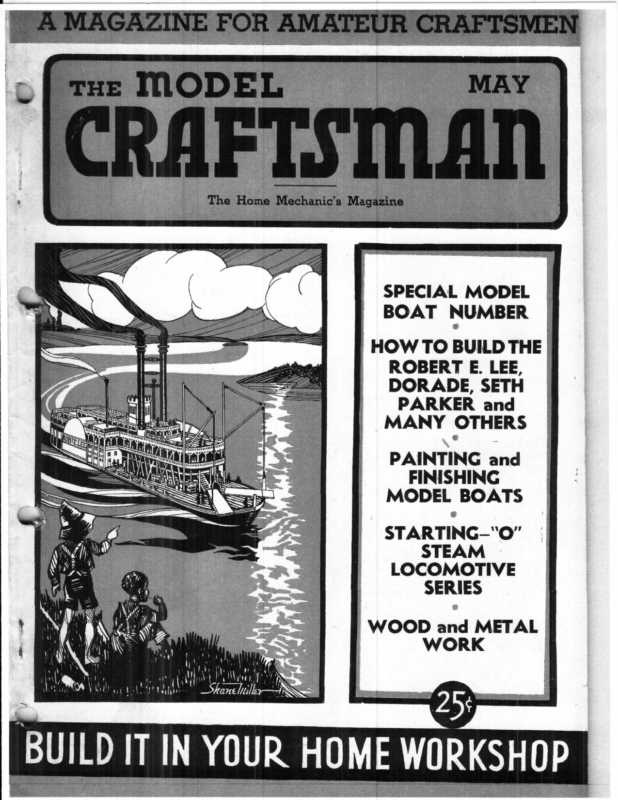
SPECIAL MODEL BOAT NUMBER -HOW TO BUILD THE | ROBERT E. LEE, DORADE, SETH PARKER and | MANY OTHERS \ PAINTING and FINISHING MODEL BOATS STEAM — LOCOMOTIVE SERIES | WOOD and METAL | holy as! Bd Wea bt, ‘ Udine ‘ \ aah Mihi I} ae y Fe Shane ltilkr1 ‘ FS See FH P O H S K R O W E M O H R U O Y N I IT D L BUI
‘The “Inland Lake’ CmM- ighs that Ow | hich heir By ARTHUR W. SIEBERT eed halt ‘rely may “aw- ll be ‘tail, pace – We have been fortunate in acquiring this “A” Class design from a member of the Inland Lakes Model Yacht Racing Association. It is a development of the Great Lakes Scow, which has a reputation second to none as a fast, all weather racing craft. and mark a pencil line round the smaller one on the larger piece of wood. When sawing out the center, the cut should be about 34” inside this line, to allow of a reasonable gluing surface. Repeat this mark- ing out operation on bottom lift. @ It is not often that a design copied from a large boat turns out to be a successful racing model. When this is the case, the credit may generally be given more to the man who sails the boat, than to the designer of the full size yacht. When, however, the design is adopted by an entire racing association and proves itself to be a winner, then the credit must be given as much to the man who planned the boat as to those who sailed it. In addition to excellent sailing qualities, this boat has the merit of being easily The entire constructed. depth of the hull, without the deck, is 314”, permitting it to be made by building up four lifts of standard lumber, 11/16” thick. The hull drawings are 3/16 the size of the model, enabling the dimensions to be scaled easily. Full size drawings should be made on heavy paper before attempting to build the boat. After the drawings have been made, it will be necessary to mark out the lifts. First of all, secure your lumber and plane both sides perfectly smooth. If there are any chips or loose fragments on the surface, the joint will not be perfect when glued, and the boat may leak. After the wood has been planed down the deck and thickness of the lifts. A center line is now marked down the surface of one of the boards, and the various widths transferred to it from the cross sectional drawing. When the curve has been laid out, proceed with the other lifts in the same manner. Then, lay the second lift on top of the upper one all but the Then saw out the cen- ters and commence gluing together. The gluing is done by degrees, as it is difficult to keep several lifts in place when there is glue between them to act as a lubricant. Fasten the bottom lift onto the next one, and, when the glue has set, repeat with the next. Last of all will be the upper lift. The hull thus obtained is then shaped on the outside with a rasp and chisel, finishing with sandpaper. After this, it is hollowed out to as thin as possible, leaving a_ thicker piece down the center for attaching the fin keel. The deck is made from 1g” 3-ply veneer, and is glued and screwed in place. A small hatch, about 4” square, should be provided for ventilating and_ baling out. Beams about 3%” square should be fastened across the hull to support the deck. These may be spaced 4” apart. The sails are made from light balloon cloth. The sail diagram is drawn to a scale of % full size, and the sizes may be taken directly from it. The mast is %4” diameter at the deck, and is through a tight ring vent leakage. It is into a block glued passed to prestepped to the bottom of the boat. In order to permit the sail plan to be balanced, the foot of the jib boom is attached to a light brass angle, which is drilled with a series of to holes, to allow the jib to be size, take the cross sectional moved back or forwards till drawing of the hull and draw cross lines parallel to the required balance is ob- Continued on page 13)
L NVNSLAVADYD TAGOW AH
THE Line 4inftpom 0fSpar te MODEL CRAFTSMAN (Continued from page 11) Trvck tained. The fin keel is made from 1.16” galvanized iron or sheet brass. The bottom, where the lead is attached, should be drilled with two or three “Foot Spar TArv Fyes -Spaced ,” 4″ holes, to give the lead a positive hold. In addition, the sides of the fin should be tinned. A mould can very easily be made by cutting a DGQDS oF Hooks cavity in a board with a saw, and placing the keel between two pieces thus treated. It should be a matter y) BOM TE SQ1/~C/ hahaa of great care that the wood is quite dry, as moiten lead is very danger- /| ous in a damp mould. / / / 4 DE TLP/L. \ Sa)! Secvred to Mast / fore Sfay | | _— \ ” \ \ | \ | | ! 5,Plagne J2C pbs Choke pes nsf LYS07 BCOPA TI 7 Bartsy Bash bast y! 4g Bows ers \. =” R glide Stay _ a “i al _ il =— a a Fyes /r Boon; we Nose Pec. Pe Be \ Ey@ Gorwrer Trave/er —* Hook ip Deck. ty (BLUE Side DI F4) | ~ i Apimaker B00Mm Notea- Defiead lines Sb0W ID ON Ef age fast yo Deck
ad dal al i do Le| a 3| k= fe) Go & & Q a > i Hy wa s > Za
= The Yawl “Dorade By IAN MacKENZIE At last we are able to grant the requests of many of our readers for this design. In making the deck houses, a small hollow should be cut in the hull beneath each, in order to give the illusion of the hull being hollow. If this space is painted white, the appearance is greatly improved. Built as a cruiser, she commenced her career by winning the Fastnet Ocean Race in 1932. Then she recrossed the Atlantic in 1933, and won the Fastnet Race for the sec- ond time. In her class, this race is the one which gives the highest honor to the winner, for it is not only hotly contested, but attracts the best boats and the most skilled sailors of both hemispheres. Having turned the Fastnet Race into a double-header, she bade fare- The masts carry a considerable amount of staying, as they are very light for the amount of work they are expected to do. The spreaders may well be placed in position and é-Seecaod2 rigged, when the masts are fastened flat on a board. This will allow everything to be lined up correctly and set with shellac before the mast is placed in the hull. Fore and aft rigged masts may with advantage (Continued on page 54) well to England, and broke all records for her size, making the distance from Plymouth, England to Plymouth Rock, Mass. in twenty days. This achievement earned the coveted Blue Water Medal for the outstanding event in Ocean Cruis- Y%” = 1’. x ing for the year. The drawings are to a scale of This is a very handy size for a show case model. Though the original was painted white, with a bronze bottom, a very beautiful model may be made in natural ma- hogany. The boot top was bright red. This is the long triangular VUIGGER section between the water line and the white top side. The deck and spars are finished in clear varnish, and the deck houses and other wooden structures are natural mahogany. The inside of the bulwarks is white. The forward sections of the hul! are a rather full V, gradually run- ning into~ reverse curved after moulds. These curves should be carefully checked as MAST Lf? PREApDER construction progresses, as out-of-place hollows in the lines of a hull as small as this one will entirely spoil its appearance. The standing rigging is bronze, and the running rigging, of course, Should be manila color. The fine gold line below the bulwarks had better be put in with a ruling pen and yellow ink, rather than to at- tempt to make the line in gold leaf, unless the builder has had considerable previous experience. 21
THE CRAFTSMAN MODEL Mare Sai TMEU a wali eed OF EVES Sera ok ree Aanr AWD LEADS DOWN TO FIFE al Ran »DETAIL OF® “MAIN SHEET TACKLE: i To Svuecer Pires DETAIL OF JIGGER SHEET TACKLE® No Scare woop BLOCKS To TO A CLEAT ON THE ®oor SOureauc Is mace AT TUE CENTER PAST © Sipe Ss FueKes ecTiow Peevewr feom PCARING DE CH / Swacece ELEVATION? DSrd6SK a te at Wo Scare eANCUOR. Seace f*sivor Nore! Tus VIEW shows akcHno e ‘Btocr COLLAPSED a= OWED OV DECK OW Poer SIDE OW CArsTAN Jieace Vavuaao LEADS TO Bire Ra FE Nee jee —7- Oeran Go.o STReiCS ey – aVAS YY EE eR nKnun » Le Feooe CF COCK Pr _ Vw ae | | wate [Torsines ~ | ——_>—_————__ 7 ¥ Beowze usprepopy / lie of Lean Keer 3-7 Nore! MAHOGANY Decw STRUCTURES ADE INNEO <1DE OF BUL Wane -—WhITE Decw ¢ sPacs -CLEAQ VARNISH DRVLIGET COMPawioNway of ve diecresr Au Serves Wits Geatine COVERED ants 488 a —_ ee - _ Waree Lidy
Rail- Miniature Building— way The Mi-Loco catall Tells alog about it. All the old methods are obsoleted by the Mi-Loco Truscale Nine Exclusive Protected Features of Construction. The Mi-Loco catalog is the greatest handbook of miniature railway build- ing ever published. Pictures and drawings on practically every one of its 48 pages—locomotives, Pullmans, passenger and freight cars of all kinds, and railway equipment. Send for your copy today,—35 cents, in coin if convenient. M i -LOC Pe) The Miniature Locomotive 14546 Co. Lorain Ave. RAILWAY Cleveland, Ohio PLEASE EQUIPMENT HELP! Lots of your friends would like to subscribe to Model Craftsman—plenty of eople in your neighborhood. You can elp the model making fraternity along by boosting its magazine. To give you even a better magazine we must continually increase the number of our readers. Take subscriptions to Model Craftsman and make some money for yourself too. It’s easy—and profitable. end coupon with your name and address for complete details of our new BOOST MODEL Making plan. MAIL THIS COUPON Cireulation Model Manager, Craftsman Magazine, 330 W. 42nd St., New York, N. Y. Name cee eee Coat eee wwe arene ewe ese ese eee eee ecns sen ees seesnsneseene ee eesene MOTORS Low Voltage Universal for All Model and Experimental Work—14 Types FIXEN Miniature Motors Keep Models Moving No Use ME U0 43 M3 Mo om) 0 0 WW4"w EM"h. 23,” 115/10" Dx2 2° x24" 0 2° 1x24" M2 MS Paes Sa 5/32"x 54" 115/16"Dx214* 271)«2 13/16" os 1 1 15/16" Dx2% MI2 Exper. 1744"w.3i"h, 17, Boar 14"w, 14"h, | Exper Mis 1i4"w, 34h. 17/16 Special length shafts Sc extra. Automatic Reverse $2 for Crovan Railway Model. senger cars, 44” scale, list Sc, Vig Y 1 Pree $9 3175 3 7 7 400 100 300 6 1 3 13 12 12 7 su Jy lo*xi4” 1 15 18 7 7 7 OM Yarx'y” 18 7 3.25 48P, 6T Gear 12 7 175 3/32" x3" ia"xh" 7 275 5/32" x" 3/10" x34" $/32"%%" Ex&S = 217/64" Dx245 MIS eg" da"x” 5/32°x 4." 3/10" x44" 115/10" Dx2! on 06008 NH 1 lig*w Linh 134° 0 M7 Shaft Length on Ma& Mi SMe Dimensions 147 Lh, 14" ix All above easily reversible Motor and Gear list sent for 5c. 3 3 ac 500) cat) 150 1.28 Hand Reverse We are agents Ask about pressed aluminum construction pas- rue FIXEN wins ST11—I 11th Street. Dept. MCS, Richmond Hill, N. Y. f A SMALL BRAKE for the model maker. A real tool, priced low. Makes sheet bending easy. m Write for details. THE MELVALE COMPANY 4070 Higbee St., Phila., Pa. Scotties’ No Getter Breeding- No Bettar Individuals. Write To: Garbrae Kennels Angola- Ind. Fainting and Finishing— Model Boats (Continued from page 24) and corners down their length with a short round shoe brush. Finish by using a good stiff rubbing brush the length of all areas. To inspect the progress of the rubbing, rub the surface lengthways with the grain using the palm of the hand. Work for an even dull tone every- where. To remove sludge, wipe off with the grain to prevent cross scratches, using lintless cloths. If additional pumice is required on the surface, lightly re-rub the entire job, as it cuts deeper and faster when newly applied. 10 imitate mahogany plank onmetal':decks use varnish stain — and a semi-dry brush -mahogany ground color; both are readily found in all paint stores. For canvased decks cut medium weight linen to fit and after moistening, lay down on tacky varnish. When dry, it shrinks tight eliminating wrinkles. Where ruling pen and India ink are used to indicate planking, apply shellac with care as alcohol is a solvent both. When painting for undetermined water lines bring the under color well up on the sides, and place the loaded hull in still water. Sprinkle powdered charcoal on the water surface and on lifting the hull out, the entire water line will be evident. Now place the hull with W. L. parallel with the table top and using surface gauge, plainly mark W.L. around entire hull. The free board color may now be cut in, using masking tape to effect the For a low dull sheen, proceed as with oil, but using water instead throughout. Never use an oil rub between coats as it will gum up anything placed over it. However, each new season, when recoating an oil rubbed hull, first wash with naphtha color separation. By this method soap and rinse well. the gleam along the edge of W.L. Natural finishes should proceed will only be seen when looked at with wash, shellac and_ sand, from below. varnish and sand; tack-rag and The beginner will find a visit to varnish. Open pore woods should the local sign shop profitable—espebe done as above, after first recially if the owner be an old-timer. ceiving wood-filler of the desired He can show you many of the color. On large sailing yachts where a ~ processes named, A mere reading of this article is letter perfect hull finish is desired no assurance of success with these some means to determine definitely methods. Practice them as outthe surface for tiny low spots is lined, and you'll have a basic required. After several coats of knowledge with which to approach enamel have been applied and rubprofessional workmanship. All bed, proceed as follows. Give the these methods have been used with entire hull a thin coat of light excellent results by many a beginchrome yellow in japan, thinned ner. You should be able to duplionly with turpentine. This is known cate their success. as a Stain guide coat. Use a water sandpaper and rub with a felt-back paper, when all low spots will immediately show up yellow. They will require individual enamel coats. Where even a brush rub will not reach small door and window details try the following stunt. Using waterproof glue, attach a piece of wet or dry sandpaper to a thin cigar box lid. Cutting it with the grain, paper included, will provide you with some splendid sanding sticks. As the end paper wears down, cut off the entire end and bevel rear. General notes. Flat japan color is used where no gloss is required as on white and black spar details. Marine buff is made of ocher and white, naval gray of lamp black and white to give it the typical cold blue tone. Finish all wood work inside and out or it will warp. Metal fittings and hulls. Start with primer and proceed as with enamel jobs. 54 * The Yawl “Dorade” (Continued from page 21) Sse, BETTER EASIER | CHEAPER be rigged as completely as possible before stepping. The shrouds themselves are comparatively simple, due to the necessity of reducing the windage as much as possible. The anchor is painted aluminum to simulate galvanizing and the capstan is bright brass. The conventional red and green sailing lights are carried, the lamps being bright brass. “Robert E. Lee” (Continued from page 53) that though these details may be made of metal or any other convenient material, for the showcase model, they must be made as light as possible in the case of the larger boat, which will turn over when placed in the water, unless this condition is borne in mind. a