- Simplified Steering for Your Model Yacht. By C. A. Adams.
- A Simplified Steering Gear designed for smaller water areas where skippers cannot follow their boats in skiffs.
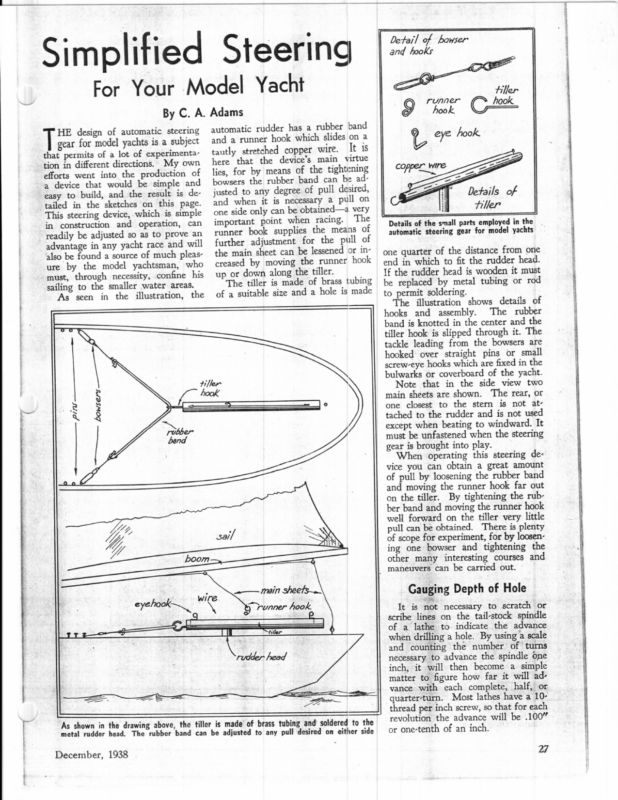
- The Mechanism: The device uses a brass tubing tiller soldered to a metal rudder head. A rubber band is knotted in the center and adjusted by tightening bowsers, allowing for a customizable degree of pull.
- Key Advantage: A “runner hook” slides along a taut copper wire on the tiller, allowing the skipper to increase or decrease the main sheet’s influence on the rudder. This enables the boat to execute complex maneuvers or maintain a straight course even in shifting winds.

Simplified Steering For Your Model Yacht By C. A. Adams gear for model yachts is a subject automatic rudder has a rubber band and a runner hook which slides on a efforts went into the production of a device that would be simple and easy to build, and the result is de- lies, for by means of the tightening bowsers the rubber band can be adjusted to any degree of pull desired, HE design of automatic steering that permits of a lot of experimentation in different directions. My own tailed in the sketches on this page. This steering device, which is simple in construction and operation, can readily be adjusted so as to prove an tautly stretched copper wife. It ise here that the device’s main virtu and when it is necessary a pull on one side only can be obtained—a very important point when racing. The runner book supplies the means of for the pull of advantage in any yacht race and will further adjustment lessened or inbe be found a source of much pleas- the main sheet can the runner hook also ng movi by ed ure by the model yachtsman, who creas must, through necessity, confine his sailing to the smaller water areas. As seen in the illustration, the up or down along the tiller. The tiller is made of brass tubing of a suitable size and a hole is made Deta// of Bowser and hooks x fo 9 |. eye hook. Details of tiller Details of the small parts employed in the automatic steering gear for model yachts one quarter of the distance from one end in which to fit the rudder head. If the rudder head is wooden it must be replaced by metal tubing or rod to permit soldering. The illustration shows details of hooks and assembly. The rubber band is knotted in the center and the tiller hook is slipped through it. The tackle leading from the bowsers are hooked’ over straight pins or small screw-eye hooks which are fixed in the bulwarks or coverboard of the yacht. Note that in the side view two main sheets are shown. The rear, or one closest to the stern is not at- tached to the rudder and is not used except when beating to windward. It must be unfastened when the steering gear is brought into play. When operating this steering de- vice you can obtain a great amount of pull by loosening the rubber band and moving the runner hook far out on the tiller. By tightening the rub- ber band and moving the runner hook well forward on the tiller very little pull can be obtained. There is plenty of scope for experiment, for by loosening one bowser and tightening the other many interesting courses and _ maneuvers can be carried out. Gauging Depth of Hole It is not necessary to scratch or scribe lines on the tail-stock spindle of a lathe to indicate the advance when drilling a hole. By using a scale and counting the number of turns necessary to advance the spindle one inch, it will then become a simple matter to figure how far it will ad- vance with each complete, half, or quarter-turn. Most lathes have a 10- the As shown in the drawing above, the tiller is made of brass tubing and’ soldered to side metal rudder head. The rubber band can be adjusted to any pull desired on either December, 1938 thread per inch screw, so that for each revolution the advance will be .100” or one-tenth of an inch. 27
on MODEL YA – CTING 6 ——— <= |-s NEWS OF THE CLUBS yc. 0. BRooK EVERAL more ambitious readers of MopEL CRAFTSMAN seem de- plated keel, spars and fittings. She may not sail, but gosh how she will K, J. Samuels, of dazzle the optics of competitors! From truck to keel a brilliant lot of shiny 1338 8th St., Alameda, Cal.; Richard R. Scarlett, 1336 Woodland Ave., Toledo, Ohio; Charles F. Petschke, Lincoln Terrace, Bloomfield, Conn.; and John Hinterhoff, 591 Ber- When we get it, we get it bad—and it can’t be helped! We have the same Officers in the M. Y. R. A. A. as heretofore. Well, sirous of joining or model yacht club. organizing a genline Ave., Union City, N. J.; each plead for information and help. Clubs nearby take note, advertisers in this mag who sell fittings etc., take heed. Each reader states his need for fit- the Boston metal—even they did to some silver-colored fine work, and we know they will do even better from M. Y. Bill Bithell, C. is up of to his old tricks. Again he takes the national championship in the “A” class. Seems as though there is no stopping Bill! In four days of racing where the wind slid by from two to ten miles an hour, it was a rather tiresome event. Four days is a long time to keep the doggies padding beside a pond. The results of this important event were: Bill Bithell, Boston M. Y. C., sailing Fortuna, 149; A. W. Greeley, Washington, Madam, 134; Bill Topping, Columbia, Colum- bia, 123; J. McKinney, Ogden Park, Glenshee, 107; W. C. Schaefer, Washington, Elwynne, 106; T. Batpg Grand Rapids, Starlight, 85; L Troeger, Chicago, Maen, 77; P. 102; Malloy, Chicago, Tom Boy, Oley, Grand Rapids, Regret, 59; Tom Rolfe, Cleveland, Aloris II, 43. And we learn that the Grand Rapids Civic Authority are removing trees and shrubs and otherwise mak- ing this fine pond still better. more events being sailed With throughout the country, we will doubtless have more ponds to talk about by this com- ing Spring. Starting my fortieth model since 1930—this time lap-straked from aluminum and featuring chromium 46 most cynical should have been satis- fied—especially if they are skiff sailors! And [ll bet none of them went out near a pond—ah it is so hard to please these Skippers! And now the young and gangling (Continued on page 49) Milwaukee M. Y. C. Invitational Regatta tings, sails and so on. And sails. now on. We are for them, as always. I wonder if the boys had any complaint about wind conditions during September. With anemometers whizrling at a dizzy pace to register from sixty to 104 miles per hour, even the “Mariner Trophy” Marblehead Class Milwaukee Pool Individual Scores Boat Honey Sinbad Sirod Dixie Girl Boots Dark Horse Click Littlebo Wench Watermatic Whim Jr. Norel Stingeree Bunty Pelican Zephyr || Tar Baby Jitter Bug Contestant E. Zaler N. Lloyd Harms Baker F. Clark Roach W. Moss Adams Howeler L. McDermott S. McDonald N. Schober J. McKinney Ely L. Troeger R. Harenburg G. Lamb E. Mueller Club Score 44 53 3 55 41 24 20 Z SI 54 Chicago Chicago Chicago Chicago Oshkosh Oshkosh Milwaukee Chicago Chicago Milwaukee 1 Milwaukee 65 22 27 Milwaukee 40 Chicago 53 Chicago 25 Milwaukee 44 Chicago 54 Milwaukee 34 Milwaukee 16 Points by Clubs Ogden Park Model Yacht Club—Chicago..... Milwaukee Model Yacht Club—Milwaukee.... Chicago Model Yacht Club—Chicago......... Winnebago Model Yacht Club—Oshkosh...... Scorekeepers:—Mrs. Lamb Mrs. Troeger Announcer—F. Best 5 7 4 2 247 240 197 44 Officer of Day—H. Teske Judges—Mrs. Schober Mrs. Mueller THE MopeL CRAFTSMAN
In addition to the Color Position Light (CP-4UL), Position Light (P-33), Position Light Dwarf (PD-2) and Color Light Dwarf (CD-2) signals shown above, other position light, color position light and color light signals are available to meet any operating condition. Staples signals are exact miniatures of the standard signals from all angles. They all have the handy plug-in feature. Detailed information and prices upon request. CRAWFORD P.O. BOX 8315 ACCURATE %'' SCALE MODEL SIGNALS _ e MODEL YACHTING (Continued from page 46) female offspring crows and chortles because in her first sailing match she won first prize. In twenty-two start- ers the men made a poor showing. The -gay daughter and another young miss took first and second place. And after more than 500 racing days, Pop has failed to do more than get a weak leg on one trophy. Methinks the youngsters have a lot of luck—and our “skill” is not much of a bulwark against it. The class-A devotees had better take hold of their tillers—only fifty were registered this year—tless than 25% of the number last year, while the 50's keep increasing. Shall we see this beautiful big ship go by the board through desertion or lack of skill? Let's make next year a bigger and better year than ever for class A. There are now fifty model yacht clubs affliated with the M. Y. R. A. A. and to think, but a few short years back there were not more than half a dozen. We have three growing divisions, with many, many clubs ready to join the national’ group. I have received a number of re- quests from secretaries asking if members of Clubs will not make sketches REMOTE CONTROL MACHINES _ e or drawings of their ideas of ‘steering gears, rigging, control, sail-plans etc., and send them to other clubs for study and comparison so that new ideas may be tried. We al) know there can be no profit made in selling these ideas and all that we have learned so far has been through the kindness of the other fellow. Let’s keep on. It’s a good work that should prove very interesting. We hear that Bill Harris of the South Jersey M. Y. C. is now Com- modore. Well, Bill is a serious and conscientious worker for the sport and I’m sure the club will profit by their selection. Clear sailing, Bill! The 1938 season is pretty well worn down. There have been some extremely interesting races sailed with more trophies given away than has been given in ten years prior to this, One would think there were enough model yachts in fine condition to put a little dimmer on building this winter, yet, hardly has Fall gotten along in days until the drawing boards are hauled out, frequent trips are made to the lumber yard (and the 5c and 10c store) and building goes on with undiminished fury—new ideas in de- sign and construction—go into the building of the “perfect boat.” Each boat we start, our admiration compels When writing to advertisers please mention MopnEL CRAFTSMAN SWISSVALE, PA. AUTOMATIC SIGNALING SYSTEMS us to “admit” that the new one is the finest job ever turned out—and will be our last (until the next one). That’s how every winter is spent— planning, building, hopeful, aye, almost certain—and our pride is pardonable. The new design by my good friend Duncan from oven on Staten Island certainly makes all of us anxious to build her. Readers are indeed fortunate to have a designer and builder of such capabilities as Mr. Duncan give them such a complete work from his drafting board. We hope to see more of his work in the future. I have seen one, built by Alex Sellers who works with Mr. Duncan. It does a nice job of sailing and is a real “boaty” looking job. I suggest that all clubs, as well as members keep this series of MopEL CRAFTSMAN on file for future reference—and that’s that, till next issue. YACHT CLUBS Other yachtmen are interested in you and in your doings, and we want to print them in this magazine. Send regular reports of your activities to Mr. C, O. Brook, 912 Broadway, Rensse- laer, N. Y., for inclusion in the Model Yachting department. 49