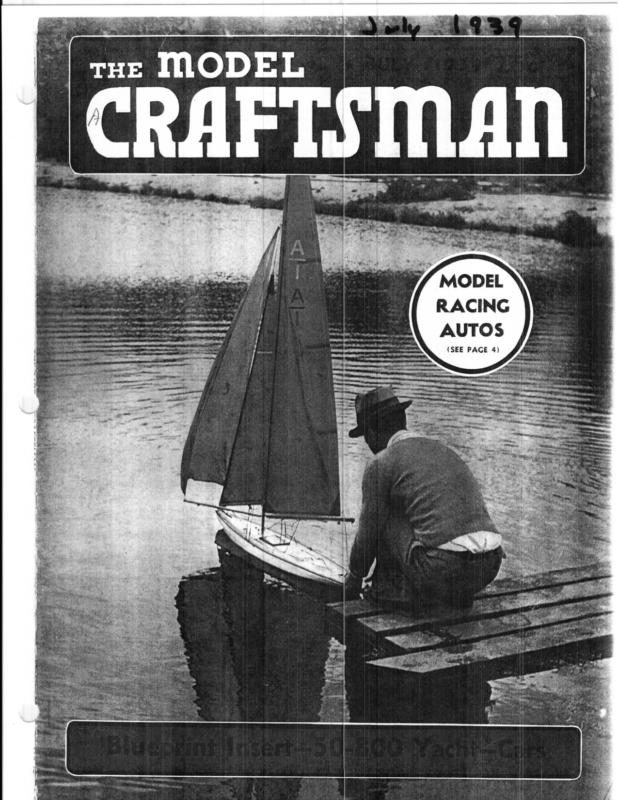
- Spindrift – A 50-800 Model Yacht. By C. A. Nedwidek N.A.
- News Of The Clubs. By C. O. Brook.
- Sail Dynamics
- Mast Interference
- Rating Rules
- Design Trade-offs
- National Events
- Regional Leagues
- Youth Programs
- Club Infrastructure:
- Belgrave Attachment
- Double-Ended Hulls
- Commercial Kits

is 2 Sims poor ae Sees 1 RRR ig mas : Ama PONIES CBS tie BET ‘i > wee ee |) : \ cidtiiaietineot ban ee : ssa = feenceaics) cash seecitiniy open
ee Se DD. ER BB i il » ae th i i i i i i i the tools to make one. This backbone, shown in drawing 2P, is one of the most important elements governing the shape of the hull, and should be made accurately. It is built up from three pieces of pine, with the grain running as shown in the sketch, and with the joints firmly glued under the i ~a pressure of clamps or a vise. After the glue is thoroughly hard, proceed to shape the backbone to the cross: By Chester A. Nedwidek, N.A. I Noses are a number of good ways to build a model yacht and each has its advantages and disadvantages. The best all-round construction; the one which has proved itself in both full-size and model work, is the rib and plank built-up hull, and in this article special emphasis is being placed on that method, although for those who prefer it, the conventional breadand-butter hull will also be described. To the uninitiate, a planked hull is a marvelously complicated looking thing. “I couldn’t make that,” the average beginner objects, “I wouldn’t even know where to start.” Oddly enough, the start is made not with the hull, but with a sort of foundation on which to erect it. This is called a building board, and is shown in drawing 1P. Take a plank 4” wide and 54” long, plane the surface true, and mark out a center line down the middle. Two inches from one end, draw a transverse line, and mark it “stem,” then make another cross line 50” from this and mark it “transom.” These lines show the length limits of our yacht. Between these marks we place thirteen other lines, as shown in drawing 1P, spacing them to match the staThese tions on the hull drawing. “stations” are the vertical lines on the sections shown, making its profile the same shape as that of the yacht, with a flat portion at the lowest part where With the building board out of the the keel will be fastened later. The shape of the backbone is best shown in The 1/16” by 4” drawing 7P. rabbet should be cut accurately. It is necessary to mark out the sta- to most people will be the hardest task in the entire construction. Actually, it is not difficult if care is used, and if reasonably good woodworking tools are on hand. A semi-shaped backbone is available for those who do not have groove, or mortise, is cut to such a depth that it meets the bottom of the rabbet just made. These mortises are not centered on the station lines. parts will save both time and money. Write to me in care of this magazine for information regarding these plans and kits. way, we come to the backbone, which tions on the backbone, too, on the inner surface as shown in drawing 2P. At each station, a 3/16” wide Instructions and plans for making this 50” hull by both the planked and bread-and-butter methods are given here ourmpe cur (We 1A) hull plan, which are marked, “A,” “©,” “1,” “2, ete. The drawings given with this article are one-fourth the actual size of the boat we are building, and dimensions can be taken from them, and multiplied by four, to get the size of any particular part. In order to build the boat, it is necessary to have fullsize plans, and these can be laid out on a big sheet of paper. The kind grocers use for wrapping packages is the most convenient to use. For those readers who are building a model yacht for the first time, it is recom- mended that the full-size plans which are available for this hull be obtained; also it should be mentioned that a com- plete kit of parts can be purchased. In communities where the right kinds of wood are hard to obtain, these July, 1939 In building a bread-and-butter hull, lifts are sawed from soft pine and glued together as shown in the drawing above. Templates are then used to bring it to uniform shape 21
COMPLETE HULL DRAWINGS FOR A SPEEDY MARBLEHEAD CLASS YACHT | JE oO SREGRDO porracKks ot J ———— Pr ovele> wires Aer THe Crt for reece. 7 [9 bs. Box. Less Keelto “ble Sr 6 S E S Rather, they are on the forward side of the station lines from A to 5, and on the after side from 6 to 11. Make the transom, or sternpiece, as shown in the plans, and fasten to the backbone. The frames are next. These act as ribs, and give the hull its shape. There are twelve of them, cut from 3/16” basswood to the shape indicated on the cross-sections of the hull; 0, 1, 2, 3, 4, 5, 6, 7, 8, 9, 10, and 11. Make them to match the inner line; the outside line, which is 1/16” away from it, represents the outer surface of the hull. This thickness is taken up by the planking. Each frame is cut to fit in its mortise on the backbone, while the top is continued beyond the deck of the hull to meet the building board. Now we are ready to assemble the parts thus far made. Insert the frames into their slots in the backbone, turn upside down, and set the assembly down on the building board, lining 22 Ee a up the frames with the station marks on the board. Unless you have been exceptionally accurate in cutting out the frames, the chances are that some of them will not meet the board withMake out straining the backbone. them all fit by careful planing at the spots where needed. True the whole thing up so that every part sets true, not forgetting to make the stern blockWhen it all fits to your ing, 4P. satisfaction, glue the frames into the backbone with casein glue, and fasten them to the building board with small brads or pins. When the glue has set up firm and dry, use a small sharp plane and sandpaper to bevel the edges of the frames slightly so that the planks, when applied, will seat flat against them. If this were not done, the planks would only touch a sharp corner instead of fitting snug’ ly. You can check up on the prog: ress of this work by tentatively bend- ing a 1/16” strip of wood around the frames, seeing just what angle is need- ed at each point to assure a proper fit. The sheer stringers are next. They are the strips which run along the corners of the hull at the angle formed where the deck meets the sides. Such nautical terms often are confusing to the beginner, but each part of a boat is simple when explained. These stringers are 14” by 7/16” at the center, and taper to 3/16” by 4” at the ends. They are notched into the frames as shown in drawing 6P. Cut the notches out carefully with a sharp knife, and make sure both sides are alike, and as close to the drawThe ings as you can make them. stringers are glued and pegged in place, and they should be flush with the outside of the frames when complete. Here comes another technical term —the garboards. In spite of its difficult name, a garboard is just the first plank put on next to the backbone. We do have to give it extra attention in this case, though, so per- THe MopeL CRAFTSMAN
PLANS ARE REPRODUCED EXACTLY ONE FOURTH THE SIZE OF THE MODEL HT aT Base Une Cor or BuLomo BoAmD) FOE BLANK HULL | | or cre cee ae Ri T S sce UNE : TOR ror 7 PLANK MLL | Use Wears eee ines AL FUANKING & tRAmrs é | 7 T | | Z- | WA ge ! Fa a ro 7 ag WiulA: La on I Smarr Le wteem CECK BEAH6. HG RUAN SOHAICH COMINGS WI PACE a proper fit. next. They h along the ingle formed b sides. Such confusing to rt of a boat ed. These 16” at the 6” by 4” otched into rawing 6P. ully with a re both sides o the drawThe them. pegged in e flush with 3; when com- chnical term dif7 0’ is \¢ the to the backZive it extra haps it deserves the special designation. Our garboards run from station 2 to station 9, and must be fitted to the backbone. planking Pin a strip of 3/32” near the backbone rabbet, and use a compass (7P) to mark the required contour. Remove the gar- board, cut it to this shape, then fasten it in place permanently with glue and pegs. The pegs are nothing more than ordinary round _ toothpicks, driven tightly into holes drilled for the purpose. The projecting ends are cut off flush with a sharp knife. The second garboard fits beside the first, forming the second plank from the keel, Now you are ready for planking Before you start, remember that it isn’t practical to plank one side first, then the other. This would set up Strains that would warp the hull out of true. Add a plank to one side; then one on the other, and so on. This balances the strains. The planks are mugh, so per- 3/32” by 34” Spanish Cedar. CRAFTSMAN July, 1939 They are sanded down to 1/16” after the hull is built. Each plank must be tapered in width to allow for the greater girth of the hull at the middle. They are 3g” wide at station 5, 3/16” at the bow, and \%” at the stern. Start planking at the sheer stringer, adding the sheer plank, 8P. Clamp it in place and drill holes for the pegs, then glue and peg in place. Follow this procedure all the way down. Each plank has a different twist, and careful fitting will be needed to make the joints meet properly. Cut and try with care before drilling the peg holes. For this operation, clamp each plank snugly to the previous one. When you get to the part where the curvature of the hull changes abruptly, you will find that the planks do not at first lie snug against the frames. You will have to use special care, to make them fit properly at this point. It is important that they touch each frame in order to preserve the designed lines of the hull. Of course, if you have made an error in cutting out the frames, your planks will not fair up smoothly, and if a plank persists in springing away from the frame at any particular spot, it is better to let the wood takes its natural curve. Be sure, though, that it matches the contour of the other side. If there are any knots or bad spots in a plank, it will not spring true, so reject any piece of wood that does not curve smoothly. When you have finished planking, the hull becomes strong enough to handle, so the building board will no longer be necessary. Remove it, and chisel away the insides of the frames so they form narrow ribs inside the hull, as they appear in Fig. 10P. About 3/16” of stock is the correct amount to leave. The deck beams and king plank are next. with The latter is 1” by 14” stock, a 1/16” by 3/16” rabbet on (Continued on page 53) 23
officials, typical of the West, who realize News of the Clubs the merit of the sport and give unstintingly of their efforts. By C. O. BROOK The biggest news of the month comes from the West Coast, where a series of interesting events will be staged during the Summer in cooperation with officials of the San Francisco Fair. An M Class Trans-Bay race, from San Francisco har- bor to Treasure Island, the Fair site, is scheduled for June 11, while an A Class race will be run over the same course on Sept. 4. In addition, there will be races With the in Treasure Island harbor. winds right, and the usual tides in that area, the skippers should know they’ve been in a race by the time they reach the Island. An A Class model will attempt to cross the Pacific to Japan, leaving Treasure Island on June 28. The well known skip- The Grand Rapids M. Y. C. is sending out an S.O.S. to all model yachtsmen, asking them to contact the officials of that City to convince them of the value of model yacht pools to any community. So far, this club merely has a hole in the ground, 210 feet by 800 feet. Members want it completed so they can sail, but the public officials won’t make the necessary appropriation, because they can’t see the possibilities for children, (from six to ninety) in a well kept pond where these youngsters can try out their skill, and, incidently, keep out of mischief. Letters should be sent by all in the sport so that these compatriots can have their pond. From our old friend Dr. Houk of the Seattle M. Y. C. comes word that they per, Myron Spaulding, has taken every are going places with their pond. They depleted their treasury to purchase a second-hand gasoline ‘donkey, a Fresno by compiling data with painstaking care, bucket, possible condition into consideration, and believes the venture will succeed. An A Class Model has been completely overhauled and rigged to withstand severe punishment and everything made watertight. A message in four languages sealed in a metal container under the hatch, offers a reward to the finder when it reaches shore. Ocean travellers have been asked and cable to dredge out their pond place, 200 by 800 feet on Puget Sound. There are no obstructions to the heavy north winds that prevail, and there are picnic grounds, baths, stoves and fuel nearby. Doc says, “At low tide we can dig clams… to wash Maybe the bath houses are the for their clams. project but was $60,000 was diverted this did not to to keep an eye out for the ship and to other report its position to Fair officials. these chaps from the cold country. They still want their pond—and are going to As my informant says: “Let all men in the sport follow this tiny vessel on its lonely trek, and wish it bon voyage.” I channels, There which daunt get it, even though only a small handful of workers do all the labor and worrying. Success attend you, Skippers. E. J. Stroud, Chairman of the Racing Irish name to loll around the tongue) wants to join a club. Michael lives at 1376 Edendale Road, Cleveland, Ohio. This ‘youngster’ used to sail one-design yachts on the Coast, but his ‘youth’ made him revert to the smaller yachts. Go after Michael, you Cleveland fans. A. R. Kremer of 5127 Cates Ave., St. Louis, Mo., wants to join a club. Both these chaps have clubs at home, and can’t find them. How do you chaps manage to hide so successfully? We here at the Deeper Hudson have guests each week-end from all parts of the States and Canada. Better get after your local papers. They’ll plug for you any time if you’ll give them the story. And I might add, in case you don’t know it, that the Moprer. CrartsMAN will be glad to spread the news. Our old crony John Black has swang back to the A’s with Bostonia 7. Well, that’s good. We didn’t think he could desert them. He still feels he can trim this scribe’s Sea Fawn IV at Port Washing- ton this month-end. “Maybe, John. No- can-tell. Following the announcement of our impending ‘forum’ our mail got heavier, and we have an idea we ‘bit off a chaw.’ We find new ideas, and hope to find more. When we’re given the job of testing a rig with the luff of the main moved several inches aft the mast, we found ourselves let in for a job. From my observa: tions, the wind is disturbed by the mast, the model points higher, but does not foot. The sails carry through with narry a flutter, laying easy and smooth, but their Committee of the Wawasee Yacht Club, drawing power is reduced so that I would say, repeating a much learned and seldom followed lesson, that the orthodox and proved methods are still the best. We are Father Neptune will guide it safely to the is organizing a model yacht club in Fort Orient. The Fair Wayne, prone to experiment, and thereby retain for one, do, and wish I could send it on its way. followed This is a venture that will be closely, so let’s all hope that Ind., and I’m sure he’s a most for each of the events staged, and addi- delightful chap. His praise of this writer’s poor efforts as a columnist makes my face tional prizes for second, third and fourth red, places in the National Championship event to be held at Berkeley on July 2-4. Here, water. then, are men nice words. officials are donating $100 in the sport plugging for all they are worth, aided and abetted by 50 That’s O.K., Skipper, I like it, and I’m sure you’re a gentleman of the first I’m inclined to be susceptible to Michael a fine alibi as to why we don’t win races. We can always say: Donovan, (what a sweet So the winner never really knows whether his winning was a good one or just an easy venture. And I do need alibis. Anyby experiment. And that’s that till next issue. way, J. “Well, it is just an experiment, and had to be tried out.” progress is made Tue MopeL CRAFrSMAN
SPECIAL: DRY COMPLETE SPECIAL OUR Guarantee The price of our Station Kits If you are not perfectly satisfied in every way that this is the finest kit at anywhere near the same price Return it — in good condition within 3 days and we will refund your: purchase price plus ~has now been reduced to 75c each Post Paid. Wood Water Tank Kits. With turned wood TER COMPAN) Wells, Teer tanks all postage. AR AR AR AR AR AR AR AR 16 AR 17. The following cars are in stock for immediate delivery: 1 2 3 4 5 6 7 AR 8 AR 9 AR 10 AR 12 AR 13 Green Bay & Western M-K-T Northwestern R.R. Swift Armour Santa Fe Reefer Pacific Fruit Express. AR 18 ee ee ee Milled Body; each ;. ssisec sss samewsaswwrenee EARL Dry Ice Reefer. (A Car That Is Different) truck esis & einers ererarers 26.5 § Bowe hearer s FRANCIS 50-800 YACHT (Continued from page 23) each upper corner. The beams are 3/16” stock, and each one is notched to receive the king plank. This notch is cut 3/16” deep so the deck beams line up with the bottom of the rabbet in the king plank. When the deck lanks are fitted, they will be on a evel with the top of the king plank. Take a piece of 34” square stock and cut it to fit on the after side of frame No. 4, fitting snugly between the king plank and the backbone. This is the mast support. Next cut and fit the deck planks temporarily to the king plank. When they are all matched properly, remove them and build in the hatch coaming between deck beams No. 5 and No. 7, Mark and cut out the space for the hatch coaming in the deck beams, and then you are ready to glue and peg the deck on. This last operation completes the hull proper, but before going on with the keel and rudder, a word or two is in order for those who want to build the hull on the bread-and-butter system. This has been described in MopeL CRAFTSMAN a number of times; most recently in the March, A brief description of the method as it applies to this boat will not be out of place. Refer to side. (D) Set of 4 (PRESSURE DIE CAST) Ice Hatches. (is) Set of 4 ladders (PRESSURE DIE CAST). Detail has been worked out to such completeness that even the small rivets on each rung can be clearly seen. (F) 1 pair of the most detailed End Sills ever offered in HO Gauge. (G) 1 pair of Couplers. Exquisite detail, Will work with almost all other couplers. Air Pressure Cast of course. Cylinder. Roof and under rails attached to the body. Fish-belly and all other wood parts. Brake (1) Milled Body Block. (J) Brake Wheel and Staff and all necessary screws. Walk. Milled Cat HARDWARE PRICES 2519 S. RIDGELAND AVE. 1936 issue. MDT. New York Central Herald. (Three Colors) Crazy Water Crystals. (Very Flashy) ation. (H) 1 ie 6 5 5 wma bReeu Couplers, pair …..ccessssccesecoeseeees oo axe atvaee SSE ee Air Brake Cylinder, each …………..- er ee Paid. (Cc) ae assembled trucks in the kit are insulated on both sides for two rail oper- Southern Pacific Herald Assembled trucks, pair ……..eeseee eee er Post (A) Authentic printed car sides. Correct colors and lettering that is absolutely scale. (B) Fully assembled Die Cast Dalman Freight Trucks. All wheels are assembled on eighth inch shouldered axles, They will not wobble or come off the axle. Trucks Py fully equalized and can not fall apart. All detail is cast into the Western Pacific Herald Fruit Growers Express D. L. & W. Merchants Despatch Transit Illinois Central Brake Wheel, each each Kit consists of the following parts Western Fruit Express. Great Northern Herald Burlington Express. Burlington Herald Colorado & Southern Pacific Fruit Express. 75c – Shanty Kits 25¢ each. 35c = End Sills, pair …….. ccc ee cece cece e eect eeeeeneeeeee Ladders, each …… ec cece eee e cece eee ceteeetseseeneee 5c 3c Jee!) FINCHES; CRCH si scawneadss cssdwacwwwsmacsasseasmese Fe 10c SHES) Hale 5. Jccicine 0.5 scnivisiie es 4S SESNGUCRS i Fis saewmee cee eseeeeeees ce eec cece …c Wood Cat Walk, each …… MINIATURE drawings 1L to 7L, and to the main line drawings of the hull. Layers, or “lifts,” indicated by lines WL in the top view of hull are drawn on clear pine boards, 1” thick, and cut out with a band or jib saw, allowing 1%” overlap at the joint. The half lifts are then glued together under clamps, and when dry the joint between the two halves of the hull is planed true, so that the two halves can be joined. At the time this is done, the station lines should be drawn across the lifts. 9 2 oC TOC 2 TRAINS BERWYN, ILLINOIS which the finished hull should have. You can judge the progress of this work by placing a strong light inside the hull and noting which are the thinnest spots. When all is done to your satisfaction, trim off the top of the hull to the sheer line, and you are ready for the deck, which is the same as described in connection with the planked hull. There is one good way of building a hull, somewhat similar to the breadand-butter style, but generally con- sidered stronger. That is the buttock method. Instead of using horizontal Make a set of cardboard templates to the outline of the station lines in the main drawing, and proceed to shape the hull to meet these. Hammer, chisel, and plane are the chief tools. Use care as you get close to the finished shape of the hull, checking frequently with the templates. In this, Black Watch plans published in the for by making the other side to match perfectly. The easiest way to check up on your workmanship when you have the hull proper finished is to weigh it. The Mark off the sheer line, or deck profile, then shape out the inside of the hull, removing all the surplus wood from the corners of the lifts. Take the templates you used for the planked hull should weigh not more than two pounds, eight ounces, ready for painting, while a bread-and-butter hull will be a little heavier; two pounds, fourteen ounces. trace a set of inside templates for the as well as a complete deck and rigging plates, allow for a thickness of 1%” ment of this article. as in all boat work, any slight error on one side should be compensated outside of the hull, and use them to interior. In making the inside tem- When writing to advertisers please mention Mover CrartsMan for July, 1939 lifts, the hull is made up from ver- tically glued boards. This was de- scribed fully in connection with the September and October, 1938, issues. For those who wish to use this method, buttock lines are given in the hull drawing. Drawings for the keel and rudder, plan will be given in the next install- Ww full CENTS 75 KIT on HO