- Spindrift – A 50-800 Model Yacht. By C. A. Nedwidek N.A. Part 2
- News Of The Clubs. By C.O. Brook.
- Large growth in the sport rivaling the U.K.

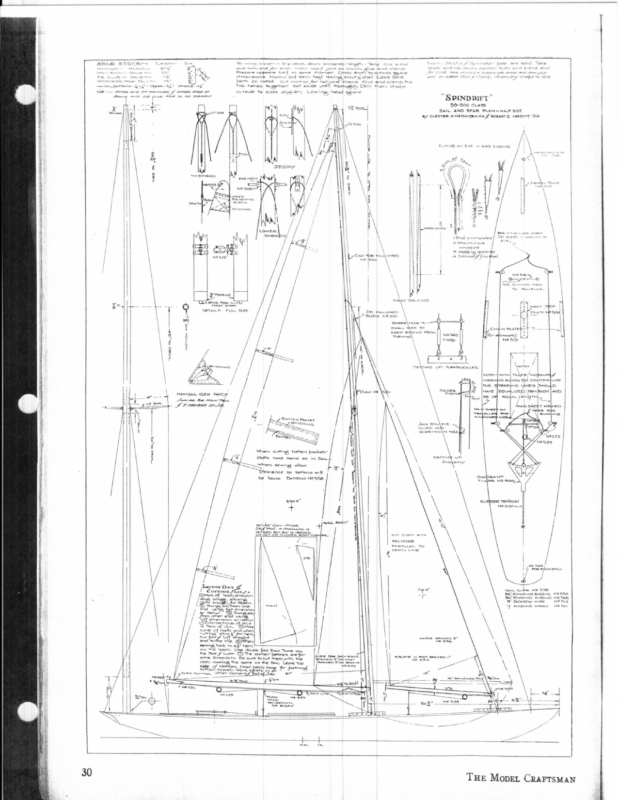
Pepe . oppose:iteelf ‘ bars -2i- re On pramnrasy, avo 10 fe \ t wie ff UMA LOGE OF Abe ro Ae as two outside sreargur ey to to-peetroe sizes squerr Jor es POT Leave Said, Fe Give. gradiclars}=ttie asaiver -e Aine, . read sduere = A “ SPINDRIFT ” = : 4 eb: | EN | 7 50-800 cLass SAIL AND SPAR PLAN~ HALF SIZE BY CHESTER ANEDWIDEGCHA £ ROBERT G HEEBEET-2Ho ann } | i} iy mal | inh \ 5It ror \! | | \ Ho Sie! ne isco MacT srre CSTALS Fu. Size f / / bauiyaen 7 MOCK NOST / / / / \ DHere| sole -«— / Ve Kerr ShowG FROM Sart as Pee Wain raw SL 2 crates a 7h. / c TURNING) / SeTTING UP = / \waters am me (igen Norte wites| nul \ \ |}\ .ad || \ TUENBUcELES. \ clear ne loko\ / rs CHAM PLATER eTM / / MAINSAIL QEW maT c ry % ° sie Wee TS AS Sosa & Se / TO / / A LEaF \ soree \ \ a) i HOOUHG Gubics > Gy! Cenitre|UNe He GYeeeinc Unrs pou oO AS \Have |BOUALIZED \TEN BION |AND Phe re vaur e of readac cenom!) i Y | w| /iaih SHEET nodceD / p Darren Roceey Sy? ONTO —— \ oad O64, r< —— ———H ‘ —* 22-0 PO _ ee \ {- cleat Ya mea / f utewe For - mnonreN + a.e< Dad OL Se \\ j 4 \ h ; | ; \\8 sae _k | j : w \ SEE em il b — f || K TV aS | j MASTHEAD ) |i | \\ d | j a \ / € | | | } / te ‘ | za og y= i { ay || Ny | A / || ( 4 |/\ aapeas ; _— | = an EYE on wiRE Baaaing PoTTING | __£ Svsne | ip oviside is Shell J Set ance until Horst) yy DRY thers shast rooted heWves | Fass, omees- 45" towsS Holle Aamerssons . >~ <5- Uppes / fs / Winer cuttings Cloths runs —*~s / = <>wires batters pocket: seme as semi in Sai sibw ~Qeorence SO tatters will / be loose DxTTeNns Ne5se. DES RED BG Oo” 19 HECOEO LAY OUT DS Wi Lowen 2G) Coesen, | r IN “a Our / } | i] } | | / | i) | j | / / / / if / / UYTING | | } / | || | / i | | / t I i; | \ | fae peda GOS enon © Jastiy « aours for i Swern actom ox fed | wy Sw “SEF gor RIGGING Hoos Ne Sia Na For . dimencion ar rettiur ce of % \ Ore \ curve of recto4”brad ae uttiras | allow Prather Cur tf Nuff afer reall \ Saha Sewing she Hust:ft= Oem \ warice oe Toot of Lure. @) The ete Sreelom. – paters are fo SACED Alor ase OACED Yod Boon wtesy of MANSAIL bead pstct boos oureen. okleis worat 7- footers NET Corres Yotse im. ai” & Bee ee Ee Ge surt to cut them with the clot rislinla the same os the Sur Leave top WM EAS TOARD. Wort seeceo t ne en Ee leach. Use double fold Dus tase oo, pam } “7 ac Wickersectors Of orca 16 O° Tack smy wie braved ved foot dimenron } rom other ¢Sd i=) / [| an 6 y | / y | hig San cube wie S36 STANDING BGOING NOSSA BS fot teach dimension / – THE Moper CRAFTSMAN
pind [ex x Oe A_ 30-800 MODEL YACH wwwwewwwewwweweweeweeeeweeee e« we we wr wewwneowweewwwwewwewewvr By Chester A. Nedwidek, N.A. q AST month, we completed the hull proper of this speedy Marble- head Class sailing yacht. In this ticle we will make the keel, and her, ready for the water. Since last issue appeared, a number of arrig the be- ginners have written in to ask what the numbers, “50-800” mean. These figures refer to the size of the yacht. The first figure refers to the fact that it is 50” in overall length, while “500” indicates the number of square inches of sail area. This class of yacht was introduced a few years ago, and beCause it represented such a sound, workable size, it has taken the country by storm. It is today the most popular class. Big enough to give a real thrill in sailing and building, it is, nevertheless, not too large to transport. This is also known as the Marblehead class, after the Massachusetts town where it was originated. No matter what type of hull con- struction you used, the keel is made on the bread-and-butter pattern. If solid lifts were cut out, glued to- gether, and shaped, there would be a strong possibility that warpage might destroy the shape of the keel after the yacht had been in use. This is overcome by making each keel lift in two halves, carefully planed and glued together. The halves are cut from 34” stock, and the section lines on the sheer plan are used for the outline. Drill the bolt holes for fas¢- weight of the fittings, and a 1% pound weight at station 4 to take the place of the rigging. When placed in the water with these loads, the hull should float to its designed waterline, as indicated in last month’s drawing. If she is too heavy, shave some metal off the keel. If too light, you can add weight in the form of strips of lead screwed inside the hull just over the keel. If this amounts -to much, it will be better to make a new, larger, keel make a lead casting for you. Put short dowels in the pattern to give the location of the keel-bolt holes. When you finish off the casting with a coarse file, use brass bolts to hold it in place, and set white lead around the bolts. To mount the rudder, drill a 4” hole in the backbone and king plank of the hull, and set the rudder port tube in with white lead. The rudder post is of 5/32” brass rod in two pieces as shown. ‘Turn down one end of the lower piece of 3/32” diameter for the heel bearing. If you do not have a lathe for doing this job properly, you can drill a hole in the end of this piece, and solder a short piece of rod into the heel bearing, to fit this hole, instead of the arrangement shown in the drawing. The heel bearing is filed from solid brass, pattern, and have a new lead keel cast, as it is far better to have the weight down here than up nearer the waterline. Next we start with the mast. This is hollow, to combine the greatest possible strength with light weight. At first thought it might seem very difficult to make a hollow mast, but if care and proper material are used, the job should not be too difficult. The process is explained clearly in the rigging plan which is reproduced on the opposite page. The boom, jib club, and spinnaker pole are not hollow. The metal fittings can be homemade, if you prefer, but the increased popularity of model yachting has made it possible for them to be manufactured in reasonably large quantities, with a consequent decrease in prices. Unless you have ideas of your own on the design and placement of fittings, it hardly pays to make them yourself. permanently in place until the rud- Contrary to common impression, sails cannot be made, with any degree of success, from old bed sheets. ter still, bring the part you have sawed off to a foundry, and have them and drilled for the fastening bolts as well as the pivot. Do not fasten this der is on. Now we are ready for rigging, but before we do so it is necessary to launch our hull and make a flotation test. Place a one-pound weight on the deck at station 5 to represent the There are several kinds of excellent sail cloth, woven especially for model yachts, now available, and you could not do better than to use one. If you wish to make a spinnaker, a yard-wide (Continued on page 59) @ 7 ening to the hull before the lifts are glued together, then sandpaper two wooden dowels to sliding fits in the holes, oil well, and use as placement pegs when glueing and clamping. Make cardboard templates from the cross sections of the hull, and use them to shape the keel, applying them as shown in the small sketch. Now two pieces have to be cut out of the keel you have just made. One is for the rudder, which is made as illustrated in drawing 6K, and mounted as illustrated in 7K. The other piece you cut out of the keel is to be replaced NOTE LS HALF UPFTS PAT rors ON Ker Sercere GUUS UFTS OGRE, with a lead keel. Make a sand or plas- GREE DRAFTSMAN TRE nea: ome ter mold from this piece, and pour in molten lead to form your keel. Bet- August, 1939 Detail drawings of the keel, showing how it is built up from lifts and shaped with the aid of templates. Construction of mast, spars, and rigging is shown on Opposite page 3)
of the entries, we must omit that much. News of the Clubs Mr. Pollard of the Warinanco M.Y.C. was O.0.D. On May 28th the day started By C. O. BROOK with F PROOF of the growth of model yachting is needed, let me furnish that proof in actual figures. These figures do not include unregistered clubs or models, but only those actually making up the two National Associations, Great Britain and the United States. The M.Y.A. (British) composed of the following, since it was organized in 1911: Scottish Clubs, 10; Northern England, 23; Midland, 8; Eastern, 6; Metropolitan and Southern, 20: Southwestern (Wales, Cornwall, etc.), 6; Ireland, 2; New South Wales, 1; Africa, 1; giving a total of 72 clubs. The M.Y.R.A.A. (U.S.) has 52 clubs in Eastern, Mid-West, and West Coast Divisions. It was organized 1924. While the British show a greater number of little or no wind, and going was slow, even with only nine entries, but by noon the breeze picked up and slipped into the Northeast held at five knots for the rest of the day—when one half of the second round had been completed. Sunday opened with a smart breeze throughout the morning and held to the ful in the extreme, holding off the heavy downpour of rain until we were putting our yachts away for the day. Monday was a repetition of Sunday, but wita the wind down to ten knots. Well, we went there to sail, and I doubt if any skipper can criticize either the amount of sailing or the manner in which the races were sailed or handled. The result follows: Lochman (Club?) ……….. Willis, Mill Pond M.Y.C. …. 116 L111 west of north where it moved late Saturday. By noon it was piping at a great rate, reaching a maximum of some twentyfive knots by 4 P.M. The Mill Pond Club, on whose water the event was sailed, treated us to a good dinner at John Black, Marblehead M.Y.C. 107 noontime, C. With only four pair to sail in each board, and the keen breezes, it was a steady trek up and down the pond for the entire three days for skippers, mates, and judges. The weatherman was thought- Wm. Bithell, Boston M.Y.C… esac cemee same SchacHer Ballantyhe: ss said ames s sie vas Frank Donnebacher, Prospect 98 95 78 ……….. 63 O. Brook, Deeper Hudson MENG. ses ¢ cuteness sare Sen ree 26 Doc. Allen, Deeper Hudson MYC. wes oes seu ss oe we 25 Park M.Y.C. (We D-H members stick together). The Warinanco M.Y.C. Invitation races models registered than we do in America, it is because they have six classes of models, Ten Rater, Six-Meter, M class, A Class, 36” Restricted, and 30” Restricted, all of which must be registered to com- pete in club and inter-club events. Even so, we Americans have approximately 60% as many registered models as has England. Now—if club members really wish to make the sport grow even more rapidly, let them register their models. It is only fair to the sport and to yourself, be- cause the finances from clubs to the M.Y.R.A.A. are used to advance the sport nationally, and therefore internationally—and this is not solicited advertising by the M.Y.R.A.A. but an undeniable fact. Another fact worth mulling over is that in Great Britain, “Individual Mem- bers’ are carried who have a vote equal to an entire club, which America grants to no one. At Avclass this writing the Championship Eastern races are Division history (sad history for this scribe). Being unable to secure the intials and Club of several August, 1939 Contestants at the Eastern Division class A championship races held in Port Washington, Long Island, N. Y. The photograph is taken in front of the Mill Pond MYC’s club house 49
Deeper Hudson, with “X”’s soon, so off eleven entries on Saturday, June 17, and Atlantic M.Y.C., Ist, with D. Harriman, Long Island M.Y.C. as Runner-Up. The have six of them here, five real good ones, Atlantic M.Y.C. won the Club Trophy with 281 points. They were not blessed four good ones and two not so good (the last two probably belong to Charley). east-northeast wind they were able to put over thirty races each for the eleven with much a three-mile blow, and at times not even that. Yet, the event was a happy one Well, they held their own with the A class in a race over at Boston, and today Charley (getting desperate, I guess) says, The Marblehead Perpetual Cup Races show you things.” O.K., Charley, we’ll held on May 14th brought out 47 entries from 11 Clubs. The result, Cecil Drake, wind, having little more than for those who took part. held at Jersey City on May 20-21 found fourteen clubs taking part in a wind varying from three to seven miles, and again Cecil Drake came out on top to take home this aging mug. In the two rounds sailed the results follow: C. Drake, Atlantic M.Y.C. …. 83 C. Farley, Boston M.Y.C. …. 82 H. Dixey, Marblehead M.Y.C… 64 ’ N. Cram, Warinanco M.Y.C… F. Donnebacher, Prospect Park IMD ee i oem 8 Bie 4 mca wxore 5 0 Joe Weaver, Central Park MYC A. Brassington, Staten 64 60 60 WW, «wim: «00 5 Sin § Sam 8 eee o See 56 54 MLY.C. oc eee cee c ee 50 A. Downie, Jersey City …… 50 E. Kershaw, South Jersey M.Y.C. 45 T. Morrison, Red Bank M.Y.C. 44 Long Island M.Y.C.; Scorers, H. Lloyd, ‘ersey City, H. Locke, Jersey City; UmTex Foster, Long Island M.Y.C. “RR. Stegman, Jersey City, H. Pierce, Warinanco, J. Pfatzer, Jersey City, R. Rogers, Atlantic, and H. Kolb, Staten {[sland. Mr. Frank Young, Secretary of the Wellington, Ontario M.Y.C. suggests that all models use flags while sailing; National races would use the Divisional Flag, International the National Flag (Union Jack), Interclub, the club flag, and Club races the owner’s flag. He suggest these be made of straining cloth, treated with lacquer filler while stretched out in can yard lengths, then, making a simple de- sign, cut a stencil, or set of stencils, and stencil the flag on light flag that will sore thumb. and agree colorful, I am they but I the cloth, a not stick out like a fond make can assuring of many events hear flags, look the old more timers saying, “Just something to drag the yacht down—a bother and guess discard decorations we a nuisance.” as we I dis- card gadgets, after the first ten years of sailing. Through this “mag” I received a letter from G. F. Shentield, 122 Sth St., Lewistown, Idaho, who wants data on rigging a model and is anxious to start a Club. It will be the first in that State as far as I can learn. Makers of sails, fittings, plans, etc. might contact “G.F,” and get him started—(you, © Medford). — of too, Farley, I have been the recipient of a number letters with friendly cause I said the “X”’ Shelf.” a As result, Farley says they have “put in your “A’ boats with ‘em, and we’ll do that. The Hartford M.Y.C. certainly were initiated into skiff sailing at their InterClub race with the Deeper Hudson M-Y.C. With a near gale from the south-southeast, the trip down the lake on a dead run, the close reach to the second buoy and the beat home gave the skippers a tough time. With six entries from Hartford and twelve from Deeper Hudson, there was plenty to keep the officials busy. With John Hamilton, Deeper Hud- sailor. W. Burgess, Empire M.Y.C… 41 H. Danstrup, Clove Lake M.Y.C. 29 R. P. Dezendorf of the Warinanco M.Y.C. was O.0.D.; Starter, H. Avery, ires, and one I built. We son, as O.0.D. the schedule was four boats up with two minutes to cross the line. This gave the skippers a chance to handle their yachts at the start without the need of trying to establish a line, an almost impossible task even to the skiff Island A. Shellmer, Irvington M.Y.C.. H. Martin, Sr., Long Island the shelf they come—to stay, I hope. The Hartford boys made a fine showing and took the rough going like the clean sportsmen they are. One of their members, Al. Adams, joined the ‘“Dunk- fifteen entries on Sunday. With a smart who started Saturday. Under the capable handling of that quiet-smiling Frank Goodwin as 0.0.D. assisted by Bill Brown, Dex Goodwin, Ed Barrow, Henry Van DePeole and Bill Hoeg, as well as their auxiliary, the event was as usual with this club, a marked success. Their hospitality, good sports: manship and skillful manner of putting on One events is legend among the clubs. saw nothing but smiling, happy faces all along the course, on the benches, leaning over the wall. We find it hard to imagine a more congenial group anywhere. Every: one enjoyed every moment of their stay if my own experience speaks for the crowd, and I’m certain it does. Their banquet left us all with distended anatomy but no danger of jitter-bug digestion. There were three high-class vaudeville acts following the banquet which in turn was followed by a dance which found youngsters of all ages up to eighty Cecil Drake, of the Atlantic club, took top honors with the almost unbelievable of a out 258 score of 300— possible and when one considers that there were fifteen boats leaving the line at one time, all sailing closely bunched with spaces of than six feet we boats, between less and from the same skiff that the first “Dunker” went in back in 1933 One of our members, Bill Spears, hustied home and “donated” trousers etc. so the new “Dunker” could get back to Hartford according to the dictates of civilization the Skipper, nor boat, but to his mate— who was none other than his nimble wife. She scaled over the rocky “cliffs” like a With the grounds so packed with there wasn’t room to turn around, the press on hand with cameras, and pencils, it looked like a gala day. cars and pads The sun went on a rampage with the mercury at 94, and uncovered hide looked like boiled lobster. One thing we noted about our guests was that their yachts were all finely built and exceptionally neat. The two trophies, one donated by Vic Hanner and the other by Charles Heisler of the Deeper Hudson M.Y.C., were for the guests, and their gratitude was something to think about. We never expect to meet a more friendly group of skippers anywhere. Everything was taken as part of the day’s fun. The results were: Vic Hanner 200, Paul Heisler 200 (both D-H men); Al Adams, Hartford, 175; Dix Belgrave, D-H, 175; Doc Allen, D-H, 100; H. Graffunder, Sr., 75; H. Graffunder, Jr., 75 (both D-H); B. A. Root, Hartford, 75; Lester Merris, Hartford, 50; Fred Gould, D-H, 50; Jim Alexander, Hartford, 50; Comm. F. Van Derlip, Hartford, 50; Bill Spear, D-H, 50; Bill Mills, Hartford, Marcius Case and John Hamilton, D-H, D.N.F. All‘in all it was a blustery event aud we know our guests were not intimidated against skiff sailing because of it. They wonder where Cecil got that control. This scribe attributes his sailing not to mountain sheep and made adjustments like a veteran. You’re a lucky Skipper, Cecil—that work should be worth a set of furs to any man. (O.K., Mrs. D.?) The results follow with a (*) showing those who sailed only one day: C. Drake, Atlantic, 258; Ben Chapman, Lynn, 167; Island, 134; H. Higginson, Boston, 131; A. Holmes, Boston, 131; R. Travers, Boston, Doc 120; Allen, *H. Nutting, Deeper Boston, Hudson, 99; 91; H. Parker, Boston, 84; H. Graffunder, Deeper Hudson, 73; *G. Craft, Worcester, 70; H. Brook, Deeper Hudson, 60; *K. Lloyd, Jersey City, 51; *W. Franklin, Worcester, 42. We received a nice letter from Ted Jacobs, 2027 Webster Ave., New York City, Secretary of the Empire M.Y.C., inviting interested folks to join their club. Ted is enthusiastic to say the least, and we know their club is going far and strong with such sincerity of purpose as Ted puts forth. New Yorkers interested should contact him and get into a real sport. They entered seven boats in the Nassau M.Y.C. Invitation race on May 28th. Saying they are all “green” at the game, they gave a fine account of themselves. Even at the Marblehead Cup Race in Jersey City one of their young members, Billy Burgess came in with 41 out of a possible 83 points—and that’s a laudable Class was “on the Over at Marblehead, Mass., at that club’s Annual Invitation Race, there were showing races the COLOE Black. Tom were too fine a group of hardy sportsmen. Boston PLAN] smooth c PLANEFT destructil Allen, Boston, 154; A. Brassington, Staten be- “scoldings” differe tremel having the time of their lives. ers’ by falling overboard in the last race, (and the law). With s ideas « Depart for beginners pitted against old timers. THE Mopet CRAFTSMAN ——— a
he has not had a spring break or come apart at the screwed-in joint, and only once did one of the belts jump off its pulley and that was when the engine accidentally became derailed on a split switch and the joint of the improving the scope of the organiza had ons esti sugg ous vari r tion. Afte int been made, it was decided to appo titu cons the nd ame to e a committe tion with a view to removing the am- switch wedged one of the spring belts off its groove. The advantage of / using double belts on each axle is obvious. It equalizes the thrust, and permits the belts to be reasonably slack and still transmit the required ntion their work. Considerable atte rules ng raci new the to n give was as e), issu ch Mar the (published in e ther that felt s ber mem the of e som ding power. When each unit is weighted wor were slight changes in the ber s of Mem . made be ld shou that with lead, disposed as convenient, so that the two units together (without the body) weigh approximately 20 the transmission | Ideal’s ‘HO’ had biguous and obscure terms which in cers offi the ped icap hand erto hith by increasing the surfaces in contact ozs.,