- In mid-1909, The Model Engineer and Electrician focused on the organizational and aesthetic growth of the sport, moving from technical construction to the logistics of competitive racing and club identity.
- The “Three in a Heat” Racing System. A significant innovation proposed by George Pontin, Hon. Sec. of the Southsea Model Yacht Club, addressed the inefficiency of traditional “tournament” rules.
- Efficiency: Under old rules, a match with 15 boats required 392 “boards” (individual races); the new system reduced this to 70 boards by sailing in seven rounds of five heats.
- Spectator Engagement: To help spectators track the action, Pontin suggested attaching colored flags to boats based on their heat (e.g., Red for Heat 1, Blue for Heat 2, Green for Heat 3).

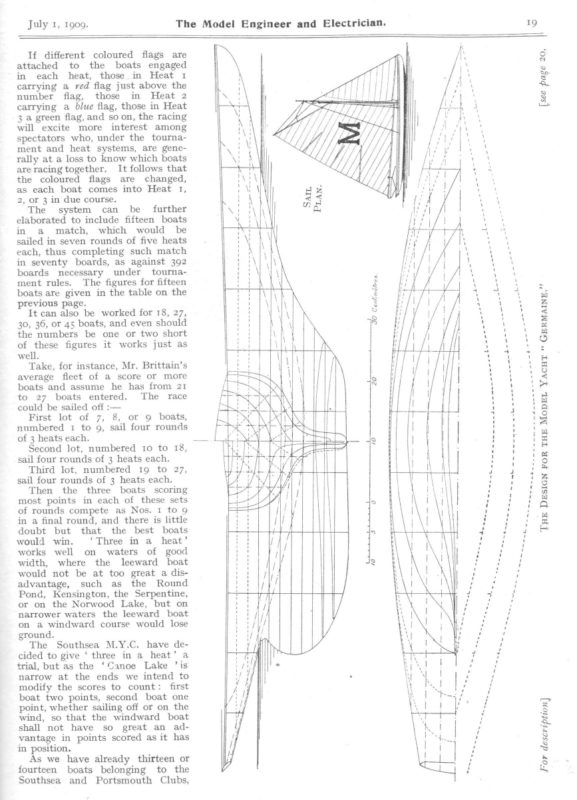
The Model Engineer and Electrician. 19 [see page 20, July 1, 1909. If different coloured flags are attached to the boats engaged in each heat, those in Heat 1 carrying a ved flag just above the those in Heat 2 number flag, carrying a blue flag, those in Heat 3 a green flag, and so on, the racing will excite more interest among spectators who, under the tournament and heat systems, are generally at a loss to know which boats are racing together. It follows that the coloured flags are changed, as each boat comes into Heat 1, ‘Three in a heat’ would win. works well on waters of good width, where the leeward boat would not be at too great a dis- saat” wp errr Ss ecw 2 Le 1 30 Cenhimélres. TSE Third lot, numbered 19 to 27, sail four rounds of 3 heats each. Then the three boats scoring most points in each of these sets of rounds compete as Nos. 1 to 9 in a final round, and there is little doubt but that the best boats THE DESIGN FOR THE MoDEL YACHT ‘“ GERMAINE.” Second lot, numbered 10 to 18, sail four rounds of 3 heats each. ee oe eee of 3 heats each. Thawsemeg ce seeaer=e boats, ig 9 ett ; xe“7 ee or numbered 1 to 9, sail four rounds _ could be sailed off :— First lot of 7, 8, rae Take, for instance, Mr. Brittain’s average fleet of a score or more boats and assume he has from 21 The race to 27 boats entered. 20~ well. K 30, 36, or 45 boats, and even should the numbers be one or two short of these figures it works just as SX previous page. It can also be worked for 18, 27, A as ee system can be _ further The elaborated to include fifteen boats a match, which would be in sailed in seven rounds of five heats each, thus completing such match in seventy boards, as against 392 boards necessary under tournament rules. The figures for fifteen boats are given in the table on the ie 2, or 3 in due course. advantage, such as the Round Pond, Kensington, the Serpentine, or on the Norwood Lake, but on narrower waters the leeward boat on a windward course would lose The Southsea M.Y.C. have decided to give ‘ three in a heat’ a trial, but as the ‘Canoe Lake ’is’ narrow at the ends we intend to modify the scores to count: first boat two points, second boat one point, whether sailing off or on the wind, so that the windward boat shall not have so great an advantage in points scored as it has in position. As we have already thirteen or fourteen boats belonging to the Southsea and Portsmouth Clubs, For description] ground.
The Model Engineer and Electrician. August 5, 1909. 135 though the latter has made a difference by placing the Club’s initials across it. Hastings, like Rye, Tooting, Southampton, and some others, gives unlimited sail area, restricting length only in their models. Barrow-in-Furness adopts a clever design—a bee and arrow. Let us hope their members are as busy ; as their burgee suggests, and their boats as fast if so, they should prove dangerous opponents on race days. Secretaries and members of Model Yachting Clubs ave invited to communicate reports of Club doings and other notes of interest for this column. Such notes should be sent in as early as possible in the month, but in any case at least twelve days before date of issue in which they are to appear.) Bootle has just designed a new flag, which is, however, the same as Cardiff and Clapham Common. The old Bootle flag is also shown having the Derby Park initials across it on a pale blue ground. The Old Clapham, whose burgee is red over white horizontal, is not much heard of in these days. The Clapham Common, whose initials C.C. are placed Burgees of our Model Yacht on its burgee, is nearly forty years younger and is one of those Clubs encouraging the steam model, in By Grorce Pontin, Hon. Sec. S.M.Y.C. Cardiff is one of the old Clubs, and dates back to 1868. Their racing takes place in Roath Park. The St. German’s Club, also of Cardiff, was founded only nine years back, their square burgee of light Clubs. T° judge from the numerous Mode] Yacht Clubs in England at the present time, there is no likelihood of the sport dying out—in fact, so many new Clubs have sprung into existence recently, bringing with them new energy and new boats, that it helps greatly to strengthen the forces of our miniature yachting fleet. Our plate Model Navy, the principal good fleet of of burgees gives some idea of our representing as it does over fifty of racing centres, each Club having a boats, and a satisfactory member- tt is, perhaps, only right that London should ship. possess the oldest Clubs—the Serpentine dating from 1842, and the Highgate in 1853; the former being the only flag on the sheet with a touch of orange colour on it, the well-known initials being on a field of blue. The arms of the City of London appear on some of the London Clubs, and it will be noticed that several other centres use the Town Arms on their burgee—Middlesbrough having three ships in full sail; Southampton three roses; Wensum gives us Norwich Cathedral; Yarmouth uses their three demi-lions and fishes’ tails; Norfolk and Nor- wich the castle on the lion’s back; Tynemouth three crowns; and Liverpool displays their strange bird, the Liver, from which the town is said to be named. A very ordinary type of flag is taken by Newcastle, Poole, Ilford, Southsea, and Surbiton, the last two being identical. Maidstone, one of the new Clubs, adopts an original colour, being plain green, and is the only one of that colour on the sheet. They sail three classes of models—3 ft. and under, 4 ft., and over 4 ft.—which seems to be elastic enough to accommodate anything. Sail area is unlimited. Perhaps one of the prettiest designs is that of Tooting, a new Club also, which promises well. The Club burgee is plain blue with lettering on it. It will be noticed that the ‘‘M”’ used to denote the Model Yacht Club is absent in this instance. Some Clubs evidently find it difficult to select a burgee, and have had to fall back on the white and blue ensigns used in the Navy. South Shields Sunderland, and Hastings are thus represented addition to an excellent fleet of sail. and dark blue suggesting Oxford and Cambridge. Edinburgh and Stanley Park, Liverpool, adopt the same pattern flag. The latter is a well-known Club, and dates back forty-eight years. A disastrous fire occurred at one of the Liverpool Club houses a few years back, resulting in the loss of a large number of very valuable models. In Sefton Park they race to windward only, in pairs, being turned by long poles and towed back before the wind with them. Of the Southern Counties Clubs, Southampton is undoubtedly the oldest and possesses some fast models, and the competition is very keen. They sail three classes—3o ins., 3 ft. and 4 ft. on water Southsea, in the line, sail area being unlimited. same county, sail on the canoe lake close by the new Parade Pier, and have a fine long stretch of water. Their boats havea girth, L.O.A. and L.W.L. measurement, which works out to three classes— 150 ins., 135 ins., and 120 ins., though they have recently been trying some metre models. Ryde, in the Isle of Wight, have the same measurement, and sail the last two classes. This Club unfortunately, seems to be falling off in member- ship, probably owing to the unsatisfactory state of their pond. Jersey, in the Channel Islands, formerly a strong Club, seems to have suffered from the same complaint, and is not heard of now. Poole, Weymouth has evidently fared likewise. however, close by, still races in Poole Park. They commenced operations in 1898. Newport (Mon.) has a pretty design for a burgee, the black and yellow being unusually attractive amongst the usual Club colours. Hull sails but one class of model now, the 10tonner, adopting the Y.R.A. 1,730 Rule. Two other Clubs flying the cross of St. George are Swansea and Rye, the Jatter sailing an over-all type of boat. Kilmarnock, established in 1897, have four The classes of ‘‘ tonners,’”’ with a time allowance. flags at their starting lines being 21 yrds. apart! They, like Southsea, give plenty of room to finish in. The Southampton marks are only 12 ft. apart, and some exciting finishes have been witnessed in consequence.
The Model Engineer and Electrician. 136 August 5, 1909. of Rule International Tynemouth have two classes, 10 and 15-tons. Wirrall is another north country Club with a large It started in 1898 and is still in active membership. service, sailing on a Corporation lake at Liscard. adopts the tournament plan of sailalso Club This ing, which is favoured by most of the large Clubs. Norfolk and Norwich, also Wensum, have neat The who has recently published an interesting guide to under this rule must be measured by the process Explanation. By Messrs. Potiitr and G. CoLMAN GREEN. inter-club racing it has now OR purposes of for clubs to F become an essential feature A yacht competing burgees. The Norfolk Club, whose head-quarters are at Norwich, should be in a flourishing condition, benefiting by the services of an energetic Secretary, employ the above rule. the various Clubs, and who is also the originator of shown here. In all probability all racing yachts (models in- the ‘‘ National ’’ movement in model yachting. The “National” flag is shown on the last square on the plate, and represents the East Anglian section. Glasgow several Clubs— possesses the Alexandra, Springburn, nistoun, Park, Queen’s Den- Victoria, and ee LWL. Hy though apparently not all in a flourishAlexandra flies the Prince ing state. of Wales feathers in a crown, and the Queen’s Park burgee is a copy of the an Measurements: Yacht \ ‘ a : 2 3 4 sss g T ‘ : 7 8 g p + ee ‘ b ‘ ‘ i; ‘ Fic. 1 Royal Southern Yacht Club. Lowestoft flies a pilot’s flag, and has a fine fleet of yawls, which do remarkably well on local waters. Leeds flies a tricolour similar to West Hartlepool. At Manchester the Alexandra has a good fleet of boats. originally Leith and Edinburgh DIAGRAMS ILLUSTRATING THE APPLICATION OF THE INTERNATIONAL RULE OBSERVE THAT THE RULE OF TAXES A HOLLOW SECTION. gt /~ CHAIN GIRTH YAcHT MEASUREMENT. hi sailed in King’s Park, when they started in 1887, but have now a fine sailing ground in Inverleith Park. Gateshead dates only five years back, and sails at Saltwell, their blue burgee having a white ‘‘S ” on it. In addition to the See” Norcu To REDUCE LENGTH OF LW.L. NoT ALLOWED \ — Wovuwe af taxeusas bb OO Club burgees, which are of sizes varying from 3 ins. by 2 ins. to 6 ins. by 3 ins., the models generally carry a racing flag at the peak, and some Clubs also use a num- ber which aids identification, and facilitates scoring. The Club colours are generally flown on race days on a —— staff by the lake. In conclusion, it is very satisfactory to note that there are at least fifty strong Clubs who proudly hoist their colours this season, and it is not improbable that this number will annually increase, as the public become convinced of the importance of these miniature fleets in providing navigators, yachtsmen, and sailors for our country. om REAL LW. Me Scare For Fics 1. § G Se $ SS SS Ka 2CNT SEEN 24 We t = Scarce ror Fico§ 2.34 65. cluded) will have to conform to this method, which is laid down by the European Union for ten years, viz., England, Denmark, France, Holland, Belgium, Germany, Austria, Norway, Hungary, Italy, Spain, and Switzerland. The formula is— L+B+iG+3d+4vV S-F 2 =linear rating,
|| | | ili) 137 | easi lil The Model Engineer and Electrician. | August 5, 1999. Ihr Hom LENT iiiM !eM po P| UL YArmoute{ For description] JHE National – i [see pages 135 and 136.
138 August 5, 1909. The Model Engineer and Electrician. in which L=length of L.W.L. (load water line) added to a added to db. a=the difference between the girth and twice the freeboard at the bow ending of L.W.L. b=one-fifth of the difference between the girth and twice the freeboard at the stern ending of L.W.L. B=breadth of beam. G=chain girth (7.¢., measured from upper edge of covering board round keel to covering board again at that station where such measurement would be greatest, less twice freeboard at same station). d=the difference between the chain girth and provided that the maximum chain girth does ne exceed that of the station so fixed anywhere for ward of that station, or by more than 3 per cent anywhere abaft of that station. Should there be any hollow in the fore and a underwater profile, the girth and difference mea- surements should be taken under an imaginary line excluding such hollow. Remember.—The rule is intended to tax the “hollow” section, and therefore compels a yach to be of ‘full’ and healthy body. Build your yacht 36 inches or 42 inches L.W.L. to get the best sport, and a sufficiently large and powerful craft te thoroughly test the International Rule, which to be in force till December 31st, 1917, 7.¢., tem years. skin girth at G. S=sail area. F=mean freeboard. Club Doings. ) | 41 | | | Lassie First, measure the length of the L.W.L. usual way from a to b, Fig. 1. Result, say, Second, measure the girth at a, as per dotted line, Fig. 2, and deduct twice the freeboard at that point. .. .. Southampton Model Yacht Club. The annual race for the Secretary’s Challenge Result, say, °5 1 42°5 Third, measure the girth at b, as per dotted line, Fig. 3, deduct twice the freeboard at that point, and divide Result, say, by 5. Cup was sailed on the club’s water on June 19th. and brought out a good show of the 30-in. class. Killarney (Mr. Bartlett) holds the trophy, and made \ I | | J Fourth, measure extreme beam wherever found… Result, say, 12 Fifth, measure the chain girth, as per dotted line, Fig. 4, at that part of the yacht at which the measurement is greatest, deduct twice the freeboard at that point and divide by 2. Result, say, See Note below. Sixth, measure the skin girth, as per dotted line, Fig. 5, at same station as above, and deduct the chain girth as found above, multiply the difference by 3… Result say, Seventh, measure the sail area (see page 17, British Model Yacht Club’s Guide), find the square root of total sail area, and divide by 3. Result, say, Eighth, add together all the 3 Mr. 15 Tenth, Subtract frcm abcve and divide ‘ MISCHIEF,” WINNER OF | THE TO LEEWARD. an excellent start by scoring nine points straight off before her career was spoiled by Mischief (Mr. Syrret) and Lady Floss (Mr. Batchelor) coming above. tion G and divide by 4. Result, say, Syrett1’s SECRETARY’S CHALLENGE CUP, WITH ‘‘ PEARL” Result, freeboard Ninth, ascertain the mean thus: Add together once the freeboard at (a) the bow ending of the L.W.L., once the freeboard at (b) the stern ending of the L.W.L., and twice the freeboard at the girth sta- =the linear rating. 9 close up. The other competitors’ scoring was not of such a character to ensure them a place, and though some of them sailed well, they invariably lost when being handled near the marks. Several close finishes 3°25 2)78°25 39°125 Note.—lf the chain girth be the same at several stations, that nearest to the greatest beam shall be adopted for subsequent measurements. But if the keel underside line abaft the girth station is straight except for a reascnable round at the extreme after end, the station for the girth measurement may be fixed by the designer anywhere abaft of «55 of L.W.L. length from its forward end- were noted, and the breeze kept up well enabling the result to be announced to the interested spectators assembled round the course. The final scores were: Mischief, 14 points (Cup); Lady Floss, 135 — Killarney, 12 (winner in 1908); Beryl, 7 (winner — in 1907); Petrel, 7; Pearl, 6; Ethel, 6; Mudge, 4; Reliable, 3. Sibbie did not start. The illustration shows the winning boat, which was recently built in Jersey for Southampton racing, and has proved a reliable model. She is a long keel type, and carries a good area of canvas. The Pearl is shown to leeward.
The Model Engineer and Electrician. 548 December 2, 1900. Sheer line BF 4 3 es \ Fig. q. ee ae Sheer Plan x 2666 Syeeess sii ee ae See a aeS eee } – Rabbet lines ‘Fig. 5. Half B: li DESIGN FOR MODEL SAILING YACHT 5-RATER. By R. P. KITcHINGMAN.
> * & o yy = = Trial 549 Midship Section. ® The Model Engineer and Electrician. = = Ss ry © a 4 —o December 2, i909. For description see page 355.