- Title. Author. Summary

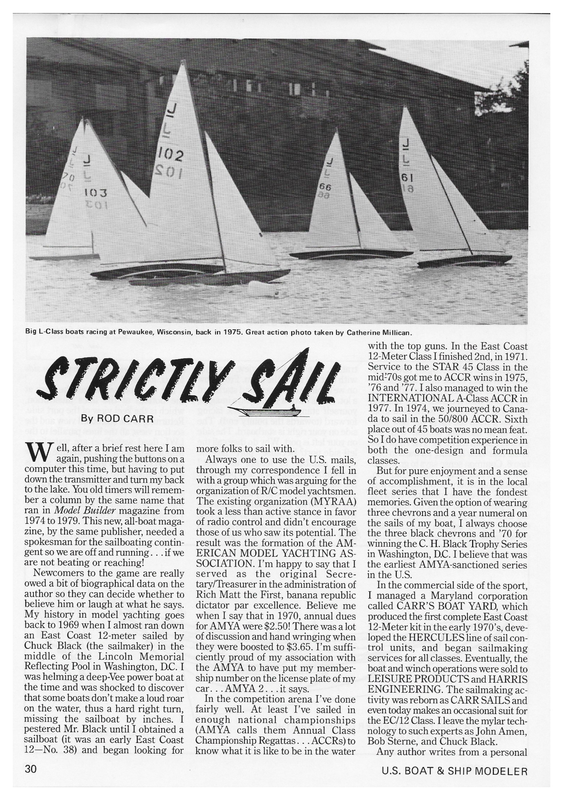
Big L-Class boats racing at Pewaukee, Wisconsin, back in 1975. Great action photo taken by Catherine Millican. with the top guns. In the East Coast 12-Meter Class I finished 2nd, in 1971. By ROD CARR \ N } ell, after a brief rest here I am again, pushing the buttons ona computer this time, but having to put down the transmitter and turn my back to the lake. You old timers will remember a column by the same name that ran in Model Builder magazine from 1974 to 1979. This new, all-boat magazine, by the same publisher, needed a spokesman for the sailboating contin- gent so we are off and running. . .if we are not beating or reaching! Newcomers to the game are really oweda bit of biographical data on the author so they can decide whether to believe him or laugh at what he says. My history in model yachting goes back to 1969 when I almost ran down an East Coast 12-meter sailed by Chuck Black (the sailmaker) in the middle of the Lincoln Memorial Reflecting Pool in Washington, DC. I was helming a deep-Vee power boat at the time and was shocked to discover that some boats don’t make a loud roar on the water, thus a hard right turn, missing the sailboat by inches. I pestered Mr. Black until I obtained a sailboat (it was an early East Coast 12—No. 38) and began looking for 30 more folks to sail with. Always one to use the U.S. mails, through my correspondence I fell in with a group which was arguing for the organization of R/C model yachtsmen. The existing organization (MYRAA) took a less than active stance in favor of radio control and didn’t encourage those of us who saw its potential. The result was the formation of the AMERICAN MODEL YACHTING ASSOCIATION. I’m happy to say that I served as the original Secretary/Treasurer in the administration of Rich Matt the First, banana republic dictator par excellence. Believe me when | say that in 1970, annual dues for AMYA were $2.50! There was a lot of discussion and hand wringing when they were boosted to $3.65. I’m sufficiently proud of my association with the AMYA to have put my membership number on the license plate of my car. – -AMYA.2……:.it-says: In the competition arena I’ve done fairly well. At least I’ve sailed in enough national championships (AMYA calls them Annual Class Championship Regattas. ..ACCRs) to know what it is like to be in the water Service to the STAR 45 Class in the mid+70s got me to ACCR wins in 1975, ‘76 and ’77. I also managed to win the INTERNATIONAL A-Class ACCR in 1977. In 1974, we journeyed to Canada to sail in the 50/800 ACCR. Sixth place out of 45 boats was no mean feat. So I do have competition experience in both the one-design and formula classes. But for pure enjoyment and a sense of accomplishment, it is in the local fleet series that I have the fondest memories. Given the option of wearing three chevrons and a year numeral on the sails of my boat, I always choose the three black chevrons and ’70 for winning the C. H. Black Trophy Series in Washington, DC. I believe that was the earliest AM YA-sanctioned series in the U.S. In the commercial side of the sport, I managed a Maryland corporation called CARR’S BOAT YARD, which produced the first complete East Coast 12-Meter kit in the early 1970’s, developed the HERCULES line of sail control units, and began sailmaking services for all classes. Eventually, the boat and winch operations were sold to LEISURE PRODUCTS and HARRIS ENGINEERING. The sailmaking activity was reborn as CARR SAILS and even today makes an occasional suit for the EC/12 Class. I leave the mylar technology to such experts as John Amen, Bob Sterne, and Chuck Black. Any author writes from a personal U.S. BOAT & SHIP MODELER
point of view. It is proper to write down what biases I can identify for your use as background. After all, you’d probably not want to try to learn how to gamble from Jimmy Swaggart ‘cause he doesn’t believe in it. I give high priority to: Introducing new people to the sport of model yachting Assisting beginners in getting boats constructed and on the water Devoting time to the study of management and administration of local fleets actively promoting onedesign sailing as a means of establishing strong, long lived fleets that don’t lose as many people each year as they gain Continually advancing model yachting as a sport that is environmentally compatible, contributes to good health, and that also fits in well with other recreational water uses Harping that model yachting is first and foremost FUN, and only a serious competition sport as a distant second. A few words about the history of our sport seem proper in this initial article. Model yachts have been pushed about ponds and lakes since organized in the early 1800s. The early boats used a clever means of attaching the mainsheet to the tiller arm. A balance was achieved which allowed the boat to sail a relatively constant angle with the wind. Subsequently, a more sophisticated method of controlling the rudder angle was conceived by a Mr. Braine and many, many boats were built with ““Braine Gear’ doing the helming duties. Further development resulted in the invention of a mechanism in which the relative wind was sensed by a wind vane on the transom and the rudder controlled by an attached gear train. Many specialized ponds were built in Europe, and a few here in the U.S. to provide sailing sites for what was known as “‘Vane Sailing.” Popularity climbed, and soon there was sufficient worldwide interest to require the establishment of a governing body, the International Model Yacht Racing Union IMYRU). IMYRU provided for each country to establish a National Authority which would be the bridge between IMYRU and the skippers in the country. In the United States, the first national authority was the Model Racing Association of America (MYRAA). MYRAA organized itself with the individual club as the standard unit. While individual skippers registered boats to race, the responsibility for voting and establishing rules rested with the clubs. Vane sailing waxed and waned until the mid-1960s. As radio control apparatus became more reliable and less Summer 1987 The guy who really started it all… R/C model yacht racing as we know it today, that is Protheroe, creator of the Santa Barbara One-Design. costly, it was applied to sailboats. Such well-known names as Buddy Black, Dwight Hartman, Matt Jacobson, Tom Protheroe, and John Reynolds began the production of fiberglass boat hulls, boat kits, and the documentation necessary for assembling and outfitting the boats. Here were born (in the Same order as above): the EAST COAST 12-METER, OLYMPIA, REGATTA ONE-DESIGN, SANTA BARBARA, and the 6-METER. It is interesting to note that all of these are one-designs, a point that naturally fits my biases, and that results from the use of fiberglass molding processes to produce a series of identical hulls. At the same time, individual skippers were applying radio control technology to the entire array of formula class boats that had long been sailed under vane gear. These classes encouraged the design and construction . Tom of individual boats to a class measurement rule or a formula. As all these folks looked for ways to pool their knowledge and learn from each other, inquiries were made of the MYRAA leadership. Yes, radio boats were welcome within MYRAA. But, one realized that individual skippers were not going to have a strong voice in the organization set up as it was for club domination. The thing most common to the early R/Cers was strong individuality of each person. The egos were not small either, and selfmotivation could be taken for granted. The most vocal of the R/Cers were formed into an ad hoc committee under the direction of Ray Hottinger of Colorado Springs, Colorado. Ray was writing a magazine columnin RADIO CONTROL MODEL BOATING, a monthly published by John Barboza. Ray formed a natural focus for all the 31
apie tiel ise Jack Elem, Fullerton, CA, launching his Friendship sloop “‘Nefertiti’’ back in 1978. Very similar to the version on our ‘“‘Cap’n‘s Log’’column head. enthusiasm, and, as his mailbox smoldered with hot letters, he finally took revenge on all his attackers by assigning the nine most pushy as interim officers and directors of the AMERI- CAN MODEL YACHTING ASSOCIATION. I must have been near the head of his list for he made me Secretary/Treasurer, a move which has kept my mail box stuffed to this very day, it seems. FIRST AMYA OFFICERS (1970-71) President Sec’y/treas QNL Editor Director Director Director Director Director Director Rich Matt, IL Rod Carr, MD Ray Hottinger, CO Dennis Eason, Canada Dick Hein, IL Bob Suding, CO Bill McLaughlin, TN Don Prough, CA Gordon Wallace, CA This unruly bunch of rabble constituted what has come to be known as the Chosen 9. (Almost sounds like the Seacaucus 7…and didn’t they go to jail?) Well, we escaped conviction and went merrily on our way establishing what has turned out to be a very successful organization. I think this success was because the founders represented a fair crosssection of the newly emerging hobby of R/C sailing. The total expertise was a balance of formula and one-design class experience. It shared a general distaste for administrative and bureaucratic processes and procedures. Today we can see this reflected 32 AMYA-SANCTIONED CLUBS—Winter 1987 CANADA Oshawa Model Mariners – Ontario, Reg Whalen, (415) 725-4675 Metro Marine Modelers – Toronto, Robert Pugh, (416) 487-9003 Montreal Model Yacht Club – Pointe Claire, Phil Turgoose (514) 695-9208 Ottawa R/C Yacht Club – Ottawa, Tom Rogers, (613) 646-8668 Upper Canada Model Yacht Club – Toronto, Wolfgang Schulze, (416) 247-9218 Vancouver Model Yacht Club – Vancouver, B.C. Bob Sterne, (604) 299-0767 AUSTRALIA Canberra Model Yacht Club – Holt, Aust., David Burns, 06-254-9122 South Australia RYS – Fulham, Rick Doorey, 88-353-1920 MALAYSIA Kuala Lumpur Model Yacht Club – Kuala Lumpur, Sidney Pearce, c/o Racal-Decca UNITED STATES AK Arctic Circle Yacht Club – Anchorage, Bill Schoephoester, (907) 279-7275 AL Birmingham Model Yacht Club – Birmingham, Myron Sasser, (205) 956-6843 AL Prattville Model Yacht Club – Prattville, Dane Drasher, (205) 365-0453 AZ Copperstate Model Boat Club – Phoenix, Glen Raub, (602) 277-4278 AZ Tillerman Model Yacht Club – Mesa, Bob Girdley, (602) 985-8393 CA Bay Racing Association – Petaluma, John Amen, (707) 762-9771 CA Canyon Lake Model Yacht Club – Canyon Lake, Andy Bajan, (714) 244-4025 CA Helmsman Model Yacht Club – Van Nuys, Charles Engle, (213) 780 3307 CS Northern Cal S/B Fleet #2 – Oakland, Irvin Blanchard, (415) 836-1467 CA Northern Cal Soling Fleet #2 – Vallejo, Howard Brown, (707) 642-9166 CA Orange County Model Sail Club – Laguna Hills, Pete Kruse, (714) 830-2764 CA Pier 1900 Model Yacht Club – Lakeport, Hans Carmiggelt, (707) 263-4453 CA RC Mariners – Santa Barbara, Ray Kieding, (805) 682-4670 CA Sacramento Model Yacht Club – Fair Oaks, Ernest Morton, (916) 967-5644 CA San Diego Argonauts – San Diego, Bill Sage, (619) 453-5851 CA South Bay Model Yacht Club, San Jose, Bob Eger, (408) 266-6404 CA The Dam Club – Altadena, Andy Littlejohn, (213) 794-0193 CA Victor Valley One-Meter Assn. – Victorville, George Floyd, (619) 245-7545 CO Colorado SPGS Model Boat Club -Colorado Spgs, Ray Hottinger, (303) 598-8105 CO Denver Area Model Yacht Assn. – Denver, Del Lauterback, (303) 934-8960 CT Housatonic Model Yacht Club – W.E. Teghtmeyer, (203) 929-8319 CT Mystic Model Yacht Club – Pawtucket, Robert Weall, (203) 599-1644 DE First State Model Ycht Club – Wilmington, George Bard, (302) 994-8962 FL Golden Triangle Model Yacht Assn. – St. Pete., John Hichman, (813) 327-5834 FL Miami Model Sailing Club – Miami Lakes, Dick Finlay, (305) 823-0330 FL Naples Model Yacht Club – Naples, Peter Bodine, (813) 263-4347 FL North Florida M.YC. – Jacksonville, Susan Milligan, (904) 733 9601 FL Orlando R/C Model Yacht Club – Winter Park, George Losey, (305) 647-2128 FL Pensacola Model Yacht Assn. – Pensacola, David Stone, (904) 932-3388 GA Atlanta Model Yacht Club – Atlanta, John Dixon, (404) 252-0008 GA Wing To Wing Model Yacht Club – Peachtree City, Tom Evens, (404) 487-8209 IA Iowa Model Yacht Assn. – Perry, Keith Miller, (515) 465-2306 IL Chicago R/C Model Yacht Club -Park Ridge, Bill Paine, (312) 823-6006 U.S. BOAT & SHIP MODELER
in the one-time vessel registration fee. This is terrific from the standpoint of the skipper, but horrific from the standpoint of the Class Secretary, who has to administer such an unwieldy information base. But, the founders clearly held the well being of the individual to be supreme. By the early 1980s, AMYA’S appeal resulted in the eclipse of MYRAA, and the assignment of AMYA as the IMYRU National Authority for the United States. Early in AMYA’S life, the Quarterly Newsletter became the focus of its efforts. A large proportion of the members were individual skippers and the AMYA QNL was the only reliable and continuing source of information about R/C model yachting. Both quality and quantity have steadily increased up to the present time. Gene Dunham, the current QNL Editor, has produced a recent series of technically oriented articles which are unmatched anywhere in the modeling press. The annual AMYA dues of $20 are a small price for 240+ pages of model yachting news, delivered to your door over the course of a year. Control of the affairs of AMYA and of its boat Classes were left strictly in the hands of the membership. All members vote on AMYA business. Class members vote on issues arising from within their own class. All the information required is contained within the pages of the QNL. Active skippers are part of the process whether they live alone up an Alaskan river, or can see the San Diego Club’s pond and are one of its 100+ members. The system has worked well for over 17 years, though not without the usual amount of controversy and debate which accompanies searches for consensus. AMYA encourages sanctioned Clubs as a means of promoting the sport on a local level. Only three (3) AMYA members are required to charter a sanctioned club. One of those members becomes the Club Contact Person, and his name and address are published each year in the QNL. Each year the club must hold at least one IL North Shore Model Boaters – Antioch, George Kellogg, (312) 395-1980 IN Indy Model Yacht Club – Indianapolis, Tug Wilson, (317) 849-4308 IN N’West Indiana Model Yacht Club – Valparaiso, Don Schneider, (219) 462-8275 KS Midwest Model Yacht Assn. – Ottawa, Joel Nordeen, (913) 242-1239 KY Bluegrass Open Yacht Club – Louisville, Ed Tasman, (502) 363-0029 LA Greater New Orleans Model Sail. Club – Metairie, O. Williams, (504) 635-3741 LA Gulf Coast Model Yacht Assn. – Slidell, R.L. Richardson, (504) 641-0816 MA Marblehead Model Yacht Club – Marblehead, Gene Thober, (617) 631-0797 MA Minuteman Model Yacht Club – Needham, John Sulivan, (617) 444-6166 MA Springfield Model Yacht Club – Springlield, George Brown, (413) 788-4669 MD R/C Skippers ASSN of Baltimore – Towson, Jim Macneal, Jr., (301) 296-4296 MD Solomons Island Model Boat Club – Solomons, Leroy Langley, (301) 326-3719 MI Detroit R/C M.YC. – Bloomfield Hills, Charles Scales, (313) 642-3811 MI Michigan Model Sailing Club – Saginaw, Wayne Westendorf (517) 793-8025 MI Sail Club ‘‘54”’ – Jackson, Ernest Beffel, (517) 782-3715 MI West Michigan Model Yacht Assn. – Rockford, Chuck Haling, (616) 866-1065 NC Piedmont Model Yacht Club – Burlington, Harry Studstill, (919) 584-5346 NH Laconia Model Yacht Club – Center Sandwich, William Visser (603) 284-6497 NJ Brant Beach R/C Club – Medford, T.W. Coe, (609) 654-0005 NJ Mini-America’s Cup Association – Montyville, Richard Palmer, (201) 335-1111 NV Reno Model Boaters – Sparks, John Hanks, III, (702) 673-3863 NY Albany Model Yacht Club – Albany, Larry Grant, (518) 489-4990 NY Buffalo Model Power Boat Club – Amherst, Jim Lankes, (716) 833-6402 NY Central Park Model Yacht Club – NYC, Madeline Tucker, (212) 874-0656 NY Heckscher Model Yacht Club – Cold Spring HRBR, David Joerger, (516) 488-3880 NY Island Model Yacht Club – Westbury, William Moll, (516) 334-5276 NY Mid-Hudson R/C Society MYC – Poughkeepsie, Henry Pletcher, (914) 454-5797 NY Mill Pond M.YC. – Port Washington, Edward Helmle, Jr., (516) 883-8453 NY Rochester Model Boat Club – Rochester, Bill Head, (716) 247-2167 OH Cleveland Model Boat Club – Middleburg Hts., Albert Zier, (216) 676-0804 OH Miami Valley Model Yacht Assn. – Dayton, Donald Peacock, (513) 845-9568 OH Sailboat Racers of Central Ohio – Columbus, Rich Ritchison, (614) 261-7624 OR Oregon Model Yacht Club – Portland, John Oettinger, (503) 646-8668 PA Mid-Atlantic Model Yacht Club – Glenolden, John Krick, (215) 461-5530 PA White Rose Model Yacht ASSN. – Middletown, Robert Eames, (717) 944-2657 PR Puerto Rico Silent Modelers – Los Frailes, Peter Mareno, (809) 721-0189 RI Narragansett Model Yacht ASSN. – Pawtucket, Michael Andrea, (401) 724-5221 SC Charleston Model Yacht Club – Charleston, William Coates, (803) 762-0624 SC Hilton Head Model Yacht Club – Hilton Head, Ron Martin, (803) 671-5485 TN Music City Model Yacht Club – Brentwood, John Workman, (615) 833-9114 TX Alamo Area Model Yacht Club – San Antonio, Jim Humphries, (512) 494-0112 TX Olympic Model Yacht Club – Sugarland, Ted Cooper, (713) 491-7397 VA Lanier Model Yacht Club – Martinsville, George Sawyer, (703) 632-3777 WA Gig Harbor Model Yacht Club – Gig Harbor, Ron Moblo, (206) 851-2489 WA Greater Seattle Model Yacht Club – Bellevue, Jim Morin, (206) 454-2654 WI Badger Model Boaters – Racine, Gary Randall, (414) 886-5295 WI Racine R/C Model Yacht Club – Racine, Ken Luedtke, (414) 554-8592. Summer 1987 Bone IV, a 50/800-class boat. Cat-rigged, canard rudder, rotating mast, and mast turtle. Keel at location of hull stripes. Design by Karl Kirkman. regatta that is open to skippers from outside the club. The date is published in the AMYA Regatta Schedule. No money passes from the club to AMYA. If the local club charges dues, that money is for local use. So while there are AMYA Clubs, they exist as a convenience for the local sailing that makes up the vast majority of events throughout the season. The founders even went so far as to provide an OPEN Class. Here are found boats of every size and description: scale, one-of-a-kind and so on. A new design which hopes to obtain its own class status will be registered in the OPEN Class until there are 20 boats of that variety, and then the class is free to organize, elect its own class secretary, establish its own class rules and conduct its own Championship regattas and other affairs. Competition, racing radio controlled sail boats, is the bottom line. Racing starts at the local level. Most clubs have local series racing. Much of it goes unpublished in the Regatta Schedule. A call to the club contact man will usually confirm that traveling salesmen are welcome at lake side, and I’ve often been able to borrow a boat from a local skipper who was unable to attend. More racing occurs at the local fleet level than on any other across the country. Next on the list are what are called GREEN CHEVRON events. These are special one or two-day regattas Continued on page 74 33
aspects of the model boating scene. (Not cars, trains, planes.) We can start you off with basic kits or pro- vide you with plans and materials. Our range also covers working or static models, and we carry an extensive selection of fittings for all types of ships and boats. Send for our newest Catalog $6 postpaid $7 outside the U.S. The Dromedary 6324 Belton Dnve E] Paso, Texas 79912 (915) 584-2445 of 10-15 degrees was often the cause for a loss or a win, so a choice where you Sailed on the pond often made the day. After the 12 races, we were all pleased to find young Lou Porro up in first place. He had been sailing a new lightweight balsa and fiberglass boat with a three-channel Futaba radio. His starts had been excellent for the entire event, he was able to stay out of trou- Strictly Sail… Continued from page 33 which celebrate something unique to the area of the club. Chesapeake Appreciation Day Regatta and The Liberty Bell Regatta are two events held for East Coast 12-Meter boats in the Mid-Atlantic, which have been sailed for over 15 continuous years. Winners down through 3rd place are awarded green chevron and year Continued from page 35 ice, but the weather was getting warmer. Along came Saturday and we found an open spot in the ice about the size of a football field. We went home and put on an X447 Octura prop and loaded every thing we needed. We expected the X447 prop would be small for the K&B, but we figured we would go easy the first time out. If other brand engines are used, try starting with an X445 Octura prop. This will ensure no overpropping. When arriving at the lake, it didn’t take long to fuel the boat and get it running. As anticipated, the boat put on an excellent display of speed and handling. From observing the speed, we knew an X450 prop would put us right in with the best running boats in the district oval races. The X447 really was not enough for our engine. We are specialist suppliers for all a E a R a The handling had to be the best I have ever encountered with any of my previous 20-size riggers. The feeling the boat gave you was that it could be turned when and where you wanted without fear of hooking, dunking, or flipping. This is the quality a great hull should have. A boat that doesn’t handle, usually doesn’t finish a race. Between the first few runs and this date, we have only put on an X450 prop. Nothing else needed to be changed. CONCLUSION In this competitor’s opinion, Don Pin- ckert has produced a kit to warm the heart of any competitor. The workman- numerals to attach to their sails. GREEN CHEVRON events are a great way to establish a club tradition, or to mark a local event of significance. Many of them are scheduled in the late spring or early fall and are able to draw substantial entries from surrounding fleets as the event is not in competition with championships of various sorts that are bunched in the summer months. DIVISIONAL CHAMPIONSHIPS are scheduled by the respective Class Secretaries with an eye to even distribution around the country from year to year. Red chevrons and year numerals are awarded for these events, and they often draw top competitors who are working their way up the competition ladder. Usually three or four Divisionals are scheduled for a class depending on its size and its distribution. Often the Divisionals are held before the Annual Class Championship Regatta (ACCR) and used as tune-up events by the strongest sailors. Such scheduling is not mandatory, however. The top of the heap at the national level for each class is the Annual Class . Championship Regatta (ACCR). This _ too is scheduled by the Class Secretary PRATHER RECORD BREAKING BOATS AWESOME PERFORM ANCE Boat Prop Balancer * Accurate ; * Easy to use * Fits most boat props For 7.5ce Outboards Cat. No. 3002 An economical prop balancer that really works. Length – 32” Beam – 1312″ Che 4 | Strut with Brackets Fits Inboard Boats Cat. No. 8073 for 3.5cc Inboards Cat. No. 8074 for 7.5cc Inboards Welded stainless steel strut with high speed bearings installed. Lightweight aluminum brackets. * Epoxy-Fiberglass Construction * Tested and Proved in Competition * Unique Bottom for Speed and Stability COMPETITION CLASS PERFORMANCE The unique bottom of the Lap Cat! allows it to accelerate and reach speeds never thought possible. A stock 7.5cc outboard will reach speeds near 50 MPH and still remain stable with excellent turning ability. This unique combination of speed and stability will make a fun day at the lake a real thrill. The competitor will find a day at the races a very rewarding experience. — new Trim Plates For Inboard Boats . Cat. No. 8077 3” for 3.5cc Inboards Cat. No. 8078 4″ for 7.5cc to 11cc Inboards Strong Stainless Steel Construction i PRATHER PRODUCTS: toso ravenna ave. wicmineton, ca 90744-1398 (213) 835-4764 74 Cais err te ery PACE [S. WUVises] fice Ship Modeler’s Center ship is excellent and your results should be as pleasant as ours. e Mo The Dromedary ble at the marks, and thus was able to add up the lowest score for the regatta. Scoring is reverse: First, 3/4 point; second, 2 points; third, 3 points; fourth, 4 points, etc. 2 SEND $2.00 FOR COMPLETE CATALOG U.S. BOAT & SHIP MODELER
and it is not unusual for clubs wishing to hold an ACCR for a popular class to bid two or three years in advance for that assignment. Contrary to popular belief, you don’t have to be Dennis Conan ACCR. To my knowledge, none of the classes are requiring eliminations to gain entrance to the ACCR. Some events do set a limi t of two or three boats per frequency, and will give priority to skippers from out of town. Local fleet members provide regatta management, race committee and other support. Members of the local club should make Sailing in the event a high priority. Youcan learn more in two days, sailing with the top skippers, than in a year of local fleet ac tion with only a sprinkling of season ed talent. You needn’t fear Sailing with the best, each of them knows the rules and will do an excellent job of pointing ou t who has the right of way (in a rather loud voice). ACCR’s award GOLD CHEVRONS and YEAR NUMER. ALS. The events are usually scheduled in late summer and almost always ar e two day events, so have plenty of char gers and batteries when you pack up to make the trip. At somewhat irregular intervals, World Championships are held within the U.S. Held under IMYRU Sancti on, they are the ultimate in model yachting competition. Again, enter one if you can. Just the chance to look over all th e different boats in the fleet is worth th e admission price. In the formula classes like the A-Class, 10-Rater, and Marblehead (50/800), the different designs, fittings and rigging arrangements are extremely interesting. Getting started in model yachting is rather easy. I would recommend tw o immediate actions which will maximize the flow of information for you. First, write a check to the AMERICAN MODEL YACHTING ASSOCIATION for the $20 annual dues. Yo u will then start receiving the Quarterl y Newsletter. (AMYA SECRETARY, Pat Hein, 1884 Campus Cour t, Rochester, MI 48065). Second, ta ke out a subscription to 1987 starts my 7th year in business. As in preceding A. J. FISHER INC. for R/C accessories, components and KITS, 20 pages of books-PLUS-ship modeling hints, list ing of ship modeling clubs, information on researchi ng Mfgr’s. of Quality Sca le BRASS ship and yach t model fittings since 1 925. for plans, index and more. Add to this the MAP #2 Plans Handbook’s for Boats, Cars and Engine s (Marine, Aero, Locomotives, Petrol, Diesel, Gas , Steam, Traction & Workshop Equip.) ALL THIS FOR ONLY $6.00 Binnacle, Capstans, Wh eels, Telegraphs, Searchlights , Turnbuckles, Travelers, Cleats, | PLUS SHIPPING: Domestic:—1st Class $3.00; 3rd Class $1.50 Can. & Mex.:—Airmail $5.00; Surface $3.50 So. Amer. & Eur.:—Airmail $10.00; Surface $4.00 Pac. Area:—Airmail $13.00; Surface $4.00 Working Blocks, etc., etc. Prints and kits of Great Lakes & Ocean going vessels. Model Yacht prints. Bo oks. Those wanting additional plans for warships, liners and merchant marine send an additional $1. 00 for the Wiswesser catalog (add 50¢ if orderi ng illustrated Catalog $2 .00 separately). 1002 Etowah Ave. Royal Oak, Mich. 48067 number. This information was taken TAUBMAN PLANS SERVICE INTERNATIONAL 11 College Drive – # 4G Dept. RCMB Jersey City, N.J. 07305 (when sending inquiries, please use a S.A.S. E.) from AMYA QNL #66 (Winter 1987) So is recent. Any changes are more re- cent, any errors are inadvertent. Ca l] the contact person and find out about the club’s activities. They are all most helpful and are interested in introduc- ing you to the sport. While we are talking about clubs, I would like to run some information in this column about the different clubs located around the country. If your club contact person will send me a description of your club, the classes you sail, what your sailing waters are like and what events you host, I’ll use them in the order received. It would be a good way to find out what is happen- ing from club to club. If you are not close to a club, your choice of a boat is less restricted. Next issue I will present a rundown on all th e AMYA Classes, develop some selection criteria to guide your choice, an d provide the name and address of the Class Secretary from whom you ma y get further information. Each Cl ass Secretary has been contacted and I’ m counting on them to give us so me in- sight into the strong points of ea ch class of boat as well as some phot o- graphs of the boats underway, and with people for size comparison. In future issues, we will take a peek inside a generic R/C model yacht an d discuss the different systems th at US. BOAT & SHIP MODELER. The “Strictly Sa il”’ Introduces two new, ready-made, handcrafted column will appear every time an d I’l] wood hulls. Each carefully des igned and tested to assure quality performance. do my best to gather up-to-date info r- mation for each issue. Having done these two things, you will be read y to consider picking out a class of ya cht to build or buy. A sensible approach would be to build or buy a yacht of the same clas s that is being sailed in your area. But, you ask, where are they Sailing ne ar me! Fair question. Table 1 provid es a list of AMYA Clubs, sorted by st ate, and giving the name of the club, the club contact person and his phon e Summer 1987 years, | have come out with a bigger and bett er catalog — 137 pages of illustrated plans, 20 pag es 38” Mahogany replica of the twoseat run-about, Century made so popular during the 1940’s thru 1960’s. A beautiful cla ssic, totally complete with four-cycle gas eng ine and all electronics. A Real Show-Stopp er! 48″ Offshore Racing Cat suitab le for .65 to .90 size engines. Its longer and narrower than conv entional models for Superior speed and handling. An all ou t performer. Competitive In Any Circuit! MODEL MAKER—A new manufacturer of quality boats for the discriminati ng hobbyist. Call or write for prices, in formation, or custom-work. 1759 LOUVAINE DR.., COLMA, CA 94015 © (415) 584-3061 17 ee| in a? sail s ner to
Waterlines … Continued from page 29 MODELER All full size plans ordered from US Boat & Ship Modeler include a reprint of the constructio article, if building instructions were part of the article. Send to: US Boat & Ship Modeler Plans Service, 898 West 16th St., Newport Beach, CA 92663. No. US2871 SPORT 40 UNLIM. $7.50 All plywood construction of this tunnel design keeps down total cost. Good for beginners, but plenty fast! Dave Frank. No. US2872 HARBOR TUG $12.50 All wood, 37”’ LOA, R/C tugboat with electric drive, bow thrusters, and device to retrieve other boats. Francis Smith. No. US2873 CHINESE JUNK $5.00 Only 16” long, but uses 2-channel R/C for unusual sail control plus rudder. Inexpensive to build. Graham Goodchild. NEW ORDERING INSTRUCTIONS Price includes 3rd or 4th Class mail. For Airmail or First Class in U.S., add 25% of total order, For Over- seas Airmail (includes Canada and Mexico), add 50% of total order. Remit by International Money Order or U.S. funds on Overseas orders. Postage paid for APO and FPO orders. Master Card or VISA accepted. Include card number, expiration date, and signature. Add 5% to credit card orders. Minimum order, $5.00 CALIFORNIA RESIDENTS ADD 6% SALES TAX make it work. It will be a general introduction to model yachts of all classes. I’ll try to assemble a list of suppliers for the different parts of the boat so that you can write for catalogs. Many of our suppliers are small firms with limited advertising budgets, so listing them here will help everyone. After that, we will look into the science of sailing itself. Talk about the different points of sail, learn some vocabulary which is peculiar to sailing (not ALL of the vocabulary, please, Rod! wen), and sail around the race course from our easy chairs. We might go into the step-by-step construction of a one-design boat, such as an EC/12, which has everything from bare hulls to complete kits available, if there is interest. Subsequent installments can cover any topic, many of which might better come from you. I’m happier writing about things that you have asked for information on than just shooting in the dark and hoping I am close to the target. So please send my your questions to: Rod Carr, 3011-177th Ave., NE, Redmond, WA 98052, or c/o U.S. Boat & Ship Modeler, 898 West 16th St., Newport Beach, CA 92663. And remember to get your annual dues off to Pat Hein for AMYA. ° 78 line, and Buttock 4 is four feet out. Remember, these plans are for a fullscale vessel. In the starboard view, these buttocks are no longer straight lines, but are curved! Let’s give your imagination a real workout! Your name is Gulliver, and you have achieved rapport with the ridiculous little people of Lilliput. You have constructed a bandsaw to your scale but with a magically thin blade. You tell the carpenters of Lilliput to locate a bunch of one foot by one foot by 40 feet long timbers (by their scale). To you, Gulliver, this is about one inch by one inch by 40 inches. You instruct the Lilliputians to glue them together so that you have five planks 40 feet long and 10 feet wide. All dimensions are to the Lilliputian scale, which we shall use from now on. When they deliver them (with great difficulty), you pick them up, one by one, and with a square, draw a line across every plank, starting three feet from the plank end. This information you found just to the left of the section view. These are station positions. Lay out the port view on the first piece, omitting the rudder. The sheerline, incidentally, is the top of the hull just under the rail. Saw the outline out. Still from the port view, lay out and saw buttocks 1, 2, 3, and 4. At this point you will have to beat up the loudest of the Lilliputian carpenters, for you will be throwing away most of their labor, and they will be perturbed. Now, go to the section view. The dotted line is called the rabbet (not spelled like the cuddly little animal), which will be discussed in a later article. Measure the rabbet at each station, and lay that dimension out on the bottom. To keep the Little Fellows busy, let them carve away the “‘steps’’ on this half-hull, dropping straight down from the rabbet. Again, from the section plan, set off the bottom half-widths and carve from the rabbet to that line. A little sanding and you have a credible half-model of the hull, less the rudder! But, we are not through. You, as Gulliver, must ask the King to send all the carpenters into the forest to chop down enough trees to provide the King with toothpicks for all the royal banquets the rest of his reign, for what you are preparing to do will make them very, very angry. Locate the LWL (from the starboard view) on each end of the model. With your square, make the flat back vertical with the table as you adjust the model so that each end of the LWL is the same distance off the table. Scribe the LWL on the model surface. Lay the model flat on its back side and very carefully saw along the scribed LWL. If you lay either of the pieces over the bottom port view at the figure bottom, you will find a pretty good match (it should be perfect, but you know how things are) with the curved line marked LWL. Sawing cuts on the top half and bottom half one foot apart (Lilliput scale, of course), you will find they match. If you like, glue these waterline sections back together with a piece of black paper between. You can see the waterlines and the buttocks (the buttocks will be more legible if the carpenters used black glue). Gulliver didn’t glue them back together, and the carpenters were hopping mad on their return from the forest when they saw several Dempsey Dumpsters full of the 12 by 12-inch pieces they had worked so hard to make for Gulliver. The powerful Lilliput Carpenters’ Union brought Gulliver into disfavor with the Court, which is the real reason for his sudden leaving the country. When he made shore again, it was in the country of those bzg mothers, which is another story. This has been a very quick discussion of the drawings which you must obtain if you are to scratch-build a boat model. It has also been a rudimentary explanation of lines. The list of topics which will be presented in Waterlines & Currents we hope will pique your interest and make you a regular reader of WL&C. (He’s really quite sane, you know. wen) May you have fair winds, and a clear star to steer by. © a Cap’n’s Log… Continued from page 6 Chesapeake Bay, and Annapolis, Maryland. Before real estate went crazy in the last 10 to 12 years, we were fortunate in finding a waterfront home in the harbor of Newport Beach, and tied up to the dock is a 32-foot Islander sloop, a 19-foot Sea Ray deep-vee with a Ford V-8 powered O.M.C. outdrive, and a canoe molded of cross-linked polyethylene as used in rocket nose cones! It’s safe to say that boating is in our blood! US. BOAT & SHIP MODELER has gathered a superior writing crew of model boat and ship experts who will provide the kind of material that becomes permanent reference. – Beginning with Jerry Dunlap, we have a longtime contributing editor, who, through national race wins and record settings, has established himself as a leader in model power boat racing. Fortunately for the beginner, Jerry has recruited Dave Frank, who, though fast becoming an expert, was so recently a beginner that he is still able to communicate with, and understand the U.S. BOAT & SHIP MODELER