- Title. Author. Summary

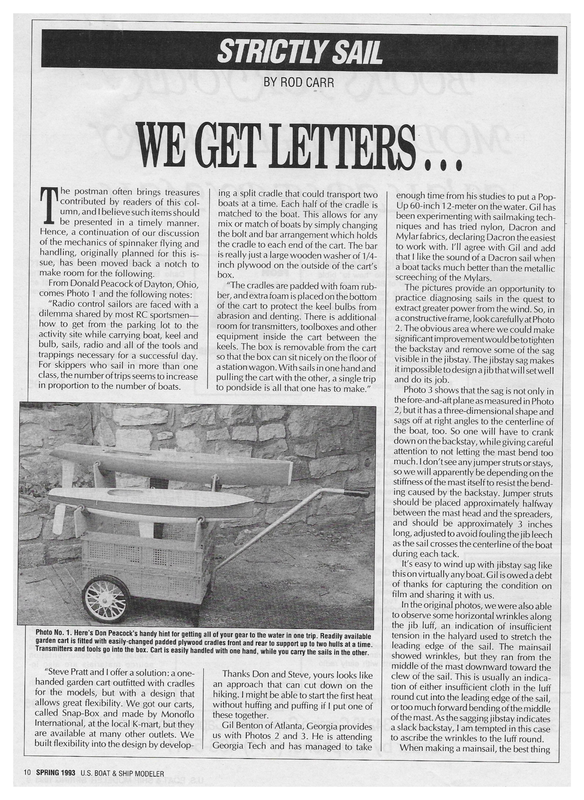
BY ROD CARR WE GET LETTERS. .. he postman often brings treasures contributed by readers of this column, and! believe such items should be presented in a timely manner. Hence, a continuation of our discussion of the mechanics of spinnaker flying and handling, originally planned for this issue, has been moved back a notch to make room for the following. From Donald Peacock of Dayton, Ohio, comes Photo 1 and the following notes: “Radio control sailors are faced with a dilemma shared by most RC sportsmen— how to get from the parking lot to the activity site while carrying boat, keel and bulb, sails, radio and all of the tools and trappings necessary for a successful day. For skippers who sail in more than one class, the number of trips seems to increase in proportion to the number of boats. ing a split cradle that could transport two boats at a time. Each half of the cradle is matched to the boat. This allows for any mix or match of boats by simply changing the bolt and bar arrangement which holds the cradle to each end of the cart. The bar is really just a large wooden washer of 1/4inch plywood on the outside of the cart’s box. “The cradles are padded with foam rubber, and extra foam is placed on the bottom of the cart to protect the keel bulbs from abrasion and denting. There is additional room for transmitters, toolboxes and other equipment inside the cart between the keels. The box is removable from the cart so that the box can sit nicely on the floor of a station wagon. With sails in one hand and pulling the cart with the other, a single trip to pondside is all that one has to make.” enough time from his studies to put a PopUp 60-inch 12-meter on the water. Gil has been experimenting with sailmaking techniques and has tried nylon, Dacron and Mylar fabrics, declaring Dacron the easiest to work with. I’ll agree with Gil and add that | like the sound of a Dacron sail when a boat tacks much better than the metallic screeching of the Mylars. The pictures provide an opportunity to practice diagnosing sails in the quest to extract greater power from the wind. So, in aconstructive frame, look carefully at Photo 2. The obvious area where we could make significant improvementwould be totighten the backstay and remove some of the sag visible in the jibstay. The jibstay sag makes itimpossi to desig ble n a jib that will set well and do its job. Photo 3 shows that the sag is not only in the fore-and-aft plane as measured in Photo 2, but it has a three-dimensional shape and sags off at right angles to the centerline of the boat, too. So one will have to crank down on the backstay, while giving careful attention to not letting the mast bend too much. | don’tsee any jumper struts or stays, so we will apparently be depending on the stiffness of the mast itself to resist the bending caused by the backstay. Jumper struts should be placed approximately halfway between the mast head and the spreaders, and should be approximately 3 inches long, adjusted to avoid foulin the jib g leech as the sail crosses the centerline of the boat during each tack. It’s easy to wind up with jibstay sag like Photo No. 1. Here’s Do n Peacock’s handy hint for getting all of your gear to the water in one trip. Readily available garden cart is fitted with easily-changed padded plywood cradles front and rear to support up to two hulls at a time. Transmitters and tools go into the box. Cart is easily handled with one hand, while you carry the sails in the other. “Steve Pratt and | offer a solution: a one- handed garden cart outfitted with cradles for the models, but with a design that allows great flexibility. We got our carts, called Snap-Box and made by Monoflo International, at the local K-mart, but they are available at many other outlets. We built flexibility into the design by develop- 10 SPRING 1993 U.S. BOAT & SHIP MODELER Thanks Don and Steve, yours looks like an approach that can cut down on the hiking. | might be able to start the first heat without huffing and puffing if | put one of these together. Gil Benton of Atlanta, Georgia provides us with Photos 2 and 3. He is attending Georgia Tech and has managed to take this on virtually any boat. Gil is owed adebt of thanks for capturing the condition on film and sharing it with us. | In the original photos, we were also able to observe some horizontal wrinkles along the jib luff, an indication of insufficient tension in the halyard used to stretch the leading edge of the sail. The mainsail showed wrinkles, but they ran from the middle of the mast downward toward the clew of the sail. This is usually an indica- tion of either insufficient cloth in the luff round cut into the leading edge of the sail, or too much forward bending of the middle of the mast. As the sagging jibstay indicates a slack backstay, | am tempted in this case to ascribe the wrinkles to the luff round. When making a mainsail, the best thing
Photo 2. The Pop-Up 12-meter as sailed by Gil Benton. Rig is in need of adjustment; note the sagging jibstay. See text for our columnist’s comments. Photo by Gil Benton. Photo 3. Here you can that the 12-meter’s jibstay also sags to leeward—not very efficient! Photo by Gil Benton. to do for luff round is to rig the boat, stretch a taut cord down the backside of the mast, then take up on the backstay, measuring the amount that the mast bends away from the cord every 5 inches down the mast. Measure the offset in millimeters, and use three or four different backstay tensions to get differing amounts of mast bend. If you have jumpers, slack them off. (Under the most backstay tension you might want to make a set of measurements with the jumpers tight, just to see what it does to the backstay shape.) Then plot the curves on graph paper, making the mast about 9 inches tall and using 1/4-inch for each millimeter of offset. You will generate a very “bloated” or foreshortened view of the mast, but the regularity of the curve will be most easily defined. Pick a middle case, say with 6-8mm of maximum mast bend, and use that as the luff round for your mainsail. With the mast straight, you’ll put that amount of extra cloth in the leading edge ofthe sail, helping to induce camber in the sail. When the mastis bent, the sail will get flatterand able to handle higher winds, as the extra cloth is pulled forward by the mast. From Kitchner, Ontario, Canada, Hank Rubie sent us photos 4, 5 and 6. He responded as a result of my recent article which focused on putting the fun back into model yachting, fun which | felt had started to disappear as a result of an overemphasis on racing. Hank’s lead photo is of his beautiful cedar planked 6meter Sunsailer. With a cabin, gleaming brightwork and the skipper at the helm, she is an example of what an impression an older design can have on those who appreciate things nautical. Photo 6 shows part of the enjoyment of sailing for fun. Just look at what one can do with ingenuity, perseverance and the business end of a rechargeable screwdriver. Presto! One high-torque, fairly lightweight Photo 5. Hank Rubie’s fleet includes the 36/600 Windsailer (top), the 66-1/2 inch LOA Sunsailer (middle) and a new Marblehead design he’s been testing. sail control unit. Congratulations, Hank, and thanks for the pictures. Hank’s fleet contains a 36/600, the 6Photo 4. Isn’t she pretty? Canadian sailor Hank Rubie must really enjoy putting his cedar-planked Sunsailer 6-meter through her paces. meter and a new Marblehead which is in the testing stages. He has been sailing the M with a temporary deck to make sure all the gear is working consistently, and preparatory to fitting a new keel which will come all the way up to the deck for a secure mounting. | hope that the presentations made here will motivate other skippers to share with us your Creations and new projects. Some- where out there is somebody who has just figured out how to rig a fisherman topsail, or what it takes to make an automatic folding propeller for a scale sailboat. Send your latest to Rod Carr, 3011 177th Ave. NE, Redmond, WA 98052. @ Photo 6. Ingenious homemade sail control unit by Hank Rubie is based on a rechargable cordless srewdriver. A separate pack of four AA NiCds is wired in parallel with the radio pack for longer running time. Two micro switches limit the amount of in outhaul.
t ne be something in the air, or | reader, or10 readers, oc r 100. readers. —ae Q intoyour car orstation wagon. maybein the water, but|have started to seea suseentel increase in the — Bob tellsmethatheiseineson Se Like all ofus, Bob has apparentlysuf_ feredin silence and sailed race after race for asecond generation version which | k activity in and around my mail box. | whi le standing iin soggy socks.Ifyyourboot Photographs of new projects, drawings and sketches, and even comments on recently published columns. Whata pleas- ant trend! Please keep it up everyone. As _ | think you will agree after seeing this month’s presentation, there are more ways to skin the model yachting cat than you can shake a jackstaff at. This month’s featureis courtesy of Bob | deep, spending the rest of the day listen- ing to the soggy squishing of your toes, it seems to take some of the joy out of _ Sailing. So for convenience, Bob’s Launch Pad seems to have no equal. | do know of a number of sailing sites that have either steep sides, as in some abandoned quarries, or else showed very Luther, 817 Gainsborough Road, Day- — _ steep dropoffs only a few feet from shore. ton, Ohio 45419. | supply his full ad— and less wood—to lighten upthe appara- has ever leaked, or you simply went too _In either of these cases, the Launch Pad can provide an additionalmeasure of | dress, for | will bet that there are more | _ than