- Title. Author. Summary

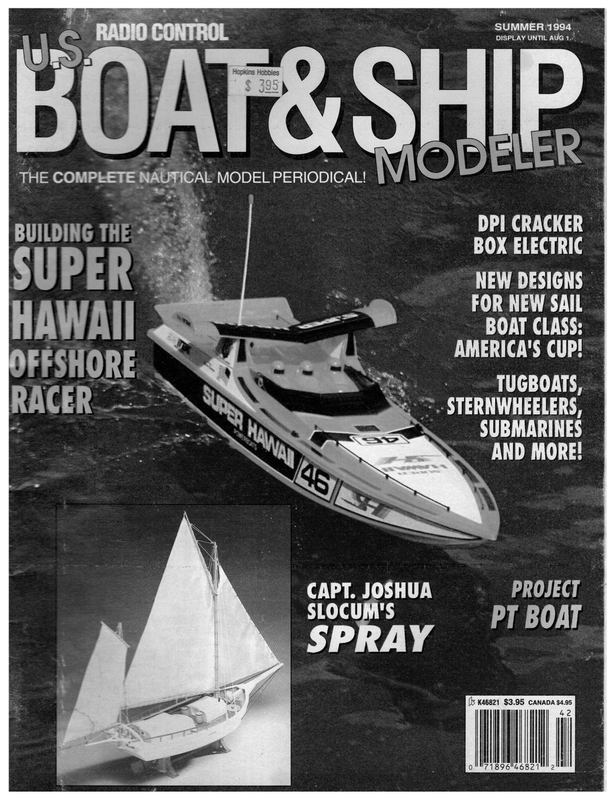
SUMMER:1394. ee ISPLAY UNTILAUG THE COMPLETE NAUTICAL MODEL PERIODICAL! MODELER DPI CRACKER BOX ELECTRIC = BUILDING THE!= % = FM te HAWAII. DFESHORE. 1.) | A -ca Sy ~ NEW DESIGNS BOAT CLASS: FOR NEW SAIL AMERICA’S CUP! TUGBOATS, – ‘>, STERNWHEELERS, — CAPT. JOSHUA | Ay SUBMARINES SAND MORE! SPRAY PROJECT PT BOAT _ fs Ka6821 $3.95 c 71896°4682l1 |
nowckat your favorite ~ See it in dry-do hobby retailer. ICA, INC.2Orion, AlisoViejo,
leasure Cruises. On sail now, from Kyosho. Length: 19.7 in Height: 31.2 in FIRST 53 F5 Length: 24.8 in Height: 41.3 in Each Boat Requires: 2-channel radio Watching one of these scale sailboats slip out over the water is one of life’s simple pleasures. In fact, you can take command of a Kyosho sailboat without having any previous R/C experience at all. Removing the glossy, 1-piece ABS hull from the box moves you from square one to nearly done without doing any building, sanding or painting. And if you can cut, apply glue or drive a screw, you have all it takes to add finishing details. Compact and the quickest to assemble, the 19.7″ Ocean 500 offers the look and performance of full-size America’s Cup racers, right down to the hydrodynamic winged keel design. The Fairwind II, with its 35.4″ hull and towering, 5′ mast height, lets you dominate other boats with sheer, majestic size, while the Beneteau puts you in command of a trim, 1/25 scale replica of the world’s most luxurious pleasure yacht. Length: 35.4 in Height: 61.4 in In fact, with the choices available and the ease of building them, the hardest part of owning a Kyosho Scale Sailboat is going to be deciding whether to display it on its stand…or to slip away for a short, relaxing cruise. Either way, the pleasure’s yours… from Kyosho. For a free brochure and the location of the dealer nearest you, call 1-800-682-8948, ext. 141L. KyOSHO E FINEST RADIO CONTROL MODELS GREAT PLANES MODEL DISTRIBUTORS COMPANY P.O. BOX 9021, CHAMPAIGN, IL 61826-9021 ‘© Copyright, 19933070338
Construction BY TOM HOULE, AMYA 5532 BUILDING AN AMERICAS CUP CLASS SAILBOAT he American Model Yachting Association (AMYA) AC boat class became a reality in April 1989 when Cory Johnson and Chris Staiger re- ceived a copy of the new International America’s Cup Class Rule. This rule effectively sounded the death knell for the Twelve-Meter class and cre- of the AC class rule. Four years later, they’re satisfied that the rule achieves their design objectives, discourages radical extremes and ensures that all designs will be of similar proportions. The ninepound minimum hull weight requirement retary. AMYAmembership is also strongly suggested to keep abreast of sailing tips, class news, regatta schedules and new developments. Addresses appear at the end of this article. The new rule and the class proposal were announced in the Fall 1989 AMYA newsletter, Model Yachting. At that time, Cory and Chris also introduced the first two designs: “Boogieman” (by Cory), and ated the new IACC “Seventy-Fives” class. “Seventy-Five” was a slang to reference new term initially used “Bahamut” (by Chris). boats before they gained formal and widespread acceptance. (They were about 75 feet long and no- Female molds were created for both designs and fiberglass hulls were made available. These fiberglass hulls, along with other designs, are still available; addresses body knew whatelse to call them. They should really be referred to as “IACC boats”.) at the end. Chris’ and Cory’s interest in (and Cory’s ongoing involvement with) the America’s Cup proceedings, plus their interest in radio-controlled sailboat racing, inspired The class grew rapidly. It soon was sanctioned by AMYA, and other hulls were introduced. Clearly the design rule has tended to produce designs that are fast, stable on all points of sail, and to windward is easy to sail. Going them to scale down this new rule for model use. Their design goal was a new 1/12 scale model yacht class that would allow model yachtsmen to design, build and race their own semi-scale replicas like being on rails. Plans and hulls have been sent all over the world. There are hun- dreds of boats sailing now singly of the new America’s Cup Sev- or in fleets. Racing fleets are active in Buffalo, San Diego, Houston, Detroit, southeastern Wisconsin, Florida, western and eastern Canada, England, and Australia. enty-Fives. Albeit less-complicated, Cory drafted the model rule with as much care as the full-size rule, to ensure that the model yachts would replicate their larger cousins. The models had to resemble the full-size boats and be relatively inexpensive to construct and fit out. A well-designed boat had to be competitive for years to come. Some individuals are building AC boats not to race, but simply to recapture those earlier days spent skippering or crewing full-size, Cory Johnson’s fiberglass-hulled Boogieman design is for AC Class. As Chris putit, “No more boat-ofthe-month club” designs. The formulae and calculations of the model rule would adhere to the spirit and intent of the full-size rule. A well-designed model should sail as well as a well- designed Seventy-Five. It took Cory and Chris three intense months of work to draft the model version 36 SUMMER 1994 U.S. BOAT & SHIP MODELER high-performance boats. The AC class offers something for everyone. The size and weight are not needed or even necessary for a of these boats dictate that you build and sail something smaller before tackling It is beyond the scope of this article to include the complete rule and the rating certificate. Copies of both and boat registration information are available for an SASE from Glen Comer, AMYA class sec- control. assures that ultralight, high-tech materials competitive yacht. one of these big boys. These boats are typically over six feet long and displace 25 to more than 30 pounds — large and fast enough to do considerable damage to people and other boats if the skipper loses
BooaitMan AC CLASS MODEL Building YACHT Shadows All Station Spacing is 5.625″ (Prepared for 1/8″ thick Planking) wo WS jf NR oe / / or a iat / SS / TSS (MEASUREMENT WATER BRUT OVERALL (Dd) USPLACEMENT 6.8 16.00″ (DSP) ‘MEASURED SAIL AREA ‘RATED SAIL AREA (Si) y MAST BEIGHT ABOVE DECK AC CLASS RULE RATING 28.809 211sTM 22 85.00″ BooatMan AC CLASS MODEL Cory V4 “= (B) J es25° oe 705 / 625 (136) (1) 1 LENGTH BETWEEN GIRTH STATIONS PORWARD GIRTH (FG) ease co, ‘MTED LENGTH YACHT Johnson Dengner 74.83 SAIL/RIGGING PLAN %qq8—12 2 ae The Boogieman America’s Cup Class sailboat, designed by Cory Johnson and converted in Computer Aided Design (CAD) by Chris Staiger. Overall length measures 77.5″, beam 16″. Up here in Wisconsin, our club, The Ozaukee Model Shipwrights, leans to scratch-building our boats. This may be because we have a generous number of highly skilled people who can cast lead, machine parts for a sail winch, perform electrical wizardry and the like. While there’s nothing particularly difficult about building one ofthese boats, they are quite large and that may be a problem for some builders. If you don’t have the space to set up a seven-foot-long building board to plank the hull, you could purchase a bare fiberglass hull, a semi-kit with bulb, fin and deck, or you might be able to purchase a finished boat. Cory and Chris created the rule so that regardless of whether you build or buy, your boat should be competitive. We’re currently racing Boogiemen, Leviathan, and Bahamut in our Club. There is no notable difference in performance between them, even though the Bahamut is shorter on the water line and carries less sail area. It makes up for less sail area with a lower displacement. BUILDING THE HULL The photos illustrate planking the Boogieman and Bahamut hulls by club member Gary Cooper. He used foam board shadows and a dead-straight sevenfoot-long 2×6″ board. Planking can be 1/ 8″ balsa or cedar strips ripped or stripped into 1/2″ widths. Planking starts at the sheers and works up the sides of the hull towards the keelson. At some point, depending on the shape of your AC hull, you may reach a point where the planks start to resist being bent. Don’t panic: Simply go to the keel- son and start laying planks downward from there until you meet the point where you stopped. Gary used twine, clothes- pins and pins shoved through the cedar with pliers to hold the planks in place after he’d edge-glued each one in place. He used Elmer’s brand yellow carpenter’s glue. It’s not waterproof, but it does just fine under a fiberglass skin and heavily varnished hull interior. Bef hull i fi he Full-size Boogieman shadows, done in CAD format by Chris Staiger. Note 1/8″ planking allowance has already been made. Shadow spacing is 5.625″. Analternative sailplan for the Boogieman curved mast Sate te FL. Fe femnoved, fromaths and mainsail. N.C. “Steve” Nicely developed this shadows, get a pile of 50-grit sandpaper anda lightweightorbital sander. Youcould block sand the hull by hand, but its a heckuva lot easier to do it straight-mast layout for his Boogieman, and others have followed suit, including author Tom Houle. with a power sander. When you’re satisfied that your hull is smooth and fair, leave it on the shadows and fill low spots and cracks with a spackle-typ or other wood e filler productbefore covering the hull with a single layer ofsix-ounce fiberglass cloth and epoxy or polyester resin. | like to thin the resin to a watery consistency with acetone or rubbing alcohol and brush it on like paint through the fiberglass cloth. Two to three coats of resin, sanding between each coat, should completely fill the cloth. To free the hull from the building board, the sheer strakes are spread just enough to clear the shadow notches. Clean out the glue blobs and smooth the inside of the hull so that there are no places for water to be trapped orsheetstosnagon.Acoupleof temporary 1/4″ cross-members amidships will keep the hull at its correct beam while you finish up the interior. If you haven’t already done it, this is a good time to con- ! ‘ ae ison ® ‘ AREA= 1402 63% AREA= 808.5 FORE TRIANGLE 36.5% | <— hey U.S. BOAT & SHIP MODELER SUMMER 1994 37
+ i | tS — fed GES Be GN Si m 9 8 ge po SEE ee Sa te =a oe | ea es ae Bi eo = (ae 5 sie Z ae Bahamut AC CLASS MODEL cere ape Building YACHT Shadows All Station Spacing is 4.00" (Prepared for 1/8” thick Planking) wm we Lh, y - o1esis 10 15 ——_ 20 —— ———————— —— SCALE IN NCHS LENGTE OVERALL (104) ‘MEASUREMENT WATER BETWEEN GIRTH STATIONS FORWARD GIRTE pigs agi nee see SACRMENT (1 DRAFT 12.02" SB 27.004 16.00" AC CLASS MODEL YACHT 2038°" William (Si) ‘2035°° BEIGHT ABOVE DECK 90.60" ‘RATED Sail AREA (5) ss 64.00" iT (b) -MBASURED SAT AREA 00" (L3G) me LENGTH ) 72.00" Ome abamut ” oon "Chris" Designer ‘ Staiger SAIL/RIGGING PLAN ee o An alternative in fiberglass-hulled America’s Cup Class designs is Chris Staiger’s Bahamut, here in Staiger-furnished CAD format. It’s 5-1/2" shorter in overall length than Boogieman. Below: Bahamut on building board. Planking is 1/8x1/2" cedar strips over foam board shadows. Bahamut shadows, done in CAD by designer Chris Staiger. Note that 1/8" planking allowance is already made. Shadow spacing is 4". See text. Below: Bahamut in cradle with cross-members installed, but no fin trunk fitted. Bottom: Removeable fin and bulb assembly faired into Bahamut hull. Hulls are weighed sans both. struct a boat stand. You're going to need it from now on to hold your hull while you finish it up. Mine is of fir 1x2". It should be strong enough to support 30plus pounds. Install a strap underneath the lead bulb to support the bulb’s weight independent of the hull. It’s not a good idea to store the boatwith nothing under the lead bulb. The dead weight could distort the hull shape. They are fast, reliable, and sturdy enough to do'the job. Commercially made drum winches are available from Bob’s Boatyard and R/C Model Yachts. Info on rigging drum winches is available from the class secretary, Glen Comer, and the AMYA newsletter. | can’t speak to what's currently being used, as our club doesn’t use them. Chris Staiger told me they’re using Bodine gear motors on their AC and J boats. Others are using Brevel gear motors and Don Prough’s Probar winches. SAIL WINCHES Bulb shape and weight are specified by the designer. Bulb weights range from a low of around 15 to a high of around 19 pounds. Unless you know what you’re doing, | recommend that you not try to FIN, BULB, AND RUDDER Our club first tried homemade gear motors consisting of a small DC motor and four reduction stages of nylon gearing. Rolf Andersen, club machinist, made up three of these winches using nylon can opener gears. There was plenty of sail sheeting ower, but within hours, all had failed: The teeth had been sheared off at the final gear stage where speed is slowest and torque is maxed out. These gears probably failed when the main sail jibed, slamming the winch arm against the output gear. We switched to surplus Merkle-Korpf gear motors with steel spur gears. Rolf adapted DC motors, added switch cams and snap-switches. These have performed flawlessly although we did take the pre- caution of adding buffer springs to both sheets to absorb the shock loads of sudden jibes. Drum winches work well in these boats. 38 SUMMER 1994 U.S. BOAT & SHIP MODELER pour the lead yourself. Pouring into a plaster mold that’s not bone-dry can cre- ate steam and splatter the molten lead so that it shoots from the mold. Better to buy a bulb or have a local foundry pour it for you. We cast a 1/4x3" strip of aluminum right into the bulb. This provides a sturdy backbone for the fin and prevents any twisting of the bulb under sail. The aluminum slides up into a trunk in the hull where it is pinned in place. Stainless steel bolts thread into the top of the aluminum fin through the deck and allow for quick removal of the fin/bulb. We built our fin trunks from 3/16" aircraft plywood with 1/4" spacers fore and aft; in retrospect, this was overkill. Glen Comer told me the boys in Houston simply insert the aluminum fin into their
FIG #8 SWIVEL LOCK SLEEVE a. DRILL FOR COTTER KEY JIB STAY JIB STAY & JIB TACK ATTACH BRKT. SILVER SOLDER TO BRASS PLATE & SWIVEL POST COTTER KEY BEND TO FORM HOOK aa Sheol SCREW s 2) WITH BRASSCLUB TUBE SWIVEL SWIVEL PLATE POST SILVER SOLDERED WASHER ABOVE & BELOW BASE Offset jib swivel adapted from Rod Carr design by Steve Niceley was used on designs. Silver-soldered joints must be well made. PLATE (SOLDER TO BASE) DRILL FOR COTTER KEY — 1-1/2" TRANSVERSE SILVER SOLDER SUPPORT TO = ia PLATE & POST pe 25 gs hulls, cover it with clear kitchen wrap, then fiberglass the fin in place at its top and bottom. After the fiberglass has cured, the fin can be slid from the hull. DECK AND FITTINGS I'd never tried an offset jib swivel on any of my boats until | began corresponding with N. C. (Steve) Nicely of Cleveland, Oklahoma. Steve was building a Boogieman and had designed his own offset jib swivel from one originally developed by Rod Carr. The fore end of the jib club is bolted to the free swiveling arm. The jib is free to wing out to either side when the jib sheet is slacked. Because of the angle of the post it swivels on, the jib club swings out at an ever-increasing angle as it moves away from the hull. There’s a lotof geometry going on here that is not readily apparent. If the axis of the post on which the jib club swivels is parallel to the jibstay, then when the jib is eased it will wing out but not change shape. If the post axis is laid back two to three degrees more than the jibstay, then as the jib is eased it will acquire more twist and draft — the very thing needed when sailing off the wind. The optimum angle is somewhere between two and three degrees. We built ours from .062" brass and held them together with silver solder. These fittings are heavily loaded and must be built quite stout to withstand jib and backstay loads. SPARS AND RIGGING We used 96" Shakespeare Ugly Stick an UCU96-8 tubular rod blanks for our masts. These are made with an inner graphite spiral and outer fiberglass lengthwise layer wrapped around the hollow graphite core. These rods weigh just 11 ounces and have plenty of stiffness even before they’re braced. We made our spreaders and jumper struts from .060" T6 aluminum. Easy-to-make .032" brass fitting used as chainplate that’s ; secured to deck with #4 wood screws. You could through-bolt, if you can reach under deck. It's not always easy! Booms and jib clubs can be cut from fiberglass or aluminum ski poles, or youcan make them from pine and skin the sides with 1/6" aircraft ply. Sheets can be braided fishing More simple brass mast and boom fittings. The three U-shaped line. Anything over 36-pound ones are used on spars, while rounded fitting is made from flat should work, especially if brass and bolted to mast as the gooseneck fitting to be used in you're using pulley blocks to conjunction with 4-40 ball-joint. See text for more details. reduce friction. Pop-Up Mfg. and others sell small blocks. this article. The subject is far too extensive Shrouds and stays can be cut from 35to cover here. pound minimum stranded fishing leader. So far ,;we’ve been content to experi| like to use the Berkeley plastic-coated ment with our own sails. We have been material. It’s available in several weights using essentially flat-paneled (no broad and there are matching crimps, too. | seaming) sails with a gentle curve running terminate my shrouds at the deck with 4up the luff of the main sail to force camber 40 steel clevises and spring retainers. into the sail. These will work moderately There are three of these, port and starwell in medium to heavy air. However, in board. Two more are used at jib and light air, unless you've cut and broad backstay. | double each shroud and seamed your sails from very lightweight backstay line. It adds virtually no weight material, they won’t work so well. We use aloft and cuts the load on each line by rip-stop spinnaker cloth from a sailmaker’s 50%. Cheap insurance. loft in our area. For those of youwho don’t SAILS I’m not going to go into sail making in want to make your own, I’ve listed some sailmakers at the end of the article. continued on page 62 U.S. BOAT & SHIP MONFIFR SUMMER 1994 20
ADVERTISER INDEX CGR International 57 Design Plastics, Inc. .27 DTN Enterprises . 60 Falk Marine ..... 9 Gallant Models Library .. .19 Tamiya... ... Inside Front Cover Harbor Models .... w 56 Microglass .... Model Boats | Model Expo... Mosquito Hobbies . Noah Boat Co. ...... Northeastern Scale Models Octura Boats .............. 55 57 60 eu A ... 54 ...53 ... 31 Sink Um & Float Um Salvage . Skunkworks Mfg. . Taubman Plans NOUN soca The Dromedary .... The Floating Drydock The Laughing Whale. Quickdraw Marine RC. Boat Works ... Radar Sales 59 ... 83 .. 55 USB7SM Binders. Vantec... Zigans .... Capri creed voiced toeba ine 59 Hartman Fiberglass . . 56 Hayes Products .........ssccssssccssecseeseenneeees 58 Hitec/RCD Inside Back Cover Hobby Lobby Intemati Hole Shot Racing Products .... Horizon Hobby Distributors .... ...12 ...9 5 6 ... 55,57 ..19 Se M.A.C.K. Products 18 Pearl Model Ship Co. . Pop-Up Mfg. ...... Prather Boats ... ... 55 et ORIN -23 AMERICAS CUP cont. from page 39 g Intemational Marine Exchange Jomar ........e-seeesseees Laughing Whale Maus Motorsports .. Mountain Mini Sport 5 Rocky Mountain Shipyard ...............es 57 Schaeffer GFK ised a oy ere Bees, g ORCA so cFuicicnscivceiaetenn ...43 A i 13 Amazon Boats ..........:::0:cssssssesssseseee 43 Boats South 61 Sig Spinnakers are allowed in this class. More than one AC skipper is experimenting with various ways to launch and retrieve these beautiful, balloon-like sails. Genoa jibs are also allowed. AMYA has 59 59 3 22 62 61 56 18 The Scale Shipyard .. TRING: 2558s cssscusssss USB&SM Sweepstak run a couple of articles in their newsletter on how to sheet and control these giant mot Back Cover jibs. INFORMATION SOURCES: AMYA Membership (necessary for AMYA sanctioned regattas): Harry Robertson, 2793 Shellwick CT., Columbus, OH 43235 CLASSIFIEDS AC BOAT Components, Plans, Hull Sources (AMYA AC Class Secretary, Boat registrations and sail numbers, Plans Boogieman, Bahamut, Leviathan): Glen Comer, 4802 Broken Elm, IMPORTANT INSTRUCTIONS: Non-commercial (personal items) rate is 40 cents per word, with a minimum of $6.00. Commercial rate is 50 cents per word, with a minimum of $10.00. No advertising agency discounts allowed. Name and address to be counted, phone number counts as two words, abbreviations count as whole words and will be spelled out. All ads are payable with order, and may be for any consecutive insertion period specified. Send ad payments to: USB&SM, Gallant Models «P.O. Box 2459 « Capistrano Beach, CA 92624-0459 Spring, TX 77388 COMPOSITE Sails & Spinnakers, Rigging hardware, Spars: John Amen, Amen Design Group, 929 West St., Petaluma, PAYING $50.00 for each Toy Metal Outboard Boat Motors: Oliver, Gale, Evinrude, etc. Gronowski, 140 N. Garfield Ave., Traverse City, Ml 49684 Ph. (616) 941-2111. REPLICA SWISS WATCHES: 18KT Goldplated! Lowest prices! 2 yr. Warranty! Heavy Weight! Waterproof! Sapphire Crystal Submarins, Daytonas. others! (404) 682-0609; FAX (404) 682-1710. CA 94952 FIRST EVER Toy & Model Boat Show and Swap Meet. Holiday inn, Alton, llinois. Tables $15. Contact Tom O'Dell, 417 Walley View Orwe, East Alon, HULL - America |, Carbon fiber spars: IL 62024. (618) 259-3052. | ORDERING INSTRUCTIONS / $10.00 MINIMUM « U.S. orders, including APO and FPO, add 20% of total order for shipping and handling. Overseas orders (includes Canada and Mexico) add 50% of total order. Remit payments by International Money Order or U.S. funds drawn on U.S. bank. Please, no cash or C.O.D.’s. Mastercard or Visa include card number, expiration date and signature. California residents add 7.75% sales tax. + Prices subject to change without notice. + All full size plans ordered from US Boat & Ship Modeler include a reprint of the construction article, if building instructions were part of the article. Send to: US Boat & Ship Modeler Plans Service + P.O. Box 2459 + Capistrano Beach, CA 92624-0459 « For Complete Plans List, Send S.A.S.E. + Please allow 6-8 weeks for delivery. US2941 CHAMPIONS FOAMVEE FL 32803 HULL- Bahamut short kit, Winches, spars, rigging, other hardware: Don PLANS No. Doug Lord, 734 North Irma, Orlando, Prough, 740 N. Metcalf #5, Escondido, CA 92025 HULL - Advantage (glass or Kevlar), Decks and paneled sails, Spars and winches: Bob’s Boatyard, 3785 Edinburgh, Burnaby, B.C., Canada V5C 1R4 $13.00 No. Simple, foam vee you can cover with balsa. Durable, easy to build. Length overall is 24". By Jerry Dunlap. US4921 Solar cat $6.00 Simple, all- bal:sa solar powered catamaran for eithier free running or single-channel RC. Measures SPARS, winches, hardware, Pe-KaBo supplier: R/C Model Yachts & Acc., 675 SW 238th Ave., Hillsboro, OR only 12" LOA. By Graham Goodchild. 971.23 HULL - Leviathan: Bob Stinson, 8926 Edison St., Crown Point, IN 46307 HULL - Boogieman (‘glass or carbon/ HIGH PERFORMANCE R/C ELECTRONICS AM & FM MICRO RECEIVERS Small and light, to make your boat jump. iN NAME: REC! TSC 432M MARINE SPEED CONTROL Powerful 300 amp high frequency drive powers most boat motors up to 32 cells. = ne send for SEE Wen a caraloS high perform- | ance charge. peEA TEKIN ELECTRONICS, INC. MADE IN U.S.A. 62 SUMMER 1994 U.S. BOAT & SHIP MODELER PLANS for hulls #1 - 2(25 and 28 lb. kit for hull displace.), Carbon fiber short #3: Wick Smith, 1595 North Renaud, Gross Point Woods, MI 48236 HULLS- Ace MK2, MK3, MK4: John Lewis, 4 Monument Lane, Rednal, near HULL - Renegade 4 (designed by Glen Comer): John Davis,12114 Westmere Dr., Houston, TX 77077 CARBON fiber hull and deck: Thomas Shipp, Sr., 3171 Heatherside Dr., Dublin, OH 43017-1821 PANELED sails, Composite sails, Winches and spars: Black Sails, 4761 Z deliver along 95119 Birmingham, B45 9QQ U.K. PEAK CHARGERS Dependable, automatic, and easy to use, they Kevlar), Lead bulbs, Spars: George Ribeiro, 312 Curie Drive, San Jose, CA 940 Calle Negocio, San Clemente, CA 92673 (714)498-9518 FAX (714) 498-6339 Niagara Ave., San Diego, CA 92107 COMPOSITE sails, Spinnakers: Rod Carr Sails, 3011-177th Ave. NE, Redmond, WA 98052 ARM winches (convertible to proportional): Andy Littlejohn, 430 Wapello St., Altenda, CA 91001 °
SH OP HINTS cont. from page26 8", blade 2"), skew knife (LOA 5-1/4", edge 1/2", blade 1"), and a super bench knife (LOA 7-1/4", edge 1-1/2", and blade 1-7/8"). - Vertical whip antenna |replaces any ~ 18 or 36-inch |receiver antenna for |R/C cars and ~ boats. Connec tors, vertical and horizontal | mounts and safety ball all | included. Stainless | spring steel whip only 1/32) diameter for minimum wind resistance. Because of the force these blades allow you to apply, they are particularly useful when heavier stock must be removed. Their balance makes them handy in tight places, for | can see the tip of the blades. If your model building includes any wood fabrication, these knives will perform duties beyond the scope of hobby blades. Look for them at your local hardware or hobby stores, or write: Mascot Precision Tools, Dept. USB, P.O. Box 243, Carlstadt, NJ 07072. Tel: (201) 939-0596. MODEL MASTER Available at your local) dealer. PROFESSIONAL AIRBRUSH “The first breakthrough in airbrush design in over 100 years.” ad HAYES PRODUCTS 14325 Commerce Wy. Garden Grove, CA 92643 That’s how Testor Corporation describes their Model Master Professional Airbrush. What makes it different is that paint and propellant come together only in the nozzle, and the nozzle simply screws into the acetal resin body that houses the control mechanism. When we saw this airbrush demonstrated at the Chicago Hobby and Model Show, we couldn’t wait to get our hands onit. The entire unit looked balanced and technically attractive. The paint bottle could be attached to either side of the body and cleanup took only seconds. Solvent was either sprayed through the nozzle or the nozzle could be quickly unscrewed and soaked for major cleaning. All of Pop Up's model sailboats will beat any manufactured in the box off the shelf model sailboat in its classification. We have the Am's Cup 92, the Stars and Stripes 12 meter, the self-righting Catamaran and other radio controlled kits. Sailboats don't crash or destruct, they become antiques. Complete line of corrosion free hardware made of nylon, stainless aluminum and mylar. Radios, servos, drum and arm winches. Sent this ad and $3 to: ‘Pop-Up Mfg. 27 Emerson Ave. Amityville, NY 11701 (516) 842-9309. FAX (516) 842-6353. Get 16 8x11" full size how to plans, color photos, prices and catalog. NY residents please add 8.5% sales tax. Use Visa, MC, AMEX, M.O. or check. Low U.S. & overseas shipping rates. 58 SUMMER 1994 U.S. BOAT.& SHIPMODELER Back in our studio, the first big plusses we noticed while using the airbrush were its delicate balance and ultralight weight. Neither the hose, which connects at the back of the body, nor the bottle are in the way, affording an excellent grip and precise trigger finger control. We were surprised at how light the body is, but soon became comfortable with it. We’d never used a double-action airbrush before, so this was one of the first features we wanted to try. A roller on top of the body adjusts the setting for either single- or double-action. When using the former, a fixed amount of paint and propellant is sprayed when the trigger is depressed. In the double-action mode, pressing down on the trigger releases just propellant, pulling back on it starts the flow of paint. Although we don’t need this double- action feature in the work we do, we quickly adapted to it. It’s always been our aim in model building to use the latest technology and best techniques, and the Model Master Professional offers both. The trigger moves smoothly, with merely a light touch and the control we have over the paint’s application is clearly noticeable. In the past, we could never spray without getting medium on the airbrush body and on our fingers. With the Model Master Professional, we’ve yet to have paint go anywhere we didn’t intend it to. A general-purpose nozzle came with the kit. It adequately performed a wide variety of tasks, but because we often have to cover large areas, we purchased a high-flow nozzle. (A fine line and spatter nozzles are available as well.) Each nozzle came in its own container, and we always store them there to protect them from dust. Changing nozzles is a snap. With threaded bases, all that’s required is to unscrew one and screw on the next. They start easily, too. It appears difficult to crossthread one, and that’s important when the parts are plastic. Another time-saving feature is that we no longer have to doctor paint with retardants or gloss to make it flow easily. We use only lacquers and these are mixed one part thinner to three parts paint. The paint pattern and texture are always smooth and even. Not once has the paint spattered like in the past. Because we use a lotof medium when we spray, the color cups were inadequate, so we purchased bottle cap adaptors in two different sizes to accommodate Floquil and Testor jars. Cleanup is a joy. As no medium ever enters the airbrush body, only the nozzle needs cleaning. Using the double-action feature, run propellant through the nozzle until it comes out clear, plug in the solvent, spray that through the nozzle, then repeat step one. That’s all there is to it. Sometimes the Deft Wood Sealer will plug a nozzle even after it’s been cleaned, but a half hour soaking in solvent will return itto duty. Not once have these little beauties required manual cleaning to make them operable. While at the Chicago show, we saw Testor’s Model Master Airbrush Cleaning Station demonstrated and decided we needed one of those. It traps solvents in a heavy-duty jar, while a fiber filter and aring prevent contaminants from escaping back into the air. Formerly, we used my spray booth to carry away odors and solids. This polluted the outside environment, while paint particles collected on my fan blades. The cleaning station is the only way to go and we wouldn’t want to be without it. Fumes are trapped to the point where smells are unnoticeable. Replacing a filter takes seconds. Simply unscrew the adjustable airbrush holder from the lids, toss the dirty filter and install a clean one. If you already own an airbrush and are ready to upgrade, then give the Model Master Professional Airbrush your full attention. Buy the airbrush kit with fittings, because it will be cheaper than purchas-