- Title. Author. Summary

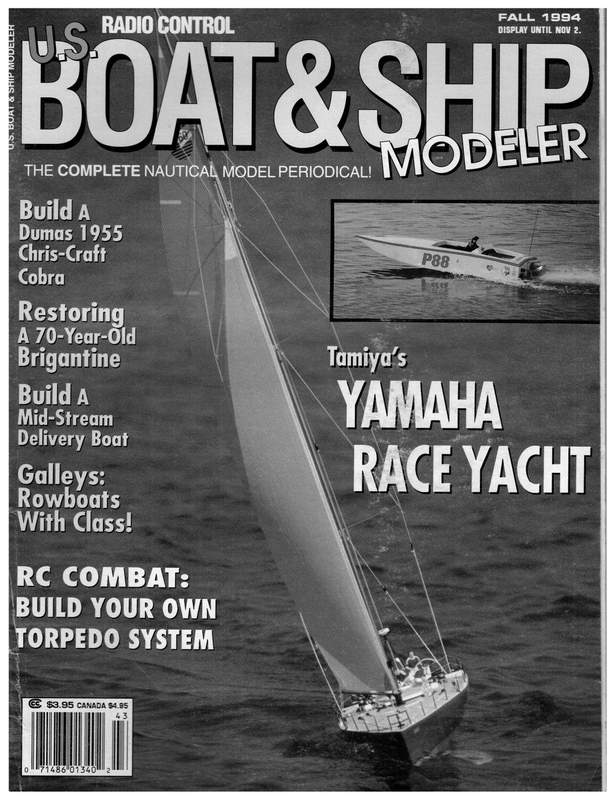
FALL 1994 DISPLAY UNTIL NOV 2. Build A Dumas 1955 Chris-Craft Cobra Restoring A 70-Year-Old Brigantine Build A Mid-Stream Delivery Boat Galleys: Rowboats ‘With Class! RC COMBAT: BUILD YOUR OWN TORPEDO SYSTEM GS $3.95 cANADA $4.95 | 340″%2 43
1994, MIYA AMERICA, INC. 2 Orien, Aliso Viejo, CA 92656-4200; > i800)-TAM|FYA-A
roduct survey BY W.H. GEBHART TAMIYA’S WHITBREAD RACING AILBOAT Most of the race takes place in the Southern Ocean, in the latitudes known as the Roaring 40s and the Screaming 60s. The HE WHITBREAD Round the World Race is called by some the most grueling names denote a band of ocean uninterrupted by landmass that is inhabited only by icebergs. This lack of moderating landmass allows the wind and waves afetch (the entire circumference of the globe!) to quickly build to sporting event ever con- ceived by man. It follows the the clipper ships around traofck the world by way of the Capes. It takes nine months from start to finish, begins and ends in Southampton, England, and covers over 32,000 miles. No wonder it’s only held every four fearful proportions. The clipper ships of the 19th Century, plying the oceans of the world in the pursuit of commerce, represented the extent of years! The race is the 1974 brain- child of Admiral Otto Steiner of the Royal Naval Sailing Asso- man’s design knowledge, mate- of beer. Coinately—over a pint rials and construction skills at that time. Our present-day equivalent, the Whitbread racers, also showcase our techno- ning of this race is under way while this review is being as- ing the spirit of man’s persever- ciation and Colonel Bill Whitbread of the English brewing family, born—appropri- cidentally, the most recent run- logical advances, but their cargo is more abstract. They are carry- sembled, so we may know the ance in the face of a challenge in outcome by the end of the article! one of the few remaining un- bridled natural arenas. Ironically, . these technically superior ves- sels are only now breaking speed and distance records (425 miles in 24 hours) set by the clipper ships over 100 years ago. The Whitbread Round the World Race has evolved to the Yamaha in perfect trim close hauled on port track. Crew set for Round the World Race is realistic in color, position. As Kenny Wooton at Yachting Maga- zinetold me, the format of the Whitbread separates the race into 6 individual legs, with a 2- to 3-week layover between each FALL 1994 U.S. BOAT & SHIP MODELER leg to allow for completion by all entrants, gear repair and a respite for the crew members. A trophy goes to the winner of each leg, but the big prize goes to the vessel with the best combined time. Heineken is the overall sponsor of the race. current two-class format: the Maxi Class (built to the maximum limit of the IOR rules and over 80’ long) and the new Whitbread 60 Class, announced in 1991. The purpose of this new class is to introduce economy into the event, as they are about half as expensive to build, maintain and campaign. Safety also is a concern. As remote as is the Southern Ocean, collision with flotsam is a growing possibility, so their design embodies a network of waterproof compartments. A unique design feature of this class
ing the various main structures and an almost overwhelming succession of small parts. | would need more than intuition to assemble this one: Tamiya has provided a manual in four languages. Besides the assembly instructions, there is a short history of the Whitbread Round the World Race, a description of Contents of 1/20 scale Tamiya Yamaha kit. Author reports an excellent set of directions is included. permits the use of water ballas A series t. of tanks along each side of the boat with a the Yamaha’sRC requirements (an option to this model), an appeal to study the instructions thoroughly before starting, anda truly monumental endeavor—teaching the fundamentals of sailing in two capacity of 700 gallons (each side) can be filled or emptied according to conditions. This water ballast allows the boat to carry more sail ina stronger breeze byfilling the windward tanks to keep it more upright, or in lighter air the leeward tanks can be filled to heel the boat to reduce wetted surface area and increase speed. In heavy weather conditions, higher speeds are attainable, but the reported disadvantage of full ballast tanks is that the boat has a tendency to go through the swells rather than over them, constantly dousing the crew. This doesn’t present a problem while in the tropics, but in the Southern Ocean where the water is near freezing it adds another wrinkle to the challenge! Conventional wisdom states that the bigger the boat, the faster it can sail. But actual results are proving that under many conditions, the Whitbread 60s are faster than the Maxis. The success of this new class has been ensured. Race organizers recently announced—even before the end of the race—that the Whitbread 60 will be the only class in the next race. Whitbread 60s comprised 10 of 15 entrants. Tamiya Plastic Model Company of- fered a 1/20 scale version of one of these revolutionary vessels, Yamaha, while the race was barely under way! “Tamiya and Yamaha Motor Company have a very close working relationship where we are licensed to produce scale models of many of their existing products,” explains Liz Geoffs of Tamiya America, Inc. “When Yamaha decided to sponsor an entrant in the Whitbread, they commissioned us to produce a scale model of the hull for their own purposes. Tamiya saw the potential, Sitting astride her travel/display stand, you can see modern bulb keel that’s filled with 4.4 pounds of lead. pages of illustrated text. works on SAE sizes, although the reverse is not true?) You will need your own The main body of the instructions is directions. The fastenings used during each step are highlighted in a corner box so that similar ones cannot be improperly substituted. The steps are sequential, although occasionally out of logical order. Modeling skill requirements for the Yamaha are moderate, with an aboveaverage level of patience necessary if you’re not nautically inclined. There area variety of challenges to keep your interest piqued. Decals, paint, detail fittings, lifelines, rig, and so forth are included. It’s a good balance that won’t burn you out on any one task. Building the stand, the first task, would’ve been easier had there been some strap dimensions in the instructions. | had to redo the strap placement three times to elevate the model above the keel depth and to make it level with the world. I’d also like to see a lift sling incorporated into the stand, to facilitate carrying the model. It’s 6′ tall when fully commissioned, so you need to be focused on overhead clearance and notbe concerned with dropping it! Scattered throughout the steps are indicated decal placement, glue points and the parts that need painting. Don’t wait until those particular steps to initiate the paint job—you’ll have about 10 starts, stops and subsequentclean-ups. | removed and deburred the parts that required paint- attention to detail. With regard to the but | didn’t paint the white parts with Yamaha Whitbread 60 1’Il confirm that! As | opened Tamiya’s Yamaha box | found a collection of smaller boxes hold- driver has been added just in case you haven’t broken down and updated your tool kit with metric sizes. (Did you know that a set of metric wrenches and sockets composed of excellent perspective drawings with parts labeled and a few written took the initiative and decided to follow through with developing the entire scale model.” Why commission a scale Yamaha? For one thing, models are frequently used in tank tests to help fine tune the design of a full- sized vessel. Tamiya has long been recognized for accurate representations in the scale renditions, and painstaking effort, the Yamaha decals represent four different styles and purposes. There is the standard silkscreened clear Mylar sheet with adhesive on one side. These decals carry the names of the sponsors of the syndicate, with the major contributor being Yamaha Motor Company. Another sponsor of note is the Japan Radio Company, Ltd., the builders of Raytheon’s successful line of boat electronics. There is a set of transfer decals that have a paper backing and aclearfront that pulls away after application, leaving only the essential graphics. Two sets of die-cut decals complete the set, one having adhesive both sides to secure the rudder access hatch and a sheet of thin, stiff polyethylene that is applied to the sails to reinforce the corners (head, tack, clew) and to serve as battens. All assembly materials are supplied, including glues and even a special nut ing and did all at once. Don’t tell anyone, white paint or the black parts with black paint. In another example of Tamiya’s extra i a The X-Acto knife is required to trim sprue from 118 individual plastic parts. Realism is Tamiya’s goal. paints to add the finishing touches. For about $5 there is a set from Testors that includes a brush andall the colors needed. About the most important tool you will need is a hobby knife. There are no less than 118 plastic parts that need to be separated from their molded spur trees and at least two burrs per part that need to be trimmed. Most of these 118 parts are strictly for detail, adding an unparalleled degree of authenticity to this model. There is a set of winches including 2 “coffee grinder” pedestals that would be the envy of any yachtsman (and whose cost alone would probably buy his boat), the mainsheet traveler with car and turning blocks, jib sheet track with car,4 gang turning blocks, 8 gang sheet stoppers, twin steering pedestals, radar and arch, deck hatch, even winch handles that fit into the winches. Added to this is a metal stanchion set including a bow pulpit and a spool of braided line to complete the lifeline system. You don’t want to lose any crew members overboard! U.S. BOAT & SHIP MODELER FALL 1994
The engineers at Tamiya designed the keel and rudder to be removable for ease of transport. All metal components are stain- less and the hull pocket and keel head fit snug. The ballast is 4.4 pounds of cast lead that fits in the bulb at the base of the high aspect ration fin keel, just like the big boys for low center of gravity, optimum righting moments. The With deck hatch off, rudder shaft head is revealed. Steering arm locks removeable rudder in place. attachment systems are quite sophisticated, involving separate shaft tubes that are installed by the modeler and “O” ringed to stays. The full-sized Yamaha W60 uses rod rigging and turnbuckles, while the Tamiya Yamaha utilizes braided line and the model industry-proven snap fitting insure waterproof integrity. Being a nuts and bolts kind of guy myself, the real appeal for me of Tamiya’s Yamahais its rig. | make a genuine living commissioning and delivering sailing vessels of all sizes. The heart of the job is assembling and stepping with bowsie friction stop arrangement to duplicate the turnbuckle tensioning func- tion. But the model engineers at Tamiya will notbe caught napping! All knots to be tied are nautical: figure eight, French knot, reef knot, and half hitch. the mast, tuning the rigging, run- The sails are die-cut of lightweight (1/4 oz.) rip-stop spin cloth. They are ning the lines (halyards and sheets, topping lifts, outhauls, downhauls, etc.) and hanking-on the sails. The Yamaha W60 is sloop Yamaha “crew” works to get everything out of the available wind during sea trials at Dana Point Harbor. would be grateful. The mast column is tuned with a slight forward bow. This bow is further accentuated by tapering the top one- eighth of the mast. All of this allows the sailmaker to cut the main with a fuller head (more sail area) and helps to preshape the mainunder certain sailing conditions. The Tamiya Yamaha commissioning | 4 An unusual view of Yamaha — from aloft. assignment, no less complicated although slightly less arduous, is a study in minia- headstay is attached about three quarters with a downhaul will allow the skipper to tension the sail to the point of the pre- scribed vertical luff wrinkles, then to fin- ish the trim job with the outhaul. The jib halyard does double duty, also acting as the headstay with a bowsie rig to apply tension. The jib boom helps to handle the sail during tacking and eliminates the need for jib sheets running back have not been able to reproduce is funchandle the sailing responsibilities, re- sponding to your voice commands. They’ve come close, with an optional moved forward and the boom is lengthened. This results in a smaller headsail but a larger main. A larger mainsail gives better performance when running off the wind (the predominant sailing conditions five-member crew. The crew set is pre- assembled and painted in the blue and white uniforms of the actual crew, in various standing and kneeling (but fixed) Full-sized Yamaha has 700-gallon ballast tanks along each side of hull, producing speed control. Tamiya version doesn’t, of course, but it’s quick. support to the mast above the headstay. | am more familiar with forward tending jumper struts which add longitudinal support opposing the backstay. In the Whitbread 60s they are neutral tending just like the rest of the spreaders, adding lateral support. Can it be that their purpose is to oppose the load from their ture of whatis entailed in an actual rigger’s job. From the aluminum extrusion of the main mast, boom and jib boom; the aluminum spreaders, chainplates and tangs; the stainless boom vang; shrouds, stays, permitted to use on two of the race legs, otherwise the 60s would probably whip the Maxis)? If any reader canenlighten me or perhaps correct my nomenclature, | function is one result. Perhaps the only compromise to pu- FAI! 1994 11S BOAT & SHIP MODELER extrusion. The main halyard cleats-off near the masthead and in combination tioning crew members in miniature to cally with this arrangement, the mast is masthead spinnakers (which they are only There is a rope luff sewn in the main which inserts into a slot in the mainmast feature is called a club-footed jib. The only thing the models at Tamiya of the way up the mast, rather than the traditional masthead attachment. Typi- struts, and their associated shrouds, add mast, the main will fill out. – to the cockpit. On full-sized boats, this rigged (single mast, single headstay) with a fractional mast, which means that the in the Whitbread). A stiffening feature known as jumper reportedly made to exact scale, although they are flat paneled so will lack shape in light air but with a bow tuned into the masthead and base fittings; boom end fittings (both main and jib boom); cleats and bales—authenticity is the pursuit, rity is the rendition of the shrouds and positions, to be known as the 1/20 Scale Yamaha Yacht Crew Set. Tamiya recommends Futaba radio control system. Removeable tray is shown in place.
Instead, we fall back on servo-driven radio control. Although Tamiya offers a fine RC system, they don’t yet build a suitable sail servo. Tamiya recommends the Futaba FP-S3801 metal gear sail servo — commendable, since Futaba is a competitor company’s product. Obviously their concern is customer satisfaction. To ensure compatibility, | went with Futaba as the supplier of the entire RC system. A near tailor fitwas achieved with the FP-T2NB-R, 2-channel AM, Dual Stick transmitter, with an FP-R102JE receiver coupled to an FP-S148 as the rudder servo and the aforementioned FP-S3801 metal gear sail servo. Power is supplied by four 1.2 volt AA batteries. They’II last about 90 minutes. The nice thing about sailing is that you still have time after sensing battery dissipation to make it back to the dock. After all, isn’t it a bonus of sailing that you only need the power of the wind? The FP-S3801 sail servo is the workhorse of the Futaba radio system, with 194 oz./in. of torque. To get a comparative feel, that’s about 5 times the pull of the rudder servo. With such a high torque rating, the gears had to be fabricated out of metal. Nylon or polycarbonate wouldn’t hold up to the potential shock loads experienced in sailing (a jibbing maneuver, for example). One alteration is necessary on the transmitter to defeat the return-to-neutral system on the throttle/sail servo stick. Behind the face plate is a spring and swing arm set that needs to be removed and feeling of kinship with the clipper ships that | embark on this maiden voyage with the Tamiya Yamaha Round the World sailboat. Although the Pacific was named for its tranquillity, to a 1/20th scale vessel it’s the Southern Ocean at times. Winds were erratic and unpredictable, blowing calm to 15 miles per hour. It was a test of the helmsperson’s reactions. We suffered a few knockdowns but the Yamaha righted itself immediately after slacking the sails. | retur to the ned dock and tuned the mast a little aft of vertical to cause a characteristic known as weather helm: With the rudder neutral, the vessel has the tendency to come into the wind during a an optional slider piece installed to achieve a ratchetlike feel to the stick and to allow full throw of the servo. Make sure to zero the servo with the stick after making this change. The hull of Tamiya’s Yahama, which started this whole thing, is a seamless fabrication in ABS resin using the injection (blow) molded tech- the helm control, permitting the rudder to return to neutral and the boat will come up into the wind, sails luffing. While the wind was strong and steady, the Yamahaexhibited a characteristic similar to the Yamaha W60. It took blue water over the bow while hard charging, close hauled. On later inspection | noticed some water in the bilges. The water rushing over the deck had forced its way through the deck hatch. | solved that situation by tightening the hold-down band. There is no end to the authenticity and excitement this sleek vessel provides! On more than one occasion one of the control lines “parted.” The first time it was the jib sheet. Limping back under main alone, we docked and retied the knot. On the next occasion it was the main outhaul. Fortunately, this vessel sails well enough under one sail alone. | concluded that | had trimmed the tail end of my knots too short to allow the slight use-tightening that the French knots undergo. | retied with double half hitches, which proved to be more reliable. , The Tamiya Yamaha is a true win- nique. The urethane paint job is scratch resistant, durable and so clean that the color separation line doesn’t need a pinstripe or toerail to mask it. It represents about 25% of the total displacement of the vessel (which, | ner, not only under sail but on display as well. The combination of authenticity and functionality of this model is can imagine, is probably the same ratio as the real thing). The hull panel strength is good, although the deck will oil-can if you tread on it too heavily. Removable and detachable appendages are a boon to the compact car driver, but fortunately |owna van So it’s not so important to me. | spent the time building it, and | hate to break it down. Without further ado, let’s go sailing. My traditional sailing venue is the Pacific Ocean, in an area popularized by Richard Henry Dana, when he wrote about commerce and the dawning Age of Sail. So it is with a gust. This way, rather than suffering a knockdown, the helmsperson can release impressive and its eye appeal will make it a proud addition to anyone’s fleet (even a fleet of one). If that isn’t enough, the Whitbread Round the World Race results are just in. The winner, with the best combined time in its class, is the Yamaha Wwée0! For more information on the Yamaha and how you can obtain one, contact: Tamiya America, Inc., Dept. USB, 2 Orion, Aliso Viejo, CA 92656; 800-826-4922. For information on the Wind abeam, sails trimmed full, Yamaha cuts a pretty picture in Pacific waters. The project has many segments that will prevent builder burnout, and finished product is sailing artwork. radio system, contact: Futaba Corporation of America, Dept. USB, 4 Studebaker, Irvine CA 92718. ° U.S. BOAT & SHIP MODELER FALL 1994
STRICTLY SAIL BY ROD CARR A performance is consistency. KEY aspect of RC model yacht Many races are won or lost be- cause of a broken fitting or the untimely loss of an important onboard function. Most yacht classes are working toward reductions in the weight of RC systems as a means of transferring more of the total weight into the keel ballast. One method for accomplishing this weight reduction is to eliminate a second battery pack, using one pack for both RC system supply and for powering the sail control units (sail winch or SCU) which trims the sails. While there are no major electronic obstacles to such an approach, it does place the skipper’s trust in one set of nickel cadmium power cells. This article addresses the influence that boat construction and rigging can have on battery life. If the SCU uses up all the electrons in the battery pack, then neither sail trim nor rudder control will remain to allow the boat to make a timely appearance at the finish line. The theory is that any reduction in frictional losses within the rigging system of the boat will be returned in longer battery life, and in an improved ability to make fine sail trim adjustments in even the heaviest gusts. The way will be shown by two experienced yachtsmen already well-known for their contributions to the sport. Jim Hitchens authored a concise article in the American Model Yachting Association’s quarterly newsletter (Summer 1983). Jim the efficiency, the lower the frictiona! loss. We see quite a range of efficiencies, increasing from a simple hole in a sheet metal arm all the way to a small ballbearing pulley. Note that 3/32″ to 1/8″ non-moving turning arrangements have efficiencies with 48% to 63% of the force being transmitted through them. With the addition of “rolling” turning—as in pulleys and blocks—efficiencies are substan- tially increased, reaching 96% in the ball bearing = example. With the returning interest to drum-style SCUs, ithasbeen possible to eliminate these kinds of friction entirely, for drum winches do not require such accessories. How- ever, this still leaves us with any internal turning fairleads and the associated sheet exit guides that take sheets through the deck. Our second experimenter set out to investigate these remaining sources of frictional loss. Figure 2 shows the experimental setup used by Dr. Larry Robinson Warren Slauson has what author says is proper attitude: Neither heaven nor hell await the outcome of a race contest. Does his workshop look familiar?!? 26 FALL 1994 U.S. BOAT & SHIP MODELER of Seattle to extend our knowledge of sheetexit AC Class model from Pop-Up Mfg was built by Irl Whitten and is typical of the 70-80″ guide frictional LOA models becoming popular. Top-quality materials and proven design are standard. losses. Tubular or solid guides dealt with the typical mechanisms seen at were drilled with a 1/16″ bit, and both the ends of swing-arm SCUs and meaends counterbored to a bell-shaped flare. sured the frictional losses produced by They were mounted horizontally. A 1,392each. For consistency, we shall use the gram weight was attached to one end of term “efficiency,” and define thatas meansheet material, the sheet passed through ing the percentage of the initial sheet the guide and a bucket was affixed to the tension that passes through the mechaother end. Water was added to the bucket nism and appears on the output side ready until the bucket would continue to move to do useful work. In Figure 1, reprinted steadily downward, once started with a from the newsletter, | have converted gentle push. Jim’s loss numbers to efficiency. The higher He varied nylon and Teflon from which
FIGURE #1 EFFICIENCY OF POWER TRANSMISSION SHEET METAL ARM 1/8″ THICK PLYWOOD ARM 1/8″ THICK PLEXIGLAS ARM 1 DA BRASS RING 3A2°LD. PLATED EYELET POP-UP NO SNAG PULLEY BALL BEARING PULLEY 33% 43% 48% 52% 63% 88% 96% the solid guides were made and 30# dacron and S0# Spectra material used for the sheet. Early results indicated that substantial increases in efficiency could be captured if the sheet exiting the guide would change direction over a block. A #515 PeKaBe was used for this purpose where indicated. Test results are shown in Table 1. For comparison, a plated steel screw eye turning 30# dacron was substi- tuted for the turning block and the result measured as having a 72% efficiency. Having studied Hitchen’s previous work, Larry also made some measurements on the new blocks available from PeKaBe. Larry tested a new PeKaBe #515 block, and one that was lubricated with 3- In some arrangements, especially those that use travelers, sheets can encounter several fairleads as they come outon deck and then run out under the booms to the traveler cars. Such systems can produce quite unbelievable frictional losses when the losses at each point in the system are consecutively multiplied. As anexample, let’s take a internal system that | have used for jib trim in an EC/12 for the past 5 years (Figure 4). A simple exercise in multiplication reveals that over two-thirds of the available force is wasted getting over and around the direction changing fittings | installed. Youcan imagine that I’ve moved re-rigging up to the top of my spring outfitting list! eee 2SECS2 > Optional Thanks to Robert Behme (R.D. 10, Box 10491, Newton, NJ 07860) for sending for an impressive sight! Now if | can just convince him to cut that forestay, all the tension will be carried in the jibstay. A straight jibstay will allow the sail to develop the kind of camber that was built into it in the process of assembling the panels. If you are absolutely certain that you want the jibstay to Figure #3 ROBINSON UNDER DECK FAIRLEAD To Sail 1392 Teflon guide turned from Ya” rod DECK FIGURE #2 Sheet Exit Guide Experimental Setup. in-1 oil using the same arrangementas the tubular guides. No essential difference was measured, and he concluded that lubrication was not essential, but cleanli- The result is a recommendation for a sheet exit guide arrangement as shown in DECK —P PekaBe Oe #515 Bl eae To Winch . TABLE 1 Test# © Guide Material © Material Block — Efficiency 1 Nylon 30# Dacron No 68% PeKaBe #515 block (available from Herb 2 Nylon 30# Dacron Yes a ries, ae USB, 675 S.W. 238th Avenue, 3 Nylon 50# Spectra Yes 84% abit of ingenuity, will give you the results 4 Teflon 50# Spectra Yes 90% Figure 3. A commercial variant of this is available, but the price is excessive. One Hoser, R/C Model Yachts and Accesso- Hillsboro, OR 97123) when coupled with you are looking for. Herb’s catalog is $4. a photo of his new AMY One-Design. This boat was designed by Bud Salika back in the mid-’80s as a low-cost entry-level boat. Many have been built, but they have not been raced seriously in class. | helped Bob with a set of3 oz. dacron sails for the boat, and he did a great job matching colors and turning out a really well-executed hull and deck color scheme. Makes continued on page 29 with block ZO ness was. EFFICIENCY ) r) U.S. BOAT & SHIP MODELER FALL 1994 27
STRICTLY SAIL sag, then you have to make some mea- surements of the amount at mid-span so that your sailmaker can cut a matching curve in the luff of the jib. A saggy stay will increase the jib’s “entry angle” and force you to sail her well away from the wind to keep the jib full. Plans for the AMY One-Design may be available through the AMYA, (William J. Hosfelt, Dept. USB, 454 Oglebay Drive, Wheeling, WV 26003). If not, send me an addressed 8-1/2×11″ envelope with two stamps on it, and I’ll send you a set of hull stations and a 2-page article written bythe designer. e@ee While waiting for the winter rains to subside, | amused myself by preparing an index of the ohne anicles which fae appeared in the first 94 volumes of the continued on page 62 FIGURE 4 JIB TO SAIL SWING-ARM SAIL CONTROL UNIT BRASS SHEET EXIT GUIDE IN DECK 68% EFFIENCY PeKaBe BLOCK 96% EFFIENCY BRASS SCREW EYE JIB TRIM 52% EFFICIENCY SERVO (1″ ARIA) A Efficiency = 0.52 x 0.96 x 0.88 = os : : Over 2/3 the poll of the Trim Serve is lest im passing throwgh jest 3. MOSQUITO BOAT HOBBIES is proud to announce the company’s newest PT BOAT KIT THE ELCO 80 FOOT MOTOR TORPEDO BOAT This 1/16 scale version is built from Original Factory Blueprints. It measures 5 feet in length with a beam of 15 inches. This allfiberglass kit includes: The Hull, One-Piece Deck, Charthouse, Molded Instrument Panel, Dayroom Cabin and Engine Hatch. Other features included in the kit are the Machine Gun Turret Tubs, copies of factory blueprints (depending on the boat series ordered), charthouse, port and starboard cabin wall, drawings (depending on boat series ordered), Engine Room Access Hatch (depending on Boat Series). Additional items available from MOSQUITO BOAT HOBBIES and HOWARD ENTERPRISES are factory blueprints (great for detailing) plus a FULL RANGE OF FACTORY PHOTOS (These photos include each boat series, their weapon systems and paint schemes—a must for detail- ing). We also carry drawings for the individual weapon systems used on the PTs. FOR A COMPLETE LIST OF ITEMS, SEND $5.00 TO: MOSQUITO BOAT HOBBIES, 7173 LOCUST AVE., HESPERIA, CA 92345 OUTBOARD Marines, Be it OUTBOARD or INBOARD, whatever is your choice, we offer 4 OUTBOARDS and 5 INBOARDS from which to choose — each a winner in its class! The first K&B Marine Engine, the K&B 35cc (21), was introduced in 1976. Each new engine, outboard or inboard, as it made its appearance was 4 OUTBOARD ENGINES . TWO WORLDS INBOARD Marines immediately proclaimed a champion. excelir: performance, durability, power and speec_ ¥ year K&B continues to maintain ther lead Can you ask for more? You can answer will come from K&B. Anco wh: have been leading the field for 17 years anc Tey to maintain that position. GINES Ssnown – K&B 11cc (.67) shown + K&B 3.5ce (.21) + K&B 7.5cc (.45) Marine Sport * K&B 13cc (.82) For K&B’s Unsurpassed Performance. . . ‘‘The Matched Performance System’ For K&B’s Unsurpassed Appearance .. . ‘‘The Matched Finish SystemTM US BOAT 4 SHIPMODFIFR FAIL 1994 29
ADVERTISER INDEX rin Alpha USA . Boat Plans . Boats South 8 Capricorn … i CGR International Col Dumas Horizon Hobby Lh adgaent cpasesictceeenare | Marine Jomar ………. aa MADEN OR aici cre sscnnesesacesedcainestens M.A.C.K. Products A RCI OER ED Foe 5c xn nsec ecvenn con teosentes Model Boat Builders . Mosquito Hobb’ 5 Sse Noah Boat Co. . 5 Northeastem Scale Models …………….. Octura BTMoats Pearl Model Ship Co. ………….sescesee0 Pop-Up Mfg. …….. Prather Boats … Quickdraw Marit Radio Active ……….. Radio Control Hobby Trade Assn. . AMYA’s quarterly newsletter. If you’d like Rocky Mi Rocky Mountain Shipyard …… haeffer GFK ships & Thine fk seca a copy, a business-sized SASE will get you ‘a 9 Model Boats Unlimite Model Expo …. Floating Drydock cat Gallant Models Plans Service B.H. Hanson… Harbor Models Hartman Fiberg Hayes Products .. Hitec/RCD …… Hobby Lobby Intemational STRICTLY SAI E continued from page29 R.C. Boat Works Radar Sales Sink Um & Float Um Salvage …………… Skunkworks Mfig. 3 Tamiya America, Inc. ….. Inside Front Cover Tekin <<, The new America’s Cup Class has pro- The D dary1 The Scale Shipyard ... Traxxas .........200000 USB&SM Sweepstakes . World Championships—G: Worth Marine ..... Vantec...... Zigans ae 47 7 46 CLASSIFIEDS IMPORTANT INSTRUCTIONS: Non-commercial (personal items) rate is 40 cents per word, with a minimum of $6.00. Commercial rate is 50 cents per word, with aminimum of $10.00. No advertising agency discounts allowed. Name and address to be counted, phone number counts as two words, abbreviations count as whole words and will be spelled out. All ads are payable with order, and may be for any consecutive insertion period specified. Send ad payments to: USB&SM, Gallant Models eP.0. Box 2459 © Capistrano Beach, CA 92624-0459 PAYING $50.00 for each Toy Metal Outboard Boat Motors: Oliver, Gale, Evinrude, etc. Gronowski, 140 N. Garfield Ave., Traverse City, Ml 49684. Ph. (616) 941-2111. REPLICA SWISS WATCHES: 18KT Goldplated! Lowest prices! 2 yr. Warranty! Heavy Weight! Waterproof! Sapphire Crystal! Submarins, Daytonas, others! (404) 682-0609; FAX (404) 682-1710. FIRST EVER Toy & Model Boat Show and Swap Meet. Holiday Inn, Alton, Illinois. Tables $15. Contact Tom O'Dell, 417 Valley View Drive, East Alton, IL 62024. (618) 259-3052. List, Send S.A.S.E. ¢ Please allow 6-8 weeks for delivery. $6.00 T No. US2921 SPORTY 4 $6.00 Sharp-looking little runabout by Graham Goodchild, for electric outboard power and two-channel RC. Simple balsa and plywood construction, with all pattems shown full size. LOA is 19°. HOLDE TSC 432M MARINE SPEED CONTROL Powerful 300 amp high frequency drive powers most boat motors up to 32 cells. RECEIVERS Small and [& >» light, to make your boat jump. send for SEEpier g caralos high performance charge. DEA’ TEKIN ELECTRONICS, INC. MADE IN U.S.A. 62 FALL 1994 U.S. BOAT & SHIP MODELER aspects of the RC sports, but will always be a special individual in my experience. He is one of the few people who have been able to enjoy racing, and at the same time set an extremely high standard of gentlemanly conduct that all of who know him try to emulate. He was quick to point out that teed neither a key to heaven nor eternal damnation, and to act as if it did was contrary to the enjoyment that the sport was Capable of providing. If you are driving up Highway 101 on the Oregon coast, keep your eye out for a set of white dacrons—and if you spot them—stop and chat for a bit. Please send your comments, SASE, photos of your projects and comments to: Rod Carr, 3011 -177th Ave. NE, Redmond, WA STATEMENT OF OWNERSHIP, MANAGEMENT AND CIRCULATION, (REQUIRED BY 39 U.S.C. 3685). 1. U.S. BOAT & SHIP MODELER MAGAZINE. 2. September 30, 1993. 3. Quarterly. 4. P.O. Box 2459, Capistrano Beach, CA 92624-0459. 5. P.O. Box a deliver along Star 45. Warren is experimenting in many 98052. ° PEAK CHARGERS Dependable, automatic, and easy to use, they |, Photo 2 shows a happily retired Warren Slauson of Yachats, Oregon, contemplating the next step in the construction of a one’s finishing position in a race guaran- PERFORMANCE EKIN HIGH R/C ELECTRONICS NANBA RECORD AM&EM MICRO Whitten (7227 Littlebrook Lane, Birmingham, AL 35235). The boat is being advertised as for sale and you can reach him at (205) 853-6450 after 1 PM Eastern Time. Tell hiny | sent you! And there was a construction article in the last issue of USB&SM. If you missed it, back copes are $6 each from USB&SM, Back Issues, 34249 Camino Capistrano, Capistrano Beach, CA e@@e@e ORDERING INSTRUCTIONS / $10.00 MINIMUMe U.S. orders, including APO and FPO, add 20% of total order for shipping and handling. Overseas orders (includes Canada and Mexico) add 50% of total order. Remit payments by International Money Order or U.S. funds drawn on U.S. bank. Please, no cash or C.0.D.’s. Mastercard or Visa include card number, expiration date and signature. California residents add 7.75% sales tax.ePrices subject to change w?thildultsizeplanserdered from US Boat & Ship Mdenkidera reprint of the construction article, if building instructions were part of the article. Send to: US Boat & Ship Modeler Plans Service ¢ P.O. Box 2459 ¢ Capistrano Beach, CA 92624-0459 For Complete Plans Simple, all- bal;sa solar powered catamaran for eithier free running or single-channel RC. Measures only 12″ LOA. By Graham Goodchild. duced some very impressive models, most inthe 70-80″ LOA range with 14-16″ beams and 8′ masts. Fin and bulb keels have given plenty of stability to balance the generous sail areas allowed. The complexity of the design rule, coupled with the large size of the boats, seems to have combined to produce a growth rate substantially below what was originally projected. Photo 1 shows the Pop-Up Mfg. AC Class built by Irl 92624-0459. PLANS US4921 Solar cat eee Taubman Plans ………..c.ecescesseereeneere 58 | No. the 5 pages, and you’II never have to thumb through 94 issues while trying to find an article that you remember from long ago. 940 Calle Negocio, San Clemente, CA 92673 (714)498-9518 FAX (714) 498-6339 2459, Capistrano Beach, CA 92624-0459. 6. Mark Thiffault, P.O. Box 2459, Capistrano Beach, CA 92624-0459. William J. Rice, P.O. Box 2459, Capistrano Beach, CA 92624-0459. 7. Gallant Models, Inc., C.P. Lewis, R.W. Arsenault, M.J. Pettygrove P.O. Box 2459, Capistrano Beach, CA 92624-0459. 8. None. 10A: 52,682; 52,952. 10B: 46,683; 45,812. 10B: 1. 46,683; 45,812. 2.3,590;3,620. 100:50,273; 49,432. 10D: 612; 587. 10E: 50,885; 50,019. 10F: 1. 385; 325. 2. 1,412; 1,608. 10G: 52,682; 51,952.