- Great Britain Again Wins International Model Race. Fred L. Pigeon.

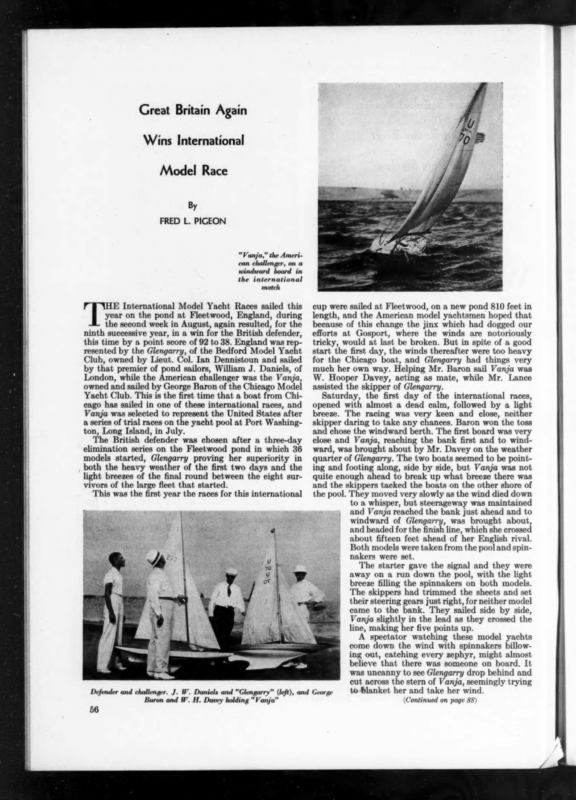
Great Britain Again Wins International Model Race By FRED L. PIGEON “Vanja,” the American challenger, on a windward board in the international match HE International Model Yacht Races sailed this year on the pond at Fleetwood, England, during the second week in August, again resulted, for the ninth successive year, in a win for the British defender, this time by a point score of 92 to 38. England was represented by the Glengarry, of the Bedford Model Yacht Club, owned by Lieut. Col. Ian Dennistoun and sailed by that premier of pond sailors, William J. Daniels, of London, while the American challenger was the Vanja, owned and sailed by George Baron of the Chicago Model Yacht Club. This is the first time that a boat from Chicago has sailed in one of these international races, and Vanja was selected to represent the United States after a series of trial races on the yacht pool at Port Washington, Long Island, in July. The British defender was chosen after a three-day elimination series on the Fleetwood pond in which 36 models started, Glengarry proving her superiority in _both the heavy weather of the first two days and the light breezes of the final round between the eight survivors of the large fleet that started: This was the first year the races for this international cup were sailed at Fleetwood, on a new pond 810 feet in length, and the American model yachtsmen hoped that because of this change the jinx which had dogged our efforts at Gosport, where the winds are notoriously tricky, would at last be broken. But in spite of a good start the first day, the winds thereafter were too heavy for the Chicago boat, and Glengarry had things very much her own way. Helping Mr. Baron sail Vanja was W. Hooper Davey, acting as mate, while Mr. Lance assisted the skipper of Glengarry. Saturday, the first day of the international races, opened with almost a dead calm, followed by a light breeze. The racing was very keen and close, neither skipper daring to take any chances. Baron won the toss and chose the windward berth. The first board was very close and Vanja, reaching the bank first and to windward, was brought about by Mr. Davey on the weather quarter of Glengarry. The two boats seemed to be pointing and footing along, side by side, but Vanja was not quite enough ahead to break up what breeze there was and the skippers tacked the boats on the other shore of the pool. They moved very slowly as the wind died down to a whisper, but steerageway was maintained , and Vanja reached the bank just ahead and to windward of Glengarry, was brought about, and headed for the finish line, which she crossed about fifteen feet ahead of her English rival. Both models were taken from the pool and spinnakers were set. The starter gave the signal and they were away on a run down the pool, with the light breeze filling the spinnakers on both models. The skippers had trimmed the sheets and set their steering gears just right, for neither model came to the bank. They sailed side by side, Vanja slightly in the lead as they crossed the line, making her five points up. A spectator watching these model yachts come down the wind with spinnakers billowing out, catching every zephyr, might almost believe that there was someone on board. It was uncanny to see Glengarry drop behind and cut across the stern of Vanja, seemingly trying Defender and challenger. J. W. Daniels and “Glengarry” (left), and George Baron and W. H. Davey holding “Vanja” 56 to Blanket her and take her wind. (Continued on page 88)
November, 1933 Great Britain Again Wins International Model Race (Continued from page 56) LIVERPOOL JARGE J HALLIDAY WITHERSPOON with Preface by Philip Hale He’s Out Again!!! A CLASSIC TRADE MARK AMONG SEA STORIES REG. APPLD. FOR LAUGHS — CHUCKLES —SNORTS AND SMILES All for One Dollar or the Price of 10 Drinks of This, Here, Now, 3.2 Bilge They Calls Beer $700 AT ANY BOOKSTORE TO THE PUBLIC T= SQUARE RIGGER CO. has always (approximately) stood ready to do its part. Our firm has, in its entire history, published only one book, the edition of Liverpool Jarge, which erupted in 1922 and which was sold out in 30 days. A notable achievement! We have often thought that we might try it again some time when we were feeling just right. And now is the time for all, — well now is the time. Our company has no ene and so cannot increase wages under the NRA. Still and all we want to do something for somebody under the new deal, — and here it is. After mature consideration and close scrutiny of the privy purse, we have decided to bring out a new edition of Léver- pool Jarge. It will be strictly limited to 100,000 copies of which the FIRST THOUSAND will be autographed and numbered by the author — if he holds out that long. If not, the janitor will do the job. Remember — one dollar in depreciated currency, TWO DOLLARS autographed and numbered. or REPEAL EDITION !! Autographed and Numbered “$3 by the Author $2.00 SQUARE RIGGER CO. 62 LONG WHARF ’ BOSTON, MASS. So it was in all twelve races that day, and at the end Vanja had scored 33 points to Glengarry’s 27. First blood for America. The second day, Monday, brought about a change in the weather — a strong breeze from the westward. Here was the weather that Glengarry had been praying for, and immediately she began to pick up point after point, board after board. Try as hard as he would, Baron could not get Vanja to respond. Apparently, she would be sailing fast, but Glengarry was standing up with a good bit of her leeward side out of water and eating to windward every minute. It was soon apparent that the American challenger was outclassed, for in twelve boards she had won only one windward and leeward leg. The score at the end of the second day was: Glengarry, 82; Vanja, 38. Skippers and mates were tired out, for it is quite a jaunt to go up and down a pool all day long, following models, and in a strong breeze one almost needed roller skates to keep up with them. About five knots an hour —and faster at times — they made in running before the wind. Tuesday, the final day, brought a stiff breeze from the northwest, necessitating the second suit of sails on Vanja. Glengarry carried full sail and stood up, carrying her sail remarkably well with a 22-mile wind blowing. Besides the lead ballast, 2 model must have a lot of stability to stand on her bottom and carry her “duds.” i. Glengarry, sailing like the witch she is, took the first two boards, 10 points — and the racing was over and the cup safe for another twelve months in England. Final scores: Glengarry, 92; Vanja, 38 points. The results of these races force American model yachtsmen to the conclusion that our method of handling trial races to select a challenger needs to be overhauled. If we are to win the cup from England, we shall have to hold our trial races on a pool suitable for this purpose instead of on open water, or where the boats are handled from skiffs. We now have two such pools in the making. We must also sail a sufficient number of races so that each contestant has an opportunity to sail in all kinds of wind. + ++ To Windward Across the Atlantic (Continued from page 26) stay trimmed to windward under all but the most extreme conditions. The fresh air which they shot below was a tremendous boon during this week, and made the atmosphere much better for sleeping. Another scheme which proved an entire success was the system of watches, Our regular routine was to stand four hours on and four off, dogging the watches as usual every afternoon between four and eight. Every evening, however, from eight until midnight, Rod substituted for one man and stood his watch for him. Thus each of us, once every four days, got a full eight hours’ sleep below. For the past week we had been by the wind the whole time. Occasionally the wind would let us fetch our course for a couple of hours, but soon we would be headed. As the breeze hauled, we would tack, and keep pointing higher until we could make good our course on the other tack. Then the wind would back ahead of us and we would repeat the process. For the next five days, the wind remained moderate and ahead. Since we could usually fetch higher on the port tack, we kept going farther and farther north, but as our position moved the wind shifted, blowing steadily from within a point or two of Cape Race. Slowly we worked our way south again, through fog which dampened our spirits as well as our clothes. (Continued on page 90)