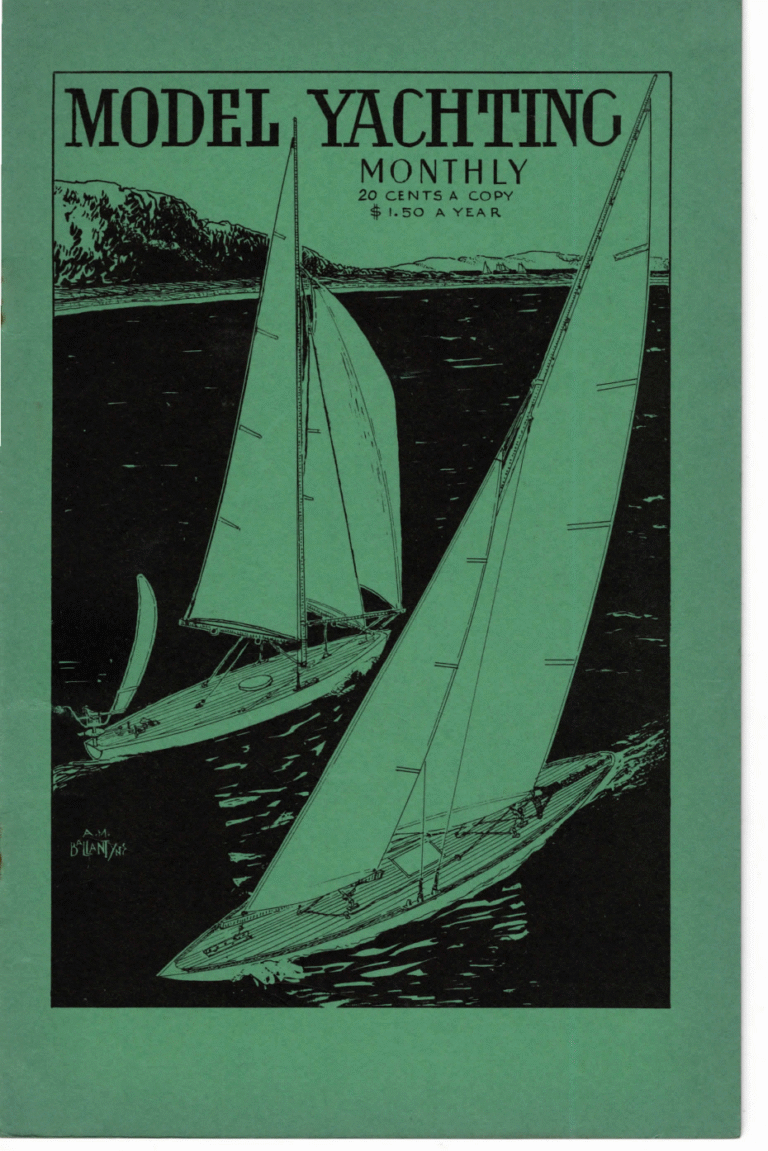
MYRAA Special Report of the Secretary of M.Y.R.A.A. – November 1940
Designs for the 6-meter, M Class, X Class and A Class

Designs for the 6-meter, M Class, X Class and A Class

Here in Wisconsin, where skippers frequently encounter high wind velocities during the course of our model yacht racing season, it is almost essential that our craft be equipped with first, second, and even third suits of sails, while the hulls themselves remain of such a design as to be driven easily on those days when the winds are light. This situation compels may of us to make more than a casual study of our sail requirements.

Naturally, every model yachter crowds the area restrictions in his No. 1 suit of sails in order to get the most out of his boat on the “light” days. When this suit (and the wind) causes too great a heel in the hull, with a consequent slowing-up of the peed, it is time to put on the second suit, continuing to the third, if the second proves too large.

Laying out the sails is the first step, so about 3” from the selvedge, and parallel to it, mark a fine, straight pencil line the length of your leach measurement—the mainsail on the left hand side and the jib on the right.

The sailing qualities, speed, and control of your model are dependent on good sails.

Over in the Quaker State, the Philadelphia
M. Y. C. is determined not to lose its many
sailing events in spite of all the handicaps the city and state or park officials might put in its path. This coming Fall the members will sail at “Hunting Park,’ located at the junction of Roosevelt Blvd. and Broad St. This is a new lake, evidently, and it runs due north and south with a measurement of 200x630 ft... . and
there is plenty of depth for A boats and a fine wall around it so wading will not be necessary.

Prior to the advent of the new X class there
existed in this country but two major classes, the A class and the M class. Many model yachtsmen objected to the A class because of its too complicated rule and excessive weight and size. With the advent of the Marblehead 50-800 or M class, it appeared that at last a rule had been perfected which because of its extreme
simplicity and the moderate size produced would suit everyone, and so it did apparently, because hundreds have been built and the M has formed the largest class and proved to be the backbone
of model yachting throughout the nation.

Model sailing yachts, especially racing craft, have their sailing qualities materially altered when a change is made in the amount of the rake of the mast—the center of effort of the sail plan is shifted backward when the rake is increased,
causing the boat to luff into the wind, and forward when the rake is lessened, reducing the “pointing” ability of the yacht.

You Should Join the MYRAA
MYRAA Objective, National Officers, Executive Committee and Division Officers
Model Yachting
1940 Racing Calendar
MYRAA Member Clubs and Officers
Other American Model Yacht Clubs
Canadian Model Yacht Racing Association
What Class Should I Build?
Official Burgees of the MYRAA
Model Yachting History
The Crakpot’s Corner: Believe it (Or Maybe You’d Rather Not)
Four Rules for Good Sportsmanship