- 1959 A-Class Championship & Yachting Monthly Cup
- Event: British Open Championship & International Race at Fleetwood (August 1959).
- Entries: 31 yachts divided into four fleets; full tournament sailed.
- Winner: Moonraker II (Britain) – P.A. Dawson.
- Technical Insights A-Class Design Guidelines:
- Sail area: ~1,600 sq. in. max for efficiency.
- Balance between longer waterlines, heavier displacement, and aspect ratio.
- Trim & Balance: Proper lead positioning critical for maintaining fore-and-aft trim under added weight (e.g., vane gear).
- Simple Vane Gear (E.G. Clay): Easy-to-build design using plastic and brass parts.
- Adjustable linkage ratio and beating stops.
- Incorporates basic principles for beginners; optional guy system for extended functions.

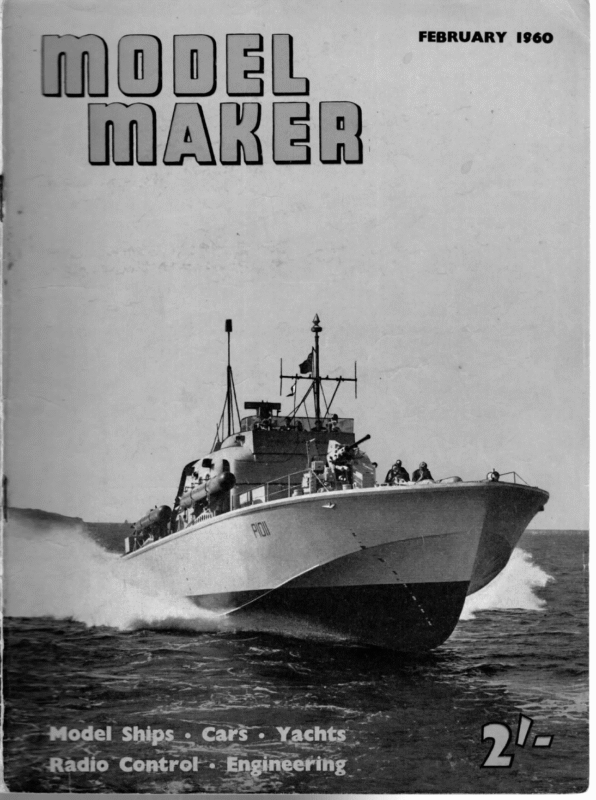
FEBRUARY 1960 “>
heats not completed till lunch-time. Later wind N.W., THE 1959 “A” CLASS CHAMPIONSHIP moderate, 5 heats completed. Saturday—Wind N.W., fresh, remaining two heats quickly completed. International Race, Yachting Monthly Cup This race started at 3 p.m. on Saturday and two NFORTUNATELY, the somewhat hectic position in the printing industry prevented our attending the 1959 British Open Championship and International “A” Class Race at Fleetwood in August last, and our attempts to secure a report and pictures heats were sailed. A light reaching wind on Sunday changed to a fresh westerly and six more heats were sailed to complete. before, during, and subsequent to the event met with no response whatsoever. We did receive the customary daily position sheets, and in answer to on these sheets. A full tournament was sailed, the 31 boats being divided into four fleets to permit skippers some free time. The first pair was started at 11 a.m. on the Sunday by the Mayor of Fleetwood. RESULTS (Scores on days when all boats had sailed equal heats) No. 746 765 DF 3°. 751 4… 616 Sse Ara 6. 716 T- 3… to 8 . 642 9». 500 723 770 732 767 13 652 i4 740 F32 16 B33 17 729 766 733 20 575 21 22 4. 698 764 23 718 734 25 769 26 637 27 28°. 3): = 7106. KSI 29 30 31 Sat. 26 Moonraker II (Britain) … 20 me Pallieter (Belgium) 9 Miss Grisbi (France)… 5 ae Elma (Scotland) The Wing and Wing Cup for the fastest to Miss Grisbi, 2 min. 10.8 sec. numerous requests publish the following notes based Posn. i ie RESULTS 738 KS2 Skipper Name West Moonraker II… P. A. Dawson J. Parkinson … T. Buchanan Raven Viola suit, fine, six heats sailed. W., top Sunday—Wind : hd A and B 4 heats, C and S., light, Ey ons Wind ring S., light Windines, T ane DENS Wee Parr ane cache 5 ; ! S.W. Four heats |]/&
55 1,600 sq. in. is as much as can be efficiently used. Of the suggest Tthree variables which enter into” the rating formula, i.e., mainsail and 41 32 WO THESE O OFARE TWO ANY KNOWN DIMENSIONS SN {5 and D 3 heats, wind 107 105 +100 96 95 94 92 85 85 85 85 79 75 715 70 68 68 68 1400 67 62 59 59 58 56 52 51 49 43 34 en’s: NAN rR A-CLASS MODEL WHEN ‘ SN \ Sak |/6° Thursday—Wind S.E., light, B being comdied in afternoon preventing schedule i ; F_ Total 129 13 fad FOR DEDUGING Le& ite B and D 5 heats, Wednesday—Wind teith: S.W., light, ACS 24 6 17 6 Parkinson … es — Saltcoats 74 46 36 24 run went 55 97 52 95 47, 96 49 91 47 87 41 84 34 87 35 75 40 80 32 75 39 81 34 76 28 67 37 72 31 70 25 64 23 66 33 62 38 64 27 59 30 57 26 59 23 54 34 55 17 54 30 = 46 25 51 24 46 39 35 30). 35 29 31 22 27 28 20 25 32 20 27 22 21 16 28 26 17 16 11 21 23 14 25 19 24 —— Zee : Priest Alexander … Priest Daniels Daniels Be Turner. W. Smith … Pe Corby after Feltwell sa —— oe _— — —_ — Boussy =e Van Hoorebeke Priest _— _— aes _ Norsworthy Daniels Littlejohn Priest 34 — Bre Priest Littlejohn des — Fleetwood E. L. My Fair Lady Birkenhead K. Jones Highlander Fleetwood N. J. Fish Rapture Birkenhead J. Pollitt Commando Y.M. 6m. O.A. A. Levison … a Jill 6m. O.A. Y.M. N. D. Hatfield Serica… Ulster M. C. McCrea Wildfire … Miniature on T. Todd Elma. Bury G. C, Redfern Shikara … Ulster R. H. Tregenna Ulster Lass Birkenhead P. Mustill Cresta Morecambe W. K. Rodrick Quest II Fleetwood H. Westerden… Cumbria Fleetwood C. H. Taylor … Clansman … France H. Boussy_…. Miss Grisbi Belgium … G. Van Hoorebeke Pallieter … … Birkenhead F. Amlot ALS Betty XII Birkenhead J. Lace Mistral Ulster P. Duffy Shangarry Saltcoats … H. Miller Morag … Bolton we G. Stobbs_… Black Tarquin Y.M. 6m. O.A. F. Shackleton Marian Too Fleetwood F. Dutton …. Pinocchio Bradford … H. Atkinson Finality … Fleetwood D. M. McIntyre Tomboy … Bury sis W. Platt Yeoman … Bolton J. Roberts Oberon Saltcoats J. Bissett Gay Gordon Fleetwood Ti 64 M 44 Designed After Turne Club Gosport Sun. 1500 1600 SAIL AREA INS.0 NaN 1700 1800 FEBRUARY, 1960 ~ in from beneath is provided with a small butterfly plate soldered or Araldited in its slot to engage with the beating stops. The vane arm is finished by screwing in place a small brass bracket to take the vane feather. The proportions shown in the draw- ing are suitable for a 36 or Marblehead yacht and although the vane is limited in its function to some extent, it does nevertheless incorporate all the basic principles and being so inexpensive and simple to make, will be extremely useful to many beginners in learning the basic handling techniques required. The addition of a further brass arm in the A Simple Vane Gear by E. G. Clay i pee very simple vane gear can be built by any modeller without any need for silver soldering or any special tools other than a tap for making a few threads. If you haven’t a suitable tap and don’t wish to spend the half-a-crown or so necessary to buy one, you could use self-tapping screws since most of the threads are in plastic. The material used on the original vane was a } in. thick black plastic, but Perspex or any similar material would be quite suitable. Brass sheet is needed for the pintle plate and the pintle itself needs to be fixed firmly in this, but to avoid soldering, it can quite easily be secured with Araldite. Over the pintle is slipped a brass tube to which is clamped one of two small brass blocks. These blocks need to be thick enough to take a bolt and to avoid the necessity of tapping a thread in the brass, it would be quite feasible to drill clearance right through and use a nut and bolt. After drilling the vertical – hole to clamp on to the brass tube (and in the case of the second block the tiller head) a hacksaw slit is made so that tightening the bolt up will clamp the block firmly in place. The links are made from hard brass wire bent into long U’s and forced into holes drilled in the blocks as sketched. The adjustable pin between these U’s is simply a bolt lock-nutted to the lower U and thus capable of sliding for linkage ratio adjustment. The Y-piece is also drilled and slotted to clamp in place on the tube and is provided with a locking screw and a further screw in each arm provided with a locknut; these two screws can be adjusted to provide beating stops. A spacing tube is now fitted and the main vane arm dropped on top of this and checked for free pivoting. A nut or small cap screws to the top of the pintle to secure the whole assembly. The vane arm is again } in. plastic with a rod driven in its fore end with an adjustable balance weight; the rod can be a length of studding or Meccano rod, so that the weight can be screwed along for adjustment. A screw passing through the arm locates on the leg of the Y to lock the arm for running and reaching, and a second screw set Y-piece equipped with a hook at each end would enable a guy in the form of a rubber band to be hooked over the locking screw, thus making the vane capable of most of the important functions. Feather bracket 20s.wg. brass MODEL MAKER ee i ee a ee a __ application. (You can get impact adhesives, but you can’t move about to adjust at all, and some folks are allergic to fumes given off; however , these may not show at all.) Do- it – Yourself Turn free edge allowance under and affix corner fillets, leaving foot and leach hem allowan ce clear, SAILMAKING but coming to edge of luff. foot. for racing and cruising craft Part Three BY J. S. DRURY ye you have got the knack of cutting the Terylene, and not until, lay the first roughed- out sail over the draft and smoot h out, securing the corners and here and there along the edges with slips of tape. Terylene towards (This masking tape does no harm to the if you always pull off from the centre the edge, course.) t‘other way you will tear it of Place the heavy mags. upon the centre; you will find you can see the marking clearly. Awl and drawing pin the spline down (a few drawing pin holes will not harm the Terylene) and cut out, luff dead to the curve and foot and roach * outside to allow for hemming. Do not use weights for holding spline— they will not hold against thrust of cutting and will either wrinkle the material or slip off onto your foot. For the cutting of the smaller suit mainsai l luff curves, take as the plot for the lower third of the luff, and then mark a spot HALF-WAY between the curved edge and the datum at headboard height and spline in, keeping curve in character; for the ordinar y mast this will be about right. Likewise for the 3rd and 4th. For jibs keep to the $ hollow and redraw for the smaller. There should be no confusion if you work down from the biggest, and you can always put some more tape over if you feel you need it. For ‘the feet of the sails, these may be all one length, but if not keep to the same actual offsets, and slightly steepen the curves, Taping Now for the fun. Taping the luffs. tack and clew at 45 degrees to the foot, it will answer admirably. Cut exact to size, exactly to slight curves, except for the “free edge”, where leave 4 allowance . Do not make these over large, have a good look at others first, but 2in. each way for tack and clew and 4 in. for head is ample for ali except a heavy 10-rater or A, where they may be a trifle larger. Jibs pro-rata. With Terylene, if in doubt be small, since too-large spoon ideal for flattening down and smoothi ng tapes and edges. Be very sure that the top foot or so of the luff has not tried to straighten itself out and reversed like a very gradual § (it will if it can) and if it has, gently pull the tape off and ease out the tape a shade for a few inches below headboard, or trim a FRACTION, no more, of luff below headboard. If a “reverse” gets made up it will spoil sail in use. Now stitch down both edges of tape; you’ll find nearly all the luff curve gone now, seeming almost straight, which is correct, the flow being now “inbuilt”, When stitching, if the needle gets a bit draggy put a spot of white spirit on it and keep on, it will clean itself. Do not use a very fine stitch, 1/16 spaced holes are ample for heavy “cotton” for a treadle or electric, and about 3 of that for “Gossamer” and hand machine. Always take it gently; most trouble with sewing Terylene is caused by rushing or forcing and jerking thread or heating needle. ning and weighting down, and, setting outside edge of spline to false line, cut on inside edge of spline. Don’t forget hem allowances. Use gum instead of Holdtite. TAPE LUFF after affixing corner fillets, then hem other edges. Next month we will see to foot, battens, metal fittings on sails and marking, and anything else we have room for. Till next month then. Now experi- ment with the “Holdtite”. Do not lash it on, or it will show through very dark; just a very thin smear at the edges is all that is needed, just to locate when You will always get a “ghost” but this is N.B.—Apologies for a transposed line in Part Two; p. 35 Jan. issue, lh. column, 7th line from bottom should be Sth from bottom. Sorry. Adhesion is about two minutese after 98 | down, Holdtite 4 in. back upper edge and carefully lay the tape. The tape will overlap the adhesive so none will squeeze out. Let dry, turn sail over, Holdtite lightly exposed edge of tape and fold over and down, Holdtite $in. back upper edge and carefully 1/16 O.K.‘anyway. Muggins finds handle back of big aspect ratio 24 to 1 have bow offsets, over 3 to 1 cut luff straight. Mark UPPER curve of foot with 4 in. instead of + bow. Jibs as Terylene. Give about double stretching allowance, unless you are proposing to dope cloth after, if so, allow as Terylene. Cut out by marking false line spline width outside all plot lines, cutting sails just inside this with scissors, pin- from scrap. There are all sorts of ideas about how the selvedge should run on these but if the head one has the selvedge parallel to the luff, and for the not unsightly. matter) and put aside. Lay sail on draft, making sure no distortion and that luff edge matches plot, weight For cloth, loose footed, proceed as above except— wards as follows. First cut your three corner stiffeners stitching. machine until it works, or get impatie nt and turn over the edge single (no need for double with Terylene) by running a blunt curved edge (a bit of Meccano strip is ideal) around the edge whilst resting sail on a bit of softish rubber mat, Holdtite down and stitch down single for now. Your } allowance is ample, and if you haven’t a hemmer or can’t get it to work this is what you will do anyway. It’s quite as good. Now take the Terylene tape and cut off length for luff, crease by firmly Biroing down centre on soft rubber mat, fold with fingers (it won’t stay but no Cloth This is possibly the most vital job of the lot, and we proceed back- fillets can spoil flow in very light airs. Then hem the leach and Oh, how simple it sounds, you can only experi- ment with “scraps” and the thread tensioner on the NORTE MODEL MAKER Readers Write… This elegant little wallet of chrome vanadium B.A. spanners in the get model sizes is presented to all “Readers Write” correspondents. therein and avail themselves of the technical knowledge in the clubs which I am sure will be gladly given if only they ask for it. As far as the MYA Council is concerned there is an immense fund of goodwill towards R/C Yachting and recognition of the “Q’’ Class (which has now been given) is only the start of their activities, not the finish. H. E. ANDREWS, Bournemouth. Hon. Editor, MYA NEWS (We suspect that the prototype mentioned is a 5.5 metre which, in the opinion of many, is still too large for a popular class. Congratulations to the M.Y.A., by the way, on acquiring Harry Andrews for the new secretary, effective from January 1st.—Ep.) MORE ON R/C YACHTS DEAR Sir, In reply to “Overlap Established’’ in the December issue. It is a pity the writer assumes ~ THE M.Y.A. AND R/C YACHTING a nom de plume. Let me therefore assume he is a prominent member of the I.R.C.M.S. He must then know the history of yachts controlled by radio. Colonel Bowden and G. Honnest-Redlich began this conquest of the blue with “A’’ boats. Members of the London section of the society then took it up and approached the Model Yachting Association for cooperation. The M.Y.A. invited members of the I.R.C.M.S., to attend their council meetings for discussion. There was no difference of opinion between the two bodies about which boat to use, and it was a natural conclusion to use the largest size boat for the heavy unbalanced gear and batteries. The combination of sail and control is still in its infancy and other sizes of boat are open to be considered. “OE’’ considers the M.Y.A., are obstructive he will be enlightened by asking his headquarters. The building of a yacht can well be compared with the building of a radio set to the uninitiated, but the writer agrees that there are spare boats to be had. The building or buying of a radio, however, is a greater problem to the yachtsman without technical knowledge. I myself have been asking for type and price for over a year but the radio people are still unable to give a clear answer. F, SHACKLETON. Ipswich. DEAR SIR I feel that I cannot let pass without challenge the letter from your un-named correspondent writing from Gosforth in the December issue on the above subject. It is a curious thing that when the MYA takes no action on any subject it is accused of “dragging its feet’? and following behind the troops, but when it does take action it is then accused of “dictatorial behaviour’’. This arises from the current mis-conception of the MYA’s Constitution. The MYA is solely an ADMINISTRATIVE Body, it has no powers to LEGISLATE. That function is reserved solely to its constituent clubs acting through their delegates at the Annual General Meeting. That is why all resolutions for discussion at the AGM are circulated to the clubs 28 days before the date of the AGM, to give them time to discuss them and to brief their delegates accordingly. It follows, therefore, that if no resolution on any given subject is received it can never be discussed and the MYA Council can take no action on t, As regards the MYA’s attitude to R/C model yachting and the current proposal concerning recognition of the “Q’’ Class I may say it is the unanimous view of Council that a brand new Class solely for R/C Yachting should be instituted at the earliest possible moment. There are sound technical If R/C yachtsmen want their sport to progress it is no use their baying at the foot of the tree on the lines of your correspondent, what is wanted is constructive thought by all hands and constructive and CONSTITU- TIONAL action thereafter. Let them join their local clubs, make their opinions heard FORMULA :— 3 S or R 1/40th Scale R — Rail FORMULA Lipre S or R Combined Scales WILSON. Lymm, Cheshire. (See our editorial—Ep.) SCALE SPEED PRO DEAR Sir, I don’t want” to revive the correspondence (in another Journal) on this subject in which I took part and which finally sank of its own weight. I would, however, like to-agree with you that, unless one goes into very detailed calculations the best comparison of speeds is by the Froude method. This has also the advantage that it looks right and it is in fact used by film makers when they want to match model shots with live action. Unfortunately it does seen that, as a matter of English, scale speed means in fact scale miles per hour, that is linear scale. That being so I would suggest that, while you should accept and use the Froude method of comparing speeds you should, to avoid confusion, use some expression other than “scale speed. ’ Possibly “comparative speed’? would fill the bill. CAR BODY REQUIRED DEAR SIR, Electric Model Car Racing will be getting out of hand shortly, if nobody sets about having an international governing body (a la R.A.C.) to handle all meetings by giving them their blessing. The Mopet MAKER has shouted itself hoarse for the growth of this great hobby— I would like to see them elected to the chair of the “International Model Electric Car Racing Control.’’ I have written down my ideas for a formulae which would have to be “‘butchered’’ about to make them sensible enough to understand and readable, even to the greenhorns, —that’s me! – The Mopet MAKER is doing a marvellous job, keep it up. I am making a 1/40th scale track (FIII?) and in a few months hope to hold a meeting for the followers of 1/40th scale, when the track is completed I will let you have details, to publish if you so desire. THE INTERNATIONA ELECTRIC CAR RACING FORMULA FORMULA :— 1 S or R 1/24th Scale FORMULA :— 2 S or R 1/32nd Scale S — Slot 100 T. W. PINNOCK. London, W.1. SCALE SPEED CON DEAR Sir, I find I cannot agree with the views stated in last month’s editorial concerning scale speeds. To talk about Froude and quote aero- dynamics and hydrostatics is pointless in the case. The modeller is not interested in the effect his model has on the air or water through which it proceeds. What does interest him, however, is how fast his model would seem to pass him if he were to the same scale. With a car of short length this fallacy of Froude doesn’t become apparent obviously. If, sir, you belonged to those corps elite, the scale ship modeller, this problem would be brought home to you in stark reality. If a full-size destroyer passes point of reference at 15 knots it will pass this point of reference in approximately 14 seconds, assuming a length of 350 ft. (365 ft. for Battle Class destroyers). If one arranges for one’s model to pass a reference point at reasons why the present MYA classes are unsuitable for conversion to R/C and the sooner an exclusive Class is recognised for R/C the sooner will that branch of the sport get on a proper basis. I am breaking no confidence when I say that such a Rule has been evolved, a prototype design prepared and the resulting demonstration yacht is now in its last stages of completion. I may say that I evolved the ‘‘Q’’ Class formula to give technical expression to the known wishes of the majority of the R/C yachtsmen whom I have had the pleasure and honour of meeting at the Poole regattas and elsewhere. The large majority of the present R/C fleet consists of ex “‘A’’ Classe boats and it is right, proper and just, that the majority should be considered first. If the owners of other types of conversion wanted their boats considered for recognition why didn’t they get a Rule prepared and a resolution submitted in the constitutional manner through their clubs? hard-to- a speed comparable to 120th of 15 knots the result is ‘“‘near perfection’’. I I assure you with my hand on my heart that if one worked out the speed from Froude and arranged one’s model to do this speed, it would plane along and eventually take off! (This, ‘sir, destroyers never do. Or hardly ever). Lastly, this isn’t a ‘letter designed to confound a very good Editor, it is a based on result obtained practically, on the water, i; 2 presence of some engineering friends wno had Mr. Froude’s bunk fresh in their minds. They were confounded to a man. No, the village duck pond or the boy’s clubtrack are not in the nature of hydrostatical and dynamical laboratories, they are areas in which modellers wish to see their models travel along with a speed which compares favourably with the real thing. Ship modellers, if they are realists, will have given up the idea of scale wave-forms before they were out of short pants. I doubt, by the same argument, if our modellers are interested in the scale draught as their cars pass. CHRISTOPHER WALKER. Newcastle-on-Tyne 1. (Froude speed, 15 knots, 1/120 scale, would be near enough 1% knots. Plane? Take off? Hmm.—EbD.)