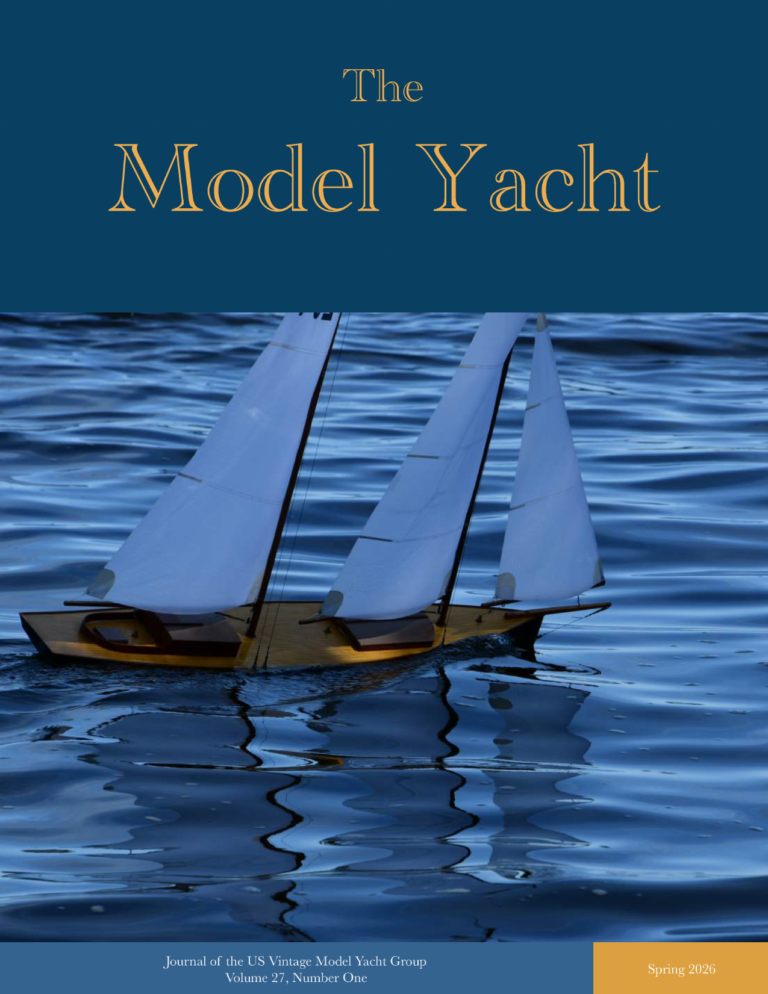
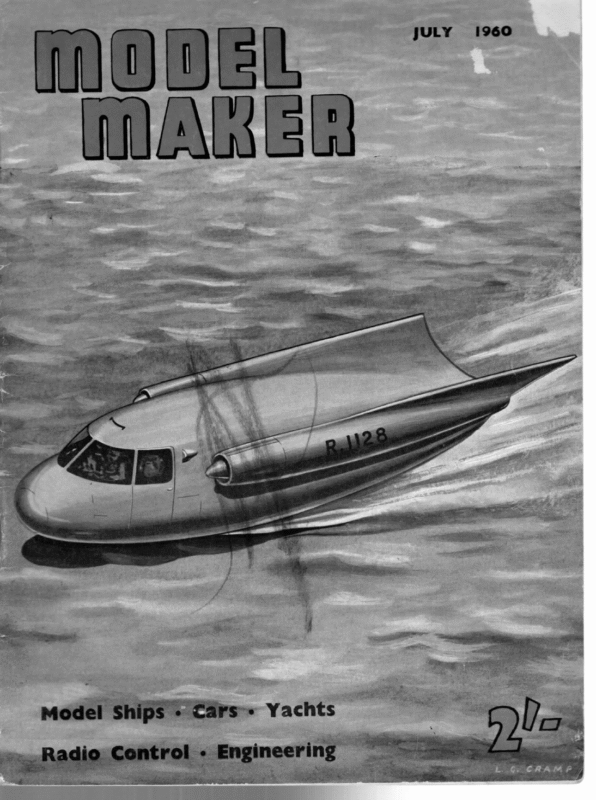
- Opening R/C Day at Rick Pond (May 15, 1960)
- Radio Control in Yacht Research (Lt.-Col. C.E. Bowden) Radio models reveal hull behavior under real wind and wave conditions better than tank tests.
- Key Findings: Excessive pitching slows yachts dramatically, especially on windward legs.
- Symmetrical hulls (matched ends, max beam amidships) pitch more and lose ground in rough seas.
- Modified hulls with wider stern sections, harder bilges, and max beam aft reduce pitching and improve speed.
- Design Insights: American “wedge” hull: shallow, beamy, fine bow, full stern → less pitching, better weather helm.
- British narrow symmetrical hulls: outdated for competitive racing.
- Recommendation: For radio racing, prioritize anti-pitch hulls with good maneuverability and stability.
- Keel Design Principles (John Lewis)
- Functions: Prevent leeway; carry ballast.
- Efficiency Factors: High aspect ratio (deep, narrow keel) = better windward performance. Avoid excessive reduction in area—can increase leeway and resistance.
- Guidelines:
- A-Class: ~160 sq. in. keel area; thickness ratio ~9:1.
- 10-Rater: 100–125 sq. in.; thickness ratio ~11:1.
- Thick keels allow lower lead placement but may harm windward ability.
- Construction Tips: Sharp leading edge; fair junction with hull; calculate lead weight and C.G. carefully.
- Extreme shapes (e.g., “seal flipper” fins) unnecessary for beginners.

an MODEL MAKER) ceric yachts attended the open R/C day arranged by the Y.M. 6m. O.A. at the Rick Pond on May 15th, five of which were Q (ex A) class of varying age; the sixth was an ex-6M, quite fast, and the seventh was a new Marblehead. A race was arranged and despite almost a calm in the morning and only a light breeze after lunch, it was found possible to run the complete tournament off in about four hours of sailing. This was considerably simplified by the fact that four of the models were from the London I.R.C.M.S. group of six which regularly sail together, using a common 465 m/c six-audio-frequency transmitter with each yacht having one frequency, i.e., virtually single-channel control but without separate carrier waves and thus unable to interfere with each other. The other yachts were on the more usual 27 m/c band. , Various forms of pulse box were used by the 465 skippers, plugged into the single transmitter, the other models using reeds. Unfortunately the Marblehead (using a glass fibre . Jemima Duck hull) was suffering from teething troubles —for example, the jib line kept running off the twodiameter sheeting drum—but when it was sailing properly it appeared to us to be close to the bigger boats in speed under the prevailing conditions; advantages with the Qs are, however, that they do not tend to stop quite so easily in wind lulls and, it is claimed, the longer waterline contributes to the maintenance of a straighter course between marks. Possibly the most interesting demonstration was the sailing of five Qs together round the course after the close of the race proper. The start and finish line was immediately in front of the skippers, the wind from behind them and slightly over their right shoulders. The first leg was between a beat and a reach, 60 yards to the buoy, turn port 90 degrees, about 50 yards almost downwind to the next mark, then a turn of about 110 degrees and a 120 yard reach, 160 degrees turn and beat back 60 yards to the finish. The whistle one minute before the start set the boats jockeying for position; one had a few inches of bow over the line at the whistle and had to try again, but the other four headed for the first turn and arrived ; easier. f almost together. Out of the resulting melee and cries of “starboard”, they emerged nearly in line ahead and thereafter were sufficiently separated to make things It was quite obvious that at only 60 yards range it was almost impossible to judge relative positions with four boats, and even the start presented problems in avoiding collision with five boats trying to cross a line something like 40 ft. long. The answer seems to be the standard tournament system, with one pair of yachts at a time, or pairs at intervals if they do not interfere radio-wise. The only other solution would possibly be portable transmitters, with the skippers following their boats. Top, Alan Tamplin’s Kit; box of tricks in hatch is just steering gear—radio is underneath! Box on stern houses vane operated sheeting gear, not in use at present, which employs photo-electric limit switches. Next, Marblehead used four channels of R.E.P. Sextone equipment; adequate access through hatch little larger than usual. Note rudder mods. Next, four of the five starters mentioned; one is ahead and going about. Bottom, the four boats converging on the first buoy. The winner of the “official” race was A. Tamplin’s Q boat with 25 points, runner up G. Carrington-Wood 23 points, B. P. Winter was 3rd with 18, and the Marblehead took 16 ‘points for 4th place for owner Parnaby.P. Cummings F. Dawe tied for 5th with 15 points and R. Redhead’s 6M was forced to withdraw. an 336 f ;
Fig. 5.—A closely matched ended “A” Class hull of “symmetrical” form, which proved to be a pitcher in difficult seas. Note the over close similarity of angles of rise fore and aft, with both ends closely the same, and maximum beam centrally Positioned, as in sketch Fig. 4 PART TWO BY LT. COL. C. E. BOWDEN Radio Control in Yacht Researeh The value of radio models in full-scale work. OWEVER valuable tank work may be, and there led to “feathering” closely to the windgusts as upright H is no denying that it is valuable, the tank cannot as possible, until it became impossible to win a major dinghy event if the boat was heeled more than 10 degrees accurately observe a yacht sailing in realistic conditions of wind gust and seas, with surface water and waves attacking the hull at an angle, as happens in full-scale windward sailing. It has been estimated in America that in a strong breeze surface water attacks a windward when sailing to windward. This technique of pinning in the sheets and feathering closely up to windgusts spread to keelboats, naturally at a slightly greater angle of heel, until today anyone in a hot keel boat class who cannot master the technique reasonably well has little hope of keeping a place amongst the leading few boats, and in every good class there are the same several boats almost always out in front, followed by a middle of the class band, and the same little group who bring up the rear, often surprisingly far behind in a couple of hours of racing. As sailing “upright” is now the thing, it means that keel boats can no longer sail off fast and free, which sailing hull at around two knots, which is a considerable side force complicating hull design. A radio model of large size, not less than seven feet in length, shows the effect of such surface water and wave flow, with wind gust effects, upon the handling and pitching of a yacht’s hull, together with the rig effects on all points of sailing. Weather and lee helm are clearly seen by a pointer and can be recorded by an instrument. Angle of heel and speed can now be recorded, whilst favours a craft that has an excessive tendency to pitch. A boat that is being feathered close to the wind gusts last year we discovered that the angle of leeway drift cannot afford to pitch. If it does so, it rapidly stops. in windward sailing can be accurately measured under natural conditions, by sailing models at a line of buoys and floats. Results were remarkably consistent. Radio model sailing shows up good or indifferent manoeuvrability, and perhaps most important of all factors, radio models quickly aid the designer to correct faults at the minimum of expense. Time in observing and correcting basic faults is immensely reduced, for it is possible to sail a model back and forth, repeating the particular point of sailing under scrutiny. In this way I found by observation of a number of models of differing It is now well known how severely pitching slows down a yacht. Heavy pitchers amongst yachts are dead when going to windward. A pitcher will nowadays never win a race against a craft with a bow that slices evenly through disturbed water having proper anti-pitch damping design attributes at the stern. Pitching also plays havoc with manoeuvrability, which is the very essence of yacht racing by tactical manoeuvre. The ability to go about cleanly, followed by sailing off smartly onto the new tack is impaired if the hull pitches. Putting about a bounding yacht in a seaway is a nightmare when the other fellow goes smoothly around and gets going at once, for as the pitcher’s speed drops on turning across the wind, the hull bounds to a virtual standstill. This action can be very clearly demonstrated on a large radio controlled model. As already remarked, to alleviate the results of excessive pitching when sailing to windward, a helmsman is forced to sail the craft off, or “freer”, in order to keep the speed up. This means sailing at a greater angle of heel than is desirable for good windward work and making the maximum ground to windward. Hence the craft falls off to leeward against its opponents. The reader may think I have devoted too much time to describing the horrors of pitching. It is however, in my opinion, certain that we will never win the America’s Cup until we eliminate excessive pitching from any future Challenger. types, the reason for excessive pitching of certain over- ““symmetrical’’ shaped ‘A’ Class hulls, and was able to reason out a remedy, and to modify a hull design which when retested had materially reduced the fault, and thereby proved on average faster. This led to design- ing other hulls of different type but with the fundamental modifications incorporated, which similarly responded to the “‘treatment”’. In my view it is highly probable that if the nine trial British models tank tested for the America’s Cup had been built larger than the tank models—say 7ft. 6in. long—and sailed in comparative races in “‘scale” open seawater conditions, the pitching fault later found in Sceptre would have been noticed at an earlier stage, and action taken. Experience tells me that open seawater conditions are far preferable and more realistic than pond tests, because the wind comes in free and unmolested by the usual obstructions that surround a pond. Even a pond bank affects airflow low down, and often demands an unrealistically high rig. Excessive pitching loses races. A cure. In my earlier days of full-scale keelboat racing, I recall that the successful had a habit of “sailing off” when beating to windward, i.e. free or full and bye, with the primary aim of keeping up the speed through the water as the major consideration. Planing dinghies were then developed, demanding sailing upright, which I noted from the Committee Boat each day during last season’s International Six Metre “One Ton Cup” series of races in Poole Bay, that whenever the seas rose with the wind, the British Six lost ground to the eventual Swedish winner of the series, in the vital windward legs. The other boats sailed up and down to the seas, and were more heeled than the Swedish boat, which sailed through the seas markedly more upright and always slightly closer to the wind gusts than her opponents. After the event, the winning helmsman told me that the design of his wider transomed hull had been influenced 346
by the designer’s visit to America. I also have consider- able experience of sailing a small full-scale cruiser with full bow and tucked in stern, which is a pitcher in difficult seas although fast in smoother water. I have noticed similar hulls to this cruiser during Cowes Week, bounding up and down in like manner in a Solent chop, whilst the wider sterned Folkboat cruisers of approximately the same length sailed through the rough stuff far more smoothly. The more ‘symmetrical’ cruiser also has a disconcerting habit of trying to sail off to leeward with distinct leehelm, which has to be resisted when sailing to windward in a smart breeze slightly free. This unfortunate habit always reminds me of the American designer Francis Hereshoff’s words in his book “The Common Sense of Yacht Design”, when he so rightly wrote on the effect of hulf shape and helm balance—‘“‘And right here I would like to note that I have never seen a sailboat that went well to windward unless she had a good positive weatherhelm”. Most winning helmsmen in keel boats like their craft to have just sufficient positive weatherhelm to eat eagerly up to windgusts, with only a final check of two finger lightness on the tiller at the last moments of each gust. The truly symmetrical shaped hull does not usually do this well, whereas the unsymmetrical type of hull that is antipitch also has a useful but controlled eagerness to windward. Excessive pitching is the result of the exciting forces of oncoming waves bounding up a relatively full bow, whilst a matching stern of relatively narrow proportions lacks adequate damping forces aft as the stern goes down from the forward upward wave force. Thus the hull pitches around the centrally positioned maximum beam position and keel weight, which is usually found in a very closely matched ended craft of ““symmetrical’’ balance. This form of “‘symmetrical’’ hull necessarily must also have a close similarity of angles of rise fore and aft, which adds to the pitching potentiality. This is particularly so if the hull is narrow and deep, when the waterflow has to be forced down, and return quickly upwards aft, thus creating an upward tendency at the bow anda squatting tendency at the stern at full speed. See Sketch Fig. 4, and also Fig. 5. The shallower beamy hull has an easier path for the water below the hull, and also permits water to escape sideways more easily, which is one of the several reasons why the shallow American beamy hull is so fast. Refer to Fig. 4. The typical American hull is not only shallower and more beamy with longer narrower lead-in than the traditional narrow deep British () Traditional British Sten | matched ended model hull effect. This “tailplane” or supporting foot to leeward aft, also adds to the hull’s stiffmess to carry sail. reduce heel. The long fine slicing flared of Americans provides a lesser exciting force fuller shorter U shaped bow. There is less tendency to lift quickly to a wave, and the full stern at the other end of the see-saw provides a greater damping force than a finer tucked in stern, which has a tendency to drop if full bows are smartly forced up by a wave. We may therefore summarise by saying the American ““wedge”’ shape provides smaller exciting forces foward and greater damping forces aft, with the result that the yacht pitches less. Some Americans also have the attractive theory that the fuller stern tends to ride forward down the stern wave, thereby gaining a speed impetus. How far this is true it is difficult to say, but if we are to beat their performance in the America’s Cup, it behoves us to examine all their ideas without prejudice. It might also be explained at this point that in practice the “wedge” shaped American so-called ‘“‘unbalanced”’ hull has in fact good balance on the helm because the greater length of entry, ahead of the maximum beam position, provides buoyancy equality fore and aft as the hull heels. This buoyancy balance fore and aft is further assisted by the wide stern partly coming out of the water to windward as the hull heels. The shape left in the water then presents a slightly curved line fore and aft to windward, which provides the slight tendency to weatherhelm so important to good windward sailing, vide Hereshoff’s remarks already quoted, and tank test findings advocating approximately 2 to 3 degrees of weatherhelm for maximum windward performance. The radio racing model Radio racing models demand a hull of greater manoeuvrability than the Vane racing craft, if they are to be on top with racing by tactical manoeuvre. This feature is exactly similar to full-scale racing yachts. Similarly, the radio model cannot afford to pitch on going about, or when being jockeyed very close to the wind in windward sailing, any more than can the fullscale racing yacht. The Vane-controlled model on the other hand probably benefits from being of the closelymatched ended type with ‘‘symmetrical”’ balance because its chief role is to sail a directionally stable “grooved” course up a pond on one leg to windward if possible, and then be retrimmed for the down wind run in similar Max. beam amidships x hull, but has its maximum beam well aft of the hull’s Full bow to match stern rises to excitation of waves centre, with a_ straight run aft to flattened-out DEEP NARROW HULL wide sections and tran- The American full scale som. When sailing to windward and reasonably heeled as designed, the wider transom and wider section at the stern trail Max. beam aft of x amidships conception peer ; to leeward aft and Long flatrunaft to wider anti-pitch hard bilged sections aft – when actwith “tailplane” Right, Fig. 4 Long fine bow to cut waves with progressive Shock ‘ absorption – less tendency to incite pitching | damping heeled and sailing to windward, gives support aft to leeward to damp pitching SHALLOW WIDE HULL 347
a Fig. 6. The author’s modified “A’’ Class hull madein glass fibre with wider harder bilged stern, and the maximum beam further aft of centre,which has materially reduced pitchingin difficult seas. A number of these hulls have been built assisted me in this demonstration, which it.is hoped will be repeated for the Yacht Research members this season. The purpose of the exercise was to show how easy it is to see both faults and good behaviour of a model yacht sob stability. Hence, asrae as my experience goes, sailing under ne I will require a radio racing hull similarin balance principle to the fastest American full-scale winners, and it will be on those lines that I shall endeavour to design my model hulls until something better is thought up. Pitching tests made on models Our tests have included comparative radio sailing of several ‘‘A’’ Class models against each other, and also versus the light displacement wider beamed and sterned hulls mentioned in Part I of these notes. During the trials Over two seasons, we noted that in rough seas encountered in open seawater those “A” Class hulls which I term the “traditionally symmetrical” or the “fully balanced” closely matched ended type (see Figs. 4 and 5), frequently lost ground in difficult seas through controlin natural conditions of sea and wind gust. Fig. 6 shows the modified ““A’”’ Class hull mentioned, which reduced pitching. Note the widened flattened sections aft with harder bilges. The longer narrower bow does not appear in the photograph. The other models have these features even more developed, for it is difficult drastically to modify an “A” Class hull within the rating rules. In conclusion, it is my personal opinion that the closer we get to the truly “symmetrical’’ hull the less likely we are to capture the America’s Cup. The Americans have found that for years the asymmetrical hull has been winning, whereas our more symmetrical hulls have won less in International events. The American unsymmetrical hull may not be the only type to follow, but as it won the America’s Cup, it behoves us to consider the theory behind it, until we can find something better. National prejudice will not assist in designing a Challenger. The narrow symmetrical hull is perfectly satisfactory for certain types of sailing, but is outmoded for a future excessive pitching. On the other hand, it was clear that a modified “A” Class hull with wider sections aft; and maximum beam aft of centre, with longer entry, pitched less and on average proved faster in adverse conditions. ie also applied to the wider sterned light displacement hulls. Challenger. In Part III of this series we will see how beam and When giving a radio test demonstration to the Saunders Roe Tank Superintendent, his Assistant, and a representative from the Southampton University, I showed the ‘symmetrical’ ““A’’ Class hull seen in Fig. 5 as our greatest pitching example, with the other hulls to demonstrate how radio control could show what modifications freeboard affect stability for a radio-controlled racing model, with a suggested formula for a small, easily transported, big beamed but fast One Design racing model yacht made in glass-fibre, for cheapness, strength, light weight, and uniformity of design shape. could achieve in reduction of a fault. Mr. John Hogg > The Model Rail Car Association A. G. M. LTHOUGH the membership of the M.R.C.A* has fallen from 49 to 45 during the year, each of the four affiliated clubs held a championship meeting during 1959 at which some very enjoyable racing took place. The capacity changes in the formula 3 and 4 classes seemed to have no ill-effects and there was no swamping influence of foreign engines as was feared by some members. The M.R.C.A. sets certain classes which must be adhered to while racing: Class Formula l C6. upto1:5 Formula 4 upto Formula 2 Formula 3 Formula Libre upto1:0 upto -80 Wheel Base in.-8in. 63in.-8 in. 5}in.- 7$in. up to 1-50 up to 84in. ‘69 7 4 Track in.-5 points awarded according to a set table. Award w nners for 1959 were: Formula Formula Formula Formula 1 2 3 4 …. B. Stocker (Portsmouth) A. Adams (Bournemouth) C. Orman (Bournemouth) M. Gandolfi (N. London) Fixtures for 1960: July 9th—Demonstration, Portsmouth M.C.C., The Cheshire Foundation, Liss, Petersfield. in. 32in. – 4} in. 34 in. – 44 in. September 4th— National Championship Meeting, up to Sin. All cars shall resemble full size cars and must be fitted with a driver except the Formula Libre class. Each year the Association awards a Trophy to the top performersin each formula determined by the number of 348 Portsmouth M.C.C., Eastern Road, Portsmouth. September 25th— National Championship Meeting, Bournemouth M.C.C.
MODEL MAKER %e4, 7 Direction of water flow past hull Yacht — Angle of leeway Direction of wind Fuselage at angle ofmin. drag Design Fg, 2 Part Direction of Four air flow By John Lewis Angle of attack of win Air flow direction High sum Aspect ratio of wings Fig, 3 F BA & = ee | ROM letters written to the Editor from time to time there seems to be an idea that yacht designers have some dark secrets about keel design. Let us face the truth that little quantitative information is available and for some time yacht keel design will remain a matter of opinion and experience. Model yacht designers generally fight shy of discussing this aspect of design in anything but vague terms because they have not the knowledge to do otherwise. Fortunately, research in testing tanks is being carried out and in a year or two some useful data may be published. In the meantime we will have to base our designs on known practices and avoid features proved to be undesirable. I have experimented steadily over the last ten years and have, I hope, come to some reasonable conclusions. It is inevitable that some of what I have to say may be contradicted by others but on the whole most of findings are in line with the scanty technical information available. The keel of a model has two main functions: (a) To prevent the model sailing sideways (known as making leeway) when attempting to beat to windward; (b) To provide a suitable appendage for carrying the lead ballast. Fortunately, these requirements do not seriously conflict as long as extreme designs are avoided. First and foremost we must consider case (a) and evolve a lateral area which is efficient to windward. The important thing to bear in mind is the leeway angle as it is this angle which closely influences the total resistance of the yacht. The angle of leeway can be likened to the angle of attack of the aeroplane wing which determines largely the amount of lift generated. It is the lift of a keel which prevents the yacht sagging down to leeward of its proper course. Other factors being equal it is generally agreed that a wing of great span compared with its width, known as “high aspect ratio’’ generates more lift for a given area, with less drag, than a wing of low aspect ratio. Similarly with keel designs a deep narrow width keel is more efficient in itself than a shallow broad keel. It must not be forgotten that an aeroplane wing is attached to the fuselage at the angle of attack, thereabouts, so that the fuselage passes through the air at its attitude of lowest resistance. With a yacht, however, which has to sail equally well on each tack, the keel is fastened to the hull without any inherent angle of attack. It is, therefore, necessary for the whole hull and keel assembly to pass through the water at the required angle. The cross-section of a hull has also to be symmetrical and this requires a greater angle than some of the carefully designed cross-sections of aeroplane wings. Many designers make a fetish of reducing the area of keel so that resistance due to skin friction is reduced. If the reduction in keel area is carried too far the leeway angle is increased and the total resistance of the yacht may be greater. This applies particularly to the “A” class which has quite a deep heavy hull and is bound to resent being pushed sideways any more than absolutely necessary. I have seen several otherwise good designs for “A” boats ruined by too great a reduction in wetted surface. With the flat-floored 10-rater reduction of keel area and experiment in shape can be enjoyed with some hope of actually reducing total resistance. I am also coming to the conclusion that, with the small models we sail, so much laminar flow can exist on the surface of the hull and keel that the proportion of total resistance due to wetted surface is very much lower than we have before imagined. Certainly the performance in light air of some models supports this belief. So much for general considerations for the time being; now let us see how to apply these remarks to finding a suitable keel profile for a 10-rater and an “‘A”’ boat. Once again the “A” Class is the easiest as the maximum draught is determined by the rule. There is no point in designing under the maximum so that we have only to decide on the total area. This will then suggest the length of the keel and a good all-round area for an “A” boat is 160 square inches. The actual shape of the profile is not critical; only depth, width and thickness really matter. We will deal with thickness later. I have tried for myself to see what influence the angle of leading edge has on performance and have used angles from 40 deg. to nearly vertical without disaster. I must not forget to point out that a very steep leading edge will be bound to pick up any weed floating in the lake. There is certainly every indication, judging from what one sees lying at the lakeside, that the shape of the after edge can be quite fantastic but really there is only one logical shape for our purposes; that is with the after edge 352
JULY. 13966 generally parallel to the leading edge. This avoids unnecessary change in cross-sectional shape which, incidentally, makes the lead calculation easier. So-called “Seal Flipper” fins and copies of Fox’s Flying Fifteen, etc., are quite unnecessary and achieve nothing that Ka TS In order to keep the lead low, plan the lowest point of the leading edge between 1 in. and 14 in. forward of the midship section and let it meet the canoe body profile somewhere between section 3 and 4. With the “*A’”’ Class it can be nearer section 3 for preference. With the 10-Rater much more scope is possible and a draught of 12 in. to 13 in. is not unusual. The area can be anything 2 . Leading the more parallel shape cannot do. Fig 4°55 ~ between 100 and 125 square inches. Much thought has been given to keel thickness and it is this question that needs careful research in testing tanks. My own experience with both thick and thin keels has ——_ ——— ied Keel proportions i 3 } 95° 45°- ea Sess mike” for {0 rater ‘3° pis Traili edge railin “Fae ome Bee” a & Keel for tid, 5 A Class aT 55° led me to the following conclusions. 10-Raters A thin keel is best for windward performance and the penalty of not being able to put the lead down as low as with a thick keel can be accepted. It is advisable to make the hull as powerful in cross section as possible. An average thickness/length ratio of 11 : 1 is advised. Measure the areas and calculate the volume and centre 0 gravity in exactly the same way as for the hull and C. of B. calculations. Lead weighs approx. 6-3 oz. per cubic inch so multiply the volumes by 6:3 and divide by 16 for an answer in lbs. The centre of gravity of the lead will normally be placed slightly in front of the centre of buoyancy. Having A”? Boats The ‘‘A”’ Class seems to be more tolerant in this aspect and provided the total area is really adequate quite a fair thickness of keel can be worked into the design. This puts the lead low and provides a convenient way of absorbing some displacement which would otherwise ahs to be accommodated in an already heavy canoe done one set of figures it will be easier to see what alteration to your lead line is necessary to put the weight and its C of G correct. With practice a correct lead line will be achieved at the third attempt. It is quite a safe plan to arrange the centre of buoyancy of the yacht and the C of G of the lead on the actual ody. A thickness/length ratio of 9 : 1 can be accepted. A thick keel does not seem to add much to the resistance of the hull when sailing downwind, but it can increase the leeway angle and spoil windward performance. Thick keels must, therefore, be avoided when reduction in wetted surface is being attempted by reducing lateral area. The thickest part of the keel should be about one third from the leading edge and the actual entry of the keel should be sharp rather than rounded. One day we may see published a set of cross sections complete with performance data as are available for aerofoil sections. Considerable care should be taken in fairing up the keel to the canoe body. It should be arranged so that the thickest part of the keel is close to the point of maximum body depth and modification to the keel sections nearer the hull is sometimes necessary. Do not let the maximum thickness of the keel be forced back more than 50 per midship section. Although there is more scope in keel design than in -any other aspect, it is most strongly recommended that for the first couple of designs at least the beginner should stick to conventional practices. It will be known that some work is being done on designs with twin, very high aspect ratio keels and it will be very tempting for the inexperienced to try and copy these experiments. The difficulties with twin keels are practical ones, not theoretical ones, and are twofold: (a) Difficulty in disposing of the lead without making the keels too thick; (b) Difficulty of accurately placing the C of G of lead unless some previous experience has been (continued on page 333) Fg 6 4 cent. of its length, however. A diagonal drawn through the junction of keel to hull greatly assists in producing a fair garboard shape. The radius in the garboard can be quite small. It is now necessary to calculate the final displacement – B of the boat and this is a repeat of the calculations previously carried out in the preliminary stage, but with the cross sectional area of the keel added. The final position of the centre of buoyancy is also ee determined at this stage. With normal forms of construction the all up weight of a 10 Rater without the lead will be about 10 1b. and 16 lb. for an “A” boat. Deducting this figure from the total displacement gives the weight of the lead to be disposed in the keel. Calculaton of the lead is rather tedious as it can only be done by a trial and error system. Have a good look at some existing designs and make a tentative lead line on your keel profile. Divide the area occupied by the lead into equal parts and sketch in the cross sections Extreme shapes such as those in Fig. 6 should be avoided. Fig. 7 seems a desirable shape, but where appropriately. 353 nA does go? the lead