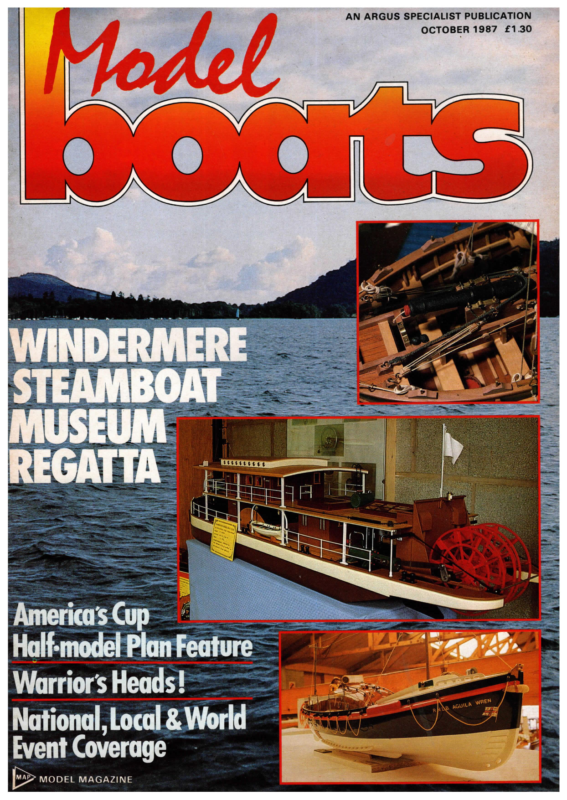
- MODEL BOATS TROPHY ‘Keith Allan reports on Chiltern MYC’s Jeg for RMs
- RANGER AMERICAS CUP YACHT David Metcalf presents a somewhat different Plans Feature – a half model of 33in. length – the Super J class yacht of 1936
- SPECIAL CURVED AIR An extended column from Russell Potts this month takes in major competitive events – and Scale and Vintage meetings.

AN ARGUS SPECIALIST PUBLICATION OCTOBER 1987 £1.30 Warrior’s Heads = | National, Local & World ~ Event Coverage — MODEL MAGAZINE
une 1987 and it hardly rained all day! It was windy though — and it was cold, jumpers and coats from start to finish! The Model Boats Trophy meeting was run by the Chiltern Club at Hinksey Park on the south side of Oxford. There were fourteen entries from six clubs, but numbers may have been reduced because there was a major meeting at Leicester on the same day. The wind was strong enough to require something between storm and working rig. There was a lot of head-scratching going on during the first half of the day, s trying to decide which sails to use. Thing lightened a bit later on and a few brave souls even ventured into tall rigs. 536 ner The Trophy was won by George Skin of s serie good very a with s) (Three River races; he only dropped back in the last race or two when the wind lightened. of Three Second was Gordon Knight alsoeake from MacP Mac was third Rivers and Chichester. Nine to Five! This year there were nine five conventionally rigged boats to just with swing rigs, and conventionals took that the first five places. It was noticeable in the swing rigs were not overwhelmed the stiff breeze, perhaps the skippers were being particularly careful! There were seven yacht designs being sailed; Tracer 6, Tornado 2, Bee 2, and one each for No Secret, Top Secret, Skippy and one own design. The average displacement was 13.0lbs. varying from 11 to over 15, perhaps slightly heavier than last year. The average keel depth was 16.2ins., varying from 17¥, for the Secrets and the O/D to 14%, for the older Skippy. This measurement was taken from the bottom of the hull to the bottom of the lead. It will be interesting to see if the tendency towards deeper fins continues in the future. Once again a very pleasant day, well run by 0.0.D. Dave Robinson, it was just a pity that it was so cold! MODEL BOATS
‘Keith Allan reports on Chiltern for RMs MYC’s Jeg Model Boats Trophy — 7th June, 1987 = Stan Collins = Stan Cleal 10 Melvyn Dackombe 11 Brian Bardoe Club Three Rivers Three Rivers Chichester Three Rivers 3599 Chiltern 3845 Milton Keynes Chiltern 3516 Guildford 3671 Three Rivers 3915 Guildford 3607 Chelmsford 12 3312 Noourhwnr Name George Skinner Gordon Knight Mac MacPeake Mike Dennis John Male Fred Catt Ted Henderson Alasdair Worsley Paul Wayte Keith Allen OCTOBER 1987 No. 3744 3742 3827 Chiltern Chiltern Chiltern Design Tracer Tracer Tornado Tornado Tracer Top Secret Tracer Bee Tracer Bee No Secret Skippy Tracer O/D Rig Conv. Conv. Conv. Conv. Conv. Swing Conv. Swing Conv. Swing Swing Conv. Conv. Swing Weight Keel 15Y, 12%, 13%, 12¥/, 15Y, Teo row, a left to right: a busy start with Gordon Knight, extreme left, gettin wellaway. Next: hard driving with Stan Cleal being pressed by Mac MacPeake (27) and John Male (11). Next: soon after a start, Worsley, Dennis, Collins, Catt, Clealand Bardoe. Next: Mac MacPeake’s Traceron the long windwardleg. Bottomrow: winner _- _ George Skinner. Next: George Knight — leaves a turbulent wake for Brian _ Bardoe. Next: George Skinner’s Tracer fromMike Dennis’s Tornado and Fred Catt’s tts Top Secret. Next: Fred Catt’s Top Secret follo wed by John Male’s Tracer and Mike Dennis’s roronde. 537
RANGER AMERICAS CUP YACHT hristmas is always a difficult time, you look forward to a couple of weeks off, feet up, in front of the telly, eat too much, drink too much. Why is it then that the day after Boxing day one is in the workshop wanting to do ‘something different?’ I decided to ‘tidy up’ my filing cabinet, and I found a small set of hull-lines and sail plan of the Ranger. Where they came from I have no idea. A search through my book collection turned up a few more David Metcalf presents a somewhat different Plans Feature – a half model of 33in. length – the Super J class yacht of 1936 details. I therefore thought it might be nice to build a model of her, however, I didn’t want to spend too much time on the model, as I wanted something quick to do, not a full-length project. Now there was quite a large blank space on the wall that needed filling! Soa half model of her to fill that gap seemed a good idea. Ranger was designed by Starling Burgess and Olin Stephens in 1936 and built to the order of Harold Vanderbilt Esq.; she was what is known as a Super J class yacht, built to defend the America’s cup for the sixteenth challenge in 1937. Ranger held the distinction of having the world’s largest single sail area for a racing yacht with a spinnaker area of 0.4 acres (18,000sq.ft.). She defended the cup against T.O.M. Sopwith’s challenger Endeavour which was no match for Ranger who won the first four races in the series to defend the cup. Ranger was a very fast yacht; she won the 1st-race by 17 mins., the 2nd by 18%, mins. This was the last time the J and Super J class yachts made an appearance in the ‘cup’ series, as their expense and size made for the adoption of the 12m class after the Second World War. We know now how much today’s boats cost to compete for the cup. What would the J’s cost now, but wouldn’t it be super to see them race again! 538 Model Drawing I scaled the drawing and lines to ‘/, in. to 1ft., giving a model length of 33%/,in. Although I built a half model I have produced the drawing for a complete yacht, so if desired, one should be able to build a nice little scale sailing yacht from it; if anyone does I would be keen to hear about it. (Remember though, at this scale the overall height of the model will be just under 45in.). I shall however refer to the drawings from now on as for construction of the half model. to save wood. Planks 4, 5,6 & 7 could come out of the middle of planks 1, 2,3 & 4 I fixed the planks together using Cascamite waterproof glue and ordinary woodworkers glue. All wood screws were No. 6 brass countersunk head with the holes well countersunk to take the heads really low. Whilst fixing the planks together, I ensured that the planks were all perfectly lined up on the back edge. Before fixing on plank No. 1, ensure that you cut in the sheer of the main deck; also when this plank is cut you mark in the deck edge on the top. With all planks glued together, I put the half hull aside to thoroughly dry for 24hrs. I made up a “T” piece from two scrap planks, and screwed this to the flat back of the model; the idea of this piece is to make the hull easier to hold in the vice. I now shaped the hull very roughly using a 10in. rough rasp. This process took me less than 30mins. I finished the hull off to shape using various grades of sandpaper, starting with coarse and working down to the very finest. black felt tip pen. The wooden shapes were cut out from the planks using a When the hull shape was finished to my satisfaction, I then had a decision to make. Should I varnish and polish the hull or paint it. Really, ifI was to leave the wood bare I should have used two different types of wood in alternating planks. I therefore decided to paint the hull. I used an aerosol tin of grey cellulose primer/ filler, I rubbed down with fine wet and dry glass paper until I had a nice smooth finish. The hull was painted salmon pink below the waterline, white above the waterline, with the deck mid brown. All paints used were Humbrol matt enamels. When the three coats of As I said previously, the half model is built solid, however, if you wish to make a working model, cut inside of planks out to the inside dotted line shown on the drawing. You can also do this if you wish down (50/50 varnish, white spirit) satin finish polyurethane varnish. I purchased from the local builders merchants an 8ft. long x 12in. wide As the model is just for display purposes, I saw no reason to make the hull hollow. After I had finished the drawing I transferred the shapes, via carbon paper, to a sheet of thick cartridge paper. The shapes were cut out with a sharp pair of scissors, and using these templates, I transferred the shapes onto the planks, holding them in position with drawing pins and drawing around the edge with Naerock band saw. paint had been allowed to dry thoroughly, the whole was given two coats thinned MODEL BOATS
Mahogany faced chipboard plank, which was cut into two 4ft. lengths. One was put, carefully protected, into my wood store, the other I was to use for the mounting board. First though I had to cover the cut ends with the ‘iron on’ veneered edging I had bought at the same time. This is a remarkably simple thing to do, you just put this veneer over the cut edge, iron over the top with a hot iron, leave to cool, and sand the edge flat with the faces and its done. I then supported this plank underneath with some blocks of wood and painted it with three coats of polyurethane yacht varnish, leaving it to dry well. I sanded it down to a glass finish with fine wet and dry paper, finishing it off with another thinned coat of varnish (50/50). The half model was fixed to this board from the back by two brass wood screws, taking extra care to ensure that the model waterline is put on straight using black tape, parallel tripe’ car bodyline ‘pin-s the bottom edge of the board. I made two wall mounting plates from brass strips, fixed to the back of the board by four short brass screws, and the model was then hung on the wall with two picture hooks. I made a name-board for mounting on the front, but didn’t like it. I therefore put the details on a small piece of selfadhesive paper on the back, after all, I know what it is and I suppose that’s what counts. Well; that’s it really, the only maintenance needed is the occasional dust to keep it clean. I hope you feel you want to build one, but the principles involved are the same for any half model you care to name. You can create a very interesting effect by mounting the half model on a mirror rather than a board, giving the effect of a full model. Below left: the templates to transfer the shapes from the drawing to the wood can just be seen at the top. Below: planks cut out. Top right: lined up on back edge before fixing together. Right: temporary vice holder. Below right: ready for painting. OCTOBER 1987 539
RANGER AMERICA’S 5 SUPER J’ David Metcalf coorigt of CUP CLASS DEFENDER. 1937 YACHT ° Model Boats Plans Service 1 2 3 4 5. f POSITION OF MAST. 6 7 8 9 | BOK 38 WOLSEY ROAD, HEM HEREPSTEAD, MENTS 12 488 10. | | | |PLANK.1 | L z fo PLANK. 2 | PLANK.3. Scale : 1/4*LSS to tft = ==| E prs AB ~ | 12 | G2. | = ‘i —— se, foals PLANK.5. | 13. | HI | PLANK. 4 a HULL n | PLANK.6§ ; eS A y rv PLANK.7. Di eubeer = SECTIONS 7! ee fs sae TM~ 8. ~ | A S| lS is MAST HEIGHT: l= | | f ra 2 DECK EDGE ‘ 151″- 7″ as ae a oe ——- ] oH Se — ARE MAKING HULL has PLANKS TOGETHER WITH FOR FIXINGS. E. ail — ae ae ——— —— —————____ ane cee : al rea PLANK1 WATERPROOF Se ica a Se WOOD GLUE. USE BRASS WOOD SCREWS tenee GLUE Be 5 a ah = Ze BE 7 PLANK 2 eat = Pra\ eS a — Sse a 4 is _ << SUGGESTED CUT LINE IF YOU i " e eS i ra aa aa =. eee aT oh ee Pe ee 1s 2 ae i> Se ~N Se se Se a PLANK 3 LENGTH } ae a if ee 68′-8 1/4*o/a,// – Pr eee : Sw \ NS i wi SAIL_PLAN. (NOT TO SCALE.) DIMENSIONS LENGTH.O.A LENGTH. WL – BEAM DISPLACEMENT. 87′- O° 21′- 0″ DRAFT SAIL AREA 135’ 1.7/8″ — < —— ——— PLANK. 6. 15'- O° - PLANK.4 ut ——— we WES ae ifn a = f PLANK. |p 2 = See — ~ pee a. = i Sa PLANK.5. TM~ oo =e = = HULL PLANKS 73 | | PLANK.3. BEFORE SHAPING. A | PLANK 2 f | 3 AS Z. = SHAPED HULL - Lee LA aa PLANKS. [RA a 9 PLANK.6. by} } ry i ED Se a PLANK.Z TYPICAL SECTION TYPICAL SECTION THROUGH HULL. Dsnercen 1067 166tons (BALLAST -110tons) 7,546sqr ft MM1403 The full-size plan reproduced above can be obtained from Model Boats Plans Service, PO Box 35, Wolsey House, Wolsey Road, Hemel Hempstead, Herts. HP2 4SS. The price codeis E, £3.25 plus 55p post and packing. Please quoteplan number MM1 403. R/C BOAT MODELLERS! WE CAN HELP YOU. _ chart] DRIVE-CONNECT: CONTROL it VARISPEED2% ELECTRIC MOTORS By BOARDS | These motor control boards are servo-mounted. Sets include a board, pressed copper wiper biades which fit directly to the servo arm with S/T screws supplied, plus acoil of power supply lead wire. The boards measure 51 x 77 mm for 2, 3, modals - as board is 71 x 77 mm. We offer a wide range of MABUCHI electric motors which are suitable for use in all types of models. Choose from the RS380S, RS385S, RS540, RS540S, RS545S, RS550S and the Mabuchi RS385S with Pile available —single or do d to _ plain or threade— makes and sizes of elec propeller shafts. Also available for IC e: cubic inch capacity. Gearbox. | MABUCHI ASK FOR | ra irt.. COUPLINGS FOR THE MODELL PAG: HOBBY DISTRIBUTORS uiTeo 540 MODEL BOATS
An extended column from Russell Potts this month takes in major competitive events - and Scale and Vintage meetings RM Nationals, Guildford It seems a very long time since I went down to Ash to have a look at the middle day of the RM Nationals. It is a long time ago, and I have managed to miss a month in my output of columns, so apologies to all concerned for the late report. As I wasn’t sailing and wasn’t there for all the time, I can only give an impression of how it went. The water is not very large and it is difficult to give a long first leg in any circumstances. In the event, the wind, which was pretty light for most of the meeting, came from the least helpful quarter and there was a large wind shadow over one half of the first beat. The admirable map that came with the sailing instructions (just one of the advantages of having an architect as OOD) shows the trees that caused the problem. The other advantage of using Roger Stollery as OOD is that he really understands the radio racing system. He’s not alone in this, of course, lan Taylor, who had brought the Vulturesoft! Scoring Facility to help give an air of modernity and efficiency to the proceedings, demonstrated that all the technological wizardry was totally unnecessary and coped manually with the whole task when he had an unexpected computer failure. The result of the course limitations and the wind direction was that for much of the time I was there, there was only one route to the first mark and some very crowded close quarter work on the mark when the fleet reached it. There was a degree of confusion at times, as skippers with the inside overlap struggled to see their own boats through the gaggle of others attempting to get round the mark outside them. The photos show some typical scenes at the first mark. so many examples of the Top With Secret design, most of them in the standard black hull, they have had to adopt more and more garish deck panels and trims to distinguish themselves one from another. You can have the hull in colours other than black, but it adds a couple of ounces to the weight and few seem to think they can afford the disadvantage. John Cleave was sailing a new boat still called Blackjack, but now to Alan Gardner’s Logic design; very finely moulded in kevlar and using the rigs carried over from the earlier Stollery Bee that he sailed last year. Another interesting boat was the first example of Kiwi production to reach this country. Paul Chisholm was supposed to be making examples of the new Geoff Draper design that is called, rather misleadingly, RM1000 Mk.III, for David Coode and myself, but when he applied the vacuum to put the glass onto the outside of the foam planking, he overdid it and collapsed the mould, so this is an ‘old’ RM1000 to keep David going until a new mould can be made and the process can be started over. Apart from the great strength and stiffness of the foam-planked hull, the boat is interesting for the carefully thought-out deck moulding. The final result of the Championship was a convincing win for Graham Bantock, with Rob Smith in second and Ian Cole third. All three were sailing the Top Secret design. The full result sheet shows many of the old faithfuls of the game in their more or less accustomed places, but joggled down the list a bit to make room for three of the Spaniards who sailed so well in the World’s and who this time managed to get all three boats into the top third of the order. It’s good to think that they enjoyed themselves enough at Fleetwood to want to come back again so soon. We also had Alan Dawson from South Australia with us; he is over here for a long post-retirement holiday, but has not been having too happy a time with his sailing. Top: Mac MacPeake’s Rattenfanger, the first Nationals entry from Chichester. Middle: Spaniard Juan de la Fuente added an International flavour. Right: the first leg. The boats that have gone to leeward in search of the wind will have to come in on port tack. Under plan, skippers at work. Left to right: Mark Dicks, lan Cole, Colin Myers, Xavier Zatarain, Miguel Zatarain, Mike Kemp. Trevor Jenkins and Elizabeth Andrews. 552 Under table, left: Hot Property, an RM 1000, moulded for David Coode by Paul Chisholm of Christchurch, New Zealand. Right: John Cleave's new boat Logic, by Alan Gardner. Opposite bottom right: coming together on the first mark time for some decisions. All photos: Russell Potts.
a Open ‘RM’ Pee ceeoes 1987 Guildford M.Y.C. 1 2 3 4 5 K3705 K3740 K3880 K3823 E9205 8 9 .0 11 K3600 K3501 E9202 K3815 6 K3733 7 K3861 Fig. 1 Lake and surroundingsat”“”TM* Ash for RM Nationals Overspill cor park 12 13 14 15 16 17 Tanding stoge nS @i3 Areo for competitors who are racing shown shaded a VW nding stage 18 19 20 21 22 23 24 25 26 27 28 86 K3475 387 K3863 88 K3483 39 K3708 40 K3070 41 42 43 44 K3559 K3569 K3601 K3392 Leicester Chelmsford Fleetwood T. Brown J. Cleave B. Cheetham Fleetwood Ryde Doncaster D. Potter M. Mickleburgh Birkenhead —Dovecote. M. Kemp T. Jenkins 1, Hall Dovecote Birkenhead Cleveland 65.1 65.2 81.4 olf 99.8 104.4 104.5 All 1161 1518 © 160.4 _ 168.4 169.7 | 197.0 | 200.0 San Sebastian Clapham M. Zatarain _C. Dicks K3865 E9208 K3900 K3807 K3758 K3841 K3902 K3884 K1593 K3836 K3905 K3889 K3718 K3737 K3879 K3848 K3607 K3313 K3899 K3632 _ 29 30 31 82 K3862 33 K3915 34 K3827 35 K3516 Chelmsford_ G. Bantock R. Smith I. Cole D. Priestley J.dela Fuente | San Sebastian Chelmsford _ C. Myers Chelmsford. A. Graham San Sebastian X. Zatarain Fleetwood. J. Brooks C. Jackson P. Thornton A. Youd P. Stollery D. Coode M. Dicks M. Evans M. Roberts B. Bardoe D. Andrews G. Elliott V. Cooney P, Edwards M. Dackombe H. McPeake S. Collins D. Fowler J. Taylor M. Ewart C. Woods E, Andrews J. Farley A. Dawson N. Rothwell R. Flavel Courtesy: Vulturesoft! 2070 233.7 256.0 Guildford Chelmsford _ Fleetwood | Guildford 204 o720 273.4 310.7 331.0 Guildford Clapham Appledore Birkenhead Chelmsford Leicester Birkenhead Woodley Chelmsford _ Guildford _ Chichester Guildford Guildford _ Fleetwood _ 340.0 369.7 376.0 378.0 390.0 — 393.0 420.0 4227 437.0 440.0 442.0 447.0 451.0 470.0 Doveeote Clapham Leicester Guildford | S. Australia Woodspring _ Leicester © _ 487.0 | 494.0 516.0 517.0 =—b220 536.0
Thames Shiplovers at the Round Pond I started this column, I said that When sail-powered I hoped to cover all forms of June | of g nnin begi the at models and went to the Round Pond ona cold and damp day to see how the scale sail ndance modellers were getting on. The atte or’s Tayl Mike with t, selec but l was smal Gold Medal winning Groene Drakke breeze showing her paces in a fairly stiff shed and a beautifully detailed and fini an Adri by r cutte pilot nel Chan Bristol Brown, which, without any of the false s find keels that many scale modeller necessary, sailed like a dream, really revelling in the conditions. There was also a nice Lowestoft smack and the usual collection of Thames essive barges. One model that I found impr d Xebec on the water was the lateen rigge os. In that is shown in one of the phot black and white you miss the multi are red h whic sails the on es strip ured colo blue and and white on the main and white on the other two masts. The effect was a bit spoilt when she was lifted out and showed the false keel of fairly e massive size that was needed to enabl the slight hull to carry her scale sail area, g the but a nice model all the same. Amon n rdia Edwa few a were sailing craft launches and a very fine model of thesail paddle tug Chieftain. I know it’s not power, but she is very lovely and it’s a good photo, so it can go in anyway. The boat that, rather surprisingly, was travelling fastest and looking most ican convincing was a model of an Amerfrom taken so, or 1812 of oat scow gunb ory of Howard Chapelle’s invaluable ‘Hist builder, the American Sailing Navy’. Herget, said whose name I’m afraid I didn’t that he had chosen the smallest andthe simplest ship in the book to reduce te time before she was on the water. Despi her unsylphlike hull form the simple rig was very efficient and pushed her along d woul at a speed that her original builder scale d have found fairly surprising when up to full size. Left and opposite middle right: Bristol Channel Pilot Cutter by Adrian Brown at the Thames Shiplovers Round Pond meeting. Above: Chieftain, not giving way to sail! Below: USN Gunboat No. 12. MODEL BOATS
Top: Mike Taylor's superb Groene Drakke, not only good enough to win a gold medal at the Model Engineer Exhibition, but she sails as well. Above left: Xebec. Above: Lowestoft Smack. Left: Chieftain, not steam powered, but electric with smoke unit. Photos: Russell Potts. OCTOBER 1987 555
ille Vintage Day at Bournv fixed for The 14th of June was the day this year’s on the water meeting of vintage fans, and the first since the p. formation of the MYA’s Vintage Grou e The weather must have put a lot of peopl itself off travelling, though at Bournville than we got through the day without morefrom a few drops of rain. As can be seen calm the photographs, the wind was near some most of the time and the boats spent time admiring their own reflections in the pool. The new boats this year included Steve Rymer’s nice restoration of the 19th in her century schooner that was featured ‘as found’ condition in a column somethe time ago. The rig is based on that of full size America of 1851 for two reasons. First, the mast steps in the boat imposed that very severe rake that was characteristic of America and second the America rig is very simple and therefore fairly efficient when reduced to model size. As you can see, Steve, who hasa lot of modelling experience, but had not previously ventured into sail, has madearea nice job of the finishing and the sails very good for a first-time effort. Richard Howlett has a number of interesting boats in the (slow) process of restoration. The first to be ready is, according to Richard, ‘a knockabout boat to sail while I get the others ready to a really high standard’. If this is the knockabout standard, I can’t wait to see the others. She is.a boat that looks very like a six-metre, but more like a full-size one than a model. The keel is full and the displacement is high. There is no trace that she was ever registered or sailed competitively, and the deck stepped and very floppy wooden mast suggests that she was not intended for competition. That said, with her new suit of terylene sails and neat, if noisy, radio installation, she was much admired. She looked good and went well too. Richard was like a dog with two tails that it had all come out right on the day. Richard had also brought with him a curious boat that he had recently picked up in an auction. She is planked in mahogany, and has a narrow hard bilged hull with a fin and bulb keel of crescent form with no rudder. The sail area is big and arranged in a gaff cutter rig. Careful measurement showed that she would rate f both as a 10-rater and as a 10-Tonner to the ‘1730’ Rule. This explains the very narrow hull. We assume that she was built in the early years of the 10-rater Rule in a club which sailed both the new 10-r Rule and the old ‘1730’ Rule, as many did well into the early years of this century. It will be interesting to see what her performance is like, as her design falls very obviously between two stools. In many ways she is more like a 10-Tonner than any of the various styles of 10-r of the period and would, I think, have her work cut out to hold a 10-rater designed as such. There was also a radioed version of the very popular 36R design Lancet from the 1950’s and Fiona, a beautiful gaff rigged cutter of the 1880’s, which Geoffrey Pout brought down for us to admire. Apart from the miniature Braine gear that Geoffrey has fitted, she is as she would have been in her heyday. I was pleased to meet Jack Drury on the side of the lake; he must be the senior member of the Bournville club and is a mine of information on all aspects of model yachting over the last fifty years. At lunch-time he took me home to see the 10-r Opal which he designed and built in
the mid-1930’s and sailed with great success in the immediate post-war years. Jack is an engineer by profession and the deck of the boat is covered by more bits of engineering and gadgets than I think I have ever seen on one boat. They include his own design of vane, with a push-rod action to the tiller which incorporates an adjustment of the vane-rudder linkage. Jack also very kindly gave me the first model he made when he was a boy just out of school. She is an electric launch complete with a Bassett-Lowke shunt wound motor of 1929. This still works and as the hull, carved from a single piece of yellow pine, is in good condition, I intend to fit her out with a superstructure in the Edwardian style that is so popular among scale modellers at present. I don’t think I shall manage the standards that Basil Harley has reached in his steam-powered version, which he brought along together with some of his collection of toy boats. The launch is no toy, and the twincylinder oscillating engine that powers her is all Basil’s own work. I was particularly pleased to see Basil at vintage day; his style of model fits in well with the old yachts that we sail and the whole’ thing is just so relaxed compared Far left: Old Trafford, a steam toy tug dating from about 1950 at Vintage Day by Basil Harley. Middle: S. Rymer’s schooner and right: Toby Churchill and his hoy. Below: most of the fleet caught in one shot. Right: Ripple, a 36R dating from 1930. Top left: Oriane and Angus - these two boats will be taken to Gothenburg for the R10r Worlds. Photos: Ray Brigden. Top and below: 10-rater Opal of 1934, designed and built by Jack Drury. The steam powered launch is from Basil Harley’s collection. Above: Bassett-Lowke shunt wound electric motor of 1929. The brass lever on the top is a switch and fits between a pair of leaves mounted on the ebonite block. Left: Jack Drury’s first model boat, 1929. Photos: Russell Potts.
with an RM Open meeting that I think I might not find it hard to confine my modelling to golden oldies. I took the pre-1914 10-rater Oriane again, but now equipped with a winch as well as rudder. I had intended to make her a new suit of sails as well, but I discovered that I needed more practice, so she is still wearing her old suit that dates from before the change of sail measurement Rule in 1920, patched and pieced out to keep them going for another few months. I also sailed for the first time Angus, another 10-r of slightly later original date than Oriane (probably some time in the 1920’s). She is rather larger, but still essentially the same hull form as Oriane. She is much more heavily built (the hull and deck weigh 9¥,]bs.) and though she was originally gaff rigged was rebuilt and re-rigged in 1945. At that stage she acquired her Bermuda rig and an extra 2',lbs. of lead to help her hold it up. She was fitted with full house Braine gear with jib steering and, rather unusually, had the sheet horses removed when she was refitted. She is pitched inside, and was so treated when built. She is practically as tight as when she first hit the water. I have lined and filled the split in her deck and scraped and revarnished the hull. She also has radio rudder and winch mounted on a spare hatch, but otherwise she is as she was when I had her a couple of years ago. Docklands Model Yachting So far the attempt to get a model yacht club organised on the vast amount of water available on the Royal Docks complex has foundered on the lack of a local group to use the water on a regular basis. A move is afoot to run a club there around a nucleus of experienced modellers and organisers in the hope that the sight of boats on the water and local publicity will attract the local interest that is essential for the club to be viable in the long term. The club would be based on the Victoria Dock Project (Shed 1, Royal Victoria Dock) and the secretary will initially be Ian Taylor, the MYA racing Secretary, AKA Lord Vulture. Details from him on 01-446-1625. London Trophy 25th October The first major task of the new club will be to run the London Trophy race this year. This will be on the 25th October, the same day as the Race of Champions. This is a deliberate choice, and the meeting is specifically oriented to the non-Champion skipper who may feel a little overawed by the prospect of meeting the top shot skippers. Well, on the 25th they will all be at Leicester being beastly to each other and the lesser lights can have a go fora major trophy. We have retained the services of Roger Stollery to act as OOD and Vulturesoft! Scoring Systems will be in attendance to ensure that the paperwork is kept in order. There will also be a new trophy, the Vulturesoft! Trophy for the best novice skipper, and a trophy for the most improved skipper. This will be judged by setting his performance on the day against his position on the ranking list. The race will be sailed on the Royal Albert Basin, which is a relatively small expanse of water, about three times the size of Fleetwood, which now has free wind access in all directions. Access to the water will be via a floating pontoon and there should be no difficulty as the water level is high. We hope for a large entry, and particularly from the skippers like myself who have to struggle to stay in the soggy middle of the fleet. Top: Basil Harley with Old Trafford. Next down: 36R to Lancet design (by T. Lance 1951) - radioed, but otherwise little changed. Next down: Mamod Meteor Steam launch - one of a very small batch produced. Above: a deck view of Lancet. Left: Richard Howlett with his 6-m. First time on the water, first time he‘d used a radio, it floated, it sailed, and he could make it go where he wanted. Bliss! Photos: Ray Brigden. MODEL BOATS
Above: a 10-rater/10 tonner hybrid. Right: how do / put all that sail on her? Richard Howlett with the 10-r/10T hybrid. Photos: Ray Brigden. Right: 1880's cutter at Bournville on Vintage Day. Photos: Russell Potts. 2 Ze gy MODEL ENGINEER EXHIBITION 1907 — 1987 WHERE ELSE Exciting News for all Modellers * MORE SPACE * * WIDER AISLES x * AN INDOOR BOAT POOL « * MORE MODEL DISPLAYS * And all because parts of the Exhibition are moving into the New Hall. This is in addition to the Greenwich Room, Auditorium and Severn Suites which will continue to be used in the Conference Centre. Of course, more space and capacity will mean less queuing for admission and greater comfort and enjoyment of the Show in general. JANUARY Ist — 9th, 1988 Adults £3.75 Open daily 10.00 am — 7.00 pm Children £1.50 9th January 10.00 am — 6.00 pm Senior Citizens £2.60 Late night 7th January 10.00 am — 9.00 pm Details from: Argus Specialist Exhibitions Ltd., Wolsey House, Wolsey Road, Hemel Hempstead, Herts HP2 4SS. Tel: (0442) 41221 OCTOBER 1987 559