- Title. Author. Summary

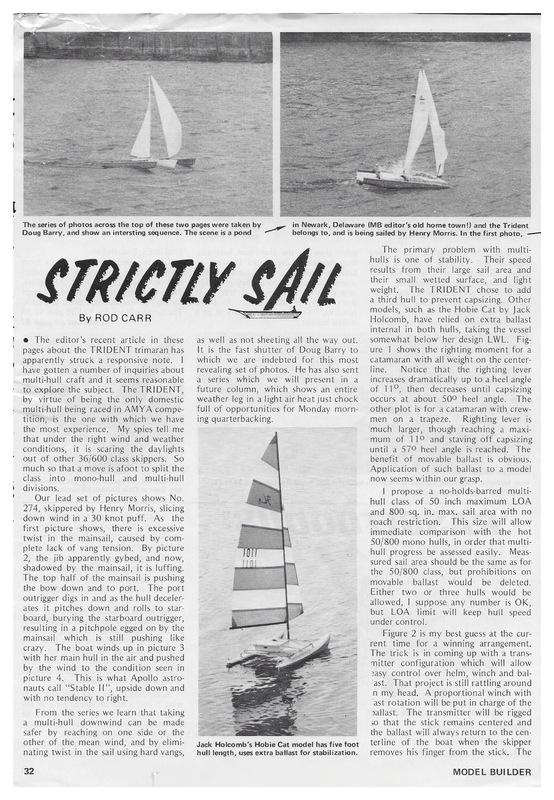
The series of photos across the top of these two pages were taken by _Doug Barry, and show an intersting sequence. The scene is a pond £ RICTL By e@ The in Newark, Delaware (MB editor’s old home town!) and the Trident belongs to, and is being sailed by Henry Morris. In the first photo, —— ROD CARR editor’s recent article in these pages about the TRIDENT trimaran has apparently struck a responsive note. | have gotten a number of inquiries about multi-hull craft and it seems reasonable to explore the subject. The TRIDENT, by virtue of being the only domestic multi-hull being raced in AMY A competition, is the one with which we have the most experience. My spies tell me that under the right wind and weather conditions, it is scaring the daylights out of other 36/600 class skippers. So as well as not sheeting all the way out. It is the fast shutter of Doug Barry to which we are indebted for this most revealing set of photos. He has also sent a series which we will present in a future column, which shows an entire weather leg in a light air heat just chock mnie into mono-hull and the mainsail, caused The TRIDENT chose to add a third hull to prevent capsizing. Other models, such as the Hobie Cat by Jack Holcomb, have relied on extra ballast internal in both hulls, taking the vessel somewhat below her design LWL. Figure 1 shows the righting moment for a catamaran with all weight on the centerline. Notice that the righting lever increases dramatically up to a heel angle of 11°, then decreases until capsizing occurs at about 50° heel angle. The men on a trapeze. Righting lever is much larger, though reaching a maximum of 11° and staving off capsizing until a 57° heel angle is reached. benefit The of movable ballast is obvious. Application of such ballast to a model now seems within our grasp. | propose a no-holds-barred multihull class of 50 inch maximum LOA and 800 sq. in. max. sail area with no roach restriction. This size will allow immediate comparison with the hot 50/800 mono hulls, in order that multi- by com- plete lack of vang tension. By picture 2, the jib apparently gybed, and now, shadowed by the mainsail, it is luffing. The top half of the mainsail is pushing hull progress be assessed easily. Meassured sail area should be the same as for the 50/800 class, but prohibitions on movable ballast would be deleted. Either two or three hulls would be the bow down and to port. The port outrigger digs in and as the hull deceler- allowed, | suppose any number is OK, but LOA limit will keep hull speed under control. ates it pitches down and rolls to star- board, burying the starboard outrigger, resulting in a pitchpole egged on by the mainsail which is still pushing like crazy. The boat winds up in picture 3 with her main hull in the air and pushed Figure 2 is my best guess at the cur- rent time for a winning arrangement. The trick is in coming up with a transmitter by the wind to the condition seen in picture 4. This is what Apollo astronauts call “Stable II’, upside down and with no tendency to right. From the series we learn that taking 32 weight. ing quarterbacking. multi-hull a multi-hull downwind can be made safer by reaching on one side or the other of the mean wind, and by eliminating twist in the sail using hard vangs, results from their large sail area and their small wetted surface, and light other plot is for a catamaran with crew- divisions. Our lead set of pictures shows No. 274, skippered by Henry Morris, slicing down wind in a 30 knot puff. As the first picture shows, there is excessive twist in with multiTheir speed full of opportunities for Monday morn- much so that a move js afoot to split the class The primary problem hulls is one of stability. Jack Holcomb’s Hobie Cat model has five foot hull length, uses extra ballast for stabilization. configuration which will allow 2asy control over helm, winch and balast. That project js still rattling around n my head. A proportional winch with ast rotation will be put in charge of the yallast. The transmitter will be rigged 30 that the stick remains centered and the ballast will always return to the centerline of the boat when the skipper removes his finger from the stick. The MODEL BUILDER
beast. Addendum: If we now install a pair of mercury switches in the wires to the sail control unit, we may contrive for the sails to automatically slack them- selves when a critical heel angle (say 40°) is reached. When the boat comes + 9 FREQUENCIES – Ato! Yachts 1 – 2 – 3 each on single frequency, ie, Aj, Az, Ag; Bi, Bg, B3, etc. 1 ey putea ~ MARK 27 -_ eae a ed tL 6) / rete Heat 1 ~ ballast itself should be made thin and capable of easy change to meet varying wind conditions. The pivoting method chosen will help to move the center of gravity aft and keep the leeward from burying its bows when pressed. Depending on the speed of the ballast winch, it might be possible to extend the ballast farther outboard than is shown in the figure. 1! would try a somewhat conservative approach in the first attempt to avoid fouling sheets and so on when learning to sail such a a hulls yaw to port, decelerate, bury, and trip over starboard outrigger. Finally, ““Stable I1”’ is attained. No damage, no water inside. See text. PS ee al the Trident is headed down wind, wing-and-wing. Next, the jib is gybed, and luffs in the shadow of the main. In the 3rd photo, the RIGHTING LEVER (Arbitrary units) me 0 FIG.1 10252030: 40. -50:= .60 HEEL ANGLE No. 2 A\ DE! B/ F|G/Hi C I yo cere le ees ea fa 2 2) 25 2)2.|’2).2) 2.2 | 2 3 31 33 | 3:3: |.33e3713 4 11243) 11213) 112.13 5 Psa A 6 3) #2134213 412 ) 7 Wel 30) 2101] Seo Vert. 23344 qe oie 8 214 9 S2241 bt 18424 S2 63 (24 a3 upright, the sails would return to their original setting. Careful set up of such a RESISTANCE TO HEEL FOR CATAMARAN 10 HULLS AS FUNCTION OF ANGLE OF HEEL 12334213) 113142 11 2134 4h S124 273 system would permit you to sail a cat to weather with one hull flying as it mon- Certainly fully battened sails would make an early appearance as would the previously-mentioned modified transmitter configurations. Having a pair of 12 34h 24213: 2 34 itored its own heel angle and sheeted accordingly with the movable ballast cranked up to the weather side. What a sight! It seems to me that this is something with which the experimenters might really have a good time. For the first couple of years, | would imagine that reliability might win races, while all the intricacies of the vehicles are explored. FIG.2 MOVABLE BALLAST standard hulls available might make it easier for class members to get started, and In such a case one might opt for use of those hulls, rather than establishing an arbitrary LOA measurement as | have suggested. Any of you potential manufacturers want to get in on the ground floor? \ 13 ASF 23 14 S24 12 Seat 1 a) 2 15 2/1/3|/1;3/2)/3/ 1/1 2 16 1/1/1/2/2/2/3/3/3 17 18 eel 2] 1S 2|22)313)314\7 | 3/3)/3}1/1,1)2)2)2 Missing from the April column was a figure that should have outlined the structure and heat assignments of the MARK 30 heat list. Since that writing, AMYA Treasurer Dick Hein has come out with a much improved heat list which eliminates some of the biases which were left in the MARK 30. Dick’s list accommodates 27 boats, three per frequency, for a total of 18 heats. One nice feature is that each boat sails once in each set of three heats, meaning that a regatta can consist of any even multiple of 3 heats. My hat is off to Dick for an important contribution to our sport. | am asking everybody, everywhere, to junk their old MARK 30 and use the new MARK 27; Continued on page 84 JULY 1976 33
Satling:. = …01: Continued from page #& it is far superior and not too far from the ideal heat list that we are all looking for. The MARK 16 which | did for two boats per frequency continues to be the best lift for that situation. Remember that regatta announcements should warn skippers that the first three boats on a frequency based on postmark date will This means limiting enbe accepted. trants somewhat, but | find sailing one race out of 4 is unacceptable, and support the limit of three boats to each Such limitations should frequency. make it abundantly clear to new skippers that multi-frequency radios are absolute- ~ ly necessary for successful registration in popular regattas in the larger classes. (Pre-registration is a necessity, and has been used in R/C soaring for several years. After initial complaints, testants soon con- learned its importance, and are willing to live with it. wen) Remember to send in your AMYA dues to the Secretary, 3917 Sunnyside Ave., Brookfield, II]. 60513. The $5.00 is worth the price of the newsletter alone. | will field questions in care of MODEL BUILDER accompanied addressed with or a directly stamped, when self- envelope, to 7608 Gresham St., Springfield, Va. 22151. @