- Title. Author. Summary

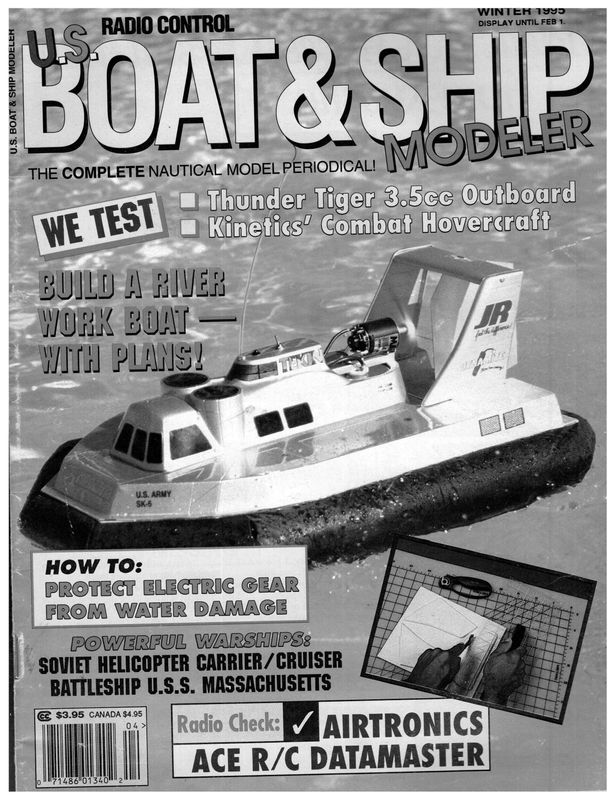
U.S. BOAT & SHIP MODELER ~ RADIO CONTROL ie “a DISPLAY UNTIL FEB 1. —a WINTER 1999 BsB@ thKiunnetidecsr,: liCogennrset3-ocHoBcveoarciuraeeftcd ~ THE COMPLETE NAUTICAL MODEL PERIODICAL! J wewae HOW TO: GEAR | | | PROTECT ELECTRICMA GE _| | FROM WATER DA | WARSHIPS: POWERFUL ~SOVIET HELICOPTER CARRIER /GRUISER BATTLESHIP U.S.S. MASSACHUSEITS GEE $3.95 CANADA $4.95 i jo gal ACER/C DATAMASTER| 5 J SS Pheny
LY r CT S RI [STy-\| BY ROD CARR A PHOTO IS WORTH 1,000 WORDS…… RE OR LESS VERY NOW and then the mailman leaves me a surprise package postmarked from some far off lake, bay or river. Inside will be found model yacht photographs, which generally turn out to be goldmines of information — and a wealth of examples of the interaction between wind and sail, wave and hull. My approach to these contributions is one of humble thankfulness. Someone has taken the time to stop sailing, pick up the camera, take the shot, process the film and send it on its way to me. That indi- vidual has madea direct contribution to our sport and by so doing, enhanced the enjoyment and satisfaction we may all derive from it. The analysis of the photos provides a means of considering the forces and geometries which come together to make our craft move. The photo captures an instant in time. may represent an aver- age condition or it might show us the ar- rival of a gust. Whatever it is, we have the opportunity to freeze that instant in time, and consider it from every angle and a sl Considering the shapes we see and diagnosing the illnesses of the odd ones, is done in hopes of all of us becoming more adept at recognizing good sail shape, and having a bag of tools for adjusting things until we see just that. No one sets out to accomplish poor sail shape, and no contributor is held to task for the conclusions | or you might draw. After all, he took the picture and bestowed it on us. Having said all that, we can embark on some particularly interesting photos that have arrived. Photo #1 came from Gunnar Salkind, a Pacific Northwest builder and skipper. His boat is a 36” LOA, 10 1/4” beam, 12” draft sloop that displaces eight pounds. 22 WINTER 1995 U.S. BOAT & SHIP MODELER Photo No. 1. Gunnar Salkind’s 36-inch LOA sloop with “Wishbone” jib club on port tack. Her rigging is somewhat out of the ordinary. The mainsail is a sleeve luff — that around the mast. is, wraps (Gunner hes chosen to use a mast {the type of which wes unspecified) that did not need spreaders or side stays for lateral support, and apparently stepped it on the keel of the boat, held firmly at the deck and with its backsiay and by the masthead jibstay. The change in relative angle between the battens in this photo indicates that the to leeward under wind mast is bending off pressure, and the result is to slacken the mainsail leech, allowing twist to develop in the sail and reducing the heeling effect of the upper parts of the mainsail. If you sail in gusty winds, this mechanism is Photo No. 2. “Wishbone” stands proud on starboard tack. automatic and can be set up on boats that are rigged differently than Gunnar’s, a subject for a future column. But notice the jib on Gunnar’s boat. in Photo #1 we see a flexible “wishbone” boom on the starboard side of the sail which is attached to the jibstay and runs perpendicular from it to the jib clew. A very careful sighting along the jib stay indicates that the stay runs from the masthead to the wishbone, makes a small but discernible angle, and proceeds down to the tack of the sail and the foredeck. This situation requires that the sailmaker know exactly where the wishbone attaches, and then he must cut the jib luff in the shape shown in an exaggerated way in Figure 1. The amount of sag to be allowed for
clew area becomes greater as shown by arrow “A”. The result is that the area in the sail marked S-T-A-R-V-E simply runs out of cloth and we might well expect a substantial wrinkle to develop running up from the clew. Photo 2 comes as no surprise and there the wrinkle is, right where it is supposed appear. The boat is heeling more than in the previous picture, and the ripple pat- tern on the water confirms a stronger breeze. It is also on starboard tack, and the wishbone is now standing proud of the sail. Why would you want a wishbone? It is a very interesting experiment, reminis- cent of the Vortex SOLING’s full length batten, “NERNY FLOGGER” of the early ‘70s. From a distance, it makes a major Photo No. 3. Ken Lockley’s Star 45. on either side of the wishbone will be different. The wishbone has a direct influence on the jibstay shape, because sail pressure is transmitted along the wishbone to the clew and almost perpendicular to the jibstay at the wishbone’s attachment point. In Figure 1, the arrow marked B indicates the movement of the wishbone forward under wind pressure, carrying the jibstay with it. At the same time, sheet pressure increases and the force on the contribution to the scale appearance of the jib and the foredeck. If | could have one wish, it would be for some draft stripes so we could tell more about both of the sail’s shapes. Photo 3 introduces the STAR 45 of Ken Lockley of Victoria, British Columbia. A pretty good-sized fleet has grown up there in the past couple of years. The STAR has a good sail area to displacement ratio, which makes it a good performer in the typically light air summers that the Pacific Northwest suffer with. The boat is well heeled, and the upper two weather tell tales on both main and jib are streaming. This indicates that the wind has filled the upper 2/3 of the sails, and is confirmed by the lack of ripples on the water surface. The puff must have just hit, since the visible bow wake only extends a boat length or so behind the boat. The jib club is strapped in pretty tightly for best speed, and from the seams would appear to have a substantial amount of camber, which will make it pretty easy to interfere with the airflow over the main if the slot is not kept well open. The STAR’s performance Photo 4 is the same boat, but a different day and a different suit of sails. Ken did a great job of getting this photo, be- cause it reveals all sorts of concerns that we have about getting proper sail set and trim. The wind speed looks to be about seven or eight knots, and the sails have been twisted off to help keep the boat on her feet. This is good technique, because a STAR doesn’t perform well if the heel angle gets up toward 45 degrees. But, since twisting off functionally reefs the sail by making head not work, then the re- maining parts of the sail need to maintain good camber to generate power needed to drive the hull through the lumpy water that the wind has piled up. The mainsail is much flatter than it needs to be in its mid and lower sections. If you have your sailmaker make you a sail that you will use in upper wind ranges, it must be designed with plenty comes from her mainsail, and of camber. A high twist sail should have efficiency is the key to good performance. Though hard to tell boat perform when the leech is tightened. Remember, when twist goes up, camber goes down and vice versa. On the other hand, if you have a sail made for lighter air when you will want optimizing trim and tune for its convincingly, | suspect that the upper third of the sail could do with some more camber to take advantage of the higher power which the higher speed wind up off the water carries. Note that Ken has color- coded his hatch to help remind of which tack he is on. | won- der if he wears one red and one green sock? Don’t laugh, the late Bob Harris used to have a jacket with a red arm and a green one, and just to be sure they were la- Figure No. 1. Forces on a “wishbone” boomed jib. Photo No. 4. New sails on Star twisted to handle heavier air. beled “PORT” and “STARBOARD.” so much camber that it cannot make the to use it without twist, you’ll still be able to let it twist off and all that will happen is that it will not maintain enough cam- ber to be really powerful. | think that is the situation with the STAR mainsail we see here. Maybe the day started light and the wind has built to the time the photo was taken. The jib is flatter than the sail in Photo 3, and is doing a good job here with the slot plenty open to not backwind the lower parts of the main, where the power is coming from to drive the hull. continued on page 53 U.S. BOAT & SHIP MODELER WINTER 1995 23
STRI CTLY SAIL continued from page 23 FRANK’S MOSQUITO BOAT HOBBIES & PT. Boats If we look carefully at the mainsail leech between the clew and the lowest igocky MZ fountain ee hipyard Seiection, batten, there seems to be evidence of a Books: cupping to weather. It may be that the Service, Ship Savings modeling, Naval and Maritime history sunlight just happened to hit that triangular slice of the sail, but if not the cupping represents a real potential for power loss. if it is cupping, it will act like an airplane flap and cause increased drag as well as additional weather helm, which is something that STAR hulls generate on their own when they heel. In Photo 5, we finally get to use the draft stripes that are on this sail and they provide good benchmarks as to shape and twist. I’d suggest at least two on the jib, so that twist can be assessed. I’d add a third one to the main for the same rea- Plans: Age of Sail, Steam, Liners, Warships, Subs, R/C Combat tS Free shipping over $35.00 For Catalog send $4, U.S. delivery Dumas * Robbe * Ace * Scale ships 866 W. 19th St., San Pedro, CA 90731 a Fax (310) 514-0818 EES imal ($5 elsewhere) to: 590 Ronlin Street, Dept. USB Grand Junction, CO 81504 Catalog $3.00 OWN A MACHINE SHOP son. ¢ Hard To Find Fittings Do your own machining and shop work with a Smithy 3-in-1 Lathe Mill ¢ Drill FIX IT Yoursttr! ¢ R/C & Static Kits ¥ ° Off-The -Shelf Or Customized Power Plants *Easy to use! ¢ Submarine Parts «Save Money! ¢ Running Hardware ’ — ¢ Electronic Parts ¢ Tools «Save Time! ge °As low as $895 For FREE Catalog Call: @ Smithy. Catalog $5.00 US P. O. Box 605 USB 1-800-345-6342 20°”… Somerville, NJ 08876 (Ask for operator MOD) (908) 722-0075 PO Box 1517 Ann Arbor, MI 48106-1517 FAX: (908) 725-8397 # 24 Hrs. RIDE THE NEW WAVE OF RC SAILING The RC Laser goes from the box to the water in under 7 minutes. WILD CAT An easy to assemble great sailing small catamaran Photo No. 5. Twisted sails on a reach with draft stripes showing. length beam height The mainsail is seen to still be twisting, and some reflections in the red head panel of the main shows that the material used is too weak and is deforming under the pressure it is carrying. The materials used in the head of such sails needs to be stronger than the lower panels, as the stress converges at the head. Control of camber in the upper 1/3 of a STAR 45 mainsail is the winner’s edge! I’m experimenting with some new hull design software and can enter hull forms from a digitizing pad quite quickly — then squeeze and stretch the hulls to come up with different displacements, beams and so forth. If you have a favorite design that you have been itching to modify, send me a full-sized set of stations and we’ll see what we can do. Send your photos, questions, comments to: Rod Carr, 3011 – 177th Ave. NE, Redmond, WA 98052. USB , | for 2 Channel R/C 32in. It’s preassembled and comes with a 2 channel radio. All you need are batteries and water 2 feet deep! Please Contact: ® 17 in. 46 in. S.A. 450 sq. in. Available in kit form or assembled ready BROOKLYN, NY 1 to sail with R/C installed Kit $89.95 Assembled $285. For details on these and other kits, send a stamped, self addressed business size envelope to: VICTOR wove. rropucs = 12260 WOODRUFF AWE_ DOWNEY, CA so2e: (Bio) 503-697 MOVING? Allow six weeks for change of address to: U.S. Boat & Ship Modeler P.O. Box 2459 Capistrano Beach, CA 92624-0459 U.S. BOAT & SHIP MODELER WINTER 1995 53