- Spring loaded boom control by H. C. ALDRIDGE
- This concludes the series with the description of an ingenious device which may be used in full sized—as well as radio controlled yachts.
- ‘Water-Fairy‘ by H. B. TUCKER
- Conclusion of an article on a modern 10-rater design, with reproduction of hull lines

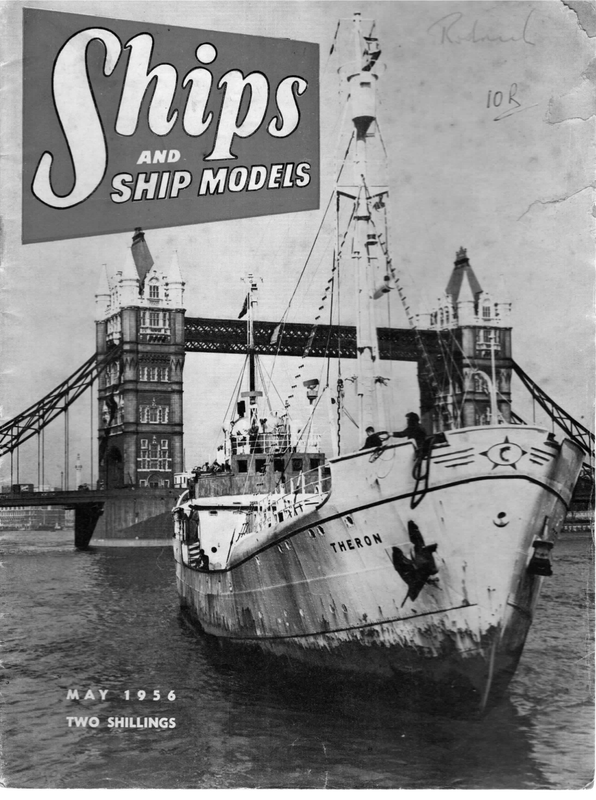
“MAY 1956 WO. SHILLINGS –
RADIO CONTROL OF MODEL YACHT S-4 Spring loaded boom control H. C. ALDRIDGE concludes this series with the description of an ingenious device which may be used in full sized—as well as radio controlled— yachts ECK FITTINGS ARE kept to a D minimum and, apart from the mainsail sheets previously described, there is only one essential addition. Necessity being the mother of invention, I have devised a spring loaded boom control which also incorporates the kicking strap. The invention is somewhat revolutionary, and in view of its application to full scale yachts, I have taken out a patent for the latter purpose. The principle is, however, so simple that it is difficult to imagine why it has not been used previously. My problem arose when I worked my winch to pay out the mainsail to the running position. The winch, being power operated, could only allow the sheets to pay out without fouling provided the mainsail and boom were under tension at all times. In a strong breeze this is usually possible but it is by no means certain, and if the mainsail slacks off for a brief moment the winch overruns the sheets and trouble ensues. A 6 to 8in. length of } in. dia. catapult elastic is fixed at its centre to the deck at a point 14 in. forward of the mast. The two ends are joined to guys and passed round either side of the mast. Both guys are adjustable as to length by means of bowsers and are attached to the underside of the boom approximately one third along from the mast. Tension on the rubber is adjusted so that both sides are equal and should be such that the boom is held at its maximum running position with the rubber on that side still remaining under very slight tension. It will be seen that the other half of the rubber coils itself round the mast and exerts no strain on the boom except along its axis. In the close-hauled position and for about 20 degrees on either side the rubbers exert equal strains, but beyond these positions, depending on the tack, one or the other exerts its influence and pulls out the boom. The whole thing is so simple, and for this reason I think it is all the more effective. Only experience will tell whether it is practicable for full scale yachts, but for models it is the only means of ensuring unhampered control of the sheets. With it I have sailed my Painted Lady out of visual range and operated all the controls by signals sent to me by friends who accompanied her on her journey. If these articles encourage a few of the hundreds of model yachting enthusiasts to change over to radio control, I shall hope to meet them at future championships. With the help of the members of Bristol Model Radio Control Club I shall be pleased to do my best to answer any of your radio problems and through the medium of this journal I shall welcome your observations. Good sailing remember, tight.” to you all and, “‘make your boat water Full scale problem, too With a very light breeze I found it was impossible to let out the sheets without pushing out the boom by hand. This problem, I understand, also applies to full scale yachting, when a member of the crew has to go forward and push the boom, and, as often as not, has to remain there and hold it out while the craft is running. The problem, therefore, is to devise a fully automatic spring loading on the boom so that it is always pulling it towards the running position whether the yacht is on a port or starboard tack. It must not, however, prevent the boom from swinging from the port to starboard tack when sailing close hauled, nor from swinging freely from port to starboard during an intentional jibe. The result is obtained by what can best be called a cantilever action. The following diagram illustrates the principle involved. SHIPS AND SHIP MODELS DIRECTION OF PULL EXERTED BY RUBBER DX. ON STARBOARD SIDE A- MAST D- ANCHOR POINT OF ELASTIC ON DECK OX- ELASTIC (both sides of mast ) XY— GUYS ADJUSTED BY BOWSERS A E — BOOM W — WINCH FIG. 4. The invention involves the principle that the boom will only come under tension from the rubbers when it reaches a point to the port side of position B or the starboard side of position C. 148 MAY 1956
S, ‘Water-Fai ry Conclusion of H. B. TUCKER’S article on a modern ([0-rater design, with reproduction of hull lines : Y WAY OF a me say a tailpiece to this article let little more about the design of Water-Fairy. In the first place her hull is perfectly balanced, and at 20 degrees heel there is no appreciable movement of the C.B. As I previously stated she should greatly SHOW — CURV’ OF AREAS UPRIGHT & ES. HEELED 20 The mainsail should be loose For the second suit I have reduced PMA merely the height of the plan while keeping the full width. A second hanger should be provided on the foreside of the mast to accommodate | the stay for the second jib. Full details are given on the actual plans. BROKEN LINES CANOE BODY footed. < LEAD UNE She is intended to have a metal mast and a flat boom. S jib-club. Fore-and-aft balance Stays. This is mainly because ae ae Lead kee! Sundries Paint and varnish whe Internal trimming ballast ay ie Rig incl. spinnaker and boom Vane steering gear Other fittings — present no difficulty by any ordinary method of SHIPS AND SHIP MODELS Deck incl. beams and hatch fe] of her great length. Owing to the easy, long lines she should be a very simple boat to plank, but she will building. TABLE OF WEIGHTS can be added without difficulty, but if the boat is over-weight her L.W.L. will lengthen and sail area be lost accordingly. Because of her great length a really efficient backstay can be used, and there should be no need for runners. If, however, difficulty arises in keeping the jib-stay taut they will have to be added. Her balloon spinnaker is large and a topping lift on the spinnaker boom should be employed. I also recommend the use of a | Liverpool Boy to ensure she does not hang in | Hull incl. deadwood — ee is all important if the yacht is to float on her designed L.W.L. It is also a point to stress with inexperienced builders that the total designed weight must not be exceeded, and that it is better to be a shade light than too heavy. If necessary a small quantity of inside ballast —-. little | inside trimming ballast in addition. Nevertheless, the builder must check the fore-and-aft balance of his boat carefully and adjust if required. The matter of fore-and-aft balance | — I have placed the C.G. of the lead kee! well forward of the C.B. and provided for a LWL ES a ee eer ends will make her very powerful without impairing her performance in light winds. She should not be pressed to the same angle as a | deep V-section boat, however. Her sail plan is moderately high. I have shown her with a radial boom though if the skipper prefers it he can use the ordinary type of model yacht FOR increase her waterline as she sails, and the ats 154 MAY 1956