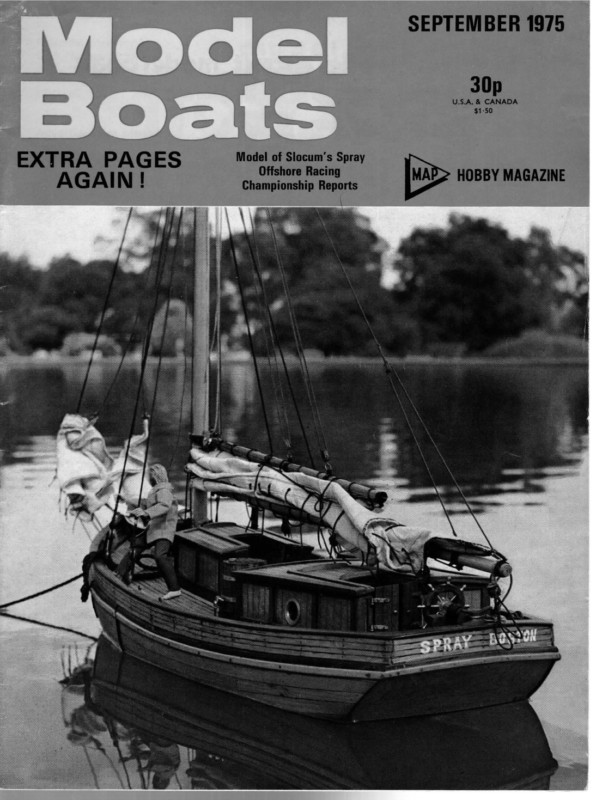
- The World Marblehead Championship Report by Joyce Roberts
- Electra XIl Part 3 Bob Jeffries concludes his notes on the whys and hows of his radio-controlled Marblehead
- Introducing Two modelling characters from the North-Eastern area of England are featured this month
- The 36in. Restricted Championship Sailed at Dovercourt June 28th/29th
- The RA Class National Championship Wet weather and radio troubles on July 12/13 affected racing. Report by Trevor Reece
- Round the Regattas

SEPTEMBER 1975 30p U.S.A, & CANADA $150 —E——EEE = XTRA PAGES _ AGAIN! Model of Slocum’s Spray Offshore Racing Championship Reports MADD HOBBY MAGAZINE
MODEL BOATS ee FIVE boats were entered for the World Championships, but one from the U.S.A. withdrew before the Championships started, and new schedule s Mi AR Be LE fal = AD were made out to eliminate the 25th boat. Mr. Gardner, as O.0.D., had a skippers and mates meeting on the Saturday, to remind competitors that two rounds would be sailed, a half day would be given if racing went according to schedule, and that rules would be strictly adhered to. A question was raised about the distance from the bank allowed or otherwise before hel was disqualified for a apap oe Sian as that it was up to the Bank judge to decide before a pole Report by Joyce Roberts off was made whether or not avoiding action was neces- sary or was taken. The Tots Trophy was to be sailed for, as the race was for more than 3 days, although the winners would only hold their parts for a week, as it would be competed again for in the “‘A” Class regatta week. The names were drawn for, and rivalry immediately developed between the Imagination, Cachucha, Northern Light team, and Bloodaxe, Miss Conduct, and Speedy Gonzales. Racing commenced soon after 9 a.m. on Sunday morning. There was a light reaching wind at first, off the hotels. Surely not a week of those dreadful Fleetwoo d reaches, with luck playing such a part in the calm patches . . » However, by the second heat the wind had moved round to the top corner, and was steadily strengthening. Now skippers looked happier. By the time the 2nd run was taken the wind was even stronger, and many boats were caught in tall rigs. Now came rapid changing down of sails, or sails and masts. Now the boats built for strong winds would come into their own. By lunch time the wind had moved to the sea corner of the lake, the rain which had been continuous and heavy ceased, and the sun came out. The wind was still strengthening, and 2nd suits were being used. Could it be possible that one of the special Fleetwood blows was going to occur? Most skippers were enjoying the conditions, not strong enough for damage, but real enjoyment in sailing. The American, Stephen Urbaniak, said that he was really enjoying the conditions, never having experienced anything like them in the U.S.A. However, he did not have any 2nd or 3rd suit sails, so his yacht was getting overpowered. The wind dropped slightly towards the end of the day, but not very much. Eleven heats had been sailed, and there were two breakdowns, Sir Prancelot and Ttocserp (try spelling it backwards), who lost a vane coming down the lake. Luckily Mariarty trailed it home. At the end of the first day’s racing the O.0.D. compli- mented skippers ahd mates on their sailing, there had been no disqualifications, no one had taken any risks on turning, and any doubtful turn had been held. All competitors also looked expert at turning with a pole. After 11 heats the result looked promising for Roger Stollery and Bloodaxe, 51 points. Although he had lost 3 points to Mariarty in the 2nd heat, mainly due to a vane fault after a retrim for a guy, this was the only time that Bloodaxe was seen sailing with the pair behind. One run had been a dead heat with Miss Conduct. Cachucha was 2nd with 46, Imagination 45, Major B 42, Soft Machine 37, Mariarty 36, Miss Conduct 36. On Monday the wind was North West, fresh to strong. This meant down the lake from the top end, and 2nd suits for most boats. A few more risks were taken, Roger lost his only 3 of the day when his mate got a blue flag against Soft Machine. Imagination was beaten by Mariarty to windward, and the wind gradually strengthened, 3rd suits being brought out. Running became a race between Top, Bloodaxe sitting up well and scorching along on the run only yards fom release (the nearer the windward end, the flatter the water) — compare the clean running with the fuss round the other boat. Centre, Imagination deep in a trough but staying level, and, bottom, Major B looks comfortable though the far boat is pitching a bit. 458
SEPTEMBER 1975 Highest placed ‘‘foreign’’ boat was Northern Light, ona hard beat here with Luncheon Vulture. The wind at its hardest was in fact om 20 m.p.h., gusting 25-26, which was when these photos were taken. skipper and boat, and many jumped in by the bridge to save their boats, or other people’s. Bloodaxe finished the day with 98 points, Imagination 89, Major B 82, Cachucha 78, Soft Machine 77, Mariarty 71. There was an evening of relaxation at the Conservative Club on Monday evening, and a later start on Tuesday morning. Some boats had to be repaired before the start, and only two heats were sailed before lunch. The first round had been completed, the results up to this point are on the score sheet. Four heats of round 2 were sailed in the afternoon. Unfortunately the American boat was withdrawn, as Mr. Urbaniak found conditions too much for him and his yacht. He had not realised what strong winds were like at Fleetwood. Conditions worsened during the afternoon, a vicious wind blew from the top of the lake, and the rain lashed down. All the boats were in their smallest storm suits, and some skippers had to cut sails down. Those who did not want to cut into good sails found that they were overcanvassed, and either sailed every heat with the prospect of losing, or eventually were forced to cut into sails. It was becoming obvious that not many people sailed in storm conditions with Marbleheads, not many had 4th suits, and quite a few did not have 3rd suits. There were a number of breakdowns, but not as many as one might expect. Most repairs had to be done following collisions with other boats and with the bank. Australopithecus hit the bank on the run, and suffered a split hull and loosened fin. With a supply of fibreglass stuffed inside the boat resumed sailing. There were various other rudder, skeg and fin troubles sustained, and a few boats did not sail quite as well after the Tuesday. Bloodaxe and Imagination carried their sail extremely well for such lightweight boats. Some of the heaver ones suffered more with the wind. By the end of the day it became apparent that the gap between top boats and those lower down was widening. Bloodaxe had 120, Imagination 107, Major B 100, Soft Machine 97, Cachucha 85, Mariarty 79. The strong wind was still there on Wednesday, but no rain. Racing started at 10.30. Eight heats were sailed. During the day Bloodaxe lost another 3 points, this time to Imagination. Major B also lost 3 to Dino. Another skeg was damaged, this time Soft Machine, and the deck had to be cut into to enable overnight repairs to be done. It was notable that in these winds the two Bloodaxes and Position Reg. No. Yacht Club Designer Skipper Bloodaxe Major B Imagination Mariarty Soft Machine Cachucha Luncheon Vulture Sir Prancelot Northern Light Miss Conduct Guildford Guildford Bournville Fleetwood Leeds & Bradford Birkenhead Southgate Fleetwood Greenock see Stollery—Bloodaxe Stollery—Bloodaxe Dicks—Extension Shepherd—Step-out Shepherd—-Step-out Dicks—Pterodacty] Taylor C. Dicks—Pterodacty! Shields Dicks—Pterodactyl R. Stollery A. Austin B. Jones D. Latham T. Armour K. Roberts I. Taylor K. Wiseman H. Shields J. Mathieson K 1800 K 2088 Shazzan Kiltie Bournville Fleetwood Lewis—Loop-Too hields K H K K K K K Fiorello Speedy Gonzales Cobra Australopithecus Dino Zita Ttocserp Newcastle Netherlands Fleetwood Clapham Leeds & Bradford N. Liverpool Fleetwood Stollery—Popcorn Dicks—Pterodactyl Dicks—Pterodactyl Witty—Bambi Dicks—Pterodactyl Dicks—Pterodactyl Dicks—Pterodactyl Ist 2nd 3rd 4th Sth 6th 7th 8th 9th K 1977 K 1962 K 2121 K 2012 K 2131 K 1797 K 2090 K 1911 \ K.S.161 K.S.72 lith 12th 13th 14th 15th 16th 17th 18th 19th 20th 21st 22nd 23rd Withdrew Imagination looked so fast in the water on the run. They cut through the water with no fuss, no desperate nosedives and rarely any hint of a broach (due also to very good trimming). Thursday, and still windy. The O.0.D. announced that he would sail only during the morning, letting everyone have a rest during the afternoon (that is everyone except Mr. and Mrs. Rodrick and Mr. Keeley, still doing scores and schedules for the “A” boat race the following week). The wind seemed to have renewed its energy, and it blew harder than ever. Mariarty was now sailing with a near invisible mainsail, only K20 was now visible. Five heats only were sailed, conditions getting really bad at lunch time, and more damaged boats had to be repaired. Holes in sides, on decks, skegs loosening—a busy afternoon for some skippers obviously. Cachucha lost her hatch during a nose dive into a wave, and sank rapidly in the middle of the lake. Luckily no damage was sustained, Roger Stollery gallantly waded out to rescue her (being misinformed about the depth of the lake however!) Bloodaxe finished the day with 182, Major B 160, Imagination 152, Soft Machine 134, Mariarty 130, Cachucha 128, Sir Prancelot 117. So the final day, which began with sun (before the race) and a reaching light wind. By 10 a.m. however the wind was straightening and freshening, so racing was held up while skippers changed down again, mostly into 2nd suits. K 1714 K 1912 1694 34 2154 2011 2141 1892 2153 G 193 Jester Namu Teifun G 201 Pannkoken U 2217 Arrow VI cotlan: Birmingham Birkenhead S.V.O.A.E Germany -O.A.E. ermany Mill Pond U.S.A. Witty—Stable Mabel Witty—(Mod.) Kullick 459 Total 103 87 89 74 82 78 49 60 60 68 204 184 179 160 152 143 126 125 122 122 H. Dovey R. —— 53 59 119 116 G. H. Keeley J. Hoogewerff B. Tibbetts M. J. W. Peppiatt J. Bus F. Jones A. Prescott 51 33 34 40 29 39 21 90 82 80 71 67 61 46 G. W G. Foeniston G. Kullick Lewis—(Mod) Loop-To Frank Jacobsen Ballantyne—Arrow Ist Round S. Urbaniak 59 51 28 18 111 98 40 34
MODEL BOATS Now nerves began to show, and a few more blue flags were seen. After a couple of heats Roger Stollery made sure of victory, no one could catch him at all. The rest of the top boats were left to fight for 4 more prizes and 5 more shields. Competition was very keen. Mariarty, after a few close races, went better and better, not dropping a point on the final day, and therefore moving up to 4th place. Imagination nearly caught Major B, and Cachucha did not quite catch Soft Machine. Another boat emerged in the top 10, Luncheon Vulture, low down at the end of the Ist round with 49 points, he got 77 in the 2nd round. Considering the boat had been rebuilt during the fortnight before the race Ian Taylor got her sailing remarkably well, and also brought a certain lightheartedness into the racing, with his cries of encouragement to the Vulture. Another very pleased competitor on the last day was the smallest mate, Martin Roberts, who had his day made for him when with a final pole off to Cachucha he saw Bloodaxe lose 3. So the first International Marblehead race was over, a week’s sailing in very strong beat and run conditions. Everyone competing seemed to enjoy themselves, the only disappointment being in the small number of entries. However, the competition was very strong, but very friendly. There did not seem to be any bitterness between competitors, and although all were very keen to do their He had proposed it a few years ago, and had worked hard to get the race past the planning stage. The Fleet- wood Club had then taken over the organizing and running of it. It was a great opportunity for families to sail together, and it would be a good idea to hold another race as soon as possible. Mr. Prescott also said that the initials of the Union were very appropriate this week, Instant Model Yacht Repairs Union. Fritz Jacobsen thanked the officials who had made the week so successful, especially Mr. and Mrs. Rodrick for all their work in preparing and keeping the office work going. Other speeches included thanks again to the officials and the hard working Mrs. Mackarel in charge of the canteen; mention was made of the great friendliness shown to the foreign competitors by the British. An extra toast was proposed unexpectedly by a “‘shy and retiring person” (Ian Taylor) to the Fleetwood Club for all its hard work. He also mentioned that during the Saturday evening before the start of the next regatta a certain the after dinner speeches, the sportsmanship being emphasised. Mr. Alan Prescott (who had competed all week group would be singing “‘As soon as this pub closes, as soon as this pub closes, the Revolution starts’’. Prizes were then presented to the top five skippers and mates, and shields and spoons to the 10 top skippers and mates. The International Marblehead Trophy was presented to Roger Stollery. This was a magnificent salver, presented by Fritz Jacobsen. The Tots Trophy was presented to the winning skippers of Northern Light, Imagination and Cachucha. So a week’s sailing was over, and everyone agreed that proposed the toast to the ILM.Y.R.U., drawing people’s attention to the fact that the race had been held because of the efforts of Fritz Jacobsen, President of the I.M.Y.R.U. weekend. Wind had been good, although tiring. Some skippers and mates have now another week ahead of them. Who knows what that result will be? A Point on Noise I am sure one competitor will not mind me quoting his boat at the Multi eliminators at Kingfisher club. Len Martin had a boat that was the noisiest of the meeting, and as it turned a corner the hull was so lightly built in the engine compartment that one could see the sunlight clearly shining through the hull; it did not take an expert to appreciate that the hull was resonating like hell! So…smaller engine compartments with the sides filled in with foam and the actual engine bay very heavily best it was with a friendly rivalry. This was mentioned in without much success, but with evident enjoyment) it had been a good thing to race “‘M”’s for more than a from John Stidwill | Dips the winter and spring months I spent many hours testing the new Weston exhaust system, and I found a very important point regarding noise; whilst everyone knows about it, they do not realise the importance attached to it. The point I refer to is BOAT Noise. We were doing some experiments with two identical boats (except for one item) and no matter what we did we could not make one boat as quiet as the other. In the course of testing we even went to the lengths of a complete swap over from one boat to another of the engine, exhaust, fuel, and propellor, and still one boat was the noisier. We sat down and thought about it and then the only difference in the boat construction came to light. The quiet boat, in an effort to increase the weight distribution, had had a really heavy amount of fibreglass resin etc. laid in the bottom of the engine compartment, to the extent that it was nearly }” thick, and it was this that substantially reduced the boat noise. To prove the point the noisy boat was then treated and sure enough 4 to 5 decibels were lost . . . and that’s a saving! In some boats this treatment could alter the handling, but it is worth while noting that so much noise is in fact generated not by the engine itself but by the hull. covered with Filrite resin or some other suitable substance, and I do mean heavily covered. The above comments would also answer the problem of why hatch covers do not always make a boat quieter, and at times can increase the noise level. All exhausts make noises, but the above experiments came to light because no matter how quiet we made the exhaust, the decibel reading did not go down accordingly. If you have a boat generating 85 decibels, no matter what exhaust system one uses you are not going to make it quieter. In fact we increased the noise level on one exhaust and the total decibel reading was not perceptibly changed as it was still well below the basic hull and engine noise. These conclusions have been so positive that I thought that they ought to be brought to light, as for years although one has known the fact I don’t think anyone has actually realised the importance of it, or how to cure it. POSTSCRIPT TO THE RM CHAMPS from Bob Jeffries Members of the committee of the New Forest Club are becoming concerned with the numbers of entries being received for their events. The days of being fortunate to receive five entries are long since gone. If the present progress continues, something will have to be done to limit entries. Who would have anticipated the progress made in the past two years? Theoretically there is no limit to the numbers that can be entered, but as many come 460 great distances to compete, they must expect a sufficient number of races to justify their time and expense of coming. This is a matter that must concern the MYA for the future, and a satisfactory decision as to how to limit entries must be made soon. The experience of the New Forest Club is that 25 to 30 boats are the maximum that can be accepted. This will only give each competitor 6 or 7 races per day. A two-day event would only double the actual races.
MODEL BOATS Electra XIl Part 3 Bob Jeffries concludes his notes on the whys and hows of his radio-controlled Marblehead Full-size copies of the drawing for this model are available Ref. MM 1205 price 90p inc. VAT and post, from Model Maker Plans Service, P.O. Box 35, Hemel Hempstead, Herts HP1 1EE. Construction is not shown on the drawing, i.e. some knowledge of building a yacht is required. | Seite I have always used aluminium tube for my nice salmon coloured finish that I was able to polish to a high shine. Similar attempts with the nickel plating believer in keeping the weight aloft to an absolute mini- ceived this treatment, and I feel the trouble was well masts. I have been able to obtain some nice straight grained spruce, and I now use wooden masts. I am a firm mum, and I find I can save precious ounces by so doing. I make them in. by 4 in. at the foot tapering to + in. at the top. They are clear varnished. The booms are also in spruce, similarly finished. All my fittings are home-made in brass. It was my intention to have them plated, but when I found the cost, I sent off for the M.A.P. publication titled ‘Electroplating for Amateurs”. A helpful local chemist obtained the necessary chemicals for me at small cost, and as I was apprehensive of using the very dangerous cyanide of potassium, I used the much less dangerous system used in the book for copper and nickel plating. For my power supplies, I used the car charger I normally use for charging my radio batteries, breaking down the current with suitable resistors. My first attempt was on a scrap piece of brass. After acid cleaning, I plated with a copper anode and a current of about one amp. Twenty minutes later, I had a copper deposit about 4 in. thick! That came off in the form of a dirty brown sludge, as soon as I touched it. For a second attempt, I limited the current to about 100 milliamps, and after ten minutes I had a produced a very satisfactory finish. All the fittings re- worth while. Because of the depth of water needed to test the flotation, I was unable to test in the domestic bath, and was very relieved to find on the first visit to the pond, the boat floated just where I wanted it to. My tests with the bare hull had paid off, and there was no need to move batteries or equipment to correct the trim. My first sailing trials I did alone. Much better than at a club meeting where there are too many spectators and fellow club members to offer help. I used the standard aspect sails, and was agreeably pleased to find the position of the mast was right at the first go. The boat would beat to windward for quite a long way without needing any correction by the rudder. If anything there was the slightest tendency to climb to windward, but leaving it alone, the boat would pay off and continue beating. Similar tests on the opposite tack produced the same results. After the first outing, I was highly satisfied, and only had one criticism. The rudder control was far too sensitive, and had excessive movement. Subsequently I reduced the total throw to about 30 degrees each side of dead Below, left, a view inside the radio compartment and, right, the cockpit and hatch over the rudder servo, Semi-scale deck appearance is evident in these views and that above. 468
SEPTEMBER 1975 The authors’ latest home-built transmitter has a rather fancy metal-flake finish; should make it easy to spotin the transmitter pound! Far right is the lever type sail winch discussed in an earlier article. centre. I found that this is ample for full control. Several subsequent visits were made to the pond to try alternative settings, and also to try out the other sets of sails. The boat has now been measured, and registered with the M.Y.A. The sails have been decorated with her racing number of K 2058 and already the boat has been entered and accepted to race in the international event to be held in Gosport in August 1975. Since this article was started, the boat has put in many hours of sailing. Only time will prove all my theories, but I feel I now have a boat that if properly sailed will stand a good chance. I have sailed in strong winds, and in hardly any wind at all, and at all times the boat has been under full control. She will beat to windward, pointing as high as any boat I have so far met. Downwind there is no tendency to bury the bow. I intend to sail it in club and M.Y.A. events this season, also when weather and time permits, I intend to carry out a series of trials with the Soling, obtaining the help of a club member and taking turns with each boat, so that the difference in sailing ability cancel out. By this means, I hope to obtain the optimum settings for each rig. Carefully recording results, so that once correct trim is obtained, it will be easily possible to reset to those settings. As a matter of personal policy, it has never been my idea of keeping my ideas to myself. I feel it helps the future of radio sailing for those with a bit of experience to help the newcomer. Towards this end I have given permission for replicas to be made off my original moulds, and have produced a set of drawings giving full details for any enthusiast who would like to make himself a replica. These drawings are available through the usual M.A.P. Plans Service. Introducing HARRY BRIGGS has been one of the most regular participants in major yacht races in the last half-dozen years, a contributory factor perhaps being that he is unmarried (no wife, he says, just a government and two breweries’ to keep). Originally a cabinet maker, for the last six years he’s been a process operator at Conoco’s Humber refinery; during his naional service in the RASC he was volunteered as a fireman and was shocked when he found it wasn’t railways and he’s terrified of ladders. . . . Harry is interested in absolutely everything, but especially real jazz, hi-fi, and ale. He can remember his first model, a chimney stack carved from firewood, made before he started school. His first boat was an airscrew MIKE VARLEY, also in his mid-40s, in the northeast, and starting life with wood, as a patternmaker, has been a strong influence on Yorkshire modelJers. He had three years in the RAF as a ground wireless mechanic and for the last twenty years has been a parts department manager in agricultural engineering. His sole hobby has always been model engineering, widening the term to embrace all forms of model—aircraft, boats, cars ete.—but he has other interests such as motorcycle sport (competing @ & & Two modelling characters from the North-Eastern area of England are featured this month hydroplane which he relied on a schoolboy to start for him, followed by an electric launch, then the catamaran Sea Mew, with which he found his way to Leeds, was introduced to Reg Norton, and shown the light. He is a Leeds and Bradford MYC member, and a founder member of Cleethorpes MBC, and his successes include last at each of the M team championships held at Witton, winner of the Grand Prix de Rheims 1973 and 1974, and taking points from The Streak at Gosport 1974. In his mid-40s, Harry is regarded by some of his friends’ children as a genuine Viking, with Father Christmas as a grandfather. As he points out, he is 6 ft., handsome in a rugged sort of way, with steely grey eyes and a charming manner. Between races he is fitting out a 3 ton 25 ft. offshore cruiser hull at present. His pet moan is about those yachtsmen who want the latest championship boat but aren’t prepared to put in the months of sailing practice required to go with it; he himself doesn’t expect ever to win a major trophy but, he says, has a secret speech rehearsed in case one day he’s the only one who turns up! in trials and scrambles) power boat racing (competing at most northern venues and holding RYA certificates for both sail and power) and BRISCA FI stock car racing. Mike, who has a wife, Margaret, and 8 and 6 year old boys, has been secretary of Keighley DMES since 1954, secretary in the early ’60s of the Yorkshire MPBA, formulated the MPBA record rules, and was responsible for the Roses Regattas, the endurance racing at Keighley Tarn, and the first world multi-racing championship outside South Africa. He started modelling during the war and his first working model was a Thermic 50 sailplane; this led to exhibition successes with c/] scale aircraft. In the last few years his time has been largely taken up on the administration side, but he is researching the Walton Thames air/sea rescue launch, building a class C multiboat and a couple of stock cars, plus constructing a stock car racing circuit for Keighley DMES. 469
alll The 36in. Restricted Championship Sailed at Dovercourt June 28th/29th FTER so strong an entry 1974 a total of 15 36 in. A boats this year was slightlyin disappoi nting and a late withdrawal left only 14 boats competing. Neverthe less, sharp at 9.15 on the Saturday the OOD (Walter Grint) opened proceedings and racing started at 9.30 in a north-easterly 5/10 m.p.h. wind, which at Dovercourt gives a broad reach out and a close reach back. The first board was completed in twenty minutes, thanks to the cooperation from competitors, and this standard was maintained so that racing went along briskly. The biggest excitement in the first board was Realistic immediately dropping points; she recovered rapidly and started to build a strong lead. Resails were cleared during the morning tea break and by 12.45 ten heats had been sailed and all resails cleared. The wind swung easterly and freshened slightly after lunch and the first round was completed by 3.15. Second round cards were prepared during a fifteen minute break for tea, the wind continued to freshen and signs of planing became evident. Sailing continued until 5.50 when nineteen heats had been completed. The day finished with a socia] evening at the Anchor Hotel. Sunday morning produced an identical wind at NE 5/10 m.p.h. and the OOD conferred with all competitors on whether they wished to sail more than two rounds; it was agreed to stop at the end of the second round which left seven heats to sail, starting at 9.25. The wind again swung easterly to give beat and run conditions during heat nine and during a tea break many skippers took the opportunity of reduci ng sail. The increase in wind had many of the boats planing, though some inevitably broached. By 11.30 waves were breaking over the lee end of the lake and the wind speed was up to 15 m.p.h. and there was some quite excitin g sailing. The last heat was completed by 12.20 but on checking scores it was found that although a definite first and second boat had emerged there were four tied on 77 points. The OOD decided to sail a complete four-boat race to resolve the situation and this started in a wind which had reached 20 m.p.h., straight down the lake. Red Baron, with a little advice from Chris Dicks, made sure of third place by scoring 15 out of the possible 15, so that the first three boats were all to the Dicks’ Realistic design, and another to this design came sixth. In accordance with the wishes expressed at the last MYA Council meeting the top four boats were measured and found to be within the rating limits, although this proved slightly embarrassing for George Clark; both of his boats had epoxied rudder fittings and it was necessary to remove the rudders to check that the boats would fit in Above, Realistic and This Way Up show the chop at the lee end of the lake and, on the right, Chris Williams wears a delighte d grin as his boat crosses the line ahead of Realistic. Below left, body English from Chris as his boat sails Spooky Spider (4th & 2nd) sailed by George Clark on behalf of its owner. Right, Alf Larraman sailed Red Baron to 3rd, here sailing against Jock Gilmore’ s Sparky, an almost parallel-sided boat. 472
SEPTEMBER 1975 In the sail-off, Spooky Spider shows how a 36 can plane, but his opponent is less fortunate and is broaching. Top right, Johnny Hyde found it warm sailing the ex-Chris Jackson Anval, but Bill Dicks decided to stay with his oilies. 3rd 4th Sth 6th 7th 8th the measuring box. Prizes were presented by Councillor G. Meachen and with expressions of thanks to officials, competitors and the invaluable ladies in the canteen a very successful meeting closed at 2.20. Ist 2nd W. Dicks 1119 Realistic 1130 Spooky Spider R. Clark 10th 11th 12th 13th 14th End of End of 19th Heat Final Heat 84 59 114 89 1129 1106 1097 1125 709 1091 1122 1120 1077 1128 1085 1117 Red Baron Jipi Japa Phoenix Yellow 36 Blue Peter Anval This Way Up Diplodocus Pink Panther Gollum Sparky Scaup P. Clark Chris. Williams I. Taylor R. Griffin J. Cranfield J. Hyde J. Raymer M. Peppiatt B. Wood Chas. Williams J. Gilmore P. Slater 55 57 60 54 53 53 49 35 39 23 29 20 Tla T1b T71c 77d 71 66 66 55 44 37 36 24 The RA Class National Championship Wet weather and radio troubles on July 12/13 affected racing. Report by Trevor Reece T was almost inevitable that the end of six weeks of blazing sunshine should coincide with the first day of the Nationals, and for the second successive year at Poole the Saturday racing was held in dreary and steady showers of rain. The weather on Sunday was slightly better and by 3.30 p.m. a new National Champion emerged, after three schedules of seventeen races each, totalling fifty-one races, each skipper sailing fifteen races with a maximum possible point score of 150 points. With an astonishing total of 144 points, Norman Hatfield, of Basildon MYC and radio secretary to the MYA, had a very decisive victory with his yacht Aubade, being twenty points ahead of the runner-up. This was no “storm in a teacup” win, as competitors included some of the finest and most experienced skippers in the country, and with twelve first places and three second places to his credit, Norman’s performance could scarcely have been more consistent. There were seventeen entrants this year, rather less than expected and in the event, one skipper did not make an appearance at all, so although a seventeen boat schedule was used, it was effectively only a sixteen boat competition. As with the Taplin Challenge Cup earlier this year, each skipper was given a race card which indicated the race numbers in which he was competing together with the race numbers, where applicable, of those races in which he was on the race committee. The frequencies for every boat in every race were also pre-determined, so that the frequency to be used was also indicated on the race card. Frequency clashes only occurred twice and were quickly rectified by interchanging channels and boats, and were probably caused by rogue crystals. OOD for the championship was Ted Gearey of Guildford, who was able to dispense quick justice against the relatively few infringements to the racing rules, although his work was hampered by the rain-soaked schedules. Accurate score keeping was enhanced by Henry Cheyney, who has personally undertaken the scorekeeping at all major events in Poole for several years. None can say that the 1975 RA National was particularly successful in so far as reliability of RC equipment was concerned, and the effect on the racing schedules was quite disastrous. Within an hour of starting on Saturday, one of the Gosport MYC boats retired completely with an un-repairable reed bank; some readers may not even know what this is!! The only entry from Woodspring MYC, Bristo], was a GRP Highlander JaCeTe and during Saturday afternoon, its skipper Mike Franklin had to return to Bristol for overnight repairs to his winch. Frank Walker’s Swara developed intermittent operation of the winch, necessitating some evening repairs to the electronics, whilst Len Thompson had to fit an extra six volt battery in his transmitter to boost an ailing output transistor. At one order, no permitted the rules stage, with only two boats temporarily out of less than nine races were being held back, as by the existing racing rules. Clearly a change in is essential, since the benefit of pre-arranged schedules is otherwise completely lost. On the Sunday, another boat retired completely with a suspected faulty decoder board, and this left one of our most stalwart supporters, Norman Grinter, as a spectator. Another skipper, Lionel Kirby with Yolanda, was unable to return to Poole on the Sunday and thus the second day’s racing started with Buccaneer, Woodspring, Yolanda and Lady Bee all permanently retired, leaving only thirteen skippers and consequently numerous two and three boat races instead of five boats. Fortunately, Swara and JaCeTe both returned on the Sunday in good sailing order and the OOD was able to restore some continuity to the much depleted schedules. The first four places were awarded as follows:— 473
MODEL BOATS Position 1 p. 3 4 Skipper N. Hatfield B. Askell R. Dehon F. Walker Yacht Designer Aubade J. G. Meir Mimi Swara R. Dehon B. H. Priest Pele Builder J. Belton F, Walker R. Dehon F. Walker F. Walker A brief description of the winning yacht would not be amiss, since Aubade is only one of two boats ever made to the Spinaway design. It was built by Jim Belton of Basildon MYC some time before contracting an illness which has left him at the moment almost completely paralysed, but Aubade was obviously a labour of love, resultin g in a beautiful yacht of exquisite lines to a standard rarely seen nowadays. Norman Hatfield was using a Custom Electronics two channel Mini Hex RC outfit coupled to one Displacement: 1,010 tons armament consisted of one 4.1 inch, one 37 mm. AA, Complement: Built: 2,880 IHP— 163 knots 3,600 SHP= 194 knots Armament: 1 – 4 inch; 2-40mm.AA; 2-20mm AA Complement: 6 — 4 inch; 4-—40mm. AA; 2-20 mm. AA 120 180 Built: = 164 knots Submerged – 1,100 SHP = 7 knots 2-20mm & 4-2 pdrAA Armament: 1 — 4 inch; 1 – 37 mm. AA; 1-20 mm. AA; 2 – 21 inch TT; 69 mines Complement: 52 As mentioned earlier U 118 was sunk by aircraft from USS Bogue in June 1943. Eglinton and Bicester were both WHIMBREL scrapped in 1956. St. Thomas was convert ed to mercantile use shortly after the war, while Whimbre l was trans- Smiths Dock, 1943 Yarrow, Oct. 1941- as HMS Sandgate Jan. 1943 Castle. Transferred ferred to Egypt in November 1949. Next month: Part IV will cover the United States Navy’s role in the Battle of the Atlantic. to RCN 1944 ROUND THE REGATTAS (continued from page 480) water of the Tynemouth Model Boat Club. It was a busy day with four events scheduled—straight running over 60 yards across the middle of the lake, scale RC steering at the boat- house end, hydroplanes for the Northern Area Championships at the north end of the lake and the final Eliminator to choose the EX team for the European Champio nships to start at 1.00 p.m. on a special course diagonally across the SE corner. The weather at Tynemouth was almost as good as the previous day, except that there was slightly more wind from the NE, off the sea, which kept the temperature down slightly and caused rough water at the hydroplane end. The start was slightly later than advertise d and the first hydroplanes were the ‘A’ Class boats on choppy water in the hope that the lake would calm down during the day. R. Kirkley of South Shields provided the interest in this class with the first flash-steam hydroplane ever to sail on Tyneside, recording a speed of 31.46 mph in his own first hydroplane regatta. In the ‘C’ Class, S. Chorley from Glasgow was the first Scottish entry at Tyneside and marked the Germania Werft, Displacement: 1,763/2,177 tons Machinery: Surface — 4,200 BHP May 1940May 1942 1,050 tons 19,000 SHP= 27 knots 6-4 inch AA; occasion by recording the fastest time of the day—not once but TWICE, with a speed of 73.57 mph to win the Northern Area Championship, the first time this has gone to Scotland. U 118 Kiel, 1941 168 St. THOMAS 1,470 tons Machinery: EGLINTON BICESTER Vickers-Armstrong Hawthorn Leslie, 146 Club Basildon Poole Poole Poole nourishment for the bedraggled but otherwi se enthusiastic skippers. It may be true that only mad dogs and Englishmen enjoy the midday sun but surely RC skipper s must be the only ones who spend a day in the rain for fun! and one 20 mm. AA. Their AA armame nt was later augmented by replacing the AA guns by two twin 20 mm 20 mm and, at the same time, the 4.1 inch gun was removed. U 118 was sunk by aircraft from the escort carrier USS Bogue (to be featured next month) on June 12th, 1943. Details of the ships were as follows:— 2-20mm & 4-—2pdrAA 144 124 114 99 supported by the ladies, who again supplie d much needed FIGHTING FLEETS (continued from page 467) (Tyne), June 1939Aug. 1940 Displacement: 1,000 tons Machinery: 19,000 SHP= 274 knots Armament: 4-4 inch AA; Points of Frank Walker’s sail winches, the whole being operated from a six volt Dryfit accumulator. As always, this major event at Poole MYC was well earlier ships, could be produced in large numbers by yards which had the expertise to normally only build merchant ships. The Castles were compara tively late arrivals, the first joining the fleet in October 1943. The U-Boat depicted this month is a Type XB, one of the larger German submarine types frequent ly used as supply submarines. Only eight were built. Their original Built: Design Spinaway Twiga Mimi Saxon Another notable performance was provide d by that veteran from Birkenhead, J. Jones, with his new 15 c.c. Sea-Jay on its first run in open competition achieving a speed of 67.28 mph and beating its twin sister, Jay-Cee, built by T. Clement of Heaton, who designed the engines for both craft. No boats below 10 c.c. were successfully launched during the afternoon despite the easing of the wind and the water smoothing out as the day progressed. The hydroplane event ended at 5 p.m. after all competitors had had four runs. Meanwhile, elsewhere, there was plenty to interest spectators and competitors, for the fun was fast and furious across the middle of the lake where 39 straight-runners battled for honours over three runs within a deadline of 1 p.m. C. Senior of Huddersfield, V. Thompson, Tynemouth and K. Hardwick, Tynemouth scored a maximum 30 points to decide final placings by re-runs whilst E. Spain (Sunderl and) with Jill, W. Thompson (Tynemouth) with Valerie, A. Porrett (Tynemouth) with Diamond 1 and P. Jennings (St Albans) with Heaton Maid scored 28 points to tie for 4th place—a high rate of scoring by any standard. Radio-control Scale enthusiasts were catered for at the south end of the lake where 11 examples of fine scale model craft ranging from pilot-cutters, lifeboats and channel (continued opposite ) 474
MODEL BOATS Round the Regattas. Attractive scene at Poole with Hibiscus, Bloodaxe, Seduction, and two other Marbleheads in one of the rare moments of wind on May 18. Bournemouth & Poole M.P.B.C. On May IIth the club held its first regatta at Queens Park since it was reformed in 1974. Although nearly 80 boats had been pre-entered for the day, only 50 actually arrived, possibly due to bad weather in other parts of Southern England. In Bournemouth it was a warm dry day. The racing had been planned for a minimum of six boats many questions; as Sir John is a trained shipw right, he knew what he was talking about. : toss Carnival Queen of Barro w presented the trophies as ollows :— Sir John Fisher Trophy (best sailing ship) C. Money (Fleet wood) sailing barge Dalphae. H.C. R Newton (Barrow) schoon er Stormy Petrel, D. Jaques (Barrow) full rigged ship Ariel. Vickers Shipbuilding Group Trophy (best scale Power ed vessel) R. Johnson (Thames Society) Clyde puffer Sealight.. H.C. A. Robinson (Workington) tug Hondo, D. Newton (Crosby) tug Willow garth. Award of Merit F. Wright (Crosby) coal-fired Bitza. Junior Trophy J. Mackay (Glasgow) frigate Phoebe. Competitions SR Nom Crosby Club. SR Crosby Club. Sailing Ship Point-to-Point Squar e Rig. I. Sharp (Barrow). Fore and Aft Point-to-Point C. Money (Fleetwood). A td Scale Event Sectio n Winners—Barrow, Fleetw ood, Glasgow, ndon. Power Boat Event (fastest boat of the day) 1. J. Bristo w (Kingf isher), 2. R. Fogg (Fleetwood). 3. D. Jaques (Barrow). Sailing Ship (radio-controlled race) Liverpool. per race, but due to non-st arters there were often only three boats in a race. Those who did race appea red to enjoy themselves, although our water is one of the smaller ones around— this made the racing close and exciting at times, which the spectators really enjoyed. The most intere sting race was the last one of ‘C’ class, when there were eight boats running for most of the time, which made our water really boil. One thing is certain, many club membe rs and spectators had their eyes opened by the performances of these models. As can be seen from the results the racing was dominated by two people, one from the Swindon club and the other from Maidstone. ” Besides the trophies from the club, prizes were also given y= Veron, Ist and 2nd overall, Westb ourne Model Centre, Ist and 2nd in each South Wales M.P.B.F. On Sunday 18th May, 1975 the South Wales Model Power Boat Federation’ held their annual Welsh Open, at Roath Park, class, Hotel Rivoli, Ist electric and consol ation prize, and Hobby Horse, Ist of Bournemouth club. RESULTS ‘A’ Class—1. F. Martin (Swind on); 2. A Dyer. (Southampton ); 3. M. Fagan (Mortlake). ‘B’ class—1. J. Cundell (Maids tone); 2. F. Martin (Swind on); 3. L. Martin (Swindon). ‘C’_class—1. J. Cundell (Maids tone); 2. C, Argent (Swind on); 3. J. Stidwill (Mortlake). Spark Ign.—1. P. Firmin (B and P); 2. C. Firmin (B and P), Electric—1. F. Martin (Swindon); 2. Cardiff. Although this is a pleasant venue, to watch the boating that many of them were coming into the marked off area and onto the course, thus inevitably causing some delay in the starti ng of some of the heats. The event was well attended, Barrow S.M.S. On Sunday 18th May, we held our 3rd Annual Regatta at Barrow Park Lake. The weath er was perfect and competitor s came from Glasgow, Londo n, Crosby, Fleetwood and West Cumberland. B.B.C. Televi sion “Look North” arrive d and Frank Mellor and his team did a great job interviewing the contestants. We had over sixty models , forty-five of which were radio controlled, and this was a real headache for our controllers. A week before the regatta, Len Tucker, one of our judges , was taken ill and we had to pull all the stops out to find a suitable replacemen t. Our judges were John Bowen, Ken Wellings (of Vickers Se maing drawing office) and Les Nelson-Ewen, and they had a very tough job made harder by last minute entries. Models worth a special mention were the Glasgow South naval ships, who had a wonderful Sailing display which included HMS Ark Royal, 8 ft. long, complete with aircraft and Royal Marin e band playing, surrounded by five other naval ships, all on R/C and sailing in company. Mike Taylor’s 8 ft. Great Britai n looked a picture steaming around the lake with all sails set, as did Don Arton’s 11 ft. Northumberland. Our President, Sir John Fisher, and Lady Fisher took a very keen interest in the models , going round and asking there being 97 entrie s, and with competitors coming from Bradford, Birmingham, South ampton, London and Bristol (inclu ding an American), it certai nly seems that this event is becom ing more “Open’’ every year, J. Cundell (Maidstone); 3. B. Pollitt (Southampton). Ist Overall—J. Cundelli (Maids tone); 2nd Overall F. Martin (Swindon). Ist Home club—P. Firmin. Consolation prize for damaged boat—J. Fagan (Mortlake), and we thank everybody for attending and giving us a most enjoyable day’s boating. Three people regrettably had to be disqualified for breaking the 80db noise limit, and two boats collided with the rescue boat (obviously being given a re-run), but on the whole the event went off yy well, although it did finish rather later ici -30 p.m.!) mostly caused throu gh radio troubles, clearing the course of the public (and ducks) and the fact that most of the heats could only be 4-boat heats due to Green being an exceptionall y popular frequency. Also I think we were a bit ambitious trying to hold Speed and Multi Multi Open or else holding two Opens, one for each event. The organisation itself was, I believ e, quite efficient with a quick change between heats and runs, i.e. the competitors for the next heat standing by the pit area before the previous race is finishe d, and a strict two-minute warmup time commencing from when the water was cleared from the previous race. This also applied to the speed runs, with second runs having to be taken immediately after the first run—a few seconds grace obviously being given to tune up engines, restart them etc. As always, there was tremendous public interest (both on the water and outside the paddock area), and many were the enquiries dealt with that day as to how to use the radio 478
SEPTEMBER 1975 equipment, what sort of boats were used, where was the nearest Club, etc. Bexley D.M.P.B.C. Bexley and District M.P.B.C. held their first multi race regatta (30 mins. duration) on their water at Sutton-at-Hone, Kent, on May 25th. This was attended in favourable weather by forty-four boats representing clubs from Folkestone, Swindon, Portsmouth, Maidstone and clubs from the London area. Prizes were donated and presented by Eltham Models. The results were as follows:— RESULTS: speed, 0-24, 1. G. Jones 30.5 secs.; 2. C. Langlois 32.0; 3. J. Fenton 24-5 c.c.—1l. C. Langlois 27.5 secs.; 2. Mr. Ottoway 31.0; 3. R. Head 32.5. ce + — 1. M. Pruitt 25.5 secs.; 2. C. Langlois 28.5; 3. R. Head Multi—0-34 c.c.—l. Mr. Ottoway 33 laps 9 buoys; 2. R. James ‘A’ class—0-3.51 cc.—1l. L. Jones (Folkestone) 78} laps. 2. F, 33 laps 6 buoys; 3. C. Langlois 33 laps 4 buoys. 34-6.55 c.c.—1. G. Jones 35 laps 4 buoys; 2. J. Prior 35 laps 4 buoy; (as this was a tie Mr. Jones and Mr. Prior agreed to a run-off and Mr. Jones won this); 3. R. Lewis 30 laps 5 buoys. 6.56 + — 1. J. Llewellyn 31 laps 1 buoy; 2. R. James 30 laps; 3. F. Probert 21 laps 1 buoy. Martin (Swindon) 773 laps. 3. J. Bristow (Bexley) 594 laps. ‘B’ class 3.55-6.51 cc.—1. D. Collings (Bexley) 1014 laps. 2. J. Cundell (Cygnets) 92 laps. 3. F. Martin (Swindon) 903 laps. “C’ class 6.55-35 cc.—1l. D. Collings (Bexley) 904 laps. 2. J. Bright (Portsmouth) 884 laps. 3. J. Cundell (Cygnets) 792 laps. The meeting finished with an invitation 100 lap race in which there was some very tight racing. Out of ten entries the winner was F. Martin from Swindon, completing the You will notice there were not many laps gained in the 6.56 c.c. and upwards class compared to the others, and the usual cause for this was that the boats were going so fast that they either flipped or else could not be steered accurately and hit buoys, the bank, etc. Good examples of how speed is not everything! 100 laps in 35 minutes, with G. Thompson from Walthamstow only two laps behind. Liverpool M.P.B.C. June Ist saw the final open regatta held by the Liverpool Club at Walton Hall Park this season. The regatta was sponsored by Ripmax Ltd., who provided vouchers for the prizes. The day was cold but remained sunny throughout. The regatta started at 11 a.m. with eight straight running entries. The Ted Crusham Trophy drewa total of twenty-six entries; the competition consisted of a difficult steering course, with a maximum score of twenty points. Multi racing then followed with 15 min. heats, for which there were thirty-four entries. The results were as follows :— ec and Metropolitan District Championships May 18th. t Poole. Dovercourt was the coldest then at Poole on May 18th must certainly have been one of the flukiest and most unpredictable winds of recent racing history. The day started with members of P.M.Y.C. staring miserably across the lake, watching the faint ripples on the water which may have been caused by a tiny puff of wind. However, a faint breeze filled in from the north giving a beat and a run. This wind was to remain fickle all day, but sailing started at 10.00 a.m. Fourteen boats had been entered but one was unable to sail due to illness in the family. In the conditions racing was slow and only four boards were completed before lunch, at which point Chris Dicks with ///usion was leading with 18 points followed by Amarind (G. Wyeth) 13 pts., and Bloodaxe and Foxtrot Uncle (Clive Colsell) joint third with 12 pts. During the lunch break the wind changed 180 degs. to come from due south again giving a beat and run but making starting on the run difficult because of a flat calm patch right on the starting line. This caused even the best of the fleet to be left “high and dry’’ whilst their opponent sailed the course. Throughout the afternoon points were lost and won right across the board with the exception of Roger Stollery who sailed in his usual inimitable fashion and Graham Wyeth (Amarind) dropping only a total of 17 points between them. The final placings depended entirely on the resails, since with points still to be won or lost there were three possible winners, Roger Stollery, Graham Wyeth and Chris Dicks. One resail finally decided the first and second places, Graham Wyeth of Poole being unlucky when his boat failed to break tack and Roger, reigning national champion, won the title. Of the boats the most interesting was Chris Dicks’ J//usion which was a stretched out 36 with increased freeboard and a square shoulder at the bow. This one was the boat that Chris took with him to S. Africa and for ease of transportation had a removable fin. Thanks must of course go to Frank Jennings who so kindly agreed to act as O.0.D. and without whose skill this event would not have run as smoothly as it did. Also putting up an excellent showing was Tony House who raced White Rabbit in only his second season of racing and who came a very creditable eighth considering he is only thirteen years old. The final results were :— 1st 2nd 3rd 4th Sth R. Stollery =. Wyeth C. Dicks A. Austin I. Taylor 1977 2082 2111 1962 2090 6th 7th 8th 9th 10th llth 12th 13th C. Edmondson D. Daly A. House J. Hyde J. Buttigieg C. Colsell C. Wyeth T. Gurr 2080 2151 1538 1776 1905 1661 1674 2158 Bloodaxe Amarind Illusion Major B Luncheon Vulture Seduction Hibiscus White Rabbit Mindbender Exocet Foxtrot Uncle Harebell Holly Bush 45 43 42 39 pts. pts. pts. pts. 34 33 30 28 26 25 22 13 8 pts. pts. pts. pts. pts. pts. pts. pts. pts. Straight Running—R. Garlick (Liverpool) 13 pts. 2. I. Rennie (Liverpool) 11 pts. Nomination—C. Broadbent. Steering—Ted Crusham Trophy 1. C. Woodman (Liverpool) 18 pts. 2. W. Milner (Liverpool) 17 pts. Multi racing ‘A’ class—1. B. Warburton (Liverpool) 274 laps. 2. M. McGlade (Birkenhead) 244 laps. ‘B’ class—1. K. Foster (Birkenhead) 424 laps. 2. D. Warburton (Liverpool) 41 laps. ‘C’ class— 1. P. Kirk (Manchester) 43 laps. 2. J. Golics (Liverpool) 42 laps. Northern District Marblehead Championship, Leeds & Bradford M.R.Y.C., May 4th. HARDLY any wind but plenty of sun greeted the competitors and their boats. Seven of the twenty-two entered were from the host club, while eight came from Fleetwood, three from Newcastle, two from Tynemouth and two from Birkenhead, a very good entry indeed. The wind was ‘blowing’ from the North East, but the direction was constantly changing, the strength was also unsettled. Sometimes there was nothing, but other times a fair breeze blew up. With so many entries it looked as if no starting schedules would be found for so many boats (22). Luckily Howard Dodd had made some out for us so the race was on. (Thanks Howard). The O.0.D., Peter Maskell, said that as many heats as possible would be completed by 6 o’clock and a result would be declared then. Racing started with the wind apparently straight, so most skippers put spinnakers up, only to find the wind blowing straight across the lake! By dinner four heats had been completed, and the position was: Cachuca 18, Kiltie 18, Oasis 17, Condor 15, Soft Machine 15. After dinner the wind improved slightly and racing pro- gressed, without spinnakers. Considering lack of wind and time the heats were quick. Cachuca took over the lead as Kiltie suffered a (well known) bad patch, but he was being closely pursued by Orinochio, whose skipper hadn’t dropped a point since dinner. (Derek had had an enjoyable dinner time down at the “Stone Trough’’). The position at the end of heat eight was: Cachuca 33+-R, Orinochio 33, Oasis 31, Soft Machine 27. Two more heats were completed by 6 o’clock but still a result hadn’t been found, the position was: Cachuca 40+-R (2), Oasis 39+R (3), Orinochio 37, Soft Machine 37. If Cachuca and Oasis won both their resails a sail off would be necessary to decide the Northern District Champion. The wind was even more fluky than before and Oasis lost her resail, so Cachuca’s resail wasn’t necessary. After countless collisions in the sail off for third place, the final positions were found. First, Cachuca sailed by Ken Roberts, 479
MODEL BOATS who became Northern District champion for the second year running. Ken sailed very consistently in a very tricky wind. Keith and Tom Armour, a little more used to the conditions , + were second and third respectively. Derek were Voom 30 points, Cygnot 30 points, Sweeper 28 points and Snoopy 26 points. Lunch was taken, and at about 2.00 p.m. racing restarted on the second schedule, when the four leading boats started Priestley, who sailed so well after dinner, was fourth. The prizes were presented, and so ended the Northern District Championship. Thanks to a very good O.0.D., Peter Maskell, and other officials, the canteen ladies, and any other helpers on the day. We at Leeds and Bradford would like to thank all who came for coming, and hope you’ll all come again. The winning boat was a Pterodactyl, (maybe slightly modified ?). Oasis is a 14 lb. John Lund design; it was in its first race but moved extremely well in the conditions . There wasn’t a great deal of variety in the designs, a few Shepherd Step-Outs, Stollery turtle-decks, Witty Golden Archers and a fleet of Prerodactyls from Fleetwood. pos. Ist 2nd 3rd 4th Sth 6th 7th = 7th 9th 10th 11th 12th 13th 14th {Sth 16th 17th 18th 19th 20th 21st 22nd boat Cachuca Oasis Soft Machine Orinochio Yella Run Fiorello Kiltie Suzanne Ill Wagamuffin Kingfisher Condor IT Goldilox Sir Prancelot Zippy Yachtsee olden Oriole Hawkwind Cobra Spectre Dino Saluki Merlin skipper K.Roberts K. Armour T. Armour D. Priestley D. Bragg G. Keeley R. Walsh club Birkenhead Leeds Leeds Fleetwood Leeds Newcastle Fleetwood Tynemouth D.Greener Tynemouth J. Dakin Newcastle S.Armour Leeds F. Percival Leeds K.Wiseman Fleetwood M. Roberts Birkenhead R. Mackarel Fleetwood Newcastle R. Southern Fleetwood B.Tibbets Fleetwood S. Cook Leeds J. Bush Leeds K. Southern Fleetwood J. Marr Fleetwood to pull away and build up a good lead. Racing continued in bright sunshine and a steady wind, until about 5.00 p.m. when the result was as listed. A couple of infringements incurred ue for a bit of barging after “overlap”’ calls. A good day of racing was had by all and it was also an interesting exercise for Birmingham, the host club, being the first of its kind on the lake. The course was fairly short but it made for a quicker event and avoided any wind traps. Incidentally, the winner, Ian Harrison, did all his sailing from a wheelchair. This is a reminder to all those “knocking” radio for a rich man’s sport that not everyone has the opporpets of galloping around a lake after their boat. Sail on, an. Finally, many thanks to David Andrews and Leicester M.Y.C. for preparing the start schedules and providing the Points/ resails/per cent. 40+ R(2) 83.33 39 37 37 29+2R(6) 30 27 27 25+ R(3) = ae +R(3) 23+R(3) 22 +2R(5) 23 22+R(2) 22 19-+(5) 16-+-(6) 13 11+(3) 9+R(2) 8+R(2) marker buoys, start buoys, start tape and recorder, stop watch, pegboard, fishing brolly and deckchai r—(thinks, have I forgotten anything?)—Oh yes, most of the entries—and for allowing various yachtsmen a fiddle with his boat and 78 74 74 65.9 60 54 54 553.19 as 0 48.94 48.89 46 45.83 44 42.22 36.36 26 23.40 19.15 16.67 gear. Results Skipper I. Harrison D. Andrews J. Mountain V. Bellerson E. Andrews S. Benn M. Colyer G. Jones A. McIndeor P. Smith Boat Tyneside Two-Day THE 8th Tyneside Saturday and Sunday, Two-Day the 7th Regatta and Position 58 54 52 50 42 40 32 32 22 20 8th took 1 2. 3 4 5 6 7 7 9 10 place of June on 1975- magnificent Tyne-Tees TV Trophy was combine d this year races very ably controlled by Chris Eagle, who proved that with the Northern Area Championship, giving all competitors five runs, the first for Nomination, the next three for the Northern Area Championship for members of the North only and the total of four runs counting for the T.T.T.V. Trophy. Mr. Jack Humpish, the Heaton Chairman, started the a powerful O.0.D. can add much to the success of such a meeting. Thanks, Chris! Wind was from the East blowing about 5’s and a rectangular course was sailed all buoys to port. One amusing incident was caused when a Basildon member who had been sailing for Medway (to make up nine boats on each side) swopped back to sail for Basildon for one race; unfortunately his team mates forgot and hampered his progress instead of the opposition’s! Results: Medway 246, Basildon 360. Maximum individual boat was David Mayne’s Sandflea which won every race it entered (even when skippered by someone else) to score 72. Sandflea is an Oliver Lee design Squiblick. Oliver’s own Squiblick came second with 70. Basildon Club would like to thank Medway for a grand event promptly at 10.30, welcoming all competitors and especially all those making their first visit to Tyneside. He reminded everyone that the 80 DB noise limit and the 12 mph maximum speed limit would be enforced. Forty-two boats competed for the Tyne-Tees TV Trophy and there were 19 entries for the Northern Area Championship. The competition went smoothly throughout the day without a break for lunch—the home club organised a shuttle service to supply fish-and-chips from the local saloon—a nd all competitors sailed by 5.55 p.m. with only the re-runs remaining for four boats requiring four runs each to settle the places. One competitor was disqualified for exceeding the speed limit. The course length was 75 yards with marker flags spaced at 4 ft. centres and scoring from the centre 100, 90, 80, 70. This layout was tried out for the first time to improve accuracy and only 17 bulls were scored out of 150 runs. Only two boats scored two bulls—Olive Cockman with Josephine and day out and hope for a return later in the year, when, rumour has it, even Cyril Gould may have fitted a winch. Midland District 1915 Radio Marblehead Championsh ip, Wilton Lakes, Birmingham May 25th. This event was designed to give wider scope to the ‘“‘Men of the Midlands”’ in District racing, especially as the interest in Radio Control is growing rapidly with clubs taking root in the most obscure of places. Eleven boats came to the start young Brian Curtis with a boat lent to him by a Sunderlan d member when his own boat developed engine trouble before the event. The competition finished at 6.30 p.m. with the presentati on of prizes by Mrs. Kelf, who had kept us all going with tea during the long, hot day. Then followed a hasty clearing up by the Heaton Club and a gallop home to clean up and change for the Dinner-Dance held at Whitley Bay at 7.30 gate at 10.30, but Harold Dovey had to scratch after his sail were “showing their teeth’? and the top first round scores Points Leicester Leicester Bournville Birmingham Leicester Leicester Leicester Leicester Leicester Leicester The Saturday competition, held at Paddy Freeman’ s Park, Jesmond Dene, Newcastle upon Tyne, the sailing water of the Heaton & District M.P.B.C. was blessed with the best weather yet with bright sunshine and a very light S.E. breeze and temperatures in the 70’s. The SR competiti on for the R/C Team Races On June 8th, Basildon & District M.Y.C. visited the Medway M.M.S. for a meeting of team races. Sailing conditions were excellent and the first class sailing water made for a really good day’s sailing. There were eighteen six boat winch stripped its gears; however he did stay for the day and did some judging. The wind was from the North East and fairly light, top suit weather but with the occasional gust. It was an overcast day with some rain at times. Each race was twice round the buoys and as a consequen ce racing was fairly rapid. The first of two rounds was completed at about 12.45. The racing was clean and the first card was completed without any penalties being incurred. Scores indicate that the local boats Snoopy and Sweeper Club Cygnot Voom Sweeper Snoopy Teazle Minimoa Limey Second Step Lukewarm Pete I p.m. This was attended by over 40 members and guests and a very good time was had by all until the early hours of Sunday. Then it was a case of up bright and early to be at Tynemouth for a 10 a.m. start at Tynemouth Park, the sailing 480 (continued on page 474)