- Title. Author. Summary

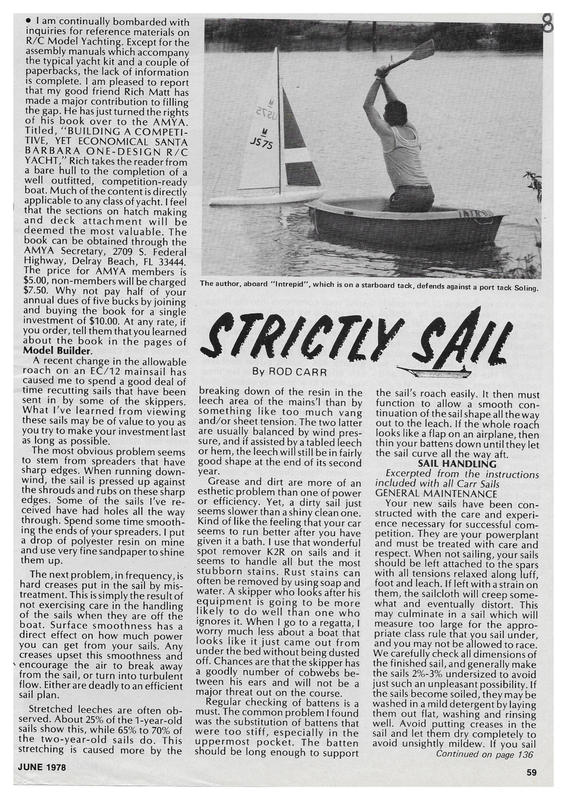
@ | am continually bombarded with inquiries for reference materials on R/C Model Yachting. Except for the assembly manuals which accompany the typical yacht kit and a couple of Bape BRE the lack of information is complete. | am pleased to report that my good friend Rich Matt has made a major contribution to filling the gap. He has just turned the rights of his book over to the AMYA. Titled, “BUILDING A COMPETI- TIVE, YET ECONOMICAL SANTA BARBARA ONE-DESIGN R/C YACHT,” Rich takes the reader from a bare hull to the completion of a well outfitted, competition-ready boat. Much of the contentis directly applicable to any class of yacht. | feel that the sections on hatch making and deck attachment will be deemed the most valuable. The book can be obtained through the ee AMYA Secretary, 2709 S. Federal Highway, Delray Beach, FL 33444. The price for AMYA members is $5.00, non-members will be charged $7.50. Why not pay half of your annual dues of five bucks by joining The author, aboard “‘Intrepid’’, which is on a starboar d tack, defends against a port tack Soling. and buying the book for a single investment of $10.00. At any rate, if you order, tell them that you learned about the book in the pages of Model Builder. A recent change in the allowable roach on an EC/12 mainsail has caused me to spend a good deal of time recutting sails that have been sent in by some of the skippers. What I’ve learned from viewing these sails may be of value to you as you try to make your investment last as long as possible. The most obvious problem seems to stem from spreaders that have sharp edges. When running down- win the sail is pressed up against the shrouds and rubs on these sharp edges. Some of the sails I’ve received have had holes all the way through. Spend some time smoothing the ends of your spreaders. | put a drop of polyester resin on mine and use very fine sandpaper to shine them up. The next problem, in frequency, is hard creases put in the sail by mis- treatment. This is simply the result of not exercising care in the handling of the sails when they are off the boat. Surface smoothness has a direct effect on how much power you can get from your sails. Any creases upset this smoothness and encourage the air to break away from the sail, or turn into turbulent flow. Either are deadly to an efficient sail plan. Stretched leeches are often observed. About 25% of the 1-year-old sails show this, while 65% to 70% of the two-year-old sails do. This stretching is caused more by the JUNE 1978 By ROD CARR breaking down of the resin in the leech area of the mains’! than by something like too much vang and/or sheet tension. The two latter are usually balanced by wind pressure, and if assisted by a tabled leech or hem, the leech will still bein fairly good shape at the end of its second year. Grease and dirt are more of an esthetic problem than one of power or efficiency. Yet, a dirty sail just seems slower than ashiny clean one. Kind of like the feeling that your car seems to run better after you have given it a bath. | use that wonderful spot remover K2R on sails and it seems to handle all but the most stubborn stains. Rust stains can often be removed by using soap and water. A skipper who looks after his equipment is going to be more likely to do well thar one who ignores it. When I go to a regatta, | worry much less about a boat that looks like it just came out from under the bed without being dusted off. Chances are that the skipper has a goodly number of cobwebs be- tween his ears and will not be a major threat out on the course. Regular checking of battens is a must. The common problem | found was the substitution of battens that were too stiff, especially in the uppermost pocket. The batten should be long enough to support the sail’s roach easily. It then must function to allow a smooth continuation of the sail shape all the wa Out to the leach. If the whole roac looks like a flap on an airplane, then thin your battens down until they let the sail curve all the way aft. SAIL HANDLING Excerpted from the instructions included with all Carr Sails GENERAL MAINTENANCE Your new sails have been constructed with the care and experi- ence necessary for successful com- petition. They are your powerplant and must be treated with care and respect. When not sailing, your sails should be left attached to the spars with all tensions relaxed along luff, foot and leach. If left with a strain on them, the sailcloth will creep somewhat and eventually distort. This may culminate in a sail which will measure too large for the appropriate class rule that you sail under, and you may not be allowed to race. We carefully check all dimensions of the finished sail, and generally make the sails 2%-3% undersized to avoid just such an unpleasant possibility. If the sails become soiled, they may be washed in a mild detergent by laying them out flat, washing and rinsing well. Avoid putting creases in the sail and let them dry completely to avoid unsightly mildew. If you sail Continued on page 136 99
Sailing…… Continued from page 59 forget to carry some spare ones in on saltwater, it is good practice to NUMERALS rinse your Saiis to stop salt buildup on the sail. SETTING CARR SAILS Your sails have been designed with plenty of flow for use in light airs with the luff wrinkles just pulled out by halyard and downhaul tension, while bent upon an absolutely STRAIGHT mast. No matter what kind of a fancy curve you think is the right thing for your mast, no sail will set properly upon it unless it is die straight, or unless you have provided a table of deflection measurements to the sailmaker. As the wind increases, bend the upper mast by increased backstay tension and maintain a straight lower mast using lower shroud tension. Increase luff tension to prevent draft from being blown too far aft in the sail, and increase foot tension to suit. Now the bottom two-thirds of the sail is producing all the drive and the head has been flattened to reduce heeling. With further increases in wind, slack the lower shrouds to allow the lower part of the mast to bow forward, reduce jenny stay tension to further flatten the upper part of the sail. For heavy air, the rig should be stepped forward to reduce weather helm and balance the vessel. Slack the mainsheet and shorten the jibsheet to produce backwinding of the main. You will now be sailin under operationally reduced sa your toolbox. Put the numerals on the sail and et it lie in a sunny window for a couple of days. The heat and UV ight will set the adhesive. DO NOT just go out in freezing weather and wonder why your hastily attached numbers shake off, give them a chance!!! SAIL LIFETIMES | Since | started making model yacht sails in 1969, | have been continually concerned about the lifetime to be expected from sails. By keeping a careful record of a number of suits in different classes, and by maintaining a log of how and when these sails were used, | can now make some general statements about longevity. CRUISING SAILS If your sails were made for sport sailing and have been used on an occasional basis, their lifetime is in excess of 4 years. This is especially true of sails made from the 3.0 oz. stabilized Dacron which comes in colors as well as white. Deterioration for these suits is in the eventual breakdown of the resin which impregnates the cloth. The cloth loses its stiffness and its ability to hold shape. By this time, it is the leeches which have gotten the worst of it, as they flogged in the wind while tacking, or by heavy air working on them when slacked to keep the boat -on her feet. area, but can reset for full power RACING SAILS To monitor mast shape, either sight down the mast while the boat apparent, but damaging ways to a vessel’s performance. | will center should wind lighten. rests on its side, or use a pocket mirror at the base of the mast to sight up it. BATTENS These important parts of your sail are used to stiffen and support the extra cloth built into your sail that lies outside a straight line between the head and clew. Your battens should be carefully worked over to allow the sail to take on a smooth Curve as One proceeds aft from the luff. Since sail shape is different from axippet to pete a we have provided you with heavy, non-tapered battens in order that you be able to shape them to fit the curve that you like in your sails. We enerally find that the battens should bend most up front and get stiffer in the after regions. The top batten usually is the most flexible of them all, while the bottom ones tend to be the stiffest. Rather than provide you with a compromise, we hope that you’ll make the effort to match your bat- tens to your sail shape. And don’ t These lose their spirit in less the discussion on EC/12-size sails (What is important is the length of the edges of the sails). If you sail a high aspect 50/800, your sails will age 20% to 30% faster, while if you are skippering a short 36/600 they may last half again as long. The first sign of reduced performance is in the mains’ leach. It is usually the result of the loads imposed on the unsupported afterside of the main which eventually stretches a bit and loses its springiness. The loose leach which results reduces weather helm, and also reduces drive as it no longer plays its role of forcing the wind to exhaust parallel to HeboatTM centerline. This will be seen as early as 1 year of hard competition sailing, especially if a good deal is in heavy air. The new tabled leaches help a little, but the cloth immediately forward of the tabling will stretch, giving you a cupped leach which promotes drag at an alarming rate. By the end of the second year of use, the typical racing main is ready to be retired. The next problem is in the jib leach. While it is not stressed as much as the main, and usually has the opportunity to lift the jib club in the puffs, the trend is not to table the leach, or to put battens in it, so the cloth Retenee and suffers a resin breakdown, allowing it to fall away. The shape and airflow in the slot goes to pot. The boat gets sluggish and starts developing weather helm in puffs that she never used to have. By the end of the second year, a jib is well on the way to needing replacement. STORMSAILS Many skippers ask if worn outsails can be cut down into storm suits. The answer is yes, but the cost is usually more than the cost of a new suit of storms’ls. In addition, they are being made of a tired cloth that is not likely to hold its shape. If you are poine te sail in heavy air, it is essential that the sails do their job of extracting power that the hull can handle from the wind. My recommendation is for new storms’Is out of 3 oz. cloth. These should be cut flat and short to eliminate heel, yet keep the hull at hull speed, and carry the extra opportunity for surfing and planing on the reaches and runs that can put you into first place. NEW SAILS My recommendation is to invest in the most efficient powerplan you t can, whether you race or sail for sport. We are firmly in favor of the California Cut jib used in conjunc- tion with a tabled main leech. You then have a jib with shape built in, but shape that can be altered unlike the fully paneled kinds. The tabling on the main leech adds life, and it adds camber aloft where mains usually flatten out. Sails of this variety have two STAR 45 Class ACCR wins in a row to their credit, and have been carried on every challenger in the EC/12 MINI- AMERICA’s CUP matches. They should be custom designed to fit your boat, and to match with your prevailing wind conditions. Questions are answered if you’ll send a self-addressed, stamped envelope to the author in care of Model Builder, or direct: Rod Carr, 7608 Gresham St., Springfield, VA 22151: ad