- Title. Author. Summary

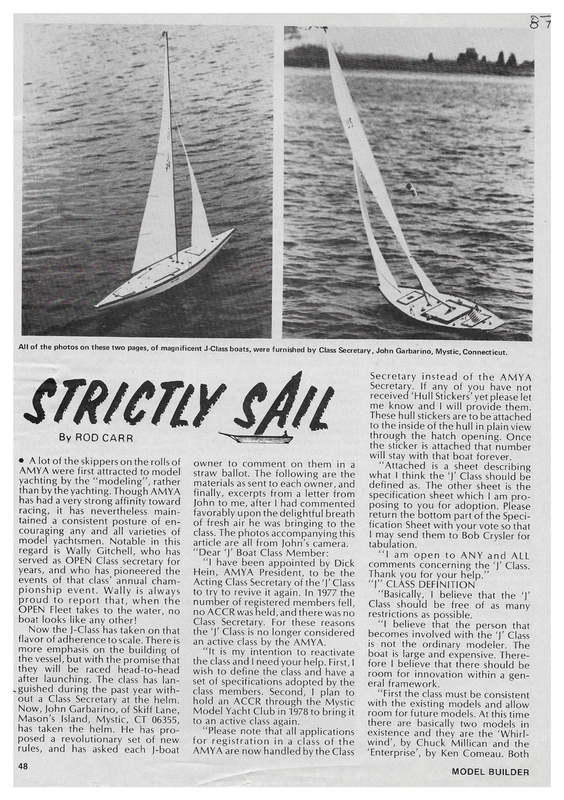
All of the photos on these two pages, of magnificent J-Class boats, were furni shed by Class Secretary, John Garbarino, Mystic, Connecticut. Secretary instead of the AMYA Secretary. If any of you have not received ‘Hull Stickers’ yet please let me know and | will provide them. These hull stickers are to be attached to the inside of the hull in plain view By ROD CARR e A lot of the skippers on the rolls of AMYA were first attracted to model yachting by the “modeling”, rather than by the yachting. Though AMYA has had a very strong affinity toward racing, it has nevertheless maintained a consistent posture of encouraging any and all model varieties of yachtsmen. Notable in this regard is Wally Gitchell, who has served as OPEN Class secretary for years, and who has pioneered the ~events of that class’ annual championship event. Wally is always proud to report that, when the OPEN Fleet takes to the water, no boat looks like any other! Now the J-Class has taken on that flavor of adherence to scale. There is more emphasis on the building of the vessel, but with the promise that they will be raced head-to-head after launching. The class has lan- ~guished during the past year with- out a Class Secretary at the helm. Now, John Garbarino, of Skiff Lane, Mason’s Island, Mystic, CT 06355, has taken the helm. He has proposed a revolutionary set of new rules, and has asked each J-boat 48 Owner to comment on them in a straw ballot. The following are the materials as sent to each owner, and finally, excerpts from a letter from John to me, after | had commented favorably upon the delightful breath of fresh air he was bringing to the class. The photos accompanying this article are all from John’s camera. “Dear ‘J’ Boat Class Member: “I have been appointed by Dick Hein, AMYA President, to be the Acting Class Secretary of the ‘J’ Class to try to revive it again. In 1977 the number of registered members fell, no ACCR was held, and there was no Class Secretary. For these reasons the ‘J’ Class is no longer considered an active class by the AMYA. “It is my intention to reactivate the class and| need your help. First, | wish to define the class and have a set of specifications adopted by the class members. Second, | plan to hold an ACCR through the Mystic Model Yacht Club in 1978 to bring it to an active class again. ‘Please note that all applications for registration in a class of the AMYA are now handled by the Class through the hatch opening. Once the sticker is attached that number will stay with that boat forever. “Attached is a sheet describing what | think the ‘J’ Class should be defined as. The other sheet is the specification sheet which | am proposing to return the you for adoption. Please bottom part of the Speci- fication Sheet with your vote so that | may send them to Bob Crysler for tabulation. “lam open to ANY and ALL comments concerning the ‘J’ Class. Thank you for your help.” “J” CLASS DEFINITION “Basically, | believe that the ‘J’ ‘Class should be free of as many restrictions as possible. “Il believe that the person that becomes involved with the ‘J’ Class is not the ordinary modeler. The boat is large and expensive. Therefore | believe that there should be room for innovation within a general framework. “First the class must be consistent with the existing models and allow room for future models. At this time there are basically two models in existence and they are the ‘Whirl- wind’, by Chuck Millican and the ‘Enterprise’, by Ken Comeau. Both MODEL BUILDER
of these boats are of the same scale which is 3/4 inch = 1 foot. Both boats have been raced in informal competition and they are equal. The proposed specifications are consistent with both models. “During the ‘J Boat Era’ there were a total of 10 boats built in this class. They were: Enterprise, Weetamoe, Whirlwind, Yankee, Rainbow, and Ranger for the U.S. and Sham- rock V, Velsheda, Endeavour, and Endeavour II for the British. | feel that this should be the general framework for the model ‘J’ Class. Basically any model scaled after one of the original ‘J’s with a scale of 3/4 inch = 1 foot should be allowed to participate. “The attached Specification Sheet is based on the above with a few exceptions which | feel are necessary to make the transition from a standing scale model to an operating scale model. ‘Please vote on these specifications as it is necessary to define the class for the AMYA. Thank you.” SPECIFICATIONS FOR THE AMYA “J” CLASS, as proposed by John Garbarino, Acting Class Secretary HULL a. Must beascale model of one of the original “J” boats. b. Scale must be 3/4 inch = 1 foot. c. EXCEPTION: The keel draft can be 2 inches deeper than scale to help the stiffness of the model. MAST a. Height: 8 feet (+ or – 2 inches) from the deck. b. Material: Wood or aluminum. SAILS a. No restriction on sail area. b. Any sail plan that was used by the original boat for which the model is scaled after (i.e. double headsails, genoas, spinnakers, etc.). RUDDER a. Must conform to the original boat from which it is scaled after. b. EXCEPTION: The rudder may be 2 inches deeper to follow the extended keel and 2 inches wider to provide extra maneuvering control. The following is most of the letter received from John Garbarino. “Here is the information you requested on the ‘J’ Class as it stands now. | was appointed acting class secretary this year and the first thing | wanted to do is set up some specifications for the class. Chuck Millican, when he started the class with his Whirlwinds, wanted a one design class but nothing was ever formally done about that. | gather that he is not happy with the AMYA and has not been a member for a couple of eas. The class was established ecause the required number of boats were sold and registered with OCTOBER 1978 the AMYA. Since then very few of the members ever renewed their memberships so now there are only 16 people who are still current AMYA members and | know some of them no longer have their ‘)’ boats. Because the class seemed to fizzle, the owners lost interest. “Here in Mystic we were building -a model of the Enterprise ‘)’ boat about the time Chuck was sellin his. Of course we were not allowe to register ours as a ‘J’ at that time even though they were compatible boats. Our initial reason for building the Enterprise was for our own private use but as time went on people kept asking us to build them a hull. We now have 14 or so Enterprise hulls out. “The specifications that | wrote for the ‘J’ class were designed to incorporate the few remaining Whirlwind owners and the Enterprise Owners into a class so we would have some numbers. To furContinued on page Ee « Cl
have with the British Boats. ~ 99) apse in Florida | found a book which is about the ‘!’ boats entirely. It is fascinating to read. Their sheer size was amazing. Th e sails would cover an entire footbal| field. The mainsail weighed one ton. The sails then were made of Egyp- tian Cotton. The costs were also very large. The crews were large and the _ parties were extravagant. The book is called ‘Enterprise to Endeavour’ by lan Dear by Dodd, Mead & Co., New York. There is an interesting picture in the book which superimoses a-12-Meter Yacht against a ‘J’ bone have been close to the 12’s and they are impressive but the top of a 12’s.mast would come only halfway up the J’s mast, about to the spreaders. A Twelve is about as long as the boom of a J boat. They really must have been something to see! The hulls of the ‘J’s’ were made of Tobin Bronze. Have you purchased a piece of bronze lately? Some of the masts were made of wood andsome were made of aluminum with about 100,000 rivets in it. Bought any rivets lately?! | could go on and on. “T recently had a letter froma club ~ ————— be INVED FROM 197 &7 ther expand the class | thought it would be wise to leave it open to other builders for the future so the class could expand. It then evolved as a Stand-Off Scale type class as there were originally 10 boats built in the 1930’s as ‘J’ boats to compete for the America’s Cup. Six boats were built in the U.S. which were the Enterprise, Whirlwind, Yankee, Rainbow, Weetamoe and the Ranger. Four ‘)’s were built in England which were the Shamrock V, Velsheda, Endeavour, and the Endea- vour Il. “Because of the size of the models | knew that there would never be widespread interest in them so | decided to keep the class as free of restrictions as possible so that the true modeler who might become involved would not feel that he was boxed in. | felt they should have room to have different sails as the original boats did, like double and triple headsails, even a Park Avenue Boom, etc. < “I have started to do some research concerning your question of whether | would be able to supply line drawings of the ‘J’ boats. The Mystic Seaport has the line drawings of both de Enterprise and the Rainbow which can be reproduced. They have suggested that | write to the Hart Nautical Museum for further help. | have done so but have had no response as yet. If it is possible | will try to provide line drawings for those who want them. | am not sure how much luck |wi vill A in Virginia Beach which indicated that they were interested in ‘J’ boats and had a few and were thinking about maybe holding a regatta either this year or next. | will be encouraging them to do so and maybe even the ACCR.” I'd like to urge any of you with an interest in a serious project to contact John at the above address. In my response, | asked him if hull lines and sail plans were going to be made available to ease the difficulties involved in obtaining acceptable plans. He indicated that an effort would be made in that direction, and that any assistance he could get from others would be most welcome. Remember to mail in your $5.00 AMYA dues to the Secretary, 2709 S. Federal Highway, Delray Beach, FL 33444. I’m still fielding questions on all aspects of the sport; send a selfaddressed, stamped envelope, along with your inquiry, to Rod Carr, 7608 Gresham St., Springfield, VA 22151.