- Poole Radio Regatta (May 28–29, 1960): 10 boats.
- Freeman Challenge Cup: 47 boats (biggest entry overall).
- Highlights: Frank Reynolds’ Seattle Fireboat “Alki”: 6 ft, 80 lb, 20 simultaneous controls. Won novelty event with dramatic fire-extinguishing demo (30-ft water jets, 15 gallons/min).
- Second place novelty: Col. Taplin’s transforming yacht (mast and sails emerged from superstructure).
- Third place novelty: R.A. Mogg controlling two models simultaneously.
- Taplin novelty boat, Speranza yachts, Vosper-type afterplane
- Lady Entrant: Mrs. Taplin (model ran out of fuel near finish).
- Design Insights (John Lewis – Sail Plan Efficiency)Key Factors for Sail Plan:
- Total area (rule-limited).
- Jib-to-mainsail ratio (recommended 12:7 parts).
- Height vs. length ratio (~3.5:1 ideal).
- Practical Tips: Avoid jib exceeding 2/5 of total area. Mast heel ~14 in. behind fin leading edge. Heavy weather: 3 smaller suits of sails; reduce luff by 10% each time.
- Advice: Start designing, learn from failures, avoid over-theoretical calculations.
- Radio Control in Yacht Research, Hull Design for R/C Models: Wide beam + high freeboard = stability and dry radio gear. Shallow draft hulls easier to drive, suitable for bad weather. Wider stern improves windward performance when heeled.
- Proposed Formula for One-Design R/C Racing:
- Glass-fiber hulls for strength and cost efficiency.
- Length ~60 in., big beam, shallow draft, detachable keel.
- Low aspect ratio rig favored for trials.
- Origins of A-Class Rule
- Developed post-WWI from 18-ft model experiments.
- Adopted in 1923 for international racing (Yachting Monthly Cup).
- Formula encourages fair rating across types; became International A-Class in 1927.
- Early dominance by British yachts; first defeat in 1935 by Norway’s “Prinz Charming II” using vane steering.
- 36R National Championship (April 23–24):
- Winner: Una (R.J. Burton, Clapham).
- 6-Metre National Championship (May 21–22):
- Winner: Helvig (C. Edwards, Bournville).

= 2 a =) “_ =© =
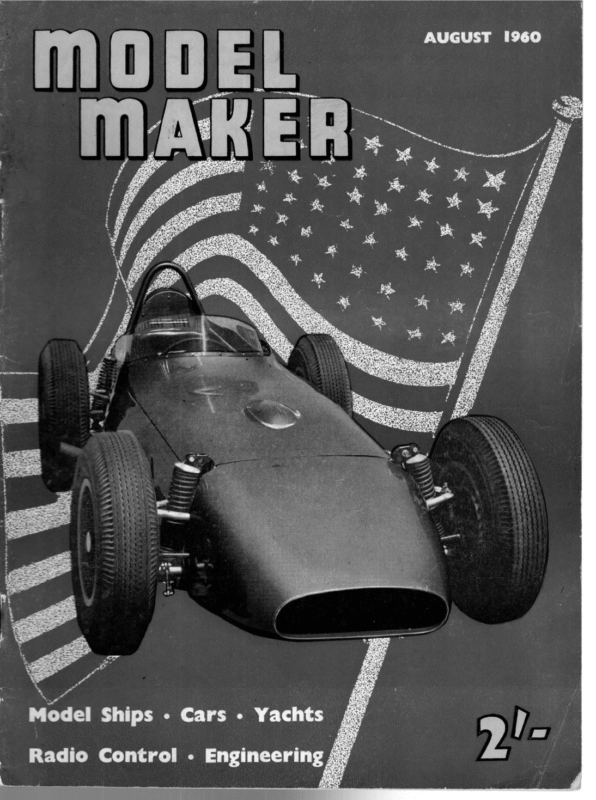
: AUGUST. 1960 OR a change, glorious weather favoured the Poole Radio Regatta this year on May 28th and 29th. In fact, the only possible grumble was that the wind was too fickle for the yacht events, especially those in which single boats sailed round the course for timed runs. The largest number of competitors in amy one event was in the Freeman Challenge Cup on Sunday, which attracted forty-seven boats; the largest number in a yacht event was ten. POO LE’S N | NTH & ANN UAL A general view of the regatta is shown above, with Satanita and Wind- rush afloat. Below, three Speranzas waiting among their turn. boats Next, Coe Westcott’s unusual vane, with the rudder tell-tale abaft. A simple bell crank linkage raises the vane for port rudder and lowers it for star- board. Bottom, Taplin novelty boat various stages. the in A glance at the results will show that there were quite a number of radio and engine failures which seemed unaccountable since they affected many of the experts and all types of equipment and engines. Nevertheless, the general standard of performance was high and there were some very fast power boats to be seen, as well as some very good sailing by the yacht entrants. An international flavour was imparted by the presence of Frank Reynolds and Coe Wescott, two top-line American modellers, and Altfreid Kleinespel from Germany. There was a plentiful sprinkling of new boats, most of which appeared to be powered with Taplin Twins though quite a few sported Gannets. Without doubt the model which attracted most interest was Frank Reynolds’ Seattle fire-boat Alki, a 6-ft. 80-lb. floating miracle with 20 simultaneous controls; operating everything on the model required four hands and an auxiliary transmitter was even brought into use. This model walked away with the novelty event with a polished demonstration which included extinguishing a petrol fire aboard a specially-constructed model in seconds. No sooner had the fire broken out (by an ‘ingenious trigger system) than the fire boat, with siren screaming, was pounding towards it with 30-ft. jets of water coming from its main monitors at the rate of 15 gallons a minute. The fire was out before the boats came together and the fire-boat then picked up a floating line and towed the wreck back to shore. It then put off again and gave a demonstration of its various functions, propelling itself by water jets alone, ranging its total of |
ee si mode MAKER) nine monitors all over the water, raising and lowering the fire tower, etc. Despite a 6,000 mile journey by ship via the Panama Canal all the equipment worked perfectly and the only thing out of adjustment was the loud speaker circuit which plays back music or speech originating on the shore. As the model cruised along in front of the crowd the operator commenced to speak, but the radio interpreted a tone in the voice as a com- Opposite, top row, Henry J. Nicholls, one of aeromodelli ng’s best known figures now bitten by the boat bug, uses the “grandstand” provided to give skippers a better view. Centre, the American fireboat Alki and crew; more details in August Radio Control Models. Right, Sue, one of the three charming Mrs. Taplins, was the only lady entrant, would have placed higher had model not run out of fuel ten feet from finish. Next row, tug Turmoil, was beautifully built but had radio trouble. Right, A. Wilson’s M.T.B. laying a fine smoke-screen. Next row, thisQ yacht used drum sheeting and unusual pulley operated rudder. Right, very fast was Alex McDonald’s Gannet boat Andy, which may, itisrumoure d, appear in kit form. Bottom, one boat was fitted witha Vospertype afterplane. Centre, “Hear no evil, see no evil… Col., mand and switched on all the monitors, dousing the crowd ! Second place in the novelty event was well earned by Col. Taplin, who put off a normal looking model; after dodging round a couple of buoys the engine cut. aoe groans of the crowd were silenced when amid horrible Joke, and Michael Taplin with H.J.N. waiting to sail in the Bravery Cup. Last, the handsome did so well Cinderella 6 metre which . grinding noises a complete set of mast and sails began to P ie Event Ml 1. Col. C. who slipped a buoy and a dinghy and operated two 4° H. J. Tapiin – : : 2 sepia 10. F.D Reynolds Be NE acidsPi a pe we a A a ne SR: ied oy ” 21°C.R.Guy… *. Kingfisher… emerge from the superstructure. When fully in position the model proved itself quite handy under sail and under complete control! Third place went to R. A. Mogg, models simultaneously, which is a lot harder than it looks. In electric steering C. Archer’s Britannic scored a close = = M: Mogg 43. AK.Wikoat Event Iv 5 ain was Coe Wescott’s Per “A” ive 4. 1. eetin sing . 1 2. L. Cassanet 4. H. J. Taplin 5. J. D. Taplin 6. M. Taplin 8. I. H. Morgan 9. G. Starling ‘7 453 gine . 9. 12. 13. 14. 15. G. Starling A. Kleinespel L. R. Wood I. J. Wood … H. Wraith … 18. G. E. Goodfellow 19. E.H.L. Woolley 22. 23. 24. 26. W. S. Warne C. A. Giecco G. M. Tipton C. Dews… 27. G. A. McDonald 28. R. M. Mogg 29. M. Gulliford 30. P. Murphy Boat Pool Porpoise vee re mae. i … … ake \.. Andy 533 … Whirlwind os yaa … Io Sea che 42. R: Foxwell ear 2m. 59-2s, eM se 2m. 48-2s, 2) ch 3m. 28s. H. tes, L. Morgan R. rey Wo –. 8m, 42s, … 5m, 24s. GYPSY, + – hes …aSatanitans oa | mee? vr sa fx peer rice Miss ape bah … Isle ee Japonica oo Dal = den Ses 3rd 38. 41. 42. 44. Ist G. A. Nurthen . Gannet I Martin mn he cio G. Honnest Redlich Thalassa H. J. Nicholls A. R. Pearce R. Foxwell Boddy ae an ook 02 ee … Britannic —… 120 em oe zs a … 201 (9m. 42:-5s.) . 178 eS … 192 60 ve Ea Bs Jt 0 ‘ ~ 30 45. E. Marcus … i! … Turmoil =a mi 4. …. Henrietta HOGG See OF CUP CHALLENGE f : (yachts under 55in. sailed OED. H. J. Taplin 25, J.C, Hoge… 33. R.1. Foster. Event VII Points 11. Coe E. Wescott e: mi atlies 49696: … Sunray If _… Cinderella “0 3m! 40s. “3m! 11s. TAPLIN CHALLENGE CUP (yachts over 5Sin. sailed simultaneously) 1. Col. C. E. Bowden Morven Junior 3. A. Wilson… … Actina CRAFT 2nd 3rd Ist 16. 17. =.20. 25. 31. 35. 44. A. Boddy 384 . Miss Seattle… R. Curwen … … J. Gascoigne … H. C. Aldridge … J. C. Hogg… … J. Merrick _«sG. Honnest Redlich … Ist Aas 46. M. Pocock… Event VI 4 49s.) aS ..« 165 me Nee … 170 = (6m. Ae .-. 202 (8m. 7s.) 2nd 65 … +e a oo R.F. .. RF, w. 45x Spe ye? ee | 85 coe ALS Radio Failure WY . Miss Mercury el = ey “Lt sake 47. R. Nicholls… acogeekts 142 Ree … Whirlwind cs … Sea Commander 36. A. Washington 2nd bv es KJ R. M. Mogg P. Murphy… … Sete Aus! . Loe … Hag3 rd 430; LOG es … st oan Bins: 2082 22. W. S. Warne 23. C. A. Giecco 37. C. Archer … Yee SA oe igo AN. SOR. … 2m. 34s. tee ek oss dm. 8s, eae 00 AOS … 148 … Amazon … The Bodge 2nd 42s, be aoe (Sm. 5s.) 3rd Tele … Customs Launch .»» 3rd ace SISOS: De Gm. 166. eee Om. SA. bes is Bye BR 0 wt ee ot: oe are R.F.= te a —…. Windrush see aarti + Sunligh 15. H. Wraith … -.» Solong … 17. J. Gascoigne … Stardust 18. G. E. Goodfellow Tina… 28. 30. 32. 34. 35. eae un te gr G — ELECTRIC I. 26. C. Dews E.F. 4. H. J. Taplin … Jemima 10. F. D. Reynolds… Alki… 217°C. R.-Guy . … Kingfisher 28. R. M. Mogg . Typhoon 34, Martin eid <0) oe 37°C. Archer... ... Britannic E.F.= Engine Failure 5m. 26s. 27. G. A. McDonald ... Andy II... 1m. 533s. ... Im. 52s 36. A. Washington 6m, 24. G.M. Tipton... Cabin Cruiser... Im. 44-5s, ee ‘ia by ie ... ... 19. E. H. L. Woolley ... Too Saucy 21. C. R. Guy .« Kingfisher veo. KeEs re, aa) 38. H. J. Nicholls... Miss Mercury ... Be Result -. RF. Commander 2 32. G. A. Nurthen» ... Gannet I ae G. Honnest Redlich Thalassa 2. e. 1. Poolesy | --jets og eng . coe 2mm, 22/23, Samantha “ep ee Um, 42s, -.. Pepys ... Aeree ... Aztec’ 2.7 oe The Bodge__... Cabin Cruiser eae ol wee N56 Miss Seattle... ww. RF. ... “ee . Redlic 16. FS. Wood Pee! 2 ce --. 2m. 15s. ... Customs Launc ... Catalina Ss i Se ... Japonica ... Tapioca... ... Solong ... Time RF, ... Se ays wees ... Aquarius ... Cygnus ... Honnest rs M ten LAP RACE ... Margaret ie ae ee 7. s. M.sraplin ; FULL ENTRIES AND RESULTS Event 2nd a 5 ae ,"" Lumpdaiie FREEMA!iks aon eri a a 2. L. Cassanet Hie Margaret 35 . H. J. Taplin ... Kittiwake w.. 193 Altogether, a very fine meeting with much of interest No. Competitor 1, Col. C. E. Bowden G. 44.A.Boddy ... | ay which will still further add to Poole’s reputation as the TWO Taplin 33. R.T. Foster nck; Cimderella an unusual square vane built of balsa and tissue covered. Another feature of the model, which may well be copied, is a tell-tale which shows the skipper the position of his rudder at any time — see photograph. ; for RIC eee of the ia J. Merrick boat (built by Gus Lassell in ic H. Coe E. Wescott 16. R. Curwen... My . ecrane * a: SRORE.-31. J. 1947) and fitted with Sutomatic. vane shretiig: ustig ed. i NOVELTY COMPETITION _ ScCRATCHE! -. Whirlwind & Typhoon Sia ee oS BRAVERY CHALLENGE CUP (mixed yachts, timed course) Time 1. Col. C. E, Bowden Tentatwo at ase bins 1983 1 : win with its incredible steering mechanism, by means Of which both motors are cut whena steering signal is sent and the rudder switches in the appropriate motor astern, which pivots the ship in its own length. : ore Notable in the sailing events was the success of R. T. Foster’s sweet little 6-metre which had been onthe water only once before this event. The other outstanding model Fe es : Z E. Bowden Windrush Senorita Painted Lady Sunlight Gypsy : ... Satanita i nae ... 3rd ... 2nd son 186 3rd 2nd Ist
nh Ns, Yacht A good all-round rule is to divide the available area into 19 parts and put 12 parts in the mainsail and 7 parts into the fore triangle. This proportion has been well proved but no serious harm will be done if the size of the jib is increased somewhat. Do not, however, let the jib exceed 2/5 of the total area without giving the matter careful thought. The height of the sail plan should be the maximum allowed by the rule in the case of the “A” Class and for all classes the length on luff to length on foot ratio should be approximately 3:5:1. Very high ratios give high windward efficiency, but it is a law of diminishing returns and a ratio of 4 : 1 is the practical limit. For down wind sailing a low ratio is required so it will be found that 3:5: 1 produces satisfactory all-round results. The amount of curvature on the leach of the mainsail Design Part Five by John Lewis EFORE any further outstanding development in hull B design can take place it is probable that a distinct improvement in sail plan efficiency will be necessary. It is difficult to see the line of progress with the present rules governing sail area measurement. On the other hand, I am not advocating any changes in the rules. Such things as rotating streamlined masts, bipod masts, rigid sail surfaces, etc., have all been tried and with some limited success, but none of these devices has become must not exceed 4 in. on the “A” Class and a maximum adopted for one reason or another. Once again the beginner is advised not to experiment for the first few designs particularly as his hull design will be somewhat immature. of 3-5 in. is advised for the 10-rater class. The sail plan having been established it is now necessary to position it over the hull in such a way that the behaviour of the yacht is satisfactory. It is well known that if the sail plan is too far aft there is a tendency for the boat to luff into the wind. Conversely, a sail plan that is too far forward will cause a tendency to fall away from the wind. things to decide to establish a sail plan. it is not difficult to find the optimum mast position on —s- From the designer’s point of view there are only three Providing the hull itself does not change trim on heeling 1. Actual area. 2. Proportion of jib to mainsail. 3. Height of plan in relation to length. The first consideration is settled by the rule to which the design is being prepared and, of course, it should not be necessary to say that the rules should be most carefully studied. Unfortunately there are very many owners and some designers who are not adequately familiar with the rules. The second consideration is rather more difficult as there are so many conflicting opinions and very little scientific data available. Ever since yachts adopted the Bermudian rig experimenters have tried differing the ratios of jib to mainsail. There are certain measurement advantages to be obtained by having a very large jib. but practice shows that windward performance suffers if carried too far. There is no point in looking at full size yachts for help as they are able to carry large overlapping jibs which give a big increase in unmeasured sail area and although the efficiency of the whole sail plan per square foot is lowered there is a net increase in driving force. We have not yet developed a method of tackling large jibs on models so we have to do the best we can. a model after a few trials. It is not yet possible to calculate a theoretical position for the mast and much thought has been given to the problem. None of the text books on yacht design offer a reasonable solution and it is left to the designer to examine previous design and to position the sails accordingly. It is a waste of time calculating the centre of effort of the sail plan and the centre of lateral resistances of the hull as both these centres move by some unknown amount as soon as the yacht forges ahead or makes leeway. A good rule of thumb for a model is that the heel of the mast should sit about 14 in. behind the point where the leading edge of the fin joins the canoe body. With this as a starting point the usual adjustment possible with the mast slide will be adequate to tune up the yacht without difficulty. For sailing in heavy weather it is usual to provide at least three smaller suits of sails and a satisfactory way of sizing them is to reduce the length of the luff by 10 per cent. in each case. The length on the foot can be the same throughout although it is sometimes thought wise to shorten the foot by 4 in. or so in the case of the smaller sails as they are subject to heavy stresses and may stretch beyond the measurements entered on the rating certificate. I hope that this series of short articles will have to some extent obliviated the fears of those who hesitate to start designing their own yachts. When one reads some of the bilge that is put out about yacht design it is no wonder that talent is diverted into other hobbies. Is it significant that the most successful designers in full size yachts write the least? They know how little they know and know enough to prevent them being dogmatic about any single technical aspect. My recommendation is to get something on paper and then build it. If it is unsuccessful, find out why and design and build another. FORTHCOMING YACHT REGATTAS July 30/31 MODEL MAKER TROPHY August 14/21 British Open Championships M Fleetwood A Gosport M Harwich September 3/4 British Open 4 Open Radio Regatta Championships 17/18 British Open R/C Championships Do not be afraid of making mistakes, but press on and let us see more designers instead of sticking to the saine few all the time. It is certain that if more interest is not R/C Rick Pond Q Witton Lake Entries close for M Championships August 6th, and for Q Championships August 20th. taken in this aspect of the sport the movement will die. There is nothing wrong with the Rating Rules as they stand and it is only necessary to encourage design for the sport to go from strength to strength. 386
z ) 1 Generally speaking the longest and heaviest hulls produce the best racing results; this means 54/55 in. L.W.L. and 54/60 lb. displacement. The new design has 55in. L.W.L. and 59-5 lb. displacement. It would have been possible to gain a little extra sail area by a further increase in weight but my feeling is that 60 lb. is plenty to dispose of such a waterline length without coarsening the lines. The fact that many of the characteristics in hull form of my 10-rater designs have been retained in Moonshine is concealed by the lack of violent tumblehome. There is a school of thought that some of my 10-rater designs are successful because of my use of this device, but the truth is that the character of the underwater waterlines provides the key. I use heavy tumblehome on my 10-raters because I like the look of it on that class. From a performance point of view I believe that the shape of the midsection for the first 2in. below the L.W.L. is far more important than the 2in. above it. After all, the reduction of “in wedge’’ by even the most violent tumblehome is but a fraction of the total displacement— it doesn’t even extend the full length of the hull and, furthermore, it sits in the hole formed between bow and stern waves. \ an) 4 hn \ WA ‘ : The cross-section of the new design shows how heavy displacement can be carried without increasing the beam and body depth beyond reasonable limits. It is convenient that the form of cross-section can also produce the waterline endings that I prefer. Fairing up the canoe body of the boat was simplicity itself and a look at the A attempt to reduce lateral area by abbreviating the profile in any way. The total wetted surface is quite normal and naturally the builder will give the hull a glass-like finish— in this respect a painted hull is easier than one that is varnished. The sail plan is unexceptional for the class and I feel a : e pe sure that Moonshine will provide excellent sport. To produce championship success, however, the very best of sails and equipment must be used. Two boats are now building to this design and as they are local to me I am looking forward to the sailing trials in a few weeks’ time. Now is the time to start building for the 1961 championships at Fleetwood. MN. iat diagonals shows that she should be extremely easy to plank up. The keel carries quite a fair displacement and I have gone as thick as I now feel wise.*So that no disadvantages shall occur to windward there has been no Hl 387 We ag \ re \ V 3NIHSNOOW 3) woe maw TD “He “ew esava men * T will have been noticed that several times in the previous articles I have expressed the opinion that the “A” Class is the easiest rule to which to design. A study of previous championships shows that all types and sizes are capable of winning and that with this closely controlled rule the efforts of the skipper and his mate count for more than in any other class. This is not to say that any old boat can win the championship, as the standard of fitting out and sailing is very high indeed, but that the differences in hull form within the rule do not produce the variation in performance as great as, for example in the 10-rater class. The designer of an “A” Class should firstly consider the sail plan. As the rule limits the height of the jib and mainsail he should decide what is the greatest area of sail that can be efficiently set under those heights. It seems to be established that 1,600 sq. inches is the maximum area necessary and a minimum of 1,520 sq. inches. siaryover Wi ssivelsivie JDIAWIS SNVId Y3IXVN T30ON AUGUST, 1960
AUGUST, 1960 Fig. 9. The author’s two identical glass fibre hulls of cabin cruisers are sailing to windward under radio control, in a comparative test between a high aspect ratio and a low aspect ratio rig. On average the latter won. Note the detachable moulded glass fibre cabins to protect the radio boxes. _—— ee Part Three (conclusion) by Lt.-Col. C. E. Bowden Radio Control in Yacht Researeh The advantages of beam and ample freeboard for model radio racing yachts. UCH has been said in these notes concerning the race-winning performance and good helm balance of the American shallow beamy asymmetrical yacht hull. Let us now consider why large beam and ample freeboard provide stability, and a good range of stability respectively. This is a feature desirable for the model radio racing yacht because it should remain as dry as possible in order to relieve the anxious mind of its owner in respect of the expensive radio gear. Radio also requires a very buoyant, shallow draft, easily driven hull, to carry the extra weight of radio. It is hoped that Fig. 7 will explain the main features of stability through beam and freeboard better than a long written explanation. It should be emphasised that only the main points at issue are considered in this sketch, and I have omitted any smaller side issues for the sake of clarity. The drawings are purely diagrammatic for the same reason. It is not always appreciated that the average sailing cruiser, and indeed most yachts, have their centre of gravity just above the waterline. Some think that all hulls have the C.G. below the waterline to gain stability like a pendulum or kelly. This is not usually so in fullscale craft. Stability is affected by beam, freeboard and keel weight whilst reasonably high weight reduces overliveliness in roll or pitch in a seaway. If the reader will study Fig. 7, it will be noted that as the hull heels from the upright position in (A) to that portrayed in (B), the centre of buoyancy B moves over to a new position B.1 which provides the righting couple (A) ——. Where the upward pushing force through (B.1) strikes the original centreline is the metacentre (M). The distance between (G) and (M) is the metacentric height. It will, therefore, be understood that increased beam increases stability, whilst increased freeboard will increase the range of stability by delaying the immersion of the deck edge. A beamy hull with low freeboard will be initially stable, but the stability will suddenly go as the angle of heel is seriously increased. This is an important point in a radio racing hull which will obviously favour high freeboard. A long metacentre height gives a stiff boat with quick roll, and a shorter metacentre height provides less stiffness and a lower period of rolling. A correct compromise is necessary. The smaller sketch, inset (C), shows the situation when keel has got out of control to the point where (G) is vertically over (B.1) and stability goes. We would obviously like very wide beam and high freeboard, but all design is a compromise between length and beam to get reasonably fair lines, remembering that greater beam can be used for stability if the hull is shallower because the path of the water is easier below a shallow hull, with less resistance than below a potbellied, big-beamed deep hull. The greater beam provides more upright sailing for better keel effect in windward work, but the skill of the designer is in deciding upon the best all-round proportions of beam, freeboard, draft, etc., of the hull for the task in hand. Perhaps the sketch Fig. 7 may give some indication as to why a shallow draft beamy hull with reasonable freeboard can be a very suitable shape for a radio racing model to take the average bad weather we usually encounter in this country. Such a hull can be fast enough for One Design racing and prove dry, stable and manoeuvrable. Great speed in the design of a One Design Class racing yacht is not usually the paramount consideration. Good racing is obtainable if all are similar in speed characteristics. Some interesting and significant quotations. To support these notes on the question of the wider sterned American type hull, I propose to give three pertinent quotations that apply to the subject. Contemporary thought by successful leaders in a specialised field like yachting is invaluable as a pointer to design considerations. Design development is usually a slow matter based on many opinions borne from practical successes, hardening into some well-defined direction. It is seldom changed overnight by one man. The first quotation is by the well-known British writer and naval architect, and regular contributor to Yachting Monthly under the signature of Argus. Argus has also written several leading books on yacht design, and numerous articles under his own name, and recently wrote in Yachting Monthly: ‘“‘The shaping of beamy, shoal draft hulls is one of the most interesting questions in yacht design today. Americans, with greater experience of the type than ourselves, usually adopt in an extreme form the wedge type of hull which everyone was damning in the days not long ago when hull balance and metacentric shelves were occupying so much attention. In terms of metacentric balance, the typical American shoal draft centreboarder, by Olin Stevens for example, has a violently-crossed shelf. Hulls have full sterns, the greatest beam is well abaft the mainsection, and the bows are of notable fineness, with waterlines running out to almost straight lines to a small angle of entrance.” 405 MM
. EE ——— Fig. 8. The below water lines of the author’s glass fibre model cruiser are seen. Note long narrow easy entry, big beam, shallow draft, high freeboard, max. beam aft of centre, and wide flattened sections and stern aft. Also note instantly detachable bronze cast keel, located by one pin. we obtain support which lessens pitching and heel. Observations and experience support this belief. It is even possible that wide sterns obtain a forward push from the stern wave.” Since that conversation I have frequently watched stern waves of racing yachts that run a smooth anti- aoe pitch course. Have a look, unprejudiced reader, for yourself and see if you agree — I believe you will. Lastly, let me quote what that noted American designer, Francis Hereshoff, in his book “The Common Sense of Yacht Design’ has to say on the subject. His words on waterflow and the wider after sections are instructive. “At first you might think a cigar-shaped hull (symmetrical hull) on top of a fin keel would keep its centre lines parallel, or you might play with the so-called metacentric shelf theory that so many amateurs have been playing with, but these things are bad, for the fact is our heeled hull is passing through water which, near the surface, is moving to leeward” .. . “So you see there is good reason why our modern yachts, which are wider on deck aft, go the best. In other words, when they heel the after weather quarter is lifted out of the water, but the after leeward quarter carries the lines to leeward so that when proportioned properly, the hull and keel are working in unison, but on a yacht which retains its same centre lines in heeling (the symmetrical Argus has more to say on the subject in the March issue of Yachting Monthly which will interest the enthusiast on yacht design. I will now turn to a well-known American designer who visited my home with Dr. Lamont, and saw the Rhodes shallow draft, wide sterned cruiser, in 9-ft. long model form, shown in Fig. 1 of Part I of these notes. We discussed his views on pitching and the wider-sterned American designs, relative to our British narrower, more symmetrical models. His words ran, as far as our notes record, close to the following: “There is, in spite of all the tank work that has been done, still much to be learnt about the forces acting on a hull in motion. We know little about the variation of water pressures over the hull. In regard to sterns we do not know exactly what the stern wave does to the stern, but we know that the waterflow is different from its action at the bow, particularly as the speed rises. We try to fit the stern and the after sections into the observed waterflow. The wide American stern reaches out to the leeward stern wave as the hull heels when sailing to windward, and from this Fig. 7. Ample beam and freeboard create easier “upright” sailing to carry more sail and permit the “hydrofoil” keel to do its work efficiently in windward work. A dry radio boat results. A or ‘cigar-shaped’ hull: author’s note) then the hull near the surface is trying to go to leeward with the surface water and the keel is trying to follow a more weatherly course which course results in eddymaking.”’ It might be remarked that the waves and surface-water created by the wind are both attacking the windward sailing yacht from the weather side at a considerable cross angle, and a simple sketch will show why the wider-sterned unsymmetrical hull makes a curve to windward in the water when heeled, which fits in towards the attacking flow, whereas the symmetrical “‘cigarshaped hull’’ remarked upon by Hereshoff, curves off to leeward and fails to fit anywhere near into this surface flow angle of attack. It is why the symmetrical hull has a tendency to bolt away from the wind and the asymmetrical hull has a tendency to work towards the wind. Formula for a modern One Design Radio Racing Model. In view of our model testing by radio, described in Parts I and II of these notes, it is not unnatural that I should have formed some definite impressions as to the type of model radio racing hull that will suit my requirements housed, to. Centre of gravity on most is sailing cruisers High freeboard \ Waterline pees =< A copsize with Gand Bl. on same vertical fine Low C ‘Pulldown of gravity) a hti we tne couple” lush up by lateral Payety to B.l, 406 a_ one-man highly shall freeboard portable, operated we say, easily model, 24 to 7 NOTES: 1. If overheeled, A high weight reduces Over liveliness ina sea. for carry, Fig. B just above waterline, Centre of buoyancy and G and B become on same vertical line and boat loses stability. 2. Where the line of force through B.1 meets the centre line is the metacentre M. 3. The distance between G and M is the metacentric height. 4. Big beam and big freeboard increase the righting couple (A). 5. A large couple (A) provides lower heeling, greater sail carrying, more effective ‘hydrofoil’ keel operation in windward work for radio controlled model racing yachts. On heeling centre of buoyancy moves out to B.1. G remains approx. where it was, thus the weight of the boat is pulled down by gravity whilst the water pushes up at B.1. The wider (A) is the greater the stability. This moment arm is affected by beam and freeboard.
AUGUST, (4) The hulls and cabins must be made from glass fibre which, once the form and initial female mould are paid for, will drastically reduce hull costs, as well as providing tremendously strong light hulls that require no painting if the colour is moulded in. Glass fibre cloth and not the cheaper glass mat should be used. All hulls will be exactly the same shape to ensure the best One 34 lb. of radio in a box dropped into a hatch in the deck. My formula at first sight may surprise some people, as it runs contrary to the accepted narrow racing shell we have become accustomed to in model yacht racing circles, such as the rating rules have produced in the “A”’ Class, Ten-rater, Marblehead, and the recently proposed 5-5 Metre for radio. This formula may interest some fellow enthusiasts, or set others thinking. I am convinced it will suit many people not blessed with deep pockets, and unlimited storage space at home and in Design Racing. (5) The matter of size is a tricky question, so I drew out a hull on the above lines in 6 ft. size, and also in a length of 60in. Whilst the six-footer is attractive, I feel that radio gear is now coming down in weight so drastically due to transistors, smaller geared electrical, servo motors pioneered in Germany, and “Deac’ accumulators, that within the year we will have superhet non-interference radio boxes weighing not more than 34 1b. at the outside. Anyway my hull will carry 43 Ib. easily. In fact, 1am having a 33 lb. box made, a miniature car transport. The Formula (1) Now that tactical manoeuvre is available through radio control, One Design racing will undoubtedly provide the keenest battles of helmsmanship, skill, and personal trial of wits, as it does in full-scale racing, where all the hulls and rigs are similar. The winning emphasis will be on the helmsman’s skill rather than on constant expensive alteration of design features within some rating rule, trying to cheat the rule by periodic modification. Although this will not suit the professional designers, I fear, I plump for One Design racing now that the design of radio is settling down. (2) The narrow deep-chested racing hull, with low freeboard, such as “A” Class, Ten-rater, 5:5 Metre and Six Metre, are not suitable, for they overheel with their tall rigs and lack of adequate beam and freeboard when radio is laden. They are “wet” boats, and wetness of the existing 84 lb. boxes I use. This sort of gear is sure to be produced by manufacturers in the near future to meet the rapidly-increasing ’ demand due to radio model yacht racing popularity. The lure of such an easily operated and carried model such as this big beamed shallow draft radio “cruiser” of only 60 in. in length is very great, for cost of production will be really low, in relation to the present “A” Class and Ten-rater wooden hulls and yet such a “glass” hull should sail fast in almost any difficult weather encountered, and yet keep the radio dry. spells disaster to radio, however well waterproofing is Most readers will know how compact a Marblehead is to house and transport in relation to an “A” Class model. My formula boat can now be produced not much larger than a Marblehead that will take rough water with dry radio under its moulded cabin, whereas the standard narrow-beamed Vane type racing craft is too wet a boat for radio in bad weather. A model of the above formula is now under construction in glass fibre to see if its performance comes up to expectations. Fig. 8 shows the proposed hull in larger size with its detachable bronze cast keel, whilst Fig. 9 depicts two of these same glass fibre models -sailing to windward on a light day in a test of high aspect ratio rig versus low aspect ratio rig under dual radio control. Information so far gained by these comparative sailing trials suggests a low aspect ratio rig for our 60-in. formula radio One Design racing model, and that is the rig it will get. attempted. A wet boat is a constant worry to the owner who fears sailing in bad weather, when some of the most exciting racing should take place. These narrow deep hulls and tall rigs require a heavy keel weight to cart around, with the maximum inconvenience to the unfortunate owner. (3) The real answer is to take advantage of modern full-scale wide-beamed sailing racer cruiser advance, and design a light displacement buoyant cruiser hull with big beam, adequate freeboard, and shallow easily driven draft, with low rig. This will give ample stability, and easy buoyancy for carrying the radio weight, and the lower weight keel can be modelled on my 7 ft. 6 in. hulls as instantly detachable and easy to 1960 carry. A detachable cruiser-like moulded cabin in glass fibre will, together with the ample freeboard and low heeling, keep the radio dry as it has done on the above hulls. Standard applies. Track—4 lane, M.R.R.C. rail and return, 70 ft. per lap, automatic lap counting. Trophies to winners in final and semifinal events, both classes. Address all cars to Bob Sellers, 15 Cherry Street, Tiffin, Ohio, U.S.A. Return postage via surface furnished by DIARY FLEETWOOD R/C MEETING host club. Power boat fans from Fleetwood and Manchester have got together to stage a North-Western R/C regatta at Fleetwood on August 21st. If adequately supported this will become a two-day annual event to include R/C yachts from 1961 on. Details and entry forms from G. M. Tipton, 20 Beamsley Drive, Woodhouse Park, Wythenshawe, . Southport Grand Prix The sixth International G.P. will be held at the “Land of Little People’? at Southport September 26th to October 2nd inclusive. Events 200 lap G.P. and 150 lap sports car, heats and finals on October 2nd. Full details available from H. E. Hatley, 49 Grantham Road, Birkdale, Southport. Note that postal entries must be received Manchester 22. Brockwell Park R/C not later than September 17th. South London E.P.B.C. R/C Regatta on August 7th (starting 11 a.m.) includes Steering and Triangular Course Race, the latter open to single or multi-cylinder engines of up to 30 c.c. Steering will be scored as last year on the club’s patent scoreboard. Details, L. Cassanet, Aug. 23 Leander Road, Brixton Hill, S.W.2. M.P.B.A. International 6 7 The “‘big’’ meeting at St. Albans will be their own regatta on Sunday July 31st and the International on Monday August Ist. Sunday’s events start at 12.30 with nomination followed by all hydroplanes, a steering event, and a second run for hydroplanes. Monday is speed all day from 11 o’clock; both days finish at 6 p.m. Record entry at St. Albans for straight runners is fifty-six and the club hope to beat this total; they also appeal to all hydroplane enthusiasts to enter. Sunday evening there will be a dinner in honour of the continental guests. Further details P. Lambert, 6 Molescroft, Sept American Invitation Oct Tiffin Grand Prix and Sports Car Races September 17-18, 1960. Entries invited in both G.P. and sports event. 1/32 scale—Southport RE. London Brockwell Park S.E. Altrincham Lindow Common 14 14 21 28 RC SR Sp SR RC Sp SR Herne Bay Southampton Wolverhampton Grand Regatta 4 SR RC Walthamstow 4 11 Farm Avenue, St. Albans, Herts. FORTHCOMING REGATTAS ag addition to those listed elsewhere) Crosby Millhouses Park Sheffield RC SR Sp SR SR RC 18 RC 16 RE 18 25 SR RC _ SR RC = Radio Control 407 M Kingsmere Brighton Bromley and S.L. West London Brighton Park Pool SouthamptonCommon W. Park Pool Victoria Park Victoria Park Rushmere Pond Brockwell Park Round Pond SR = Straight Running Sp Speed (To be continued)
The Origins of the A Class _ rating rule for Model Yachts H. B. Tucker traces the story of A ae and uncovers much model yachting history ALTHOUGH there was no organised model yacht racing during the 19141918 War, some members of the Model Yacht Sailing Association managed to do a certain amount of experimental work at the Round Pond, Kensington Gardens. This mainly consisted in trying out 18-footer models on a scale of 2 ins. to the foot to a new rating formula devised by the late Major M. Heckstall-Smith for the Boat Racing Association. The B.R.A. was formed by yachtsmen to cater for small boat sailors, and was eventually taken over by the Y.R.A. The B.R.A. 18-ftr. Rule as applied to models was :— Ee VS SEX VS = 3627 W 36 ins (18 ft. on a scale of 2 ins to a foot) Where L = Waterline found as below, with the addition of (1) 1} times the difference between the girth, covering board to covering board, at the bow ending of waterline and twice the freeboard at that point, and (2) 1/3 the difference between girth and freeboard at after ending of waterline. To find the waterline (L.W.L.) a verticallift of 2.4 lb. is to be applied to the model floating in the measurement tank, this lift representing scale weight of crew and compensation for difference between fresh and salt water. Where S = Sail Area. Where W = Total weight of model less 2 Ib. crew weight. The novelty of this rule was the introduction of a two-part formula, of which the first directly encourages a light displacement boat, whilst the second favours heavy displacement. Another point of interest about this model class is that the L.W.L. is measured without crew, as was subsequently done by a different method in the I.Y.R.U. 6-metres model class. After the War, the 18-ftr. Class was adopted for full-sized yachts, but proved rather small for the Solent, and was dropped. The 18-ftr. models were very nice little boats, but the Class was never popular taken in feet. Otherwise there was no difference. Mr. Daniels accordingly built ‘Endeavour’ A and in 1922 took her to the States, where she was beaten by the American “Polka Dot?’ sailed by Mr. A. E. Bull. However before Mr. Daniels returned to England, the Americans promised to give him a return match, and the direct outcome of this promise is the series of international contests for the “Y.M.’’ Cup which continues to this day. In passing, it may be of interest to note that twelve years later in 1934, Mr. T. O. M. Sopwith repeated the name “Endeavour’’ for his unsuccessful Challengers for the “‘“America’s’’ Cup. On returning to London, Mr. Daniels called on Major M. Heckstall-Smith, who was then Editor of the Yachting Monthly, to tell him about his American trip. As is well known, “Bill’’ Daniels believed in using scale sailing models for testing fullsized yacht designs, and the Major concurred about this. Now at that time, European yachtsmen were racing yachts to the 1920 LY.R.U. Rule, while Americans used their own Universal Rule. It was the Major’s idea to find a rule that would be acceptable on both sides of the Atlantic, and thus promote Anglo-American racing in the smaller classes, particularly the 6-Metres. To further this end, the proprietors of the Yachting Monthly offered the first Yachting Monthly Cup for international competition with 6-Metres models (on a scale of 2 ins. to a foot) to a new formula promulgated by Major Heckstall-Smith. These models were subsequently adopted as the International A-Class. The formula is:— L+vS LxvSs = Rating 4 1238vyD Where L = L.W.L. plus } any excess in Quarter Beam Measurement over and above percentage of L.W.L. given by the formula:— Percentage = 100—JDE.WL.L. Where § = Sail Area measured in accordance with I.Y.R.U. regulations. and Where D = Displacement (Volumetr c). It will be seen that the Y.M. (or A-Class) Rule, like the Major’s earlier 18-ftr. Rule, is in model yacht racing at Kensington with this is that any tendency to produce an undesirable type of yacht can easily be outside the club where it originated, this also was dropped after a few years. Personally, I still have a sneaking regard for the class, as in 1921 I made my debut an 18-ftr. of my own design and building. About this time, our old friend, the late Mr. W. J. Daniels, issued an open challenge to any American model yachtsman to meet him in a series of races. This was accepted by the Central Park M.Y.C., New York, for races to be sailed from skiffs on open water with models to the American “B’’ Class. These models were boats having a rating of over 38-in. but not exceeding 46-in. by the American ‘Universal’? Rule:— 0.18xLx yS= Rating avD Where L = L.W.L. plus } any excess of Quarter Beam Length over and above percentage of L.W.L; given by the formula:— : Percentage = 100— VL.W.L. Where S = Actual Sail Area. Where D = Displacement (Volumetric). For models all measurements were taken in inches, whereas for full-sized craft they were a two-part formula. The great advantag e of corrected by an adjustment of the constants. The main difference between these two formulae is in the calculation of L. In the 18-ftr. the ILY.R.U. system of bow and stern taxes was employed, while in the Y.M. the American Quarter Beam Penalty is used. The substitution of the cube root of the Displacement in the later rule for the cube root of the Weight in the earlier can be regarded as tidying-up the formula by using the same units of measurement throughout. Another interesting little point is that apart from the constants, the second hale of the Y.M. formula is the Universal Rule. From its inception the new model class was a success. Nor was this to be wondered at, as the rule gave designers plenty of scope, yet still rated different types fairly together. Moreover, the boats were handsome, upstanding craft that were a pleasure to handle. Hence, when a Danish Challenge for the ““Y.M.’’ Cup was received in 1923, there was already quite a fleet of these yachts 408 from which to choose our British representative. The first Gosport Regatta was accordingly held in 1923, and after a very strenuous Selection Race the honour of represe nting Britain was gained by “Invader’’ (owned by Mr. H. Scott Freeman, Staines M.Y.C., and designed, built and sailed by “‘Bill’’ Daniels), which followed this up by her vanquishing Danish opponent. A second Danish Challenge followed in 1924, and again Mr. H. Scott Freeman proved the winner with a new boat, the celebrated “Crusader’’, which also was designed, built and sailed by the redoubtable Mr. Daniels. In 1925 our Challenge came from the United States, and once more “Crusader’’ proved victorious E These three successive victories won the first “Yachting Monthly’’ Cup outright for Mr. H. Scott Freeman. For the 1926 Gosport Regatta, the proprietors of the Yachting Monthly provided a_ new trophy, which is in fact the present “Y.M.”’ Cup, and being a perpetual challeng e cup, cannot be won outright. Interest in these annual international races was growing fast, and in 1926 the British boat faced no less than three foreign entrants. In 1927, the class was adopted officially for international racing as the “International A-Class’’, and in 1929, the then President of the M.Y.A., the late Mr. H. Scrutton, donated a handsome cup for the British race which now changed its title from ‘‘Selection Race’’ and became the British A-Class Champion ship. Yearly, the Regatta became more important, until it was even dubbed the “Model Yachtmen’s Cowes Week’’, while International Challengers for the “Y.M.’’ Cup included Belgium, Denmark, France, Germany, Latvia, Sweden and the U.S.A. Meantime, however, the Lancashire town of Fleetwood had constructed a new model yacht lake rivalling Gosport, and in 1933 for the first time the A-Class Regatta was held at Fleetwood. Since that date the Regatta has been held in alternate years at Gosport in the South and Fleetwood in the North. The thirteenth Annual Regatta, held in 1935 at Fleetwood, proved unlucky for Britain, which in the International event had to face rivals from Norway, France, Germany and the States. The Norwegian ‘Prinz Charming II’’, designed, built, owned and sailed by Mr. Sam O. Berge, proved the victor. Not only was this the debut, both for Norway and Mr. Berge in these ““Y.M.’’ Cup Traces, as well as the first defeat suffered by Britain since their inception in 1923, but also the first time that a model fitted with Vane Steering Gear scored a major success in this country. Vane steering was actually invented in 1875 by the great American yacht designer, Nathaneal G. Herreshoff, when he was conducting a series of tests of hull forms by means of sailing models on the River Potomac. His steering gears were of the fixed, non-tacking type, and almost exactly the same pattern as Mr. Berge used some sixty years later. The conditions of the ‘“Y.M.’’ Cup specify that races must be sailed on an enclosed water and yachts handled from the bank. As there is no suitable water in Norway and all racing takes place from skiffs on open water, the 1936 event took place in this country at Gosport, and a British yacht regained the Cup from Norway. However, in 1937 at Fleetwood, “Prinz Charming II’ repeated her previous success, and for the same reason the 1938 event was held in this country. Both the 1938 and 1939 events were won by British yachts, and on September 3rd, 1939, the Second World War brought all model yacht racing on this side of the Atlantic to a stop “for the duration.’’ On the other hand, model yachting continued in the States until that country also entered the conflict, and it was during that period that the Americans improved the vane gear by incorporating a schismatic motion, and thus making it self-tacking. (To be continued)
1960 ———————————— | F = AUGUST, 36R NATIONAL CHAMPIONSHIP "THE racing started on April 23rd, 1960, at 2.30 p.m. in a light northerly wind, Above is Una, No. 470, winner of the 36 R championship. Top right, two of the ten entries, Pretty Puss (797) and Feanette. Below, two of the 6-metre boats, 807 Oberon, and 806 Psyche II. Bottom, skipper C. Edwards and Helvig, winner of the 6 m. being presented with the cup by Mrs, W. K. Rodrick giving tricky sailing. One boat proved a non-starter, and owing to the starting sheets being made out for 11 boats this made it necessary to have two byes in each heat. A break for a late lunch was taken at about 4.0 p.m. Racing continued until about 6.0 p.m., when a second break was taken for a cup of tea and a sandwich. Racing finally ended for the day at 8.30 p.m Place 1. 2: ae 4. DE 6. 7s 8. 9. 10. 11. Number 470... 936 ~~... 797 ~~... 372. ~—«.... 612. .... 949 ... O752)7 Yacht Una .. Jean III... Pretty Puss ~Mickey ... Quackie Hoplt cx, Chatics in 976... 1012... 975... 704 The leading boat at this stage was Una, followed by Mickey. Owing to the lateness of the hour, two resails from this day were taken next day, before the actual Sunday racing started at 10.30 a.m., in a wind which was much stronger and from the north-northwest. This stronger 3rd or 4th suits of sails. The racing went on, with an hour’s break for lunch, until 4.0 p.m., when final placings were:— Skipper R.J. Burton _D. Lippett C. Dicks A. Cole F. Ivory a J. Graham ... Club Clapham ... Bournville ... Clapham Clapham. ... ... Clapham ... ... Bournville ... Jeanette J. Priddey ... ... Panther R. Sedwell. Gillian R. G. Bonthrone ... L. Nason After the Sdesontetion of the trophy, Honours Certificates and prizes, by Mrs. E. Britton, hearty votes of thanks were tendered to the ladies for providing the meals and the officials of the race. There was, of course, the usual club ... Points 67 65 64 55 54 41 Clapham ... Bournville ... Pi J Sales: 3 Grand Slam wind caused most of the skippers to change to 38 32 Bournville ... 20 Clapham 14 Clapham (Scratched) banter and good humour, and jokes and stories. All members of both clubs seemed to have had a good race and a good weekend, and all parted on the best of terms after arranging for an inter-club return in October. 6M NATIONAL CHAMPIONSHIP "THE 6-metre yachts, their skippers and mates assembled at Bournville on May 21st, 1960, at between 1.30 p.m. and 2.0 p.m. After greetings between old friends and yachts being got ready, racing commenced at 2.30 p.m. in a very very light breeze from the South East, which at times gave the yachts very little more than A slightly stronger breeze which veered towards the South, favoured the re-start at 10.30 a.m. on Sunday. The two heats left over from the evening before and the resails for the round were cleared up and a tea break taken. The positions and scores were:— 1. Helvig ... 25 steerage way. The strength of the wind may be gauged by the fact that by the 4 o’clock tea break only two heats had been sailed. Racing commenced again (if it could be called racing!) at about 4.30 and continued until about 7.30 p.m., by which time only five of the seven heats in the first round had been sailed. Place Mi: 2) Ey 4. 5) 6. 7. Number 444... Yacht Helvig ... 658 ... 807... 3. Psyche II Skipper C. Edwards 518... Shuna J.S. Drury R. Harris 806... 103 8 Psyche I cUustit W. K. Rodrick eUMLOOTe, ~ si T. Todd 520 Chance Again G. Talbot The cup, Hionuuek Certificates, and prizes were presented by Mrs. W. K. Rodrick. Many thanks were voted to the 409 ... 18 The second round was then’started with, of course, the choice of berth reversed. The breeze very gradually strengthened throughout the day, and remained in the South. Sailing finally finished at 4.0 p.m. after all resails were taken. The final placings were:— Lapwing Oberon 660 2. Lapwing ... 25 ... Club Bournville ... Bournville ... Bournville ... Miniature (Glasgow) Morecambe Birmingham Bournville ... Points 47 46 31 28 25 22 13 ladies of Bournville for the way they provided tea and meals and to the members who organised the race.