- Title. Author. Summary

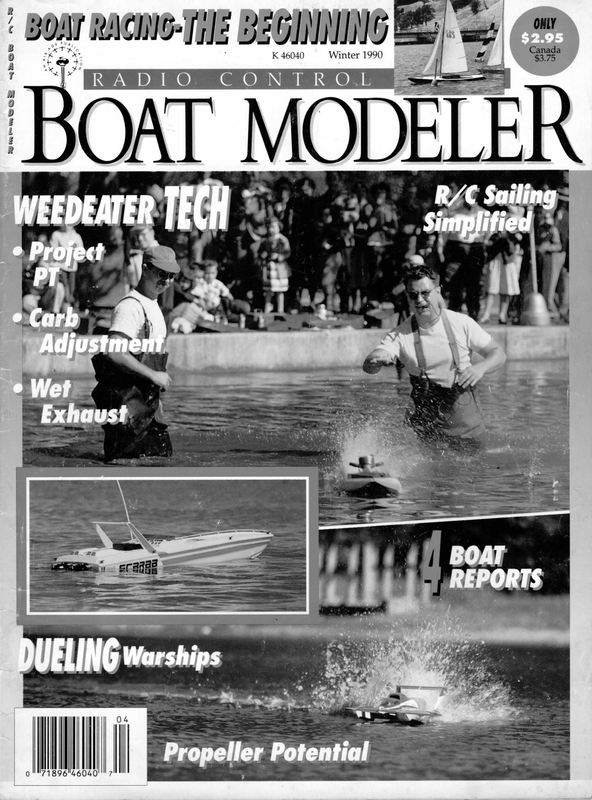
Ars s~Pew OAT MODELER K 46040 Winter 1990 Ba=mSeSet rRA DIO. COND. fe 0 || | “71896’46040 i] 04 7 Ses < Sea Se “« _ Propeller Potential e...
SCRATCH DEE 9 Off-the si by GEORGE FOX LANG RECENTLY FINISHED making a Dumas* Huson | sail then fit very nicely into the extruded spar. 36 R/C sailing sloop. Although the kit’s hull and deck are robust and reasonably well thought out, the pine mast, booms and associated hardware fell short | of my expectations. I elected to design and make my own rig, but to retain the basic geometry of the Huson design. The approaches discussed here are equally appropriate for upgrading a kit Both of the booms were made of the same !/4inch fiberglass tubing (fig. 2). | bonded a 4-40 threaded (R.A.F.* no. 1632-440-SS-O) stand-off into the free end of each boom (fig. 3). The mast end of the main boom was bonded to the bought gooseneck, while the club boom was merely plugged with a dowel and resin. model or fitting out an origi- nal design of similar (36/600 class) size. I bought a 6-foot length of aluminum mast extrusion (no. 69) from Pop-Up Manufacturing Company.* This has of section airfoil an approximately °/sx°/s inch with a cross web and an open sail track at the trailing edge. I also bought the companion gooseneck (no. 37), the mast foot (no. 70), a length of fiberglass tubing (no. 118) for Aluminum masthead provides smooth attachment edi stays, for halyards, and cney turnabout seals spar. Plastic-bushed, “hounds band” secures shrouds. Cleat permits the booms (see fig. 2) and several small plastic fittings. After inspecting them, | elected not to use the Pop- mast rake adjustment. Up boom-end fittings (no. 8), but made my own. | did use Pop-Up’s small (no. 5) bail and several of its small blocks (no. 10) in my servo installation, because most of its materials are of good quality and fairly priced. The Dumas sail had a folded and sewn luff seam, and I slid a 48-inch length of 1/16-inch plastic tubing into this pocket to serve as a luff rope. As shown in fig. 1, the 20 RADIO CONTROL BOAT MODELER Las sid Allybeth, the author’s much-modified Dumas Huson 36 sloop has an aluminum mast and fiberglass booms for improved performance, appearance and durability. Each boom end is fitted with an outhaul fitting that has been filed from !/s-inch aluminum bar stock that’s secured to the stand-off by a screw. Back-to-back shoulder washers (Weckesser* no. SW-4) are used on this screw, and a second screw is tapped into the outhaul fitting to form a cleat. The outhaul line is protected by two shoulder washers (Weckesser no. SW-2) that form a bushing.
Rig steps quickly. Shroud turnbuckles are secured to deck fittings with pin (temporary installation without safety wiring shown). Snap swivels secure club jib, sheets, Deck fitons permits choice of jib position. Club-boom end per- vang. Note outhaul fittings, mast cleats. mits adjustment of close-hauled luff! leach tension ratio. Note teak trim! Fig. 1: Plastic tubing in sail’s luff pocket fits smoothly into The forward end of the club boom is equipped with a fitting made of three pieces of aluminum. The two L-shaped plates were cut from .032 stock and secured sail slot of Pop-Up extruded-aluminum mast. Note the rounded sail entry slot and teak cleats for halyard and down-haul. by a “wraparound” made of .016 stock. Seven steel spacers (R.A.F. no. 1122-4-SS-0) separate the Lshaped plates and are secured by 4-40 screws and plastic cap nuts (Weckesser no. NC-440). These provide attachment points for the tack and the luff wire, and they give five boom tie-down locations. Both booms are fitted with movable clamps to which the sheets are attached. These allow you to “tune” the mechanical advantage (draw) of each sheet independently, as they’re controlled by a common servo. A second clamp is fitted to the main boom as a vang, and this reacts against the tang of the mast foot. Fig. 4 shows the masthead assembly. Again, steel spacers separate parallel aluminum plates. The head and back stay wires are looped around the outer pair of these steel spacers and secured with crimped fittings. The halyards cross over the inner pair of spacers and are secured by cleats lower on the mast. An aluminum sealing plate that matches the spar’s airfoil shape caps the mast and is caulked with RTV sealant during assembly. The upper cleat shown in fig. 4 originally secured a short nylon line from the jib’s luff wire (the head stay). While this was useful for initially establishing the mast rake, I’ve now substituted a short wire lead Fig. 2: Club and main booms are made of fiberglass tubing and aluminum sheet and bar stock. Note the use of Pop-Up plastic gooseneck, mast foot and bails. Clamp-positioned sheet attachments allow servo tuning; end brackets provide outhaul bushing and cleat. WINTER 1990 21
ailing Rig that’s crimped about the forward masthead spacer to speed rigging. Fig. 5 shows the various masthead components. The outer plates and sealing ring were filed from .032 aluminum stock; the center spacer was formed of 125 aluminum bar stock; and the “hounds band,” which secures the upper shrouds, was formed of .016 aluminum sheet. Contact drilling was employed to ensure that all the holes align properly. Two lengths of 2-56 threaded rod secure the assembly to the extruded spar; tapped holes in the center spacer and external plastic nuts mate with these. Fig. 3: Various parts of the club boom are shown in an “exploded” view; main-boom assembly is similar. Club-boom tie-down may be tuned to choice of five positions. Note the custom aluminum parts made of sheet and bar stock; various Weckesser plastic and RAF metal hardware. Fig. 4: The masthead assembly profile. Note that the plasticbushed aluminum “hounds band” for upper shroud attachment is secured by steel through stud with trailing edge anchored by short nylon screws. Cleat secures short line from jib luff wire and permits rake adjustment. threaded steel rod, not by the plastic screws. Fig. 6 shows the lower spreader installation. The white pine spreaders were carved and sanded to a tapered-planform airfoil shape; each spreader has a brass tube running along its length at the 1/3 chord and center thickness point. The spreaders slip over 2-56 steel rods that pass through the mast spar and are secured with plastic nuts. Vertically oriented brass tubes bush the shroud through-holes at the tips. Shroud pressure retains the spreaders when the rig is stepped. RTV was applied to the mounting rods at assembly, and this loosely bonds the spreaders to the mast, and prevents them from coming adrift when the mast is removed for transportation. It also eliminates any tendency they might have to flutter in heavy Fig. 5: The components of the mast- head in exploded view. The two outer plates sandwich a spacer bar; the sealing ring slips over this assembly; four plastic screws join these and provi lateral guiding inside the mast extrusion. Two 2-56 steel studs hold this assembly in the mast extrusion (one secures the “hounds band”). 22 RADIO CONTROL BOAT MODELER I don’t know the origin of the term “hounds band,” but I do know that they're difficult to make! I wrapped a paper pattern around the spar to find the basic dimensions; then I spent several hours carefully drilling, filing and swearing! Plastic shoulder washers (Weckesser no. SW-4) mounted with CA are used as shroud bushings; 2-56 plastic screws hold the trailing edges on the spar (these were razor-trimmed in the sail slot). The shroud load is borne by the lower air. The spreader assemblies’ components are shown in fig. 7. The upper spreaders stand alone, while the mounting rod of the lower set also supports the lower hounds band. Also shown in this figure are the teak cleats used to secure the halyards and the down-haul. These are oil-finished (varnished cleats get scuffed) and secured with 2-56 nylon screws. I considered leaving the spar “raw,” or having it anodized clear, but the yellow fiberglass boom tubes and pine spreaders definitely needed paint! In the end, I sprayed all the components “Yacht White” before assembly, but other colors would be just as appropriate for a modern design. I disliked Dumas’ suggestion that you use brass
screw eyes to secure the head stay and shrouds to the under-deck pine blocks. I prefer machine screws mated with tapped backing plates, as I think they’re more secure. Fig. 8 shows the fitting I cut and filed from 1/2-inch aluminum angle stock to secure the club boom swivel. This fitting is secured through the deck with two 4-40 screws, and it offers three attachment sites as an aid to helm tuning. Fig. 9 shows the components of the club-boom attachment fitting. Had my scrap box contained a length of T-section extrusion, this would have beena single piece. Since my larder was bare, my Scottish heritage forced me to form an inverted “T” made of three pieces joined by 2-56 nylon screws. The teak trim is non-structural and is attached to the metal parts with Fig. 6: Head-on view of lower spreader assembly. Note brass bushing tubes at tips of carved pine atiogride for upper shrouds, and plastic bushed “hounds band” for lower shrouds. Axial brass tubes in spreaders slip over steel studs through mast. Shroud pressure secures spreaders; RTV bonding prevents rotational flutter. = CA. Radio Shack provided the basis for the shroud fittings. I bought four binding posts (no. 274-661) and used the solid-brass cores. I discarded the plastic binding nut and cut off the threaded section of each post just above the transverse hole. This yielded a “cup,” which just accepts the base of a turnbuckle and provides a through-hole that’s in line with that in the turnbuckle’s end tang. To avoid scratching the deck when rigging, | mounted these fittings over teak trim plates. I secured the rig with a single pin through both turnbuckles on each side. These pins are each made of a large paper clip; one for each launch. This major expenditure allows me to shoehorn wife, boat and two daughters into an aging RX-7 for an outing and still be ready to sail only moments after arriving. Yes, the project was a lot of work. It took about 100 hours to design, fabricate and finish this rig, but with this article as a guide, you should have no trouble producing a similar one in a quarter of that time. The effort was worthwhile...The Allybeth sailed well on its maiden voyage, and the rig has been trouble-free and structurally sound. It gives the boat a finished high-tech look that’s frequently admired, and it sets it apart from the other vessels at our local port. + oes are the addresses of the companies mentioned in this article: eos Products, Inc., 909-AM East 17th St., Tucson, AZ Pop-Up Manufacturing Company, 27 Emerson Ave., Amityville, NY 11701. R.A.F. Electronic Hardware, Inc., 260 Hathaway Dr., Strat- ford, CT 06497. Weckesser Company, Inc., 4444 West Irving Park Rd., Chi- cago, IL 60641. Fig. 7: Components of the popes and lower spreader assemblies and teak cleats fitted below to restrain halyards and down-haul. Note 2-56 threaded steel studs that secure spreaders and lower “hounds band.” Fig. 8: Custom club-jib tie-down features choice of three attachment positions for helm trimming; bolts to deck with machine screws. Teak trim not yet rounded and finished. Fig. 9: Metal components of club-jib fitting are formed from '/2-inch aluminumangle extrusion, joined by 2-56 plastic screws. Trim ring is cut from slasinch ok plank and bonded with CA. oa WINTER 1990
BOAT REPORT VICTOR MODELS BY BARNARD S. KEMTER ICTOR MODEL PRODUCTS* might be the largest producer of entry-level, radio-control model yacht kits in the United States. Its latest set of creations, the “Cup Series,” conforms to the 1-Meter Class specifications of the American Model Yacht Association*. The Australia II and the Stars and Stripes are semi-scale versions of the 1983 America’s Cup yachts. Both are designed A beautifu 1-meter craft that can be fine-tuned for competition 58 RADIO CONTROL BOAT MODELER for 2-channel operation, rudder and sail-control unit (SCU), or what’s commonly referred to as a “sail winch.” The kits are nearly identical: The only major difference is in the shape of their wing keels and their beams. The Stars and Stripes’ 7-inch beam (about 1 inch narrower than the Australia II's beam) may offer a slight advantage in speed, and this might explain why more than 700 Stars and Stripes are now sailing, compared with 300 Australia II yachts. I compared the kits closely. The quality of wood was excellent, and their instructions were very clear and well-illustrated. Both kits come with a suite of sails and all the hardware needed to complete the rigging. The high-strength polystyrene plastic parts were all wellmolded and required minimal trimming. The question was, “Which one do | review?” A quick flip of a
SPECIFICATIONS Type: 1-meter sailboat Length: 39 inches Beam: 9 inches Sail Area: 595 square inches Hull Material: Vacu-formed, high-impact polystyrene No. of Channels Req'd: 2 (sail control and rudder) Sug. Retail Price: $94 Features: Easy to build; all plastic parts are pretrimmed. Nylon spinnaker sail material is included, as is all hardware required for assembly. Builder must provide lead shot for ballast. Comments: Owing to its ease of sailing and highly prefabricated nature, this is an ideal beginner's sailboat. The vacu- eS : x I added a strip of foam around the hatch to waterproof the Australia I. The distinctive wing-shaped keel is one of the intriguing features of the Australia II. Note that the stock mast and clubs are painted aluminum to resemble the original yacht. required in the keel. The remaining void was filled with fiberglass resin. When using resins, don’t use too much catalyst! Using more than seven first roughen the plastic with 60-grit sandpaper to remove the waxy surface, or the epoxy may not adhere properly. formed hull eliminates the CONSTRUCTION begins need for any exotic and time- with the consuming finish preparation. With some additional fine-tuning, the boat has the potential to be competitive. winged keel. For ballast, the plans recommend that you use 7 pounds of lead shot and hold it in coin determined that it would be the Australia II. This review will help you make either kit, place with fiberglass resin. as will the review of the Victor Soling that appeared in the Spring °88 issue of Radio Control! Boat Modeler. I've already made several I used automobile wheel weights from my local serv- Victor kits, and I've learned to avoid the solvent adhesives that are usually recommended in the plans, because, after a Above: Close-up photo of the mainsail shows the high-performance Amen sails. The computer design and cut of the panels are designed to transfer the stresses imposed on the sails to maintain a proper airfoil. Left: The radio board features an Ace Nautical Commander radio that operates Multiplex servos. Note the smallness of the sail winch, which is actually a retract servo that has a metal gear train. while, the seams on the hull start to ap- pear. | prefer to use Hobbypoxy* Formula 3 and CAs. Formula 3 is a drops of catalyst to each ounce of resin could gen- thick, two-part epoxy that doesn’t run or sag when used on vertical sur- | faces, and it forms ideal fillets around the keel area. When using epoxy-type adhesives, | ice station, and these allowed me to lower the keel’s center of gravity (CG). The lower the CG, the less weight (mass) is erate excessive heat as the resin cures, and this could deform the keel. To prevent | this, I set the keel in a pan of | (Continued on page 66) WINTER 1990 59
LAP CAT Ill (Continued from page 65) PARMA MOTORS & BATTERIES George Pekarik of Chicago, Illinois set five world records, with Parma Motors & Batteries during his assault on the IMPBA Electric Boat Speed Trials. If you’re into R/C boats, planes, cars or trucks, Parma has the motors and batteries to make you a winner! Ask crhemat your local (,ee, ERATED ME INTERNATIONAL INC hobby sh OP. 13927 Progress Parkway, North Royalton, OH 44133 PARMA regrets we cannot supply individual orders on a retail basis. For parts and information, contact your local PARMA Dealer. Send $2.00 for full color catalog. 5 a a® a” a a” . BOATERS! Having trouble finding parts? % *OCTURA MODELS *STEVE MUCK'S R/C BOATS eHUGHEY BOATS eMARINE SPECIALTIES wt ==“ POWER PRODUCTS B a a” a a eAEROMARINE LAMINATES —-* ROSS *PRATHER PRODUCTS BeRPM, INC. *POSI-TRIM *MAC'S PRODUCTS *AVENGER/SPIDER BOATS *0PS eHIGH POINTS eDUMAS/JG *DU-BRO *SULLIVAN *BONDHUS Catalog $2.00—refundable with first $10 order. IPE of R/C boaters! ) (916) 723-4124 =— f ()) aZHEPIPELINE a @ love it. The drawback? You'll have to wait for your turn at the transmitter! *Here are the addresses of the companies mentioned in this article: Prather Products, 1660 Ravenna Ave., Wilmington, CA 90744. Irwin Pipes, Rt 4 Box 198, Muncie, IN 47302. Hobbypoxy Products, 36 Pine St., Rocka- way, NJ 07866. K&B Manufacturing, 12152 Woodruff, Downey, CA 90241. Williams Bros., 181 Pawnee St., San Marcos, CA 92069. Futaba Corp. of America, 4 Studebaker, q Irvine, CA 90718. (Continued from page 59) WE SPECIALIZE IN COMPETITION BOATS, HARDWARE, PROPS & ACCESSORIES WE STOCK to build; it’s strong; and it runs well. It's also quiet, and your family will AUSTRALIA II Need a larger selection? Need the largest stock for ~=immediate delivery? For fast, friendly service... . 5, For racing, or just for fun, I think you'll enjoy the Lap Cat Ill. It’s easy 8389 Canyon Oak Drive « Citrus Heights, CA 95610 “= S = y @ shape the sail. If you sail (or try to) directly into the wind, an equal amount passes on each side of the sail, and the result is a shape like that of a tadpole heading upstream (fig. 1, no. 1): No shape, no force—OK? So we point the yacht away from the wind (about K NOTE: @ 1 ON STARBOARD 2ONPORT ». eo x uw < 7 & » x Fig 3. Tacking into the wind 70 RADIO CONTROL BOAT MODELER DESIRED COURSE
TL 0661 YFLINIM “‘Burluuns aq 0} se “yoe] preogieyjs UO S ji ‘od | (‘sdeysed ‘12}e7) J@} OS JOU yNQ ‘puIM aU} JjO saa 0} no a1 Aau} J] “ere sjres spt | ‘Jeu} [Je OJUI Je5 0} Suu} Ou} }, USI -2P 06 Ue} e10WW Buyres ‘at alayM Aq pauluayap s jeu} your} ‘(¢ ‘ou ‘T By) ,5uryseai peoiq, 2 UO SI JOA ay] Jeu] SI Jams | Jaddiys e yeu} SIa@ANBULUL pal | -IRA BU] JO} S1@YJO UU] Ja}}eqQ aq StU} INQ ‘Op oO} JyDeA e sjueM JO ‘(Burjjny NoyyM Je5 ued noA -ue—juorsanb poody ~Usa}s ou} se asojp se si YyoIym) 5uryeaq aq Jano Burwioo st pulm ay} ueyM O} SB ASOJD Os JOU nq ‘seei5ep sueddey yeym pue ‘apis Jayjie 0} 06 UU} PUIM aU} O} JasoyO ‘*a"T JNO aq ued s]Ies ay} ‘pulmMUMOp ‘(Z ‘ou ‘T By) ,Suryoeas asojo,, Sutuuns st yyoeA e uayM yey} yo | aq Ud SIU], “SMO;G PUIM aU} aq ued Surpseey , Suryoeei, pejurod ysnf woos ay} jo yoeq | se Je Joye] a1oyMOUIOS O} jsa1 S,]I ‘Pulm au} sso19e pure : Sulu jsnuu sadeys [res auos ‘(sesntuad | OQ} ‘yseg] Je) AsnoIngg ‘suoTye -NjIs Ws Ul adejueApe O} pesn je SI [les ay} USM sant] }I a1eyM aU} Ul URW ou] gJeU} Seu -unJ,, $ }I ‘(teljee passnosip se) ‘paeoqgie}s 0} no peysnd aorjd e wo. sayer5twi jnq ‘jnd qno sires au} YyIM pulmuMOp Bul ase sles ay} pue apis od ay} Aejs } USeOp esp WUNUUTXeUU JO -[les UayM ‘(pajney-asojd) aul] 12} J@AO HUIWOD SI pulm ay} UUM julod sres ay} ‘Ienemoy ‘Sum -Udd $ ][NY ay} O} asojd Ul paney yore} pod e uo ogre st yoeA 2 ayl[UA) “(Yoeey O} Jynj) 1ea1 OF sjfes s}i eaey [IM jYyIeA e ‘pum VY ‘Hod 0} Jno BurSuey aie ‘a10j UOJ} WO} Suto ‘yj5ue] proyo -a10U} ‘s[les ay} pue ‘NY ay} Jo ay} Jo abejuaosed e se passaid 2} O} asojo BSulyres uay/, jPJO} 21,9mM Os ‘ainy apis preogise}s ay} JeAo Surwos -x@ SI pue , ‘yerp wnwixeu -DeIJ [[NYS & JOaTJOO 0} Aem yea SI PUIM BY} UBYM , YOR} preog Jo yulod,, ay} payyeo st jurod sty} e st Surqif pouuejdun ‘syeoq -I2}S,, 2 UO aq O} ples si jyoeA ‘Tres e uy ‘(e5pea Sure. ou} 0} 5iq uy , eq, esq Aes ajdoed e pue ‘Suryoer},, payyeo si ssao0id Sulpeg] eu} WO} aul] ayy) poy S}I WO1] @UR]sIp JSajeat5 ou] ye Ul, Uy} ‘(YIYys pum e oO} Bul aU *},URd jNq ‘[res 0} ay1) p.NoA -mo sdeyied) pulmumop ‘1ayj0 GSINOD BUTJ-]YHIe1s ay} JO do} SI ‘@de]ANS S}I UO JUIOd aUUOS je aU} O} apis BUO WO Jano sBurms uO jno pre] si Hezbiz styj ‘je1oued ‘alOJar1eu] ‘pue ainyenmnd @uOs WI00G aU} JI ‘Aljeyuaprouy [Ay uJ “(¢ “5Y) JeyJO ay} UO UA} -Aded UI sprepue]s /Da4 Mo} OU} pue ‘pulmM au] JO apis auo UO "sires aU} UJIM UO Jab JO OUO YIM anBie oO} ynoge jou JS] ‘asinoo Sezbiz e Surjres Aq [,2M pue ‘premsoj sanow jyoeA a1,aM pur ‘st 1 Aem ay} S.jyeuy prempulm oO} paedoid snus syeoq qnqg ‘Aym mouy },uOp ayy ¢AuM -[res yey} mou Aq noA uo peumep ‘JayoR}] WO k JaAO Jaye} pred0g sey [les Alana ‘sBuIM ayl] 2U} MOYSUOS Jeu} YyID{ aAey | ‘MOU JO} jsf *noA sayzznd sty} J] -IR}S 2 O} ABM Jo ]YyHU ay} anid 2u} Suryjejs nouyM eqissod se Algeqo.d sey y *(5uyyn}) [res “AYM s Jeu} ‘jeey e sey [NY ey Ajje1ouead seins Suloes ay} asneo PUIM aU] O} asojD se—prempuIMm Sur} eu} },useop AyM Os ¢(s10 -2q ‘jJIS SOA ¢S1a}}EUW STU} TV 0} Suryres yyoeA ay] 0} yorg épjnous li se ‘sipmapis eacu -[fes Op Os puke ,‘psoyp,, jt eo Hoffy fo saquap $, 110s Surpury “fp 814 “‘THAIMS Ne W auf pe NIVW] dif NIV GNIM CNIM aif
Sailin Simplifie WIND PRESSES ON SAILS ¢ LEAST RESISTANCE PATHOF WATER PRESSES AGAINST KEEL AND HULL Fig 6. Why a sailboat sails yacht had only one sail, but this isn’t usually the case. Get back on the ladder and look down at the CLR°e sails again; see if you can get yourself to believe that the two sails can act like a slotted wing, i.e., that Fig 5. Relationship of CE to CLR New thought: If a yacht is a flat-plate proposition downwind and a wing-like affair beating to windward, will you buy the idea that somewhere in between it’s partly both? Thank you, it is! As a matter of fact, on a reach, both mechanisms are at work, though neither is fully efficient. The sum of both efforts, however, is typically greater than either alone, even when each is working at best advantage. This means that reaching is a yacht’s best point of sailing, when it will move the fastest. Before you got into the hobby, you probably fancied that running would be best (mental pictures of tea clippers with clouds of sail set, spray flying, and so on), but it just isn’t so. We guess you never looked to see which way the spray was flying! Back to the boat beating to windward for another new thought. All through the discus72 (or, more correctly, the water’s resistance to it) is equall on both sides of the push point. The sion so far, we've acted as though the CE same thing would happen if I pushed equally at both ends, right? That’s easy, mostly because the two-by-four is of uniform shape all along its length. Now replace it with a yacht hull, | which is in no way as symmetri- | cal as the wood; if we push equally on both ends, one end or the other will be more resisted by the water, and the hull the jib (besides acting like a self-standing sail) can act to chan- nel air off its windward (concave) side and over the leeward (convex) side of the main, thus enhancing the main’s airflow and increasing its “lift” (we usually call it “drive”). Further, if the jib is somehow set wrongly with respect to the main, it can “choke off” some of the air that usually flows through the “slot” (between the leach of the jib and the mast) and thus reduce the main’s airflow, or it can cast turbulent air onto it. If the jib is trimmed in much too far (or the main eased out too far), it can actually channel air onto the main at such an angle as to partially collapse it, so reducing its drive. Let’s take a stab at something else. Suppose we float a two-byfour in our swimming pool and push it parallel to the surface of the water and perpendicular to the long side. What happens? It moves sideways in the water, since its resistance to the water will start to turn in some way. | | We can experiment to find a place on the hull where we can push with one finger and move the hull sideways, but it won’t be in the center. This place is called the “Center of Lateral Resistance” (CLR), and every floating body has one. It helps to know where it is; look for it on drawings, and later, we'll put it to good use. Now think about a set of sails (main and jib) mounted on a mast and set up on a swivel like a weathervane, with the mast directly over the swivel, and the main and jib being of equal size (fig. 4a). Blow a wind at it and what happens? The thing sits squarely across the wind because it has equal area each side of the swivel—it’s balanced. “Aha,” says you, “but jibs aren't the same size as mains—at least, not in the drawings and photos you’ve used.” Right, matey, and if we adjust the sides of the main and jib, leaving the mast where (Continued on page 80)
€L 0661 YFLNIM (¢Z a8pd uo panunuod) (Araal[ap IOJ SYOM f-Z MOY) *L6890 LO ‘UOmM “PHY Amqueq [Gz ‘Aiopauiq qniD 42/2po! ShIbL MO ‘PSinL yoog j01ju0D OIppy :O} Jequnu auoyd aIOOW JJ -2[2} eu pue uosiad joejuod e jo aureu ayy :0] IopIo AQUOW IO YIOYI $G'*6T$ PUDS yim Buoye ‘sqnjo stay jo sseuppe Buyreus pure | auweU au} plas pMoys pajsi] aq 0} Surysim $]00} ppoyasnoy suojeztueBio pure sqnio ‘Alopaiip Juana pue JIM JJBSANOA UOTSAIAUOD OG x gnp e aney mou am “rayja6o} siejapour Sut -Bunig Aq Aqqoy ay} ayerjaciad 0} axisep sno pepnyput surjd pur dung x pue peau sity} jo }YSy Uy “ease sayy Ul Siaja -poul Jayjo puly ued fay} moy Buryse si2je -poul WO} sYayja] AUeWI pentedel eneYy a, suoTjoON.Ajsul pazvajysnyyft ‘MOo][OJ-0}-Asvq x iNOILLNALLV YOLOW LVOd WALVA-GaaM ANOA TOOOD WALVM 60ST-SPS-LTE Areyaioas [euoyeyy ‘uo}dwepy uuy ‘jJoe}yUOD) uo}durepy ane :10}9adIq] ZYS ppe “Say WN “ES PPe (4Se9)G09 ‘OS*ps Burddiys 90128 WN ‘anbsanbnq|y Aug saapug 404 pEALs ‘3S ay [e4quag BITZ Ol ‘39 92290 NI ‘syodeuerpyy 4d TPH 1eMe] 8TeS TLv2-829 (008) uoyepossy iO3FLNVYWND NOILOWISILVS WSS "OjuL auowW UOJ LLNY 99¢1-86£-S08 yey dwiems apniaut ou (uojsspummi0g Buiopy J2poW D/H) | uoneDpossy yeog | IaModg UPCILIBWwWIYy | Liny sseibuaqiy e 8899-759 €1€ Areyja108G diysiequisy] | 66€S$ | | €908b NIN ‘IH J21seyooy | uoyepossy BuyyoeA JopoW Ueopouly VAWV LOLE-198-LTE Areyaiaag angnoexy ‘aneuyeg eng ‘jeJUOD JojAe], auad ‘jyuapiseig | -JUNOUI $,esed aU] JO do} UO are speo] OAIaS AU} JLU} 25 |],NOA ‘sydes5oj0yd ay} Ul “eased peosoyules e pue sieved jejaur ‘speas Buu-E YM yeys yndjno Hueeq-jeq e sainyeay }t ‘AuewIeD ul painjoejnuey] ‘somes jres ajqerene ysoul ueY} [nJemod aioul pue jy] ‘Jse} Sj] “syYyoeA saifews ul asiOyyIOM ayureuAp e aq 0} uaAoid sey OAIas si} ‘yesosre jepow ul seab Surpue| yoedal jeotueysauwl ayesedo 0} paubis -ap AyjeurBbuC “waysAs o1pes Jepuew -WOD JeoyNeN ,20y ey} esn pynoo [fe yey} eins ayeul pue preocg ey} sndo ppoy Asnquog [SZ | “SOMJES OU] JUNOU 0} Asea Alan Ht Seyeur sty} ‘sea Sul [[eJsut 0} WOO. efdure aney ]],NOA “jo yoap ay} UII “Preog OIpe ANOA [TeysuI Ze £6890 D “UOuIM ‘ula}] e1oUTed “e}UOD ay} Jo uOTETeEYsul pue uoTesedaig sueyd au] ‘Buruedo ypyey ay} ySnosyy gjqisseooe ere smeios Suljunouw saut6u3 62" 6 « orpey yo e 10} edeys papuewIUiOde1 ey} O} papues are sdiys seays ay} yey} eins aye] ‘suejd ay} uO UMOYSs se SI Yep “OAIS ][2]S ,Xe|dyIN] & asn 0} asoys | ‘uoteoydde sty} 10-4 ‘YOUTM [les SOI -UOIUIY ue Sulsn uoyelyeysul ue moys 666E$ 606 VO ‘Pleys4exea "IE AUIOIS TOOS 0} yOeP au} Jo [eas joosduayem ‘yudy ] Jey} Os 10J99uUOCD edAéj}-sueaq e 0] 10JOBUUIOD JeoLJeje ay} pabueyo | opey 4) Za yuapisalg ao1/\ ‘ID sndureD 8st BzL4M/[ 129 poom/ueos saulbuj 61°-60° « qremays Aypeyy ‘e}yUOD ‘IP away prempy ‘juepiseid Yaleper [OL *O°W/42949 puas 40 LLB) 4aP4O OL S,12]2po| drys aTeoS VaddV elat-22e ($05) pue YO yoIy}.asn noA yey} spueul -Wwodel Jampoejnuewl ey] [NY eu} # ‘19901§ WISS “A €0S6 semaros s0p4g pow a6y ay 48440 joDeds smay aunjday FoPoW :04 ‘papnpul eBnysod ‘anjpa 667$) LS puss ‘guizoBpw aunjduip 5/y Buippay ayy yo Adod ajduins b 4104 jsounjdyos pup syal ‘ssoydorjoy ‘sounyd 9/y GuiAy Jo pjsom Buypxa ayy jnogn a40U! Usa] Ajiresoduua} pue ued nod yey} puew -W109a1 | ‘yap ey] Hurypeysut a10joq ‘goueuuojied do} ensue pue Seip aziwiturw |],NoA ‘Jeey ay} jo aul] 1aJUSd au} YIM paubye eqny Sut -Jeaq Jappni pue Jappni ay} Sure uO aut] e1yxa puads nod J “‘peubiye aq jsnul [aay pue Jeppni oy ‘poubye Ajiedoid asm sajoy eu} yey} ains Suryeu Jaye syjoq Suyunow Jeey OU} 40} TINY ey} Ut Sefoy pal[p | ‘e0Rjd OyUI payog st jeey ey} UeyM payeioued aie yey} Sseo10j uolsseid -UUO9 BY} QlOsge O} PUR S}[Oq Jee4 OU} OTOP NI ‘UMojureyUNC; AOOT xOg *Z ANOY feANY Jo} ayejd Sugunous e se ansas 0} |[NY Vddil JUSWIAIIOJUlal SIU], [NY ey} jo ease uoneDpossy yeog Jomod fepoy] [euoHeus}UT €099-66-LOL peor “g afAW ‘ye}UOD uosuyor Aled ‘juapiseld LSbG6 WO ‘2427 2Mo7 anu esUUNS €/.09 uoqeDossy JeOg Jepoy] UBILIOUTY YON] VaNVN SNOLLVZINVDOYUO ONILVOd TAGOW au} apisut perxoda sem duyjs pooméid yUSY YOUI-pXb/,xv/, YW “BUISIM) WO} } sjuanaid pur |Iny ay} suayy5uadjs osye (apis pue 1a}Uad) Jabse] & Jano sesseljs pue speoy SujunowsJaey ay} speeds pueq suf ‘yINY ey} episul ,pueq Aljeq, e& [feo | yeym powo} esey ‘TAY eu} Jo sapis ey} dn pue ease jeey dU} OJUI poomAld jessie YOUL-9T/; JO sdigs uty} jeranes parxoda | ‘pepraoid ayeyd poddns jeey ay} Sutsn jo peo}su] ‘IOPAO Ul ae SaJOU @LUOS “UOTE][e}SUI [224 aU} Ay[pouu 0} asoyp | esneseq (‘days sty} Bunp yYNoYyIpP (99 a8nd wow panuyuod) I VTvaisny
the Stiletto Super Stiletto .90 and twins .45 to .80 engines $275 Since years be the The send to for coast. STLETTO Now SUPER STILETTO- STILETTOS custom introduction the three has proven an outstanding competition hull coast our it’s ago, come engine free catalog to with mount for we have added terrorize the a to in big top floatation and are and hardware. more Call us races brother engine ready to classes. to bolt order in yours or details. DAGGER BOAT WORKS 2392 New London Turnpike S. Glastonbury, Ct 06073 AUSTRALIA II (Continued from page 73) then re-glue the seam. I used Hobbypoxy Formula 3 on all the deck beams and shear strips. I spread a thin layer of epoxy onto the surfaces, positioned the deck and, while the epoxy set, I held the deck in place with numerous strips of masking tape. As excess glue was squeezed out of the seam, I wiped it up before it could set. Twenty-four hours later, I removed the tape and trimmed the deck overhang with a sanding block. Check the seams: They must be sealed. Fill any gaps with thick CA and accelerator, then check the Learn more about the exciting world of R/C cars in all scales: on-or off-road, electric or gas! For asample copy of the leading R/C car magazine, send $1 ($2.95 value), postage included, to: Radio Control Car Action Special Offer Air Age Mail-Order Services How Fast Is Your Mopet? END THE GUESS WORK WITH SPEEDTRAC With this low cost PC-Compatible Computer Program instantly know your models performance in Miles per hour, Kilometers per hour, Knots & Feet per second Measures speed over any distance Built in data base permanently keeps track of speed records for all your models and your clubs models. Prints record certificates Specify 5Y% or 3% diskette with order $7.95 E.0.M. Systems 9730 Ash Creek Dallas Texas 75228 214 321 3673 seams again. The mast provided is of Sitka spruce and comes in two pieces that must be joined. Most of the shaping has been done by the manufacturer. Of all the Victor kits, this series is the easiest when it comes to woodworking. Because most of the sails on the other Victor kits hit the backstay in light winds, I made an extended masthead bracket. The original bracket is 1'/2 inches long; I made mine 3 inches long, so that I'll be able to change sails later. I sanded and primed the wooden pieces, and I finished them with two coats of aluminum-colored automotive acrylic lacquer. Rigging the boat is adequately explained and illustrated on the plans. To prepare the hull for painting, I wet-sanded it with 400-grit wet sandpaper and progressed to 600-arit. I bought several spray cans of acrylic lacquer automotive touch-up paint in various colors. I applied two coats of “sandable” primer and wet-sanded with 600-grit paper between coats. I painted the hull white and the deck light green. When the paint was tel: (203) 633-0398 / 568-8778 completely dry, I applied striping tape and the supplied markings for the finishing touches. I recommend that you paint the deck a different color, because the light green is hard to see when the boat is under way. A dark water line or a dark, contrasting deck color will provide a more visible, and much needed, reference when you're trying to round a far mark. PERFORMANCE: When I first sailed the boat in its stock configuration, I was amazed at its performance. The Australia II] has a most unusual flow of water along its hull: The boat seems to be surfing on the crest of a wave. This appearance results, in part, from the hull design, which allows the aft portion to lift out of the water. | was also impressed with the moderate wake created by the boat: It cuts cleanly through the water with minimum effort. I sailed the boat on all points of the wind and, other than tightening the backstay, I didn’t have to tune it further. Sailing it was a delight! The boat is quick to come about, and jibes are easily performed—the handling is faultless! Building the boat with the stock keel and sails will provide the owner with many hours of enjoyment. The kit is well-designed, and the materials are first-rate. To make an affordable boat for the novice and to keep costs down, many _hardware-store-type items were adapted for the rigging. If you build the Australia II according to the plans and use an inexpensive radio system, you can be sailing for less than $200. To increase its performance, however, you can make several modifica- tions, including changing the keel design to a conventional removable fin and bulb, as I did. I also changed the mast to accept a new suite of sails.
MICRO BOAT WORKS I made a 65-inch spruce mast (the maximum allowed in the 1-Meter Class of the American Model Yacht Association), and it has triple diamonds for rigidity. I added a suite of composite Mylar sails, made by Amen Design Group*; their high-aspect design is intended for light winds. Changing the sails on this boat really improved its speed. Made from SPECIALIST IN R/C SPEED BOATS Radio & Marine Supplies at Discount Prices Most brands available Hours: Mon.-Fri. 4 - 9 p.m. Sat. 9 a.m. - 9 p.m. one-piece, flat Dacron, the original sails are well-suited for an entry-level sailor and 5-knot winds. The Amen sails are a composite of several Mylar materials; they’re designed to provide an airfoil shape that maximizes the FOR THE R/C CAR ENTHUSIAST available wind power and handles all the stresses generated in the sails. The Australia II is a very affordable, semi-scale model yacht that offers good performance for a low price. It’s ON NEWSSTANDS AND IN HOBBY easy to transport and can provide its owner with many relaxing hours. The Australia II is best suited to racing the Victor Stars and Stripes in a match race. It won’t keep up with some of the other high-tech (and high-price) 1-meter yachts, but it will provide an inexpensive way to experience the enjoyment of sailing an R/C model yacht. With the modifications I described, it will be competitive with some of the more expensive yachts. R/C YACHTS I: xpertence the thrill of 12 meter yacht racing with Victor Gup Series yachts. Leach are I meter senu scale models of the most famous of the international 12 meter racing yachts designed specially for R/G sport or aan Satling. At $94, it presents one of the best buys in novice or entry-level boats. *Here are the addresses that are pertinent to this article: Victor Model Products, 12258'/2 Woodruff Ave., Downey, CA 90241. Complete kits (less ballast) i| STARS € STRIPES | , American Model Yacht Association, 1884 Campus Court, Rochester Hills, MI 48309. Hobbypoxy Products, 36 Pine St., Rockaway, NJ 97866. Airtronics, Inc., 11 Autry, Irvine, CA 2718. Multiplex; distributed by Beemer R/C West, 7725 E. Redfield Rd., Scottsdale, AZ 85260. Ace R/C Inc., 116 W. 19th St., Box 511C, Higginsville, MO 64037. Amen Design Group, 929 West St., Petaluma, CA 94952. qo TALE OF TWO BOATS (Continued from page 64) either. (I had considered twin mufflers or extra baffles, but I just ran out of space!) When you kick-in the twin Peak Performance* electric motors as well as the glow engine, it’s as though the boat had afterburners! The boat (Continued on page 78) (717) 938-6776 404 Steigerwalt Rd. New Cumberland, PA 17070 Grange County Born fol three boats per ant. Closing deadline: Deaber 2, 1989. Contact Brian ub (407) 275-7054. length 392in sail area 598 sq in io AUSTRALIA IT length 39in sailarea 598 sqin $94, | 17-18—President’s | a, Kiwanis Park, Contact Maritime 10 4 Garfield, suitable forAMYA Olympic1 Meter competition Additional fits; SOLING IM _ length 393in. $82. TAHOE II length 36 in. $70.” MINI SOLING fsength 30 in. $50. SNIPE $40. length 232in. me For complete details send astamped addressed business envelope. cath kit add $4TM shipping VICTOR Model Products 12258'/2 WoodruffAve. Downey, CA 90241 (213) 803-1897 WINTER 1990 75