- Title. Author. Summary

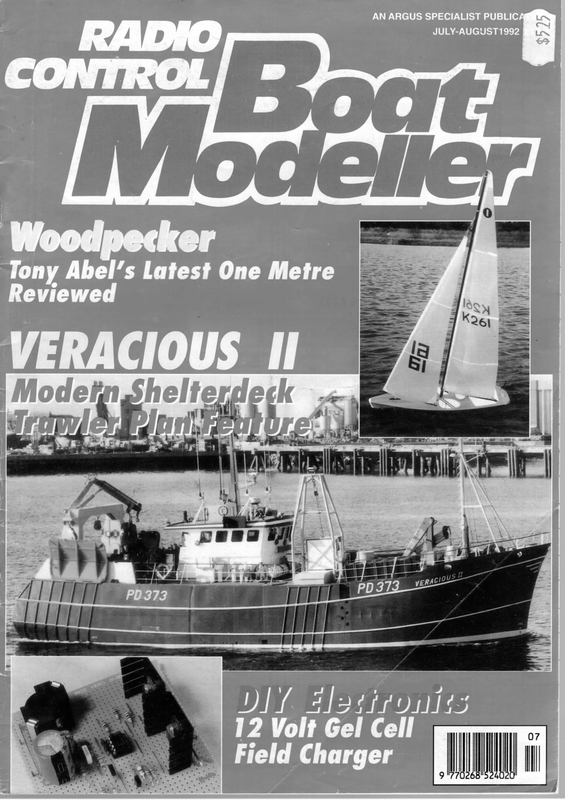
AN ARGUS SPECIALIST PUBLIC JULY-AUGUST1992 Woodpecker Tony Abel’s Latest One Metre Reviewed VERACIOUS H | Modet, heltey if me o> u 4eeeiiy — — — YIf dlatieouits 12 Volt Gel Cell Field Charger’ MM)
Boating in Buchan The Buchanness Model Boat and Power Boat Club was re-established back in 1986 from the ashes of the old Buchanness Model Yacht Club, which has been sailing for over 100 years. At present the membership stands at 15, most of whom sail both Marblehead yachts and Fifies for various cups and trophies throughout the year. The Fifie is modelled on the old sail fishing boats at the turn of the century; these boats fished all round the UK coast, drift netting for herring. The Reaper is the last remaining example of this type of vessel, and can be seen most of the year at Anstruther harbour. As far as the club knows, no other group regularly races these boats, and they invite anyone in their area who would like to participate in this sport to contact The annual Fifle Race Day amongst the heather and on the Lochs of Scotland. can obtain more details from the Secretary, John Wyatt, 1 Princes Road, Felixstowe, Suffolk, IP11 7QY. or telephone 0394 279853. Alternatively, the club Chairman, John Crook, can be contacted on 0473 827557. them. Errata The Marblehead scene is pretty Anchor Windlass, RCBM for active with a variety of different hull designs competing. The Club Vice Commodore and Secretary have built March/April 1992 In this article D5 is shown in the component list as connected from AB22 to AE22. This should read AB22-AF22. The drawing shows the component wired correctly. Wafer design hulls, and these are competing very strongly in all weather conditions. All but two skippers sail using swing rigs. The power boat side of the club is almost non-existant, although there are known to be a number of such modellers in the area, so the club would be willing to put up trophies for racing, boat manoeuvring, best turned out boat, etc., if a suficient number of skippers are willing to take an interest in sailing their boats competitively. The club has access to a large rural waterway situated three miles south of Peterhead on Stirling Hill. Two small jetties have been built and paths run up both sides of the Dam. If you live in the Aberdeenshire area and would like more information on any aspect of model boating, you are invited to contact the club on any of the following telephone nos: Alistair Law — 0799 73086; David Buchan — 0779 74351; Alex Buchan — 0779 74409. Ramsgate Model Ships Rally Ramsgate Viking Model Boat Club will be holding the above Rally on 13 September at Westcliff Leisure Park, Ramsgate, commencing at 10.30am. There are restaurant facilities with toilets, a childrens’ play area and a small zoo, plus adequate parking alongside the facility. Pre-booking details will be sent to all those who took part in the 1991 event, but anyone wishing further details is 6 Servo-Free Switching Unit, RCBM November/December 1991 Jim Reid races his four foot Fifle Acorn. asked to contact Secretary Peter Stafford, 33 Effingham Street, Ramsgate, Kent CT11 9AT. The club guarantees at least two sailing slots per entrant with more available during the day. Clubs attending will be given an extended club spot. A good entry was received last year of over 135 craft, which together with mementoes to each entrant this year, should guarantee a fine turnout. Harwich and Dovercourt Model Boat Club Reinstated The above club has recently been reinstated and will be meeting on a more regular basis to sail yachts, fast electric, and scale boats. The members so far are all relative beginners, and the general aim of the club will be to enjoy some casual sailing with people of a like interest. And also, to introduce some racing. The Dovercourt yacht pond is an ideal place for a family day out, being adjacent to the indoor swimming pool, childrens’ play area, toilets, car park, large areas of grass for picnics and of course the beach. Anybody interested in joining this friendly club, Queries have arisen about the suitability of this unit for use with the current Futaba-Robbe sets which use sub-modules to give either an extra eight proportional channels or eight switched channels. The sets can be used satisfactorily in themselves, but there are problems if the unit is attached to the sub-module. The switching sub-module will not work with this unit, and this should not be attempted. In theory it can be used with the proportional sub-module by increasing the various time constants, but no component values can be offered at present. It is realised that this is an attractive option, as it offers a mixture of proportional control and switching on a single sub-module, so a theoretical outline is given for anybody wanting to attempt it himself. The sub-module operates by using blocks of eight pulses to drive eight sub-channels. The result is that only one eighth of the normal number of pulses is provided on each subchannel. Users will have noted that servos, for example, run very slowly as a result. The zero may function as it stands, but the deadband and pulse expansion circuits will need their time constants increasing to allow for this. Radio Control Boat Modeller
Two Wafer design boats; K361 belongs to R Brown of Edinburgh and K365 to Peterhead’s A Law. Potteries Navy Day The Potteries Model Boat Club is once again hosting a Navy Day event, this year on 2 August starting at 10.30am at Westport Lake, Longport, Stoke-on-Trent. The event is open to all ‘service’ craft (Navy, RAF and £247.62 inc VAT FOO OOO tn 1/96th H.M.S. LEANDER – SIRMAR hull and Fittings, JECOBIN plans and our own RUNNING SET ………… £231.96 inc VAT FOO I ALL ABOVE CARRIAGE FREE UK MAINLAND ONLY To obtain our Catalogue listing 2, 3, 4, 5, 6 and 7 blade scale brass propellers, hull, kits and fittings for GERMAN, BRITISH and AMERICAN Warships, Merchant Ships and Lifeboats, Running Sets, SIRMAR hull and fittings, FLEETSCALE hulls and plans, Electrical Equipment and accessories, Batteries, Books, PLASTRUCT, HUMBROL, EVERGREEN and Etched Brass, send £3.25 to:- ERADESTOC July/August 1992 2 GOVERNMENT ROAD, HOYLAKE, » WIRRAL, MERSEYSIDE. L47 2DB SRM SANYO GRAUPNER MFA MICRO MOLD SLEC RADIO ACTIVE HOBBYS MINICRAFT P&S HOBBIES & MODELS 32 CASTLE ROAD SCARBOROUGH TEL 0723 377020 ALSO 4 WALMGATE YORK TEL 0904 611761 SCARBOROUGH’S AND YORK’S PREMIERE MODEL BOAT SHOP Good Range of Modellers Tools And Acessories Full Range Of Billings Boats & Fittings. New 5 Pole Low Drain 545 and 385 Motors now in stock From £6.95 Robbe Berlin Rescue Boat and fittings Now Ex Stock New Robbe Fast Electric Little Devil £79-95 MATCHBOX CORVETTE NOT MANY LEFT NOW AT ONLY £39-99 Telephone Orders Taken Personally From 8am Till 10pm Seven Days A Week For mail order same day service ring the Scarrborough Shop Super Prices on nicad and Gell cells all ex stock Access and Visa welcome. All Items Offered Subject to Availability DBmxroOoov JECOBIN plans and ourown RUNNING SET The change of name from Hove Model Sailing Ship Society does not mean that the Hove Rally is lost. On the contrary, it will be held on 5 July starting at midday on Hove Lagoon. Activities include Nomination and Steering for Radio Control Scale Sale plus Power Models; also free sailing models are welcome, however no . internal combustion engines allowed. Entry is £2 for the first model and £1 -each for additional models. Hove Lagoon is between Hove and Portslade. Turn right at Brighton along the coast road to the traffic lights just before Shoreham Harbour; the Lagoon is on the left between the road and the sea. O2-Fr–w 1/96th TYPE 42 H.M.S. EXETER – SIRMAR hull and Fittings, Hove Ship Modellers HAZY SCALE BRASS PROPELLERS Army) of any country, including submarines. Large models are especially welcome. Entry fees are £1.50 per model if entered on the day or £1.00 if pre-booked. Further details and entry forms can be obtained from Terry Edwards, 1192 Leek Road, Abbey Hulton, Stoke-on-Trent, Staffs, ST2 8BP. 4mn-O0 With the launch of the Appeal in February, donations are now starting to come in and we are well on the way to the first thousand, and would like to say a sincere thank you to the following for their donations: New Brighton Model Boat Club; Stan Catchpole’s Model World; The Charity Shop, Barrow; Fred Talbot of ‘Good OLTHOKA Newton POCHACTN Modeller 2 Inshore Lifeboat Appeal Progress Report by Des NZO0OYFY The above Association is holding the 1992 Midwest Regionals, hosted by the Indianapolis Admirals on 26/27 September. Events include Precision Steering, Predicted/Precision Log, Conning, Scale Judging and Straight Running. So if you are holidaying in the area at the time and want to see how the Americans do it, then contact Dave Hampton, The Indianapolis Admirals, 1992 Regionals, R.R. 6 Box 19, Shelbyville, IN 46176, USA or telephone Dave on (317) 545 1509. Morning T.V.’; Alan Voce M.M.M; R M Langford, P&P Coachworks, Cambridge; donation received in memory of Roy Thexton, Barrow by Richard Mercer, Litherland. Anyone wishing to donate may send either to the Treasurer, David Lewis, 88 Buckingham Road, Maghull, Merseyside, L30 5QY or the Appeal Co-ordinator Des Newton, 29 Westminster Avenue, Merseyside, L30 5QY, or to any of the Area Representatives for which a full list was published in the April issue of Model Boats, or directly into the Appeal Account which is ‘Modeller 2 Inshore Lifeboat Appeal’, Account No. X5610106 RNL. Abbey National Building Society, 45 Lord Street, Liverpool L2. PEDryu Scale Ship Modeler’s Association of North America TAMIYA RIPMAX ROBBE AMERANG HUMBROL LESRO TRINITY SCHUMACHER BADGER Kindly mention R/C Boat Modeller when replying to advertisements 7
Mike Robinson reviews Tony Abel’s latest One Metre Yacht Woodpecker Trying out the tall suit of sails. The author rigging Woodpecker for its first outing. owards the end of last season | was invited to take part In a club One Metre event at Eastleigh. | took my trusted Magpie boat along for this event and fully expected to find Tony Abel sailing his own Magpie; | had even added a one to my jib number as Tony’s boat is 261 and mine is 361. Much to my surprise Tony turned up with a new all-wood boat. When quizzed about the new addition to the Abel fleet Tony said he had been looking around for a replacement for the Firecracker and had come up with a quickbuild hard chine hull design that conformed with the |.M.Y.R.U. Rule; the boat was christened Woodpecker. A feature of the new boat is the interchangeability of the keel and 8 cdipecker sails from the Magpie, so ! still needed the one in front of my jib number. Tony promised me a kit early In the new year and this duly arrived at the end of January. Hull Construction The basic hull comprises 5 strips of 1.5mm shaped plywood (Parts 1, 2, 3) with transom (4) intermediate (7) and bow (5) formers, and 3mm thick liteply deck. | paired up the hull strips (2) and (3) and gave them a sanding to ensure they were identical. Another useful tip | learnt from my aeromodelling days was to give all the plywood components a light sanding to remove any residue of release agent left by the manufacturing process, as this can inhibit the strength of the glued joints. Before assembling the hull | drew a centre line on the bottom section (1) on both inside and outside faces and made reference marks along this line for the position of the rudder post and keel fin. The five strips of ply were then Sellotaped together with the tape on the outside face, making sure the joints are tight and working from the stern to the bow along each joint in turn. Next fit the bow section (5) and the transom (4). These formers will need a little chamfering to ensure a good fit and one other tip is to check the overall length carefully. This should not exceed 988 millimetres, allowing for the bumper. | used a spot of cyano glue to hold the former to the ply Radio Control Boat Modeller a ee
Rudder Tony provides a stainless steel rudder post which runs in a brass sleeve. However | have recently found that this type of assembly wears with use and allows lateral movement of the rudder. | therefore substituted the steel and brass with carbon fibre rod and sleeve which makes a much more positive bearing. The rudder is made from two precut liteply blanks. Mark off the position of the rudder post and cut a slot in each of the blanks, insert the rudder post in one half with masking tape on the outside then give the inside face a coating of resin and position the other half on top and lay on a flat surface with some weights to keep the assembly true whilst the resin cures. Finally sand to similar section as keel fin. The hull components. Fin & Mast Box Installation Mark vertical centre lines on former (7), mast box and fin box. Position former (7) inside hull, two small notches will be required for the ‘sin x ‘kin inwales and the former should be flush with the underside of the deck. This will leave a small gap at the bottom to allow any water to be drained out of the hull. With the vertical centre line aligned with the centre line on the bottom of the hull, the former is epoxied in place. The mast box is positioned slightly in front of former (7). | used some scrap wood to fill the gap. Again with centre lines aligned with those on the bottom of the hull and the former (7), epoxy in place. | left the mast box long enough to project through the deck, the surplus would be sanded off at a later stage. Cut The hull taped together with all formers, strip wood and keel fin. sides and then masked the joint on the outside with Sellotape. The hull Is now ready for reinforcing with fibre glass. Cut the 2in wide glass tape into four strips to run along the inside of each joint. Mix up a quantity of fibre glass resin in an old foil container, | keep the type used by local Chinese Takeaway. Tony recommends using Car Plan resin but | used Ripmax SP113 stocked by my local model shop. The resin comes with dispensers so is easy to mix in the correct proportions. Coat the inside face of the hull before positioning the strips of glass tape, stipple more resin onto the tape until it is well wetted, and additional short lengths of tape are placed around the bow and transom formers. Finally add the ‘in x ‘sin inwales ensuring the top edge is ‘kin below the top of the hull sides. These can be held in place with clothes pegs and the hull should now be left to cure overnight In a warm place. | July/August 1992 : . a slot in the bottom of the hull for the fin using Completed hull prior to fitting deck. leave the heater on a low setting in the workshop, but don’t tell my wife! Mast & Fin Boxes The fin and mast boxes were made up from the formers and strip hardwood provided, although in the case of the mast box, | substituted liteply for the strip as it was a little on the narrow side to allow the ‘in stub mast to be inserted, especially as | coated all the inside surfaces with resin before glueing together. the datum point and centre line previously marked on the hull. The alignment of the fin pox is critical to the design of the boat and considerable care is needed in its installation. | started by putting the hull in my boat-stand on the kitchen table (any flat surface will do) and with a spirit level across the hull and a set square on the table top, | aligned the keel box with the keel pushed into the box
from underneath. Tony has indicated a datum mark in the keel 10in below the exit point and 16ins from the transom. The diagonal check dimension of 19 ‘ins is obtained by sanding the bottom of the keel box. With some care, the box can be adjusted to fit the above criteria and when satisfied, a few spots of epoxy resin will hold the box in place in the bottom of the hull and against the rear face of former (7). Remember to use all the centre lines for correct positioning. After the epoxy has set, the joints can be reinforced with glass tape and fibre glass resin, this will also ensure a watertight joint between the fin box and the hull. Rudder Installation Foredeck detail. | used carbon fibre sleeves set in wood blocks for the rudder bearings. The alignment of the rudder bearings is another critical element and once again, | positioned the hull In my boat stand with the keel in the keel box. The rudder can be inserted from underneath and the lower bearing block slid over the rudder post. The upper end of the rudder post can be moved to left or right, forwards or backwards, until the rudder and fin are perfectly in line. The rudder Carbon top and bottom bearings and closed loop control system. post can now be held against the transom with a clothes peg and the bottom bearing block epoxied in place, making sure not to get any glue on the bearing sleeve. When the glue has set, the top bearing can be fixed to the transom making sure that the top of the block is level with the underside of the deck. Remember to leave sufficient space between the top and bottom bearings for the tiller arm; | used a closed loop system. Fitting Out The Hull Cut the king plank to fit between the bow and front of the mast box. | used scraps of triangular fillet to support the plank. The vertical 10 place with strips of masking tape and weights along the top of deck and set aside to cure. Keel & Ballast Mark the keel at the exit point from the underside of the hull and draw a horizontal! line 13%ins below the hull for the maximum length of keel. Midship detail. support, which is located mid way along the jib track is glued between the underside of the plank and the hull. Again, | used triangular fillets to reinforce the joints. The R.C. tray is made up from liteply and is slotted to fit around the keel box. | should have dry fitted the deck at this stage to determine the best position for the winch and rudder servos, but | forgot and, as a result, the winch is slightly out of position and | can only get at 3 of the 4 fixing screws! | reinforced the underside of the tray with % x % spruce where the screws pass through, as | find that liteply wears easily and if one changes radio equipment from boat to boat, the screw holes soon get The keel leads need quite a lot of preparation if you want a good smooth finish so it is worth while taking time over this operation. After drilling and countersinking 3 No. holes in the leads, the mating surfaces are coated with P38 resin and the leads screwed together, the central screw going through the keel. Remove any surplus resin and set aside to cure. Cut off excess keel and sand off to lead. | used grey primer and sloppy. All that now remains is to fit blocks for the rigging wire eyebolts and backstay eyebolt and give any bare wood a coat of resin. Deck Fitting Before fitting the deck, | traced the servo access holes and rear access opening for use as templates for patches. The deck edge needs a slight chamfer to obtain a good fit. Cut out a rectangular slot for the mast box and the deck should now drop in place. Remove the deck, coat the upper surfaces of the inwales, the king plank, bow, central former, transom, and underside of deck with resin, refit the deck and hold in Author’s home-made burgee. cellulose paste to remove the last blemishes in the lead and rubbed down with wet and dry emery paper and finally a coat of enamel paint. The keel retaining bolt is positioned by drilling a pilot hole through the deck centrally through the keel box. This pilot hole will locate the position on top of the keel. Remove the keel and open up the Radio Control Boat Modeller a a aia al ba
hole to accept the keel bolt. Drill another hole at right angles for the captive nut approximately 1in below the top of the keel. This will ensure the keel bolt locates in the nut (mine didn’t as | made the hole 1/4in too low. The captive nut set in nylon bush should be a tight push fit into the keel and requires some sanding to make flush with the surface of the keel. Hull Finishing | decided to keep a bare wood finish to the boat, but in order to stiffen up the hull | covered the entire surface with 0.60z/sq yd glass cloth, and by applying several coats of resin and rubbing down between coats, | was able to get a very smooth surface. The final job was to fit the main sheet fairlead, radio pot, aerial sleeve, aluminium jib track, sheet return and eye bolts. Mast & Rigging The stub mast is made up with a Jin length of %in diameter aluminium tube into which is inserted a mast joiner. The gooseneck fitting is pop riveted through the mast and joiner. The main and jlb booms are cut to length and holes drilled as per drawings. The main boom is connected to the gooseneck and FE alriage kicking strap. The mast is drilled for the shrouds and jib stay. The backstay requires a narrow slot at the rear of the mast and after inserting the backstay, crimp the slot slightly to hold it in place. Rather than bore experienced modellers with detailing the fitting of sails and rigging, | will pass over this bit but for the benefit of any newcomers | can thoroughly recommend a book by Trevor Reece entitled ‘Radio Control Model Yachts which describes fitting out in a very (£14.00) tn. 3 Suit of detailed way. Conclusion | have not sailed my Woodpecker in serious competition yet but on its first outing on my local lake, it performed very well, pointing up to the wind extremely well which is an essential quality if one wants to lead the pack around the windward mark. My boat took about 16 hours to construct over a three week period. | seemed to spend more time waiting for the bits to dry than actually building! The kit is very competitively priced and | can honestly say that | thoroughly enjoyed building it. R/C BOAT MODELLER READER OFFER HEXAGONAL KEYS 6 in 1 Precision Screwdriver Set Get to grips with this versatile 6 in 1 screwdriver set and dispense with all those different size screwdrivers taking up valuable space in your toolbox. Presented in a handy plastic case, the set comprises of three 12cm chrome vanadium hexagonal shafts, each with a different size crosshead and flat blade at either end, and a sturdy ABS plastic handle. The handle features an instant locking device, to grip the blade shafts at any chosen point along their length, with a swivel base for ease of use and speedy operation, Woodpecker under way, in her working suit. Hexagonal keys in the toolbox can be an unexpected bonus when faced with the repair of a commercially made piece of equipment. No other tool will undo them. Having them retained on a key ring means they are all there when you want them. Available in Imperial or Metric. Credit Card Hotline 0442 66551 (24 HRS) Credit Card Hotline 0442 665551 (24 HRS) Please return coupon to: ASP Reader Offers, Argus House, Boundary Way, Hemel Hempstead, Herts. HP2 7ST Please return coupon to: R/C Boat Modeller Reader Offers, Argus House, Boundary Way, Hemel Hempstead, Herts. HP2 7ST PIGQ8O QUDDIV – 6 oepetcegie 60.054 veiw ower RORM/20 @ £5.99 PIOBSABEPPIY -0:0:0 5 srersie s araraia sd 6 ovois & o1elBtele ROET/24 @ £2.99 | enclose my cheque/P.O. for£ ……sseeeeeeeeeeees payable to ASP | enclose my cheque/P.O. for£ ….seseeeeeeeeeeeees payable to ASP IMPERIAL 0 METRIC 0 (Please tick) or please debit my Access/Visa CrITTTITTtTrTitttTrtyi werniere etsBED IGY Ms cistersieVelsuossjeeacy pteraliegertrvin5ie 4 0/e 2615 sierasaselpiereiaoie SIQMALUIS N LIMO} s:s:aereleittore ss Rescarsse waseine slesntadave wlaserwie # wipisla 6 erojecs’s vivieigia Pigsereiale giwsernlars Aadraas ees, care ee CEEOOCEOOOEOOOOS © 0 0 0 Please allow 28 days for delivery. U.K. only (Overseas upon request) Note: You may receive information about offers and services which may be of particular July/August 1992 METRIC O (Please tick) or please debit my Access/Visa LitT Titi ryi tet i iy) SPIRO. soos 5 ceive « nies e tnjee # cs EXPY sevaseseserseresevenvaes IGITUD so ais & sivas. 8b aceiein ¥ Sinveld © Wine 6 b HiGleie & WIEN address nos xine Side isnot, «= =e.) SCC interest to you. IMPERIAL 0 lhl Ce F ewinieie 8 Hain’ § aieleie.s BW eats 6 « rs oe Stee eet ek cae Oc ea Please allow 28 days for delivery. U.K. only (Overseas upon request) Note: You may receive information about offers and services which may be of particular interest to you. Kindly mention R/C Boat Modeller when replying to advertisements 11
WITH MIKE KEMP YACHTING The season has started well and looks like being another busy one with lots of people getting out there and racing. The League scene is hotting up, in more ways than one, and the Radio Six Metres match racing series gets under way. The whole of B fleet rounds the wing mark at Birkenhead’s Northern District Ranking Race. Those houses in the background play havoc with the wind. ver the past few months | have been trying to have a quick look at some topics that might help shed a little light on some of the constructional side of our sport. None of them have been very thorough coverage of the subject — just a quick look to prompt a few ideas and maybe answer a few questions. Two items just happened to have come together this time, from two quite separate stimuli. Sail Materials Some time ago a reader wrote into the magazine with a question about sail making materials. In response to that reader | have had a quick look at the topic, although | do not pretend to have become a master of the subject and have tried to gather information from several sources, including one of the world’s leading sailmakers to the model yachting market. You too can acquire Graham Bantock’s fact sheet on sailmaking materials and techniques in return for a suitable payment, £1.00, plus postage. The materials available to the average ‘sailor in the street’ fall into three basic types; woven materials, plain films, and reinforced laminated films. For most of the yachts considered in this column, general non-scale, woven materials equate to one of the polyester based cloths available; these are available under a variety of trade names but the one that has become synonymous is ‘Dacron’. Woven sail-cloths are available in a variety of weights and degrees of ‘hardness’; for radio racing we tend to use only those from the lighter end of the scale, no matter what that scale is. This last statement may seema little odd and is worth exploring for a moment. There are three ways of measuring the ‘weight’ of sail material in et ae | Skurt, John Cleave’s new RM, built and designed by Roger Stollery, combining Stollery swing rig, Wallick rotating mast and Bantock sails. (Also a good cushion!) 24 current use: the ‘English’ ounce per square yard, the American ounce per yard, and the metric grammes per square metre. The first and last of the three are self explanatory, it is the Radio Control Boat Modeller
Laminated materials have been with us for some time and have changed over the last few years. Originally they consisted of a very light woven material on to which was affixed a lightweight mylar film. The film imparted considerable dimensional stability, for the weight, and | can remember having several light airs suits of this material. Because the film was applied to one side only the material had a natural curl and sails were constructed of panels which alternated the dull and shiny sides aU ee in an effort to maintain a straight sail. Modern laminates tend to be a double layer of film between which is the reinforcing medium which is often woven with a much looser weave than normal. The ultimate on Radio yacht sails has got to have been the material that Andy McCulloch one used to build some vertical panel sails. They earned the nickname of ‘shower curtains’ but held their shape remarkably well and Sailmaking There are an increasing number of skippers who are having a go at making their own sails. In some countries it is more the norm than in the UK. Whether this is because we are fortunate enough to have a good selection of ‘commercial’ sailmakers from which to choose or for some other reason | am not sure. There is enough involved in sail making to occupy a book, possibly several. The basic skills revolve around planning and drawing the shape, marking and cutting the material, and piecing it all together. Each of these is covered briefly but effectively in the aforesaid leaflet from Graham Bantock. | have always dreamed of ‘having a go’ myself but have not yet got around to it. There is one part of the operation that | fear more than any other: joining the panels together to induce some desirable shape in the final result. In the past there have been a number of Graham Bantock’s new Paradox called… Gone, clearly shows the new IMRUMYRBRD sail marking layout. American system that | find fascinating especially since it is in use for many of the materials available in the UK. The US weight is based on a cloth width of twenty eight and one half inches! Thus a yard of US cloth is marginally lighter than a yard of English cloth, based on a thirty six inch width. As a result of all this there may be some confusion if questions are not asked about measuring system at purchasing time, for instance: the same piece of cloth could be described as 190 gram, 4.50z. (US), or 5.50z. The actual weights will be marginally different as these figure have been rounded, but | think you can see the point. Our sailmaking guru, Graham Bantock, recommends that the beginner to the game should start practising the craft with woven materials. Plain films used for sailmaking on Radio yachts are found in two basic forms: draughting film and packaging film. The former is found under a variety of trade names but the one that tends to be used is ‘Mylar’. It is available in a variety of ‘weights’ but is actually measured by its thickness: | can remember two main ones from my design office days 2 thou. and 5 thou.; though | guess it has ‘gone metric’ by now! It can be obtained from drawing office suppliers and some artists shops ‘off the roll’ or in cut sheets: many get theirs from the actual drawing office — sometimes in the used form with a drawing still on it! The packaging film is, unlike draughting film, totally transparent and is a little more difficult to track down. When you find it, it too is available in rolled form and must be handled with considerable care if it is to be kept totally wrinkle and crease free. Some have used it for light weather sails, the most notable on the UK ‘circuit’ being Nick Weall’s old Enigma (now in the hands of Lindsey) and Dave Potter. July/August 1992 # Squire Kay’s entry in the z s t a lightweight stakes. It is Squire has succumbed to the lure of carbon fibre. produced so much lift that one extremely successful skipper of a few year back complained that his yacht pointed too high! | still have a full area marblehead ‘C’ rig shower curtain wonder if it would fit Hemlock? Current laminates used are much lighter than this stuff and find there way into sails for all weathers, sometimes in the majority and often for local panels. The racing scene can be enlivened by the addition of a little colour to our sails. For the purist, however, there is a penalty, coloured sail-cloth is heavier than white – for the same weight. Perhaps | should have said for the same grade. There have been some notable exceptions to the rule that light weight sails go better; many will remember the bright orange sails that Barry Jackson used to use to great effect. These days the bulk of the colour added to racing sails is in the form of brightly coloured self adhesive sail-cloth used for reinforcing corner patches. i am odified Auk and shows that articles published in the magazines explaining ways of building in this shape. Graham’s text describes how it may be tackled, but | suspect that this is one area where his much practised skills would make it seem terrifyingly easy while we ordinary mortals would find we need a few more hands. | recently received some pictures and a little text proposing a system that some are using in New Zealand; this seems to be a system that | might be able to relate to; I’ll let you know. In the meantime | will do what | can to explain how it works. The accompanying photographs will serve to clarify the explanation. The ‘secret ingredients’ of this system are the moulds, formers or patterns which are used at the stage of joining the sail panels. Metal panels are carefully bent or rolled to the aerofoil section required. These panels are produced in sets that can hold two adjacent sail panels in a clamp system while they are joined – it is suggested 25
Making a metal mould for sailmaking. Checking the curvature using a wooden former. First sail panel clamped into mould with double sided tape already applied. ae Setting up a pair of moulds ready to receive a pair of sail panels. They are clamped together and the angle between them is set with rubber wedges. x — Completed shape is taped to the work table and lightly tensioned to check built in shape. Second panel laid into position with maximum chord marks and luff and leach marks aligned. Clamp then applied. TlLt Using a spline to mark the luff shape; flexible length of wood is held in position with suitable weights. Photos: Martin Firebrace. Basic sail panels marked with luff and leach shapes plus point of maximum chord. Excess material allowed at luff and leach. that the best material for this is double sided adhesive tape. The clamping panels illustrated are constructed from a coated steel so that they are sufficiently rigid to allow working without being bent out of shape whilst not making unsightly marks on the sail material. Softer materials, such as aluminium, are likely to be distorted by pressures applied while trying to work the sail panels into position they are also prone to leaving indelible marks on cloth materials coming into contact with them. One Metre sails would seem to be an ideal starting point for the tyro sailmaker as their dimensions are laid down in the rule. There are various theories around for the amount of ‘draft’ that should be built into a sail. My New Zealand contact, current NZ One Metre Champion Martin Firebrace, aims for roughly 10% of the sail chord at a position 44% back from the leading edge. This means that for a One Metre mainsail with four panels one would need three moulds, one for each seam. As the seams should be at or about the quarter height measurement points the dimensions are given in the rule. Sail material panels are cut roughly to shape, with a reasonable excess at both luff and leach 26 Lay lower panel into mould lapped over upper. Peg keeper. Fold back top of lower. Remove tape and lay panel back onto tape from centre outwards. edges and with a smaller excess at the overlap or seam edges. Most theories tell us that woven cloth should be cut with one set of its threads at right angles to the leach edge so that when it is tensioned down the luff the sail material tends to distort and induce the ‘belly’ in the sail. This is in addition to the shape that will be built in by angling the seams. When using non-woven materials most of the shape has to be built at the seams because they tend to stretch less — if at all. The starting move for producing a mould is to create a pattern profile of the desired aerofoil shape; much like a rib in an aircraft wing. The metal panels are then carefully bent or rolled to match the pattern (I can see this being one of the trickier parts of the operation). Two outer panels are required for each seam so that they can be joined edge to edge at the seam position but slightly angled using wedges where they are supported on the bench. Two more panels are required to serve as clamps to restrain the sail panels whilst they are joined to one another. These must be rolled to fit inside the main mould panels. Spring loaded clothes pegs can serve as clamps to hold the whole lot together, | have it on good authority that the joining operation requires the assistance of a trained octopus! Three lines need to be marked on the moulds, one at each of the designed extremities of the sail and a third at the point of maximum draft. Similar lines are lightly marked at the seam edges of the sail panels. Once the individual sail panels have been cut, one is clamped into the mould with its ‘draft line’ aligned with that on the mould and its seam edge along the edge of the respective mould panel. A strip of double sided adhesive tape is applied along the seam edge; a special sailmaking tape is available from various sources — often the supplier of the sail cloth will have it. Next the top strip of backing paper is removed from the double sided tape and the second sail panel is carefully set into place; ensuring alignment of the ‘draft line’, good contact with the mould, and pressing the material on to the double sided ‘sticky’ working from the centre of the join out towards the luff and leach edges. With some of the tapes available and materials like draughting film it may not be necessary to add any stitching along the seam. However if stitching is required it should only be applied after the sail has been removed from the moulds and gently stretched to check its shape under tension. If an unsatisfactory shape has been achieved it may still be Radio Control Boat Modeller
possible to persuade the sticky tape to part and let the seam be remade. If the panels have been stitched together it is unlikely that a satisfactory job can be completed of remaking the seam. Once the tensioned shape is satisfactory the sail can be trimmed to its designed shape and any ‘frills’; corner reinforcements, luff tapes, sliders, battens, and eyelets can be added. The mystery of this particular method of building-in shape would appear to be the angle between the two halves of the mould. By adjusting this angle it would seem possible to considerably alter the amount of belly put into the sail. It is at this point where theory and experience begin to swap significance: | would guess that a starting point might be as little as two degrees, if that. Too little and there will be no more built in shape than in a single panel sail, too much and the sail just won’t be able to set to a nice smooth shape. Another necessity for this particular branch of Radio Yacht building would appear to be a sail building board or surface large enough to accept a complete sail, plus a bit. The League Scene | seem to have stirred up the wrong club with my comments last time. In trying to hold up one club with an apparently outstanding record in the league scene over the past few years as an example to others who aspire to league greatness, | have inadvertently caused much grief and gnashing of teeth. You see, what many view as a very successful campaign to sew up the club league championship is actually a by-product of a completely different endeavour. The Woodspring Club set out to do no more than get all of its not inconsiderable membership totally involved in sailing: not just in one class but in many. Because of their undoubtedly efficient event and sailing management they are regularly blessed, or ‘lumbered’ — depending upon one’s viewpoint, with the organisation of many important sailing events for the South West District and occasionally the National MYA. All of this means that their members build up the league points without really trying. Now, in the last issue | reported that some had suggested that this South Western Club had ‘fixed’ things so that One of the quickest radio 6 metres around, Paul Hey’s Promise; a one off design by John Lewis. pronouncement, anything you read here is the result of my own brain function based upon things | have read, seen, heard, experienced or have had sent to me by one or more of my very welcome and useful contacts in various parts of the globe. It should not be taken as anything other than the ravings of a confirmed Model Yachting Enthusiast. The fact that | just happen to hold some position within one or more of the known Model Yachting Authorities does not mean that | speak with any voice other than my own. | am sorry if what | wrote last month has offended anyone: the offence can only have come from reading more into the text than was really there. Contrary to what seemed to have happened during 1991, results from league meetings have been flooding in very soon after the meetings have taken place. This allows us to keep the whole system very up to date; if you are one of those responsible for returning them to me, thankyou – its great — keep it up. . As a result of these prompt returns | am able to announce that at the latest time of writing but excluding the Tucker Trophy and the Met & South. One Metre District Championship meetings, the leading five clubs and individuals are as listed below. Here are the top five individuals and clubs at the middle of May: they would have all these important events on their water with the aforesaid points success. Unfortunately in the current vernacular ‘fixing’ is believed by some to imply corrupt practices — hence the dismay in the South West. | do not believe that it would be possible to successfully fiddle the league results other than to lodge false claims or to fail to lodge any claim. The latter was actually the case during the 1991 season, though | do not believe it was by design. The former would be rapidly discovered in a close society such as ours and would soon be rooted out. It also appears that some of the aggrieved persons are also under the Skipper Club Gordon Sears Market Bosworth Mark Dicks Clapham Nick Weall Gosport Peter Stollery Mike Evans Guildford Woodspring July/August 1992 normal report is constructed. As is often the case on this lake the wind was light, North-westerly, and variable so it did not really drive the rain that simply fell on the sixteen chosen competitors. In this damp scene the opening shots of the competition took place: there followed six hours of match racing — the bit | really wanted to have a go at! With this number of competitors the governing formula decrees that a total of 120 races was necessary for every skipper to sail every other once. (Number of entries multiplied by the number of entries minus one and all divided by two). Recent form in the ranking and league races showed through in most of the races with the expected superior yacht/skipper combination quickly taking the lead and proceeding to pull away. Because of this the match racing was not as exciting as it might have been although there were some exceptions such as the match between Andy Kissick and Graham Bantock. Andy won the start and, despite the best efforts of Graham, managed to successfully defend his position all the way to the finish. John Carroll was another to win a start from Graham but in this case the Paradox’s superior boat speed allowed Graham to power through John’s Lee and into a lead which was not relinquished. There was only one Club Woodspring Guildford Swanley Ashton Clapham double delusion that what | write here is in some way the ‘official word of the MYA’. | have published this before but will do so again — unless | make it quite clear that | am quoting from an ‘official’ the 1992 Champion’s Cup meeting held this year at Guildford’s water. | found this particularly disappointing as last year | felt unwell and was unable to take a real part in the meeting; | was looking forward to having another bash at Marblehead Match Racing in the exalted company one meets at this invitation only event. The prevailing Race Officer, Roger Stollery, has provided me with some notes from which this shorter than Champion’s Cup Because of an unscheduled hospital visit | was unable to take part or visit protest from all these match races; this came as a result of a closely matched pair becoming involved with the trailing yacht of a preceding match. There was some confusion brought about by the apparent conflict between the normal right of way rules and the modifications introduced by Appendix 4b and the special sailing instructions issued for the meeting. Eventually the Jury decided that the normal right of way rules should be applied to over-ride the other 27
i | amendments in such a case of ‘interference’ which is normally prohibited by the Match Racing Appendix. They decided they would like to see a better definition of interference in such cases. At the end of the match racing two skippers, Peter Stollery and Graham Bantock were tying with thirteen wins apiece while next came John Cleave having achieved eleven victories. After all the Match Racing activities | the whole entry were thrown onto the water together to squeeze two fleet races out of the rapidly dying wind. Sunday morning saw a resumption of hostilities on the water in a slightly changed wind direction but one which always produces some changeable conditions on this lake at Farnborough. There was enough of an increase in wind strength during the morning to persuade many to change down from A rigs into B rigs but maintaining full area. Things began to get quite exciting as yachts became overpowered off the wind with the usual result of airborne Above, exciting racing at Buchan in Scotland. Don’t copy the position of K336’s sail numbers as they are rudders and subsequent broach and capsize. An additional hazard in these incorrectly placed. Left, pair of wafers conditions were the waves created by going to windward at Peterhead. water skiing activities on an adjacent area of the lake. Two designs in particular showed some spectacular sailing in these conditions: Nicks Weall’s Walicki Skalpel and the Stollery designed ‘Roar Edge’ being sailed by Peter Stollery and John Cleave proceeded at tricks; starting the day by disappearing completely for a half hour spell during the first race, after which it picked up to © a force 4 or 5 South-westerly by mid tremendous pace through it all with great clouds of spray. By the afternoon the wind had moderated a little allowing most to return to tall suits. After sixteen fleet races, during which only four protests had been presented, the prizes were handed out and the meeting brought to a close. In the eyes of Race Officer Roger Stollery this meeting had demonstrated what a sporting bunch the top Marblehead skippers really are, despite Racing In Scotland Since the Scottish model yachters rejoined the ranks of the Model Yachting Association we have become a little together’ during the whole day (so it is more aware of what is happening ‘north found when, after having travelled some of the border’. Much of this has been thanks to the efforts of a few kind skippers who have been kind enough to forty miles to the meeting, he plugged in put pen to paper, and film in their their collective reputation. Martin Roberts gained a special mention as he was camera, and send the results down to me. The latest to arrive is a short report presented with Race Officer’s special prize for the most sporting behaviour. Martin had also put in a remarkably from Phil Buchanan on an open meeting consistent string of races which included five second places and a third; this helped him to finish in fourth place overall without having won a single fleet organised by the Buchaness Club, based in Peterhead. The regatta was sailed on claimed!). The day was not without incident however as Donald MacDonald his batteries and blew up his winch! The design stakes favoured our friend Graham Bantock with three each of the Wafer and Enigma hulls, and two HushHush’s claiming superiority over a Tornado, a Sea Scamp and a Sea Scorpion. Robert Brown took his ‘Wafer’ into first place, followed by Ron Den Dam at Stirling Hill and hotly MacKenzie with an ‘Enigma’. Alistair Law contested by eleven keen scotsmen sailed his ‘Wafer’ into third despite (or should it because of) his wife being Race Officer – only kidding, Alistair and Fiona! sailing some very up to date machinery. It seems that no matter where one goes to sail the wind plays the same old race. afternoon. As might be expected of a small group of Scottish sailors racing under the keen eye of a lady Race Officer; the regatta was conducted in gentlemanly atmosphere with only one ‘coming It sounds as if there was some good racing in good water going on up there; if only it was not so far to travel. 1992 Champions Cup Summary 28 Place Skipper Club 1st Graham Bantock Chelmsford 2nd Peter Stollery Guildford Roar Edge 3rd Mike Weston Swanley Slick 4th John Cleave Ryde Roar Edge Design Paradox Mackies Shield Open Meeting – Top Three Place Skipper Club Edinburgh Design 1st Robert Brown 2nd Ron MacKenzie Edinburgh Enigma 3rd__ Alistair Law Wafer Peterhead Wafer 5th Martin Roberts Birkenhead Mystic 6th Nick Weall Gosport Skalpel Mystery 6 Metre Antics under way for 1992 with a meeting at Sneyd. As might be expected the 7th Chris Dicks Clapham 8th Dave Potter Birkenhead 9th Phil Playle Chelmsford Enigma 10th Lindsey Weall Gosport Enigma 11th Mark Dicks Clapham Mystick 12th Colin Smith Birkenhead weather did not want to play ball and Paradox 13th Andy Kissick fooled the local organisers into laying Fleetwood Enigma 14th John Carroll the dual course markers in one part of Woodspring Aixtra 15th Mick Chamberlain Doncaster Slick 16th Tony Ryan Swanley the lake. Then just as racing was to start the wind swung around so that we were Enigma The 6 Metre match racing series got faced with a simple reach one way then reach back again. After the first few dismal races, or should they have been Radio Control Boat Modeller / | –
called processions, with rotten rain dampening everything from skippers to racing schedules skippers prevailed upon locals to call a short halt while we went out in the boat to reorganise the course to ensure a half reasonable beat. At the same time Brian Corley, currently without an operational yacht, was put into the driving seat to try and get the meeting moving along a little faster. Despite the best endeavours of the weather — it took the wind away, as well as the rain — we did manage to get a better strike rate before a halt was called after six or seven races each. With what looks like becoming the standard course layout of dual squashed triangles there were up to seven match races on the water at any one time. When the wind decreased to drifting levels there was a period when a casual onlooker could have been forgiven for thinking that no serious racing was even being attempted, as fourteen yachts appeared to be scattered all over the sailing area and pointing in all different directions. This meeting saw a welcome return to 6 Metre competition of Neil Rothwell who had only just returned to the world of sailing following an unfortunate accident involving one of his fingers: let’s hope it is not the last we see of Neil and his mini-Kubernetes, actually called a Dolphin and designed by Roger Hatfield. Some twenty skippers arrived for this inaugural meeting of the 1992 season run under slightly more stringent conditions than in previous years. For a start all skippers were supposed to have ‘signed on’ a week before the event; thereby giving record keeper Bill Green the opportunity to draw up a suitable schedule of races prior to the regatta. A iso all yachts taking part should have been measured and certificated, though there still appeared to be one or two who failed in this respect if sail marking were to be believed. A third noticeable change, felt necessary by the majority to speed up sailing, is that all entrants must have access to their ‘own’ yacht for the event — no more sharing. Its getting more serious folks! As another facet of the seriousness it is apparent that competition is a lot tougher, right from the start, this year. Hopefully, however, the good natured and friendly side of the competition will not disappear: though there is still the odd infringement going un-exonerated, despite the occasional cry of ‘protest’. A new form of scoring for the series is top in a small entry meeting. Thus it was that yours truly emerged from the Sneyd meeting with 20 points followed closely by Tony Riley and Barry Dimmock with 19 each and Paul Heys with 17. Brian Corley did not lose out by virtue of another change being introduced whereby a skipper . withdrawing to play race officer will also score points equivalent to the first place. The second meeting was at my home club, and was the last organised meeting to take place on the Dovecote Lake — our next race is scheduled to be on the new home of what is now called Haversham Brian Corley’s revised, reduced weight Rival to Graham Bantock’s Revival design sits in Bournville’s new measuring station. being tried, with points for the day being allocated in the same way as is used in the MYA League system, basically this means that a skipper is awarded points directly related to his/her overall finishing position ‘on the day’. Thus if one comes out on top of a large entry one will score more points than being Sailing Club Ltd.; Haversham Lake. This time the weather decided to be a little more co-operative, though not a lot. At least it did not rain but the wind settled in just about the worst direction for our lake — the west. Race Officer Mike Ewart took the bull by the horns and, when it seemed that we were going to be forced into the inevitable reaching race, set about creating one of the most unconventional courses we have yet to see. We were still faced with a start line which was all but impossible to cross in the direction of the course on starboard. However once that was negotiated we set off to a mark where we turned right – to starboard – and proceeded to carry out two runs and two beats, rounding marks to starboard, before turning right at the windward mark and very close reaching to the finish line. As we were running away from the control position, th and beating back towards it, there were some tricky moments as skippers tried to judge their leeward mark rounding and the windward lay lines. Further tricky moments were brought about by the two courses being fairly closely spaced, side by side: consequently racers on the ‘green’ course found themselves getting mixed up withthose on the adjoining ‘red’ course. Occasionally it was possible for skippers to make use of this to ‘lose’ an opponent behind the other pair — all yachts racing having to observe the normal rights of way of course. Umph, a Jazz at Primrose Valley was sailed decisively into 1st by John Downham. July/August 1992 My yacht …IC working well close hauled By driving the meeting along at a breathtaking pace, there was very little and leading the fleet back up the Mere in the hands of Terry Costigan, who was taking a break from running the 575 events on the Primrose Valley site. time to rest or have lunch, Mike achieved a first at this meeting. All skippers had the opportunity to get in their full quota of fifteen races, there 29
were sixteen entries for the meeting. In fact the full round of 120 races was not completed because of one or two equipment failures, the most notable of these being Brian Corley’s radio failure. Just over halfway through the meeting Brian’s 40Mhz set refused to play ball; all it wanted to do was to set the servo and winch shuddering. Despite close examination which revealed nothing significant to the naked eye this bit of kit left Brian high and dry and counting a score of 2 series points. Brian was not alone in having troubles, even my normally reliable set fell foul of wires broken inside their insulation, something which pre-race preparation would normally have identified except that | didn’t do any; for the same reason that kept me from going to the Champion’s Cup. Fortunately | was able to effect a temporary repair while Mike was rearranging the course: there was no other time. In fact | had to switch in my standby 27Mhz set for my first one or two races until | was able to diagnose the fault: it was at this time that my ‘plug in’ aerial system came into its own together with close compatibility es Blue Nose schooner being given sailing trials on Scarborough Mere during the Primrose Valley week. Owen Fire did not sail with the One Metres but helped at times with the observing. to re-cross the start line: in fact in my Match Race Series Top Five After Two Meetings Place Skipper Club 1st Mike Kemp Haversham Renaissance 2nd Paul Heys Bournville Promise Design efforts to shake off the close cover Paul applied | actually lost ground at one stage. Watch out for this yacht in the future, it is called ‘Promise’; | have my doubts whether we shall see Paul’s wife =3rd Tony Riley Bournville =3rd Barry Dimmock Cotswold Renaissance 5th Jack Day Haversham Revival sailing this one! Are You A Sailing Race Scorer? If so, and you have ready access to an IBM PC compatible computer you might be interested in a piece of software now available from Finland. Written for and used in the 1991 European RM Championships in Hanko this is designed around the IYRU-MYRD RC Yacht Racing System 1990 and can handle up to 96 yachts, up to 6 Heats with Heat Bases of 8, 10, 12, 14, 15, and 16. It will permit a regatta duration of up to 41 races, including the preliminary ‘seeding’ rounds and communicates in English (the ‘official’ language of such race meetings). It is menu driven and can handle up to 20 yachts in a single heat competition; it also includes an online help system. In addition to doing what one would expect, take in scores —S— Double heavy duty Whirlwind winch installation in the Blue Nose. Rudder servo is giant sized as well. between the setting of the two transmitters, although | did have a little trouble having the rudder centred — must fix that before the next time! This meeting saw another well known face join the ranks of the 6 Metre group: sailing a nicely built and ‘rating to drawing’ Petrel designed by John Lewis was Fred Ivory. This design has yet to demonstrate what its ideal conditions are, although there were times when Fred’s could be seen moving along very nicely. Another Lewis design saw its competitive light of day for the first time at Dovecote: this one had been built by Paul Heys for his wife to sail and is somewhere between ‘Flair’ and ‘Petrel’ in evolution terms. Like Flair it has a chin but it has the same water-line as Petrel with shorter overhangs than Flair; it also has a reduced skeg to improve its turning ability. Whatever its stage in the design evolution, this yacht proved to be quick! As a result Paul turned in the first 100% performance of the year; although | tried to spoil it, | chose my race with Paul to have brain fade at the start and be over the line. There was no way | was going to recover the length or so lead that | handed to Paul by returning 30 and rank the yachts accordingly, it can provide Competitor Lists and Cards, Heat Results, and a Detailed personal result for each skipper. The program has filtering during input to check for a variety of possible errors, it automatically performs discards and resolves ties. It does NOT make the scorer a cup of coffee, so | won’t be buying it just yet! However it does support a variety of printers capable of emulating IBM Graphics, HP DeskJet, or HP LaserJet outputs. Its database files are dBase III compatible although the code is prepared and compiled using Clipper. If all this sounds tempting, it will cost you 100 US Dollars or £60.00 Stirling. Contact RC-Sailors of Finland, C/O Bernt Paqualen, Kavallvagen 36, SF-02700 Grankulla, Finland. They are threatening to use it for the forthcoming World Championships in New York. Radio Control Boat Modeller a!