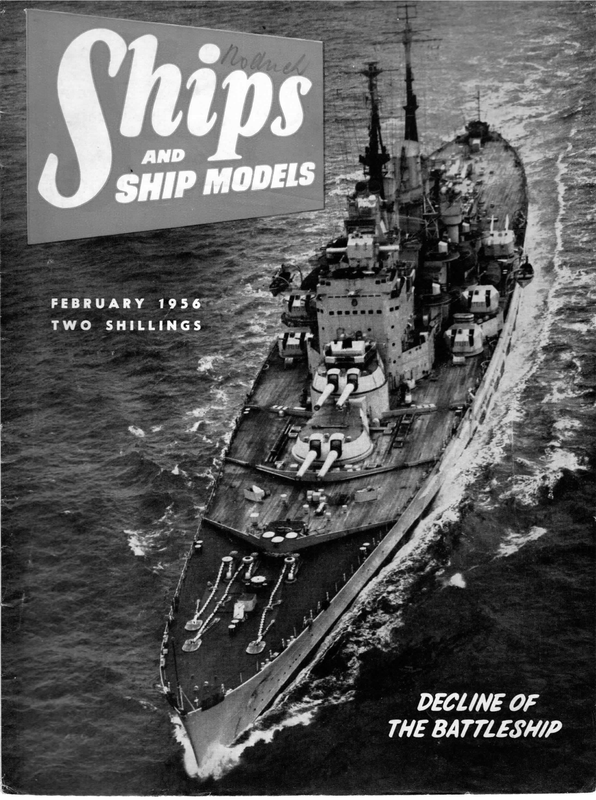
- THE ART OF SAILING UPRIGHT by Lt.-Col. C. E. BOWDEN
- He explains the meaning of sailing upright, the reasons for its adoption, and how it affects the model yachts. It is particularly applicable when model yachts are under radio control.
- RADIO CONTROL OF MODEL YACHTS—Part l by H. C. ALDRIDGE
- Making a start. First of a series which will examine problems encountered by model yachtsmen who are experimenting with radio control.

FEBRUARY 195 TWO SHILLING
THE ART OF SAILING UPRIGHT Lt.-Col. C. E. BOWDEN explains the meaning of sailing upright, the reasons for its adoption, and how it affects the It is particularly applicable when model model yachts. yachts are under radio control. AILING UPRIGHT, OR sailing flat as the S Americans sometimes term it, is one of the most vital and fascinating factors in modern racing sailing, as it so materially affects the modern yacht with its deep keel and shallow canoe body. It is an art that all leading helmsmen understand and practice. The art is not as easy as it sounds, and therein lies the gain for those who excel at it. Closehauled on the wind, it calls for great powers of anticipation of the gusts and a delicate hand on the tiller. To be well applied, it also calls for a knowledge of hull and keel action in the water, as well as the angle of attack and trim of sails. It even requires some knowledge of design. Sailing upright or flat does not mean dead bolt upright at all times when beating to windward, as a few individuals seem to imagine. It means holding the boat on her feet and not overheeled when sailing to windward, and as near upright as no matter when off the wind and running. The model yacht is as much affected by heeling as the full-scale yacht. To understand the subject properly the technique of full-scale yacht sailing is required. Sailing to windward When sailing to windward, different craft have an optimum angle of heel to suit the hull and keel design. To exceed this optimum angle of heel causes a lowering of speed and ground made good to windward, due to increase of hull resistance, reduced lift/drag ratio of the sails, and, most important of all, the reduced efficiency of the hydrofoil keel appendage. The above facts have been abundantly proved by the following :— (a) All leading helmsmen of one design classes have found it to be so by experience. Many have written or lectured about it. FIG! THE MODERN KEEL ACTS AS AN“AIRFOIL’ OR HYDROFOIL WHEN BEATING TO WINDWARD. Puno gneae L — ao ANGLE OF ATTACK — Semen eee MEaCe tf, Loin LEEWAY DRIVE OF SAILS SHIPS AND SHIP MODELS windward (c) in strong difficult gusty weather, – than their less skilful competitors. It has been proved beyond any doubt, by tank tests of models, and measured sailing tests fullscale. Dinghies take more heel Some types of craft can be heeled slightly more than others, according to shape and design, when beating to windward—all should sail upright off the wind. Thus the American scows for lake sailing are heeled more than normal boats, to sail along their long chines, or bilges, and reduce wetted surface when going to windward. Some of the new flaired British dinghies take more heel. Narrow fine lined displacement keel yachts can be heeled slightly more than planing keel craft, beamier keel craft, and centreplate planing dinghies. There is however no normal modern boat that can be sailed overheeled. The thing to remember is that above the optimum angle of heel of any particular yacht the performance drops off quite sharply, and that to go beyond this angle will lose you races against those who understand and apply this knowledge. This optimum angle of heel is far less than many people think. A number of years ago I drew attention to this matter of sailing upright in the first edition of my small book “ Model Yacht Construction & Sailing ” when the subject was not so widely understood as it is today. Since those days angle of heel has been scientifically studied, practised, and tests measured. It has altered the technique of modern sailing as well as design of hull and keel. To understand why we should hold a yacht up when beating closehauled to the wind, it is necessary to know how a yacht sails to windward by its hydrofoil keel appendage. The reader should study Figs. 1 and 2 with the explanation below. Action of the hydrofoil keel The modern keel owes its changing shape to aerodynamics, like almost every other improvement to LIFT OF KEEL TO WINDWARD course 2© Nia, (b) In any well-known one-design class (full-scale) it is easy to pick out the leading helmsmen by the way they sail their boats more upright, to Hee 5S?i smite ROXcl tared 8 APPROX. TARGET ARRIVED AT DUE TO LEEWAY CRABBING BY DRIVE OF SAILS. our yachts in recent years, for water flow and airflow are very similar in action, allowing for the greater density of water. Some years ago, small gliders built exactly similar to aeroplanes were glided in a water tank, and their action observed through a glass window. The “airflow” effect and the “stall” were observed to be similar in general action. Nowadays airflow is still studied over miniature wings with small aluminium particles in the water. FEBRUARY, 1956
Getting down to the fundamentals of fluid . mechanics, it is found that at low speeds, air behaves in very much the same way as water, and if the velocity of water is multiplied by a factor of 13 it will give the approximate speed of air for the equivalent results. Therefore, the keel of a boat moving at five knots in water could be considered similar to a wing doing around 65 to 75 m.p.h. in the air. Let us visualise the keel as an “‘ airfoil’? on end working vertically downward, with a thrust sideways when it is dragged through the water at an angle of attack suitably small to prevent stalling, as happens when a yacht is beating to windward, Fig. 1. The action “‘ on top ” and at the ** bottom ”’ of this foil is the same in principle as in the case of an airfoil, Fig. 2; it has a low pressure * suction ” lift on top, greater than the high pressure lift on the ‘* bottom ” of the foil. We can now work out how the “airfoil”? or hydrofoil keel operates below the water’s surface, pulling the boat to windward, against the sail’s drive forward and to leeward. The keel in action In order to reach a particular target when beating to windward, the boat is sailed or pointed to that target above it, as seen in Fig. 1. The hull and keel crabs through the water at approximately 5 deg. on a modern yacht, as it slides away to leeward to the target, pulled there by the side and forward thrust of the sails. The hull and keel are therefore attacking the water at this small angle of attack around 5 deg. as they progress. The water therefore reacts upon the “ airfoil ’’ keel | | 2 tue AGTION OF A SYMMETRICAL AIRFOIL FIG IS SIMILAR TO A HYOROFOIL KEEL APPENDAGE WHEN TO OPERATING THE AT AN ANGLE OF ATTACK MEDIUM.— AIR OR WATER LOW PRESSURE ‘SUCTION’ LIFT OVER CURVED TOP OF SECTION ry WING OR KEEL. Ser Berk ANGLE OF ATTACK APPROX.5°