
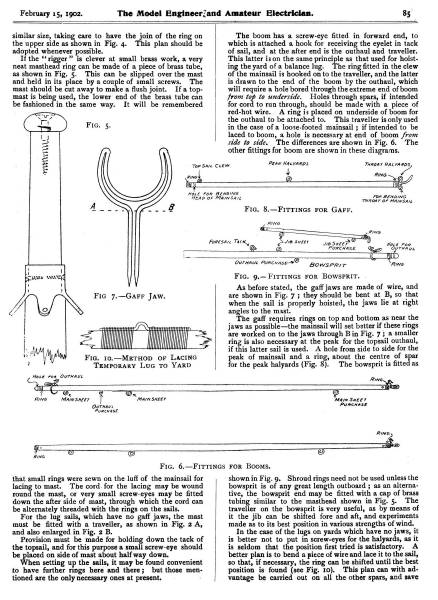
- Technical Rigging and Fittings. The author provides a granular guide to spar and sail hardware, emphasizing modularity and “tuning” for performance:
- Boom and Gaff Fittings: It describes the use of outhaul travellers and screw-eyes to adjust sail tension. Figures 7 and 8 detail the construction of gaff jaws (made of bent wire) and how they should sit at right angles to the mast for a better sail set.
- The Bowsprit: Figure 9 introduces a “traveller” on the bowsprit, allowing the jib sail to be shifted forward or backward.
- Experimental Rigging: The text suggests using temporary wire “lugs” (Fig. 10) instead of permanent screw-eyes, allowing skippers to find the optimal “lead” of the halyards through trial and error before finalizing the build.
- Model Yacht Club Updates
- Sheerness Conservative Model Yacht Club: Reports on a “Model Yacht and Nautical Curios Exhibition” opened by Captain G. C. Langley, R.N., designed to stimulate interest in the sport.

The Model Engineerzand Amateur Electrician. February 15, 1902. similar size, taking care to have the join of the ring on the upper side as shownin Fig. 4. This plan should be of sail, and at the after endis the outhaul and traveller. This latterison the same principle as that used for hoist- ing the yard of a balance lug. The ring fittedin the clew of the mainsailis hooked on to the traveller, and the latter is drawn to the end of the boom by the outhaul, which will require a hole bored through the extreme end of boom from top to underside. Holes eae spam _ intended for cord eerun through, should be made with a pi red-hot w A ring i and held in its place by a couple of small screws. The mast should be cut away to make a flush joint. Ifa topmast is being used, the lower end of the brass tube can be fashioned in the same way. It will be remembered FIG. 85 The boom has a screw-eye fitted in forward end, to whichis attached a hook for receiving the eyeletin tack 5. WET laced to boom, a hole is necessary at end of boom from side to side. The differences are shownin Fig. 6. The other fittings for boom are shownin these diagrams. PEAK HALYARDS Top Saiz CLEW RING y THROAT HALYARDS e, 4 © as ANC 4 FOR BENDING HOLE FOR BENDING THROAT OF MAINSAIL HEAD OF MAINSAIL Fic. 8.—FITTINGS FOR GAFF. RING ‘ So z FoRESAIL TACK Gi 8 SHEET g © OUTHAUL PURCHASE-®Co) P? z JIB SHEET PURCHASE HOLE For aa ve x RING BowsPRIT Fic. 9.— FITTINGS FOR BowspPRIT. a Fic are made of wire, and j As before stated, the gall jaws are shownin Fig. 7 ; they should be bent at B, so that when the gleis= propeniy hoisted, the jaws lie at right The gaff panuee rings on top and bottom as near the 7.—Garr Jaw. angles to the | ttt 2 TTT : ey ne Hoe ror axe ( 7 RING Fic. 10.—MgrHop oF LACING Temporary Luc TO YARD => jaws as possible—the mainsail will set better if these rings are worked on to thejaws through Bin Fig. 73 a smaller ring is also necessary at the peak for the topsail outhaul, if this eeeperryis used. A hole from side to side for the peak of mainsail and a ring, about the centre of spar for the eae“halyaxdé (Fig. 8). The bowsprit is fitted as OUTHAUL RING. ite We, KR MAIN SHEET 2 ? MAIN SHEET MAIN SHEET PURCHASE Ourhave PURCHASE RING , is t (9) RING Oo (2) —___ & > Fic. 6.—FITTINGS FOR Booms. that small rings were sewn on the luff of the mainsail for a e be Ae ee threaded with the rings on the sai ‘or the lugsails, which have no gaffjaws, the mast must be “fitted with a bevels as shown in Fig. 2 A, and also enlargedin Fig. 2 Provision must be made for holding down the tack of the topsail, and for this purpose a small screw-eye should be placed on side of mast about half sy down. When setting up the sails, itey beean convenient to have further rings here and there; but those mentioned are the only necessary ones at present : shownin Fig. 9. Shroud rings need not be used unless the bowsprit is of any great length outboard; as an alterna- tive, the bowsprit end may be fitted with a cap of brass tubing similar to the masthead shown in Fig. 5. The ogi on the bowsprit is very useful, as by means of the jib can be shifted fore and aft, and experiments made as to its best position in various strengths of wind. In the case of the lugs on yards which have no jaws, it is better not to put in screw-eyes for the halyards, as it is seldom that the position first triedis satisfactory. better planis to bend a piece of wire and lace it to the sail, so that, if necessary, the ring can be shifted until the best position is found (see Fig. 10). -This plan can with adtage be carried out on all the other spars, and save
214 The Model Engineer and Amateur Electrician. Therefore,15 =C X Universal’Electric Saniy ae = 15+8 = 1% ampéres. (6) T mpany give this information in thet catalo; es, if sensitive enough. (8 and 9) See anarticle on the mahieer:in April ist issue. (10) No. wi [6095] Model = N.R. Locomotive. I wish to buil G.N.R. No. in. scale M. B. frome) side firames,alee ale sketch showing shape of same? (2) e are afraid ich do you 1901, do, and also you be be mle to arrange two (slide-valve) cylinders between the inside frames of a 3 in. scale model without To this scale the boiler ee road be smaller than advisable. You may, however, ado.t 7-x6ths in. May 1, 1902. modore) for having scored the greatest number of points curing the season. The sailing of some 25 os events pro- du ver! om the closest ith the addition of eight embers, the majority of aint are going to compete,“it was hoped to make better progress in the future. The first race of the season was held on Saturday, March 22nd, and there will be sailings twice a month during the summer, the last fixture being dated cadens 11th, boats are divided into classes, as follow: The ho from 22 te arins. L.W.L., 30 ins. L. W.L. Class boats from 28 to 32 ins. L.W.L., in draft not to exceed 1 36ins. L. W.L. Class boat from 34 to 38ins. L.W.L., draft not to exceed 1 42 ins. L.W.L. Class os from 40 to 44 ins. L.W.L., draft not to exceed 12 ins, The sail area to be carried is as follows :—Multipl C wheels may, with navonteses |be e: of boiler from rail, 3 7-16ths Tue first cooneey, caslpped motor has recently made her trial trip fishing boat Lowesto:os This is the. “frst fishing craft which will uw petrol to generate the force required for all puesoece.acling er nets, hoisting sails, working the capstan, and driving her pumps. 24h.-p., andis fitted in a case 4 ft. b ie The sailing station is at lake at St. George’s Park, and the Hon. Secretary is Mr. J. W. Millier, 50, Heath Street, Eastville, Bristol. The Institution of Junior Engineers. ON the 15th March, this Institution held its annual t the VW alace Hotel, the guests being received by the President, Sir John Jackson, motor is of the three ayer — pam type, and sell, starting and reversing —Zxg7 nd Lady Jackson, and by the Marshall, an rs. Marshall. airman, Mr. Percival There was a crowded Model Yacht Clubs. Sheerness Conservative Model Yacht Club. motives run upon them. Amongst other tetenes of interest were the Stroh violin—shown by its inventor, Mr. Charles Stroh—and the Pianotist ; and in the lantern neeri with that end in view that a Model Yacht and Nautical Curios Exhibition was recently heldin the Conservative Cclub. The exhibition was opened by Capt. G. C.Langley, R.N., Captain-dee ogee ay of Sheerness Dockyard, who ata shortly prior to half-past seven, being re ceived R r. S. Chittick (President of the Yacht Club), r a5ce Baskett (Secretary of the Conserva- was given by the Ch 1: renderedin the a hall; in the short concertsby the Oceasional Ae‘ots, and a number if nt! installed for the use f the ateeny a4 Charles Haile, Mr. J. T. Wood, roft, Messrs. Yarrow, the Great Eastern Railway Co., ve ussons, Mr. J. B. Thorp, the Power Gas Corporation, Messrs. David Joy & Son, the Parsons Marine Turbine Co., Messrs. Lobnitz & Co. Professor Dalby, the Empire Roller Bearing Co. and dive nie and Mr. G. Searle (Secretary of the Yacht the Hulburd Engineering Co., wereSeay those te Chittick (president), G. Searle eae ear J. Par- the Victoria and Albert Museum, South Kensington, to Club) he fo ‘ollowing are the officers of the club :—Messrs. S. rett (hon. treasurer), G. .N. (commodore), Jordan aren) G. Searle, senr. , Palmer, Bostridge, and G, Milner (committee). T the A visit was paid by the members on the 2and March to party round, Bristol Model Yacht. Club. annual general contributed to the exhibition of models, &c. inspect the collection of, Naval, Mechanic al and Scientific Models, di &c. M . * Last kindly conducted the meeting of this club, held recentlyunder the presidency of Mr. F. Leader, ii was stated t july, which were, Boneh sailed off later inn the season. six ets ‘including the three challenge cups; winning he also won Warren has been very successful, the aggregate prize (presented by Mr. ‘Averay Jones, com- inter and pointed out Id see ge sed t the features men the of special sight of the proved gatticalasly attractive, and apap was exprested atgees were thus preserved Sa com it st showed the members For the courtesy extended the Institution, cordial acknowledgments were conveyed by the Chairman at the conclusion of the visit.
238 The Model Engineer and Amateur Electrician. field-magnet winding is insufficient. Six layers (about 2 Ibs.dot No. 18 are required—of course, to be connected i t n series. winding will do, but, theoretically, carry a heavier winding—say increase in output. owever, 55 The armature coonine of this sizarqould with acc crresponding with th mentioned alterations, you should obtain from 2 to 3 ampéres at 30 May 15, 1902. panyin; ketch should be adopted. 9lbs. or the No. 18 wire should sed, 434 Ibs. on each limb. The tw in parallel with one another ‘2) With regard ‘a‘the accumulators, your calculations are correct, and the cells, if of good make, would run the Jampswell forthe time. e shoul advise a somewhat volts, when runnin: Z at 3000 revolutions per mi nute, and 20 volts at the speed you specify. At the higher rate the c the machine would be about ro to2 he number of cellsin eaties which can be charged from the dynamo depends upon the voltage. Itisnecessary of this “should cut out, as the charging goes on andthe back E.M.F.” of thebeaccu- mulator rices. 4 Fan. R. (Roc! 8 o§ = e388 ae 3 Q S.. 5 g oO s g a? oO J > o. 2 a s i ugel writes: (1) How u make a fan for a vender tocbe ed by an slecais 3 gé [6149] holt rape I get such a fan? Where could (2) What size of motor should I need, and how much would the cost be? quir ork (3) What world be the strength of the the te and ventilated will be pbout 14 ft. by fan? The building to be 1) You can mal e fan very by cutting out some No. 26 or 28 gauge hard vie sheet as Lasily here shown(half size). Bend the blades to the The Sea charging rate ampéres per square foot of positive plate surface so that al lowing 2 ampéres as the output, your cells sho} ach have Je shown in t out the correct angle, viz., from aeits per cell, oe:that at 30 volts 12 cells gan be charged: rt 20 to be steadied. one to another by pieces them, or rings of wire may be puto view the blade A being at ZS. lades may brass wire, aa, soldered to side of fan, being secured tovan blade. The middle o: fan iiseach strengthened by a little brass ins. surface. This would 3 the case with cells paving one positive ‘and two negative plates, is. by 6 ins, and this je minimum size. You can fanke the cells as rachpe as you like, and will not lose any 10, 20, 30, 40 watts, and so on up to 500 watts output, with windings to suit each case. will findit a really practical little {6×05] Dyn We think you T. C. P. (Burton-on- Will you be good enough to answer the followin i of boo! ccumulators, rent) writes: lynamo wound for so volts, but I wi sh ii ins. le of lamina- 22 wire, which should give 100 volts and S. : want to wind fields for series, as I want fall output athe time she i * 1% 1ins. thick 4%ins. wide and legices. deep. I have plenty‘of ‘unnin: gauge yp wire; rather winding s; how much is it necessary to put on fields? (2) I wish to Alathie 5 C.-p. lamps through the night, say nine hours, Query No. 6149. VENTILATING FAN. bush B, soldered or brezed oa) and drilled and tappedto run on the end of shaft as shown. u 5 It should An mn the other side, N, acts as a lock- 5 have a laminated drum orring: monnd A armature, some- where about thiins. diameter X x} ins. You omit to state long, f the drum type. of advertigns for prices, (3) You the source of ‘ssupply current. Thisis important, as there is a gra difference petween publicmeeand private supply (from battery, &c.). The amor 30 or 40 watts. MODEL YACHTING and I wish to construct accumulators |tbat will1 ge the work well and with little trouble. work it 60 watts ; 60 watts require 5amperes ae I thus –p. requires supplied easily by six cells with x cell Will you tell mulators withred AT ILFORD.—Model yachtsmen in the “ford district will have an excellent opportunity of Query No. 6105, me ie this pbout right? G d and mal c up accu- rge, thatis A ie d for one and litharge for the other late, what is seeing a display of their own and other craft at the opening er atta in the new ‘‘South Park” (Green Lane) on May 10th. We are informed by Mr. P. Bennett that a dinkis in course of formation, substantial support having been obtained and a committee formed for the ae of enrolling members. The tg it is stated, will be a merely nominal amount, with hose inte rested are With 25-volt dynamo, how must I reduce voltage to charge six cells? he proposed windingis rather too heavy. lbs. No. 22 should give the required 100 volts. To wind the1%fieldAbout magnets in series with your No. 18 wire the plan shown in accom- pel belonging to members of the Highgate Club will be present as well as those of the local yachtsmen.
42 The Model Engineer and Amateur Electrician. Answers to Correspondents. “E.G, E.” (Bath).—Thank you for the photo of your model yacht. Althovgh this has not sufficient of special interest in it to warrant our reproducing the photo, we think you have turned out a very creditable piece of July 15, 1902. Model YachtingCorrespondence, (The poe invites readers to make use of this column Sor thefull discussion of matters ‘oth practical and mutual interest. wor ended for publication. “E, L.’—You do not send your address or = a stamped envelope. We believe the same lat. y be e paper only.) obtained from Mr. Stiffin, 4, eatin Buildin, 1pe N. “WwW. G.” ewton).—Wedo ourSes to help you in your Sails of Model Yachts. ge THE EDITOR OF Zhe Model — Street, ymeed London, difficulty. We cannot too strongly advise purchasers of castings, &c., to find out if drawings are supplied with the goods before ordering them, and if so, stipulate for proper working drawings to be sent. Itis hardly fair to us for our peccnaes to expect the Query Department to do work which should be done by draughtsmenin their employ. We have, of late, made several workg drawings for querists from rough sketches of the s, onsi¢er an untaped headsail with a cord throuah tke luff and fastened to the sail at the points A an is more or less in the The direction tension in the sailcloth of the arrows. The portions AC and BD will tend to stretch, since C will be but we cannot be expected to do this as a regular g- Prize Competition Competition. No. 23.—Three prizes, value 41, 15s., and 10s,, respectively, are offered to the owners of the three model steamboats doing the fastest authenticated performances. The following special conditions will apply :—The boat must make three successive trips over a course not less than one hundred yardsin length. The exact length of the course must be must be sent in to us not later than July 31st, and the winning competitors will be required to furnish photographs and short descriptions of the boats, in ae with the usual General Conditions printed below. The competition is limited to bcats not sr eysix feet in length, and the starting time is to be taken at the moment of turning on steam, GENERAL CONDITIONS FOR ABOVE COMPETITION, 1. All articles should be written in ink on one side of a paper onl . Any drawings which may be necessary should be in gen black ink on white Bristol board. No coloured ae or washes should be use The dinwings should peaoe as-third larger than they are intended to appear if publish 3. The |ae of the prize articles to be the property of the proprietor of THE MopEL [NBER and the decision eh the Editor to be accepted as fi 4. itor reserves the right to bani, the whole or any portion of an unsuccessful article which he maythink worthy of publication, berate the competitor distinctly expresses a wish to the co’ competitions shoult be Sy cae to The Editor, THE MODEL ENGINEER, 37 & 38, Temple House, Tallis Street, London, E.C. ould be marked out- Model Engineer cord tightly, but the needle must not go through the cord. The ends may be finished off simply by two half hitches. This is perfectly adjustable. If permanence is required, the ends may be sewn into the sailcloth and cord after the sail has been used a fewtimes. Another thing that requires adjustment after trialis the leach. It is usually too tight or too loose, according to extreme edge with e tightened by sewing the very fine cotton, taking stitches about Y in . long and two threads deep (G) ; thisis also adjust- able, ‘and is unaffected by changesin the dampness of the ze *. any men cling to the loose-footed mainsail. Itis cer- tainly more difficult to make a laced sail sit well; but, once fixed, the better distribution of strain enables the . and drawings should bear the sender’s full name and address on the bac! sail to keep its shape oe lighter cloth and a lighter b fod admits of the use of r. Wilson Theobald states that the foot of a laced fail should be cut concave.
The Model Engineer and Amateur Electrician. July 15, 1902. | this a slip? I always do the opposite. I believe in will ee the ordinary ig the lightest lot a ater in damp uch weather, and I risk ihe posetbiity of _ speasional tear in n, because it a a collision, | | fitting lid thisis unnecessary. the safety factor to the lowest limit. Itis only by doing so and replacing those parts which prove too weak, that he can really find out the strengths fapiived’in the various N.S. parts.—Yours truly, Troedyrhin. = Practical Letters from Our Readers. urse, for more drills truly, London. A Fast Model Steamer. THE EDITOR OF The M To — Dear Si1r,—The ecmmpeea te photograph which is capable model steamer which I of five of travelling over a measured aieice at bythe6 rate ins. broad, miles an hour. The hull is 34 ins.ee e. The deckis tin, by 6ins. deep, andis made of re madein three sections for lifting aes unnecessaryfy Huge are dispensed with, as speed is the main pol ote The funnels, forehatch, and bridge are made to slidedown when mast shownin the photographis always taken the boat is under steam. (Th: Editor nvites readers to make use of this column for|the full liscussion of matters of practical and mutual interest. ey we. be signed spt a nom-de-plume i/ desired, but the – and address of veene: MUSTp imvariably be pokey‘though f or larger sizes the dimensions can “he altere Unlike the mcdel engineer or ‘‘large” yachtsman, the mneiel yachtsman runs no serious risk in cutting down 43 may be put on the base to hold it oo but for a tight- The boiler I am using was es . oes : : By] Power Transmission in Motor Bicycles. To THE Epiror oF Zhe Model Engineer. Dear Sir,—Having read < exceedingly able and awleyin your June Ist his Seiten to anew specially issue, I should like to — riveted hide belt, invented, I nteresting article by rT. constructed V-shaped believe, by Mr. Ii. W. Stones, of Stones & Higgs, cycle some severe testing by that clever motor cycle rider, H. bd oe the only successful belt on the mar! WAYGOOD. Yours llersie. Storeton Road, Birkenhead. Mr. ANDREWS’ MODEL STEAMER. ——_ A Handy Box for Twist Drills. To THE EpiTor oF The Model Engineer. Dear S1r,—I enclose a drawing of a very hand I have made for covist drills. Mine holds thirteen ‘nile ae as i jy) J made from a design given by Mr. Halpinin the April ss issue, 1901, of THE MODEL ENGINEER, I ha and to get it into my boat. I have tried muchofsmaller make ittypes boilers, but none of them could keep up several at steam for any length of time. The above boiler works 30 Ibs., but fails tokeep up this pressure when full steam is turned on=ees but it can keep up 20 Ibs. with the I use meevinied spirits for firing, the valve half o tenet heieg - ¥ ins. The chief dimensions of oiler at :—Length, "854 a diameter, 33{ ins.; firebox, il 2%ins. high by 24ins. Steam gauge, two gauge apssteam tap, and filling screw. The engine is partly designed from the one described by the exception of Mr. Morriss for his torpedo boat, wi ball-bearings and return crank for- working the slide-valve. = A Hanpy Box For Twist DRILLS. rom 1-16thin. to 4 in., and the drawing—whichis oneI made it of whitewood, third fall sea aie this size. and stained it mal r and varnished it. baseis cut from a soll;alapbee all round the side to a depth of about 34 in. the holes for the drill IT have used an eccentric, and oe-shaft runs in ordinary bearings. The cylinder is % in. bore by % in. stroke, the ports are 1-16:hin. by 3-16thsin. oreand the exhaust engine runs at a is 3-16thsin. long by %thin. wide. very high speed, and drives a four- bladed propeller 13¢ins. diameter. 3 ins., and two 1 to fit horizontal edges are rounded off, and the lid madehooks nicely on to the rabbeted base. If desired, two ins. dia! having to) Dia a Propeller, 3 blades ... 2%ins. ... 3 miles per hour. I i 3 79 run through it till the shank fits in ae The orna e lid has its o! mental bottom is afterwards glued four sides mitred together and the _ let in. The top I havetried four aie propellers, amtins., three blades Rash The ae with the above propellers are as follows: ” This appears to prove that a small ‘propeller running ata high speedis a great deal better than a large one running at a lower speed. It took 4> ins 5 the 3-in. propeller, andit only takes about 2 Ibs. to drive highly i 134-in. propeller. Although the boat is not
The Model Engineer and Amateur Electrician. July 15, 1902. the copper wires are for the following numbers, namely, Nos. 14, 20, 21, 22 and 24, e, for a e gauge“impliedbytthe author o¢ f he gin ay 2ache design. by Mr. E. x” = i.s the English sake (whic! is the most “ offici of the article hundre auges in existence in thiscountry)s The following shows il ee diameters of the partic!citar numbers you quote : Gauge No. 14 20 2 = om iam. in inches. es “080 *036 os wie so28 a “032 es 22 47 the casting fer the regulator: valve may be used in its place. casting The igned—it requires to Diam. lcncees: 2°032 “9140 oi “8124 7189 24 “5585 You do not mae it “quite diese what extra details you require,the article in n being complete in itself, although, o! of course, it uction. . (Uxbridge) a method of making a ball thstist bearing for the Propellersshaft, It consists of a brass tube, tapped at ends, to take the hard steel cups B B, and held to a baseBRASS =~ SUPPORTS \_ Query Iv? 6208 BRASS TUBE ELLIE. CYLINDER FOR MODEL TRACTION ENGINE. exhaust can be connected by a pipe to the chimney very easily with a piece of 3-16ths-in. pipe. Inside the funnel, should be slightly contracted, and the end u uptu exactly con- centric with it. The steam port 1-16th by 3-16thsiih should be sunk and connected to the ends by two 5-64ths o placed side by side and at the covers the cylinder may be chipped “SUPPORTS RIVETED INTO away to BASE PLATE form a passage for the steam to the aking ype of screwed on astings satisfactory stu tu: and rdinary gland with two madein preference to the model makers’ glan [6413] 5=Rater Model Yacht. J. R. G. (St. Leonards) writes: Please can you inform me whether the following dimensions of hull 5 would be ary good for a 5-rater, << =x S. rule? 4 have no exp erence ofde: +: ening 3 L. . 3t_ins., beam i N draught 14 ins., ull to carry a given area of sail. a ins., extreme displacementcrt84% lbs.,L.O.A. ship section ratheer flat, lines of an average “falness, TurustT BEARING FOR PROPELLER SHAFT. = AR" plate by two Bese brackets, soldered, ang having the bottom edges The catch-plate A—also of Iam fairly expert at de:esigning the shapes of hulls feya given displacement, but NN : 4rins. ; mid- Roughly nN steel—is screwed 4B fell having a milled the other end, the out edge,and being provided witha Steel bicycle balls,ee larger 1vhan, Aiin., should bi If the: e uld behard. case-hardene ofiron these bearings should be should allowa little play, but not enough to leave room for another © RS “(6208 ] Cylinder dir Model ee Engine. cordance ocwtn, (sa: dle, two obliged for rv previous reply, and in ac- Tam sending. you erewith the castings , cylinder, and two v: stand your sketch (not reproduced) of the do. ). quite under- usual arrangement of a MIpDsHIP SECTION—5-RATER MopgEL YAcurT. should be obliged if you could show the position and speaking, ido you think such z hull would be sefacientlySealy traction engine i intended to cover in; umber cf steam connected to, and 3 b howe: t think addle here is may understand it better than you i e face of the upper chest and where ¢ the opening on the valve chest occurs from with its g6o sq. ine.? The prevailing fashion at Hastings towards preposterous width of of m the general experience ae leans beamyaand shallowness of hall, s oOit s of hull (say, 122 ins, bi ins. draught), are t eel of more moderate propor- Abas and y no conrection with the boiler cast in the cylinder as is usual in traction engine practice. In the steam valve regulator should be indicated in the sketc! fitted; box, a slide- this is, we think, quite clearly rts Ly 5-64ths in. holes running into a 3-32nds in. inclined hole drilled from the main e face. A nick will bave to be filed in the steam chest to form a clear passage for the . The re; regulator-valve must be specially made, and, as the main valve you send is useless for its purpose, s e midship section. As ropose 31 ins. = W.L. the fraction for obtaining the area of the MS. would je ~ = 235 where we find MS. = about sq. ins. draught(the draught at the MS.is always less than the extreme draughtof hull), it would be neceary to have ann absolutely e MS. to make it large enough. We should recommend that
The Model Engineer and Amateur Electrician. 48 the drpuahe Beeet age to 2% ins., leaving. the L.W.L. 31 ine one wu Ss. tsich may be of nclose a the OW, as regards extreme drau; of bost, including fn, podhcog which you suggest as 14 ins., this is cpatint outrageous. would you think if Shamrock were to draw 4o ft. f nis is ihe 3(-in. 9 ins. is amp le for a beam—and good I but with a nice easylines fore and att) it should not be necessary to have a draught of more than quarter of the L.W.L. Light Installaance of I Electric Resort)seiwrites: [65394] TestingNewpo: have fitted our house with tion. G. J. eight electric lights of 16c . each, | and am thinking of getting |the them to their pmains; butI any to connect sulation must amounttt to so waaay ohms beforethey will connect “Now lain DOE sure if mywork ofa friend will come up to their standard, but through the indicts actly as vsed for testing, and I should like to nc."the eeult ofa y Baye woe use of a testing mpany test myself before I call them in to pass the work. Will you kindly July 15, 1902. come cheaper than that previously obtainable from them. Their li.t (price 4d.) gives full particulars of the sizes and cost per foot run of all tubing at present kep! *A Cheap Boring Bar. Mr. H. Hine, of ror, Winchester Road, Tew x Edmonton, Lon- don, N., has designeda new Sakele boring bat,which has the merit e boring of being” lowincost and for many purposes, and, ae fa of x wiins.maller baris suitable be bored, provid over are to jement, aud tools ‘wo) id holes can also be bored bya secondCie each, and a key for Securing themin t price is 5s., and the shank of the baris 3{ in. ‘quate.* entiion Tis Mops. ENGINEER ey writing. Blow-Lamps for Model Boi! Suitable blow-lam; s for model boilers, iitended “or operation by usack, 15, H olywell Row, hav:e, of course, no wicks and do not need pamp: any position; they ha as lamps Finsbury, Londen, e flame can be regulated to any degree, and ia various sizes and with can te had, readers one or two nozzles should have no difficulty in securing the right | one for their own individual needs. They should: 7 ention THE MopEL ENGINEER when corresponding on this subject. ange of Addresses. E UNIVERSAL areata Suprpty Company have wiitten asking us to ann>unce that they have removed to 60, Brook Street, Choriton-on-Medlock, Moenae where they will have a show- room, and keeep a large assorted! si tock of everything electrical, in- BuTLEeR Bros.—We have been requested to noireaders of THE a e wet floor and placing my finger on terminal A, I got a deflection ingimy finger away, the needle retarted, to zero. uld be very d Move. gli raad that this firm havechanged their place of busiure, all correspondence should be addressed to ness, and, in Henry Butler (the new style of the firm), Whiston Street Works, information thesinstrument you are using. Tae without a:seeches apply |to _tnree or four instru© you give is rather vague, and might i a wire onto the the ne it al a your installation, earth. re your the gas pipe other end on to If you get a big deflection, and d is connec! test earth deflection whe: to the instrument, we should be inclined to think that your installation is good certain, not knewing the instrument you Catalogues Received. Tryjoining re your lead coines to, wire and pis ttcont we cannot say tesbury Avenue, London, W.to anders & Crowhurst, 71,, Shaltapparatus and accessories is of pase ee goods, Atneat areot rs interested can obtain a copy on appli- cg: ENGINEER being quote Frank F. Wellington, Ltd., The Towers, 36, St. George’s ‘s Park oac , London, N.W.—We!Iington’s monthly Motor Car Register and A AUEEEEE is a publication of interest to a class of our readers. large cl in the April ii ssue, for example, Amateur’s Supplies. te, risk have been based on editorial inspection of the poids noticed.| burettors, coils, accumulators, switches, pulleys, &c., can be had : pp r Road, Tunbridge Wells. comple! the Sonvetsion of Castings a d forgings, finished, partly machined, or rough, can be and ordinary bicycles‘are amongst the matters Mr.*Bravvery underta) takes. Men ntion should be made of THE Mopgr ENGINEER in corresponlence. Lathes on Easy Terms. srs. S. Holmes & Co, Albion Works, Bradford, have informed us that they have decided to all amateurs to jase their lathes on a system of ment! ly pay oO! rse, this c on! lathe being forwarded on receipt of the first payment. These terms apply only to the above ard to the 22s. 6d. lathe by this firm. Notices. The Editor invites correspondence |and original contributions on only,and should invariably bear the sender’s name and addresPte echanical and electrical subjects. Matter int—— all amateur mec should be distinctlysoemwhen sending contributions, washes remuneration is ex] snvelope for return in the eventtof by astampeda addresoed panied to see t! rejectio: or not, and all MSS. should be so by Galllag ait appointment in advai essrs. . This has been met by ‘0. annum, Order. persia rates may be had on application to the Advertise: ment Man: How To si eeLerrers. Il_correspondence relating to the literary portion of the paper, n apparatus and price lists, &c., for Revie to be addresse and all new & 38, Temple House, THe Epiror, ‘‘ The M odel Engineer,” 37 o Tallis Street, London, E ¢ ADVERTISEMENT redea The Model Bogivece,! 37 & 38 Temple House, Tallis Street, London, E.C. iameter, and light nase tube from }th in. to 3-16ths in. outside ett-Lowke state that they will nowibe able e addressed hd n o be addressed to the Pubbohers ewoaan & Ward, Tiaten & Farringdon Avenue, London, E.C. Sponand Agents for United States, Canada, and Mexico: Sole .A., to whom mberlain, 123, Liberty Street, Newi vor US Cham All to supply light brass Tabes suitable for flue tubes and which will – for 6s. per This bears) will be sent post|ee to anyidaddress be made by Postal *For Model Boller Maker: ie adv:vantages ofof solid drawn (i.e., seamless:. fabing. for boilers need not be reiterated here, and the only drawback which presents itself to the amateur boiler maker in the use of this materialis the pecasionel difficulty of obtaining it readily. ‘bl hilst actual Bicycle atid Parts. for the construction of motors for breycles, and also car- . icycles oe or exinterested Hlsmal cars, motor vans, Acsor; butsalethose toThevoiturettes price ofthe Register is a penny per will do well to remit 1s. 6d. to the publisher, ‘aad have it forwarded regularly for a twelvemonth. and tricycles in | (Theheading Editor Foe be pleased aypreceioeofjornewveview underthis tools, apparatus, all subseriptic ea
The Model Engineer and Amateur Electrician. 62 whole of the work of the Ea elas- ome electricaily, the current being taken fro circuit. The keyboard, of course, requires pares supply latingin the usual way; but the operator merely touches the keys, no power being required beyond the very light tap required to make the necessary electrical contact. Most exhibitions have their curiosities, and not the least interesting example of this kind at Wolverhampton is the collection of inventions and literature belonging to the Pomerat pany |ane shown oni mer standin the Industrial Hall. Here may be seen a model of a steam en- gine:eae for blowing domesticfires, and for Yeuulathe ty‘Liew, -Col, Thorneycroft. Some illustrated.waa vented of this gallant officer’s aeronautical experiences are also on view, together with a number of other items which testify to his ingenuity and enterprise. One thing which the engineering visitor to Wolverhampton will not fail to observe with interest is the new service of electrical tramcars now running from the railway station to the exhibition gates. This is installed on the August I, 1902. long, oS _Preposterous draught under the late L. and S.A. rifle surprising that those who app! thirsting for some satisfactory fanaa, should not jump at the opportunity afforded them. THE MopEL ENGINEER does not hold a “ brief” for either in the embryo state, or those contemplatin; trial, change, threw away the chance of giving this rule; abut at The old L. and S.A. Rule had a long innings the finish it was admitted by all to have run to seed. Models, of course, could never have been built on the lines of the most extreme craft, as these latter were prac- tically kept on an even keel by the acrobatic performance of the crew, and for this very reason the model never Lorain i ipsin bales no overhead wires or under at Geeta suds eaten a rails, by means of a iat conduit sed, the ci sipey contact bar underneath thecar. The Rating of [llodel Yachts. By W. H. WiLson THEOBALD, M.A. N the June Ist issue of THE MODEL ENGINEER appeared a note to the effect that a new Model Yacht Club was being formed at Hastings; it was further stated that the Secretary was anxious to obtain particulars of the rulesin force amongst the various model yachting clubs to enable him to frame rules for his 0 By “rules” it is assumed iis meant ‘‘ rating rules,” and not ‘¢ sling rules”: if the formeris the case, that Secre tary is to be pitied ! Perhaps by this time he and his colleagues have come to some satisfactory solution of what will—more is the pity—always prove a vexed question amongst model yachtsmen ; but if they have not done so, why not go the ‘‘ whole hog,” and sail under the new .A. Rule—namely, LABS HOC + f+ MVEA = LR. Admitted that the feeria presents difficulties to the novice, after all a modelis an easy thing to handle, and could wellbe measuredin a bath or suitable ta The actual ce eg of the boa’, however,is probably not a a difficu who follow.the sport, design and build their own ar;conte take the trouble to master the whole subject of lines and centres (may their number increase) ; others merely take a block of wood, and cut it down until it pleases the eye, afterwards weighting it with lead to bring it to the desired L.W.L. The latter folk are those who probably cause the aennle when any rating, other than L.O.A. or L. W.L., is proposed. No doubt many ‘an excellent boat results from this rough-and-ready method ; but the chances are that, if re- quired for a certain rule,” she would be found too big or too smallin some dimension The excuse of not being able to secure a design, or not rule have, and do appear in the Yachtsmanand Fie/d, which could, with little modification, be used for models; and surely there is more pleasure in sailing a miniature of a real racing yacht than some ‘‘ glorified washtub” produced by a ‘‘length only” rule, or a shallow dish of 5 ft. Fic. 1. really became a freak, although many had a depth of fin which was absolutely unnecessary. Any untaxed element in a rule will naturally be ex- aggerated untilin time it becomes entirely out of propor- tion. What the new rule will have produced by the end of 1907 (the length of lifeit _ been given by the wage ties) remains to be seen; but there is no doubt that ai ihe moment it is producing a most desirable typ Before discussing the possibilities under the rule it may be well to explain whatis meant by each element. The length (L)is the length on the L.W.L. B is the extreme beam. Gis the chain girth taken at ‘6 of the . from its fore-end ; @ is the difference between “the chain and the skin girth at that section (as in Fig. 1). girth, to1 ,/S.A. explains itself. These elements are added gether, and divided by 2°1, and the result is the linear rating of the boat The classes are. divided into 18, 24, 30, 36, 52, 65, and over 65, and take the place of the old 1%, 1, 236, 5, 20, A. Rule. a fe drawn at random will give thedesignee siti idea of what
August, I 1902. 63 The Model Engineer and Amateur Electrician. an important question this @ becomes. The skimming dish is, of course, absolutely wiped out, and the ‘‘ theoretical” perfect section would be that without any hollows . The question, therefore, is how much in whic Sican be given to the section to obtain the best result, without overdoing the d. There is one weak point in the*formula, which is pro- | The following are details of the model, the drawings of which are to a scale of 1} ins. to a foot (one-eighth full and 5 show the sheer plan, body plan size). Figs. and half-breadths respectively. Fig. 6 indicates the area and displacement curves. The length over all is 53°3 ins.; h .W.L. = 34 ins. ; beam (extreme) 9°28 ins. ; (extreme) 7’I ins. The rating may as well be shown as ducing an undesirable profile. The draught of the boat must not be greater forward than it is at °6 of L.W.L. follows : i-g that there must be no hollow. The result is that, by drawing the profile in a straight line from the fore end of rying it well under the after the water line, an be most carefully considered by the designer, and that is without the extra draught being added for the measurement ; but nothing is said about a/f of the section, except- lateral resistance, and the girth G (measured at °6) can be Fig. 2 (A) shows the extreme profile possible. Such a boat would be very tricky to steer, besides being apt to damage herself badly in the event of bump- L. (34) + B. (9°3) + $G.(10°7) + 4d. (2’2) + 4 J S.A. (19°4) = 75°6, which, divided by 2°1, = 6L.R. There is one point in mo el yacht design which should the sail carrying capacity. Readers of THz MODEL ENGINEER will have noticed how, when on the subject of locomotives, it has always been pointed out that a boiler made to a certain scale is not powerful This enough to feed cylinders of the same scale. can be said also o* model yachts, if ‘‘ hull” is substituted for “boiler,” and ‘‘sail area” for ‘‘ diameter o’ cylinders.” Take, for instance, the Valkyrie [1I. She was 90 = ft. on the L.W.L. and carried An exact 14,000 model of 3 ft. W.L. would have y ; 2,240 sq. ins. of sail. (The sail area varies as the square of the scale in this case zy, and, there- ‘6 LW.L. (Displacement varies as the cube of the scale). A model Io rater cou WwW i —, to scale, both as d sail area, would be most is unsatisfactory. 6 LWL Fic. 2. ing heavily on hard ground. A compromise is usual, – either by a long easy sweep as in Fig. 2 (B), or by dropping the keel as in Fig. 2(C). Both theilatter outlines enable the lead, and consegently the centre of gravity, to be placed lower, giving greater stability to the boat. As a help to readers the accompanying design, Figs. 3 to 6, is given as an example of the type of craft produced Sheis by this rule and was drawn to represent a 36 L.R. W.L. and carries 1,500 sq. ins. of sail. i The overhangs are, perhaps, a trifle exaggerated, but the value of these, in enabling the buttock lines to be drawn out, has been fully demonstrated by the old L.W.L. and Rule. The sharp angle on the section of the lead .A gives the least possible 3 girth on the given beam an If the latter were decreased a trifle, the usual The displacement of the practically the same. just under 13 1bs., showing her to be a lighter craft than the usual 10-rater. consequence, a model could carry a press of canva strong squally weather, which would be positively unsafe i a But there i in a real yacht. and, as a general rule, a model that keeps on fairly even keel and steers a steady course will be found to win more races than another perhaps a trifle faster in medium the in awash rail lee her get breezes, but which will strong puffs and so distort the curve of immersion. The present rule tends to decrease beam ; but from the cus- certificates of yachts built it would appear that the onetom has not been to reduce the beam to less than is more W.L., and stabi’ity lost on beam ballast beyond the crew, and this limited to two people (say, 300 Ibs.). The present 18 L.R. is a
September 15, 1992, The Model Engineer and Amateur Electrician. and, having removed the bits gelbrricis yey sponge all round the varnish with warm e-dissolves the isinglass and the superfluous a comes a with it, leaving a clear gold circle protected by the varnish. The whole can now b: coated with the black varnish, two or three coats being required. Fig. 32 isa diagram of the connections, only one indicator bobbin being shown. The thick line shows the ‘‘main” wire, which is carried to every push, and should pee ‘be of some different colour from the rest, so as to be able to dis: tinguish it should any additions be necessary, or should anything go wrong. The indicator is fastened to the wall by four screws, one at each corn i Three e . quired to work it. If carefully made to the foregoing instructions, it will bea useful addition to any home, an will amply repay any one for the trouble involved. 129 es ene or the base line must be drawn above or below .W.L., so as to bring the depth a multiple of one. When the number of planks necessary for the under water body has been decided upon, measure upwards and arrange the top half of boat in the same way. If a boat is to be designed for building in this manner, a lot of trouble is saved if this planning of water.lines is thought out before the drawing is started he top layers are apt to give a little trouble in consequence of the differencein height at stem and least freeboard. Inthe design given the pein at a is 4 ins., and the least freeboard is 23¢ in therefore, 1-in. planking were used for all the layers above the L. W. the top plank would bre where between sections No. 3 and 4, as in Fig. 1 ere is no reason why it should not do so; but a better finish will result if the top layeris made from planking sufficiently thick to avoid this break. In the design given it is suggested that 13%-in . plank be used for ie top and second layers. This will leave 4ins. from W.L. No. 2 to the bottom of hull, The Construction of ‘‘ Dugut’? Model Yachts. and four 1-in, planks can1 be used, By W. H. WILSON THEOBALD, M.A. ‘*BUILT-UP” model is not an easy job for an amateur to tackle, and moreover, so far as actual sailing qualities go, it is a moot point if, after all, the ‘‘dug-out” craft does not give the better results. Euchival tests tend to show (in the smaller classes, at any rate), that, size for size and equality so far as sractiona strength is a the latter craft will ve an advantagein weight of hull” over a boat «bu It-“up ” from the sam The ‘‘ dug-out” plan acer has the aig of really simply a question of careful use of the chieel:and being far easier for the amateur to undertake. is spokeshave. The most primitive way of digging out a model is to _ a block of wood of suitable dimensions and cut way outside until the lines ‘‘ pleasethe eye,” and inside until auticieny hin. This —_ in olden says before the about, the pla: aloptecat ” builders ine abtainiog fair theory of ‘‘lines” and s” was Fic. 2. much troubled Another difficulty may arise with the water lines above lines for boats they proposed buildi en, however, a boatas large as = 1o-rater is required, the L.W.L. if the boat has what is called a ‘‘ tumble home” (shownin Fig. 2). In cutting the plank for the ae difficulties arise; the most important being that of obtaining a piece of wood of suitable size, and, secondly, the enormous amount of manual labour which ha: as to be expended on the piece of wood when found. As an example, suppose a 10-rater is 55 ins. long, I1-ins. beam and 6°5 ins. deep (including above and below pees bod A piece of Bootsot these dimensions would c *g tain just about 4000 inches, or about 2°31 cabic feet. A cubic foot of A pine weighs 40 lbs.; the log, therefore, would weigh 92°4 Ibs. s the hull when finished would turn the my at about 4 to 5 lbs., it will be seen what an enormous amount of hard work would be requiredin the digging. out process. It is now customary to build a model of any size by means of layers, commonly called the ‘‘ bread-andplan. butter” When a design has been chosen, it will first be neces- layer nepeeenied by a rectangle A, B, C, E, if the dis- tance ABis taken, the edge of the plank will fall plumb down from A to C, and the curve of the section from to C will be entirely lost. It is necessary, therefore, to examine the sections of a design, and see whether the line AC, dropped at right angles from the end of any particular water-line (or deck curve), cuts the curve . the section or not. it does so, the distance AB must be increased by the addition of the full width of theren and this measurement substituted instead of AB. Cutting models from blocks of wood, or on the layer plan, always entails a lot of waste; but with a little ingenuity a great saving can be effected. The system will now be cee. Itis clear, if a piece of wood te pos out exactly as the ‘‘half breadth” plan, and cut out at the water- sessonthe pieces, if held up ean one another, would for dship section, like Fig. 3a, and a sheer plan, as a Fig. 4a”; if let go, they would promptly up flat again, as shown in Fig. 3B, an ii What is required, therefore, are ledges at a, 4, =ré ree planks will be required; if a trifle less than 3 ins.,— same number will answer equally well. But suppose the hullis only 24 ins.; in this case the bottom layer wou e inconveniently small, both in length and thickness. To remedy this, either a larger plank must be chosen to dispense with the to prevent this collapse. For simplicity, only two waterlines, representing two layers, will be taken. On referring to Fig. 5a it will be seen that a ledge is required on the inside die of the larger water-line, which will rest on the smaller layer when the former is placed on the latter * This only shows up to the top of W.L. No. 2.
130 The Model Engineer and Amateur Electrician. To obtain this ledge a new centre line (CD) is drawn and fr line is drawn, as shown by the upper line. Ow, Su pposing the wood were cut out first along the smaller ortgzna/ water-line from G to M, and afterwards along the new larger water-line from N to O, and then placed one on top of the other, the two lines AB and CD, being the centre of the boat, must, of course, be exactly over one another, September 15, 1902, used for these measurements, they being fuller here than at the bow end. Assiniing the water-lines of the design to have been suitably spaced, and the examination of the sides of the The details will, of course, refer to the design given. A full-size drawing of the sheer plan should be made; and the inside edge of the larger layer (represented by the the ‘‘ buttock,” however, may be left out, but another layer, at the keel, stem, and stern (see Fig. 6). curve of the smaller water- line) will lap over the smaller db dine, and the ledge necessary for the support will be formed. Fic. 5B. curve must be drawn in showing the thickness es be left e half- breadth plan draw the centre line AB, and linesx right angles to represent the sections. Draw iin the curve for the top of the bottom layer—viz. W.L. No. 5. Now, by the rule already given, find the distance between the centre line and the new centre line CD, from which the distances on the sections for the next layer are F Fic. 5A. [| Fic. 6. /| ic A 12 a“ wt. Ss a Le c 8 10 a9 8 7 Ss 4 3 2 / Fic. 7.—CONSTRUCTION OF ‘*Duc-ouT” MopgL YAcHTSs. Thus, from a ng of wood of the length meueeety: ist the larger curve and only the distance between the lin B and CD wider than the width of the nascurve, both igenhave been cut. ‘o obtain the distance necessary between the two . lines, proceed as follows :—Fig. of the sheer plan with the thickness of wood in- aed to be left when the inside of boat has been dug out; EF represents the joint of the two layers, the curves of which are shownin Fig. 5a. Measure the distance along EF, and transfer to the water-line ae GH. From H draw HL at right-angles to AB, where this line cuts the water-line at L sae be ‘hepant through which to draw the new centre line C. It will be found that the fuller the water-lines are at the ae the greater will be the distance from H to and the after ends of the water-lines should always be o be measured; this is water-line No. 4, Proceed in this way with a new centre line for each water-line, until water-line No. 2 has been drawn in. Thisis the top of the fourth layer (counting from the keel), and the finish of the layers to be cut from the I-in. plank (Fig. 7) gives fhe drawing of the water-line layers. On another piece of paper mark out a centre line and sections, draw in water-line No. 1, and having found the distance from this centre line to the new centre line for the deck, draw in the latter curve. These two layers are, 9 ins. long, 11 ins. wide, by 1 in. thick; and nthe other 54 ins. long, 9 ins. wide, by 14 ins. thi k. If each layer had been cut from a separate plank it would have been necessary to procure a plank 150 ins.
September 15, 1902. The Model Engineer and Amateur Electrician. 131 Tlouveg eniazing 2 0 f mon T/A aeA OFLVYINAMZ Vv + e — | | I i I RXASZ7/7 p § p o if Zz g t ee v NY bliin SsJ Zs
finished separately, and the layers must be held together is done. For those who find such in some way while this useful, a Table of Offsets i s given below. thick for the two top ones; and in this case the whole (Zo be continued.) of the inside would have been solid, whereasin the system explained there are only the edges of the planks to smooth down on the inside. Templates of the half-sections must now he made 4 ae cardboard, or better, thin sheet bras: c) and piher st deck September 15, 1902. The Model Engineer and Amateur Electrician. 132 long, 6 ins. wide, by 1 in. thick for the ey ae layers, and another 106ins. long, 6 ins. wide, ins. marked S.M.E. Medallists and their en made, should have the L. W.L. WwW ork. fos and the height of the under side of on it, ai ould be numbered as the sec- tion in theApe (seeFig. °3). can now be boug ht, and it will be a saving of dine and work to have it planeduup to its W. T. Bashford. R. BASHFORD, the present yeecha rosa of the great exact known TABLE | ° ao OF which he FOR ‘‘OFFSETS” 10-RATER. O.A.= 52 His L L.W.L.= ButTTocks. i & Heicuts Deprtus. Har BREADTHS ° g r4 mbers for his y th Society,is well in skill in workmanship, and for teturnsrapidity his attene uces very fine models. tion principally to model locomotive éeaetraction, andis should thickness by machinery. Each of the 1 in. planks be marked out as the paper pattern shownin Fig. 7, and the 14-in. planks as the paper pattern, showing W.L. Beam of L. W.L.=10’4 ins = 40 in Extr ine to Bs tn W.L.| W.L. |u.w..| W.L |W.L are 4 ins. spay No. 2=1’5in. £ | D Sections 2.|No. 3.)No. 4.|No. 5. Deck | Keel.) A B |__|] 1.|No. a || Deck No. Between W.L. No. | Bow. ° I 3 re “72 4 2°04 | 1°82 | oe rot 2 | 3°08 | 2°96 | 2°42 | x 58 3°96 | 3°88 | 3°5 – af ‘2 ¥ ue wa os oe Eo 2°88 | 1°72 3 4°58 | 4°32 | 3°88 4 | 4°62] 4°6 5°06 | 5°06 | 4°9 4 ‘ 1’5 = 3°4 1°95 | 1°46 52 a 3 ais =“ =a oe iia . 4 | 27 “84 i “16 18 I “94 1°68 275 | 2°45 | 2°06 | 1°46 1°62 3°25 | 2°85 | 2°85 | 2°66 | 242 | 2°r 5°38 | 522] 47 5°4 54 164 | 138 535 | 5°35 | 5°3 | 512 | 4°48 | 2°36] 276 | 2°46 | 2°32 | 21 7 8 4°64 | 3°44 5 515 | 5°15 ‘22 475 | 4°72 | 4°36 | 3°45 28 3°46 | 3°25 9 10 Ir 4°22 | 4°12 | 3°r 12 Stern.| 3°04 | 2°74 No. 1, and deckcurve. eA aie oe 275 | 185 | 1°7 ros} *85 2°75 2°76 | 122] 1°43] 275 2°78 5 . To save re-measuring on to the first, and, placing the paper on the wood, draw round it Then cut down to the next water-line, but onthe wood. To ensure this, draw a centre line on wood and a few of the sections, and see that these coincide every time the paper pattern is replaced. I’s “6 1°22 “24 ee . 7 5 ‘oz | 212 18 17“44 2°28 ee ae weod, cut out the paper pattern to the /argest water-line tion the we “ ae 85 | 3°5 | 215 | 1°67 13 | 3°25 | 2°54 2°58 | 2°2 2°9 3 2°44 | 3°6 39 5°36 | 5°36 | 5°24 | 5°06 | 4°46 | 312 | 2°95 5 6 ae 39 3°75 3°56 | xr ion’t destroy the paper layers when cut, ey will be required . the centre lines must appear on the wood at each end of their respective water-lines. The planks should be cut out wit! and saw, starting from the smallest layer; remember that the various layers are measured from different centre lines; the second layer is measured from CD (see Fig. 7), and there must be no wood left Je/ow the centre line CD. a fie planks are taken to any sawmills to be cut out, to see no . Nos.2,23 4, and 5=1 in. Buttocks are Spaced 1 End of bowsis2ins, from ani Noo0. .. » W.L. No. ris 1°35 in. » » W.L.No. 4is *5 ins W.L. No. 5 is 3°6 ins. +3 -L. No. 2 is 2°8 ins Aft ” ‘ 55 No. Nori; No. 2, No. 4. End of Stera i4 s2ins, .. from —— No 12, 12, W.L. No. 1is 1°8 in. ”» .L. No. 2 is 33 mi W.L. No. 4i » W.L. No 5 is 3r08 ing. i 5 in he No No. 10. No. 8. at present building a model of one of the G.W.R. “At- bara ” class, and has also on hand a model triple — sion marine engine. The engine now under consider tion, like Mr. Bashford’s G.N.R. locomotivein the com petition bein 1900, gained a silver medal at the reeeul a %-in. scale model of the Caledonian Rail- way ‘‘ spunastair 2nd” class of express locomotive. The maker aaah the construction of the model as follows: The frames are made from sheet brass, the horn blocks being small castings, riveted and soldered on to Angle brass was riveted a the top edges the frames. the ends for for attaching the footplating, oc ro lank: i ral mistakeis made, andinstruct the eehinut to follow the curves so that, when cut, the pencil ee are just visible. The second layer from the top, og ae ingthe curve of 1, is solid, an e cut out before the d have been p) layer at water-line No. 2, had the two been cut from the same piece of wood. When found, place the paper pattern, representing the water-line No. 2, on the wood re presenting the layer to be cut out, and shift the paper pattern down until its ends are distant from the edge of the wood a distance equal to the length between the centre lines. ps lines representi ng the sections are ext can be cut away from the layer. cil mark round the hen this amount of wood Each half of the boatis ways of making a anewxle. turn it out of a solid piece of a steel, rather a big job; piece of flat steel and also the easest which considered Highly stslacony, of all procured four pieces under the thr ethod: of in. thick, roughed of mild zeal, |1% ins. by 4in by ¥ then marked them them each into an oval shape,and with two centre-punch marks 13-16thsin. apart (stroke
October 15, 1902. The Model Engineer and Amateur Electrician. the apparatusis turned round through 180 degrees, and all the readings repeated; so that in all eight observations are made, and the mean taken as the most correct Suppose N represents one end of needle, and N’ the other end. Also suppose that S and S’ represent the two faces of the needle. Then the eight observations will be as follows :— Side of needle e Reading Reading vertical circle. eoN. of N’. ae Ss ws AS Pesition of instrument. Ist position % Turned through 180° an Sl cis B … S .. , C D ees .. C D’ the aethod of ‘* divided touch,” so as to make the other end he axles must then be cleaned with cork, and the nec again fixed between its pivots and eight farther observations taken. This second series is precisely analogous to the first, the only difference being that the reverse end of the needle is dipping. The observation is now complete; but in order*to een a true dip, the mean of the sixteen readings must be Pole N eee A. Mean.2 oy”3 67°°25 67°35 7 4 or” 375 67°5 Cc. 67°5 Cc 67°”50 67°38 C. 68°0 77 D. A. B. 67°83 | 68.0 15 of 6means “25 re ee Mean The = 67°”700 68:25 68°°125 D’ 6: 1 of 67°15 67°’125 Mean means 67°’58 Mean of all ihe observations 67°°52. vertical te or graduated circle, and not at the sides as figures, The inclination as observed at London in the ie 1880 was 67° 36’,in 1891 it was 67° 31’, andin 1900, 67° 11”8. Itis of the highest importance that the bearings of ‘this apparatus be kept clean and free from dust. THE Locomotive, an American paperce pebiished by the Hartford Boiler Insurance Company, records the follow- ing:—A toy boiler gees by the son of William Seeyets manager of the a ee at Charlotte, U.S.A., ex- oys had arranged a boiler about 4 ft. long and 12 ins. iam., over an arch. Filling it partially with water, indled a i they had attached. The resulting explosion threw chunks of iron in all directions, and the lad Sawyer was injured so badly that his left leg had to be amputated. TuREE Scotch boilers of the type used on ocean liners, but probably the smallest ever built perfectin a detail, ofthe oast are being constructed for three open launches and Geodetic Survey by the James Clark Company,at Baltiof 5 ft. 5ins.,and an The boilers have a length more. inside diameter of 53% ins. The diameter of the tienes is 24ins. oe a ‘ LW. 600 boats, and has furnished us with the eildigied results of the ap ynesnon of the newer rule to the vessels in his own club. In addition to this, Mr. Hiley has detailed his own views on the rule, which does not find favour in his eyes. To quote his own words : “ The pinion of our members is that the present models are only faired on paper, an no ‘he subject of thorough calculation and ceaminetient and the rating wouldve very uncertain until the model was finished. I regret to say the rule will not be accepted here, as the advantages obtained by its adoption are very uncertain, and being all fin-keel boats, the factor in the rule of four times the difference in girth is very considerable and variable. ‘In my opinion, a fin keel is absolutely eee ae pin, urs : B’. 67°6 Ci 90° marks should be at the top and bottom of the shown in the Model Yacht Club, has been good enough to go into the subject of the Y. rating in connec- Pole “ oping. 67°2 B, R. ALFRED HILEY, – the Barrow-in-Furness tion with Y.R.A. Rule is too much Kant ger gal : acne. The polarity of the needle must now be reversed by Easpaces 177 Model Yachting Notes. ft. The fireboxes have a heating surface of 163 The boilers are to carry 125 lbs. of steam, and are of 2. As the launches for which the ed cannot always get fresh water, the use either fresh or salt water, will Scotch boilers, which beinstalled. —Mautical Gazette, U.S.A aft, it effers great moment of resistance to turning as well —an essential condition in a model. “In conclusion, I should like an opinion of a rating rule which I have devised, and which could be universally ap- plied to a mils craft. ** The rule would admit the several BPE ef pone balk under fe aiateent ratingrules, and the capability of the yacht pen egard te,pene:a the sailing qualities. It would not involve any dodging measurements as is so common nowadays. I arrived at the rulein the following steps :— (1) A yacht’s capability for speed depends on— PROPELLING FORCE «,/ Lancet RuTARDING Senin Bouck (2) ee ae ce por I to sail area. BNGIS SAIL AREA iesinancesis Proportional STABILITY