- Title. Author. Summary

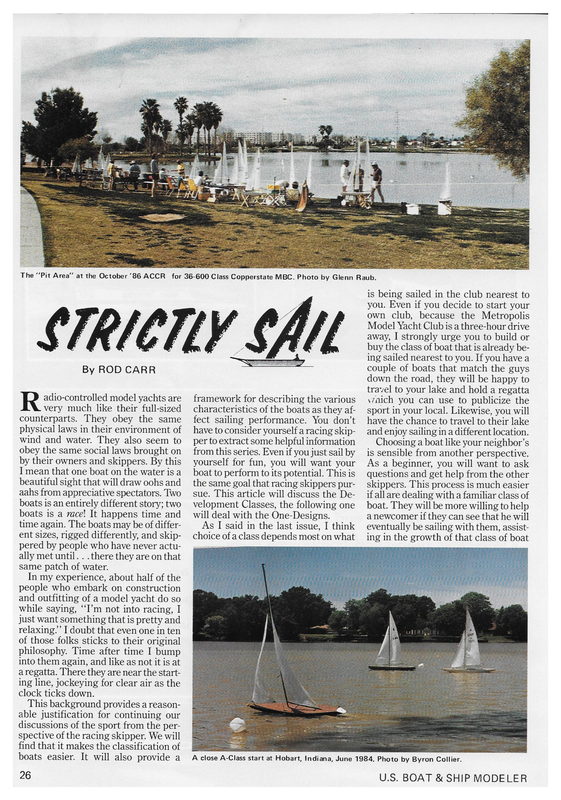
a The “Pit Area” at the October ’86 ACCR_ By for 36-600 Class Copperstate MBC. Photo by GI enn Raub. is being sailed in the club nearest to you. Even if you decide to start your own club, because the Metropolis Model Yacht Club is a three-hour drive away, I strongly urge you to build or buy the class of boat that is already being sailed nearest to you. If you have a couple of boats that match the guys down the road, they will be happy to ROD CARR R adio-controlled model yachts are very much like their full-sized counterparts. They obey the same physical laws in their environment of wind and water. They also seem to obey the same social laws brought on by their owners and skippers. By this ] mean that one boat on the water is a beautiful sight that will draw oohs and aahs from appreciative spectators. Two boats is an entirely different story; two boats is a vace! It happens time and time again. The boats may be of different sizes, rigged differently, and skippered by people who have never actually met until. . .there they are on that framework for describing the various characteristics of the boats as they affect sailing performance. You don’t have to consider yourself a racing skipper to extract some helpful information from this series. Even if you just sail by yourself for fun, you will want your boat to perform to its potential. This is the same goal that racing skippers pursue. This article will discuss the Development Classes, the following one will deal with the One-Designs. As I said in the last issue, I think choice of a class depends most on what travel to your lake and hold a regatta waich you can use to publicize the sport in your local. Likewise, you will have the chance to travel to their lake and enjoy sailing in a different location. Choosing a boat like your neighbor’s is sensible from another perspective. As a beginner, you will want to ask questions and get help from the other skippers. This process is much easier if all are dealing with a familiar class of boat. They will be more willing to help a newcomer if they can see that he will eventually be sailing with them, assisting in the growth of that class of boat same patch of water. In my experience, about half of the people who embark on construction and outfitting of a model yacht do so while saying, “I’m not into racing, I just want something that is pretty and relaxing.” I doubt that even one in ten of those folks sticks to their original philosophy. Time after time I bump into them again, and like as not it is at a regatta. There they are near the starting line, jockeying for clear air as the clock ticks down. This background provides a reasonable justification for continuing our discussions of the sport from the perspective of the racing skipper. We will find that it makes the classification of boats easier. It will also provide a_ 26 A close A-Class start at Hobart, Indiana, June 1984. Photo by Byron Collier. U.S. BOAT & SHIP MODELER
in the local area. When your boat gets on the water, you will have your neighbors as immediate bench marks against which to gauge the trimming and tuning of your boat. So no matter what the inherent advantages of either of the one-design or the formula/development classes, having other boats of the same class to sail with is very, very important. FORMULA/DEVELOPMENT CLASSES If yousettle onadevelopmentclass, you are embarking on a part of the 7 i (gum sport that is quite enthralling. Nothing is more fun than going to a race and seeing all the new ideas that people have come up with since you last saw them. New boats, new rigs, new fittings, and all sorts of “go fast”’ stuff appears on the boats. The development classes are the home of the tinkerers, the engineers, and the theoreticians. Radio-controlled everything is often the approach taken. Sometimes the swapping of ideas is as much fun as the 8 ee —— The 36/600 Class 1986 ACCR winners (I tor): Ted Morgan, John Amen, Bob DeBow, Andy Littlejohn, and Jim Meister. Amen holds 36/600 perpetual trophy. Glenn Raub photo. ———— ~ | FIGURE 1—MODEL YACHT DEVELOPMENT CLASSES IMYRU Recognized Classes racing that gets sandwiched in be- tween the technical conversations. If Don Schneider and unknown partner with big A-Class boats, Hobart, Indiana. International “A” Class International 10-Rater Class International ‘“‘M’”’ Class (Marblehead) ‘J” Class AMYA Recognized Classes Olympic One-Meter Class 36/600 Class 36/600 Mulit-Hull Class Open Class Other Development Classes “Oe? Class 36 UR (Unrestricted) “V’’ Class you want to build a boat and then sail it unchanged for five years, you’ll have a tough time keeping up with the front runners in a formula/development class. But if you like to build and experiment, changing your boat as you try out new ideas, a development class will be your cup of tea. The upper echelons of development class competition are quite involved with what I call hi-tech materials. Super-light hulls, carbon fiber, and titanium, all manner of shrink film decks and so on, put a premium on hav- ing building experience. The fundamental goal is to reduce the yacht to a bulb keel and a sail plan. The hull is seen as an obstruction to ultimate performance, for it makes waves and causes drag! The majority of people enter model yachting for the fun of building their own boat. The development classes (sometimes called formula classes because the size of some boats 1s controlled by a mathematical formula) Continued on page 76 a John Amen and his winning yacht at the 1986 ACCR for 36/600 Class, Chapparal Park, Scottsdale, Arizona. Glenn Raub photo. Fall 1987 Ted Morgan with his Amen P-36, took Second at ‘86 ACCR. Note four control sticks on transmitter. Photo by Glenn Raub.
You can’t live long enough to make them all yourself. It is the inventiveness of this work that is the thrill. There is a great satisfaction of accomplishment in solving problems of construction. Making modelsis creative and, above all else, thought stimulating. My wife calls it 1987 starts my 7th year in business. As in preceding years, | have come out with a bigger and better catalog — 137 pages of illustrated plans, 20 pages for R/C accessories, components and KITS, 20 pages of books-PLUS-ship modeling hints, listing of ship modeling clubs, information on researching § for plans, index and more. Add to this the MAP #2 Plans Handbook’s for Boats, Cars and Engines (Marine, Aero, Locomotives, Petrol, Diesel, Gas, Steam, Traction & Workshop Equip.) ALL THIS FOR ONLY $6.00 PLUS SHIPPING: Domestic:—1st Class $3.00; 3rd Class $1.50 Can. & Mex.:—Airmail $5.00; Surface $3.50 So. Amer. & Eur.:—Airmail $10.00; Surface $4.00 Pac. Area:—Airmail $13.00; Surface $4.00 “psychosomatic sawdust.’ Sometimes, often, it keeps me on the sane side of living. In future writings, we will dissect the sailing ship. As each area of the vessel is covered, I shall give some addition- al sources of research and learning. We haven’t the space to complete the study in detail in one issue. If at all possible, I shall try to avoid the ‘‘continuing”’ serialized-type of writing. Perhaps now and again, along with a few hints and tips on construction, there could be a discussion of a certain type ship. Please request items of interest and advise me of your problems. I have learned from Those wanting additional plans for warships, liners and merchant marine send an additional $1.00 for the Wiswesser catalog (add 50¢ if ordering separately). my own and mostly the mistakes of others. It is my hope that my experiences will be of some benefit. 9 TAUBMAN PLANS SERVICE INTERNATIONAL Strictly Sail. . Continued from page 27 11 College Drive – #4G Dept. RCMB Jersey City, N.J. 07305 (when sending inquiries, please use a S.A.S.E.) ed. Of course, if you are not up to challenges, there is a release for you. Secure the catalogs of the people who sell the products you require. Build your personal library of sources supply and information. Above all else, remember where you saw the information. You need not memorize everything. Secure what you need when you need it. Make it if you can’t find it. Satisfy the wish to create above and beyond your ability. Learn to solve a problem without creating another. Perhaps all this is best summed up by the statement I read somewhere, ‘‘Learn from the mistakes of others. NSPE ADVERTISING ACCOUNTS MGR. RCMB INC. is looking for an articulate, self-motivated, aggressive person, to be responsible for servicing established advertising accounts and for soliciting new business. Knowledge of the hobby industry and graphic arts, some accounting and typing ability, are all desireable, but not essential. Send application and resume to Wm. C. Northrop, RCMB Publications, 898 West 16th St., Newport Beach, CA 92663. (RCMB is aNON-SMOKING office) 5 ANTE TE MIO provide lots of opportunities for scratchbuilding. A substantial number of designs are published for the development classes in the model yachting press. I hope to start publishing them here too as we get settled down. A typical example, here in America, is the rapidly growing Olympic One-Meter Class. The size (39.38-inch Length Over All—LOA) makes it a good first boat for the novice. Recent winners have used homebuilt hulls of balsa planking with forcement. fiberglass rein- The ease of construction makes new boat design limited only by the time available for hull construction. As a result, progress is very rapid in the class with new boats coming out almost weekly. In my opinion, skippering skill will always be the most important ® WANTED @ ILO parameter, nevertheless all formula classes are full of budding naval architects who think nothing of building two to four new boats a year as they search for a little less drag and a little more speed. Figure 1 provides a descriptive arrangement of the Development Class- es. Let’s discuss each in the order that they appear in the figure. For further information contact the AMYA Class Secretary whose name, address, and phone number appears. Don’t be disappointed if they are a little hard to contact. . .they would rather be sailing than manning the phones, just like you and me. In each case, I have used the materials that I gathered from the Class Secretary when I asked him for information about his class. I’ve only added other information when I have had personal experience with the Class. As in any area of human endeavor, Class Secretaries vary from the rabid and hyperactive to the lethargic. The job earns no pay, requires substantial inputs of time and money, and leads to having your dinner continually interrupted. Please, consider what time it is at the Class Secretary’s house. If he is liable to be sitting down at the dinner table, say between 5:30 and 7:30 p.m., let him get through his dessert and a cup of coffee. You’ll get more information if he is relaxed and full, than if his dinner is going cold on his plate while talking to you! INTERNATIONAL ‘A’? CLASS The Class Secretary is Byron Collier, 11579 Earnshaw, Overland Park, Kansas 66210; (913)469-8499. The “‘A’”’ Class currently consists of 45 members who have registered boats holding valid rating certificates. The most active clubs are found in Pennsylvania (AMYA Club #24), Illinois (#7), Kansas (#81), Indiana (#111), and Oregon (#45). The boats are rated using a formula which is virtually identical to that used for the full-sized, 12-meter boats. The formula is arranged so as to reduce the sail area as the boat gets longer on the waterline and capable of higher hull speed. The Class Secretary does not know of any complete kits available for the boat, though Chevron Boat Co. used to produce the Gem designed by Bud Salika. Most A-Class skippers design and build their own yachts, or purchase a used yacht which is reworked as necessary. Plans for many designs are available, and a few sources of fiberglass hulls are in existence. The following table gives an indication of the range of dimensions for the top five boats in the 1986 Annual Class Championship: Place LWL(in.) Beam (in.) Sail Area Displ. (Ib.) (sq. in.) 1 43.3 8.1 22.68 1669 2 49.9 11.4 39.50 1569 3 50.5 14.5 50.25 1805 4 54.2 14.0 53.50 5 1597 56.5 14.1 54.00 1413 A flood of new concepts are on the drawing boards of present-day designers. John Oettinger of Portland, Ore- gon, continues his successful Nova series. Bob Sterne of Vancouver, B.C.., Canada, is working on an Orca IIwith carbon fiber/kevlar hull. Adrian Brew- er of Australia is having good success with his Blurred Image and his countryman, Frank Russell has recently published Tyolley Jack and finished a new design called Alien. Of course, the En- U.S. BOAT & SHIP MODELER
glish designers are exploring the rule with their usual thoroughness. My thanks to Byron for the A-Class photos which he provided for us. The contrast between them and the little 36/600 show that you can have model yachting “‘your way.’ INTERNATIONAL 10-RATER CLASS The Class Secretaryis Fritz esp, 103 Putnam Road, New Canaan, Con- necticut 06840; (203)966-3107. The 10-Rater Class is perhaps the oldest class of model yacht still being sailed today. It is celebrating its 100th birthday this year. First developed in Europe in 1887, itis a result of the relationships between water line length and sail area being recognized. Combined with weight or displacement, these three variables need to be interrelated in order that model yachts with comparable sailing potential, yet of different sizes, could be raced together with reasonable fairness to all competitors. This situation led to the development of the class rating rule. The present 10-Rater formula is: Length Water Line x Sail Area/7500 = 10. It is apparent that the rule permits model yachts of variable lengths to race as 10-Raters, providing that they control their sail area to comply with the formula. Most modern 10-Raters are approximately a 60- to 65-inch Length Over All (LOA) with about a 45-inch LWL. When heeled by the wind, they rapidly pick up sailinglength, which adds to their speed and stability. Marblehead class yachts are often sailed as 10-Raters and, in fact, are competitive with the current boats in the class. The ““M’s”’ are equipped with sails of about 1500 square inches and a heavier keel weight. There are a modest number of 10Raters in the U.S., mostly clustered in New York City and Toronto, with a few on the West Coast. More than 300 boats have been registered since AMYA was founded in 1970, but the centennial year class population is less than one quarter of that. Since the 10-Rater is an open design, there are no standard kits available. New boats are constantly being designed and are available froma varlety of sources. Special purpose boats, such as the Infinity 54, are well suited The Class Secretary is Standley Goodwin, 33 Norman Street, Marble- head, Massachusetts 01945; (617)631-5847. The Class Secretary tell us: ““The ‘M’ Class is the largest class in AMYA and, for that matter, the world. Its principle features are a 50-inch long hull and 800 square inches of sail area. The result is the largest high-performance sailing model that easily fits into the normal American automobile. Its size, reasonable weight (10 to 14 pounds), and performance have made it a very popular class. It sails well in conditions from flat calm to 30 miles per hour. In winds above 12 mph, many of the better designs plane, adding additional excitement to sailing. “The class is active throughout North American, with fleets located around most major cities. Divisional and national championships are held every year. In most areas, a local circuit is available for those who prefer a more relaxed style of sailing. ‘“““M’ Class models are available from several manufacturers and a few local builders. Prices are reasonable and competitive with other classes. As A. J. FISHER, INC. Mfgr’s. of Quality Brass ship and yacht model fittings. Scratch build a competitive R/C model yacht in the 36/ 600, 1 meter, 50/800 or 10 Rater class. Kits of Great Lakes and ocean going vessels. Plans & books. ILLUSTRATED CATALOG $2.00 a newcomer to the class, you can pur- chase a used model, build one froma 1002 Etowah Ave. Overall cost is mainly a function of how Royal Oak, Mich. 48067 kit, or design and build your own. much you build and how much you buy. ihhe we Vie Classiissiqgic-highperformance model with competition available in most areas. If you are thinking of entering model sailing, look into the ‘M’ Class. You will like what you find.” “J? CLASS The Class Secretary is Ralph McCafferty, 107 Armstrong Ave., Wil- mington, Delaware 19805; (302) 995-6830. A fairly recent issue of the AMYA Quarterly devoted a major article to the “J” Class. In summary, the boats are 3/4-inch to 1-foot scale models of the mighty ‘‘J’’ Class of sloops that raced for the America’s Cup in the 1930’s. As the Library at Mystic Seaport in Connecticut has hull lines available for the boats, most J’s are scratch-built. The boats are large, averaging 7 feet long with 8-foot tall masts. Displacement is in the range of 70 pounds, and the ballast is usually made removable in several pieces to reduce the strain on the skipper. Fiberglass hulls of the Whirlwind, designed by Francis Herreshoff, were manufactured in the 1970’s, but Iam not sure that they are still being turned out. Ask the Class Secretary. Active fleets of J’s are found in the Long Island Sound vicinity. I would estimate that there are approximately 40 to 50 of the boats registered with the class. OLYMPIC ONE-METER CLASS The Class Secretary is Bob Debow, 4415 Longbranch Ave., San Diego, This competition proven hull is a NAMBA Record holder and has been @ winner in static display as well. This kit is €asy to build and features: -joined hull and deck 40 *11 lisa Boe cional Rte. colored gel coat deck $7 -red : orange: yellow sae groy al blue : sky blue to conversion to 10-Rater Class racing. Carrying such a large amount of sail on a long overhang hull produces a sleek appearing boat, and many people consider the 10-Rater to be the best looking of all model yachts. INTERNATIONAL ““M’”? CLASS (Marblehead) Fall 1987 -multi or single -predrilled -transom straked engine and rails floatation installed -camplete 14. page basic |Unie 3422 3rd Ave W Hibbing kit 40/60 size s hull installed es instructions 75 £S shipping Minnesota 55746 7/7
— ORDERING INSTRUCTIONS Price includes 3rd or 4th Class mail. For Airmail or First Class in U.S., add 25% of total order. For Overseas Airmail (includes Canada and Mexico), add 50% of total or- der. Remit by International Money Order or U.S. funds on Overseas orders. Postage paid for APO and FPO or- MODELER All full size plans ordered from US Boat & Ship Modeler include a reprint of the const- ders. Master Card or VISA accepted. Include card num- ber, expiration date, and signature. Add 5% to credit card orders. Minimum order $10.00 CALIFORNIA RESIDENTS ADD 6% SALES TAX ructio article, if building instructions were part of the article. Send to: US Boat & Ship Modeler Plans Service, 898 West 16th St., Newport Beach, CA 92663. — ~ SS = a —- a No, US3871 MESSENGER $13.00 An all wood Chesapeake Bay ‘‘Sharpie”’ rudder only. LOA 48”. By Tim Miller. $7.50 shine look inviting? Modified Deep Vee, plywood constructed R/C racing boat. Electric 05 power. LOA 22’, 7-cell battery. Jerry Dunlap. 36/600 MULTI-HULL CLASS The Class Secretary is John Ulrich, 2733 Shelter Island Dr., Suite 131, San No. US3873 R/C STEAM LAUNCH $9.95 Natural finished, mahogany planked, 40” LOA, “African Queen” style, with | Diego, California 921 06; (619) fringed “Surrey” top. Kilburn Adams. No. US3874 “SCORPIO” $5.00 Electric powered mini R/C aircraft carrier that catapult-launches, and then retrieves aircraft. By Graham Goodchild. 36, Victor Model Products, Downey, California; Tradewinds, Tower Hobbies, [linois. The class is about equally split between scratch-built and kit-built boats. Their portability and ease of transportation are a major reason for their popularity. My thanks to Glenn Raub for the excellent pictures he provided of the 1986 36/600 ACCR held in Scottsdale, Arizona, last year. Doesn’t that sun- for static display, or radio control of No. US3872 ELEC. SKICRUISER boats and hulls are available for the class. Some of the more popular are: Amen 36, Amen Design Group, Petaluma, California; Skamp I Mark IV, Ozmun Design, Huron, Ohio; Huson 36, Dumas Boats, Tucson, Arizona; Victor No. US2873 CHINESE JUNK $5.00 Only 16” long, but uses 2-channel R/C for unusual sail control plus rudder. In- expensive to build. Graham Goodchild. 291-0743. He tells us: “The Multihull Class was formed in 1986 as a split-off from the 36/600 mono-hull class. Don Prough (AMYA #3) was the instigator of the idea and as of now we have 30 No. US2871 SPORT 40 UNLIM. $7.50 All plywood construction of this tunnel design keeps down total cost. Good for beginners, but plenty fast! Dave Frank. ing and would be true for any bulbkeeled boat. The length of the fin/bulb below the boat is limited, and the maximum sail area allowed is 600 square inches. The class has been notable for | the free exchange of hull lines and sail rig information. Full-sized hull stations have been published in the AMYA Quarterly. Even computer-aided design of boats has started and been freely shared with all comers. This wide-open interchange of ideas is the main reason the class is growing so rapidly, at the expense of others I might add. 36/600 CLASS The Class Secretary is Glenn Raub, 810 East Meadowbrook Ave., Space # A-7, Phoenix, Arizona 85014: (602) No. US2872 HARBOR TUG $12.50 All wood, 37” LOA, R/C tugboat with electric drive, bow thrusters, and device to retrieve other boats. Francis Smith. California 92107: (619)222-1991. — ~ This classis an excellent choice for the beginner. The main reason is the fantastic support provided to the class by the Class Secretary and his close ring of associates in San Diego. A catalog of plans is available as well as excellent directions for scratch-building any of a number of hulls which have been designed. The fin and bulb keels do best if sailing can be accomplished on water which is free from weeds, but that seems to be the only major shortcom- 78 277-4278. This class was one of the first AMYA classes to gain class status. It represented a typical American approach to developing a boat which would fit in the newer, smaller cars which were starting to appear. The Class Secretary tells us: “At the end of 1986, there were better than 400 registered boats in the class.’ The average weight of the 36/600 (a boat which is 36 inches long and has a maximum sail area of 600 square inches)is about 7 pounds. The 1most popular sails are in Mylar and are made by Amen and Black. Typical mainsail luff lengths are 60 inches, with storm sails cut down to 55 inches or thereabouts. Currently a substantial number of kit registered members and inquiries are increasing. The class specificiations are quite simple and few: 1) 36-inch hulls Over All Length (OAL), maximum; 2) 600-square inch sails, maximum; 3) Roach unrestricted; 4) Sail number visible at 100 feet. “This is definitely an open class and many novel ideas are being tried, but the overall name of the game seems to be ‘lighter is better. ”’ OPEN CLASS The Class Secretary is Eugene Sali- ka, 3917 Sunnyside Ave., Brookfield, Illinois 60513; (312)485-5712. The Open Class serves two basic functions. First, it provides a haven for the registration of boats that are oneof-a-kind. Sail numbers can be assigned, and the skipper has the benefit of AMYA membership and an AMYA ®WANTED® EDITORIAL ASSISTANCE RCMB Publications is looking for someone to assist in the production of three magazines. The qualifications necessary include a command of the English language, a knowledge of magazine production, including layout, paste-up, ad pro- duction, and proofing. Position offers the opportunity for the successful candidate to grow with the company in an atmosphere of close cooperation and a rewarding future. Experience in model building is a plus for the position. Send application and resume to Wm. C. Northrop, RCMB Publications, 898 West 16th St., Newport Beach, CA 92663. (RCMB is a NON-SMOKING office) U.S. BOAT & SHIP MODELER
sail number to wear on his unique vessel. The second function is as a holding point for new classes which are trying to register the 20-boat minimum necessary for becoming an AMYA-Sanctioned Class with its own Class Secretary. One of the reasons AMYA was formed was to provide a simple, straightforward procedure for any group to develop its own class of boat with the direct assistance of the national organization. OTHER CLASSES | Other formula classes have appeared from time to time, such as the 36UR (a 36-inch hull, unrestricted sail area approach), the “X’’ Class (1000 sq. in. max. Sail area, no limit on hull), and the ““V”’ Class (600 sq. in. max. sail area). Each served some special need, and, as the concept was of a specialized na- ture, they, in general, developed fairly short-lived and localized followings. EPILOGUE Next issue we will get involved with the one-design classes. Here a premium is placed on careful preparation and maintenance of your boat, as well as insightful handling of the boat on the race course. The winner in onedesigns is often the skipper who makes the least mistakes. This column is hungry for photo- graphs of all classes of racing yachts, as well as those special one-of-a-kinds that are being built out there. If you want to see your project in print, send it to me, and I can practically guarantee that it will appear in these pages. Photos of boats under construction are especially helpful. Send them to Rod Carr, 3011-177th Ave., NE, Redmond, Washington 98052. While you have your stamps and envelopes out, send your annual AMYA dues of $20 to Pat Hein, AMYA Secretary, 1884 Campus Court, Rochester Hills, Michigan 48063. e 2 I Cap‘n’s Log… Continued from page 9 body of water that, using a golfer’s estimate of distance, is about 70 yards wide by about 250 yards long, and sur- rounded by a close-cropped grassy shoreline. The elliptical-shaped pond is feby d an underground pipeline from Mission Bay by means ot a control valve, which is opened now and then to compensate for evaporation and seepage loss. The same body of water will host the 1987 NAMBA Championships (which will be over by the time you read this). Yes, it is as salty as the Pacific Ocean that keeps it filled! Just as with the Ship Modelers Association, we plan to present a more Fall 1987 thorough story about the Guild ina future issue. For now, we just wanted you to see some of the fine models that were in action at the Regatta. WELL-DESERVED PLUG Just before the Toledo R/C Expo show in April, Ed Rogala, of Midwest Products Co., sent us a sample kit from the company’s new line of wooden scale boats. Many boat modelers will immediately recognize the fact that these designs come from Ted Stinson’s “Laughing Whale’ line. True enough, but there is one “‘whale’”’ of a big difference between the new Midwest kits and the old Stinson kits. To put it most kindly, Ted’s kits were strictly for the expert model ship builder who knew exactly what to do and how to build a model from a plan and some odds and ends of wood scrap, without detailed instructions. The kit Ed sent is for a one-inch scale dinghy. Sure, it’s just a little 10-inch long rowboat, and the total amount of wood in the kit could be mistaken for a couple of oversize tongue depressors and a dozen shishkabob sticks, but the zustructions. . .you have to see the instructions! In reality, the kit ‘1s a 24-page primer on the basics of wooden model boat building, accompanied by a full-size plan and those pieces of wood, so you can act out the instructions as you read and study them. Actually, the shishkabob sticks are all precisely cut strips of basswood, and the “tongue depressors’’ are accurately and cleanly die-cut sheets of basswood and mahogany. At Toledo, I ran into Ed Rogala and Don Sobbe in the Midwest booth, and complimented them on the excellent quality of the kit, and pretty much said it as above…outstanding instructions. That turned out to be a home run in diplomacy, as Don actually is the one who 1s writing all the instructions for the Midwest kits! The first two pages describe and even illustrate the tools and materials _ needed to build the model. Next there is a list of the kit contents, including drawings of the die-cut sheets, naming each piece. In effect, it’s an illustrated glossary of common wooden boat parts; garboard planks, frames, skeg, knee, stem, quarter knee, and breasthook. The actual building instructions are numbered step-by-step, and, in addition to telling you what to do, you are also told why you do it. By the time you have completed the dinghy, you will have followed 102 steps, and, believe me, you’ll be well prepared for some of the more complicated boats in the beginner series. Incidentally, Midwest has labeled INDEX TO ADVERTISERS AceiRadio:Controlaa. ACJ EIshetm InCs AMIntronics INC: s.- «4-0. oe 23 paewee ook. ape cate edie. ee ov a 77 Sed Altech! Marketingue. i… Astrouklight ‘Incks. . 2. dee. «os 3 oo Cover 2 | 61 Beemer R/C West Dist., Inc…….. 53 Carl Goldberg Models, Inc. ……. Chicago Model & Hobby Show 1 …. 63 Coless*Power Models=* 452554 5 os 74 Dagger Boat Works: 3% 4-3. 744 4 74 EutabasCorp. ofsAmerica =. 5 Gartman Eibreglass R/G. =… = . 60 | HobbysEobbyiintii=e 4. 1. = Cover 3 Initernationalk Hobbiesis. 4.4… se) 69 International Modeler Show (IMS) RUOMANING scetce=. sar MTGCOP ec 39 eee 76 ee oon eal tipo ala Dern eal KeCevVianufacturing 10. 70. –0 .. K&S Engineehingices cites 74 4 ee 59 M.A.C.K. Products Model Marine … 69 Matrix@Enterprises Inc’. a. 74 Model Racing Products (MRP)…. . 25 Model Rectifier Corp. (MRC). . . Cover 4 Northeastern Scale Models, OcturavModels. 2s). Inc. …. 71 Seo ee 73 Pinckert Custompboatse a eee 68 Polk’s Model Craft Hobbies. …… 65 Pops) peMitgs Gowns. PrathersRroducts” sa ee i937 40 eh 2k 70 eee 71 PrGed Gemeente ese aR 75 RiCsBuyers: iGuiderier.. fs RadionBoatecex se. bon Seat oe 62 eee 63 | Radio Controlled Models (RAM). … 60 SatellitelCityeiig ess Aen Oe .) a Taubman Plans Service Intl 55 …… 76 inthesDrome daira.) <0 oak wae, wo ee 73 Uber Skivernskinives cir cinco dct Fyn 80 HOUSE ADS EullgSizese lanspsenvices Model as. ae 78 Builder Subscriptions ...... 47 U.S. Boat & Ship Modeler Subs...... 72 —— this as one of its ‘Success Series’”’ kits, meaning that with the step-by-step instructions and the full-size plans, you are assured success in building the model. We wholeheartedly agree! Midwest also produces basswood, walnut, and mahogany sheets and strips for scratch builders of model boats and ships. Send $2.00 for the complete Midwest Products Co. boat catalog, to 400 S. Indiana St., P.O. Box 064, Hobart, Indiana 46342, or phone (219) 942-1134. POACHED LOBSTER Expert aircraft and boat modeler, Don Typond, found an interesting new model boating competition activity written up in a recent issue of Sea Heritage News. It’s called ‘‘Poacher,’ apparently originated by modelers at 79 |-