

The Model Craftsman: Volume 10, Issue 6 – November 1941
Recently, in the annual meeting of
M.Y.R.A.A., we have had an example
of the proper settlement of conflicting
opinions and divergent desires, in an
American way.
Recently, in the annual meeting of
M.Y.R.A.A., we have had an example
of the proper settlement of conflicting
opinions and divergent desires, in an
American way.

In 1940, Charles Simpson suggested to
the writer that a self-tacking vane might
be linked in some manner with a counterbalance mounted on the vane assembly.

The outer edge of the frames may be
perfectly bevelled with a batten about
3/4" wide and two or three feet long, to
which a strip of garnet-paper or garnet cloth has been glued.

July 19, 1921, the Model Yacht Racing
Association of America was organized.
At that time, the classes were A-B-C-D
classes. After the race with Mr. Daniels,
the A class was adopted, which has
eliminated the foregoing classes and did
much to develop the interest in this
country.

A year or so ago, I heard there was a setup near Houston, Tex., that was a swell replica of the Washington Monument and its reflecting pool. So, while at Houston I inquired around and found out how to get there. Well, sir! I was sure surprised. As you can see by the picture, it is just what the doctor ordered. No trees or anything to bother the wind except the wind from the S.E. The pool lies N.W.—S.E. The monument is at the S.E. end. The pool is
perfectly constructed, and is from 3’ to
6’ deep. It is filled by rain, and, according to the WPA foreman, it rains plenty, and the water has to be lowered quite frequently by valve. Nobody I talked to ever heard of a model yacht.

The rabbet may be cut either before
the backbone is finally joined together, or
in sections, taken apart for convenience
in handling. On small boats it is hardly
necessary to cut separately, however.
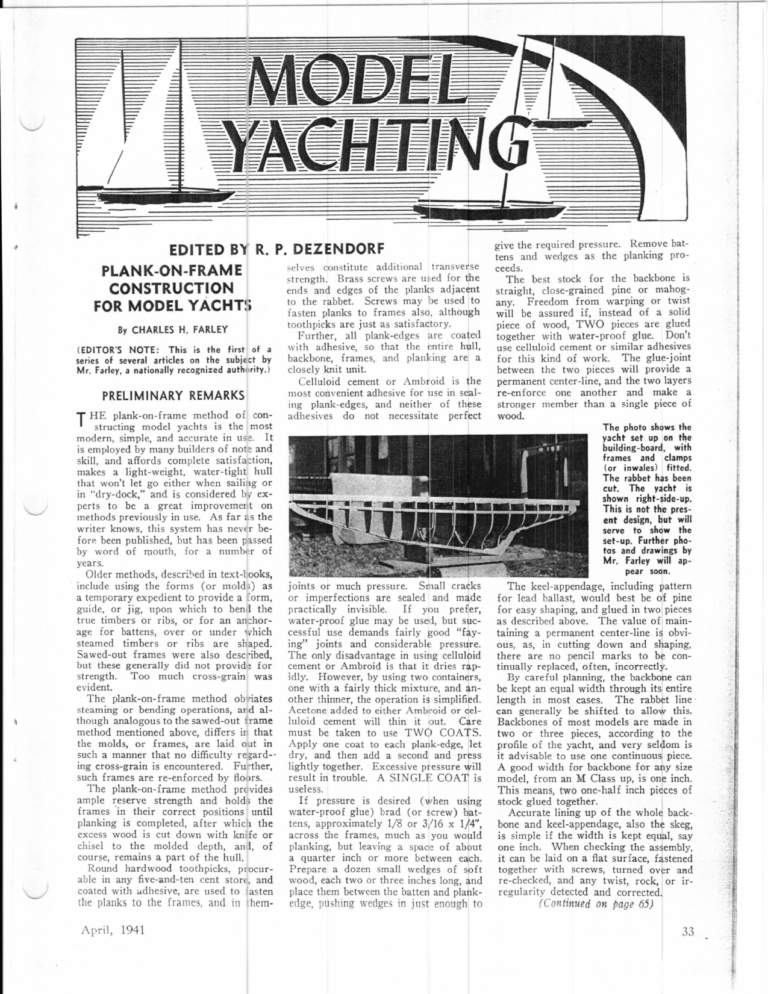
The plank-on-frame method of constructing model yachts is the most
modern, simple, and accurate in use. It
is employed by many builders of note and
skill, and affords complete satisfaction,
makes a light-weight, water-tight hull
that won’t let go either when sailing or
in “dry-dock,” and is considered by experts to be a great improvement on methods previously in use.
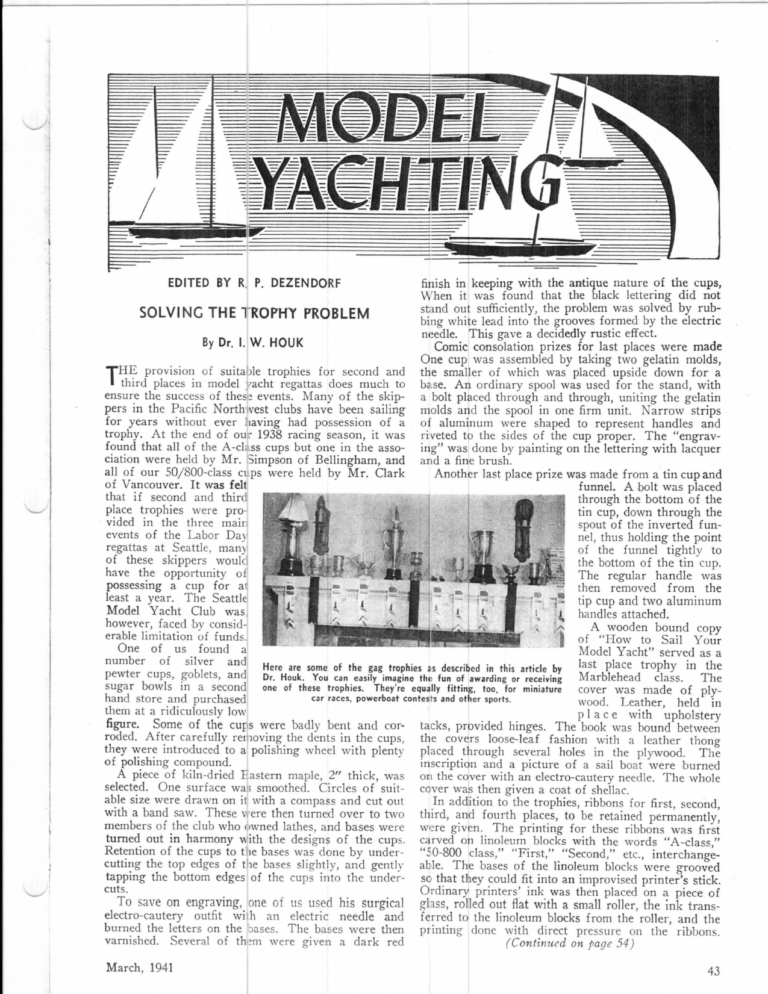
To save on engraving, one of us used his surgical electrocautery outfit with an electric needle and burned the letters on the bases.
Several letters have been received advocating the adoption of a 36” National Class for juniors. This idea has been suggested many times, but up until now, nothing concrete has been done about it. A Committee will be appointed shortly to formulate proposed rating rules and a scheme of conduct of racing for this class, to be submitted to the Executive Committee of the M.Y.R.A.A.