- Title. Author. Summary

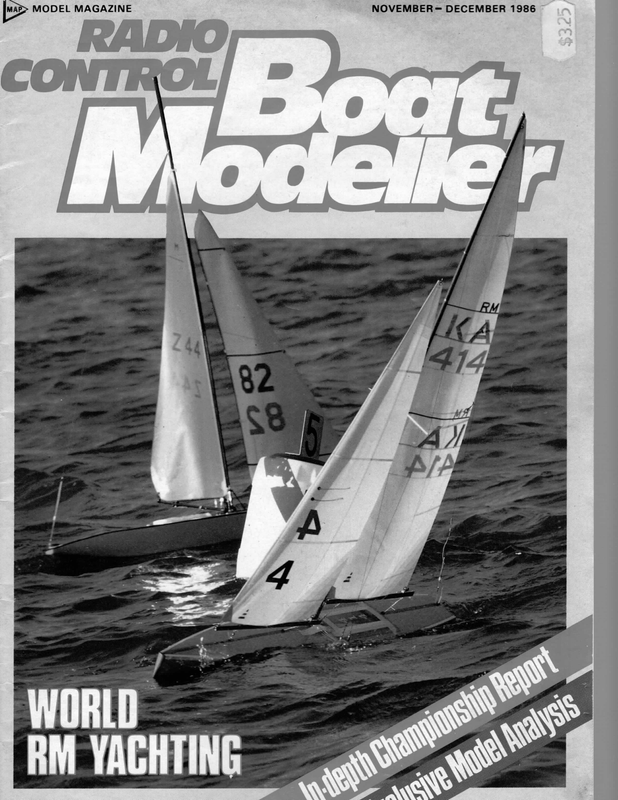
MAB> MODEL MAGAZINE EC NOVEMBER= DECEMBER 1986. RADIO “6 WORLD RM YACHTING
co’ HAMPS — from skippers Four’ four twenty the of en ninete countries in the International Union Racing Yacht Model converged on Fleetwood, that Mecca of Model Yacht Racing on the Lancashire Coast just nine Eighty miles North of Blackpool, ready for Saturday 12th July. Bringing with them a wide variety of yachts all built to the Marblehead rule of 50 inch overall length and 800 square inches of measured sail area. Despite claimed differences in interpretation of the rule in various coutries the main differences in the apparent performance of diversed craft were often quite obviously due to differences in skill level of the skippers. There were ‘traditional’ looking planked hulls which concealed the latest in carbon fibre and even titanium reenforcement: there were glass fibre hulls so thin that they flexed at the slightest touch: there were swing rigs (mainly British) and there were conventional rigs: there were boats rigged with bits of string and there were boats whose fittings would have not looked out of place in a Model Engineer magazine article. There were sails bent with jacklines, rings, cords, rope, and pocket luffs; there were panelled and flat cut sails made from cloth, mylar, kevlar and even drafting film. Ballast weights ranged from long and thin to short and fat bulbs, there was even one made from cne of those rare and_ probably expensive ‘superheavy’ materials which looked positively tiny by comparison. One of the few common features among the boats was that they were all rigged with Bermuda or Sloop sail layout and they all had fin bulb keels and semi-balanced spade rudders. This meeting was sponsored principally by Ever Ready, the battery company that has put a considerable sum of money into a variety of model sports. For those awaiting completion of the Su/a Bula | am afraid this episode will be a disappointment, there was so much of interest to see at Fleetwood that | just do not Radio Control Boat Modeller
have enough space to relate the latest developments. Before going any further | want to mention the week long task undertaken by Elizabeth Andrews. During the periods when she was not representing England in the racing this very able skipper compiled a technical survey of almost the entire entry. Much of the material used in my research for what follows is drawn from Elizabeth’s fascinating survey, for which we should be grateful. discussion about details of their own that coats stayed on for most of the “off the control platform all became incredibly friendly and co-operative. | want to try and pass on some of the tips etc. gleaned from these conversations, | hope the reader finds them interesting didn’t know the half of it! 5 Saturday dawned dull again with during the racing, once skippers were and useful. Weather etc For those interested in the weather on such an occasion | can give the following summary: Personal Impressions Unfortunately work prevented me from getting to the event until Thursday morning by which time the fleets had been sailing in basically light airs so my personal view of the racing was mainly during the ‘heavy stuff’. A lasting impression from the event is a memory of the oft times multiple language of descriptions and_ discussions technical and constructional details of the various boats laying about in the Skippers enclosure. competitors’ seemed to be only too glad to enter into OF UI WIIG Wado SUITIUICIIL LU Clhloule or _ other bystanders with boat competitors. There were undoubtedly many lessons to be learned from these ‘workshops’. technical impromptu Although voices were raised in protest 1 y there was Up tothe end of Wednesda beautiful sunshine and light South Westerly to Westerly winds. As a consequence everyone had a very healthy looking tan by the middle of 2 the week. Late on Wednesday the wind picked up, with dire consequences for some, see below. 3 Thursday dawned windy and dull. When the cloud broke the wind got up to force six at times, the ‘Fleetwood’ wind was here at last! 4 Friday saw the wind abate alittle and the sun return although the strength day. Occasionally there was some rain. Some even said that they felt cold! Those who remembered the ‘Nationals’ at Easter just chuckled at the thought — these newcomers some breaks in the cloud at times. Wind was around 10mph for most of the time allowing top suits later on as it dropped further. Rain arrived to wet everyone as they made their way to the Presentation Dinner and Dance. A Flavour of the Racing The strong winds for which this venue is famous and of which the foreign visitors had been warned just did not materialise during the early part of the Championship. Late on Wednesday it happened! In the middle of one race the wind arrived,|much to the chagrin of the swing rig equipped lan Cole and John Cleave. Carrying tall rigs these two boats, lan’s Vo Secret and John’s Bee, found that they could just about go to windward but the down wind legs were something else. Falling from side to side and being laid flat on the water, their antics had the rest of the competitors in Above, Mad, the Cedar club design sailed into second place by its designer Paul Lucas. Below, Mr Crusty, skippered by Crosby member Mike Williamson appears to be overpressed in Thursday’s conditions. Photos: Mike Kemp. Above, the winning French boat Rajah by Pierre Jahan pictured in Race 24, Fleet A by Mike Kemp’s camera. Hull is epoxy/glass/carbon fibre; carbon fibre mast and Mylar sail material. November/December 1986 ;
stitches as lan and John tried in vain to avoid all the involuntary pirouettes. Ata protest meeting resulting from the race lan asked if some of the multiple turns performed during the downwind legs could be taken into account for turns in done_ have should he that recompense for an infringement. Bryan Willis, Chairman of the International Jury, was not impressed – though amused. A Few Race Comments With a meeting such as this it is not possible to give a blow by blow account of all the racing. Overall the racing throughout the week was keen and full of incident; language proved to be a minor problem although there is a suspicion that some competitors used it to their advantage on some occasions. There can be no doubt that the eight days of sailing sorted every one into their respective order, taking into account sailing skills, knowledge of the rules, and boat preparation. There are many incidents that | could describe to try and portray the flavour of the racing, the following may give a glimpse of what it was like. It was reckoned by many of the skippers that Fleet B was generally much tougher than Fleet A because it seemed to be much more difficult to win promotion and avoid relegation from the select bunch. In the second ‘hot’ Fleet – C; Race 26 sawa Starboard end start for most of the fleet but Louise Smith tried the port end and got away with it into the middle of the fleet, just crossing in front of the defending champion Barry Jackson. Louise unfortunately blew her good start by sailing Chat No/r (Black Cat) on Port into Christian Goubet’s Mister Cat (Monsieur Chat). A case where it would have been better for the Black Cat to have crossed behind? There then followed a good demonstration on how the swing rig stalls and once stalled can be difficult to get going again. This incident dropped her back to last but one place before being able to start doing her turns. At the first mark Mike Williamson sailed inside the mark, was involved in a collision with another boat as he returnedtoreround. This race saw defending Champion Barry Jackson actually get ahead and leading from Phillipe Sol who in turn was leading from Mark Dicks. Barry was caught on the second windward leg by Christian Goubet, who had passed Phillipe in the process, and sailed into some slack air which allowed Christian to come up from behind and overtake on the downwind leg of the sausage. Phillipe sailed straight past as well on the same leg. Mark Dicks, meanwhile sailed down the middle of the lake and he too caught Barry: This all would seem to raise a question over the Sea Scorpion’s downwind overstood considerably Barry mark performance. downwind the allowing two the Frenchmen to get away. The three of them took vastly different courses up the lake while once again Mark Dicks went to the middle of the lake and short tacked his way up that way. Barry meanwhile sailed a very sensible course up the middle but was then subject to protest from Christian over an incident where Barry tacked on top of him on the finishing line. Barry accepted turns his’ did and penalty the immediately before crossing the line allowing Mark Dicks to slip through, Phillipe to get back and also allowing Norwegian Bjorn Hellberg to get All pics on this page are from Ray Brigden’s camera. Above left, lan Cole’s Carbon Copy, number 19, makes the best of what can only be described as a very busy start. Above, number 27, Germany’s Klaus Schroder hits heavy weather at the mark. Left, number 24 is Chat Noir, skippered by Louise Smith from the Leicester MYC races for the line with No Secret, skippered by another English entry Graham Bantock from the Chelmsford MYC. Graham made third. Right, Juan Betancor from Spain at the mark, photo: Ray Brigden. Opposite top, Lulu 32, Katarina 34, and Challengeur 33; three French boats. Bottom, Swiss yacht Anja by Claude Momo tacks ina flurry of spray. Photos: Mike Kemp. Radio Control Boat Modeller
through : Louise, meanwhile, pulled back to get just ahead of Chris Dicks. The last race of the meeting was run in reverse order, with Fleet G going first, leading up to Fleet A from which the All through new Champion would come. Saturday winners of races were greeted with cheers and applause from the amassed skippers and spectators. This ‘started as encouragement from the winner’s fellow team members but soon spread to become a friendly gathering that was not too partisan. Technical Notes Turning now to some observation on various national and individually interesting yachts let’s look first at the ‘home’ team, although there are those who would say that this is a misnomer. There were mutterings that the English were tending to sail more as individuals lan Cole. [hese Dlack mouldings are stark in comparison to many but their simplicity hides some clever tricks to achieve a stiff and robust shell. The self deck garish, adhesive, and often’ panels hide a generous inward facing considerable imparts that flange stiffness around the inwales. The small patch seen to the port side covers a neat sunken winch and servo plate to which is fed a short tube to guide one part of the endless loop sheeting system into the winch. The simplicity pays off as was seen when one of the Smith family yachts was sunk. During the heavier winds Robert was caught on port by another boat, the ensuing collision put a hole in Robert’s after deck and Black Shadow was on its way to the bottom of Fleetwood’s lake. The rapidly manned rescue boat recovered the yacht before We can learn the lessons of simplicity it finally disappeared. Once ashore the decks and radio gear were removed, the hull washed out and dried, a spare radio installed, and new decks stuck on between races. Try doing that with many of the installations seen around at impressive Vo Secret hulls produced by The other half of the Smith family also against each other than some of the other National Groups. The English lessons from our ‘home’ team; in particular the November/December 1986 open meetings! suifteread from Some MINOF PFODICINs as the salt water started to find its way in. Louise demonstrated how ineffective the swing rig becomes when sheeting control is lost. At first her problem looked like a failed main sheet but on retrieving Chat Noir it was found to be a battery problem. Robert representative, Scotland’s Brown had similar symptoms show on his swing rigged 7ornado; in this case it was a rigging failure as the main sheet, his ‘little bit of Kevlar String’ broke. Graham Bantock was heard to dismiss the failure as inevitable because the string needs to be replaced regularly as it chafes! French Lessons? As is often the case, the behaved in complete contrast English. There appeared to be strong ‘team’ behaviour, and French to the a very with a large team the appearance was even larger. The French contingent were occasionally, and unofficially, accused of behaving too much like a ‘team’ by looking after the interests of their ‘key’ members to the detriment of some of the other nationalities. There seemed to
be little positive evidence to substantiate such claims although a good deal of circumstantial evidence was seen, and heard, by many. In sticking together and supporting one another they were no different to the other visiting Nationals who all had the usual ‘abroad’ problems of language etc. Their yachts incorporated some very interesting and different features that will be explored elsewhere, that they were effective in the right hands is unquestionable. Whether they would work for the majority in this country remains to be seen, if someone tries them. The French Team did win the team prize so their sticking together worked. German Engineering The German approach to Model Yacht shapes has obviously been strongly influenced by Ska/pe/, the craft of Janusz Walicki. At first glance the thing that impresses about this yacht is its hull shape: vaguely like a ‘skimming dish’ hull with an uncommonly — short waterline and avery pointed bow shape. Experience of British yachts with a fine bow shape makes one suppose that this hull would dive like mad when hard pressed downwind. Not so, the shallow dish-like shape obviously gives a terrific amount of reverse bouyancy to keep the bows up in a strong blow. The rounded sections and the short waterline help to reduce wetted area leading to an overall very slippery shape for light wind performance. A further glance at this ingenious craft will be developed in a later issue. certain elegance about the ‘home grown’ Italian yachts numbered 51, 53 and 56. Their lines and fin/rig relationships were reminiscent of some earlier designs. The other yachts sailed by the Italian team were variations on the Lost Love theme and these faired no better in the overall competition. This perhaps points to the skippers themselves not being used to either the level of competition or the wind and wave conditions prevailing at Fleetwood. Italian Fittings The Japanese experience A glance at the Italian yachts revealed some very carefully engineered radial The two busy looking skippers all the way from Japan were obviously not quite prepared for the full range of wind conditions of Fleetwood. This was despite a special briefing organised by Guildford Club member David Coode during a recent visit to their homeland. The Japanese boats are obviously better suited to lighter conditions than we have to contend with. Their rigging was of a much lighter standard than is required to meet 20 mph _ winds. Beautifully crafted wooden masts with shim-like ply spreaders just could not stand the winds that arrived late on jib fittings, an arrangement all but vanished from the modern British Marblehead. A fascinating blend of model engineering and model yachting, it would have been interesting to witness the setting up procedure whereby proper alignment of the boom pivot axis with the jib luff was assured. Although the construction was interesting the final placings of the yachts raises a few questions over the after all the effectiveness, actual highest placed Italian yacht was 64th. As might be expected there was a Wednesday. Above left, Jean Louis Bernard from France hits heavy weather as he runs for the line with Evolution Il. Above, Robert Smith rescues his yacht Black Shadow after a sinking due to collision damage. Photo: Ray Brigden. Left, Tximisto sailed by designer/ builder Jose de la Fuente is tacked away from Fleetwood’s deadly concrete edge. Photo: Mike Kemp. 4I£ Radio Control Boat Modeller
Not to be totally thwarted these two happy looking skippers completed their repairs and returned to the fray for race 24 during Thursday afternoon. Their return to the water was accompanied by yet another disaster. During the start period for his first race back after repairs Ninao Kato lost rudder control as his yacht sailed away from the far end of the line. Out of control, the black yacht opposite into the straight sailed edge; the ensuing lake concrete collision with the immovable object sheared the keel/hull joint. Quick thinking action by a spectator recovered and spotted the sunken keel so the yacht that it too could be recovered. Not to be discouraged, repairs followed and the yacht Dobu returned for the final races during Friday and Saturday when the winds had moderated. Space Frames Several of the yachts sailing made use of the ‘space frame’ concept in order to reduce weight and dependence on substantial hull mouldings. In these, as in other parts of the rigging of many yachts, portions of arrow shaft were much in evidence. t Odds and Ends The two boats of the Swedish Falck family both had polished metal keels, they looked like stainless steel though they could well be titanium. Many skippers had rigging failures during the higher winds and there was some rapid sailmaking going on ‘in the as the organiser’s pre-race pits’ warnings about small area rigs started to become valid. There were a number of continental sails receiving the scissors treatment in an effort to maintain some form of control over the yachts as the wind and the waves built up. Technical Analysis Elizabeth Andrews’ survey provided me with a basis for some technical analysis that | found very interesting exception oF thelr OWN CONMSUuUctior. Several were sailing yachts with a basic design by someone else but with their own significant modifications. Graham Bantock was notable in having his design built by lan Cole; with consider- able success as well. The league table for boats from the drawing board of any one designer was lead jointly by Paul Lucas from France with no less than seven of his Cedar range being saled and Torvald Klem also with seven. Next was the eventual Champion, Pierre Jahan with six of his designs sailing. Graham Bantock and Squire Kay were next with five apiece followed by the Spaniard Jose De La Fuente who was responsible for 80% of his country’s representation. ‘charts’. The Norwegian Tonnesson was the designer of at least three of the yachts being used by other competitors. Seven others can lay claim to two of their designs being represented. Designers Hull Material Of the 84 skippers. sailing at Fleetwood 26 were sailing craft of their without almost and design own undoubtedly arrived in the Model Yachting world! No less than 25 of the and_ illuminating; here are some summaries resulting from studying the New Technology materials have Above left, Norman Hatfield presents the Yachting Montly Cup to the winner, new World Champion Pierre Jahan. Left, Graham Bantock receives his award for a well deserved third place. Top, the French receive the team prize, the Model Boats trophy. Above, Norman Hatfield poses with the Japanese team and his ‘Mini America’s Cup Racer’. Photos: Mike Kemp. November/December 1986 A7
Final Competitor Place No. Total Boat Name Boat No. Country Points Boat Design 67.7 Dejah Regate 82.2 Cedar Club Designer Builder Hull Material P Jahan P Jahan Epoxy/Glass/C-Fibre P Lucas P Lucas Kevlar Epoxy G Bantock | Cole Carbon Fibre P Lucas C Venot Kevlar J De La Fuente J De La Fuente ist 36 Pierre Jahan Rajah F577 France 2nd 30 Paul Lucas Mad F377 France 3rd 20 Graham Bantock No Secret K3705 England 4th 42 Christian Venot 7 F2252 France 119.1 Cedar Club 5th 69 Miguel Zatarain Sargoya E9205 Spain 157.1 6th 45 Janusz Walicki G6 Germany 161.5 Own J Walicki J Walicki 7th 77 Carl Fagergren Skalpel Ebba Gul Epoxy /Kevlar/GRP Keviar/Carbon Fibre $332 Sweden 174.9 Circus Killer C Fagergren C Fagergren Rohacell/GRP 8th N39 Norway 218.4 Laxy Lady T Klem T Klem GRP/Foam F2099 France 253.1 Cedar Club P Lucas P Sol Kevlar F2044 France 254.1 JL Bernhard Kevlar 11th Lazy Lady 60 Torvald Kiem Dephi 39 Phillipe Sol Boisnault Cobra Christophe 38 Evolution Il 37 Jean Louis Bernard F617 France 257.7 Lordat/Bernhard 12th 25 Squire Kay TC 10 K3750 England 282.0 Sea Scorpion 13th 68 Jose De La Fuente 23 Robert Smith 83 Claude Momo Tximisto E9202 Spain 307.7 Gomar – 2 Black Shadow K3740 England Anja Z67 Switzerland 9th 10th 14th 15th 118.1 No Secret Gomar – 2 Cobra Kevlar /Rohacell JL Bernhard 311.7 No Secret Lordat/Bernard S Kay J De La Fuente G Bantock 343.1 Lupart C Momo Carbon Fibre Keviar/Carbon Fibre R Stollery R Stollery C-Fibre/GRP/Kevlar J De La Fuente J De La Fuente R Smith | Cole Epoxy /Kevilar/GRP Carbon Fibre Carbon Fibre Anja 16th 18 Roger Stollery Buzzbee K3675 England 382.5 Bee 17th 70 Xavier Zatarain Txalaparta E9208 Spain 18th 24 Louise Smith Chat Noir England Carbon Copy K3741 K3702 397.7 Gomar -2 409.5 No Secret S Kay J De La Fuente R Smith GRP Epoxy/Kevlar/GRP England 423.7 No Secret G Bantock G Bantock Steam Boat KA414 Australia 427.7 Spot T Allen W Pettingell GRP 21st 78 Lars Andren VaSaNi Sweden L Andren GRP 43 Jean Louis Brillot Clementine Tango 474.7 Circus Mk III 514.0 Own L Andren 22nd $345 F2290 JL Brillot JL Brillot Kevlar/Carbon Fibre 23rd 82 Michel Malatesta 21 Chris Dicks Pierrot Il 744 Switzerland 542.7 P Noverraz (Geneva) M Malatesta Kevlar Raider K3733 England 24th 25th 26th 19 lan Cole 4 Bill Pettingell a 19th 20th Mike Bielby 49 Dick Eastwood France C Dicks C Dicks Bullen’s KA631 Australia 552.0 Deception 577.0 Own M Bielby M Bielby GRP/Foam Sandwich Yee Sap Ng KH25 Hong Kong 586.0 Circus L Andren D Eastwood GRP S Kay S Kay JL Cabanne . Kevlar Xana K3774 Champion 591.0 Sea Scorpion Lulu F452 France 591.0 Cedar Club P Lucas 29th 32 Jean Luc Cabanne 84 Mario De Marchi Limelight 271 T Klem 64 Tomas Dreyer Litus P18 Switzerland Portugal 608.0 Lost Love 30th 634.4 Dotti Dotti Dotti S Kay D Priestley Barry Jackson 27th 28th M De Marchi 31st 17 Mike Williamson Mr Crusty K3627 England 668.4 Sea Urchin 32nd 29 Patrick Taillez Dejala P363 France 699.0 Deja P Jahan P Taillez GRP Kevlar/Carbon Fibre GRP B55 Belgium J Dezonne Carbon Fibre E-By-Gum K3611 England 700.7 Own 700.7 Sea Urchin Mk 1 J Dezonne 16 Terry Brown S Kay S Kay GRP 35th 15 John Cleave Blackjack K3600 England 705.4 Bee R Stollery R Stollery C-Fibre/GRP/Kevlar 36th 41 Christian Goubet 28 Olivier Faucompre Mister Cat F2144 France 715.0 Faucompre Faucompre C Goubet Zef F342 France 747.0 Own O Faucompre O Faucompre Cedar Wood Cedar Wood White Spirit B76 Belgium 800.8 Own M Sambreee M Sambreee GRP Assassin K3737 England 835.0 Circus Killer C Fagergren M Dicks Galerna £9210 Spain 840.7 Gomar – 2 J De La Fuente J De La Fuente GRP (Carbon Reinf) Epoxy /Kevlar/GRP K Falck Kevlar 39th 40th 41st 42nd ~ 38th Jean Dezone Marc Sambreee 22 Mark Dicks 71 Javier Aguirre 73 Kjell-Ake Falck wo 37th o>] Sept sur Sept 33rd 33rd Nestor Bettinotti Nermal S2 Sweden 948.0 Guner Escapa Balena A74 Argentina 965.7 Escapa Balena N Bettinotti N Bettinotti 969.0 Own 43rd 26 John Brooks Just William K3758 England 44th 33 Guy Lordat 79 Dave Potter 44 Gerhardt Mentges Challengeur F512 France Use Your Loaf K3699 England Kalamoun G1 Germany 45th 46th 46th 62 Bent Nilsen-Vig 46th 81 J Brooks J Brooks 1025.0 Lordat/Bernard 1034.7 Sea Urchin Mk II Lordat/Bernard G Lordat S Kay S Kay G Mentges G Mentges Tonnesson B Nilsen-Vig Darth Vader N69 Norway 1047.0 Own 1047.0 Tonnesson May Be IV $404 Sweden 1047.0 Egaltie (Synthesis) D Hollom (orig) H-W Krull Kevlar/G/CF/R Merete “3° Ex-Peri-Mental N65 Norway 1140.0 Tonnesson 54th Benet Andersin 47 H-Wolfgang Krull Jos Henderickx 74 Jan Dejmo 66 Robert Brown 61 Bjorn Hellberg 40 Gilles Garidel F2111 France 1159.7 Cedar 4 55th 63 Gunnar Karlsen Jaquline N95 Norway 1184.7 Tonnesson 56th 59 Bjorn Nygaard Trolline N13 Norway 1215.0 Lost Love 57th 14 David Andrews Leisure Centre K3313 England 1223.0 Cedar 4 (modifi 58th 34 Jean Louis Vincent France 1233.0 Cedar 3/4 59th 35 Emile Servella Evalyn Il F557 France 1247.0 Deja 60th 72 Kjell Falck Fem Bla S1 Sweden 61st 48 Gunter Stasch Moni G37 Germany Germany K Lauschmann GRP Kevlar/Carbon Fibre Kevlar/Carbon Fibre K Takei GRP 49th 50th 51st 52nd 53rd Anja G47 Germany Tornado IV B211 Belgium 1052.4 Own 1070.0 Own Atlantis XIl $3 Sweden 1086.0 RM1000 Copy Cat KS336 Scotland 1114.7 Tornado O Lee Tonnesson P Luc J Henderickx Draper Wood/Carbon Fibre Carbon Fibre/Kevlar 46 Kurt Lauschmann Unhold 63rd 48 Karuo Takei The Takei J449 Japan 64th 53 Ugo Rije 1130 Italy 65th 57 Ninao Kato Dobu J466 Japan N Kato 66th 10 Celio De Souza Little Joe BL2002 Brazil JD 67th 31 Thierry Bayard Saturax 68th o 62nd G22 Jorge Bercht Rije Kevlar GRP F404 France M Trulin Kevlar/C-Fibre Sapeca BL53 Brazil J Bercht Wood Greenfly IR11 Ireland O Williams GRP Rimfaxe D130 Denmark — Rasmussen 69th 50 Oliver Williams 70th 11 7ist 80 Olle Bengtsson White Shadow $375 Sweden L Andren O Bengtsson 72nd 67 Juan Betancor Canarito E8205 Spain P Jahan J Betancor Kevlar/Carbon Fibre 73rd Germany Beck K Schroder Kevlar/GRP 74th 27 Klaus Schroder 13 Elizabeth Andrews G545 Combat Hamster K3070 England W Sykes D Andrews GRP 75th 12 Mikael Hvid Scirocco D151 Denmark 1620.0 own M Hvid M Hvid 0.8 mm Plywood Jahan R Pollono GRP/Foam 76th Erik Rasmussen Riccardo Pollono Oxido A69 Argentina 1631.0 GRP 77th 55 Roberto Co’ Schizzo 1164 Italy 1650.0 Lost Love T Klem R Co’ Kevlar 78th Azzura 1615 Italy G Ricci GRP Chihauhua 181 Italy 1663.0 Own 1674.0 Trieste G Ricci 79th 56 Gilberto Ricci 51 Armando.-Savio Scaglia A Savio GRP 80th 52 Amerigo Ciociola Lady “R” 183 Italy 1705.0 Lost Love T Klem A Ciociola GRP 81st 76 Lennart Holmgren Athena V $33 Sweden 1743.0 Lost Love (Modified) T Klem B Bellander Kevlar/Carbon Fibre 82nd 54 Gianni Magnini Adrenalina 1156 Italy Rtd(20)Lost Love T Klem G Magnini GRP 82nd 65 Joao Figueiredo Spot P26 Portugal Rtd(26)Spot T Allen J Figueiredo GRP 82nd 75 Bengt Bellander John G $19 Sweden Rtd(26)Synthesis(Modified) D Hollom B Bellander Kevlar/Carbon Fibre
Keel Moment 9.3 9.9 8.5 9.4 153.45 187.11 167.45 172.96 150.23 158.76 162.80 149.85 17195 154.56 152.29 144.00 150.23 161.50 153.00 132.60 150.23 161.50 167.45 135 172.48 176.40 141.10 16.5 18.9 19.7 18.4 18.1 19.6 18.5 18.5 18.1 16.1 15.7 18 18.1 19 17 a7. 18.1 19 19.7 18 19.6 19.6 17 j ? Ballast Righting Depths (Ibs) 8.3 8.1 8.8 8.1 9.5 9.6 9.7 8 8.3 8.5 9 7.8 8.3 8.5 8.5 75 9 8.8 9 8.3 Total Ballast Weight Ratio 129 12.8 11.6 12.7 12.3 12.1 13.6 TAZ 12.7 13.4 13.4 11.8 42:3 11.6 13.2 11.8 12.3 11.6 11.6 11 13.8 14.3 14.1 72.09% 77.34% 73.28% 74.02% 67.48% 66.94% 64.71% 61.36% 74.80% 71.64% 72.39% 67.80% 67.48% 73.28% 68.18% 66.10% 67.48% 73.28% 73.28% 68.18% 65.22% 9 Rig Type Mast Material Sail Mast Mounting Type Standard C-Fibre Standard C-Fibre C-Fibre Swing Standard C-Fibre Standard C-Fibre Standard C-Fibre Standard C-Fibre Standard C-Fibre Standard C-Fibre Standard C-Fibre Standard C-Fibre Standard C-Fibre/A1 Standard C-Fibre C-Fibre Swing Standard A1/C-Fibre Swing Standard i Rings Rings Luff Rope Rings Round Round Groovy Round Round Oval Round Round Round Round Round Round Round Groovy Groovy Round Round Groovy Groovy Round Round Rings Pocket Luff Jack Line Rings Rings Rings Rings Rings Rings Luff Rope Luff Rope Rings Rings Luff Rope Luff Rope Dental Floss Rings Rings Luff Rope Luff Rope /Rnd_ 62.60% Standard C-Fibre I 16.1 17 185 17:3 17.3 15:3 16.5 15.3 14 14.1 18. 15.7 14.1 18.1 19.6 15.5 14.9 18 I 19.6 17.7 IVT 16.3 TFT 20 16.9 8.8 9.9 9.2 8.8 155.76 183.15 150.88 140.80 13.2 13.8 13.8 12.5 9 153.00 13.7 8.3 8.8 117.03 159.28 9 86 of, 6.6 7 7.7 8.5 74 8.5 7.9 9 8.8 75 8.7 73 8.3 99.2 6.6 red 8.6 9 9:5 Let 8.8 144.90 159.10 121.10 114.18 107.10 127.05 130.05 103.60 119.85 142.20 138.16 147.00 134.85 117.71 124.50 162.84 129.36 136.29 152.22 146.70 168.15 154.00 148.72 V3.2 11.4 10.7 10.4 9.4 12.7 11.4 14.7 13.4 13:2 15 13.6 13.6 13.6 13.3 12.8 13.2 13.4 14.7 12.1 14 15 12.5 16 10.7 11.2 Standard Standard Standard Standard 66.67% Swing 74.80% 177 18.5 164 16 Standard 67.69% 67.48% 75.44% 71.93% 66.67% 65.03% 70.00% 63.46% 62.60% 66.67% 65.04% 71.74% 66.67% 71.74% 66.67% 70.40% 68.18% 65.69% 75.44% 65.42% 63.46% 74.47% 60.63% 74.56% 50.34% 63.43% 59.85% 60.00% 64.71% Standard Standard C-Fibre C-Fibre Round Round C-Fibre Round C-Fibre Round Round C-Fibre/A1 Groovy Round C-Fibre Round C-Fibre Wood/C-Fibre Oval C-Fibre C-Fibre Round Round Standard A1/C-Fibre Groovy Standard Standard Standard Standard C-Fibre Aluminium C-Fibre C-Fibre/A1 Standard Standard Standard Standard Standard Standard Swing Standard Standard Standard Standard Standard Standard Standard Standard Standard Standard Standard Swing Standard Standard 61.03% Standard 64.71% Standard Standard Standard Standard Standard Standard Standard Standard Standard Standard Standard Standard 78.57% Standard 56.39% 67.97% 59.85% 61.94% 62.59% 54.55% 55.00% 57.33% 72.00% 59.38% 71.96% Round Aluminium Groovy Round C-Fibre tandard Swing 69.40% C-Fibre Standard tandard C-Fibre C-Fibre G-Fibre C-Fibre Aluminium C-Fibre C-Fibre C-Fibre C-Fibre C-Fibre C-Fibre C-Fibre Wood Aluminium Wood Aluminium C-Fibre Aluminium Aluminium Aluminium C-Fibre C-Fibre C-Fibre C-Fibre Aluminium Aluminium Aluminium Aluminium C-Fibre Aluminium Aluminium C-Fibre C-Fibre C-Fibre C-Fibre Groovy Round Round Round Oval Grey Groovy Groovy/Rnd_ Round Round Groovy Round Round Round Round Round Oval/Round Round Groovy Profile Groovy Round Round Round Groovy Groovy Round Groovy Round Round Groovy Round Profile Profile Profile Profile Round Profile Round Round Sail Winch Radio Mylar Mylar Mylar Dacron P Jahan P Lucas GB P Lucas EOL Whirlwind Whirlwind Whirlwind 4 2 2 2 Material Maker GB/De La Fuente Dacron J Walicki Mylar Mylar/Dacron C Fagergren Mylar/Dacron GB Mylar/Dacron P Sol C Boisnault Mylar JL Bernhard Mylar Kay S Sailtex GB/De La Fuente Dacron GB Mylar Mylar/Dacron C Malatesta GB Mylar GB/De La Fuente Dacron GB Mylar GB Mylar Mylar /Kevlar Allen Mylar/Dacron GB JL Brillot Dacron M Malatesta Mylar GB Mylar Mylar/Dacron M Bielby Mylar/Dacron GB/D Eastwood Squire Kay Rings Sailtex Luff Rope Rings Rings Mylar/Dacron M Malatesta Dotti Mylar Squire Kay Mylar Rings Standard Standard Standard Standard Rings Luff Rope/Rings Sail Rings Rings Rings Rings Rings Rings Rings Mylar/Dacron Dacron Dacron Mylar/Dacron Mylar Mylar Mylar Dacron P Lucas P Taillez J Dezonne Luff Rope Rings Rings Rings Luff Rope Luff Rope Luff Rope/Rings Rings Mylar/Dacron Mylar/Dacron Mylar/Dacron Dacron Dacron Dacron Mylar Mylar Mylar Dacron Mylar/Dacron Mylar Mylar Mylar Mylar Dacron Mylar Mylar/Dacron Dacron Mylar/Dacron Dacron Luff Rope Rings Luff Rope Rings Rings Rings Rings Jack Line Rig/Pocket/Rope Pocket Luff Luff Rope Luff Rope Luff Rope Rings Rings Rings Luff Rope Luff Rope Rings Luff Rope Rings Rings Luff Rope Jack Line Luff Rope Luff Rope Luff Rope Luff Rope Jack Line Luff Rope Rings Jack Line Whirlwind Whirlwind 2 2 Whirlwind 2 Jackson Jackson Whirlwind Dotti Whirlwind Robbe Graupner 2 2 3 2 2 3 2 Whirlwind 3 C Goubet M Sambreee N Bettinotti J Brooks Robbe Graupner Whirlwind Whirlwind Whirlwind Futaba Whirlwind 2 2 2 2 3 2 2 G Lordat 3 G Mentges GB GB GB J Hendrickx GB GB GB Whirlwind Whirlwind Whirlwind Whirlwind Whirlwind Whirlwind Whirlwind Whirlwind 2 2 2 2 3 2 2 2 JL Vincent E Servella GB G Stasch K Lauschmann K Takei U Rije N Kato Brazilian T Bayard Brazilian GB GB/Jens Brandt Whirlwind/Own Jackson Whirlwind Whirlwind Whirlwind Whirlwood Futaba Whirlwood Whirlwind Robbe Whirlwind Whirlwind Whirlwind Lordat/Brandt/Jahan Mylar/Dacron _D Potter Mylar/Dacron Dacron Dacron Sailtex/Dacron 2 2 2 3 2 2 2 2 4 2 2 3 O Faucompre Dacron Mylar 3 3 Whirlwind Whirlwind Whirlwind Whirlwind Jackson Whirlwind Whirlwind Whirlwind Probar Microprop Whirlwind Graupner 2 2 Rings Rings EOL Robbe 2 3 2 2 2 Whirlwind Whirlwind Mylar/Dacron _ D Potter GB/De La Fuente Dacron Mylar/Dacron GB Dacron Whirlwind Whirlwind Microprop Whirlwind Whirlwind Channels GB GB Luff Rope Rings Jack Line Rings Maker P Lucas GB GB S Kay/GB GB Dacron Mylar/Dacron GB GB Mylar GB Dacron Mylar/Keviar Jens Brandt Mylar/Dacron Pollono/EOL Scaglia Dacron G Ricci Dacron A Savio Dacron Scaglia Dacron Mylar/Dacron GB/Dejmo Scaglia Dacron GB Mylar Mylar/Dacron GB/Dejmo/Bellander Jackson Whirlwind Whirlwind Whirlwind Whirlwind Transtook Jackson Whirlwind Whirlwind Whirlwind Whirlwind Whirlwind G Ricci Simprop/Futaba Whirlwind Whirlwind Futaba Whirlwind Whirlwind x 3 2 2 2 2 2 2 3 2 2 3 2 3 3 2 2 2 2 3 2 2 3 2 2 2 2 2 S 3 2 2 2 4
boats sailing were claimed to contain varying degrees of carbon fibre; from the complete moulding of such as the that wood was the main material used area and thickness of each fin at this in no less than five of the yachts. The competition it is very difficult to make Danish boat of Mikael Hvid used 0.8mm real judgements of lasting usefulness to No Secrets of the English Team to the reinforcing ribs of Jean Louis Vincent’s wooden hull. Even more, a total of thirty four, contained the ‘wonder material’ Kevlar. Once again this material was sometimes used in isolation as the reinforcing material for, usually, an plywood and it is likely that a similar the thickness However epoxy resin; and sometimes mixed with other media such as carbon fibre. Six yachts used foam as a building material, usually in association with glass, Kevlar or carbon fibres as a sandwich construction. The favourite material appeared to be Rohacell, that difficult to get but beautiful to work substance often found in sailplanes. Divinycel found its way into the Australian boat of Mike Bielby – Bullen’s – that is now part of the Dublin Radio Boat Club’s fleet. The ‘old school’ will be pleased to note was Woodstock used being in the sailed Brazilian by Jorge of Radio some Yacht comparisons Racing. can be made by looking at the relatively simple Bercht. The most impressive performers keel depth dimension. The shallowest were undoubtedly the French boats two draft of which were planked in cedar wood. These two sailed by Messrs Goubet and designed, built, and raced by Belgian yacht measured was_ that Jos Henderickx. 7ornado /V was fitted Faucompre to the latter’s design ended with a keel of only 14 inches (355.6mm) up in 36th and 37th place respectively. Glass Reinforced Plastics were still depth. At the other end of the scale was the T used in around 50% of the entries, often Allen Spot design being sailed by Jose in concert with more exotic stiffening Figueiredo with a 20 inch (508mm) keel. materials. ‘pure’ This yacht was just a shade deeper than GRP boat, according to the technical survey, was Squire Kay’s Sea Scorpion in 12th place. John Brooks’ own design at 19.8 inches The highest placed One factor and the No Secrets of Graham Bantock and lan Cole with 19.7 inches each. The Keel Depth average measured, of some depth eighty of those of those considerable competing, was 17.36 inches (441mm). importance in the design of the modern Some two thirds of those sailing had racing yacht is the shape and depth of its keels keel fin. Without actually measuring the inches Above, French yacht Dejala skippered by Patrick Taillez. Photo: Ray Brigden. Left, simple, but effective, closed loop rudder system on Brazilian Jorge Bercht’s Sapeca, a Graham Bantock Woodstock design. Photo: Mike Kemp. Above right, typical of French mast stepping arrangement clearly seen on Evolution Il, built and co-designed by Jean Louis Bernard. Photo: Mike Kemp. Right. close-up of mast step and bracing on Txalaparta; notice also the jib track. This boat was 17th; its sister took 5th overall. Photo: Mike Kemp. on future with depths of between (401.33mm) and 18.9 15.8 inches
eventual top ten. The two exceptions being Graham Bantock’s Vo Secret and Janusz Walicki’s Ska/pel. Ballast and Righting Moments Hand in hand with the discussions of keel depth must go the related, and usually attached, ballast weight and the associated (and calculated) righting moment. The ballast is a fairly obvious part of most Radio Yachts, particularly the Marblehead where it usually lives almost divorced from the floating bit on the end of a precariously thin fin. The righting moment is calculated taking into account the weight of the ballast and its distance from the metacentre. In an article such as this and with the scant details of each boat available it is not possible to carry out a complete analysis of the stability of each yacht. Nevertheless | feel that it might be useful to Carry out the simpre comparison of easily calculated ‘righting moments’ achieved by just multiplying the keel depth by the ballast weight to get an idea of the ‘stiffness’ of the various designs. | should point out, before the real designers besiege me, that | am aware that hull form will have a lot of influence on the stability. Thus a given ‘righting moment’ on a circular section hull will affect its stability and ‘stiffness’ in a completely different way to the same moment on a flat sectioned hull form. The lightest ballast weights declared were on Kurt Lauschmann’s K/ub design, H-Wolfgang Krull’s own design, and the own design of Gilberto Ricci. Each claimed to be carrying only 6.6 Ibs (2.99 kg) of ballast. Although near the extremes of ‘tenderness’ because they were carrying this weight on longer keels their righting moments were not really extreme. The heaviest declared ballast of 9.9 Ibs (4.49 kg) was hung on Top, another view of French yacht Dejala built from wood with a yellow transparent deck. Photo: Mike Kemp. Above, Roger Stollery checks the trim on Buzzbee. Roger was 16th overall. Photo: Ray Brigden. Right, the man with ‘no secrets’. The yachts point to their designer, Graham Bantock, as he sets up a suit of sails. Photo: Mike Kemp. tne VOLO! OF TIVE YaClits, MUMIVDEIrS Ul, 84, 63, 32 and the craft of the eventual runner up, no 30, Paul Lucas’ Cedar Club Mad. This last boat also topped the charts in the righting moment stakes with a figure of 187.1 Ibs-inches (2.156 kg-metres). The mean figure for the ballast carried was 8.5 Ibs (3.86 kg) whilst two thirds of those sailing were between 7.73 lbs and 9.29 Ibs (3.51 kg and 4.22 kg). The eventual Champion, Pierre Jahan, was right on the top of this range with 9.3 Ibs (4.22 kg). When we start calculating the simple righting moments we find some interesting figures. Firstly the extremes were 103.6 Ibs-ins (1.194 kg-m) and 187.11 Ibs-ins (2.156 kg-m). The mean of the sample, some 78 boats, was 147.1 Ibs-ins (1.695 kg-m) and the two thirds population was between 128.2 Ibs-ins and 165.9 Ibs-ins (1.477 kg-m and 1.912 kg-m). All of the top twenty yachts, with the exception of Squire LSA (460mm); Including ali Dut two of the
extremes did not shine at Fleetwood. The lightest boat, that of Japanese fact some of them were towards the Karuo Takei, very extremes. (4.265 kg); the heaviest was sailed by its mere 11.2 lbs (5.08 Gianni This yacht was retired after 26 races so Squire’s boat carred 8 lbs (3.63 kg) weighed in Magnini and was a at 9.4 Ibs At the other extreme was the Swede Bengt Bellander whose modified Dave Hollom Synthesis managed 78.57% of corpulant kg) as ballast. perhaps it fell foul of the heavy weather and a righting moment of 144 Ibs-ins (1.66 kg-m). It is interesting to reflect here that the Sea Scorpion appears to Lost Love of 16 Ibs (7.26 kg). The mean of the fleet was 12.79 Ibs be a fairly narrow hull and could well be a case where the ultimate effect of the righting moment is less than the same failing between 11.6 Ibs and 13.98 Ibs The mean ratio worked out to be a more manageable 66.94% with the two (5.26 kg and 6.34 kg). All of the top thirds nineteen boats were within this bracket 61.35% and 72.52%. Once again, with of weights, something which can be the exception of Paul Lucas” yacht and emulated by most builders these days if the four carbon fibre No Secrets the majority of the top twenty yachts fall within this medium band. Those value on a broader boat such as the older Sea Horse. The Spot design also looks as if it is fairly narrow and Bill’s boat came out with a moment of 135 Ibs-ins (1.556 kg-m). a little care is taken with the application of the resins, glues and fittings. The last of the calculated analysis that factor that gets model ‘ballast ratio’. This can be defined as the up weight of yachts. There are those percentage strength, sometimes to reduce the of the overall weight concentrated in the lump on the end of the keel fin. weight of their yacht to the absolute The prize for the lowest ballast ratio minimum. It is heartening for those of goes to the Brazilian Celio De Souza with his Little Joe with only 50.34% of its 14.71 lbs (6.67 kg) carried as ballast. us lesser mortals who have to make do with ‘middle of the road’ boats that the limits between look down to 32nd place and Patrick Taillez with Deja/a at 58% before there is one below the range. | have performed is that relating to the yachtsmen talking these days is the all who sacrifice everything, including hull population mentioned were above it and one has to Ballast Ratio Weights Another (5.8 kg) with two thirds of the group towards the end of the week. Masts and Materials An important element in the yacht, part of its ‘engine room’ one might say, is the mast. Here, as with the hull, ‘New Technology’ has arrived with a vengeance. Only 23 of the entry used aluminium Top, Mike Beilby, from Western Australia, did just about everything on Bullen’s except build the radio and winch. Above, twin winches and a very long pushrod rudder system visible on the Guner called Nermal and sailed by Kjell-Ake Falck. Above right, Michael Hvid’s Scirocco was the only true hard chine yacht sailing. Like many it displays the continental semi-elliptical profile rudder. Right, No Secret maker lan Cole makes some adjustments to his Carbon Copy, by now in Brazil. Photos: Mike Kemp. 99 Radio Control Boat Modeller —’ Kay’s Sea Scorpion and Bill Pettingell’s Spot designs were above the mean. In
986L Jequis2eq/JequisAON £2 ‘dway ay ‘soloyd ‘1ydeq pauieu qni9 1epad S,jOS adijjiy4d 0} apew ase sjuausnipe se uojj2e ul wea} youasy ay} ‘anogy “S614 sly Jo auO 0] Sjuausnipe awos sayew ueyer asad uosdueys jenjuana ay) ‘a7 ‘bN des aa, payjeo snoid pauibsap Madspuy S1e7 siy1 yum Buoy Buoy pajuasaidas poomysez 91 ‘143] BAOGY QUO 1SB9| JE SEM B1J9U} ‘WaUaq SMaIPUY aaeg e A|paiqnopun sem Buljeew siyt ‘g0a1de YOUIM BUO }se9| Je YIM Burjies uno} Ayia ay} yo INO 4NO} AjxIS ueu} ssa] Ou paijddns uosyoer — uosyde¢ Asieg pue ‘pulmpiuAA — SMaipuYy sAeqg sialjddns ay] usu ‘xeIeS Sse yYyons sjelia}ew pepueig aWOS Sse |jaM Se Bsn UI! Je|Ay| QWOS SEM 919} IS|IUM UMO S}! UO pesn sem uosoeg “xi uol9eg/se|AW| e& JO JejA\| pasn sueyewjies 8u} Jo 4jNg OY] “SOWI]OWOS ysi|bug ‘os as0W 1Nq sjles YIM se osje uMo 4184} Buipnjoul ‘yoee sjeoq OM} patjddns uelizeig juesqe pue uMoUu HUN |ed!UY4d9} ‘191104 8Aeq IS|IYM S]UDPA 8814} P349A0O wey} usemjeq :pejJeulWop ‘eaue SI} Uj] “SAYEW JUSJO}IP UBd}IIY} jo je}0} e pajeanei AsAins au} esi9eid aq O| ‘pejuaseidel suayeuw jUusJayIP JO Joquinu eB 318M 31ay} S@YOUIM Y}IM OS sjles YUM se Isne SOYOUIN ue pue ejsajejeyy jays ‘owfleq uer ‘e1|Beos ‘saljddns ueljel uy “yoee s}eoq JNO} YUM ajUSN, e7 8q Bsor pue ‘seon7] Ineg ‘Aey auinbs a1em jseieeuU 1x8U aul ‘s1yoeA snoj AyyBia ay) Jo 4NO} ALY} @WOS UO JaYy}OUR JO BWI} BuO je Bsn UI 318M Ss]onpoid asoyuM yooOIUeg WeYeIS ‘YE1D 119} JBAO 101]U09 jo 9ai1Bap awos ulejUlew 0} Ajajeiedsep pais} suaddiys se syd, ay} ul uo Bulob Buryewyies njdwoidwi awos mes osje Aepii4 pue Aepsinyy uo spuim Aaeay ay, ‘jelajew wy} xXeuleuw 410 4sej;AW SI4} UO |IESUIEW 84} UO UMOYs sue|d 8u} pea 0} ajqissod |\!11s Sem }| ‘asayMawos ao1yjo Bulmeip awos woul} pasinboe Ajsnoiago (eidas, e ylim_ peddinbs jyoeA suo Bulpnjoul asn ul sjelieyew ee ee eeEe ee ee sem aiddns oyyoid ysow ajbuls GU] “}USAS BU} Je JOU B1aM Sau} JO OM} pue siayjo Buidjddns 40} ajqisuodsa 31am Yo aulu AjUO JaAeMOH ‘sdiys -uoidwey) plioj, ey} Bulunp sjonpoid uiay} Buryles uaaes Ajyiu} sieyewyjies = judlajjip yea; Je SJAaM |B1JBY] SIBYEWIIES ‘aoeid uig Ul IyDIJEA\ zsnuer Rinan nanpid icaiAis O117 LIIAA ALIPLUIOO WOJJ B1JBM Ba14} || jO0} paxoo| Aauy adlu Asa pue ‘sjles jinj jexood pesn siaddiys aesy) ‘asodind awes ay} JO} SSO}} |EJUSP BSN O} pawle|d ‘eljessNny wo jjaBuineg |jlg ‘euo Is|IYM sjles @Y] Ud}SE} 0} BUul|yDeF e jo Bsn spew siaddiys xis ‘jelejlelu aseq 94} Se pOoOM uaa JO 84qIj UOqJed JO WiNiuIWwinye Buisn pue a|lJOsg, JO JBAO ‘UOI1DES Ul JejNDII9 ‘SUIJOJ JEJBABS Ul QWeD s}sewW AAOOIN) ‘yes 94} ul adoi jjynj e payesodooul pue Aaooi6, aiam uoljiodoid sabe; 1X8U BU] “SEW 34} O} j1eSs 84} Bulpusaq 40} SBuls pasn pue uolj}0as U! puNnos a19M Ajuofew ayy ‘payoeye o1am sjles YoIyM ui Aem 9y} uodn Bulpuedap ‘sedeys pue SUJO} JO AJalIeA e Ul BWeD S]SeW SY] “yoom ay] ul Jaje] dn pexyoid pulm ay} usyM sBi1 4194} YUM pey oyum ueder ajqGnoJ] wo sajqesapisuod sieddijs om} 8} 819M OM} JAaYIO EU] “UO!}ON1}SUOD Sl Ul a1gly UuOoqIed paj}esodsoou! sly pue puzy ul eunusebiy wo ioulneg JOISON SEM aSau} Jo peodejd jseyhiy ay} ‘sJSeW UBPOOM BHuilsn 9es4} 818M 3194} “SISBLU 1gI} UOGJeD B1OW JO BUO pasn Gg Jo 1}#e JO Aue UO S]SeW 1012101e ‘s6ii 119U1
Whirlwind winch on fifty eight different boats! One or two claimed to have more Final Memories sure many were expecting to be a dry old affair. It was not to be! Two gentlemen than one! took up their places at asynthesiser and Barry supplied a further six yachts Saturday 19th July saw the end of World Championship where a a drum kit to play a fanfare for the entry whilst Robbe and Futaba looked after this of Councillor Anderson the Mayor of each and Graupner supplied three. EOL greater number of countries than ever before competed. During the afternoon Wyre did Microprop, and there was one each from Probar (American), Dotti (Italian), of the last day cards started to appear on Yacht Racing Union. Then, as everyone a number of the boats advertising their started to eat, the strains of wintertime and Simprop. Three skippers built their sale. Mike Bielby was among the first, music started to fill the air. Slowly the own – in addition to Dave and Barry of selling diners began to realise that this musical course. from France The two Whirlwind managed arm as Bullen’s for £200 less radio: and Chairman Norman Hatfield, of the International the Model several of the French boats were for duo were used sale, although the prices seemed a little expected. winches whilst on the high side. Top price was probably what it was all about, and during the Japanese lever two skippers not quite what Audience had been involvement was three that offered, and accepted, by lan Cole meal that followed we were treated to lightweight for Carbon Copy – £900 from one of the one Synthesis installation. With all those winches to look after or Brazilians. The surprise of this sale was ‘conducting’ the way that the new owner set about Beethoven. Then a young lad hada goat be the carbon fibre masts with a hacksaw conducting, with amusing results as he so that they would fit in the box for the couldn’t quite keep the correct time. A Bengt Bellander Whirlwinds in concerned should go his managed _ super about wrong lest and to something have radio of the Swedish the nutty Competitors pair in some problems, it is not surprising that Dave journey home! Andrews found it difficult to do better Priestly, was seen surveying the wares Doncaster Club and Bill Pettingell from than and eventually purchased one of the Australia were persuaded to show us Spanish boats. how well they could play the trombone; 57th. Fortunately he was only spotted attending to one errant winch late in the week so he need not have worried too much. The Even the OOD, Derek little later Tony Drury from the evening saw all gather in the not very well! The OOD, Derek Priestley, Marine Hall, Fleetwood for what | am gave us a note or two onthe Euphonium Above left, the Brazilian team pose with their ‘Manager’ in front of Little Joe. Above, Robert Smith concentrates and almost climbs over the end of the control platform. Left, racing makes Guy Cordat rather weary! or was it the late Fleetwood night life? Photos: Mike Kemp. Radio Control Boat Modeller
and the serving stati were chased about a bit by the musical comics. After the meal were the toasts and the speeches during which lan Taylor of Southgate (and Vulturesoft – the computer ‘driver’) tried to spread the rumour that Graham Bantock was rumoured to be transferring to the Italian MYC for a fee of £500. The most that the MYA could afford! We also heard from Graham that his next yacht is to be called Rainbow Warrior, a reference to some of the incidents involving him and numerous French yachts during the week. At times the casual observer could have been forgiven for believing that Graham was being nobbled. However as he led the event up to Wednesday evening when the wind picked up and the heavier boats increased their advantage this must have been imagined! After the scheduled speeches came presentations from _ various some National Groups to the OOD and to Norman. The Japanese team presented Shek l=,5 2 io Norman witn one ortneif VLUPNACeis ,d small 12 metre model about the size of a 575 yacht, complete with radio. After making their presentation the ebullient Brazilian team spokesman informed us that they had come to Fleetwood to learn how to sail but had learned how to eat Fish and Chips! After all this Brian Willis gave us a short report on his spell as Chairman of the jury. Well experienced as an International Judge and Rules advisor at ‘full sized’ race meetings it would appear that he was a little shaken by the sheer volume of protests but concluded that if one compared this meeting with a dinghy meeting with a similar entry the protest overall different. level was not so If the general atmosphere during the latter part of the week and the dinner can be used as a measure, this World undoubted an_ was Championship success. | am glad! went, | even hadago with one or two of the yachts, well done Derek, Russell and the MYA Team. (ELS ia Mee SoHIP FLEETWOOD 1984. FREQUENCY CONTAOL.> Above left, the king-size frequency board with 130 + frequencies in operation; 27 40 – 72 MHz by special permission of the licensing authorities. Top, keeping the scores, a mammoth task. Above, Patrick Taillez trims Dajala. Photos: Ray Brigden. Left, Dave Andrews (right) and Guy Lordat (centre) concentrate on their yachts while Martin Mickleburgh observes. Photo: Mike Kemp. November/December 1986 25
INTRODUCING This ingenious device, designed by practising yachtsman Trevor Reece, will help you make those agonising sail tuning decisions. New members and visitors to our clubhouse at Poole invariably have difficulty in understanding what tuning a yacht is all about and so they tend to veer away from the subject, perhaps on the basis that if you don’t understand leave well alone! Other newcomers to model yachting will very often build their first boat and then spend many hours trying it out on their own, but usually rather aimlessly because they cannot remember or do ormica upport } / | not know what has to be done to get the best from their pride and joy. The most neglected area seemed to be that of setting the sails properly despite the fact that there have been several well written accounts of the techniques. | came to the conclusion that this was a difficult subject to assimilate, perhaps because of the many variables involved, and that something in the way of a pocket guide would be helpful to our many novices (and some non-novices!) Anything that had to be studied was out of the question as the water’s edge isn’t the without it, some skippers may never get November/December 1986 The leach of the sails should have a slight curve from top to bottom set We hope that your Yachtmate will put you on the best course for successful by the kicking strap. When in the slackest position, the centre of the leach should be about 2.5% of the sail height away from a straight line trophy-hunting! Using your Yachtmate from boom to masthead, ie., approx 2in (5mm) for a sale height of 80in (203mm). Gradually increase kicker tension with increasing wind but Yachtmate is a guide to sail setting and indicates what adjustments are necessary as the wind strength changes. The first requirement is to make sure that the mast is perfectly straight initially with adequate support by shrouds, stays or other means, to keep it straight whilst actually sailing. 1 Avoid wrinkles or creases in the sails as they will upset the air flow and lose power. 2 3 Never sail with the leach of a sail tight as that will also lose power. If you have uphauls on the sails instead of downhauls, use the guide for downhauls. Only relatively small movements are needed to effect the given adjustments. 4 For a sail with a foot length of 12in (300mm) the total movement of the never to the extent of making the leach straight. The leach of the jib should be a little more curved than the mainsail. Wind Strengths 1. Smoke rises vertically or nearly so. Boat upright 2. Wind felt on face. Boat heels up to about 10° 3. Light flags or burgies extended by wind. Boat heels up to about 30° 4. Wind raises dust and moves small branches. Boat heels more than 30° 5. Small trees begin to sway, Heavy going. Chain sails? clew outhaul is only 1/2in (12.7mm). For a sail foot length of 23in (610mm) the total movement is only approx 1in (25mm). For this reason the chord sections on the Yachtmate have exaggerated outhaul movements to show the effect more place for reading! | made several prototypes from card which were either uneconomical to produce or ungainly to use. The end result is the Yachtmate, designed to help newcomers in model yachting to set-up and obtain a good performance from their boats. Yachtmate shows rather than explains how the rigging needs to be adjusted to cater for differing wind conditions and has been manufactured in pliable, waterproof plastic to give long service in pockets or tool boxes! After using Yachtmate over a period of time, sail setting for wind conditions should become second nature whereas 7 the hang of it. To Sales Office Argus Specialist Publications Ltd. PO Box35, Wolsey House, Wolsey Road, Hemel Hempstead, Herts. HP2 4SS. (0442-41221) clearly. Please supply (1) Yacht-Mates £2.20 inc p&p YM1 When the downhaul (or uphaul) is tensioned too much, a crease will appear vertically behind the mast. 6 When adjusting the back-stay, look at the top of the mainsail. As the stay is tightened, the leach will fall 5 away and this will allow air to be spilled. ; l enclose Cheque or Postal Order foré……… Please make payable to A.S.P. Ltd. We take Barclaycard and Access orders by telephone.
HE’S ATIT AGAIN! HARVEY’S BOAT YARD IS NOWOPENFORBUSINESS, A WARM WELCOME TO OLD AND NEWCUSTOMERS. “590’ ONE CLASS £34.95 Or general purpose sailing. Length 23¥,”, Beam 61,” O/A Height 38”. Weight included in kit. Ideal for beginners and experts to get in to radio sailing. Fair weather & storm sails available. THE BEST IN BRASS FITTINGS WATER CANNON working model, 38mm high approx, 2mm I.D. Pipe fitting, polished finish, deck mounted £3.20. BINNACLES 30mm high x 10mm diameter, deck mounting, polished £2.90. Short version £2.70. 25mm high x 8mm diameter £2.70. Short version £2.50. 12 volt lighted versions of the above binnacles add 90p. SHIPS WHEELS turned brass 18mm overall diameter x 26mm high, deck mounting £4.40. Bulkhead mounting £4.10. TELEGRAPHS turned brass, painted face, single 25mm high £1.70. Double £2.25. Single 30mm high £2.20. Double £2.40 TURNED FLANGED GLAZED PORTS 6mm outer diameter 4 for 60p. 8mm O.D. 4 for 72p. 10mm O.D. 4 for 85p. 12mm O.D. for 96p. MUSHROOM VENTS turned brass 5mm diameter x 6mm high 4 for 60p. 7mm diameter x 7mm high 4 for 90p. Please add 40p postage to the above prices, return of post service. Fittings made to order, one off or quantity. Trade enquiries invited. Mail order only, callers by appointment. All the above fittings in stock, available from your local model shop, or direct from the manufacturers. Send SAE for illustrated lists. PRECISION CONTROLS 7 Chantry Ave., Bideford, Devon EX39 2QW. Tel: 02372 76820 ‘TRIDENT XV’ £34.95 60ft. Ocean Racing Trimaran Length 23%” Beam 16%” O/A Height 36” Will self right when knocked down using her weighted keel. Not for the absolute beginner storm sails available. These are very complete kits. Full instructions and drawings. No expensive sail winch needed just standard servo’s. New electric power kit (not sail this time) available soon — a choice of 4 variants in 1 kit!!!! Good steering and regatta boat. Send SAE to be put on mailing list when ready. Kits available from all good models shops. If not, send SAE for details to: HFM MARINE, 5 Brinsmead Road, Knighton, Leicester LE23WD. Tel: 0533 558414 Day 0533 884172 Evening Take out the guesswork in model making Variscale Ltd can reproduce your plans to any scale required on paper or film (clear or matt surface). Photographic reproductions can be made from any original, whether it be small books, magazines or original drawings with a while-you-wait service or by return of post. Any section of plans can be enlarged or reduced to an accurace scale, thereby saving you time and headaches on redrawing. Wariscale AN 9 Park Place, Clifton, Bristol BS8 1JP. Tel: (0272) 277427 the complete reprographic service PORTSMOUTH * BRITAIN’S HISTORIC NAVAL PORT * IMPORTANT CAR FERRY PORT * HOVERCRAFT TERMINUS * HOME PORT FOR ROUND-THE-WORLD YACHTING * PROUD DISPLAY PORT FOR “THE MARY ROSE” AND NELSON’S “VICTORY” ls well served with a host of maritime museums from the newest “D DAY” to the SUBMARINE MUSEUM at H.M.S. Dolphin (actually in GOSPORT, our equally proud and_ historic neighbour. While, as a break from ships, you could have a DICKENS of a time at another famous birthplace museum — Or indulge in your favourite hobby and visit what must surely be THE SOUTH’S LEADING MODEL CENTRE EF 2. silencer eS FRATTON BARGAIN SHOP One thousand square feet, open plan, and full to the gunnels of both essentials and luxuries to please all modellers. FOR EXAMPLE, we stock, Sirmar, Artesania Latina, Lesro, Ripmax, Veron, Billings, Graupner, Steingraeber, Krick, Aeropiccola, Rivabo, Deans Marine, Caldercraft, Hydrofibre M.F.A., Riko, Constructo, Tamiya, S.H.G. Marine, Aero-Naut, New Maquettes, Corel, Mantua, Keil Kraft, Micro-Mold etc., including thousands of fittings, (props from 2 to 5 blade), far too many to itemise here, but you name it and | feel sure we can supply. So, to the serious modeller of SHIPS, PLANES, or TRAINS, we say — COME FRATTONISING FOLKS EXPORT A SPECIALITY, VAT FREE, P&P AT COST. P&P £1.00 over £30 Post Free. Diners Club, American Express, Access, Visa Ample free parking six-day week. Hours 9.00am-6pm Open Lunch Hours. MERRY XMAS TO ALL OUR CUSTOMERS FRATTON BARGAIN SHOP — ESTABLISHED nia, SAILMAKERS AND YACHT MANUFACTURERS. COMPLETE SERVICE. 1946-1986. 40 YEARS OF NYLET OFFER THE SAILMAKING. NYLET SAILS WERE USED ON THE YACHTS TAKING 1st & 2nd PLACES IN THE R10R NATIONALS AT GOSPORT, JUNE’86. NEW 1986 SERIES SAILS IN COLOURS: Sailwinches, and Books. Latest 2 gha £48.40 incl. post U.K. New 36 inch yg size plan £4.00 (add post U.K. 55p;/Ai “SPRINT” — NEW 36 INCH RACING YA mast & sails £120, plus pos NYLET WORLD-WIDE MAIL IRE2 notes; ABROAD 6 £5 (cheques abroad in/$téeF When ordering from ata American Expres q also offer Masts, Fittings, Whirlwind el FUTABA ATTACK with rudder servo, WISP”, easy to construct timber hull, full 1 £1.50). / , easy to Sail fibreglass yacht, kit price incl. 7 CATALOGUE WITH COLOUR COVER: U.K £1.50; Eire Ss OR Currency notes ! £3 Sterling. gute your Access or 171-173 FRATTON ROAD, PORTSMOUTH PO1 5ET TEL: (0705) 827117/750774 54 Badia Panitira!l BDaat hAadaliar