- Title. Author. Summary

Transmifter | Trickery | ” k Records Fall at Doncaster 24 Hour
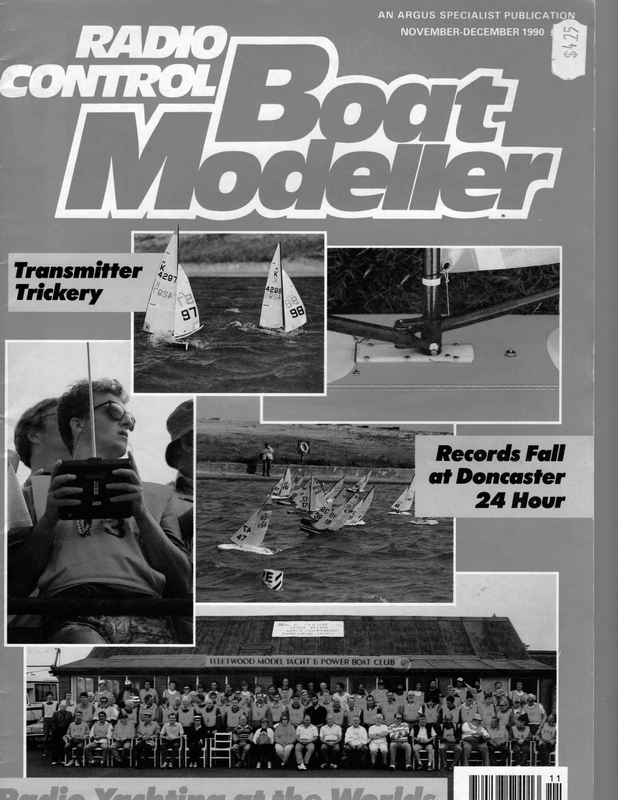
“AOUS SPECIALIST, PUBLICATION November/December 1990 CONTENTS Volume 5, Number 32 Messing About with Servos Dockside News and Letters Mods for tug rudders Doncaster 24 Hour World Record broken 12 Grebe A steamboat dream 21 Loctite Competition Win some adhesives for your next project Radio Yachting Mainly on the World Rm Championships What’s New Products new to you 34 36 46 24 Cutter to Lifeboat Conversion DIY Electronics The design and construction of circuits 25 Transmitter Trickery Sticks to steerwheel 30 Billing’s US Coast Guard to Waveney Boxing Clever An interchangeable R/C system 48 50 The RM World Championships at Fleetwood. Bottom shows entire entry and officials. Top left, Phil Playle (97) and Martin Mickleburgh (98) leave themselves plenty of room as they race downwind in their ‘C’ suits. Top right, carbon engineering on the Break-back swing rig fitted to John Elmaleh’s shocking pink yacht. Middle left, winner Chris Boisnault, from France, concentrates in the crush on the control platform. Middle right, one of the earlier races in the rough. All photos: Mike Kemp. EDITORIAL Editor John Cundell Editorial Assistant Andrea Silver Art Editor Peter Kirby Design Rozel Cassap ADVERTISING Advertisement Manager George Kynicos Advertisement Sales Vanessa Pritchard Advertisement Copy Control Karen Bashford MANAGEMENT Managing Director Terry Pattison Production Manager Tony Dowdeswell Group Advertisement Manager Sharon Shaw Circulation/Promotion Manager Debra Stupple Difficult to believe, but these are both Marbleheads. K26 is sailed by Model Boats Curved Air columnist Russell Potts, K2510 by Leon Talaic. They are years apart — the boats that is! Photo: Mike Kemp. A S Pe Control Boat Modeller magazine (ISSN 0268-5248) is published bi-monthly by Argus Specialist Publications, Argus House, Boundary Way, Hemel Hempstead, Herts HP2 7ST. England. Tel: Hemel Hempstead (0442) 66551. Correspondence anticipating a reply must be accompanied by a stamped-addressed envelope. Forthcoming events should be notified at least seven weeks before publication date and are included as space 06 permits. Prospective contributors are invited to send a self-addressed, stamped envelope for a copy of our ‘Guide to Contributors’. 198 Subscriptions: Select Subscriptions Ltd., 5 River Park Estate, Billet Lane, Berkhamsted, Herts HP4 1HL. (0442 876661. 6 issues UK £8.70, Europe £11.30, Middle East £11.40, Far Ea st £12.35, Rest of World £11.55 or USA $20.00. USA Subscription Agent: Wise Owl Worldwide Publications, 4314 West 238th Street, Torrance, CA 90505 USA. Back Issues: Back issues for the past twelve months, subject to availability from: Select Subscriptions Ltd., 5 River Park Estate, Billet Lane, Berkhamsted, Herts HP4 1HL. Tel: (0442) 876661. To avoid disappointment check availability before placing your order. Each copy costs cover price plus 60p p&p. Binders: £6.80 each (including p&p). Telephone your Access or Barclaycard order through on (0442) 66551. Distribution UK Newstrade: SM Distribution Ltd., 6 Leigham Court Road, Streatham, London SW16 2PG. Tel: 081 677 8111. Telex: 261643. Fax: 081 677 0136. Overseas Sales, UK Specialist Retail Sales and all magazine availability enquiries: Copy Sales Co-ordinator, Argus Specialist Publications, Argus House, Boundary Way, Hemel Hempstead, Herts. HPs 7ST, England. Tel: (0442) 66551. The publishers cannot accept responsibility for unsolicited material. The contents of Radio Control Boat Modeller including all articles, designs, plans and photographs and all copyright and other intellectual property right therein belong to Argus Specialist Publications. All rights conferred by the Law of Copyright and other intellectual property rights and by virtue of international copyright conventions, are specifically reserved to Argus Specialist Publications and any reproduction requires the consent of the Company ©, Argus Specialist Publications. Printed in Great Britain by Loxley Brothers Ltd., Aizlewood Road, Sheffield S8 OYS. Mono origination by Ebony Typesetting, Liskeard, Cornwall. November/December 1990 3
Fleetwood ‘90. Theory says ‘Start with a good speed and clean air’. Leon Talaic (10) from New Zealand is about to do just that in the strong winds, while the rest jockey for position at the more familiar end of the line. Beginners find it here; or at least some of it! WITH MIKE KEMP YACHTING Norman Curtis Only a day or so after presenting the text for the last issue | received confirmation of the sad loss to the model yachting world of Norman Curtis. Norman passed away on Friday 29th June after a fairly extensive battle against leukaemia. This had required him to have regular ‘top ups’ of blood, which many of us new about but perhaps did not really know the full reason for. Norman was known to many as the Secretary of the Woodley Club near Reading and had what many would consider the ideal home site; literally backing onto the park area adjacent to the Club’s home water. How many of us remember using Norman’s ‘facilities’ whilst attending a Woodley regatta, or crowding into his kitchen and dining room for a prize presentation when it was raining. In fact all of us Radio Yachtsmen in the UK have slightly more than this to thank Norman for. It was in the early 1970’s that Norman first appeared sailing Vane Marbleheads with the Guildford Club. His first venture into building yachts was when he built a half Marblehead (remember the MM25?) for his son to sail; it was not very long before Norman caught the ‘bug’ and built a yacht for himself. This yacht was for radio though he was frustrated that there were no others in the club and actually raced the radio yacht with a vane for a while. In 1973 he finally managed to get a radio section of the Guildford club formed and a year later was a prime mover in the organisation of the first MYA National Championships for Radio Marbleheads run at Elstead Moat in 1974. Norman was also among the leaders in innovative design of Radio Yachts and initiated the ‘narrow at the top – wide at the bottom’ semi-balanced rudder seen on many radio yachts today. He was also quite a prolific boat builder and produced a number of glass fibre hulls for a variety of Model Yacht classes. Despite this he was a wood worker at heart and produced some fine wooden hulls, the last of which was a Cedar Club: planked in cedar, of course, which started life as a garden fence! His design and construction skills also led him to produce several designs for home built winches, some of which were published. He will also claim a place in the history of It has been some time since we made some suggestions for the beginner to note where to get bits for his/her boat so we start again. Racers are catered for with the latest from the ranking circuit and a National Championship with a difference. All this plus photos and a report from the Worlds. international racing in this country with his third place in the first such major meeting at Gosport in 1975 when he sailed a Una-rigged Bloodaxe into third place behind a skipper from Sweden and another from Canada. Norman also made his mark on the organisational side of model yachting by setting up the Woodley club in 1974 and serving as Metropolitan and Southern District MYA Council Member for over ten years. Despite his failing health and the loss of his wife Margaret some three years ago he maintained his interest in the sport. | remember the last time | met him was at the Met.& South. ranking race run by Woodley club earlier this year. Norman Curtis will be remembered by many of us in the sport: | am indebted to Roger Stollery for much of the details in this little piece. Ranking in the West In a dress rehearsal for next year’s RM National Championship the ‘circuit’ moved to the Cotswolds Water Park on Sunday July 22nd. Thirty nine skippers enjoyed the sun and
sailing at the home of the Cotswolds Sailing Club, one of the few Clubs in this country to combine Radio Sailing with the usually expected dinghy and sailboard activity. Just for a change a Race Officer was imported to oversee a meeting organised by local man Roger Neeve and his club colleagues. Who was this hero to give up a chance to mix it with the cream? Why, none other than ‘our hero’; Martin Roberts, MYA Racing Secretary, fresh from his winning success in Dunkerque. That meeting was also a European Ranking meeting; this Cotswolds meeting was our 1990 event chosen for this potentially prestigious series. What a pity that there were no other Europeans to challenge the home ‘team’. Martin, ably assisted by Roger, when not sailing, kept the meeting moving along at a reasonable pace. He was also assisted in this task by that other well known secretary – the General — lan Taylor who kept the scoring under control. Eschewing the chance to try solar power for his computer lan was testing his ‘green solution’ to a race scoring. In addition to a monster score board he was trying a score card system that seemed as if it had developed from a board game, or maybe it will develop into one! Fashioned from thin ply, velcro, and using a manual read/write memory system it proved eminently effective at allowing a rapid assessment of heat size and constitution; and, come the end of the approach to the windward mark, or the shorter route up the middle with several tacks, or risk the long starboard approach followed by a port tack into ‘suicide alley’. The first of these carried a risk of sailing into winds considerably stronger than those closer in, they were also shifting so that overstanding or, worse, having to put in another tack faced the skipper. Roger Stollery used this route successfully several times. The middle route was also tried by many but ran the risk of dropping into a very disturbed region of wind just upwind of the start line; never the less it proved the superior route on many occasions. The last of the three was not tried by many because it was just too risky trying to approach the windward mark on port through the distinctly ‘hole ridden’ patch just down wind of the starboard reaching leg. During the early races, until Martin decided to leave the course alone, the leeward mark became so divorced from the line towards the finish that there was only one way to finish; close hauled on starboard at the starboard end of the line! By the time lunch was over and every one had consumed their fill of an excellent barbeque laid on close to the control point the course had been sorted such that the leeward mark had been moved further to our right and the start/finish line had been more or less aligned with the beat. Thus the fleet racing continued on a similar but slightly more even a decision: a meeting of all skippers was convened, the Race Officer put forward the proposal, there was no dissension, we continued sailing with but two fleets — each with slightly more yachts than before. The net result — we gained at least one extra race, even after the time taken out for the meeting. Common sense prevailed — | bet they won’t be as flexible at the next International meeting | attend, see elsewhere for comments. All the usual rankers were present, plus a few newcomers to the hurly burly of this bunch. Fortunately there were few protestable incidents for Martin to preside over; though he had already done the crafty thing and delegated such matters to others including Nick Weall who is getting more and more involved in this area of racing; adding valuable practical experience to his theory. | guess we shall begin to see the results of this in future issues of Nick’s column in Model Boats. Sailing was generally to a very friendly level though one or two tempers began to get a bit frayed when a less experienced skipper appeared to be ‘getting in the way’. Fortunately this never developed into anything serious although some of the regulars again started to ‘lose their cool’ as their performance seemed less than they had expected. As always happens their performance then deteriorated even more, adding further dissatisfaction. | can vouch that it is easy to The, now outlawed, stern overhang ‘shelf’ comes into operation as Bill Green gets Nemesis, to the pre-1985 Polaris design, moving at last; and Bill carries out some sheet surgery to Nemesis. day, permitted an equally rapid sorting of the finishing order. Three groups of yachts were sorted for the seeding rounds and resulted in some pretty close racing in between Martin’s antics in the rescue boat. The wind, though mainly from a direction which allowed a reasonable course to be laid, was having to find its way through the dinghy park and its surrounding trees and shrubbery. As a result there were a few bends and holes to disturb and test the skill of skippers as they approached the windward mark and went on to the first short reach down towards the bank. Some skippers managed this test of distance perception and its subsequent examination of their patience much better than others. The second reach along the bank in front of the control position was almost a run due to the bend in the wind. The second beat was a long affair with quite a lot of scope for tactical sailing, either taking the long port tack out into the centre of the lake and the following long starboard November/December 1990 course. With the entry divided so that each race consisted of three heats there were quite a number of yachts on the water at any one time. However, this meeting was to prove too much for several of the entry with even exalted skippers such as John Cleave eventually retiring due to radio failure. Thus C fleet shrunk to such an extent that discussions took place about the feasibility of altering the fleet sizes. It was during this period that a classic quote was heard to emerge from the lips of our exalted scorer in chief; “MYRCS has a number of holes in it”!?! Through the subsequent discussion ran a hint of rebellion when it was realised that adjusting the ‘heat base’ would result in a significant reduction in fleet sizes. The ‘sensible’ thing to do would be to reduce the number of fleets to two, each being of a slightly increased size. This procedure, though easily handled by the sophisticated scoring system being used, is strictly not allowed by the 1990 ‘IRYU-MYRD’ system. It was time for say; though very difficult to practice; but one should really try and get a grip on those feelings, put the bad vibes to one side, and concentrate on just settling down to improve the sailing. Just for once | was able to overcome preoccupation with negative thoughts about my performance and settled down to tune and sail with my ageing ‘B’ suit. This proved to be an ideal combination for the stronger winds out in the centre of the lake and the lighter off-wind patches close in. Because of the wind strength many of the newer yachts were sailing with their shroudless conventional ‘B’ rigs, they were tending to lose out to the swing rig on the off-wind legs. This put many of these skippers in a quandary; which rig to try? Only having swing rigs avoided having to make such a decision and allowed me to concentrate on making the thing go well. You will also note that there are no photographs from this meeting: | am sorry, but in my enthusiasm with performance | left the camera 37
oe ——— in the car and just got on with sailing. Later in the day the general wind strength decreased marginally and persuaded one or two that it might be worth trying an ‘A’ rig: the only skippers that seemed to be able to make this pay were the Stollery family. Those ‘Tops’ must have a considerable righting moment, though there were a few occasions when even they came close to the traditional swing rig, wave the rudder in the air and fall over sideways, ‘capsize’ that befell one or two others venturing upwards with their rigs. At the end of the day’s sailing we were gathered together for results and prizegiving and – surprise, surprise — that man Bantock came out on top again, but not by much. Peter Stollery chased hard into second spot, with yours truly in third spot a little ahead of Phil Playle. Phil was heard to comment that he wished | would concentrate more on writing and less on sailing as we had been having some close individual duels all day long. More news from the ranking front, (or middle?) next time. Radio 6 Metre Nationals In contrast to 1989 this year has seen sufficient new Radio 6 Metre yachts on the water to actually support a National Championship. Thus it was that on the 1st and 2nd of September Dovecote Sailing Club became host to the first MYA National Championship for Radio 6 Metres. In stark contrast to previous nationals where numbers have been counted in tens, this event just failed to make double figures after one yacht was withdrawn at the last minute. Never the less this meant that each skipper had twenty four out of 108 races to make his mark in this two day event. Contrary to the wishes, it seemed, of all but those who took part the meeting was run as a match race event or, as one described it, a Radio Vane Race. Three rounds of races where each skipper met each other started during midSaturday morning and were completed during the middle of Sunday afternoon. There was sufficient time for one fleet race following completion of the sequence. This was used to decide any ties that were left after all the matches were completed. Surprisingly after all these races there were two pairs of skippers tying on points but only one could not be separated by the result of the matches between them. One of the criticisms levelled at Above, Alan Bright with Rival (72) has a close race with Mike Ewart sailing Night Vision at the Radio 6 Metre Nationals. Top left, Mike Ewart shows one way of checking sail alignment on Night Vision. Above left, Rival’s beautifully planked hull, built to the Revival design. this style of racing is that it is uninteresting: little could be further from the truth, Both days saw numerous close races, some where there was only inches between the yachts as they finished. In a number of the races the winner did indeed take a positive grip on the match right at the start and successfully defended his position. Even in most of these races the winner did not have an easy time so close was the performance of the yachts involved: one mistake or tack into a poor channel of wind could see his opponent through to take over the winning position. The weather was kind, though the wind could have been more co-operative; fortunately the breezes did not rise to a point where reduced rigs became necessary. If it had there would have been one or two skippers in trouble such was the newness of many of the yachts. Most of the yachts taking part had been seen before during the previously reported Match Race series. One of the three Revivals sailing was new and had been put together in as little as two months by its skipper Alan Bright and was to be advertised for sale shortly after. Another yacht also for sail was the white glass fibre Renaissance design owned by Geof Earle and being sailed by Paul Heys who struggled to master what appeared like a slightly hasty radio installation. The other yacht not previously seen ‘on the circuit’ was the beautiful John Lewis design Flair; owned, completed and skippered by David Trippe, the yacht was planked by Ken Jones. Like the others this was sailing in its first competition and showed that, when fully tuned, it could be a very competitive yacht indeed. Not that any of these yachts was really shown up as being totally outclassed by its competitors. Having set up all the organisation before the meeting the running of the regatta became largely automatic, particularly as this event joined the slowly growing number of National Championships completed without a single protest being lodged: all incidents being sorted out on the water. This latter feature allowed yours truly to have a sail with lan Cole’s Transition which must make it the first Radio Yacht to have won two National Championships; in 1988 it was used to win the Radio ‘A’ Nationals. Where to Start? It has been some years now since this column featured some ideas for the raw beginner — apart from the odd piece of information about measuring, numbers etc. At the prompting of one or two letters it struck me that | should try and present some sort of guide to the acquisition of those bits and pieces that rarely, if ever, appear in the ‘local’ model shop. In the intervening years there have been some changes in the model yachting supply business. Purveyors of goodies, and not so goodies, have disappeared from the scene and their place taken by a new breed. With the wealth of information available for me to pack into these columns | am going to have to stretch the information for this and the following topic (the RM Worlds) over a couple of issues. This time | will highlight one or two suppliers of the basic large items required by a beginner in our sport: hulls and sails.
Hulls The first provision for anyone considering building a yacht is the hull. After all without a hull what is a yacht? Nothing but a collection of fittings, tube and sails which would almost certainly sink to the bottom of the first water it got in. Another choice about hull provision is whether to acquire a ready built or moulded hull or lay hands on suitable plans/drawings to built it yourself. We will look more closely at plans provision another time so let us assume that the decision has been made to start with a means of floating the assembled pieces that does not require extensive shaping. Hulls come in a variety of sizes, according to class; materials, linked to class and closely related to cost; and states of finish, again related to cost and source of supply. Most of the current sources of hulls can provide the basis for yachts to fit the main radio classes currently being sailed or developed. These vary from a bare moulding that may require its raw edges trimming to a finely finished replica of a championship winning yacht ready to accept radio and other fittings. Costs can spread from a few pounds to a few hundred pounds for the supply of a hull. Several of the sources of hulls are already well known in the Radio Yachting world and one or two are also well known for their design and sailing prowess which adds to the potential value of their product. Perhaps the leader in this field in the UK, but supplying the world, is Graham Bantock whose company, ‘Sails etc.’, can supply just about everything needed to get a competitive skipper to the water’s edge – at a price. In the background, teamed with Graham, is one of the leading exponents of the state of the art techniques for moulding model yacht hulls, lan Cole. This combination has consistently brought out sport hulls, fittings, sails, and complete yachts of the highest quality. As in any such sporting hobby, quality often costs and Graham is not noted among participating skippers for his low costs; never the less it is extremely rare for a bad product to leave their hands. The high resale value of yachts originating from that stable is testimony to the quality and effectiveness of the product. ‘Sails etc.’ can supply hulls to fit all classes from the One Metre to the International ‘A’ rule. Yachts from other designers are now available from the company in addition to Graham’s own designs. There are others in the world of hull provision that have seen a renewed surge of interest with the coming of the One Metre class. Tony Able has been one of the leading lights in this sphere supplying moulded yachts to his own design — Cygnet is now in its Mk2 guise — as well as a wooden hull in kit form originating from the French side of the English channel. Tony also supplies hulls to the Marblehead and 10 Rater class rules as well. David Trippe’s Flair Radio 6 Metre, planked by Ken Jones, designed by John Lewis, gets moving on a close reach in the slight chop at Dovecote. This very competitive boat has a pedigree as well as a beautiful appearance. Another who has been faced with a recent rush is Ray Baker who undertook to supply the Clapham club with their Chris Dicks ‘One Design’ One Metre – Comick — only to find himself besieged with invitations to build these hulls for many others. Ray is a well known supplier of mouldings for ‘class’ model yachts whose quality is proven by many successful yachts in the hands of skippers at all levels within our sport. Oliver Lee is another name who has been involved with the supply of model yacht hulls for some time. Oliver withdrew from the modelling world a little while ago to concentrate his efforts on a ‘full-sized’ Marblehead; actually a three man keel boat. He is now back in the One Metre business with a mark two version of his Tempo, a forerunner of the One Metre class. Yachts from this designer/producer always look pretty and the redesigned Tempo is no exception: it also contains a few innovative design features that add robustness to its structure yet keep the whole a very simple and cost effective product. It will not have escaped the notice of the observant reader that most of these suppliers are in the South of England. It would be wrong to assume that it is only in this area that good competitive hulls are produced. One designer/skipper/manufacturer stands out in that area North of Watford; Squire Kay. Known for light weight yachts created from glass fibre rather than Carbon and Kevlar Squire’s yachts, though not fashionable, are still very good value and if built properly and sailed well are competitive. In that they are no different to any other, any yacht ‘thrown together’ and not sailed to the best is going to be less successful than one where time and trouble are taken. Despite the fact that the One Metre is only slowly spreading to ‘the North’ Squire produced one some time ago, then shelved it. In the hands of the Kingsbury Club it has been demonstrating that it is as competitive as any other. Squire’s boats have won many championships in the past and still show up well whenever they appear. A name already known to many competitive skippers is that of David Coode who currently serves the MYA as League Secretary. Many also know that David has, as a result of his business related travels, built up quite a relationship with the ‘other’ side of the world. To such an extent that he has been sailing yachts originating from ‘down under’ for some time. Many of these yachts and their related ideas have considerable potential for a skipper looking for something a little different yet competitive. Consequently David now offers a limited range of hulls to fit Marblehead, 10 Rater, and ‘A’ class rules. The yachts are available in just about any stage of completion and a view of one of David’s own yachts will demonstrate what can be achieved. David is, like me, one of those skippers whose sailing performance has its ups and downs — despite the quality of the equipment! Long time supplier of mouldings to the At Fleetwood, Odi (10), the radical New Zealand yacht chases through the waves in company with Carmina Banana. November/December 1990 model yachting world is Bob Underwood: who used to supply an effective 36 Restricted hull called Taxachun and its One Metre derivative 39
Fleetwood ‘90. Three Mustangs get a little closer than they should during the Tuesday evening ‘racing’. Fleetwood ‘90. Peter Stollery’s Pitstop leads the charge downwind accompanied by Allan Gardner’s Orbit (X10) before its demise with radio problems. Close relatives; X47 is Martin Robert’s Zap, a Mystick design; the other is a Comick One Metre – both designs by Chris Dicks. Extenshun. Unfortunately the early versions of this hull did not fit the IYRU rule because they were laid up with coloured resin. Bob was not alone in using coloured resin but most of the suppliers into the One Metre market now produce hulls that match the requirements of the IYRU rules. This is more than can be said for some of the designs around for One Metres, some of which originated under one or other of the rules that preceded the IYRU set. Some of these designs, like the ‘sinking Swing’ mentioned last time do not adapt well to the new minimum displacement of 4Kg. People acquiring hulls or plans for some of these early designs may find that details shown, such as sail plans, are at odds with the current International Rule. Sails Sails are the power unit of a yacht; without them the vessel will normally just sit on the Fleetwood ‘90. The strong winds caused some spectacular sailing like this shot of Christian Goubet’s yacht Banco. water and drift. With a good suit the craft will seem almost to fly. Between these two extremes are several choices; buy from one of the recognised model sailmakers, talk a clubmate already developing his/her sailmaking skills into producing some, or have a go one’s self. The first of these is probably the best route for the beginner to follow and there are three main regular suppliers to whom one might address one’s enquiries. Once again Sails etc. is a prime source with Graham Bantock being recognised as one of the world’s leading model sailmakers. Graham offers a wide range of ‘stock’ sails for the main classes of model yacht as well as a bespoke sailmaking service for those classes like the 6 metre where sails have to be built to fit dimensions established during the yacht measuring process. Rapidly becoming a viable alternative to Graham since he decided to set up in a similar but smaller business is Martin Roberts trading under the name of Housemartin Sails. Martin also offers a two tier sailmaking service with a stock range and the facility for custom design and build of sails. Using the ‘Bantock’ swing tig design as a standard Martin is offering kits of parts to construct alternative swing rigs. A third source of competition proved sails is PJ Sails, built by Peter Wiles. Peter’s sails have become one of the standards of the One Metre fleet and are included with one of the largest selling One Metre kit boats of the moment — the Cygnet. Peter’s offerings are starting to appear on the Marblehead scene, being spearheaded by Nick Weall’s successful campaign in this class. There are also numerous members around the yacht clubs who have blossomed into building sails now that sources of sail material have been sought out. Some of these will occasionally make suits for their club colleagues and others, if you talk to them nicely. The main advantage of buying from one of the recognised suppliers, however, is their backup service should the sails need repair or modification following yacht measurement. Many is the skipper who has had a pleasant surprise when asking for modifications to be made to their originally quite expensive sails. Suppliers In addition to the specialist manufacturers of parts, there is also a growing trade in suppliers of other people’s products and fittings. Sails etc. list a wide range of fittings in addition to their hulls and sails. In the South, based next to the Swanley Club’s water, is Swan Models, which aims to supply all the necessary bits and pieces to construct a complete yacht. Swan offer a limited range of successful French Hulls in addition to sails from Sails etc., P.J., and Housemartin. Their catalogue also lists fittings from various sources both English and continental. Many of the other suppliers will also have fittings available in addition to their sail range; but more of them next time. 1990 World Championships for Radio Marbleheads At this time last year there were those in the MYA who were trying hard to make sure that they ended the season high enough up
David Coode,Warringah Cottage, Salt Lane, Hydon Heath, Godalming, Surrey, GU8 4DH Bob Underwood, 6 Winsley Road, Bradford on Avon, Wiltshire, BA15 1QR P.J. Sails, 1 Courtney Road, Poole, Dorset, Transition (K852) sailed by Mike Kemp and Flair pilotted by David Trippe involved in one of their close races at the Radio 6 Metre Championship. Photo: Charles Chambers. Saturday —- Prelude Saturday 18th August saw the official start of activities. From 11 o’clock onwards the team of Norman Hatfield, Vic Bellerson, and Ken Roberts carried out a thorough check of participating yachts, their rigs and certificates. the ranking list to qualify for the 1990 RM World Championship. In addition they were making plans to find the best way of transporting themselves and their gear to Las Palmas, the venue. What nobody new as we said goodbye to kingpin of the organisation busy preparing for it, Armando Bentancor, after the 1989 European Championships was that we would never see this jovial Spaniard again. Late in the year Armando passed away and with him the likelihood of the ‘Worlds’ going to the Canaries in 1990. With barely six months of organising time left the Fleetwood Club’s offer to host the event was accepted and one of the few groups in the world capable of putting such an event together swung into action. In the middle of August the success of their efforts was finally put to the test. From this correspondents point of view, they passed with flying colours. 75 skippers representing twenty two of the current twenty six member countries of the IYRU — Model Yacht Racing Division spent the penultimate week of August at the Lancashire seaside. They came from as far afield as New Zealand, Japan, the USA, and Canada. Between 10.30 am on Sunday 19th and 4.00pm on Friday 24th August each skipper had twenty eight races to fight out the seventh World Championship for Radio Marblehead Key points checked included marking of hulls with numbers, mast bands, identification marks and signatures on sails. After a visit -from the trio; Norman checking sails, Ken and Vic checking hulls and stamping all the separate parts with the ‘official’ Fleetwood ‘90 stamp; many little groups of activity could be seen. Some adding mast bands, others rerigging sails to fall within the bands, yet more adding ‘M’s or pondering the correction of mistakes made when certificates were originally completed. Surprisingly some of the more eminent of competitors were caught out by this examination, just occasionally there was potential embarrassment as a really eminent body was found to have some serious omission. When not being checked, those competitors who were ready got out on the water to practice and tune up with some impromptu Above, Fleetwood ‘90; difficult to believe, but these are both Marbleheads. K26 is being sailed by Russell Potts, KZ510 by Leon Talaic. They are years apart. Below, the magnificent Sir Winston Churchill sailed about during the Tuesday evening session. . yachts. Christophe Boisnault from France became the new World Champion, in front of Robert Wattam from New Zealand. The defending champion Janusz Walicki from Berlin finished the week in third place. Following these three were no less than five of the ten strong English team, thus ensuring that their three top skippers qualified for the team prize. During six days of racing competitors had to contend with winds varying from near force six to nearly nothing. Although many of the European and Australasian skippers are used to the heavy winds prevalent on this coast; some, like Stanley Goodwin from the USA club which gave the class its name — Marblehead, had never had to contend with such conditions before. Others, like the Japanese, may have heard about it from their colleagues that visited Fleetwood for a previous Worlds four years ago. and were a little better prepared. November/December 1990 41
Faces of Fleetwood ’90. What it was all about. Smiles in ‘A’ fleet as Guy Lordat (left), Harry Drenth (centre), Phil Playle (right), and Martin Mickleburgh (background) share an amusing moment. races. At one stage there were some thirty five yachts involved in this racing. This was made possible by arrangements providing for virtually all competitors to have their ‘own’ frequency for the whole week. Other entrants who had arrived earlier were to be seen tidying up with a few making repairs after the informal practice of Thursday and Friday. These sessions, it was reported, were rather hectic as visitors got to grips with the wind and wave combinations that prevail on this famous lake. Among those in need of some repair was our own Graham Bantock who eagerly awaited the arrival of his ‘support team’ of lan Cole to expertly patch up a few splits in the latest incarnation of ‘Nimrod’. After many hours of preparation in the sun on Saturday the assembled body of 75 competitors, many officials, and their families and friends gathered in the Marine Hall for a Civic Reception. Hosted by the Mayor of Fleetwood this slightly formal session gave everyone a first, non-sailing, chance to renew old friendships and originate a few more before ‘hostilities’ began in earnest. ‘>. il, Ex-olympic skipper, Geoff Smale (05), explains some sailing technique(?) to eventual Sunday Seeding Starting with a briefing for skippers at runner-up Robert Wattam (right). 9.30am the event proper leapt into action on this wet Sunday morning. Not only wet but the wind had developed into one of those ‘blows’ for which Fleetwood has become famous, though more was to come. Unlike some previous radio Marblehead championships no time was wasted waiting for flags to be formally raised or opening speeches to be made. Instead the Race Officer team of Derek Priestley and lan Hall (fresh from his success at the 1999 MYA RM Nationals) promised us as many seeding races as possible. Sunday would be used for seeding, there would be no seeding rounds carried over to Monday. Our race cards contained predefined seeding heats for six such races; there were few that imagined we would complete them all. With a pre-race and starting system that worked like clockwork all six seeding rounds were completed by shortly after six o’clock in the evening. Each of the thirty heats sailed had taken a little over fifteen minutes to complete; quite a remarkable achievement. Sunday was not slowly piling up for lan.Cole as his own new without its incidents, though there were commendably few protests for the Jury to sort Enigma was damaged during a collision with the unyielding bank. out. Collisions were also remarkably few in number despite steadily increasing winds and the highest of six seeding scores, the leading a large number of skippers as yet unused to skipper was Mario di Marchi from Switzerland sailing in the confines of Fleetwood concrete. sailing “Murphy’s Law” who had amassed a One of the later collisions saw the first of the grand total of 3.0 points from five races. Spain’s Jose de la Fuente with ‘Calerna’ (E24) week’s two sinkings. Unfortunate Brazilian skipper lan Astbury, slightly over canvassed, fell foul of defending champion Janusz Walicki on a different leg of the course. Leaving avoiding action just a little too late the two yachts made contact. Skalpel mounted the Hush-Hush starboard bow quarter, splitting its gunwale and deck; they were then driven further together and the Skalpel fin rammed into its quarry continuing the split around to the underside of the Brazilian’s hull. The green yacht came to rest on the bottom of the lake with its relatively large rig easily visible above the stormy water’s surface. The work was At the end of the first day, after discarding was second 1.7 points ahead of Graham Bantock, a further 1.3 points back in fourth place was Claude Momo from Switzerland. In sixth place was the most radical looking yacht of the meeting, Odi, being sailed by Leon Taliac from New Zealand. Janusz Walicki was in seventh place with 9.4 points. Following Janusz were a quartet of English skippers; split into two pairs by Philippe Sol; Chris Dicks, Martin Roberts, Phil Playle, and John Cleave. This group all formed the initial ‘A’ fleet for heat racing. They were joined by four others to make up the first fifteen. The Brazilian
Pedro Stier Neto; New Zealander, Robert Wattam; Frenchman, Christophe Boisnault; and our own Martin Mickleburgh all had their first chance to mix it in the top fleet. Monday — Heat Racing Begins in Earnest Jack Edge, the beach master, worked wonders again during this first day of heat racing: operating at a very high level of effectiveness throughout some of the worst weather conditions to drive us through a full six races. Rain and a steadily increasing wind accompanied by the Fleetwood waves, complete with white caps, all conspired to dampen the spirits of competitors and officials alike. Some of us were reduced to C3 rigs during the day; others ceased, voluntarily or as a result of equipment failure, to sail until the weather abated. As many struggled to find the right rig to use and others strived to find ways of keeping their yachts working the top group were trying to sort themselves out. At one stage, after the penultimate race for Monday, no fewer than seven English skippers were in the top ten. By the end of the day after race twelve New Zealand skipper Robert Wattam had displaced John Cleave from the top ten. After two hectic days of racing during which 60 heats had been completed and only 22 protests had been heard there was a spread of just under thirty points covering the top ten. Graham Bantock was leading with 20.4 points and sitting in tenth spot with 50 points was Martin Mickleburgh. To many of the entrants Monday was something quite alien to their usual sailing experience. American visitor from the birthplace of our class, Stanley Goodwin of the Marblehead Club, found himself in the middle of one fleet as big as many typical race meetings. In addition his yacht was surviving, just, in wind and wave conditions that Stanley had probably only ever dreamed of – in a nightmare! Tuesday – the Wind Drops and Protest Delays go up A number of pundits were predicting that with a decrease in wind speed would come an increase in protest activity. So it proved to be. In contrast to Monday when six races or 30 heats were completed Tuesday saw four races, a total of 20 heats struggled through. Several protests were claims for redress, a move obviously not approved by Marianne Ericsson Considerable interest was shown by the general public as shown in this shot which also shows the ‘cosy’ elevated control platform occupied by 15 skippers and at least four observers during each heat. who was chairing the committee. “Her indoors” as she became affectionately known by some seemed to feel that many such claims are frivolous and should be avoided by suitable sailing. In many cases one feels inclined to agree, but what is one to do if one’s rig becomes locked to another and then gets damaged in the ensuing drift and/or separation? As the day wore on we had a slowly increasing strength of wind though not really enough to return us to our ‘C’ rigs, or certain skippers to the clubhouse. Tuesday evening saw the barbeque accompanied by a knockout Mustang meeting. The idea was to enlist the sailing skills of as many assembled skippers as possible to guide these una rigged One Designs around one lap of the lake. The first half of each group of twelve taking part then went on to another round, and so on until only one fleet was left. As darkness fell the deciding race had yet to be completed. In addition the Japanese contingent had assembled two of their new baby America’s Cup Class yachts and invited entries for match race competition using these relatively tiny yachts. The match racing took place around two marks close to the clubhouse. One of these marks was shared with the Mustang racing which produced a certain amount of mirth as the two sets of racing converged several times. They were rounding the marks in opposite directions! As the light faded, leaving those still sailing with some difficulties in finding their charges, the barbeque and music got under way with some international assistance; Martin Mickleburgh on keyboard and Peter Gernart on guitar. Wednesday – the Half Lay-day? Billed as a potential early finish Wednesday dawned slightly misty with a light wind. Eventually the wind increased to one of those, in between A or B rig, breezes. This feature = Left, Vic Bellerson (with the hat) and Ken Roberts became very familiar wth 75 radio Marbleheads on the first Saturday during scrutineering. Right, Graham Bantock tries to fathom the intricate course laid in the light airs at the end of the week. November/December 1990 43
alone made Wednesday morning discussions interesting. The morning also saw the retirement of Alan Gardner from Canada whose Futaba PCM radio gear had decided to do more thinking for itself than it should do. Considerably dispirited with the failing performance of his expensive, computerised, all singing and dancing multi-channel set with a multitude of knobs and levers and declining several offers of replacement simple sets Alan withdrew and packed away his yacht. He was soon to be joined by colleague Baird Maclean, presumably in sympathy. Despite briefing, cajoling, and threatening Derek Priestley failed to get us to complete Race 21 before the desired early finish. Unfortunately the protests kept rolling in: some frivolous, many not, but all taking a little of the precious time available for sailing. Having sailed a Starboard hand first mark figure of eight course on Sunday and a squashed Olympic course on Monday and Tuesday; the fourth day saw us starting with a figure of eight followed by a sausage with a half twist. (left hand marks to port, right hand to starboard) After a few heats this was changed to another modified Olympic course which was maintained until the end of sailing. By four o’clock it was clear that our target of 21 races was going to be missed and twenty would be the last race of the day. However because of a delay for protests there was a long break between C and B heats resulting in racing not being completed until around 6:15 pm. This had a knock on effect and delayed A jubilant Chris Boisnault celebrates after his last race secure in the knowledge that he has emerged as the new Champion. Thursday – the Wind Finally Went Away championship. It was the beginning of the end for Graham Bantock who suffered at the whims of the radio waves during one of his the start of the IYRU-MYRD general meeting, which had been due to start at 6:30pm. Thursday provided probably the toughest test for the Race Officers to lay a good course. Starting with mist and cloud and a light South Easterly wind which fairly quickly swung trips to ‘B’ fleet. As a result of this ‘C’ was his next port of call. Then, in a fashion known well to this columnist, Graham blew it and around to enable Wednesday’s course to be used. This did not last for long and we were ‘A’ heat of the day Peter Stollery did his absolute best to legally give Graham a fighting chance. Breaking away from the mass Port tack start with John Cleave, Peter actually got went to ‘D’ fleet. Meanwhile in the very last soon sailing a strange course involving short reaches and beats across the lake coupled to some starboard roundings. Another hazard, well to windward of the Port tack lay line for the first mark. Meanwhile the bulk of the fleet progressed to set themselves up for a seen briefly on Wednesday, came to the surface during the light conditions and sun which eventually appeared — eels. An eel on the keel is not good news! Several suffered, starboard approach to the starboard rounding mark. As the inevitable chaos developed at the including yours truly. mark Peter swept around the outside ahead and into an unassailable lead. Eventual This penultimate day of racing also saw some knotty protests so our target of six races was missed again. Race 25 was the last to be sailed and started at about 6pm which meant champion Christophe Boisnault also broke clear at this point but was totally unable to close the gap on Peter. As Pitstop gently streaked away (in these conditions the terms sailing drifted on well into the evening and saw some pretty nail biting heats. are purely relative) the bunch fell over one another one another in the scrabble to avoid what was becoming a distinct possibility. It was these late afternoon heats that set the seal on some of the top placings in ja _ Would, could, Peter complete the course quickly enough to put the whole fleet out of time? All those skippers and supporters still present at this late hour (nearly 8:00pm), and there were a lot, stood riveted while the struggle continued. We were treated to a magnificent display of the how the Walicki Butterfly sail control system is able to flip, or should it be flap, the jib right out to the opposite side to the main — several times in one broad reaching leg. Unfortunately for Janusz and his compatriot Peter Gernart it was having no discernible advantageous effect; indeed it might even have slowed them down. Whatever the effect the appearance certainly bordered on the ‘un-natural’ and might, in positively hostile circumstance, be thought to fall into the realms of illegal propulsion. This apparent skulduggery was to develop, right in front of the watching competitors. Peter romped (!!??!!) home with a clear lead and to the sound of cheers from the audience. Over half a leg behind Peter and an equal distance in front of the next yacht followed Christophe. As ‘time-out’ was called vi = Fleetwood ‘90. To the sound of Thunderbirds a re go…, Commodore of the Fleetwood Club, Derek Priestley and his wife lead in the top table guests to the presentation dinner. Right, he came to Fleetwood as Depty Race Officer, was offered a last minute vacancy, and took sixth place overall – MYA Chairman Chris Dicks.
there were still six of the fleet to finish including the defending champion who could surely see the title slipping from his grasp. The evening’s activities were continued with what was billed as “Not the World Cup”. A football match? A team drawn from the English skippers, organisers, the Fleetwood Club, and probably any other English person that could be found faced ‘the rest of the world’. With Emile Servella as team manager the ‘ROWdies’ could hardly lose — and they didn’t. After a hard fought match during which several of the ‘English’ team suffered injury the result was a win for the ROW by four goals to one. However following the trend set in such events the result was subject to protest which, to my knowledge, is still being heard! While all this was going on the protest committee itself remained in session until around eleven o’clock, chewing over a protest between No.1 (Janusz Walicki) and No.133 (Chris Dicks). This particular debate was eventually settled in Chris’s favour and could have definitely sealed JW’s fate. The morrow was to bring a desperate and successful attempt by the German group to reverse the decision with ‘new evidence’. As a result of the re-opened enquiry Friday morning was postponed and we all had to sit around a while until the jury eventually withdrew JW’s disqualification. Thus things were put back as they were; just as if it had never happened. Friday — Continuing Challenge to the Race Officers Apart from the change of date, the fact that most of us had had some sleep, and that today was definitely going to be an early finish Friday could have been a continuation of Thursday. The wind was very light, oscillating from North-West to North-East and back again; in fact the main difference was that someone had moved the sun! Because of the protest appeal delay, the light winds and the early finish it was certain that fewer races would be completed. This was confirmed when an announcement was made at around 3:30pm that the race in progress after heat E would be the last. So we were only to have a total of 28 races but the excitement was not over. Heat 28 B was to see an unfortunate incident which some described as the most blatant example of ‘team racing’ demonstrated all week. The incident(s) were witnessed by many including other skippers, race officials, and spectators and the related discussion was overheard by at least one observer with an understanding of the language being used. As a consequence it was the subject of a protest under fundamental Rule C. This incident alone sent the jury into session for some considerable time. The ‘team’ concerned were fortunate to escape total exclusion from the regatta; something that the ‘Vulturesoft’ scoring program had no provision for. Ultimately the skipper doing his best to help his colleague collected a non-discardable disqualification for his trouble. It is alleged by some that several groups of nationals were seen to be indulging in such practices earlier during the event. One of the key features of the latter part of the week was the considerable good natured banter going on between skippers high up on the scaffold. In fact this may well become one of the most memorable features of the whole event as new acquaintances and friendships were forged and old ones renewed in ‘combat’. Friday Night – the Finale Anyone who remembers my report on the previous Fleetwood World Championship will probably recall that | was extremely impressed by the entertainers supporting the presentation banquet. | am about to rave about them again. The moment we walked into the Marine Hall | commented that | recognised the musical setup in front of the stage: | was right! Prior to the arrival of the ‘top table’ party we were entertained, or was it warmed-up, by this pair of musical looneys. Audience participation is their thing and they successfully involved just about every national group in some sort of antic to break the ice before the formal bits started. Not only that but they put on quite a significant display of musical talent as well, finishing the first part of their act with what could be described as floodlit timpani solo of water music. Well, the timpani were drenched with water, they were floodlit, and the water danced in the lights as an energetic drum oriented piece of music was played. The top table were led in by Fleetwood Club Commodore Derek Priestley and his wife, to the theme from Thunderbirds – which somehow seemed very appropriate, though | am not sure why. The serious part of the evening had begun; eating, drinking, and giving away the goodies. After the speeches had been made and presentations made to that important band of helpers without whom the event could not have taken place it was time for the top competitors to get their trophies. Starting at the top was the new Champion, 22 year old Christophe Boisnault who started sailing eleven years ago with an Optimist dinghy. Runner up to the Frenchman was another 22 year old, Robert Wattam from New Zealand. Proving that the young generation do not still have it all their own way was the deposed champion, 50 year old Janusz Walicki. In fourth place and, as in Italy, best placed English skipper was Martin Roberts. The team of three trophy went to a powerful trio of Francois Beaupain, Migel Zatarain, and Henry Ericsson. Having given all the major prizes away there were a couple presented from the scorer’s ‘shack’. First, for consistently presenting a smile all week despite some absolutely terrible placings and having come an awful long way to be very near last, Richard Simmons from Australia received the Race Clock — one of those ‘heirlooms’ mentioned in a previous issue. Another special award, the ‘Wham of the Week’ shirt was presented to lan Astbury in memory of his slight tangle with Herr Walicki. After this, the hair was let down and even Marianne took off her hat, the night was danced away. Saturday morning saw a small band of skippers back at the lake — but, more of that next time. RM Worlds (1990) – Team of Three Francois Beaupain (France)/Migel Zatarain(Spain)/Henry Ericsson(Finland) Next time we will have a look at some of the developments in the RM class as demonstrated by the recent World Championships and continue to consider bits and pieces for constructors. There should be a couple of ranking races to report and another first – the MYA One Metre National Championship. leads a successful Yet again the top placed English skipper, ‘Martin Roberts, an extremely smart hero, takes fourth place and dinner. English team. Right, the new Champion, Christophe Boisnaulit, from France poses for photographs at the presentation November/December 1990 45