- Title. Author. Summary

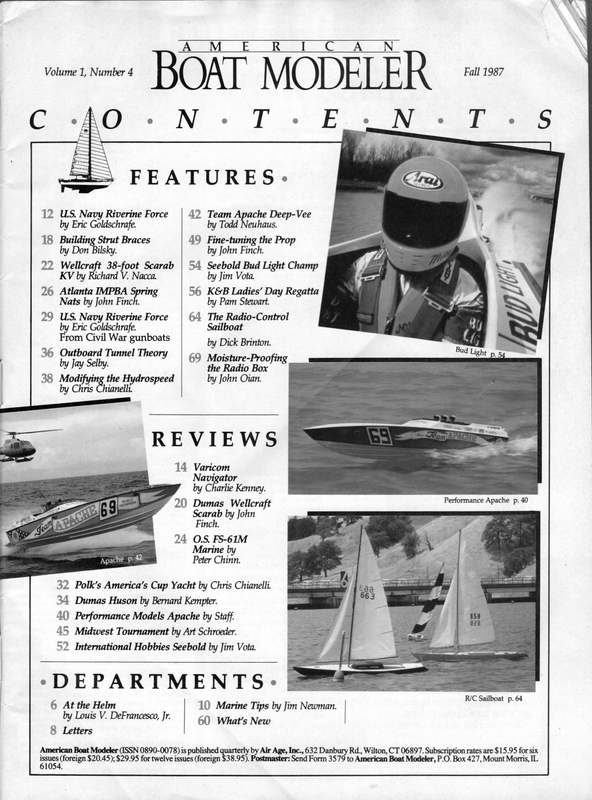
| J wwe BOAT MODELER = Pee eo oe FEATURES: 12 US. Navy Riverine Force by Eric Goldschrafe. 18 Building Strut Braces by Don | 42 Team Apache Deep-Vee by Todd Neuhaus. 49 Fine-tuning the Prop Bilsky. by John Finch. 22 Wellcraft 38-foot Scarab | 54 Seebold Bud Light Champ KV by Richard V. Nacca. 26 Atlanta IMPBA Nats by John Finch. Spring 29 US. Navy Riverine Force by Eric Goldschrafe, a ais os War ian Outboard Tunne by Jay Sel _+—_— | CN AR EN ory 38 Modifying the Hydrospeed by Chris fei : by Jim Vota. 56 K&B Ladies’ Day Regatta by Pam Stewart. | 64 The Radio-Control Sailboat by Dick Brinton. ; . 5 tate Bae by John Oian. REVIEWS 14 Varicom Navigator by Charlie Kenney. 20 Dumas Wellcraft Scarab by John Finch. am Apache p-42 24 Os. pe Marine Peter Chinn. 32 Polk’s America’s Cup Yacht by Chris Chianelli. 34 Dumas Huson by Bernard Kempter. 40 Performance Models Apache by Staff. 45 Midwest Tournament by Art Schroeder. 52. International Hobbies Seebold by Jim Vota. “DEPARTMENTS: 6 At the Helm by Louis V. DeFrancesco, Jr. 10 Marine Tips by Jim Newman. R/C Sailboat p. 64 60 What’s New 8 Letters American Boat Modeler (ISSN 0890-0078) is published quarterly by Air Age, Inc., 632 Danbury Rd., Wilton, CT 06897. Subscription rates are $15.95 for six rete(foreign $20.45); $29.95 for twelve issues (foreign $3 8.95). Postmaster: Send Form 3579 to American Boat Modeler, P.O. Box 427, Mount Morris, IL
REPORT £ t toa Fro-ream dystarfinish, race thequirmoded el3%onlyhoure-rs | of assembly time. cont torubbsecer urecesili men the decandk toto theob- NY elingof modtype elethe es unit that and air of ts men water is to me the lesssea– | I’m hope why with love lyin planes. A sailboat Theinstructions re- commend using best of both worlds. That’s hatch tain a good seal. This worked very well, but I do sug- on the heel, kicking up a silent wake, is the epitome of form following function, hol alconing turefordclea dena dy han excessezesglue the out. that sque gest having some e times tos chnotmorlead whi than PolkHob’sThe ty. beau t Craf el Mod The parts bies’ America’s cellent, and the Cup yacht is not whole project can only a well-made and detailed 20inch rendition of the full-size 12- be described as a relaxing and enjoyable one. Threading the nylon lines through some of the small holes is meter Cup racer, itis also extremely affordable and is complete with an Aristo-Craft Challenger 250 radio, also from Polk’s. lis avail The mode o. radi able sans Some. probably the most difficult task to be encountered. The booklet suggests hardening the thread with a few drops of cyanoa- more crylate for easier threading. Even impressive features of this kit center around the deck detail: winches, chainplates, hand rails, tracks, coffee grinders, and wateradir-tioanhatcabsoghthpre-lutearefablyall to be found. Other so, this “difficult” task presented no ‘s ie bb Ho ft Cra l de Mo 17 Die 7 4 V pe ” 7 o eae nies niceties are an aluminum mast and spreaders, a scale-like winged keel, and a radio 32 AMERICAN BOAT MODELER level of frustration whatsoever, part- the by ed help ly neea of n usio || incldle threader. Incidentally, a sailboat of this size needs no ex- pensive sail winch. by CHRIS CHIANELLI tion ch makes radio installahole gear mounting bracketthewhi . re squa re peg in the tantamount to putting frosqua a and s trie coun t eren ten diff Also included are flags nm prov ing sail ary imin prel ides set of instructions that eve fundamentals and tips. fit throughout is ex- The servo sup- plied with the ex- is more than sufficient. tended arm, also supplied,phot os, this little Cup racer sails As youcan see from the note that there are minim quite well, evenin light winds— s performance is better than ripples on the water.forThia boat of this scale. average, I might add,
A highly detailed entry-level scale yacht. Length: 20 inches Height: 27 inches Type: 12-meter model class photos by LOUIS V. DeFRANCESCO JR. Brightly colored stick-on flags of ten countries and corresponding numbers are included. Rigging drag and weight can really take their toll on a small craft in nominal winds, but the America’s Cup yacht did excel in this respect. I believe the graphite I added to the jib and main sheet line holes did its part in cutting down on friction. The model also demonstrated excellent handling characteristics for its size in a clear reach. Like others in its size class, in gusty wind conditions the model would change heading, and rudder adjustment was needed for maintaining a constant heading, but this is to be expected. All in all, with the very low price I expected to get a kit with the bare basics. What I got was a surprisingly detailed little yacht, in all respects, which performs as well as it looks. This has to be one of the Winged keel performs just like full- scale brother. (Continued on page 67) FALL 1987 33
BOAT REPORT A truly beautiful model yacht for the 36/600 class. Dumas today which can be HERE ARE boat kits on the markofetthe Dumas* Huson purchased for less than the cost you pay for. The what 36. But, as we all know, you getl of a sloop rigged ocean mode Huson 36 is a semi-scale complies and t yach iful beaut truly a is it l, racer. As a mode l mode of class 00 the 36/6 with all of the requirements ofAmer t Yach l Mode ican yachts as sanctioned by the your money is quality. Association*. What you get forin one very large package. THE KIT. The kit arrives as has done an Upon opening it you’ll discover that Dum s to prevent any outstanding job of packaging the part damage during shipping. ix-page manual which Dumas has provided a twenty-s lete with dimensions includes an inventory of all partides,acomp the items listi and materials. They also prov the modengl,ofallo wing you to h finis and required to assemble to get the paint, glue, make one trip to the hobby shop sives. As the Huson 36 is pushrods, switch mount, anddetaadhe look like a full-size iled designed to be painted and w theirtoreco mmendation and follo to yacht, you might want some plastic putty, visit an auto paint store and pick upeste . cream hardener (Bondo), and poly kit,r resin the instructions read the mble Before starting to asse uses a carefully. This is especially important because Dumasand r resin to make the hull fiberglass-reinforced polyestecert ain methods and adhesives. deck, and they recommendbefore starting construction, By reading the instructions . It’s also a good idea to lay areas lem you’ll avoid many prob m to the inventory listing. out all the parts and compare tthe s to build a field stand for Dumas provides excellen plan board box. I used a g usin the boat or a building standdbox duricard truction as I had cons ng boar their plans for a card the boat. a field stand that would fit ed along the centerline Following the instructions, | sand instructions said that The r. pape of the hull with 150-grit sand
At a glance This photo sequence demonstrates the extremely scale sailing characteristics of : the Dumas Huson. Note wing and wing Length: 36 inches sail attitude in middle photo. Sail Area: 600 inches Beam: 10 inches hull to the other. I did this to allow for a close fit of the deck to the hull with minimum overhang and to allow for the proper alignment of the interior components. The rudder installation required drilling a Y-inch hole for the rudder shaft. By using a pilot hole and increasing the diameter of the hole with increasing diameter drills, I avoided chipping the exterior gel coat. It does pay to read the instructions. The rudder block was shaped to fit the interior of the hull and to maintain a proper alignment of the rudder and the skeg. The instructions and drawings show how to hold the rudder, rudder tube, and block in alignment and these directions must be followed. Glue the rudder block in place with plastic Top: Solid-state (Bondo). putty expanded scale Make sure the voltmeter in operation. At the rudder is properly push of a button, aligned with the the receiver’s battery condition hull, because is checked. proper alignment Right Interior of cuts down on hull looking forward during a trial fit of the radio tray prior to joining the deck. Bottom: Detail photo of main sail attached to jack wire with dress hooks. The jack wire has been silver-soldered to the brass drill head. this rough seam line would have sharp edges which could cause cuts to the skin, but the hull I received had none. Switching to 220-grit paper and then to 320-grit wet-and-dry paper I wetsanded the hull to smooth out the previous sanding along the seam. I sanded the hull sheer flange (where the deck bonds to the hull) with 150-grit paper to remove any mold release and to provide for better adhesion. I then laid the deck on the hull to check fit and alignment. Some small spots on the vertical edge of the deck needed to be knocked down with 220-grit paper. I made some temporary bulkheads with masking tape stretched from one side of the drag. (Continued on page 58)
Dumas offers over 70 Dumas introduces several new and exciting models every year. . .and their popularity continues year after year! New this year is the Wellcraft 38 Scarab KV. Just like the TV boat, this long, lean drug chaser is all hand laid-up fiberglass construction. Hull and deck are joined for fast and easy completion. 55” long, this model is fast yet very easy to drive with radio control and engines up to .90. Kit #1435. and painted model (#11 15) ready for The new look in deep sea sport- RC and sail control unit. fishing machines is captured in the Donzi Z-65 model. 49” long, she’s detailed to the nines with outriggers, tower, pulpit, railings and fishing chairs. Plenty of room for radio gear, electric or gas power. . .even twin One of the latest fishing trawler designs is the Thompson Trawler and Dumas offers it. The 36” RC model features fiberglass hull and deckhouse with wood deck, kit #1224. The mast, outriggers and deck hardware is kit #2106. Running hardware kits are available from Dumas for all these models. Send $2.00 for a complete color catalog of these and 70 more Dumas models and supplies. A0s! Kit #1226. The Huson 36 — Dumas’ most popular RC sailboat. She sails great in any wind, yet is small enough to fit in a compact car, fully rigged! This 36” fiberglass model is available as a kit (#1119) or asa completely finished THE NEWEST AND MOST POPULAR MODELS a ion see i nae pnt AZ 85719. Telephone (602) 623-3742 Dumas Products, Inc., 909-AM East 1 7th Stree t, Tucson, ,
tested them and then removed them DUMAS SCARAB so I could coat the radio board with \ (Continued from page 55) K&S Engineering, 6917 W. 59th St., Chicago, IL 60638. Pro Products, 1422 Ballentine Blvd., k, VA 23504 Norfol Octura Models Inc., 7351 North Hamlin Ave., Skokie, IL 60076. Hobby Lobby International, 5614 Franklin Pike Circle, Brentwood, TN O 37027. catalyzed polyester resin and set it ona piece of waxed paper to cure. of the mounts and platform, I glued the mounts in place with plastic putty. Wood blocks are used to reinforce some underside areas of the deck. I glued these blocks in place with plastic putty, following the instructions. When the putty in the hull and under the deck had cured, I needed to protect the bare wood. The instructions called for the wood to be coated with polyester resin. I chose to mount the radio and sail control at this time so that when | DUMAS HUSON (Continued from page 35) Following the instructions, the installation of the sail control and radio equipment is easily accomplished. A %x3x13-inch birch plywood platform is used as a tray for all the radio and sail-control components. The forward end of the platform slips into the forward mount and is held to the aft mount with two screws. After a trial fit coated the wood all mounting openings were cut and all edges would be sealed. I used a Dumas No. 3702 Sail Control Unit in this boat. The SCU has a safety spring built into the winch arm, which dampens the stress on the gear train if the arm is forced to stop while the motor is running. For a radio I used the new Futaba* FP-2GS. I installed all the components and AT LAST! U.S. NAVY FIGURES coats completely covered the original white gel coat and there was no bleed- IN SEVERAL SCALES AND STYLES! through where the seam was. I painted the upper portion of the hull white and again the paint completely covered the SEND SASE FOR LATEST CATALOG UPDATE SHEETS gjyvamic ii P. O. DRAWER C, PORT seam. The upper portion where the deck joins the hull I painted red. | masked off the deck using the moldedin scribe line, following the instructions. MINIMUM CHARGE – $25.00 Icarried the red color % inch on the hull to balance the red on the deck. When the paint was completely dry I applied striping tape above the waterline and (516) 928-8200 MODELS JEFFERSON STATION, NY, 11776 along the sheerline. The next sequence in the construc- RPM. e @ e e tion was straightforward. I drilled the holes for the rigging and screw eyes, following the instructions to the letter. I Hi-Performance Connecting Rods Rubber Flex Motor Mounts Hi-Performance Carburetors Fast, Friendly Service Since 1974 taped the Plexiglas hatch cover over the hatch opening and drilled holes as required. I left the protective paper on the Plexiglas when I was drilling the pilot holes to prevent scratching the cover. Richardson Precision Machining Inc. 5070 Golden Drive « San Jose, CA 95129 2 58 AMERICAN BOAT MODELER (408) 257-7059 Dealer Inquiries Invited I bonded the deck to the hull with a mixture of resin and cabosil. I deviated slightly when I joined my boat. First, I did a dry run of taping the deck in place to check the fit. Satisfied that all was in order, I removed the tape and mixed 5 ounces of resin following the manufacturer’s instructions. I then brushed a small amount of resin on the hull flange and taped the deck in place. I poured the remaining resin inside the hull along the deck seam and slowly rotated the hull to allow the resin to flow into the seam. I continued to rotate the hull for about 15 minutes, which resulted in a perfectly sealed seam. | filled the small gaps on the exterior seam with plastic putty. When it was cured, I carefully sanded the seam in preparation for painting. As this kit is definitely first class, I wanteda finish that would be in keeping with a quality yacht so I painted my boat with Perfect Paint*. After giving the hull a final wet-sanding with 400-grit wet paper, I wiped it down with Perfect thinner and allowed it to dry. I then masked the hull at the molded water line and air-brushed Insignia Blue on the lower portion of the boat. Two By The plans call for the spars and mast to be shaped and sanded as desired. I was glad I had taken the time to lay out and mark centerlines, hole locations, and cross-section dimensions before starting to shape the blank spars.
Check and double-check your measurements and layouts. Drill pilot holes prior to shaping the spars. When I was finished shaping and sanding, I applied two coats of clear polyurethane to the spars. The Huson 36 attaches the mainsail to the mast with dress hooks. This arrangement requires a jackwire to be placed along the aft side of the mast. This wire must be straight and true, and this is where a careful layout of dimensions pays off. The jackwire runs almost the full length of the mast and is soldered into the slots in the heads of 0-% brass round-head screws. Use a low temperature silver solder and liquid flux. (Electrical solder won’t hold in this application as the wire is stainless steel.) Make sure that you have a clean screw head before soldering. I took a piece of 220-grit sandpaper and cleaned the screw head slots, fluxed them, and had no problems with the soldering. The standing rigging makes use of nylon-covered stainless steel cable. The method of attachment to the various points is that of standard rigging with the use of copper sleeves crimped or flattened in place. I again followed the instructions and experienced no problems in completing the rigging of the boat. I installed a Du-Bro* switch through the deck as suggested on the plans. Since the Plexiglas hatch cover is held in place with eight screws, it’s easier to use this Kwik-Switch mount than to remove and install all those On a broad reach or run, the boat moves effortlessly. When close hauled, the Huson 36 really moves out. In lighter winds, the boat is a little slower to start moving than other lighter 36inch boats, but once under way, the Huson 36 will keep up the best of them and gain slightly on a tack due to its weight and momentum under sail. screws to turn on the receiver. The one major modification that I made to the boat was to install an allsolid-state expanded scale voltmeter made by SAI* to monitor the condition of the receiver batteries. This unit was designed to be used in R/C aircraft, but has won a place in my heart for use in sailboats. At a push of a button I now know the condition of the receiver batteries, measured under load, between racing heats. Because this unit is rather inexpensive, I’m going to add one to my other boats. PERFORMANCE. With the radio installed, fresh batteries, and fair winds, the time had come for a maiden voyage. I did a quick check of the mast tuning per the instructions. Everything checked out fine, so it was off to the local yacht basin. Sailing the Huson 36 proved to be a real joy. I was concerned that with a weight of over 11 pounds the boat would be the “pig of the pond.” Not so. When the mast was tuned per the instructions for light to moderate winds, the boat proved to be so easy to sail that I turned the controls over to a four-year-old while I took some photographs. Try that with an airplane! The Futaba radio performed flawlessly on 75.340 (channel 62). Servo response was immediate and accurate. The Dumas SCU handled the sail outhauls without strain in all wind conditions. And everyone who has seen the boat has remarked on how nice the Perfect Paint finish is. AsI mentioned before, the Huson 36 is more expensive than some other boats. However, when you consider that you get a hand-laid hull and deck with the ballast molded in the keel, and brass and stainless steel fittings, you do WhenI sailed it against other boats I was very surprised at how the Huson 36 handled. In heavy winds the Huson kept on sailing while other, lighter boats needed more rudder correction to keep them from being blown sideways. Being a very watertight boat, | was not afraid to sail in winds over 20 knots. After two hours in very heavy winds, there was no water in the boat. indeed get what you pay for. This boat kit is first class and will give the owner many years of enjoyable sailing. I’d recommend this boat and the components which I used in this project to anyone who is looking for a relaxing boat to build and sail. While there are faster boats in the AMYA 36 (Continued on page 63) PRATHER RECORD BREAKING BOATS Epoxy Glass Construction: WHY CHOOSE A PRATHER BOAT? 7 Epoxy-fiberglass provides many times the strength of polyester resin hulls. The reduced shrinkage insures an accurate hull with a minimum amount of warpage. Always ask for Epoxy-Fiberglass Construction. iN Designed and Tested by the Experts: Our hulls have been designed by George Campbell, probably the world’s most experienced model boat designer. George works with some of the most experienced modelers in testing his designs. All have won National Championships, set World Speed Records, and are consistant winners in local competition. Contest Proven: The difference between a scale fun boat and a real competition boat is AWESOME. If you haven’t seen a real competition boat perform you are in for a real treat. Speed, reliability and stability are what competition » boats need to win. Prather hulls hold more N.A.M.B.A. Records than any other manu- facturer, plus they are consistent winners in local competition throughout the country. 2S PRATHER PRODUCTS, INC. 1s60 ravenna ave. witmineToN, cA 90744-1398 (213) 835-4764 SEND $2.00 FOR COMPLETE CATALOG FALL 1987 59
DUMAS HUSON (Continued from page 59) class, there are few which can offer the owner as much for their money as the Dumas* Huson 36. *The following are the names of the companies which are mentioned in this article: Dumas Products, Inc., 909-AM E. 17th St., Tucson, AZ 85719. American Model Yachting Association, P.O. Box 468, Port Washington, NY 11050. Futaba Corporation of America, 555 W. Victoria St., Compton, CA 90220. Perfect Paint, Cheveron Hobby Products, P.O. Box, 2480, Sandusky, OH 44870. Du-Bro Products, Inc., 480 Bonner Rd., Wauconda, IL 60084. SAI, 27107 Richmond Hill Rd., Conifer, CO 80433. oO SEEBOLD (Continued from page 54) and the new Driver Safety Restraint system, Bill went out and qualified for the race at 116-plus mph. This was only exceeded by Mike’s 117-mph in the older boat. Bill’s 34 years of racing experience and extensive design knowledge allowed him to perform the remarkable feat with a brand-new boat. Bill has been building competition boats for the past 17 years. Twelve to 15 boats, all handcrafted, are built each year. This includes about 95% of the hull’s rigging, which is machined in Seebold’s shop and is custom-made to each racer’s specifications. About half of the IOGP boats on the circuit currently use Seebold hulls. The hulls are constructed in the stringer-and-wooden-frame construction, with the exception of the new high-tech cockpit, the Driver Safety Restraint Capsule. The driver is strapped into the cockpit with a 6-point harness similar to Formula I and Indianapolis race cars. This keeps the driver inside the capsule in case of an accident. If an accident occurs, the capsule absorbs the impact instead of the driver. In closed-course tunnel outboard boat racing in 1986, this safety device demonstrated several times with no serious injuries to the drivers. Kevlar laminated with balsa makes a very stiffand durable safety-cell structure that absorbs the impact. Once the safety capsule is completed, the sponsons and hull are builtup around it. The entire hull is handchecked and all surfaces trued to ensure the proper attitude and performance for speeds of up to 140 mph. Each hull is tested on the Meramec River prior to being delivered to its owner. The motors Bill and Mike run on their champ boats are the Mercury 2liter, V-6 power head made from the production 2-liter, 150-horse pleasure craft engine. The production engine runs at about 5,500 rpm on regular gasoline. The racing version employs Mercury’s electronic fuel-injection and runs at about 10,000 rpm, producing nearly 300 horsepower on aviation gas. The Mercury power head runs on a racing lower unit that uses power trim, adjustable height, and 6SSM racing case with 7% gear reduction. The complete engine weighs 290 pounds. Combining Bill and Mike’s many years of racing experience with the care and craftsmanship that goes into their boats, how can you lose? Oo A Special Message TO RETAILERS! MAGINE the benefits of drawing many more I regular customers into your store every month. Imagine adding a popular, profitable—and returnable—hobby product to your store. By stocking Model Airplane News, Radio Control Car Action, and American Boat Modeler you’ll accomplish both! These are the most informative and entertaining modeling magazines available to the R/C consumer—and they’re in tremendous demand. These magazines will actually stimulate more sales of R/C Airplanes, Cars, Boats and accessories for you. If you’re not already stocking Air Age magazines, please call us toll-free and we’ll let you know how they can make money for you. Call Yvonne Toll-Free at 1-800-243-6685 (in CT 203-834-2900) (dealer inquiries only) Air Age Publishing – 632 Danbury Road – Wilton, CT 06897
by DICK BRINTON The Radio-Control CHALLENGE THE ELEMENTS WITH ’VE ALWAYS THOUGHT that sailboats were pretty, but until I tried one, I couldn’t see why anyone would have even the slightest interest in Sailing. It seemed like such a laid-back sport, if you could even call it one. Thena friend invited me to help sail his boat, a Santana 22, across Lake Tahoe. Lake Tahoe covers about 195 square miles, is about 1,600 feet deep, has a surface elevation of 6,220 feet, and is one of the clearest, large lakes in the United States. The lake is often windy; this particular day it was blowing about 20 mph. The lake, rough with white caps, looked like a place to avoid. “Come along,” said my friend, and not wanting to appear timid, I went. It was one of the most exciting days I’ve ever spent on water; and I’ve been across the Pacific four times on a destroyer! The wind was a force to harness, to turn that force, make it lift the boat in the direction we wanted it to go. Every element counted: wave direction, wind shifts, the tautness of the sails, their position, how much rudder was used, how the rigging was set, the angle of heel; they all had their effect. And those effects seemed to Two Infinity 54s on a broad reach while two are beating upwind after rounding the leeward (downwind) buoy. 64 AMERICAN BOAT MODELER A SAILING SHIP! change every 10 seconds or so. I gradually began to understand the mystique of sailing. By the time we crossed-the lake, I didn’t know much about technique, but I understood how challenging it was to sail. Since then I’ve sailed on countless boats, and have owned and raced a Lido 14 and a Hobie Cat. What’s all this got to do with R/C sailing? Everything works just the same, except you don’t get sea sick. Sailing an R/C sailboat competitively requires a lot of practice but—and here’s one of the beauties of R/C
Sailboat sailing—even a rank beginner can have fun! You don’t have to reach a high, or even moderate level of proficiency to enjoy the sure the size is convenient for you and be sure it’s “selfrighting.” After the wind lays the sail, you’ll want it to come upright by itself. It’s sport. also a good idea to assume For instance, I fly R/C that at sometime your boat’s airplanes and I know from going to fill with water, so experience that you’ve got make sure it has sufficient to be able to do a reasonable flotation to keep it afloat, job of flying for it to be and be sure to protect the Marblehead class (open class) boats. Fifty-inch-long pleasurable. But sailing an radio from moisture. hull and 800 square inches of sail area. R/C sailboat is relaxing On the other hand, if you enjoyment from the very want to race, a little different beginning. In addition, you’ll approach is needed. R/C never reach a point where sailboat racing is different there’s nothing further to learn. The challenge continues than any other kind of racing. For instance, the start is for as long as you’re involved in it. an art form. The race itself, an exercise in applied Furthermore, handicaps such as poor depth tactics. Boat speed counts, but a really good skipper perception, slow reflexes, arthritis, etc., don’t preclude with a medium-speed boat will win almost every time participation in this sport/hobby. In some cases it may against a medium skipper with a faster boat. I don’t even help by providing an outdoor hobby and the know of any other kind of racing where this holds true camaraderie of others. to such degree. It’s fun to sail your boat when you’re alone. The R/C Since most classes are designed to provide racing sailboat blends with the serenity of the lake. Since it among nearly equal boats and leave the winning or doesn’t disturb the environment, you can sail on waters losing up to the proficiency of the skippers, you should where motors are prohibited. check around before purchasing your boat to see what’s If this is your game, your choice is wide open. You popular. Try to get involved in an active one-design can buy a boat almost ready to sail, or a more involved class. In one-design, all the boats raced are of one-type. kit, or you can even scratch-build one yourself. Make The class rules are very strict and only minor A Santa Barbara class boat, seventy mches long with 1,100 square inches of sail area. This & 2 omedesign class, that is, all boats are bucit to the same specs and very little modification s allowed.
modifications are allowed, if any. If you purchase a boat that’s heavily raced in your area, you’ll be able to get a lot of help from other racers in setting it up and in taking some shortcuts to enhance performance. Get a consensus on which boat to start with. Sometimes you’ll be tempted to start in an Open class where a premium’s placed on experience and complexity. This choice usually spells problems for a beginner. Throughout Amer- ican Boat Modeler you’ll find articles and ads for various sailboats to aid you in your selection. But what happens after you’ve purchased your boat, put it together, and are ready to go out on the water? We might as well get used to using nautical lingo starting now since it is de rigueur (good form). Sloop: a small, single-masted sailboat carrying two sails, one forward of the mast (in front of) and the other aft, behind the mast. Jib: the forward sail on a sloop. Usually smaller than the main. The servo setup for an Infinity 54 class boat. Sail control servo is on the right, back- ne top left,andrudderbottom left. 66 AMERICAN BOAT MODELER Main: the large aft sailona sloop. Sheet: the line (rope) that controls the position of the jib or main. Ease out: allow some slack. Sheet in: take out some slack. Here are a few guidelines that’ll help keep you out of trouble that first time—especially if you are going without the help of someone who sails. @ Pick a launch site where the wind is blowingmostly toward shore. If you get out and can’t get back, just let the wind bring your boat back to you. @ Pick a day when the wind is light, around 5 mph. But remember, if the wind is too light or inconsistent it’s not much fun either. Furthermore, if the wind stops completely while your boat is out on the lake, you may have a long wait. I personally would rather sail in wind that’s a little strong than in wind that’s a little weak. @ Re-check the manufacturer’s directions to make sure you’ve followed them to the letter. e@ Turn on your radio and check the controls. Perform a range check at home according to the manufacturers instructions. If you’ve forgotten, range-check it now. @ If your sail(s) are controlled by a servo, ease out the main and jib sheets before you launch. @ Center your rudder. @ Place your boat in the water. Aim it so the wind is coming froma point about 60° to 90° off the bow. Closer to 90° is better for our purposes. @ Give it a light shove, steer it straight and watch to see how much it heels (tilts over). Most sailboats are made to sail somewhat heeled over. Check your manufacturers directions. @ If your boat is heeled too far over, there are two options. Ease out the sheets, or steer up into the wind. In the beginning, I suggest you ease out the sheets. In a sailboat this is a bit like easing off the throttle in a car. ® To return the boat to you, sheet in enough to pick up speed, then turn the boat so that the bow crosses through the wind while easing out the sheets. As soon as the boat pivots through the wind, the sails will be blown over to the other side. When the boat is pointing back at you, sheet-in or ease out the sheets depending on the angle of heel. Sheeting in increases the angle, easing out reduces it. If the breeze is steady from one direction, you’ll be able to sail all day (or until your batteries go flat) and never get bored. I’ve described tacking, that is, changing direction by steering the bow of the boat through the wind. This is how (Continued on page 79)
MODEL APACHE (Continued from page 41) engines, they do produce much more torque, enabling the use of a larger prop. However, the best feature of the Black Widow engine is its dependa- bility; they usually start on the first pull once they’re broken in (after about 1 gallon of fuel has been used). And you get 40 to 45 minutes running time ona 16-ounce tank of gas. You can play all day for about a buck. There are no starters, batteries or other equipment needed to begin, just the boat, radio and can of gas mixed with two-cycle oil at a 50:1 ratio. As I mentioned earlier, the crankcase is drilled and tapped for a pressure fitting. This is because the crankcase pressure operates a small water pump that circulates water through the head and into the exhaust, even while in neutral, giving the Apache a true wet exhaust system (chrome-plated just like the full-scale). When the Apache is cranked up, the engine is in neutral, due to the centrifugal clutch, allowing you to put the boat in the water and walk back to your radio. As you advance the throttle, the centrifugal clutch engages, permitting the Apache to idle at 1 to 2 mph, slow enough for realistic decking maneuvers. As you advance the throttle further, the. boat wall fly wave-top to wave-top. While the Apache is a quick and responsive boat on the lake, it’s really at its best in 2- to 3-foot oceanic chop. (But remember that careful maintenance is a must when running in salt water.) To complete the scale appearance of the Apache, Performance Models has coupled their Black Widow engine to one of International HobbiesTM scale outdrives which have performed flawlessly, even under high-torque loads and in salt-water conditions. All of Performance Models’ boats are of hand-laid fiberglass with decks butt-joined to the hull rather than “shoe box” fitted, and are bonded with fiberglass mat instead of putty. A solid bulkhead of core material is then glassed in place near the middle of the boat, creating a watertight compartment in case of a flip. After the engine stringers and transom plates are glued into place, the interior of the hull and hatch are given a coat of gray gel coat for protection. *The following are the addresses of the companies mentioned in this article: Performance Models, 1866 N.W. 22nd Performance Models offers the Apache and their other offshore boats in three versions: hull and deck kits, unassembled complete boat kits, or, for those with limited time or ability, completely assembled, painted and ready-to-run kits. Performance Models also offers painting and graphics on Place, Miami, FL 35125. International Hobbies, 1505 ABM TimoO berline Rd., Ft. Collins, CO 80524. CUP YACHT (Continued from page 33) their boats. Performance boats don’t come cheap, as the company’s emphasis is more on creating a durable product than a ubiquitous one. Their completed boats will look and perform like their full-scale counterparts and make a hotperforming scale sport boat as well. And their noise level, it deserves men- best bargains in the hobby world. Two of the America’s Cup yachts are the perfect models for you and your wife to take on an extended weekend camping trip, to relax with by a pond, to soak up the sun with, to learn a little about sailing, and to observe the sight of nature at work with the machine. tion, is very low. Hopefully, there will soon be a special *The following is the address of the company mentioned in this article: Polk’s Model Craft Hobbies, 346 Bergen Ave., Dept. 97B, Jersey, City, NJ 07304.0 racing class established for these high- performing offshore sport boats, enabling these warriors to run together. Now the OCTURA X-SERIES PROPELLERS TO FITALL R/C MODEL BOATS LEGAL UNDER BOTH IMPBA & NAMBA ENGINE DISPLACEMENT RULES… From the 3.5cc outboard up toand including the15 and 30cc marine engines there is now an Octura X- series metal propeller to get maximum performance. RECOMMENDED APPLICATIONS 3.5 OUTRIGGER 7.5 OUTRIGGER moped marine SUPPLIES OCTURA MODELS, INC. X440 X445 ndcaes TUNNEL TUNNEL X452 (__X455 7.5 OUTBOARD X457 X460_ .65 DEEP VEE X455/3 ee 3-Bladed Propeller *X467 *.250 Bore. 3.5 OUTBOARD 7.5 OUTBOARD X447 \_X450 .75 DEEP VEE 19″ X437/3 xeao 13 .65 SCALE HYDRO . .65 OUTRIGGER -90 DEEP VEE *X482———- TWIN .90 OUTRIGGER THE R/C MODEL BOAT PROPELLER PEOPLE 7351 N. Hamlin Ave – Skokie, IL 60076 FALL 1987 67
TN 37027. R/C Research Engineering, 823 Ricket Rd., Unit 15, Brighton, MI 48116. Trinity, 1901 E. Linden Ave., No. 20, CLUB DIRECTORY Linden, NJ 07036. Product Design Inc., 16922 N.E. 124th St., Redmond, WA 98052. Octura Models, Inc., 7351 N. Hamlin Oo Ave., Skokie, IL 60076. FLORIDA Orlando Culvert Dodgers Inc. 1384 Westdale Ave. R/C SAILBOAT Winter Park, FL 32792 OHIO Contact: Brian Kubik 305-275-7054 (Continued from page 66 a sailboat goes up-wind. As you can see, it’s a zig-zag path. Each leg of the path is called a “beat.” You’ll find that more than 50% of your sailing will be R/C Electric Boat Racers SMRBA Southeastern Miniature Race 8103 Greenwood View Dr. #911 MASSACHUSETTS CANADA Performance R/C Boaters Saskatoon Model Boat Lowell, MA 01851 Contact: Paul Griffith 617-459-8777 Saskatoon, Saskatchewan S7M 2L8 Parma, OH 44129 Roman Slowinski 216-886-2307 after 7:00 p.m. Boat Association 200 Greytwig Rd., #208 Vero Beach, FL 32963 “beating to windward.” In the early days mariners had to find steady winds to blow them in the direction they wanted to go. This is how the trade winds got their name. It’s much easier and quicker to let the wind blow the ship straight to port than to spend weeks tacking back and forth. However, downwind is not the fastest point of sailing. More on that in the O next issue. Racing Association 215 Lincoln St. 1015 Ave. M South Anton LaVallie 306-653-4023 306-254-2609 pan « JOE NEW JERSEY Camaraderie 417 Ocean Rd. Spring Lake, NJ 07762 Let your fellow model boaters know where your club is. Each issue American Boat Modeler will publish a free listing (space permitting) of clubs around the country. To join in, rl ae club location with your name, address, and telephone number to “Club Directory,” American Boat Modeler, 632 Danbury ‘d., Wilton, CT 06897. THE MOST REALISTIC R/C DEEP VEE’S AVAILABLE! 52” LONG! : THE ENGINE IS THE DIFFERENCE. Our custom designed “BLACK WIDOW” is a 22cc, water cooled GASOLINE ine with a built-in centrifugal clutch allowing full neutral capability. Starting is easy with recoil rope starter. Like the real offshore raceboats, our exhaust system is chrome-plated and water cooled. INTRODUCING: THE “APACHE” WHAT ABOUT PERFORMANCE? We are custom builders of ready-to-run scale R/C ne es ee mthe offshore powerboats. Each of our boats is custom pe like a true offshore champion. Designed and bu “= © cach Customer’s Spececations and is availto give hour after hour of realistic offshore racing performance ONE Oly GS Treacyt COMPLETE CUSTOM PAINT AND GRAPHICS AVAILABLE Call us with your requests. PERFORMANCE MODELS 1866 nw. 22nd PL. MIAMI,FLA. 33125 (305) 634-8145 SEND $2.00 FOR COMPLETE BROCHURE. FALL 1987 79