- Title. Author. Summary

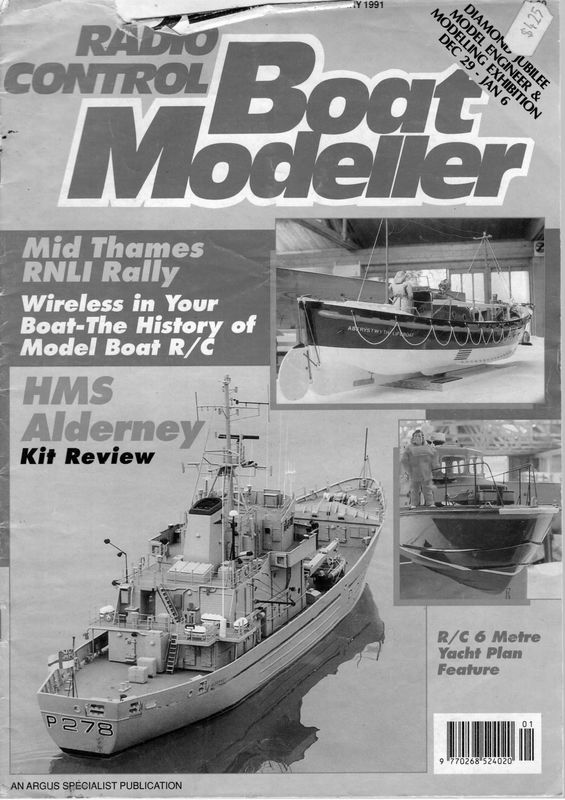
Mid Thames RNLI Rally Wireless in Your – Boat-The History of| Medel! Boat R/rf HMS Alderney Kit Review R/C 6 Metre Yacht Plan Feature ~ AN 7 S SPECIALIST PUBLICATION ae Se
forced to stop by some problems with his knees. Thereafter he concentrated on avidly watching and supporting the younger Dicks skippers at most of the meetings. The late Bill Dicks on the right photographed at Dovecote SC early in 1990, as many of us will remember him. : RADIO WITH MIKE KEMP YACHTING Ranking round-up and the First One Metre Nationals reported plus some technical stuff from the RM World’s It’s finished! At last your correspondent joins the growing ranks of the Radio 6 Metre sailors with a yacht of his own but more of that next time. We have race reports from yet another National Championship and a round up of the ranking scene. In addition we look back and see whether anything can be learned from the 1990 RM World Championship week. he Model Yachting world lost another of its well known characters during October. Better known to others in the Vane Sailing world than to me, Bill Dicks had become a familiar sight around the Radio Circuit as he followed the fortunes of his son, Chris, and grandson, Mark. 36 Where ever he appeared at a Radio event Bill would be an avid observer with a keen eye for the performance of the yachts — and skippers. The last time we saw him was at the Eastern District Ranking Race sailed at Dovecote on the 9th September. Shortly after that Bill suffered a stroke from which he never recovered; he died on October 10th at the age of eighty eight. Bill started his connection with Model Yachting in 1954 with the Clapham Club. He sailed actively at Club level but when it came to National events turned his considerable supporting skills to acting as mate to his son Chris. He was instrumental in Chris achieving the M class National Championship (for vane yachts) in 1960, 1961, 1965, and 1966; all with the same yacht! Bill was a great fan of the Free Sailing classes although he could see the day when Radio classes would predominate. It seems that the A class was one of his real favourites and he attended every national championship for the class from 1957 to 1990 either as a participant, officer or spectator and supporter. He was last seen sailing competitively in around 1970 at which point he was | am sure that everyone in the yachting world that ever met Bill will join me in wishing the Dicks family our best wishes following their loss. | will end this piece with a quote from the notes that Chris Dicks kindly provided: it sums up how many of us will remember Bill. ‘He always seemed to find the right words either to encourage those who were not doing so well, or to bring back to earth those who were carried away by success.’ Lessons from the Worlds Those of us who were fortunate enough to have the chance to sail in the 1990 IYRU World Championship for Radio Marbleheads undoubtedly learned a lot that is difficult to quantify and record. However | feel there are two areas where lessons can be learned. One is with regard to equipment and preparation; the other concerns the Racing Rules, particularly as they apply to such things as redress. Redress A great deal was made of claims for redress at the World Championship and such claims have been a feature of several other events | have attended recently. Indeed | had cause to make such claims myself. As, whenever one makes any protest one has to feel that there is a case to be made, | may show a little bias in some of what follows; however let’s try to look at the situation objectively. The International Yacht Racing Rules have a section specifically devoted to redress to be claimed by a yacht materially prejudiced by actions of others. The rule (69) is split into several clauses and a further two are added by our own Appendix 15. 69(c) deals with damage incurred when in collision with another yacht that was required to keep clear. Such damage, caused by inadvertent contact with a burdened yacht, can ultimately result in sinking. Though an extreme case, this is an example of how claims for redress come about following damage. This rule has changed significantly from its previous version where a yacht had to be disabled to claim redress. ‘Disabled’ was then defined; damage is not so precisely defined in the new version, which presumably leaves degrees of damage to the judgement of race committees. Our own IYRU division Racing Rules Committee have published an interpretation attempting to clarify the situation as applied to model yachts. Unfortunately no indication of degrees of damage acceptable is included. However case law suggests that dismasting or temporary removal of one or more sails; cracking or other damage to the hull likely to result in eventual sinking; or damage to steering or other control mechanisms are all likely to be generally accepted as sufficient to qualify. 69(e) (in our Appendix 15) states that proven radio interference can be called Radio Controlled Boat Modeller
upon as a reason for obtaining redress. Unless a fully effective frequency monitor is available it is extremely unlikely that this could be satisfactorily proven. Such a monitor was available for use at the 1990 World RM Championship and still there were problems. When a skipper is operating on frequencies well outside those normally used in any given location there are two major issues. One is that it is very difficult to monitor such a frequency, therefore how can interference really be proven: the other says that the competitor must bear some of the risk for operating so far outside the known band of frequencies for the area. 69(f) (in our Appendix 15) is, in my opinion, the real knotty one. It permits redress to be claimed by a yacht entangled with another that was required to give way. There is, as yet, no clear definition of acceptable degrees of entanglement. It is possible for two yachts to be held together by their own suction effect in very light and still conditions: one or both would almost certainly be delayed in continuing progress. In addition, as they would be adjudged to have contacted there would almost certainly be a rule infringement; thus one would be in a right-of-way position. Some would argue, at times successfully, that this is ‘entanglement’ within the scope of this clause. In the heavier air situation this could not happen, instead there would have to be a locking of rigging or even fins. Again there are many situations where one or both yachts are temporarily delayed, though they do often separate fairly shortly afterwards. There are yet more circumstances where redress is claimed by the ‘meat’ in a sandwich situation, often around a mark. Although either the outside, or sometimes the inside, boat is in the wrong the boat in the middle is the one that often feels aggrieved. It could be argued, however, that its delay is not that significant and it would have been possible to have predicted such a happening. Therefore no redress should be granted as a large part of the blame for the delay was self inflicted and could have been avoided. Perhaps a fairer way would be to actually define delay due to entanglement in terms of whether outside intervention was necessary to separate the yachts; or measure the delay in terms of a percentage of the race duration. Whilst this would undoubtedly introduce some borderline cases where there would be skippers who struck lucky and others who felt that they had been unfairly treated; | feel that it would significantly reduce the unnecessary delays caused by many — on the whole frivolous — claims for redress. At the World’s there were claims from at least one non-competitor of blatant ‘team’ racing by some Country representatives — including the English. From this competitor’s point of view | suspect that some of the ‘suspect’ instances were a result of competing skippers being ‘gentlemanly’ in their sailing. During the early part of the event this was a sensible selfpreservation procedure to prevent the sort of sinking collision suffered by Brazilian lan Astbury. Later in the week the danger was delay in the light airs due to contact and entanglement. Many were the occasions when skippers of No, they are not finishing; Vic Bellerson (left) and Mike Ewart are deeply involved in a match race with 6 Metres at Sneyd. Above right, the author’s new yacht, a Renaissance called Red Dwarf (K865) takes place in its first event, partially shieded by David Trippe’s Lewis boat, Flair. Below, Comick in 1 Metre Nats built by Clapham’s Rob Vice and painted in camouflage pattern. Very colourful in yellow, red and green. Les Robins still sailing a primer grey yacht, this time a Comick in the Nats. various nationalities collaborated to keep clear rather than press home their rights and risk getting tangled. It pays not to get hooked up, my own progress was arrested twice as a result of entanglement whilst being the right of way yacht. Dismasted once and with the jib ripped off the second time | successfully claimed redress on both occasions; but that is no guarantee of upwards progress. Equipment and preparation There were many who suffered from lack of preparation at this year’s Fleetwood event. | am proud to say that | was not one of them —- why? | was sailing a well proven yacht, some would say old and outdated, fitted out in as simple a way as possible. The radio pot lid had been lightly lubricated with petroleum jelly and was always screwed on tight. The contents of the pot were individually protected with tubular rubber sleeves with most of the servo plug connections made within the receiver ‘sleeve’. In this way they were protected even if a small amount of the evil brew in Fleetwood lake made its way in. Lastly, every time the pot lid was removed after a race both the lid and my hands were dried using a towel * to avoid wetting the main power plug and socket. These precautions prevented any radio trouble due to water. Both the rudder servo and the winch motor unit are of the ‘water resistant’ variety and include application of silicone sealant around the lead entry points and the case retaining screw heads. The winch amplifier is similarly sealed in a small plastic case within which there are a few silica gel crystals to control any moisture that might condense. Although Hemlock is reasonably watertight heavy weather conditions still find a little fluid finding its way into the hull. At the end of each day | removed the sealing patch and flushed out the inside of the hull with fresh water as well as washing down the outside of the yacht. Another precaution that | regularly take is when removing one of the deck patches. Avoiding the use of the superb, but expensive, fabric deck material | use a medium grade of Fablon self adhesive decorating film. This is much more prone to splitting under impact than the fabric but can be made to adhere just as well to the epoxy deck surface. | have found the key to success is to ensure that, after removing an old patch, all traces of the old adhesive are removed as well. A suitable solvent is ordinary 37
One of the earliest 1 Metres built and the very first registered, Number K2 is Hammerhead; designed, built and sailed by Ken Butler. Boat Nene istophe |Boisnault _ Skalpel _ Zapl 17 Martin Roberts— Graham Bantock 92 10 — _ Nimrod 3 Krystick — _ Pitstop : Total Points F2044 KZ606 G6 —K4347 _ ~Ka291 Invisible Touch Janusz Walicki Chris Dicks ‘Peter Stollery |} John Cleave Boat No. Country = : ; : K4239 Look Out!!! K444a4 Willieming F2400 Francois. Beaupain K4292 lan Cole _ Roger Stollery K4217 Tampa Miguel Zatarain _ ES _ Dephi F2099 Philippe SolForeign Affair — N47 Torvald Kiem Martin Mickleburgh — Carmina Banana K4298 © : Leon Talaic Odi KZ510 Jon Elmaleh Pinter tt US2769 2 Eltoo Christian Lindholm / Ton France — 1250 New Zealand 161.8 Germany England 167.2 180.4 England 187.4 _ England 195.1 200.1 England England France 212.1 England England Spain France Norway | England © New Zealand USA Finland : Boat Design Berlingo. Enigma = Enigma Fast Enigma | 288.7 Top 301.0 302.7 G Smale _J Walicki C Dicks G Bantock C Dicks R Stollery G Bantock G Lordat G Bantock R Stollery M Zatarain P Sol _Mystick 223.7 286.7 _Texanpan Dephi 319.4 Enigma | : 323.0 ‘Axitra 328.7 Odi 343.7 Pinter 2 356.0 Quantum Skalpel Enigma Fast Kiwi Logie Saga Berlingo P Lucas R Wattam J Walicki { Cole P Lucas Kiwi Logic Skalpel Mystick Top Builder Designer G Bantock C Dicks R Stollery G Bantock G Lordat | Cole R Stollery M Zatarain P Sol G Bantock __ G Bantock _ G Bantock PSo L Talaic ‘L Talaic — J Elmaleh J Elmaleh H Eriesson Clindhcin : | Material : Kevlar Foam C-Fibre/Keviar _C-Fibre C-Fibre C-Fibre/Kevlar Carb/Kev/Glass C-Fibre/Keviar C-Fibre/Keviar C-Fibre Carb/Kev/Glass Kevlar Kevlar/Glass C-Fibre/Kevlar C-Fibre/Keviar Foam/Keviar C-Fibre/Keviar C-Fibre/Keviar ‘Resin Keel Depth 480 Epoxy 470 Epoxy Epoxy Epoxy 450 Epoxy. 450 Epoxy 420 445 470 520 480 Polyester Epoxy Epoxy Epoxy Polyester Epoxy Epoxy Epoxy Epoxy Epoxy Epoxy N265 _ Norway 384.7 J Walicki — Solum C-Fibre Epoxy 403.7 Dark Crystal K4297 England G Bantock G Bantock _ C-Fibre/Keviar Epoxy _ Lordat Boat 28 406.0 Guy F512 France G Lordat G Lordat C-Fibre/Kevlar Epoxy —_s KZ605 GeoffSmale Kiwi Logic New Zealand 412.4 Foam G Smale G Smale Epoxy 9 Pedro Stier Neto BL1008 P Stier P Stier -Alforria tl Brazil 418.4 C/GF Epoxy Switzerland } Claude Momo Berlingo Z67 468.0 P Lucas J Lemeur C-Fibre Epoxy 486.7 Jose de la Fuente Pistacho Kevlar E2 Spain Texanpan M Zatarain J de la Fuente Epoxy F2144 France 494.4 Clementine Brillot Christian Goubet _ Banco C Goubet Kevlar Epoxy Chicca | Giorgio Pinzani 1188 Italy 507.7 Own G Pinzani G Pinzani Epoxy C-Fibre/Glass Texanpan Xavier Xatarain OTs E18 Spain 534.7 M Zatarain X Zatarain C-Fibre Epoxy P 1 Michel Malatesta 244 Switzerland Berlingo Lucas C-Fibre New Option 548.4 P Lucas Epoxy 158 Graziamo VI Italy Own Dario Scaglia 619.0 D Saglia D Scaglia C-Fibre Epoxy Murphy’s Law Cedar Club Mario de Marchi 271 Switzerland 654.0 P Lucas P Lucas C-Fibre/Keviar Epoxy : Hemlock K3807 England No Secret Mike Kemp 660.0 G Bantock M Mickleburgh C-Fibre Epoxy 1988 W Germany 31 Gerhard Mentges _ M88 Gi 679.7 C-Fibre Epoxy K Beck | G Mentges _ Robert Brown Fast Forward Scotland Enigma KS361 692.0 G Bantock -R Brownfl Cole _ C-Fibre/Kevlar Epoxy Suske 701.0 Harry Drenth H364 Holland Anja 18 HLupart H Lupart C-Fibre/Keviar Epoxy 45 Frederico Ciardi dedy Jedi F Ciardi 41100 Italy 710.0 P Jahan C-Fibre Epoxy 1988 ASAP W Germany Polyester 32 Klaus Schroder G545, 718.0 C-Fibre K Beck ¢ Mentges Blue Mist Enigma 732.0 8 Alistair Law ~KS368 Scotland G Bantock __ C-Fibre/Kevlar itce is Epoxy Mandarine } Patrick Taillez C-Fibre/Kevlar F363 France 758.7 Brillot Epoxy Brillot Finland 773.0 Kisutch Esa Anbtilla _-EX8 L43 Epoxy B Sterne E Antilla Kevlar Evalyn V Emile Servelia Fast F557 France 774.0 G Lordat G Lordat | C-Fibre/Keviar Epoxy Norwegian Cedar Norway 826.0 Franchise N95 Epoxy Gunnar Karlson _ MTonnesen C-Fibre/Keviar Wiesel Peter Gernart G86 W Germany 829.0 Archer P Gernart J Elmaleh C-Fibre Epoxy Stanley Goodwin US2281 USA 847.0 Logic B Sterne S Goodwin — Kevlar Epoxy Norway Trolline 3 _ Bjorn Nygaard N13 J Walicki 873.0 Skalpel J Walicki. C-Fibre Epoxy Alan Gardner _ Orbit KC14 Canada 903.7 Orbit Epoxy B Sterne _A Gardner Wave Arrow | Kazuo Takei Wave Arrow J1012 Japan 912.0 K Takei K Takei Polyester _ C-Fibre/Keviar Finland Henry Ericsson— Runaway 1125 Quantum 918.0 H Ericsson H Ericsson _C-Fibre/Kevlar Epoxy Gb42 938.0 Skalpel Juwel | W Germany J Walicki N Seebeck _ C-Fibre/Kevlar Epoxy $28 . Ulf Newmann _ Roza Sweden Sam 942.0 U Newmann vu Newmann _Glass-Fibre Epoxy Firebird _Minao Hirao Wave Arrow 943.0 K Takei J466 Japan K Takei _ C-Fibre/Keviar Polyester Sharky | W Germany 960.0 Skalpel G967 J Walicki C-Fibre/Keviar J Walicki Epoxy Sea Scamp Zit R27 treland 998.7 S Kay M Roberta’s Kay Glass-Fibre _ Epoxy Argentina A102 1033.0 Zim R Azar J. de Deus Glass-Fibre Polyester Dandy -Fanirebi E45 Spain 1036.0 Berlingo P Lucas C-Fibre : Polyester ‘Calerna — 1054.0 Texanpan Javier Aquirre E24 Spain C-Fibre M Zatarain Epoxy| Heinz-W Krull _W Germany C-Fibre G47 1086.0 Meysencyet HOW Krull” _ Pulso — K4493 Portugal 1094.7 Enigma G Bantock C-Fibre Epoxy 1138.0 No Secret Holland _Watergruwel +1366 G Ban Hee – : Baker C-Fibre/Keviar Epoxy — $3 _ Boatname 66 1173.0 Jacar C-Fibre/Keviar Epoxy Sweden ‘Hot Property _ a KZ616 New Zealand 1190.0 Haka — C-Fibre Epoxy Brazil 1191.0 Hush Hush Why Not — _—-BL2024 C-Fibre Epoxy _ Hong Kong KH51. Aphrodite Epoxy _ C-Fibre/Glass 1217.0 ‘Hush Hush 1218.0 Hush Hush ‘ramp : —BL2014 Brazil C-Fibre Epoxy _ -PI6 1223.0 Sea Scamp Portugal — V _ Camopus Polyester Glass-Fibre _Ecuanine _ A103 Argentina 1230.0 Congo Conzalez _C-Fibre/Keviar Brazil 1248.0 No Secret BL4020 ~G Bantock —_ G Bantock CFibre — Epoxy _ 1266.0 1988 W Germany K Beck — _ G Mentges CFibre/Keviar — HH Lupart Holland — 1269.0 Anja ~H Lupart _ C-Fibre/Keviar E Switzerland 1275.0 Chine Boat —Ettling © __ K Oberholzer _ Carb/Kev/Glas: . Bjorn Hellberg Philip Playle — _ Nicholas Seebeck _ 6 Bantock | Australia 1299.0 Zero Logic 4306.0 L 4 a Pocket Rocket / F Rusel BSteme _A Brewer | B St . _ = HI hrybecki_ CLindholm _ AB BM Epoxy _ 480 420 440 480 475 470 435 460 510 530 445 470 470 460 460 440 460 480 440 450 470 440 450 450 450 470 470 520 450 510 450 470 415 550 455 §30 504 480 470 490 390 480 460 420 470 370 440 : be
World Championships Technical Details. Probably the most radical design at the event. Fabricated from two halves of foam and covered in keviar; Leon Talaic’s yacht has its rudder towards the bow. World Championships Technical Details. Interesting fin and rudder on this ‘Fast’ designed by Guy Lordat and sailed by Francois Beaupain. Fin Angle 2B Sail _ Maker : Vertical / : Dual Taper Tapered 2 Boisnault Tapered Tapered ‘Composite C-Fibre — Composite C-Fibre | Swing = C-Fibre74.10% Composite C-Fibre Vertical Vertical Dual Taper 2 Raked Aft Dual Taper Vertical 365 _Raked Aft© Tapered &8a Vertical _ Dual Taper Raked FWD 3.90 3.52 Vertical Dual Taper Vertical — _ 3.50 Dual Taper Raked Aft 4.20 3.73 Tapered Vertical — Dual Taper Raked Aft — Dual Taper Tapered Tapered Tapered Vertical Vertical C-Fibre _ TB6.47% Swing | C-Fibre _ J4.10% Composite _C-Fibre 73.21% Swing C-Fibre 77.00% Composite 74.04% Composite C-Fibre 65.52% Conventional C-Fibre ys Tapered — 71.23% Aw Raked Aft ‘ Vertical Tapered NO. Tapered | . Dual Taper Dual Taper Tapered Sea;—— Tapered | Composite 76.47% Swing 71.84% 5.60 Composite cent ae: Mylar _ (DWG Film — / C-Fibre : _ DWG _ tylar F Beaupain Mylar DWG Film/Dacron G Smale G Bantock Groovy/Rnd DWG Film ~ Tapered © _ Vertical Tapered Vertical Raked Aft Dual Taper _ Vertical Tapered Dual Taper Vertical Dual Taper Raked Aft Dual Taper Raked Aft Tapered Vertical Tapered _Raked Aft Vertical — Raked Aft “Vertical _ Raked Aft _ – » Composite Swing 64.17% Swing 82.57% Swing 3 = 3.8 4. Round Mylar Beaupain/Boisnauit Round Mylar G Bantock Round Mylar Dacron Dacron/Mylar Dacron/Mylar C Goubet G Pinzani/G Bantock G Bantock/Zatarain Round Round Round C-Fibre C-Fibre Mylar Round Groovy/Rnd Dacron | C-Fibre C-Fibre _ Groovy/Rnd Swing C-Fibre Aerofoil 70.00% Conventional C-Fibre Groovy/Rnd C-Fibre 0.00% Swing Conventional C-Fibre & Al. Groovy/Rnd 69.81% Round _ 78.43% Swing CFibre _ Aerofoil 70.00% Conventional C- Fibre 68.18% _ J Walicki DWG Filrm/Dacron G Bantock 4.90 Dual Taper Raked Aft J Eimaleh/J Amern _ B Sterne 70.00% Vertical -Raked Aft Vertical Raked Aft- Dacron/Mylar DWG Film/Mylar Dacron/Mylar _D Scaglia G Bantock G Bantock — G Mentges G Bantock G Bantock Mylar G Bantock DWG Film/Mylar J Walicki Tj G Bantock Dacron/Mylar a G Bantock B Sterne/Mylet_ FBeupain Dacron/Mylar G Bantock Vertical Vertical Conventional C-Fibre Conventional Conventional Conventional Conventional Vertical Raked Aft Swing C-Fibre C-Fibre— C-FibreC-Fibre fe ie: C-Fibre Conventional C-Fibre Conventional C-Fibre Conventional C-Fibre Conventional C-Fibre – C-Fibre & AL CompositeComposite C-Fibre : Composite C-Fibre Composite C-Fibre Conventional C-FibreComposite Composite Conventional Conventional 5.45 C-Fibre C-Fibre C-Fibre C-Fibre _ _ Swing C-Fibre Composite CFibre Swing C-Fibre Conventional C-Fibre =G _ . Conventional C-Fibre , Swing C-Fibre Conventional C-Fibre 5.50 5.50 70.91% Conventional 69.09% Conventional 66.79% Conventional 69.23% Conventional 65.49% Conventional 78.05% Conventional 74.55% Conventional _ C-Fibre — C-Fibre C-Fibre C-Fibre Aluminium C-Fibre— Aluminium Aerofoil Round © Round © Aerofoil Round Groovy 40/60 Whirlwind — Bantock/Beaupain/own 25/75 Whirlwind J Walicki B Sterne K Takei GB/Beaupain : J Walicki ee : 26/74 Whirlwind Whirlwind Apex © Robbe _ : Jackson — : Ble Multiplex : Multiplex iba
ue The prototype Comick 1 Metre designed by Chris Dicks; called Dandy and built and sailed by Jim Vice it is planked in mahogany -! think. dissolve the remaining glue or cause it to come off as a sort of jelly when wiped with a paper towel. | never re-use an old patch! | have not had a patch lift at the wrong time since | adopted this technique. None of what | have written here is really new or revolutionary, but there appear to be many who still suffer when a few simple precautions could save a lot of heartache. While these precautions did not prevent me slipping further down the overall lists than | would have liked my performance was not marred in any way by equipment problems. Yacht design and evolution Has Radio Marblehead design moved on since the last time the ‘World’ representatives got together? Having the event on our home territory makes studying the developments over the last four years much easier. Once again Elizabeth Andrews did all of the ‘Press Corps’ a marvellous service by gathering technical details of the entries. Analysis of this information takes time but here are some of the findings. The chart prepared, based on Elizabeth’s original information, very closely follows the format of that published in 1986 so making comparisons easier. It does not claim to be exclusive but probably contains more analysis than may have been published elsewhere. Designers Now he will have to get one! The first MYA 1 Metre Champion, Phil Playle, sailed the prototype Rhythm into first place in superb style. More skippers seem to be turning to the use of yachts designed by third parties. Only eighteen of the 75 skippers taking part were sailing yachts to their own design; 24% compared to 31% in 1986. In several cases there were National groups sailing yachts designed by one of their team. Apart from the obvious case of the English sailing Bantock yachts; several of the French were sailing Fast by Guy Lordat, and the Spanish were all sailing the same design produced by Miguel Zatarain. There were one or two new designers showing off their creations including the Finn Henry Ericsson who was having a good time sailing while his wife kept track of things in the protest room. Hull material Only 13 claimed to be including any glass fibre in the construction and of these there were only 6 that were purely glass fibre/polyester resin. There were three that included foam in their construction, all from New Zealand, compared to twice that number in 1986. What is more significant though is that this year there were NO yachts built from wood in the event. Apart from those mentioned all the yachts were either pure Carbon Fibre, pure Kevlar, or a combination and most used epoxy resins. to bind the whole lot together. The most radical yacht actually used a process which is extremely simple to apply; it was carved from foam which was then given a Kevlar coat. The only hollowing was for the radio gear. Its builder Leon Talaic claimed that it took only a few days to create the hull so he was not too heart-broken when parting with it before returning home to New Zealand. Presumably he had built another within a week or two of his return. Keel depth Keel depth is a parameter that can have a significant effect on the performance of a yacht: both beneficial and otherwise. It is one of those measurements that many seem to make when examining a yacht new to them so we measured every one. By far the deepest yacht sailing was the Archer built by Peter Gernart, it will come as no surprise to many that this yacht was also one of the lightest. In order to try and gain ‘stiffness’ Peter extended the fin so as to carry what weight he could manage as deep in the water as possible. Ballast and righting moments Combined with the fin depth the weight of the lump stuck on the end of the projection can do a lot to control the ‘stiffness’ of the yacht. Hull form also plays an important part in this factor of a yacht’s characteristics, however it was very difficult to make an objective assessment of the part played by the hull so we look just at the easily measurable bits. The heaviest ballast being carried was claimed to be 4.5Kg, while the lightest checked in at 3.1Kg. The average works out at 3.78Kg. With the notable exception of two Walicki boats the top twenty yachts were all within a couple hundred grammes of the average. When it comes to a measure of the stiffness, the ‘righting moment’ calculated by multiplying the fin length ft Almost overwhelmed by his Model Boats hat, Simon Bright collects the 1 Metre Juniors Trophy from Charlie Coventry. Right, World Championships Technical Details, very neat execution of a jib twitcher on Martin Mickleburgh’s Carmina Banana. Far right, Christian Lindholm’s Eltoo from the Quantum design by Henry Ericsson almost had the deepest fin. 40 Radio Controlled Boat Modeller nemesis gee ne a white spirit which will either totally ; ;
by the ballast, the story is much the same. With the exception of the Walicki boats which are right at the maximum end of the scale at 2.23Kg-Metres and the two Stollery boats which at 1.55 are towards the low end of the scale, the top twenty all hover around or just over the average of 1.75. Weights Again there is not a lot of comfort for those creators of extreme yachts in the figures from the Worlds. The top twenty the field. Sailmakers Nearly half the entry owned up to using sails by Graham Bantock, even if they also had some from other sources. Many of the other non-English skippers were using sails of their own construction and one or two other commercial manufacturers had a look in. yachts, and many others, all hover around the average weight of 5.1Kg. What is more significant, however, is that the average weight has reduced by around three quarters of a Kilogram in the last four years. The lightest yacht is now only 160 grammes lighter than the lightest 1986 yacht; but the heaviest is 1.16Kg lighter than its earlier counterpart (that’s over two and a half pounds!). Sail construction materials do not seem to have changed that much over the last four years though there have been several refinements in the actual process of holding them together. Mylar, in various guises, seems to predominate though much use is still made of woven materials generally described under the name of Dacron. Drawing film is also claimed as a material by many, though this is also a mylar film but without the fabric reinforcement seem on some of the ‘Mylar’ sail cloths. Ballast ratio Winches As might be expected with an overall reduction in the weight of yachts there has been a drift upwards in the ratio of ballast to hull weight. The average is now just a little over 70%: some 3% up on last time at Fleetwood. The maximum however is a remarkable 86% of the yacht weight down below achieved by Alan Gardner with the Bob Sterne Orbit design from Canada. That is with a yacht that is almost at the bottom of the overall weight scale as well. Using the weights declared by Alan we see that his whole yacht, less its ballast, weighs in at 0.6Kg (1lb 50zs for those imperial types); now that really is some achievement. Mast and materials Just as with Hulls but more so, Carbon Fibre has become almost universal for masts and spars. Only two yachts entered declared Aluminium masts exclusively and only another two claimed to have them in their wardrobe. What is perhaps surprising is that the trend towards predominantly swing rigged vessels seems to be reversing. Indeed those equipped only with swing rigs were the minority, just, while what | call the composite rigs – a mixture of swing and stayless conventional — were used by twenty two yachts. The majority, thirty three, still used conventional rigs: although they did seem to be populating the lower half of When it comes to analysing the hauling force of the fleet there is only one manufacturer that can lay claim to the majority; and he is English. The Whirlwind winches from David Andrews are now established world-wide and were used by all but eight of the entry. The next major winch manufacturer quoted has not made a winch commercially for some years. Never the less four of the English fleet stick resolutely to the one time king of the winch, Barry Jackson. Despite its demise when the Futaba 17M ceased production the Jackson winches continue to serve faithfully, and quickly, often on lower voltage battery packs. A couple of Walicki winches were in use as were one each from someone called Blessin and an Australian name Rob Guyatt. Over all though, the Whirlwind reigns supreme even in the Japanese yachts. With 90% of the entry using his winches Dave Andrews must have felt very pleased, yet apprehensive as he roamed the compound renewing acquaintances and keeping an ear open for the statistically inevitable faulty winch. As far as | know there were very few for Dave to be concerned about during that week. Summary | find it difficult to find anything really outstanding technically to concentrate on following this event. What appears to have happened is that there have been a few years where construction techniques have been improved to produce yachts that are technically very similar to those used four years ago; but built much better. There seemed to be fewer actual failures during the 1990 regatta which reflects significant improvements in both construction and preparation. Leon Talaic’s ODI took a real plunge and moved the rudder from the stern to the bow. It sailed well in most conditions and did not seem to be handicapped in any way: in some conditions the bow rudder certainly seemed to make the yacht easier to tack. It construction is also not new, indeed many prototypes have been built this way. Leon is probably the first to take the plunge and bring such a product to a major championship: | suspect that he January/February 1991 World Championships Technical Details. The butterfly mechanism and sheeting system on the latest Skalpel from Janusz Walicki. Beautifully engineered radial jib mount on the same yacht. – will not be the last. Now that the revised Marblehead rule has been with us for a while a few are starting to experiment by stretching it a little. Perhaps stretching is the wrong word; working within its framework is no doubt what they would say they are doing. Leon Talaic from New Zealand and one or two of the Scandinavian skippers have had sails produced that deliberately carry cross width measurement penalties so as to produce a very even vertical ‘wing’ of a sail. The theory is, | imagine, to try and shift some of the chord of the sail up the mast into the faster moving air where it can produce more drive. Whether it worked significantly was difficult to assess but it is certainly an area that might be developed further: so perhaps our measurers had better start brushing up on their maths in readiness. There were flashes of brilliant technical construction methods such as that used to fabricate the Carbon Engineered ‘break-back swing rig’ seen on Jon Elmaleh’s yacht – featured on the last issue’s cover. | know how it is done but it must be an awfully messy process.! Another area of technical excellence was on the deck of the latest Walicki 41
World Championships Technical Details. Orbit designed by Bob Sterne and sailed by Alan Gardner from Canada, was ultra lightweight construction and featured multi channel control including kicking strap or vang. The yacht was claimed to have the highest ballast ratio at Fleetwood. yachts. The fittings, and that ingenious ‘Butterfly’ control’ all appeared to be machined and fabricated from titanium and would not look out of place in our sister magazine ‘Model Engineer’. Of equal quality, though perhaps not realised by many, are some of the mouldings for hulls. We tend to take them for granted but there is considerable skill in producing hulls such as the latest Skalpel and Enigma types. Will any of the few radical experiments catch on and be developed? We shall have to wait and see. One Metre Nationals Saturday and Sunday 22nd/23rd September saw the first MYA National Championship for One Metre class have given us a good beat. Despite this the One Metres confirmed what | have marquee to witness Charlie Coventry present the first time winner with his become convinced about. Irrespective of design, the controlling factor in their performance is the person setting and trophy. There were several other prizes of note including a trophy for the best ‘novice’. Novice was defined as being a sailing them. In fact | suspect that we could almost have drawn lots as to who skipper who had not previously won a ‘gentlemanly event’. Under the guidance and government of imported Race Officer Mike Ewart the Brentwood Club, would sail whose yacht and the end result would have been very similar. In itself only two years old, presented a very polished performance as organisers; almost every heat the racing between groups of skippers of equal potential setting an example to many clubs of longer standing. Leading up to the event was close. It was very rare for one Mike Weston from Swanley amid some barracking from the ranks. Another special trophy was presented to the best placed junior competitor: the recipient of this trophy was without doubt also the smallest – Simon Bright, son of Alan, had performed solidly all weekend with ever growing enthusiasm as he sensed that this trophy might be within his grasp. As the weekend wore on Simon’s yachts. Attracting some 47 entries ranging from established ‘stars’ to skippers of only six months sailing experience this event was billed as a Club Chairman Charlie Coventry continued to be a major driving force as he has been since the club’s inception: he acted as front man on the organisational side leaving Secretary Chris Carter free to compete in the event. skipper to break completely away without at least one other closely chasing. The significant exception to this came towards the end of the meeting when the wind went ultra-light. Elizabeth Andrews, sailing one of the new Oliver Lee Tempo 2 designs, managed that supreme stroke of annihilation and put Although 47 entered, one failed to the rest of her heat out of time. Several make the start and another considered that he was performing so dismally that others looked as if they might do this but failed to make it back up the windward leg without the pack catching he would gracefully withdraw and concentrate on what he had already done so well — make the event a good one to remember. Charlie Coventry was not doing very well with his Philippe Sol design so he left it parked in the boat park after the seeding rounds and allowed the Heat Racing Schedule to be run with three fifteen boat fleets rather up. In another heat there was a sight to gladden my eyes. Following a frustrating first leg during which there appeared to be yachts in every inch of the lake trying to find just that little bit of drive two came together in close formation around the windward mark. Two of the oldest National Championship; this went to competence also increased, witnessed by the fact that he climbed into the exalted A fleet at the end of the meeting. Without doubt this meeting had proved a success, firstly for the young organising club; secondly for the race management team and skippers, many of whom had never taken part in a National event before, and lastly for the Class. It is difficult to realise that the One Metre yacht as we now know it has only been in existence for a little over two years. How long will it be, | wonder, before there are the required eight Countries with registered fleets to than four unequal fleets of eleven or yachts sailing, two of three Rhythms support a proposal to recognise the twelve. In this way the rest of us were able to squeeze just that extra race or entered, converged and slipped around the mark and off into a gust that class internationally? As | write these last words | have heard that the New two that would not have been possible. Thank you Charlie! seemed to catch them and no-one else. This whisked them off to the wing mark Zealand National Championship has just finished having had a total of thirty Adopting the by now familiar round ‘em up into a holding pen technique, Race Officer Mike Ewart struggled valiantly to inject some pace into a meeting beset with depressingly light and on towards the leeward mark before the other yachts caught a breath of the breeze. As one of these | chased the eventual winner, Phil Playle, but failed to seven entries from a registered fleet of around 75. Perhaps | may be able to get a further report on that event for the winds. Not only were the winds light but they contrived to arrive from just about prototype Rhythm to victory. As the meeting drew to a close we all every direction except those that would packed away and gathered in the 42 catch him as he successfully piloted the next issue. Ranking Over The 1990 ranking season went out with a bang. Or at least a crash. That Radio Controlled Boat Modeller
crash was the sound of the waves breaking over the causeway beneath the bridge at Fleetwood. Scheduled to be run at Rhyll during mid October the Northern District event was shifted to Fleetwood at the last moment because of weed problems at the planned venue. At the end of October more or less every year the Lancashire coast club organises its Commodore’s Cup weekend. Two days of racing for Marbleheads is split by the club prizegiving dinner: the ‘rankers’ were invited to join in the meeting as they were being denied their trip to windy Wales. As a result some 31 skippers gathered in the Clubhouse at eleven on the Saturday morning to hear the briefing with the prospect of some heavy winds forecast for Sunday. Two unfortunates were eventually prevented from starting by flat tyres on their car, which was in Ilford! Tim Townsend and Tony Ryan also had the small rigs belonging to Les Robins and Mike Weston in their car which was potentially difficult for these two skippers. Even worse was the fact that also stuck in Ilford were ALL of the sail rigs for Mark Dick’s yacht as well as his radio gear. Rapid work around the gathered entry and Fleetwood club provided Mark with enough sails and radio equipment for him to have a sail, despite the rigs being from Derek Priestley’s yacht of a non-Mystick design. Each skipper was offered three seeding races with the field being split into three roughly equal sized fleets for this process. Races were run at a fairly relaxed pace resulting in a break between seeding and heats at around late lunch time. Continued leisurely pace saw the afternoon provide a further three races with the entry divided into two fleets of sixteen and fifteen. The January/February 1991 . — : wind slowly increased until in race five several of us were down to reduced area suits, but it moderated slightly for the ; ; – last race. Its direction was being a little kinder than during the end of the World’s and allowed Derek to set a fairly World Championships Technical Details. Lean and elegant, Invisible Touch is one of two yachts built to the Kiwi Logic design created by Ex-Olympic skipper Geoff Smale. Notice the paddle shaped rudder and triple shrouds supporting the carbon mast. 43
normal course, though it had to be starboard rounding and was occasionally reduced slightly as the wind changed. Phil Playle and freshly married Nick Weall were obviously going to be the two in firm contention, with the rest of us following at a distance. When a halt was called just after five we had completed six races. We all retired to our respective lodgings to clean up for the evening’s festivities. Among the notable things to report from the dinner is the superb ‘custard pie’ job done on Martin Roberts by Mike Weston. | don’t think it was actually a true custard pie, but it was just as good, turning our smartly dressed Racing Secretary into a true pale face. Of rather more significance is the number of prizes presented to junior members of the Fleetwood club. This is a significant result of the magnificent work done by Commodore Derek Priestley and his club colleagues to help and encourage the younger members of the surrounding community. Through organising Monday evening ‘build and prepare a boat’ sessions coupled with finding and scrounging of old boats for the youngsters to start on the Club is ensuring that it has a very good chance of remaining a thriving centre for model yachting. Derek and the Fleetwood Club have set a magnificent example that we should all think about emulating. The morning after Fresh from an extra hour in bed, the clocks were put back to GMT overnight, the entry slowly re-gathered at the lakeside to witness some of the storm that was forecast to sweep the southern part of the country that day. What we were not to know was that we seemed to be the only bit that really saw anything like what had been forecast. Most skippers looked at the water, staggered out of their vehicles, and were helped by the wind to find their way into the clubhouse to ponder the situation. The locals, the seabirds, had obviously heard of the ‘Ewart windscale’; they were making better progress walking up the grass at the side of the lake than by flying. Using my windspeed indicator | measured a steady 30 mph with occasional gusts into the mid forties at rig height – around one metre above the water. A couple of us, Nick Weall and yours truly, rigged our yachts in order to be ready for the planned start time of 9.30am. After conferring we decided that yes, we were going to have a go at sailing in it. Choosing the smallest rig available we ensured a tight seal on our pots, donned our waterproofs and marched slowly backwards up the lake side carrying the yachts horizontally. It would have been virtually impossible to carry the vessels in any other attitude because just walking into the wind was difficult even without a yacht in one’s hands. Crouching down at the lake’s edge we Not the start of conditions conducive to safe radio yachting. The leeward end of Fleetwood on 28th October. comparatively mountainous waves, it seemed more prudent to gybe before getting too close to that far concrete edge. Around went the yachts and back they came; try another tack, better luck this time — over went Hemlock from Starboard to Port, again no joy back on to Starboard. As it sped down wind the bow was depressed enough to dig in, up came the rudder and the yacht was on its own — will the foredeck hold? — it did and control was returned. The next worry was how do we retrieve the thing? By this time some other die-hards had emerged from the club house to watch these two Wallies, but they had thought to bring some vane sailing poles with them. Using these it was feasible to bring the yacht safely within arm’s reach of the concrete as it was held off the potentially destructive immovable object by a couple of poles. It was possible to sail in the stuff — but race? A meeting was convened in the clubhouse; Derek put it to us that he was prepared to make a decision on abandoning the race and letting us all go home early; but felt that it was only fair to let anyone else who wanted go, rig their yacht, and have a sail. In thirty minutes he would call us together again and we should make the final decision. Only two other skippers took up the offer, or was it a challenge, Martin Roberts and Dave Geldard launched their yachts into the fearsome stuff. Martin fairly quickly became beached on the sandbank dangerously close to the far concrete while Dave managed to make some progress up the lake but was having considerable trouble off the wind. Really it was not the wind strength that was the problem, it was those waves combined with the wind that prevented serious and safe close sailing. The meeting was reconvened and the decision was sadly unanimous, end the meeting and take the result on the previous day’s results. Nick Weall won by 1.3 points from Phil Playle. Another ‘Southerner’ came in third, Mike Weston had a lucky escape as he did not have to sail in the heavy stuff for which he was no longer prepared. Colin Smith from Birkenhead was highest placed Northern District skipper half a point behind in fourth. On the whole the meeting had been run in a friendly and relaxed manner providing us all with almost as much sailing as could have been crammed in the time available: and those of us from a long way away had the chance to get home early for a change. Eastern District RR Another club beset with water problems was due to host the Eastern District Ranking race during September. Chelmsford Club’s water at the Channels Golf Course became unusable through a combination of the dry summer period and an ever more rapid deposition of sand by the surrounding mining process. In order to run their race they subcontracted the Dovecote water and Graham Bantock took on the pleasure of laying a course in this tricky sailing area. The weather was kind and the wind was chose an appropriate moment when the waves seemed slightly less violent and threw the yachts clear of that vicious concrete edge. Off they sped, laid over at 45 degrees and pounding through the waves. Eventually it became necessary to tack from Port onto Starboard; after a couple of attempts, each thwarted by the 44 Radio Controlled Boat Modeller
mainly North Westerly, though it was not really sure about that! Twenty three skippers gathered to contest the event and we were treated to ten races each divided into two fleets. The day was run in generally good humour though there were a couple of tricky protests for Graham to sort out and that slowed us a bit. Peter Stollery had his ups and downs but put together a consistent series of races to win by nearly four points from John Cleave who was nearly two points ahead of Chris Dicks. These two events ended the 1990 ranking season which had its moments but, in my opinion, had been slightly less ‘aggro laden’ than the previous year. Over all the entry levels for the events had been maintained with some notable exits from the scene being balanced by a few new faces. The English success at the World RM Championship would seem to be proof that the ranking system has had its effect on the standard of racing in this country. It is now a lot tougher at the top! What will next year bring? It has already been decided that 1991 will see a ranking series for both One Metre and R10R classes and the RM will undoubtedly continue; though could we see the support drop as that for the newer series increases? Next time | hope to report on the last of the Six Metre match race meetings and the forthcoming MYA AGM as well as picking up the overdue ‘Bits and Pieces’ overview to help newcomers to our sport; Happy Christmas everyone. An Would you launch your yacht into this? Martin Roberts sends Zap off to test the water at stormy Fleetwood. offer from Radio Control Boat Modeller Peugeot CORDLES S Reversible Electric Hand Drill for only £42.99 inc. p&p (A.k.P. £59.80) PLUS FREE GIFT!! Screwdriver bit set (value £4.50) * Fully independent with built-in rechargeable battery * Charging time: 4 hours* * Battery voltage: 4.8V (four 1.2V/1.2Ah) * Chuck 10mm * Capacity: 15mm wood, 8mm brick, 8mm steel * Max. screw @ 5mm * * * * * Reversing switch for screwing-unscrewing Automatic chuck slow down Spindle locking Light and easy to handle: 0.9kg Supplied with: 1 charger on mains 1 chuck key fixed on handle base Telephone orders… . just call us on 0442 66551 (24 hours) ASP Reader Offers, Argus House, Boundary Way, Hemel Hempstead, Herts. HP2 7ST. *N.B initial charge must be the full 4 hours. January/February 1991 * Speed: 350rpm PIBASE SUP Dan eit asecrscteadsdllss céecssscets ROMC/24 @ £42.99 + Free gift | enclose my cheque for f …………….000.. made payable to ASP or debit my Access/Visa ……………. SR f saspsctincvelees ee IRC GH RoW INGRIVNG cata Ie ee NET ws ccccsesescatacdvarlocennd ia ERP IN WCU s ire set! tehet netics. e teres Sets bob oes des cosssavsaeus cssslosdesgueseroslibcyeess ca Papeegne amine ssestoceaee sd PROAE CSS 5, Fras 550: 051451108 cSbceginacenettcusacioreseiicscs cpeetuate sas cthgedia suas cseereeiaaets Coupon to: ASP Reader Offers, Argus House, Boundary Way, Hemel Hempstead, Herts. HP2 7ST. JAN ‘91 Please allow 28 days for delivery (U.K. only – overseas upon request) Kindly mention R/C Boat Modeller when replying to advertisements 45
; Rial es ie stom “TM tl an a — um A Nd ie Xn / \N Kl REFER TO CLASS RULES © INTENDING TO RACE ull size. ae pretle iyae half full d ns ya SPY THIS MODEL BODY PLAN – FULL SIZE. “PETREL” MODEL 6 METRE CLASS FOR RADIO CONTROL. IGN BY LOA + 57.9″ LW BOW GRTH OFF « 130″ GARTH OFF ‘DRAUGHT ¢=2ER0. « 925° 410 s7 AREA + — Lewis, DISPLACEMENT + 26.6p0unds, TH DEF FREE BOARD » 4.00″ AR John +330″ nber 26.58pounes ( Rule Min « 3″ FON Fommya » as aoBALLAST = 19.7508, 1.216ngr ns or those who are interested in model yachting and who wish to sail for fun or in competition the 6 Metre class has a lot to be said for it. It was when putting together a specification for a non-class model for sport sailing that | found my ideals for such a yacht are very largely met by the 6 Metre rule. The Class Rule produces a yacht that is not too long to transport easily but large enough to look significant when on the water. There is enough displacement to make for realistic action when afloat and stability to carry the adequate sail area. The yacht can look like what most people perceive as a yacht. The rule itself which has been in existence for many years was at one time considered to be complicated, and the models difficult to measure. All things are relative and today neither the rule nor the measurement should present difficulty for the average yachtsman. Of course if you are building and sailing for fun, then the niceties of the rule may be ignored and one can enjoy a beautiful model with a classic pedigree. On the other hand, if the model is built so that it is within class rules and is registered as such, then the value of the model must be enhanced. A perfectly satisfactory and competitive yacht can be built in wood and although the question of ballast ratio should not be ignored, 48 = Master designer John Lewis presents an unusual approach to a Radio 6 Metre Class yacht it is not vital to use ‘exotic’ materials. | suppose it is inevitable that in the event of the Class resurging into radio racing popularity that the top boats and skippers will be using expensive composite materials. This does not however have to spoil the enjoyment or validity of the Class for fun sailing. A number of requests for 6 Metre designs have come my way over the past couple of years and it has been interesting to get to grips with the Class again after a lapse of some forty years. Although the designs have been for both vane steered and radio controlled boats; the two requirements are more easily merged into one design than advisable for the other MYA classes. This adds to the class’s general versatility. For the design of Petrel | have opted for a relatively short hull which makes for ease of transport and enhanced handling when radio racing. The water-line length is longish without being excessive and this gives a minimum displacement which should provide enough stability to cope with the large sail area. Therefore the natural displacement speed will be fully competitive. It is in the design of the overhangs where the subtlety of the. 6 Metre rule appears. Make the ends full and wide, the measured length increases and the sail area is cut back. This is intended to discourage the design of hulls of scow form which increase their sailing length, thus potential speed, Radio Controlled Boat Modeller
on heeling. On the other hand there is a minimum fullness requirement which prevents hulls being too sharp and thus losing seaworthiness. Petrel is designed with an amount of fullness only just over the rule minimum and thus the allowed sail area is distinctly greater than the average 6 Metre of 41in LWL, Performance should be extremely good in light to medium winds and only marginally slower in strong winds compared with the longest and heaviest designs in the fleet. Ideal for radio control competitions or for pure enjoyment on all types of sailing waters. Points to watch during RC ELECTRONIC ACCESSORIES Electronic Motor Speed Controller MCZ910 A digital proportional speed controller which will give your model smooth control from zero to maximum speed with reverse. No Servos required, just plug into receiver and its ready for use. (Receiver plug not included). * é 4.5 volt to 12 volt motor supply * 10 amp continuous, 25 amp peak current rating * Full forward and reverse function * Motor shuts off if signal is lost * Full wiring instructions on unit * Fuse protection * Full neutral adjustment * Size 75mm x 50mm x 25mm * Relay Switch Unit RCS-1 Price E2870 tHe. The RCS-1 offers two independently controlled relays from one RC channel. The unit may be used for driving small electrical accessories, lamps, motors, sound generators etc. It does away with the servo and micro switches previously used for this function.The unit plugs straight into receiver and it’s ready for use. (Receiver plug not included.) * Relay ratings 4 amp * Each relay has normally open and normally closed contacts * Fully adjustable switching positions * Size 70mm x 48mm x 24mm Price £17.70 inc. IPSWICH, SUFFOLK IP3 ORS. It does not make construction easier, but it must be the better way of finishing off the lines and is certainly most elegant. Some of my recent 6 Metre designs have incorporated a ‘bustle’ type of bow which does have theoretical advantages, but it is difficult to build satisfactorily. | think it is unreasonable for a published design to be only suitable for the skilled builder when the advantage in terms of performance may only be marginal. Petrel should look good both on and off the water and hopefully will also be a good performer. SCALE BRASS PROPELLERS “MAAS” CLASS WWII GERMAN DESTROYER ERICH STEINBRINCK Z15 at 1/100th scale. Length 47”. Hull, Plans, Running Set and Fitting Bio teeny| £151.88 (Carriage FREE UK MAINLAND) SIRMAR PRODUCTS SIRMAR Hulls and Fittings, RADESTOCK Running Sets, JECOBIN or SIRMAR Plans where applicable:1/96th SCALE 1/48th SCALE USS OeeeeaniWe dseaawice pe Ses 10 (CARRIAGE FREEUKCAINLAN ONLY) HMS ANDROMEDA……… £210.10 Tel: 0173711538 0789 292385 ON THE LEFT IS A SUMMARY OF OUR RANGE – OVER EVENTY SUPERBLY FINISHED BRONZE & ALUMINIUM PROPS OUR CATALOGUE GIVES THE FULL STORY! PLEASE SEND £1.50 TO: PROP SHOP, 40A PERCY STREET STRATFORD-ON-AVON CV37 6SL BERETS GARE By January 31st 1991 we will be able to offer two new hulls inc drawings PPAR SPREE G6” DY COY/2″ cin… oe cinsiee sve cine e.sinveieis v:0ia]8 8 oe £69.50 PEO G8 DY 45/4″ oo. sinc oo wo vsle ay eos dante ee he es cues £56.50 To be released early 1991 >. DEVONSHIRE 60” by 61/2″ …….ccscrecececcesorccsesen £65.50 £.M.S. SOUTHAMPTON on 57” by 61/4″… eoceecccccvetesese £65.50 O VENET O/ROMA nad a To obtain our catalogue listing 2, 3, 4, 5, 6 and 7 blade scale brass propellers, hulls and fittings for German, british and American Warships, Merchant Ships and E. RADESTOCK, 2 GOVERNMENT ROAD, HOYLAKE, WIRRAL, MERSEYSIDE L47 2DB RACING tus eee ef — x “WASP RACING are now vapenine MRP high performance racing boats. The FAST ELECTRIC OUTBOARD TUNNEL HULL & Mr. PRINGLES UNLIMITED TWIN MOTOR HYDRO. Both boats give awesome performance on two 7.2v packs and are fully comprehensive kits with everything except radio and batteries. Full high quality decal sheets are included. Mr PRINGLES UNLIMITED 1.0.0.0… ccc cceeeeeeesseeneeeneeeeeenes £159.00 BUD EIGHT, TUNNEL. HULL………………2.-csgsceelecrecoseregnerescoeees £108.00 For full details of these and other items please send a stamped address envelope for our list to the address below. WASP RACING (Dept. MB), 13 Morningside Road, Worcester Park, Surrey KT4 8LQ. Tel: 081 337 2921 Mon.-Sat. 9-5.30 Fax: 081 330 6999 Access/ Visa or CWO. No Shop at this address. Callers by appointment. WHIRLWIND ® SAIL WINCHES Congratulations to CHRIS BOISNAULT the 1990 WORLD ‘RM’ CHAMPION who, like 90% of the competitors, used a WHIRLWIND ® WINCH send S.A.E. for catalogue For more info send £1 to WESTWARD MOULDINGS Greenhill Delaware Road, Gunnislake, Cornwall or call Peter on (0822) 832120 FLEETSCALE OWNERS wishing to attend our first regatta 27th/28th July 1991 can obtain a gate pass form our hosts. Roberts (Sec) MID eet BOAT CLUB 36 Herons Rise, Andover, Hampshire January/February 1991 HMS ORKNEY …………. NEW!! Sheet of ETCHED BRASS Porthole eyebrows, 1/96th scale and assorted handwheels from 5mm down to 2mm PRICE: £4.75 each plus 75 pence p&p PROPELLERS Also well advanced are the battleship VITORI big surprise HMSARUN……… ; WATERMAN …….. lifeboats, Running Sets, SIRMAR Hulls and fittings, JECOBIN Plans, batteries, motors, etc., send £2.95 to:- C.E. SYSTEMS (Dept B.M.) 61 WORCESTER ROAD. nicely rather than ending in a sharp, rather messy run into an angle. construction are:- (1) No hollow must be seen in the hull surface between the LWL and sheer line and to assist the builder additional cross-sections are shown fore and aft of section 10. (2) The designed displacement is very close to the rule minimum so do not over estimate the final thickness of your planking when cutting the shadows. (3) Take care that tumblehome does not exceed 0.2in. This should not really be a difficulty if normal care is taken. The stern fairing to the rudder post, or bustle, is not extreme but | have shown a radius to the profile immediately above the rudder. This enables the bustle to be faired out DAVID H. ANDREWS 49 Aberdale Road, Leicester LE2 6GE England Tel. (0533) 883309 Fax. (0533) 812529 Kindly mention R/C Boat Modeller when replying to advertisements 49