- Title. Author. Summary

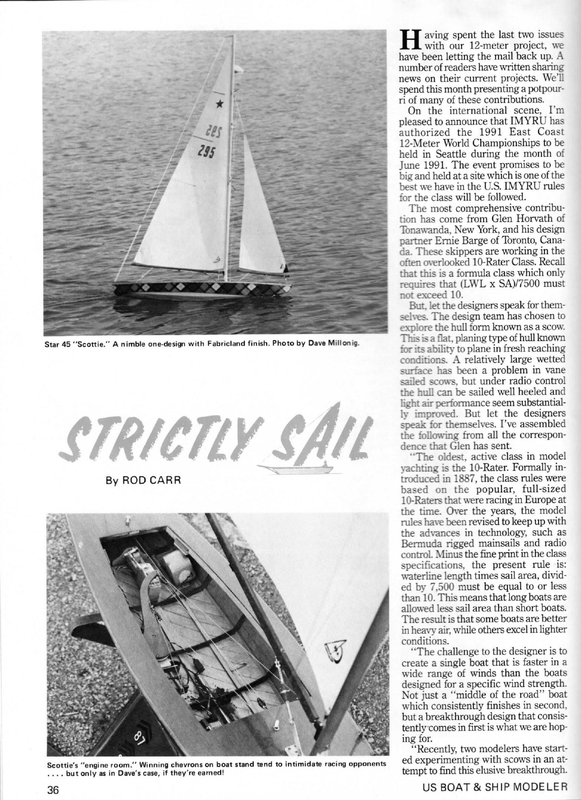
aving spent the last two issues with our 12-meter project, we have been letting the mail back up. A number of readers have written sharing news on their current projects. We’ll spend this month presenting a potpourri of many of these contributions. On the international scene, I’m pleased to announce that IMYRU has authorized the 1991 East Coast 12-Meter World Championships to be held in Seattle during the month of June 1991. The event promises to be Star 45 ‘‘Scottie.”” A nimble one-design with Fabricland finish. Photo by Dave Millonig. big and held at a site which is one of the best we have in the U.S. IMYRU rules for the class will be followed. The most comprehensive contribution has come from Glen Horvath of Tonawanda, New York, and his design partner Erie Barge of Toronto, Canada. These skippers are working in the often overlooked 10-Rater Class. Recall that this is a formula class which only requires that (LWL x SA)/7500 must not exceed 10. But, let the designers speak for themselves. The design team has chosen to explore the hull form known as a scow. known type of hullng isa flat, plani This for its ability to plane in fresh reaching conditions. A relatively large wetted surface has been a problem in vane sailed scows, but under radio control the hull can be sailed well heeled and light air performance seem substantially improved. But let the designers speak for themselves. I’ve assembled the following from all the correspondence that Glen has sent. “The oldest, active class in model yachting is the 10-Rater. Formally introduced in 1887, the class rules were based on the popular, full-sized 10-Raters that were racing in Europe at the time. Over the years, the model rules have been revised to keep up with the advances in technology, such as Bermuda rigged mainsails and radio control. Minus the fine print in the class specifications, the present rule is: waterline length times sail area, divided by 7,500 must be equal to or less than 10. This means that long boats are allowed less sail area than short boats. The result is that some boats are better in heavy air, while others excel in lighter By ROD CARR conditions. “The challenge to the designer is to create a single boat that is faster in a wide range of winds than the boats designed for a specific wind strength. Not just a “middle of the road” boat which consistently finishes in second, but a breakthrough design that consistently‘comes in first is what we are hoping for. 3a Scottie’s “engine room.’ Winning chevrons on boat stand tend to intimidate racing opponents …. but only as in Dave’s case, if they’re earned! 36 “Recently, two modelers have start- ed experimenting with scows in an attempt to find this elusive breakthrough. US BOAT & SHIP MODELER
Glenn Horvath’s scow 10R376 going to weather, shows how much waterline length she gains when needed. The American boat, designed by Glen Horvath, was launched in the fall of 1987. See Figure 1. The Canadian boat, slated for a spring launch in 1988, was designed by Ernie Barge. See Figure 2. “Glen’s boat used cold-molded construction. He stapled a first layer of 1/40-inch thick western red cedar to a ¢t Downwind in a stiff breeze, Horvath’s scow shows her ability to plane on an even keel. an athwartships direcvere stapled above the lity knife is used to cut t layer to release the the jig. (Photo 1.) The were laid diagonally at ) the centerline. The last situdinally and allows a vork finish on the hull. tact cement was used to d working time as the nd because it remains ent providing greater . Much of the stiffness rom the hard bilges, curves that make up the from a cambered formitransom, deck beams, pocket, the hull weighed in at three pounds, six ounces. Hull was Gienn shows off cold molded scow hull and &s building jig. FALL 1988 varnished inside and out, no cloth or resin was used for waterproofing or strength. “The Canadian scow was designed independently of the earlier American boat, but it incorporates many improvements which were indicated by the performance of the American boat. Glen’s scow is fast to weather over a wide range of wind, but downwind performance varies considerably. In winds over 15 mph, the boat lunges over its bow wave and planes the length of the pond in a manner similar to a water ski- er towed by a fast motor boat. Unfortunately, in lighter wind, the large proportion of wetted surface tends to hold the boat back. “The newer boat should be much better downwind due to several subtle improvements. The first is a reduction Glenn Finished American Scow with cedar planking; looks as good as it sails. Phot ‘o by Horvath. 37
MOTE: 4OJUST OMEN SION ae SO THAT CENTERLINE OF SERVO DEM PULLEY ARE SAME HEKGHT —— PULLEY SHAFT 3 or aa ———— ———; N piles acral HOLE TO SUIT |. TWICKNESS O8 LESS seeve Deut _ ee TO FIT OVER TRAY LOATE HOLES TO SW7 AFTER 4% DIMENSION A 7 (a: ia LODPTE HOLES TORN FOR MON TING RUDDER SERVO STO SWT ll wink SERVO IO ST Tear Ay | ee ibs: 5) | ee qa he So 2° WSIE “me =r = NOTE: MAY BE MADE BH. OR Lm oe j~— ah LADS METAL THANESS OR LESS N 3 FIG. in wetted surface gained by making the fin smaller, narrowing the beam by a half inch and softening the turn of the bilge (making the hull rounder in section). Still there is a lot of wetted surface in any scow, so Ernie has gone farther. By using lighter winches, batteries, spars, and hi-tech materials in constructing the boat, he has reduced displacement by 28 ounces to only 14.5 pounds. (Use of the Sail Area to Displacement ratio, SA/Disp., tells us how many square inches of sail area are pushing each pound of boat. This helps us assess how much power can be delivered to the hull by the rig. For Glen’s boat the ratio is 110.4 sq in/Ib; for Ernie’s 126.2 sq in/lb. The latter has a 14-percent relative power increase which is significant). “The bottom rocker (curve of the bottom centerline of the boat as seen in profile) has been reduced and a slight reduction in waterline length occurs, allowing the increased sail area. But won’t shorter waterline reduce windward heavy air performance (by limiting hull speed)? Not on a scow. The scow develops a longer effective water- Bob Olsen’s Robbe “Pirol’’ shows mainsail wrinkles. See text for Rod’s remedies. 38 line length when it heels. (Photo 2.) This is the reason for the wide bow and stern, as well as the flat bottom and long overhangs which are typical of scows. “While the Canadian scow is a step in the right direction, it is certainly not the last word in the development for the 10-Rater class. In the months to come, new boats will be designed based on the lessons learned from racing the two boats against each other and against conventional hulls. Ashley Marshall of Toronto has already started building. Hopefully, each new boat will be a little closer to the ultimate 10-Rater, the one that wins all the time. The designers have released the designs as published here in USB&SM. You are free to copy and use them for your own experiments. They acknowledge their debt to Howard Chapelle, and to Starling Burgess and his 1902 Tom Johnson’s all-in-one winch and rudder servo tray for EC-12 No. 1025. Plan for construction of sheet aluminum shown above. US BOAT & SHIP MODELER
Sleek Amy O/D hull can be planked with balsa, or fiberglass hulls are available. Tom Houle pic. most venerable of these publications, scow Outlook. If you would like to have the Minuteman MYC. (Check the full-size blue line drawings for either AMYA listing for addresses.) This is boat, send $10 to Glen Horvath, 62 St. one certain way to increase the informaAmelia Drive, Tonawanda, New York tion flow to your club. Reproduction of 14150; (716) 834-5249. articles from other newsletters is taken Please give Glen and Ernie a standas the sincerest form of flattery as long ing round of applause for their willingas credit for the source is clearly given. ness to share all the above with us. I I just saw something that I received wish more people in our sport would from Graham Bantock in England get stop thinking that they are going to which has found its way into fourth rich from selling some hull form, or generation usage here in the US. It some good idea. You’ll get richer by seems to me that if you trade with 10 sharing your creation and harvesting a other clubs, you only have to generate whole crop of new friends from across 10-percent original material each the country who love the same hobby as Anyway, if you would like to month. you. Tom Johnson of 2652 Yalonda Court, Beavercreek, Ohio 45385, (513) 426- trade your monthly newsletter for the GSMYC version, deal directly with me. For the other club mentioned, deal with the AMYA-listed Contact Person. ARGYLE 45 CLASS? David Millonig of the Oxford Port Tackers shares his one-of-a-kind Star 45 called ‘Scottie’. Originally scheduled to be called ‘Miss Paisley,” either there was no paisley loud enough or scotch plaid was on sale the day David went to Fabricland. His description of this unique approach to hull finishing follows: “Be sure to iron the cloth flat and spend the extra two bucks to buy 5844, provides us with a super efficient radio board design. The photo shows the board with drum winch, radio, batteries, and servo already for installation in Tom’s East Coast 12 Meter. The compact size means that one radio can go into many different classes of boats if you happen to sail in more than one class. Figure 3 provides guidance for construction. Tom says most of his local club members are using them. You should contact him to see if they are available from him or a local source. Thanks, Tom, the drawing was excellent! CLUB NEWSLETTERS My local club, the Greater Seattle Model Yacht Club (GSMYC), has begun to trade our monthly newsletter with other clubs. So far we deal with Gig Harbor MYC, Greater New Orleans MYC, Oxford Port Tackers, Oregon Model Yacht Club, and possibly the FALL 1988 Plans are available for scratch-building this Amy one-design. Photo by Tom Houle. 39
enough fabric so that the patterns can match on both sides of the hull. Remember that the cloth has a right and a wrong side and you may waste quite a bit getting it exactly right. Since Star nules presently call for either fiberglass or 1/16-inch plywood, I used 1/32-inch ply and two layers of resinimpregnated cloth to meet the fiberglass requirement. Cloth weight isn’t too important, but it shouldn’t be heavy wool because it must be saturated with resin. (I thought the Kiwi’s used wool—rc) I would guess that any resin will work, but I used Epon 828 with a Versimid-40 catalyst. You can probably translate this ‘people boat’ clear epoxy FOR PRINTING FIN SHORTENED to a modeling supply. Be sure to use enough resin to fill the weave in the cloth without floating it. Too little, and it will take a number of coats of clear lacquer equal to the national debt to fill it. When you finish the job, you will have a hull with a finished weight equal | ~ MAST AREA G9 sesh ‘RATING 9.9866 .SAIL AREA 1794 sain. jLOA 65” LWL 41.75″ BEAM 15″ ‘DRAUGHT 2 0″ DISP. 16.25 LBS. | DESIGNED BY GLEN HORVAT! \TEN-RATER MODEL YACHT FIG.1 L —| | L \o ee | to a fiberglass Ozmun Design boat.” Note in one photo the clean condition of Scottie’s bilges. The long Star 45 main boom requires a double purchase has ol unit which the sail contr arm from been mounted on the starboard side rather than on the centerline. Aft of the boom vang, on the centerline of the deck where a sheet can’t snag it, is a cutoff switch for the R/C system. It is off the able to turn nt enie to be very conv radio between races, or during delays without having to unseal the hatch, especially if the day is damp. 45 Class is wrestling witha The Star revision of its class specifications. If you have concerns, you should contact the class secretary and members of the mules committee to give them your input. Tom Houle of Mequon, Wisconsin, responded to my request for pictures of the different AMYA classes by sending in two photos of the AMY One Design. Plans and instructions are available from the Open Class Secretary, Bud Salika, 3917 Sunnyside Ave., Brookfield, Illinois 60513; (312)485-5712. The boat is presently being registered into the Open Class while growing toward a 20-boat minimum required by AMYA for class status. At 64 inches LOA itis slightly longer than an EC/12, but smaller than the typical 10-Rater, Aboat, or Santa Barbara. Displacement is in the 17 to 18-pound range. The keel bulb is about 10 pounds, giving a ballast/displacement ratio of 0.56 to 0.59. Should be plenty stiff in a breeze. This boat can be built by planking with balsa over frames, and the directions provided are just right for a beginner. I believe a mold exists and fiberglass hulls would seem to be available. Ask Bud. Were I to jump into the class, I’d US BOAT & SHIP MODELER
hope to do as good a job on the hull as Tom has done, though I might go for an / 123457 get a good shot, and remember to fill the frame (Well, almost. We need some space between subject andframe for composing layouts. wen). Decide ahead of time if you are featuring the hull, the sails, or what the water is doing and expose for that part of the picture. Properly exposed sails will usually leave the hull quite dark; proper hull and/or water exposure will over expose the sails leaving them white and featureless. Only experience will tell. But in this hobby one picture is worth a thousand words. A clear shot of your boat, frozen in time, is something you can study to try to improve its performance. Is the jib stay sagging? Hold aruler up to the picture. OFFSET 20° ORT & STBD RUDDERS yi j / FIN SHORTENED | | 5 FOR PRINTING \\ 7 / WS. He 79101 12I5 T 4 t ‘ | ! || || STATIONS G28 omiTTED LW = a elliptical rudder to avoid the dragproducing vortex that the barn door variety is reported to cause. It looks as if the keel can be dismounted for traveling; can you confirm that, Tom? What method do you use to hold it in place? Thanks to all the skippers who have contributed to this column. I have been able to use virtually everything sent, with the exception of some photos that were either too dark or the boat was too far away. Count on using a roll of film to 3 2 7/ +$—_] \ Is the mast bending? Hold the ruler up to it. The photo allows you the chance to focus on each visible part of the boat. The more photos, the better chance ay ———— | \| is MAST AREA 53 V fe wrinkles along the luff. 2. Adjust the luff tension with the FALL 1988 will remove the other half of the ee 9,98 RATING DISP. SAIL AREA BEAM 14.5” DRAUGHT 20” 14.5 ces. ISO saw. wrinkles. LWL 40.9″ | TEN-RATER MODEL YACHT] DESIGNED BY ERNIE BARGE LoA 60″ a 13 | downhaul or halyard. This adjustment |ion | of Bullhead City, Arizona. Frozen for posterity and exposed to show good detail in the sails, we see the problems which can be caused in very high aspect ratio mainsails. Based on this single picture, Bob could set about to do the following to improve the smoothness and 1. Check to confirm that the mast is absolutely straight. It looks like it is bowed aft by the backstay which has slacked the leech of the sail. This bow has probably caused about half of the | / the Robbe “‘Pirol”’ owned by Bob Olsen shape of his mainsail: | a you’ll have to decide what corrections need to be made. As an example, check the photo of 3. Confirm that the mainsail clew can’t lift off the boom. A single line led to the clew grommet is not sufficient; it allows the clew to lift. A loop of line tied round the boom and grommet constrains the clew to move in or out on the boom only. maker and look for either some lighter 4. If the wrinkles persist or if a smooth camber (like we can see in the jib) cannot be obtained, call your sail- weight cloth or go to a paneled mylar 41
Along those same thoughts, now is Ask Jon Elmaleh how well he likes his Nautical Commander. He should know it inside and out since he helped develop it… and also won the European and U.S. Marblehead class championship with it! No longer do you, the boater, have to settle for a radio that has a stick configuration designed to fly a plane or drive acar. Now you can have a system that is configured in a mechanical setup that is compatible with your requirements as a boater: twin vertical sticks for throttles/ sails and a single horizontal stick for rudder. More importantly, you have the utmost in quality and dependability of operation. The system’s RF link descends from the Ace Silver Seven, long recognized as one of the most trouble free systems available today. Would you want to trust your boat to anything else? Five proportional channels (three on the sticks and two on auxiliary levers) are available, four of which have servo reversing switches. Sanyo ni-cds throughout with dual charger. A user installed Dual Rate is available for rudder function. Less Servos, Connectors to suit available Jon Elmaleh won the European and U.S. Marblehead Championships using our Nautical Complete Catalog $2.00 Commander!! not too soon to consider saving design materials from some of our early designers. The Marblehead Class started here in 1930, and active formula class designers used to travel all the way to Europe to compete. I believe that AMYA needs a historian and should fund the postage and reproduction costs of ferreting out, gathering, and protecting these important materials. Any response, AMYA? Remember to send in your $20 annual dues to the American Model Yachting Association, c/o Pat Hein, 1884 Campus Court, Rochester Hills, Michigan 48309. Gene Dunham’s AMYA Quarterly Newsletter just keeps getting better and better and provides 60 to 70 pages of yachting information in each issue including regatta reports, Class Secretary columns, technical information, photos, and advertisements from suppliers of fittings, sails, hulls, and R/C gear. Send your contributions and/or questions directly to me: Rod Carr, 3011-177th Ave., NE, Redmond, Washington 98052, but don’t call at dinner time (6:00 to 7:30 p.m. PDT) or you’ll incur the wrath of she who is “Mistress of the Blue Horizon.’ e ie ee Light Speed .. Continued from page 20 2. K&B Manufacturing, 12152 South Woodworth Ave., Downey, California 90241. 3. Satellite City, P. O. Box 836, Simi Valley, California 93062. 4. G & M Models, P. O. Box 342, Broadview, Illinois 60153. 5. Hobby Dynamics Distributing, 513 Curtis Rd., Champaign, Illinois 61820; (800)458-0241. SEE YOUR DEALER FIRST! If he can’t help you then you order direct from us by sending the full price plus $2.00 handling fee to: Ace RIC 116 w. 19th St. P.O.Box 511H6, Higginsville MO 64037 or call (816) 584-7121 sail cut specifically for the mast height. Good photo, Bob. It really focuses us on the specific problem in a way that simply can’t be accomplished while the boat is sailing. If you have an interest in the history and beginnings of model yachting, consider joining the MYA Vintage Group. This is headed by my colleague Russel Potts, 8, Sherard Road, Eltham, London SE9 6EP. He has in preparation a catalog of about 400 plans of vintage models including some as far back as 1852 and 1863, but starting about 1884 ina comprehensive way. If you contact him, inquire about his excellent mono42 graph 100 Years of the 10-Rater Rule. It should be in any serious yachtsman’s library. Also with the Europeans, Chris Jackson, editor of the quarterly Model Yachting News, has made it easy to obtain a subscription. Simply send a $20 bill to Chris Jackson, c/o Model Yachting News, 33 Yorke Gardens, Reigate RH2 9HQ, England. This quarterly is full of design information, with lots of photographs of top competition boats from the European countries. Plans and supplies are prominently featured, and there is even a column in each issue about the East Coast 12-Meter! 6. Prather Products, Inc., 1660 Ravenna Ave., Wilmington, California 90744. 7. Teague Model Marine Products, 8027 Genesta Ave., Van Nuys, California 91406. 8. Octura Models, 7351 N. Hamlin Ave., Skokie, Illinois 60076. e Continued from page 21 things. However, a truth is that “in numbers there is strength,” and I can’t help but believe that a single, more unified model boating group would not benefit all of its members. Amen! RADIO EQUIPMENT DEVELOPMENTS There have been many R/C equipment developments in recent years, and it can be a confusing thing, especially since there is little standardization in terminology. We’ll stay with the basics and, wherever possible, point out other terms you may run into which mean the US BOAT & SHIP MODELER
KyOSHo P R O D U C T S U R V E Y: By BILL NORTHROP… RADIO 1-2 CHANNEL (NOT INCLUDED) TECHNICAL DATA * LENGTH – 900mm (35.4 in.) * WIDTH – 255mm (8.9 in.) * HEIGHT (KEEL TO MAST) 1560mm (61.4 in.) * TOTAL WEIGHT – 3600-4200 g. (127-148 02.) * SAILAREA – 38.1 dm2 (5990 sq. in.) ] t’s kind of interesting to realize that only about twenty years have passed since possibly the first article ever appeared in a nationally distributed magazine about radio controlled model sailing yachts. Up to that time there were only scattered reports of efforts to control sailboats by radio, and those usually concerned the use of directional control only. In the middle to late 50’s, most all modelers involved with radio control had only one control function available, and that was by an escapement powered by a twisted loop of rubber strand. This worked fine in the model aircraft of the day, as the air loads imposed by the small rudder surface area and the slow flying speed of the aircraft were minimal. The development of electric motorpowered servos a few years later solved the problem of moving a boat rudder in the more solid surroundings of water. Next came the multi-function radio s tem, which allowed two or more c trols to be used, and better than that, to use them simultaneously! Finally, in the early 60’s, came the biggest step in the progress of radio controlled modeling; multiple frequencies, which allowed more than one model at a time to be operated at a common site. As has been said many times, the fun of operating a radio controlled model all alone wears thin after a while, but when two or more models and modelers get together, the fun and strategy of competition becomes limitless. What does all this have to do with a product survey of the Kyosho ‘‘Fairwind” R/C sailing yacht, available through Great Planes Model Distributing? Mostly we’re trying to give newcomers to the hobby the opportunity to Rudder shaft tube and support epoxied into place. Rough up plastic for good adhesion. Fine bird-shot lead ballast poured into keel, followed by liberal dose of white glue. 44 lly appreciate what they can ith radio control at the flick of and the wiggle of a stick, bee development of R/C led to the nent of high quality, easy-todels such as the Fairwind. h it is a scale-like model not | racing competition, the fits into the AMYA 36/600 with a length of 35.4 inches and a of 590 sq. inches. The beam ches, the overall height from | to mast tip is 61.4 inches, and the approximate weight (displacement) is eight and three-quarter pounds (de- be Plywood servo tray and hatch support epox- ied in place . . after waterproofing, US BOAT & SHIP MODELER
Finished Fairwind, with Robbe “Atlantis’’ and Aristocraft “America’s Cup’ under construct- ion. Not shown is Pop-Up 12-meter Phase I1, another project in the model shipyard. The completed Kyosho ‘’Fairwind’’ ready for its first shakedown cruise. Servo/radio tray built from clean die-cut ply. Sail servo mount (left) not required if Airtronics 94581 servo is used. Just starting to come about from starboard to port tack. pending on radio equipment and amount of lead ballast used). The kit includes a one-piece, blow-molded ABS resin hull, a molded hatch cover which includes the cockpit, two-piece extruded aluminum mast, aluminum main and jib booms, materials for building the Radio gear bolted or strapped in place. No vibration damping needed! work/storage stand, pre-sewn main and jib sails of lightweight rip-stop nylon, metal and molded plastic deck trim and hardware, rigging line and fittings, prefabricated bow and stern pipe rails, radio installation hardware, trim decals (no painting necessary), and a sixteen page illustrated instruction booklet. Everything is there but the radio equipment, glue, and a few hand tools… whoops. . .and a five-pound bag of fine buckshot (tiny lead pellets found at your local gun shop). The least expensive radio required for the Fairwind, which must be on a Surface Frequency (27 or 75 MHz), would be a dry battery-powered twochannel system with one servo for rudder (an idle R/C car wheel-type radio Continued on page 68 sere b Preformed wire bow and stern rail ends inserte: molded plastic feet, which are screwed to deck. Black elastic cord for life line is very practical. White cord can be substituted. Note lightweight rip-stop sail material. We’ll relocate jib sheet attachment for better control of jib. FALL 1988 45
PORTABLE PIT STOP. THE ALL PURPOSE SHELTER THAT YOU CAN PUT UP OR TAKE DOWN IN SECONDS. Whether your pit stop is at the track, park, beach or even in your own back yard, E-Z UP” shelters are the answer. No tools needed. Free standing. They are super light weight and self contained. Standard 10’ x 15! red or blue, $449.95. Assorted sizes, colors and lettering also available. MARTEL BROTHERS w & s RACING PRODUCTS H t P oO A Ul L 4 Call toll free today. 1800-882-RACE 5331 Little John, Katy, Texas 77449 or 2902 Alvarado Sq., Baltimore, Maryland 21234 MasterCard, VISA, Money Order, Certified Check, C.0.D. Accepted HAYES WHIP ANTENNA | | | Vertical whip any |replaces antenna /receiver 18 or 36-inch antenna for R/C cars and boats. Connec tors, vertical and horizontal mounts and safety ball all | included. Stainless spring steel whip only 1/32) diameter for minimum wind resistance. pag ioar ot ot =a HAYES PRODUCTS 14325 Commerce Wy. Garden Grove, CA 92643 68 If you want to go one step further, remove the engine and take off the back plate. Squirt more oil in the motor around the bearings while rotating it. If you aren’t going to run the motor for three to four weeks or longer, I would suggest removing the front case (containing the bearings) and leave it soaking in a dish of oil. Many people have different philosophies on types of oils to use. I like to use good old WD-40 to clean the motor out because it will help remove the water. I then use Marvel Mystery oil for shortand long-term after-run maintenance. Salt water is an even greater enemy of engine bearings. See USB&SM Winter 1987 issue for information on eaintenance I water ee The effects of bad bearings on engine performance can be mystifying. Usually a good indication of bad bearings is the engine acting like it’s running lean for no good reason. To find a bad bearing, it is necessary to be very patient, rotating the motor slowly and feeling for any rough spots. If it is determined that you have bad bearings, it is important that they be replaced properly. If you don’t have the proper tools to remove and press the bearings into the case, you should have someone else do it or replace the entire front end with bearings and crankshaft installed by the factory. Ifa ball bearing is mistreated by hammering or getting jammed crooked in the case, the hardening on the balls and race can chip, and the bearings won’t last more than a few runs. The engine is only one part of your boat that must be maintained to provide reliable operation. The fuel system can also cause problems if not set up or maintained properly. Be sure the fuel pick up and vent are in the proper place to work when gforces throw the fuel around in the tank. Don’t bend them too much as to cause a kink or split. Check the tank stopper periodically for tightness and leaks. Silicone fuel tubing can sometimes have pinholes or cks. I always use a fuel filter between the tank and carburetor. f possible, use exhaust pressure to el tank for a better fuel delivery. ) keep the fuel tank as close as pose to the carburetor and use the force oat thrust to push the fuel from the to the carburetor. uel can also upset the apple cart. ethane can draw moisture right the air. The result is a white y substance in the bottom of your fuel container. Keep a tight lid on your fuel when you are not using it. Your boat’s drive shaft system should also be cared for to prevent rust. If you use an adjustable strut with needle bearings, you should squirt grease into its housing, forcing the water out between runs. A small grease gun witha pointed tip works well for this. I use a Lincoln Lubrigun Model 5912. A solid shaft’s stuffing box should also be packed with grease. If you have a flex shaft, remove it after every day of running and coat it with waterproof grease. Servo arms, ball links, and steering linkages can also get worn out and should be replaced when too much slop is encountered. With a routine system of after-run maintenance, your engine will provide you with many hours of enjoyment. If you have any problems or questions, write me a letter. Please include a self-addressed, stamped envelope. David Frank, 8907-34th Ave. So., Tacoma, Washington 98409. Let me know how those David Frank e Sport 40s are doing! SSNS Ns EO TS Fairwind….. Continued from page 45 will do). Next best would be a twochannel, two-stick radio with one regular servo for rudder and a special sail servo for control of the sails (hauling in or letting out). Both Futaba and Airtronics offer inexpensive radios of this US BOAT & SHIP MODELER
S t=, type. Obviously, more expensive and fancier radios may be used, requiring no more than two channels, but they must be on a surface frequency, and you’ll still have to invest in that sail servo. The power and amount of travel re- 4 ” Wy servo. Construction begins with assembly of the stand. You may be tempted to skip the stand at the moment and get on waterproof it. Admittedly, I often found it more convenient to rest the hull on my knees while working on it, but then not mentioned, these and all other ply- fore installation. A couple of coats of dope should do it. It’s also not mentioned that where you epoxy plywood to the inside of the hull, the plastic surface should be roughed up with course sand- paper at the points of contact, for better adhesion. Incidentally, after many years experience fighting the removal of parts from a die-cut sheet of plywood, we feel qualified to state that the diecutting by Kyosho rates a solid 10, not only for ease of removal but also for accuracy of fit. As suggested, the lead ballast should be added before installing a brace that partially blocks access to the hollow keel. We used fine buckshot, and it’s really the best as it’s almost like pouring molten lead, without the heat (!), and it packs solidly and conforms to the shape of the hollow keel. Squeeze in a large stream of aliphatic glue after pouring the shot and stir it into the shot with a long skinny stick. We’d suggest holding back about 12 ounces from the recommended quantity, then trim your boat later when you’ve had a chance to sail it. The additional ballast can be sealed in a small plastic zip bag and wiggled into the keel past the plywood brace. This way you can add or deduct ballast as you see fit. It would be tough FALL 1988 = : — ” ” (a ” >| | Ay ay fh th ih f) Flash on the molded hull centerline is wood parts should be waterproofed be- 6 i) fh) large flat areas, such as the foredeck and transom, the long blade of our thinner Swedish army knife, carefully sharpened, did a better job without digging into the hull. Next, the plywood reinforcement pieces are epoxied in place. Though it’s ‘ | is removed using a model knife. For the ° (| when the phone rings or nature calls . .. You should also soak the ends of the cloth straps with thin cyanoacrylate to prevent them from unraveling. DID IN ALL OF WORLD WAR II! () | {pa () f) f a ” e . oY J ” : High Performance, Twin Engine, Conversi on 0 Packages with Speed Control for LIND BERG ” PRODUCTS and DUMAS Model Boat Kits of “PT-109” @ (201) 870-2966 ” For further information send $2. for complete catalog to: M.A.C.K. Products Model Marine P.O. Box 464 Long Branch, N.J. 07740 DEALER Inquiries INVITED! © ¢ A ee «6b to remove once glued in place. The radio tray is built from the previ- ously mentioned die-cut plywood sheet. Decide if and what kind of sail servo will be used before you complete the tray. If for instance, you use the Airtronics 94581 sail servo, you won’t need the servo mounting pieces provided. The radio installation itself is well explained and illustrated, and quite easy, using the hardware provided. With no vibration and hard knocks to contend with, the radio stuff is simply strapped down with rubber bands…except for the servos, of course. Couple more things about the radio installation. As the large hatch (which includes the cockpit area) has a water- A with a molded soft rubber switch cover. The switch is mounted ona designated portion of the fixed deck, outside, and the rubber cover is bolted on with the Mfgr’s. of Quality Brass ship and yacht model fittings. Scratch build a competitive R/C model yacht in the 36/ 600, 1 meter, 50/800 or i0 Rater class. Kits of Great Lakes and ocean going vessels. Plans & books proof seal, and is held in place with two bolts, it is inconvenient when sailing to access the on-off switch if mounted inside the hull. Kyosho has solved this mounting screws. Neat! The receiver antenna is supposed to be taped around the perimeter of the hatch opening, just under the deck. This means the antenna is located in a horizontal plane about three inches above the water surface. No thanks! This may be okay for swimming pool J 2 2 FISHER INC 5 2 ILLUSTRATED CATALOG $2.00 1002 Etowah Ave. Royal Oak, Mich. 48067 , y) you start sailing the boat and returning the wet hull to the stand, you should @ (0 the boat. Now or later, especially before : PRODUCTS HAS POWERED MORE PT iL) with the boat, but don’t. It only takes a excellent “third and fourth hands” while working on the construction of IN ONE YEAR M.A.C.K. BOATSTHANTHEUS.G OVERNMENT quired are beyond the scope of the normal steering or control surface few minutes to assemble, and provides “=,” _=_ = =
DeeenRi EnEFINED c.. | _2. PERFORMANCE REDEFINED E Ii SHOCK WAVCLASS | SPARTAN GRAND PRIX 45 SPORT p> Joined Deck & One Piece Cowl p> Engine Bearers Drilled & Positioned For 4” Mount p> Kit includes Decals Shown this out for us). p> Uses Hardware Set #69 Unlike all-out competition model sailboats, the Fairwind carries deck detail Manufacturer of Precision Quality Cable Nuts & Tuned Pipes. Send $1.00 For Catalog STEW MUCIK’S ric Boats 6003 Daven Oaks Dr. U.S. NAMBA NATIONAL WINNER 214-380-9274 Dallas, TX 75248 match up exactly with the hole spacing. Drill one hole, plug in or screw down the item, then mark the locations for INSTANT EXPERT — -—— Weso-Nes 2 56 MINUTE VHS MODEL CONSTRUCTION TAPE – SPECIAL COUPON – “If we had seen this tape $30.00 Gets you-VIDEO-TIPS 2 earlier, “HOT STUFF”TM could have saved us_another 90Lbs. Voyager” Plus 1ea. FREE Dick Rutan $15.40 Pilots: Dick Rutan & Jeana Yeager 1oz. _ SPECIALTTM SUPER’TTM oz. KICK-ITTM oz. “VIDEO-TIPS # 2” IS A BUILDING SESSION, NOT A LECTURE. Instant ConstructionTechniques – Building Tips- See a TOP-FLITE “Hot Kanary” built from start to finish, then crashed purposely to demonstrate bond strength. Send the Coupon & $30.00 Check or M.O. j Lees Satellite j City Simi Vv Valley P.O. B ce Gat, , Een “Qs RIL AG) CeBAT PLANS For C.0.D. Orders Call 522-0062 (805) ‘ $19.50 PLANS guess EDGE }—_1_7 __1__ TS PROODUC Commutator & Brush Cleaner & Skill level ||Batteries for R/C nome __ s Cars & USS NewOrleans class…. Intermediate ||boot USS Pensacala class… ….Beginner || Bilge pump (less USS Chester class..(best* Beginner || motor}…51Z00 _ Intermediate || Single Shot Mini- HMS Exeter… FN Alge rie. Ps ella Gun…… $68.00 DKM Litzow………best). ® Beginner \\ 1JN NocWv. class ……..datermediate roe scales pata JIN Aabo. class …… $2300 PLANS Soft medal fitti Aavanced)| ing 114 4. IDKM Prinz Eugen….. ..datermeoiate (Serving combatants \__since 960 uss Alabamo…………..datermediate AMARILLO SCALE WARSHIP al/ plans 5 LINCOLN. véase nce $3.50 1204 for First Coss (28) AMAPILLO,TEXAS. 7910/ 1-806-372-6202 sailing, but it would make this old-time R/Cer, no matter how good the radio, very nervous to sail the boat out in open water and very far from the transmitter! After the first sailing photos were taken, we drilled a hole in the deck just big enough for the antenna lead, near the starboard side plate, fished the antenna through the hole after tying an anti-strain knot for slack to the receiver, and ran that sucker up one of the dac- ron shroud lines! The Grommet Riddle. Three grom70 drilling the other holes. Lifelines for the Fairwind are black elastic cord. Different, certainly, as all lifelines we’ve ever seen are white plastic coated stainless steel. It’s easy enough to obtain white elastic cord if you want to be conventional. The cord sags when it gets wet, but tightens again when dry, and when working around the model or digging into the R/C compartment, the elastic feature is very accommodating. 1/144 (“12”) SCALE. PLANS!S jem SUPPLIES CATALOG $2.50 to give it a more scale-like appearance; winches, handrails, fore and aft piperail, stanchions, and safety lines. Hole locations for all items that fasten to the deck and cockpit area are molded into the hull. Check each item to be installed be- fore drilling holes, as they may not “HOT STUFF” onthe through the deck for the main and jib sheets, it’s hardly that critical. (Why “sheets?” Don’t really know. They’re the hunk of rope, or line, that you pull or release to pull in or let out the sails, which is sometimes referred to as “sheeting in’ or “‘sheeting out’. . .so there we go again! I’m sure some of our rag sailor readers will staighten [iron?] ‘” al] Increase your RPM High performance cars, parts, stock and modified motors available. _Call (§Q5) 324-1090 Price $495 plus .75¢ S&H to Edge Products 2520 H Street, Suite D -:- Bakersfield, CA 93301 Dealer Inquiries Welcome mets are called for during construction. You are supplied two each long grom- mets, and two each short grommets. The instructions aren’t clear when you come to the first one to use. It just says “‘Grommet (Plastic). Well, all four are plastic! By reading ahead, I found the callouts for the other two . They are specified as ‘“Grommet (S).” “S” for ‘Short,’ I hope, because that’s what I decided. So now I have one spare Grommet (Plastic). Actually, I’m just having fun. In their use as guides When it comes to rigging the boat, a single length of woven dacron line is supplied. There’s more than enough, but not knowing this for sure at the beginning, we measured off each of the prescribed lengths, and marked them with orange crayon instead of cutting, until we knew for sure that we had enough. Also, if you’re going to use a sail servo, and the instructions don’t mention this until later, don’t cut lines according to Step 21, as these are for hand-setting of the sails, and will have to be discarded in favor of longer lines… .whoops…sheets when you make the sail servo installation. (Like they almost always say, it pays to read all the way through the instructions before taking certain steps!) With the mast stepped in the center of three positions, we went out for the first shakedown cruise. It only took a few minutes to realize that more ballast was needed. Although the sail servo added five ounces, it is located on the radio tray, not down in the keel, so we were heeling pretty badly and showing alee helm during gusts. Twelve ounces of ballast were added, which improved the stability, though we are still inclined to add a bit more. As yet we haven’t restepped the mast to the more aft position in order to adjust for the lee helm. Also we found that there is sufficient trim on the rudder control to hold a US BOAT & SHIP MODELER
steady course without having to hold the stick off-center, thus freeing both hands to take several action photos. Our next revision will be to move the sheet attach points to directly over the exit guides. For both the jib and the main, this will shorten the distance from the pivot point, which will give us more travel for the amount of servo movement available. It will also increase the load on the sail servo, but indications are that the Airtronics servo has much more than enough strength to handle the job. The Kyosho ‘“‘Fairwind”’ is a very realistic sailboat both in performance and appearance, and you can get it from the kit box to the pond in just a few enjoyable hours of work. If it’s your first R/C sailboat, you’ll find it a great introduction to a fascinating and truly relaxing part of the hobby. Yes, Martha, you can sail upwind. It’s sorta like doing a zig-zag stitch on your sewing machine… NEW 12 METER UPDATE PHASE 2 HULL 60”, HEIGHT 0.A. 88” WEIGHT 25#. KIT $444.90 COMPLETE, LESS RADIO. SHIPPING AND HANDLING EXTRA. See inventory in price list. HULL: Finished in blue gel coat $150.00. KEEL: unfinished $75.00 : Continued from page 28 superstructure is very simple. The main deck is medium balsa, but the remainder of the superstructure should be very soft balsa. This will add to the model’s stability somewhat. MAIN DECK The main deck is assembled with four pieces of sheet balsa, butt-joined securely. When cutting the deck to shape, be certain that the center rectangular opening fits the coaming snugly, not loose or too tight. Apply two coats of sealer to the top and bottom of the main deck and sandpaper lightly. UPPER DECK The upper deck is also assembled with four pieces of sheet balsa. Cut to shape and sandpaper smooth but do not round off the deck edges yet. Apply one liberal coat of seal to the top and bottom of the upper deck. MAIN DECK SIDES The sides must be assembled with several pieces of sheet balsa, butt-joined together, because the grain must run vertically for strength and in order to bend and follow the curvature of the upper deck. Cement the main deck sides to the bottom of the upper deck at the edge as shown on the drawings. Hold in FALL 1988 85’—$15.95 8 for $108.00 > NO SNAG BLOCKS NG $4.00 each ; SEND $3.00 For catalog and prices, get 14 how-to plans worth $7 free, to: POP UP Oh, that first article on R/C sailboats about twenty years ago? It was by Tom Protheroe and his design, the “Santa Barbara,’ written before he sold the rights to Vortex. The article was solicited by this writer, who was then Managing Editor of the vintage MAN magazine, under publisher Walt Schroder. Little did we realize at the time how popular R/C sailing yachts would become. ° MASTS: Alum. 72” $13.95, 8 for $92.00 27 Emerson Ave., AMITYVILLE, NY. 11701. (516) 842-9309. USE VISA, M.O. MASTER CHARGE, MINIMUM ORDER $10. MINIMUM SHIPPING $2. place with pins. Re-cement the joint at the inside edges. Apply a coat of sealer to the inner surface of the main deck sides. Now mark the proper location of the main deck sides on the main deck, following the plans. Cement the main deck sides in place on the main deck and hold with pins until cement is dry. Apply more cement to this joint at the inside edges using a long strip of wood to apply the cement. UPPER DECK SIDES Unlike the main deck sides, which are open at the ends, the upper deck sides run all around as a continuous enclosure. Grain must run vertically, therefore the sides must be made up of butt-joined sheet balsa. The sides are best installed in sections; two sides and two ends. Mark off the location of the upper deck sides onto the upper deck. Cement the side sections to the deck, holding in place with pins. Steam the assembled ends into the proper curve and fit in place, trimming here and there as required. Cement the ends to the sides and to the upper deck, holding in place with pins. Re-cement the inner edges of this joint and sandpaper the outer surface of the upper deck sides. Apply sealer to the upper deck sides inside and outside and sand gently. OR CHECK. SHADE DECK The shade deck is assembled from four pieces of sheet balsa. Taper the edges of the deck all around as shown on the drawings. Apply a coat of sealer on both sides of the deck and sandpaper smooth. Mark off the upper deck side location onto the underside of the shade deck and cement the deck in place on the upper deck side. FITTING THE SUPERSTRUCTURE Fit the superstructure to the hull by placing the main deck opening over the coaming. Fit must be snug but not tight. With the superstructure in place, the outline of the main deck is traced onto the hull overhang. Remove the superstructure and cut the hull overhang to shape. Replace the superstructure and sandpaper both decks together using a sandpaper block, held in a vertical position, to insure a vertical edge and identical contours for both deck and overhang. The side edge of the upper deck is now sandpapered flush with the main deck side and rounded off as shown in the typical section view. Do not round off the ends of the upper deck because they must remain vertical. Seal and paint the shaped edge of the hull overhang. SEALING THE 71