- Title. Author. Summary

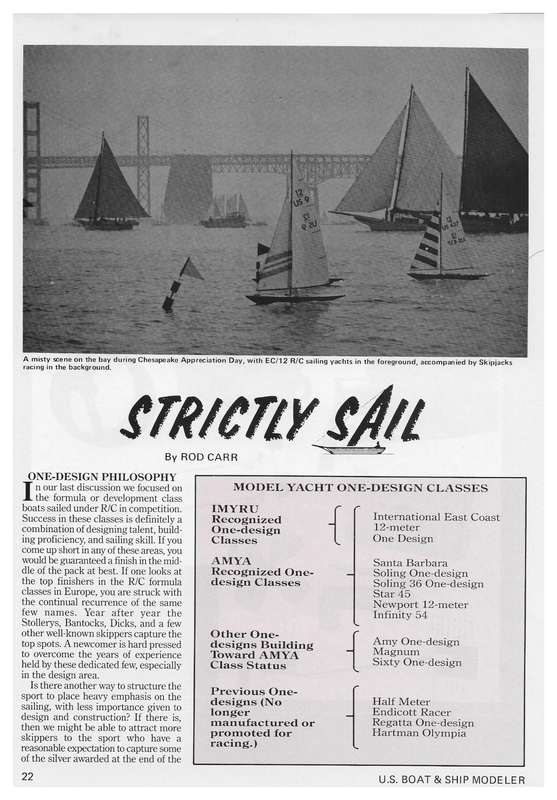
A misty scene on the bay during Chesapeake Appreciation Day, with EC/12 R/C sailing yachts in the foreground, accompanied by Skipjacks racing in the background, By ONE-DESIGN PHILOSOPHY n our last discussion we focused on ROD CARR MODEL YACHT ONE-DESIGN CLASSES the formula or development class boats sailed under R/C in competition. Success in these classes is definitely a Roch cnived International East Coast ing proficiency, and sailing skill. If you Classes One Design AMYA Recognized Onedesign Classes Santa Barbara Soling One-design combination of designing talent, build- come up short in any of these areas, you would be guaranteed a finish in the mid- dle of the pack at best. If one looks at the top finishers in the R/C formula classes in Europe, you are struck with the continual recurrence of the same few names. Year after year the Stollerys, Bantocks, Dicks, and a few other well-known skippers capture the top spots. A newcomer is hard pressed to overcome the years of experience held by these dedicated few, especially in the design area. Is there another way to structure the sport to place heavy emphasis on the sailing, with less importance given to design and construction? If there is, then we might be able to attract more skippers to the sport who have a reasonable expectation to capture some of the silver awarded at the end of the 22 One-design Other One- 12-meter Soling 36 One-design Star 45 Newport 12-meter Infinity 54 designs Building ny Cae dee Class Status Sixty One-design Toward AMYA Previous Onedesigns (No longer manufactured or promoted for racing.) ees men: | Half Meter Endicott Racer Regatta One-design Hartman Olympia U.S. BOAT & SHIP MODELER
regatta, and do it without spending 15 years in preparation. Of course, the so- lution is to put all skippers at the helm of boats which are all just alike. If the boats are “‘all alike’ (and we will discuss what this should mean later), then the skill with which the boat is sailed should be the controlling factor in competition success. So far so good. We can now bring new skippers into the game. All they have to do is learn how to sail, and then they should be competitive. This is just what happens, with one caveat. By each of us sailing a boat just like his fellow’s, the responsibility for performance is assigned directly to the skipper. Trim and balance of the boat, the set of the sails, the tuning of the rig, and the hand on the tiller are the single obligation of the skipper. Gone are a handful of convenient excuses which are often invoked within the formula classes. You’ve all heard them. ““This was a heavy air day, and I have a light air boat,” or, ““My boat does best in flat water, it was too choppy today,’ or, ‘““The race committee should have given us some real windward legs to sail; my boat is not great at reaching.’ With all the boats of the same design, all are potentially affected the same by wind and wave. Now, the difference is the skipper. He or she is responsible for the maintenance of the boat. It is how the boat is set up and how it is handled under the prevailing conditions that eventually determines the winner. I would be less than candid if I said that everyone loves this kind of accountability. Some skippers simply have a hard time dealing with the results of their own sailing skills. Others take it as a challenge and start searching out the specific abilities and tools that are required for competition success. Right now, the two most relevant books on the subject are Comeback by Dennis Con- “Strictly Sail’ columnist, Rod Carr (right) congratulates Dennis Conner on his America’s Cup win, and on joining the AMYA and the East Coast 12-meter class. design fleet and substantially more difficult in a formula fleet, due to the different designs being dealt with. As an example, back in the old days I was a member of the Potomac Model Yacht Club, in the nation’s capital. In that club’s East Coast 12-Meter fleet was Bob Harris (who eventually won the Mini-America’s Cup), Ron Stephanz (who won many a Divisional and National Championship), and other driving skippers like Joe Schoonover, with yours truly scrambling to stay up with them. This nucleus of skippers got so competitive that they would hold midweek tuning sessions to which all the fleet was invited. When the MidAtlantic Racing Circuit started there was an order of magnitude difference between the Potomac MYC and the other clubs in the area for the first couple of years. Subsequently, all the clubs Ase took up the challenge and that circuit persisted at a competition level very comparable to Atlantic Coast Conference basketball. The success of the program was the open exchange of ideas, techniques, and tips that made every- one faster. It made the racing closer, more exciting, and more fun. It was common to hear leading skippers cheering for those behind locked in a duel for fifth place on the final leg of the course. R/C yachting is no less expensive than any other aspect of the modeling sport. However, in a one-design fleet, the skipper is virtually freed from continual expenditures for new boats. With no change in the basic design, there is little chance of obsolescence requiring the construction of a new boat. I am Continued on page 70 eee ner, and Born to Win by John Bertrand. Each provides great insight into the mental side of sailing competition and how a successful skipper has dealt with personal responsibility. They have somewhat different perspectives, but together provide a well-rounded approach to the subject against a background of the America’s Cup. Substantial benefits are gained from sailing a boat exactly like your companions’. The major one is the chance to learn from others in your fleet. If he is smart, the best skipper is sharing all his ideas and procedures. By assisting the beginning skippers, the competency level of the whole fleet is raised. An open exchange of technical information is vital and in the best interests of the fleet and the sport in the long run. Such an exchange is very easy in a one- WINTER 1987 Dwight Hartman and his “Olympia’’ at the 1971 EC/12 ACCR. 23
Po < » old, and the boat is still as competitive as always (sometimes the skipper interferes!). New sails occur every two or so ae / years, and sometimes it is repainted, just like the living room furniture gets rearranged. At the replacement rate of VS BOAT € SLIP MNeVLCCO IN = MAR (BOSC 5 gk =: Se eS _ cyTM bs; = ace Ni-Cd batteries, my estimate is that the vehicle costs me about $30 per year to maintain. If we amortize the cost of building a boat of this variety over the 11-year life, the total annual cost is just about $70. That is not expensive com- pared to some of the other hobby activi- ties I see. Another major benefit of sailing in a one-design class is the ability to deal in the market for used boats. On the way into the sport, or on the way out, onedesign used boats seem to hold their value. On a cost basis, building a boat or buying a used one seems to come out about the same. One-design construction is usually assembly of a kit, as the hull is likely to be premolded. An excep- tion to this is the AMY One-Design (AMY O/D) championed by Bud Salika and described further below. Remember that we previously used the term “all alike’’ to describe boats in a one-design class. Rest assured that though boats start out being almost physically identical, the individual skipper will soon put his mark on the boat. If he religiously slacks off his halyards between sailing sessions his sails will maintain their original shape. But if his neighbor fails to slack the halyards, the sails will creep slightly and little by little drift further and further from the optimum shape designed by the sailmaker. Likewise, the careful skipper will routinely check his sheets for wear, replacing them two or three times a season. His less careful associate will wait until a sheet breaks, while on a race course, where he gets a Did Not Finish (DNF) for the race. So the boats will be “all alike’ to the untrained eye, but eventually vastly different in the many little things that add up to make a boat fast. There is no way to change this, it just happens as a result of the priorities and the energies of the skippers involved. In his book, How Sailboats Win or Lose Races, William Smith devotes substantial time to a discussion of the impact of the skipper on the eventual condition of the boat. If you can find this book, you’ll discover much food for thought. The following discussion describes the major one-design classes currently established. As with the formula/development classes we covered last time, the important thing is to find out what is being sailed near you and pick that as your first boat, no matter what it is. Being the only one sailing a lateen rigged WINTER 1987 ~ Strictly Sail... Continued from page 23 sailing an EC/12 that is almost 11 years U.S. BOAT & SHIP MODELER e 3-CHIME DIESEL HORN e SINGLE-CHIME HORN DIESEL ENGINE SOUND MODULES | STEAM WHISTLE SOUND @ 5-CHIME STEAM WHISTLE SEND S.A.S.E. FOR FULL INFORMATION ROBART asks.... SHOULD YOU OR SHOULDN'T YOU PURCHASE AN ELECTRONIC SPEED CONTROL FROM FUTABA, NOVAK, TEKIN, ROBART or any of the others that are available? WESTWARD HO SOUND SYSTEMS POST OFFICE BOX 233 CARMICHAEL, CA 95609-0233 ... BEFORE YOU BUY, take a very close look at the device you have selected. shoebox amongst a fleet of another class can be mighty lonely. AMYA CLUB ONE-DESIGNS There are a large number of AMYA Clubs throughout the U.S. (See listing of AMYA clubs in the premier, Summer 87, issue of USB&SM.) Separated by large distances, some clubs don’t have the regular opportunity to sail with their neighbors and place an emphasis on local fleet racing. In many instances, this has taken the form of adoption of a specific boat as a club or fleet onedesign. Virtually any boat will do, and club fleets have been made up of: Cox Tradewinds, Dumas Huson 36s, and even [om Protheroe’s Peapods (plans for which are still available through Model Builder). In some instances, clubs have picked a formula class boat such as the 50/800 EPIC or the One-Meter LONA. Usually a boat with a commercially molded hull is chosen to help constrain the vessel and some sort of a criterion for a standard sail plan and rig is established. A great benefit here is to be able to use the boat as a fleet one-design at home, on : gprail CLAIMS .... Most manufacturers profess incredible current capacities of their controllers. For instance, Futaba says that its controller will pass 150 amps continuous and 450 amps surge. Now really. . .consider the wires entering and exiting these devices and you will find the wire rating alone does not support that level of energy. In addition, while the main power devices may be bolted or riveted to a heat sink, the wire leads are still soldered to the main circuit board and will transfer the heat to the foil and other sensitive components. True, it makes for a smaller package but just how many “small packages’ do you want to buy this year?? Spending $100.00 for a piece of toast should not be the idea of having fun. WANT TODOATEST?.... If you already own a controller other than a ROBART HQ unit install it in your car, plane or boat and before you activate the full-on position, Stall the drive wheels or propellor-and see if the control lasts more than a few seconds. Many of you have already experienced the painful and expensive reality of this problem. The ROBART HQ electronic trottles will not destroy themselves no matter how long you stall the motor. If you think we are trying to fool you by using a fuse, well guess again!!!_ PROVEN RELIABILITY... . We did something the others may not have done. Rather than rush to meet a rapidly growing demand for electronic motor controls: we tested our unit for four years with over four-hundred units in Customer use before we introduced it to our Gistributors and valued customers. We weren't satisfied with the old inefficient bi-polar technology and even the early MOSFET science could not meet the specifications our engineers wanted so we waited... and finally we found a | brand new power device that at normal operating parameters, has a rated life of 20,000 years!! After our four year test and a failure rate of only one half percent of all units in field service, our engineers said. “build them”. | HIGHLY EFFICIENT .... j That is what you buy when purchasing a ROBART HQ 500 or aHQ 505. Itis acontrolthat will operate at over 98% efficiency from six cells to thirty cells. Its power rating is 600 watts and it =| weighs only 1.4 ounces. Of course we are optically isolated to provide “glitch” free performance. It’s a mizer for power too, requiring only 5 to 40 milliamps of current to operate. BEST FORLAST.... Look. . .any manufacturer can claim anything they want. but here is our offer. We are so sure that our speed controls are so good that we are willing to place a limited lifetime warranty on the HQ 500 and the HQ 505. Your neighborhood dealer has all the details about our warranty program All New 40-60 & 20 Deep Vees Hulls White Gel-Cote Finish Joined Deck, Cloth Reinforced Engine Rails Cut, Drilled & Clothed in Place. Complete Instruction Booklet Super Fast Design Also Available-Cable Nuts-Tuned PipesMachined Rudders-Seals-Exhaust Throttles-Hardware Sets. SEND $1.00 FOR CATALOG 6003 Daven Oaks Dr., Dallas, Tx 75248 214-931-6597 ROBART ....WE’RE WORKING HARD TO ENSURE YOUR LEISURE TIME SUCCESS PO Box 1247 St. Charles, IL 60174 (212) 584-7616 —== —— _—————-— 71
t The REAL how-to maga- zine on all types of mod- el boats and ships; R/C, steam, electric, sail, rac- ing, sport, static and . i I I I I 4 i j I I I 5 SUBSCRIBE NOW (Starts with next published issue). One year (4 issues) - $9.95, two years (8 issues) - $18.85. For overseas subscriptions, add $3.00 postage per year (Canada and Mexico included, but not APO and FPO). Payment must be in U.S. funds, drawn on a U.S. bank. Nome operational scale. Also i construction articles on I I | all types, with full-size | I City plans and patterns available, complete with re- print of building instruc- tions. I J I I I I I Address State Visa or MIC No. (Add 5%) Zip Exp. Date BACK ISSUES AVAILABLE - Limited supply. $4.00 per copy. U.S. add 50¢ per I 4 and have it do double duty in a formula class at nearby clubs. Twice the bang for the buck. I would suspect that the previously mentioned AMY O/D will provide a good starting point for club fleets. OTHER ONE-DESIGNS The following boats have the potential for becoming recognized AMYA classes if they gather the necessary minimum of 20 registered boats. If you have interest, contact the persons listed for up-to-date information. Magnum One-Design This is another “bigger and an M”’ and was designed to have the scale appearance missing from some of the formula classes. Most activity has been in Southern California. Class status was achieved, but recently decreased below the minimum required by AMYA. Contact the previous class secretary, Craig Belden, 18302 Pammy Lane, Huntington Beach, California 92648, for further information. AMY One-Design Currently registered with AMYA’s Open Class while gathering the 20 boats required for class status, the AMY One-Design was devised by Bud Salika. He desired a one-design boat which could be easily scratch built and which would have a minimum of rules 72 | copy, outside U.S. add $1.50 per copy for shipping. U.S. BOAT & SHIP MODELER, 898 West 16th St., Newport Beach, CA 92663 in order to encourage beginners. The boat is 64-1/4 inches LOA and sits on a 52-1/2-inch designed waterline length. Sail area is 1200 square inches, draft is 15 inches, and all up displacement must be between 17 and 18 pounds, ready to sail. For further information, contact the designer, Bud Salika, 3197 Sunnyside Ave., Brookfield, Illinois 60513. Epoxy fiberglass hulls are available for $65 from Gary Boeckman, 860 North 18th St., Manitowoc, Wisconsin 54220. Sixty OD Based on the 12-meter Intrepid/Courageous lineage, the Vortex 60 is the only commercially available, ‘‘fullfunction’ model yacht which carries an overlapping genoa jib. The sail is handled by a special winching mechanism which is capable of bringing the genoa clew around the front of the mast and then sheeting it home on the new tack. Further data may be obtained from the manufacturer: Vortex Model Engineering, 434 E. Ortega St., Santa Barbara, California 93101. ONE-DESIGN CLASSES WITHIN AMYA AMYA one-design classes fall into two varieties. Originally there were some “‘proprietary one-designs,’ classes which had a single manufacturer and very tight, monopolistic control on production of hulls. This was not a bad thing, as these manufacturers were a major support to the organization in its early days. Vortex Model Engineering with its Santa Barbara and Soling, Matt Jacobsen and his Regatta One-Design and Magnum, and Dwight Hartman and his Olympia were typical. As AMYA gathered headway, other one-designs came to the fore, but were not functioning as proprietary. Multiple manufacturers were established for classes like the East Coast 12-Meter and Star 45. Santa Barbara One-Design The Class Secretary is Jerry Dolis, 1018 Maple Street East, Lompoc, California 93436. Designed in 1964-65 by Tom Protheroe, the Santa Barbara is a large sloop of 72-inch LOA and displacement of about 25 pounds. It was designed with the 10-Rater rule in mind and has been used successfully in that class also. A large mains’] on a mast placed well aft, coupled with a flattish floorec hull produced an excellent heavy air boat, able to handle rough water anc likely to plane on the reaches and runs if handled carefully. The original design had a skeg in front of the rudder, but was redesigned with a balanced spade U.S. BOAT & SHIP MODELER
Complete Fibreglass hull and superstructure of this forty two inch Tug model with many optional parts including metal crew castings. For steam or electric power and R/C. Full sized detail plans and color photos available. We also build Fibreglass hulls for the 1/50th scale mode! of the Steamboat Delta Queen,a 1/96th scale —- — - C-2 Cargo Ship the East and two R/C sailing yachts, Coast twelve class yachts. For to the builder. meter &50/800 AMYA full details, photos and _ prices, Please send $2.00. 24 years of service Made model iin USA Since the Dwight HARTMAN BOX 86, Hartman FIBREGLASS R/C DEPT. MB 1962 THE CLASSIC HARBOR TUG “DOUGLAS GREG” 217-795-2275 ARGENTA. ILL. 62501 rudder that made the boat extremely maneuverable. More than 1,000 were manufactured and though presently out of production, there are about 150 AMYA registered boats sailing in a number of fleets across the nation. Buffalo, Chicago, Detroit, Los Angeles/Long Beach, San Diego, San Francisco, and Toronto have active fleets. Used boats are actively sought after. If you have one in the attic you aren’t using, notify the Class Secretary. I’ll bet he will be able to locate a buyer, pronto. Soling One-Design The Class Secretary is Howard Brown, 130 Bayview Ave., Vallejo, California 94590. Originally destined for duty in the 50/800 or Marblehead (M) class, the Soling was a scale version of the Olympic three-man keel boat. Beautifully rendered by Vortex, the Soling is a beamy boat, with a relatively short cast iron lead keel and a low-aspect sail plan as found in the original. Subsequent developments in the 50/800 class put a premium on lightweight boats with the full 50-inch waterline measurement. As the Soling became uncompetitive, skippers took the boat into a one-design status and have continued excellent racing with a model that has scale appearance and whose rig and size make for convenient transport. The boat is notable for a full width batten in the jib from the clew to the luff wire. Termed a “‘nerny flogger’’ during the debates, it caused a rash of discussion as the rule benders - and rule makers clashed in the early seventies. The Vortex hull is presently out of production, but hulls are still produced by Hartman Fiberglass R/C at 233 Melrose St., Argenta, Illinois 62501. The sailing activity centers around the San Francisco Bay area, where Northern California Soling Fleet #2 holds forth, and Barbados, West Indies, where the boat is also raced. WINTER 1987 Soling 36 One-Design The Class Secretaryis Stuart Stanfield, 205 Beech St., Apt. 13, El Cajon, Cal ifornia 92020. The desire for a somewhat smaller Soling led to the development of the Soling 36. It became a one-design for the same reasons as its older brother. When thrownin with the 36/600 class, Solings sailed on a shorter waterline length and suffered from scale stability. Sailed as a one-design, they have provided many hours of sailing and may be stowed in the back of a small station wagon fully rigged and ready to sail in a large puddle if you get stuck in traffic! Star 45 The Class Secretary is Charles Hoehn, 644 S. 39th St., Birmingham, Alabama 35222. The Star is a two-inch to one-foot scale model of the Olympic Star class. The full-sized class just had its 75th birthday. That is pretty good evidence for the long life and popularity whicha well-managed one-design class can in- stitute. The boat was first manufactured by Dumas in wood, and later in fiberglass. Both kinds of hulls are acceptable for AMYA competition. Stars ‘TIS the month before CHRISTMAS AND all through our SHOP SANTA has stocked so many SUPPLIES WE expect our wall to POP!!! We have a complete stock of STUARTTURNER and REEVES castings and supplies. Also our OWN extensive selection of STEAM and GASOLINE engine castings, drawings and sundries. Suggested STOCKING STUFFERS: Fittings, Nuts & Bolts, Books and Small Tools. A note to SANTA will bring COLES’ COMPREHENSIVE & illustrated CATALOG #25 to your door! U.S., CANADA & MEXICO-$4.00/All other Countries-$6.00 MERRY CHRISTMAS FROM THE STAFF OF COLES’ POWER MODELS, INC. P.O. BOX 788 VENTURA, CA. 93001 (805)643-7065
main/jib sheet for a total of three channels. All dimensions and specifications as manufactured are to be adhered to and no modifications of any kind are allowed. Any attempt to circumvent the one-design intent is punishable by being barred from the class for two years. In a notable departure from other AMYA classes, the Infinity 54 class intends to issue new measurement certificates each year in order to control racing eligibility. Standard equipment includes a mandatory carbon fiber mast. 1987 regattas for the class are scheduled for The San Rafael Civic Center pond and the Sacramento area. ONE-DESIGN CLASSES WITHIN IMYRU AND AMYA International East Coast 12-Meter One-Design The Class Secretary is Rod Carr, 3011-177th Ave., NE, Redmond, Washington 98052. The East Coast 12-Meter is a 9/10inch to 1-foot model of an America’s Cup 12-meter which was designed and tank tested but the full-sized yacht was not actually built. The model has a length of approximately 60 inches and a 24-pound displacement. Hulls are produced by six authorized American manufacturers. One can purchase a bare hull, a short kit including the deck and rudder, or a complete kit. Some manufacturers will custom build boats and provide them ready to sail. Over 1,000 boats have been registered in America, with the current active list being about 400 boats. Another 150 are registered in Australia and New Zealand, with a few in England. The boat was accepted as the first International One-Design model yacht in IMYRU in January of 1980. Following a moratorium on changes, the class is now completing a revision of the class specification, and preparing the necessary documentation for formation of an EC/12 Owners Association which will assist IMYRU in the management and administration of the class. Though my involvement with the class makes my objectivity suspect, I believe the early 1960s vintage design to be one of the prettiest on the water. The boat is an excellent light air per- _ former, and becomes quite a handful in - heavier air, testing the skill of the skipper. The revised rules will make this a very tightly controlled one-design class, with allowable configurations and materials carefully spelled out in the class specification. The Class now has in its possession all rights, interest, and title to the original design drawing for the Morgan Design #2770. Named Eagle, this design formed the basis for the original MorWINTER 1987 gan Plug, specified in the early EC/12 Class specifications. As part of the ar- rangement, the designer has agreed to write a short history of the design. All class members are going to be interest- ed in the “rest of the stoty”’ as Paul Harvey says. Also included was an arrangement to obtain the original ‘Morgan Plug’’ used in the towing tank. Since evolution in the hull shape (which later led to the Treasure Tooling plug being used as the primary standard) has been confined to areas above the waterline, the Morgan Plug is going to be a valuable reference point for controlling the critical areas of the keel and the underbody. We owe the designer a large vote of thanks for his attention to our needs and for his generous support of the East Coast 12-Meter Class. I managed a short conversation with that full-sized 12-Meter skipper, Dennis Conner. He was in Seattle promoting his book, Comeback. My dear wife Linda obtained tickets for us to go to a local TV talk show to see and hear him. As a result of my hasty hard-sell job, Dennis is now a member of AMYA and has had a somewhat smaller 12 ‘US 99’ than he is used to registered with the East Coast 12-Meters in the class. My next project is get Max Lewis to catch up with John Bertrand! In our next two installments we will go through the steps in outfitting an East Coast 12-Meter. I will use a commercially available hull, deck, and rudder, then pick up the other bits and pieces along the way, developing a com prehensive list of sources. If you would like to be ready to work along with me, write to the following authorized manufacturers for their price lists. Obtain a hull, deck, and rudder, and be ready to go. EC/12 AUTHORIZED MANUFACTURERS Dumas Products, 909 E. 17th St., ‘Tucson, Arizona 85719. Hartman Fiberglas R/C, 233 Melrose St., Argenta, Illinois 62501. Skip Hickman, 2501 Dartmouth Ave. N., St. Petersburg, Florida 33713. Ozmun Design, 3808 Fox Road, Huron, Ohio 44839. William Schell, 8310 E. Windsor Ave., Scottsdale, Arizona 85257. Bill Low, Rd 1, Box 263, Westlake Dr., Montauk, New York 11954. Till next time, remember to send in your $20 dues to AMYA Secretary, Pat Hein, 1884 Campus Court, Rochester Hills, Michigan 48063. And when you are cleaning out your camera bag, send me those pictures of your boats on the water and under construction. I can practically guarantee that everything I receive I will get into print. (ll go along with that. wen) Rod Carr, 3011-177th A. J. FISHER INC. Mfgr’s. of Quality Scale BRASS ship and yacht model fittings since 1925. Binnacle, Capstans, Wheels, Telegraphs, Searchlights, Turnbuckles, Travelers, Cleats, Working Blocks, etc., etc. Prints and kits of Great Lakes & Ocean going vessels. Model Yacht prints. Books. Illustrated Catalog $2.00 1002 Etowah Ave. Royal Oak, Mich. 48067 UNIVERSAL ELECTRIC MOTOR | MOUNT 4 FOR ALL 05-10-075 MOTORS For ALL 035-05-15 COBALTS FOR ALL 25-40 MOTORS CAST ALUMINUM Large heat sink clamp makes motor run cooler. If not avalable at your hobby shop, ORD ER DIRECT for Immediate shipment. Check. MO, Visa, MC or COD accepted, Acs S250 for UPS; $2.00 for COD; and 6% soles tax for Calif. resident. Zilib School St. Daly City, Ca 94014 (415) 756-3400 Ave., NE, Redmond, Washington 98052. References: 1. Bertrand, John, Born to Win, Hearst Marine Publishing, New York, 1985. 2. Conner, Dennis, Comeback, St. Martins Press, New York, 1987. 3. Smith, William A., How Sailboats Win or Lose Races, Van Nostrand Reinhold, New York, 1973. e Continued from page 45 ENGINE RAILS By drilling three sets of engine mount holes in the engine rails prior to instal- jie
main/jib sheet for a total of three channels. All dimensions and specifications as manufactured are to be adhered to and no modifications of any kind are allowed. Any attempt to circumvent the one-design intent is punishable by being barred from the class for two years. In a notable departure from other AMYA classes, the Infinity 54 class intends to issue new measurement certificates each year in order to control racing eligibility. Standard equipment includes a mandatory carbon fiber mast. 1987 regattas for the class are scheduled for The San Rafael Civic Center pond and the Sacramento area. ONE-DESIGN CLASSES WITHIN IMYRU AND AMYA International East Coast 12-Meter One-Design The Class Secretary is Rod Carr, 3011-177th Ave., NE, Redmond, Washington 98052. The East Coast 12-Meter is a 9/10- inch to 1-foot model of an America’s Cup 12-meter which was designed and _ tank tested but the full-sized yacht was not actually built. The model has a length of approximately 60 inches and a 24-pound displacement. Hulls are produced by six authorized American manufacturers. One can purchase a bare hull, a short kit including the deck and rudder, or a complete kit. Some manufacturers will custom build boats and provide them ready to sail. Over 1,000 boats have been registered in America, with the current active list being about 400 boats. Another 150 are registered in Australia and New Zealand, with a few in England. The boat was accepted as the first International One-Design model yacht in IMYRU in January of 1980. Following a moratorium on changes, the class is now completing a revision of the class specification, and preparing the necessary documentation for formation of an EC/12 Owners Association which will assist IMYRU in the management and administration of the class. Though my involvement with the class makes my objectivity suspect, I believe the early 1960s vintage design to be one of the prettiest on the water. The boat is an excellent light air per- - former, and becomes quite a handful in - heavier air, testing the skill of the skipper. The revised rules will make this a very tightly controlled one-design class, with allowable configurations and materials carefully spelled out in the class specification. The Class now has in its possession all rights, interest, and title to the original design drawing for the Morgan Design #2770. Named Eagle, this design formed the basis for the original Mor- WINTER 1987 gan Plug, specified in the early EC/12 Class specifications. As part of the ar- rangement, the designer has agreed to write a short history of the design. All class members are going to be interested in the “rest of the stoty”’ as Paul Harvey says. Also included was an arrangement to obtain the original ‘Morgan Plug’’ used in the towing tank. Since evolution in the hull shape (which later led to the Treasure Tooling plug being used as the primary standard) has been confined to areas above the waterline, the Morgan Plug is going to be a valuable reference point for controlling the critical areas of the keel and the underbody. We owe the designer a large vote of thanks for his attention to our needs and for his generous support of the East Coast 12-Meter Class. I managed a short conversation with that full-sized 12-Meter skipper, Dennis Conner. He was in Seattle promoting his book, Comeback. My dear wife Linda obtained tickets for us to go to a local TV talk show to see and hear him. As a result of my hasty hard-sell job, Dennis is now a member of AMYA and has had a somewhat smaller 12 ‘“‘US 95’ than he is used to registered with the East Coast 12-Meters in the class. My next project is get Max Lewis to catch up with John Bertrand! In our next two installments we will go through the steps in outfitting an East Coast 12-Meter. I will use a commercially available hull, deck, and rudder, then pick up the other bits and pieces along the way, developing a com prehensive list of sources. If you would like to be ready to work along with me, write to the following authorizec manufacturers for their price lists. Obtain a hull, deck, and rudder, and be ready to go. EC/12 AUTHORIZED MANUFACTURERS Dumas Products, 909 E. 17th St., ‘Tucson, Arizona 85719. Hartman Fiberglas R/C, 233 Melrose St., Argenta, Illinois 62501. Skip Hickman, 2501 Dartmouth Ave. N., St. Petersburg, Florida 33713. Ozmun Design, 3808 Fox Road, Huron, Ohio 44839. William Schell, 8310 E. Windsor Ave., Scottsdale, Arizona 85257. Bill Low, Rd 1, Box 263, Westlake Dr., Montauk, New York 11954. Till next time, remember to send in your $20 dues to AMYA Secretary, Pat Hein, 1884 Campus Court, Rochester Hills, Michigan 48063. And when you are cleaning out your camera bag, send me those pictures of your boats on the water and under construction. I can practically guarantee that everything I receive I will get into print. (/7// go along with that. wen) Rod Carr, 3011-177th A. J. FISHER INC. Mfgr’s. of Quality Scale BRASS ship and yacht model fittings since 1925. Binnacle, Capstans, Wheels, Telegraphs, Searchlights, Turnbuckles, Travelers, Cleats, Working Blocks, etc., etc. Prints and kits of Great Lakes & Ocean going vessels. Model Yacht prints. Books. Illustrated Catalog $2.00 1002 Etowah Ave. Royal Oak, Mich. 48067 UNIVERSAL ELECTRIC MOTOR | MOUNT 4 FOR ALL 05-10-075 MOTORS For ALL 035-05-15 COBALTS FOR ALL 25-40 MOTORS CAST ALUMINUM JFELTS @ Large heat sink clamp makes motor run cooler. If not avaliable at your hobby shop, ORD ER DIRECT for immediate shinment. Check, MO, Visa, MC or CoD accepted. Acs 52.50 for UPS: $2.00 for COD; and 6% sales tax for Calif. resident. izle School St. Daly City, Ca 94014 (415) 756-3400 Ave., NE, Redmond, 98052. References: Washington 1. Bertrand, John, Born to Win, Hearst Marine Publishing, New York, 1985. 2. Conner, Dennis, Comeback, St. Martins Press, New York, 1987. 3. Smith, William A., How Sailboats Win or Lose Races, Van Nostrand Rein- hold, New York, 1973. e Continued from page 45 ENGINE RAILS By drilling three sets of engine mount holes in the engine rails prior to instal- Fhe,