This list will help to standardize the model yacht rig terms we use in model yachting. They are listed in alphabetical order for ease of reference. Terms were defined by Wikipedia, with appropriate modifications by The Model Yacht editorial staff.
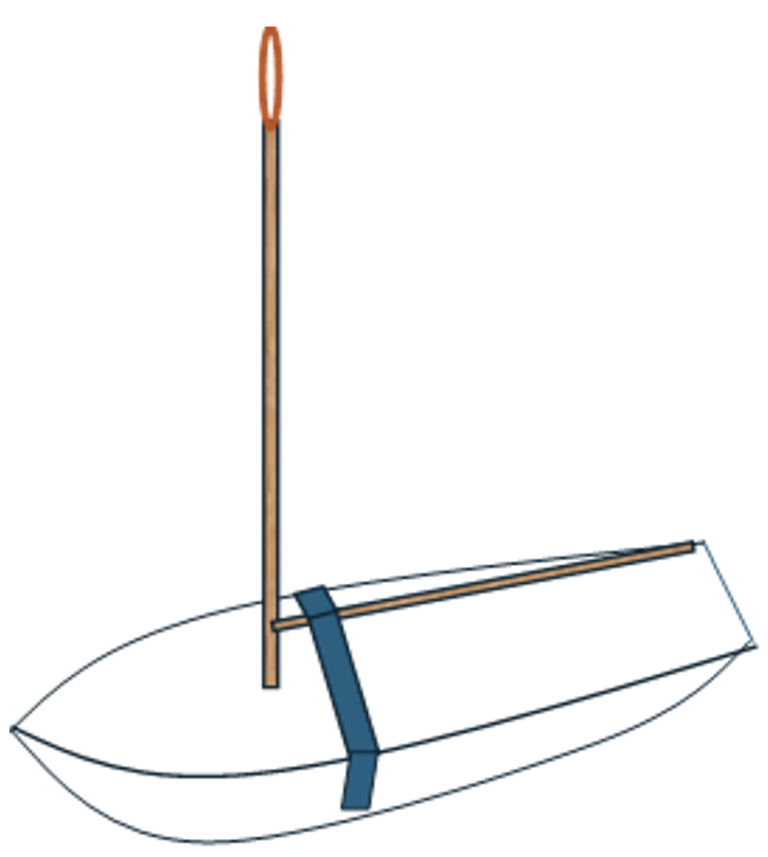
See the Rig Terms Map for a view of the model yacht terms on a boat.
Note: If you find something on this page that needs to be updated, please make a Website Comment on our Comment Form.
backstay [R01]: A piece of standing rigging on a model yacht that runs from the mast to either its transom or rear quarter, counteracting the forestay and jib.
backstay bracket [R02]: A fixture that the backstay attaches to near the stern of a sailboat as noted under backstay.
bolt wire (bolt rope) [R03]: The (wire) rope that is sewn at the edges of the sail to reinforce them, or to fix the sail into a groove in the boom or in the mast. It may also be used with cotter pins or mini screw eyes to attach the sail to the mast.
boom (jib/main) [R04]: A spar (pole), along the foot of a fore and aft rigged sail, that greatly improves control of the angle and shape of the sail.
boom vang (US) [R05]: A line or piston system on a sailboat used to exert downward force on the boom and thus control the shape of the sail. This is a kicking strap in the UK.
bowsie [R06]: A simple device with three holes used for tensioning lines on a model yacht.
chainplate [R07]: A metal fitting used in sailing vessels that connect the shrouds (side stays) to the hull of the boat.
clew [R08]: The after corner of a sail.
compression strut [R09]: A structural component that supports the mast of a sailboat and transfers the load from the mast to the hull, enhancing stability.
control loop [R10]: A loop of line or wire placed around a mast or boom to help maintain sail shape.
cotter pins [R11]: Used along with wire to attach the main sail to the mast.
deck fairlead [R12]: A fitting that allows a sheet to come through the deck and change direction as needed.
downhaul [R13]: A device used to tighten the luff of a boom-footed sail by pulling downward on a eyelet in the luff of a mainsail above the tack. This is also known as a Cunningham.
eyelet [R14]: A small round hole (metal) in the corners of a sail to thread a string through.
fairlead [R15]: A turning point for running rigging like rope, chain, wire or line, that guides that line such that the “lead” is “fair”, and therefore low friction and low chafe.
foot [R16]: The bottom edge of a sail.
forestay [R17]: A piece of standing rigging that keeps a mast from falling backwards. It runs from the top of the mast to the bow and is sometimes just called a “stay”.
gooseneck [R18]: The swivel connection on a sailboat where the boom attaches to the mast.
halyard [R19]: A line used for raising and lowering a sail, spar, flag, or yard on a model yacht.
head [R20]: The top corner of a sail.
hook [R21]: A piece of hardware used on a model yacht for the jib swivel and backstay attachment to the backstay bracket.
Jenny stay strut (Jenny strut, stay strut, jumper strut) [R22]: A support structure used on sailboats that helps maintain the tension of the headsail and prevents the mast from bending under sail pressure.
jib (foresail, headsail) [R23]: A triangular sail set ahead of the mast and main sail.
jib club fitting [R24]: A fitting on the forward end of the jib boom to which the forestay and control loop are attached.
jib halyard [R25]: The line used on a sailing vessel to raise and lower the jib sail.
jib rack [R26]: The bracket on the deck where the jib swivel is attached near the bow. This is the jib attachment point.
jib stay [R27]: Rigging used to support the jib sail, running from near the top of the mast to the jib club to help maintain the shape and tension of the jib.
jib swivel [R28]: An assembly that attaches near the front of the jib and the deck allowing the jib to swing back and forth with ease with the movement of the boat.
kicking strap (UK) [R29]: See boom vang.
king plank [R30]: The longitudinal member that runs down the center of the boat just under the deck.
leech [R31]: The trailing edge of a sail.
line [R32]: Used on model yachts for things such as sheets and topping lifts.
luff [R34]: The lead edge of a sail.
mainsail (main) [R35]: The largest sail on a sailboat, crucial for propulsion, is attached to the mast and controlled by the main sheet.
main halyard [R36]: The line used on a sailing vessel to raise and lower the mainsail. On a model yacht it is often replaced with a control loop.
mast [R37]: A tall spar, or arrangement of spars, erected vertically or near-vertically on the median line of a ship or boat.
mast crane [R38]: A device at the top of the mast to which assorted items attach such as the backstay.
mast head [R39]: The highest part of a ship’s mast.
mast heel [R40]: Where the critical components are located at the base of a mast.
mast step [R41]: The combination of parts, the deck fitting and mast bottom fitting that position the mast on the boat.
mast tang [R42]: A fitting, typically made of metal, that attaches to the mast of a boat to provide an anchor point for rigging like shrouds and stays.
“O” ring (solid) [R43]: A connector that, with the snap clip joins the sheet lines together, one coming through the deck fairlead and the other coming from the jib or main boom.
outhaul [R44]: A control line that attaches the clew to the boom and tensions the foot of the sail.
outhaul fairlead [R45]: A fitting inserted vertically into the aft end of a boom to prevent damage to the boom by the outhaul.
running rigging [R46]: The rigging used for raising, lowering, shaping, and controlling the sails on a sailing vessel.
sail [R47]: An extent of fabric used in propelling a model yacht.
screw eye [R48]: Hardware used in various places on model yachts for sheet attachment on a boom and a topping lift.
sheet [R49]: The line used to haul the boom down and toward the center of the boat.
shroud (sidestay) [R50]: Wires that support the mast from the sides and connect the mast to the deck or hull, providing lateral stability.
shroud plate [R51]: A piece of wood placed along the sheer strake under the deck at those places that are below the shroud racks.
shroud rack [R52]: A metal plate used to fasten a shroud or stay to the deck of a sailboat.
sleeve (ferrule) [R53]: A connector that gets crimped using a hand tool to join wires.
snap clip [R54]: A connector that joins to the “O” ring to connect the sheet lines together, one coming through the deck fairlead and the other coming from the jib or main boom.
spar [R55]: A pole of wood, metal, or lightweight material used in the rigging of a sailing vessel to carry or support its sail.
spreader [R56]: A horizontal rod or beam on a sailboat’s mast to support the shrouds and distribute the tension evenly along the mast.
standing rigging [R57]: The rigging that supports each mast or bowsprit on a sailing vessel and reinforces those spars against wind loads transferred from the sails. It is composed of fixed lines, wires, and rods.
swivel [R58]: Hardware used on a model yacht in the jib swivel assembly.
swivel ball link [R67]: A component of the gooseneck assembly that mounts to the forward end of the main boom.
tack [R59]: The forward lower corner of a sail.
telltale [R60]: A piece of yarn or fabric attached to a sail, a stay, or any rigging on a sailboat to help read the wind.
thimble eyelet [R61]: This is an open eyelet (that can be closed over the wire) that is used to terminate the wire backstay and provide a smooth “O” ring that the line can pass through for the control portion of the backstay.
topping lift [R62]: A line that applies upward force on the outer end of the jib boom on a model yacht. The use of a topping lift may be controlled by class rule.
turnbuckle (stretching screw or bottlescrew) [R63]: A device for adjusting the tension or length of ropes, cables, tie rods, and other tensioning systems.
wind indicator [R65]: A lightweight, pivoting device mounted at the top of the masthead of a model yacht.
wire [R66]: Used in various applications on a model yacht for things such as shrouds and backstays.